Newsletter
Resources
Courses
Books

Welcome to Emerging Futures -- Volume 254! Spontaneous Flights and Other Creativities...
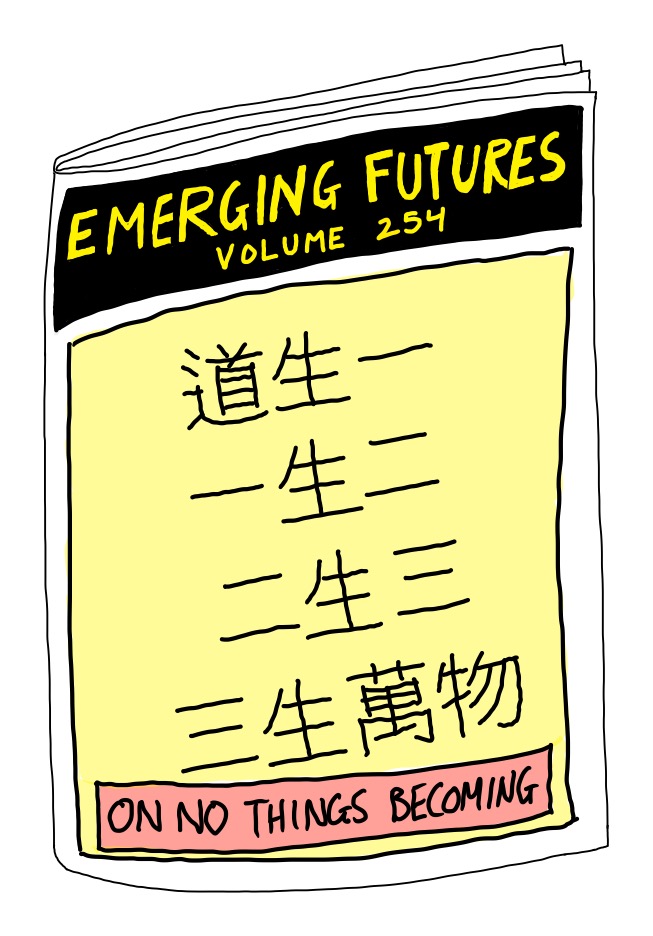
Good morning becomings of summer's highways and their configurational phantom propensities.
This is one of our favorite experiences (really): in this region come Thursday evenings in summer – there are lots and lots of people on the move – it’s time to get out of Dodge and head for the ocean edges. Millions of the inhabitants of the Boston-Washington Megalopolis are on the move.
Suddenly traffic slows down; soon you find yourself moving at the speed of the ants. Then, after what seems like a small lifetime, you are moving again and really gaining speed. As you pass where you imagine the accident must have been, you scan the emergency lanes for the signs of what happened – but there is no car, no visible accident, no emergency vehicles.
What is going on? Where is the accident? It is surprising and impressive: Wow – they cleared that up fast! (I’ve thought all of this).
Oddly, there is nothing to see. There is no “there” there – no smoking gun – no creator or source of the act.
And on we drive – we need to get to the shore. With still an hour to go before the edge of the North-West Atlantic greets you – there is time to think. Something was created – a full-on traffic jam – but there was no obvious source – no actual creator anywhere to be seen. So how was this creatorless creative event created?
If you happened to query some digital font of knowledge, it might inform you that you just co-creatively participated in the becoming of a so-called “phantom traffic jam.”
What is this – what’s a phantom jam? With roads of a certain width, and being unimpeded by traffic lights or intersections for very long stretches, meeting lots of cars that have been designed to accelerate and slow down very rapidly, joined to systems that have put time pressures on people, who, when driving, have the need to pay attention to multiple multiple discreet events to which they have varying reaction times – we then find ourselves of a highly creative relational configuration.
Drivers are necessarily speeding up and slowing down continuously in ongoing response to a myriad of contingent events – a low-flying bird, a piece of wind-blown debris, impatience, that throbbing tech-death comes over the airwaves, the beauty of the clouds, a blowout, another car changing speed – or simply for no reason at all. This inherent pulsing irregularity of speeds ripples backwards through traffic and quickly creates a slowdown, and on occasion it will bring traffic to a full stop.
Something has been created that was not there before – so it is reasonable to say that this is a creative act – perhaps not the greatest creative act ever, but an interesting variation (the way the latest Madonna album is also a modest creative variation on a generation of house and trip-hop sounds). This creation of a traffic jam has no singular cause or discreet author. No one had the idea or planned this out carefully.
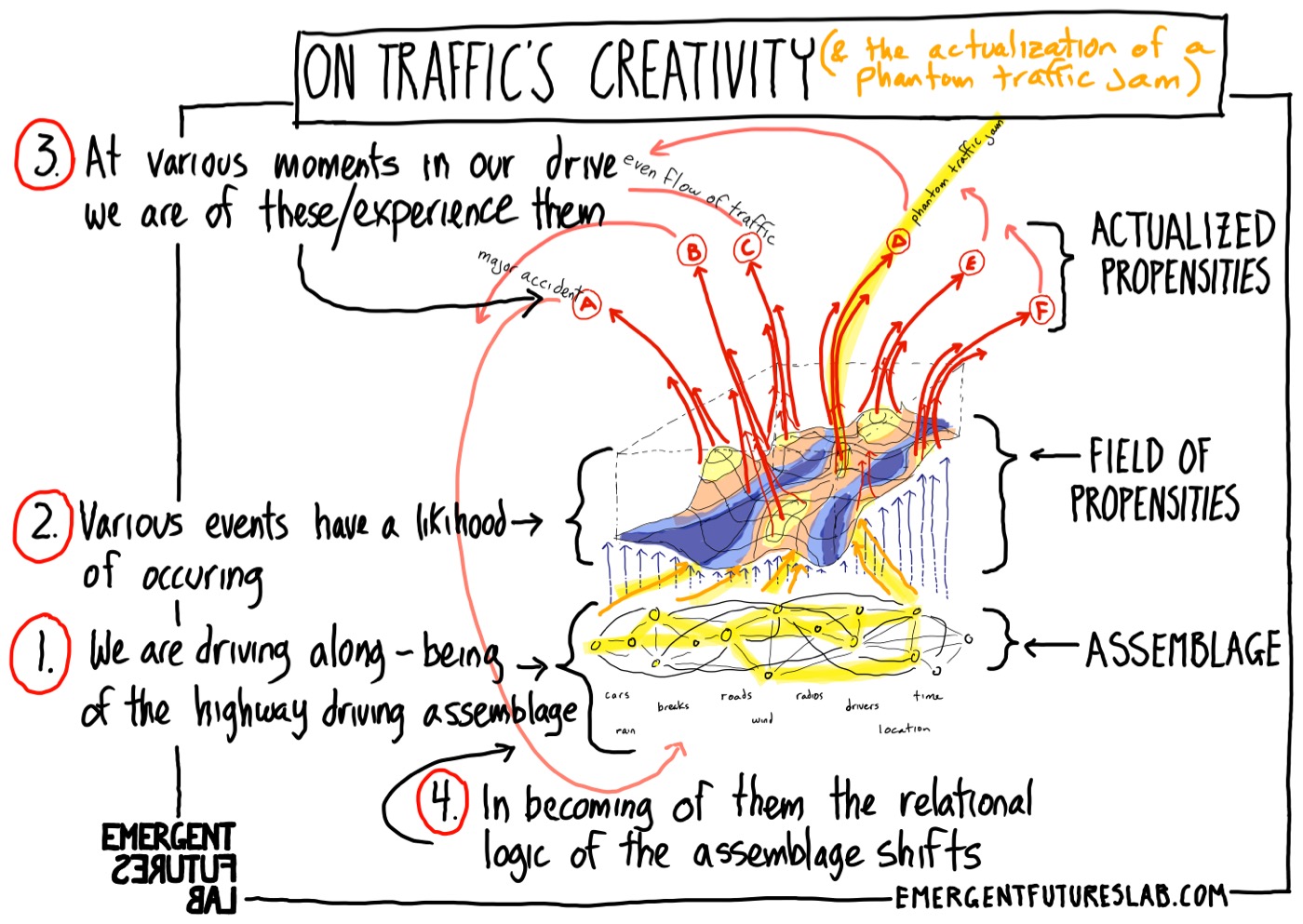
Rather, we have a uniquely configured dynamic assemblage – that, as a relational configuration, creates a number of stable propensities. One of these being the bringing of traffic to a halt. And as sure as rain, eventually the phantom jam comes into being. It is something made – created but with neither creator nor maker – it is something we “find” – we find ourselves of this state – but it is not something we have simply come across that is separate from us – we, after all, were parts of its creation… paradoxes indeed…
Now, if after reaching the shore, we – you and I, were at some nice clam shack parking lot hanging out after such an experience and discussing it – perhaps one of us might suggest, “It is incorrect to say no-one caused this – after-all someone must have acted erratically – they hit their brakes too hard, and then everything rippled out from this one instance. So there is a cause, and there is an author!”
But here is the thing: that might very well be true in this case, and putting aside the fact that there could have been any number of factors leading to their braking behavior – say someone is car sick beside them. The very same so-called phantom jam will happen again and again and again – and each time the immediate causes will vary – and vary considerably. So, who should get creative credit – the immediate quasi-author or the configuration and its emergent propensities?
A Speculative Flight of Fancy
We have all been in such an event. As the traffic slowly picks up speed again and you start moving, you soon see that there is no cause – there is nothing stalled on the side of the road – no broken glass and tangled plastic, nothing there whatsoever – do you ever wonder:
How many creative outcomes that we have ascribed to some author are far more like phantom traffic jams than we care to admit?
What if the emergence of human flight is a similar phenomenon?
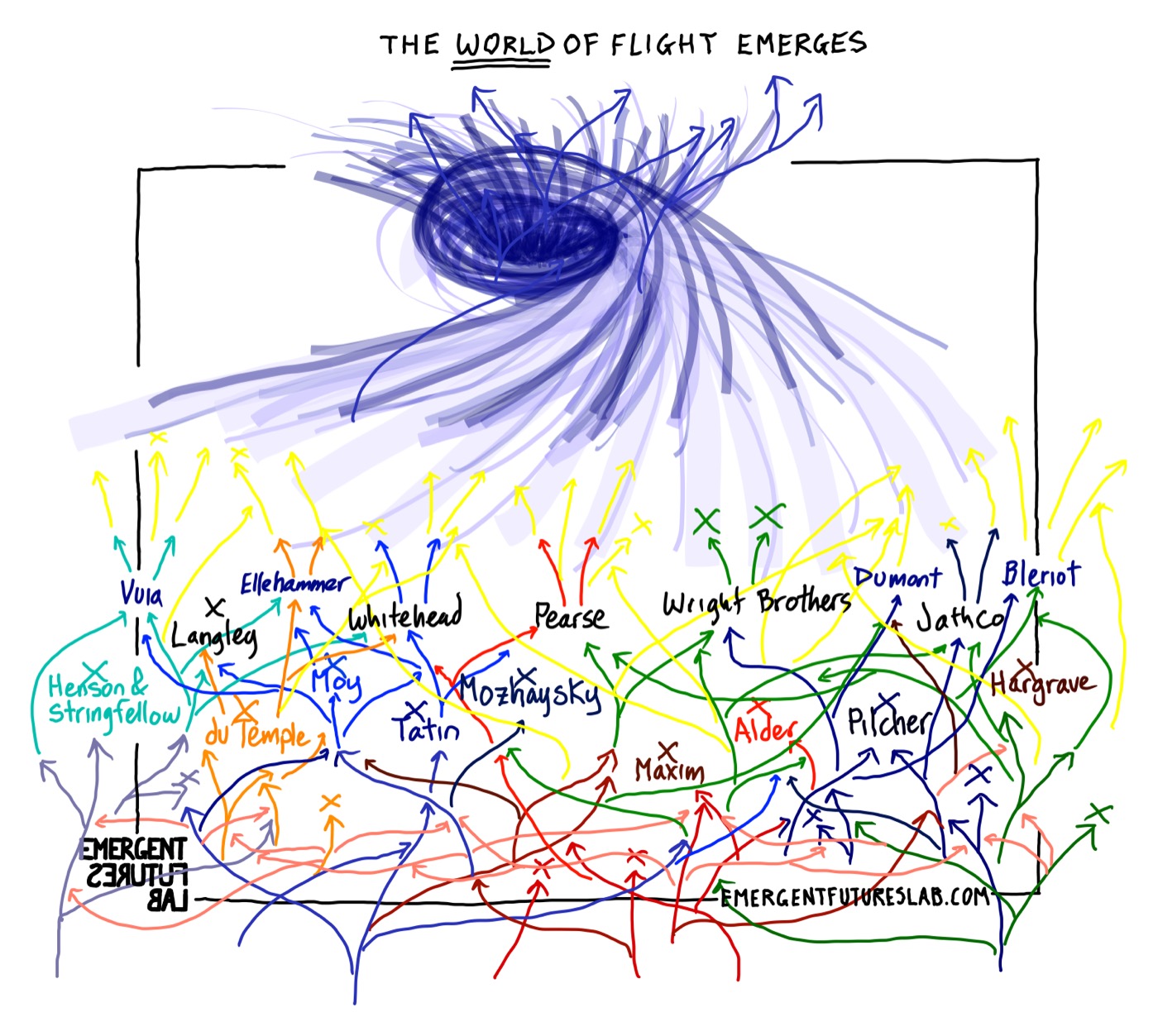
The wider and perhaps more jarring speculative question is: could it be that all human engagements with creative processes are more similar to the phantom traffic jams of summer than they are to anything else?
A dawning realization that this might be the case would certainly come as a potential blow to our ego, sense of autonomy, and internalized image of authorship and agency. It should also come as no surprise that in cultures where this worldly approach to creativity is pervasive, the sense of self is far more relational, dynamic, and situational (something we can see clearly in the ethical, aesthetic, and philosophical traditions of South and East Asia).
Guattari and Deleuze helpfully refer to these authorless distributed creative processes as the abstract machines. They are “abstract” because they are nothing other than the relational dynamics themselves, and they are a “machine” or perhaps better said “machinic,” because they consist of discrete processes that function together in coordinated ways. Unlike physical machines with fixed parts and clear operators, Abstract Machines are composed entirely of immanent relations - they exist only in and through the actual connections between their component processes, not as separate entities that could be isolated or possessed. This gives them what the Daoist philosophers might call an “empty-fullness”.
Once a stable configuration emerges (a relation-dominant assemblage), these “machines” set particular processes in motion autonomously (spontaneously), without anyone guiding or controlling the outcomes – which is what we can observe at differing scales from biological evolution, to the many centuries long process of human flight’s becoming, and to the phantom traffic jam we might now be listening to this as a podcast from.
We can also think of Abstract Machines as emergent “configurational technologies” or “relational engines”. They are the invisible logic of assemblages (the relational dynamic and unique coming together of technologies, techniques, subjectivities, and environments in ways that qualitatively exceed any single component’s capacities) that give rise to stable processual propensities and tendencies without requiring centralized coordination. They are in this manner, properly speaking: spontaneous self-created creativities. An “abstract machine” is what emerges when discrete elements achieve sufficient coherence to function as integrated emergent wholes while maintaining their dynamic, processual nature.
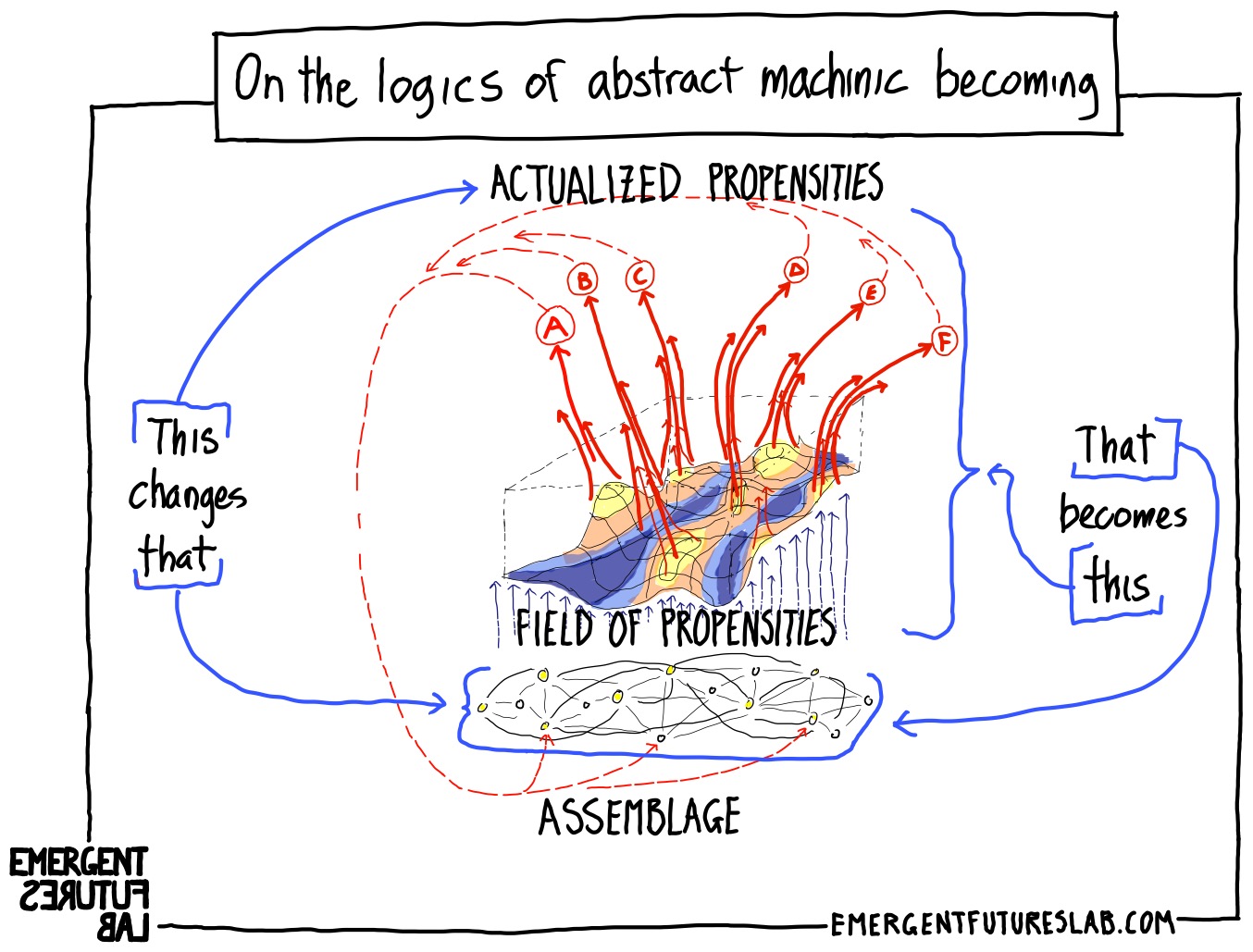
From a very general perspective, an Abstract Machine can be said to have three mutually co-shaping aspects: an Assemblage, a Virtual Field of Propensities, and Actualized Propensities (see diagram below). And operationally speaking: an enactive assemblage gives rise to a real (but not actual) virtual field of propensities or tendencies – of which some are actualized – and which in turn transform the assemblage:
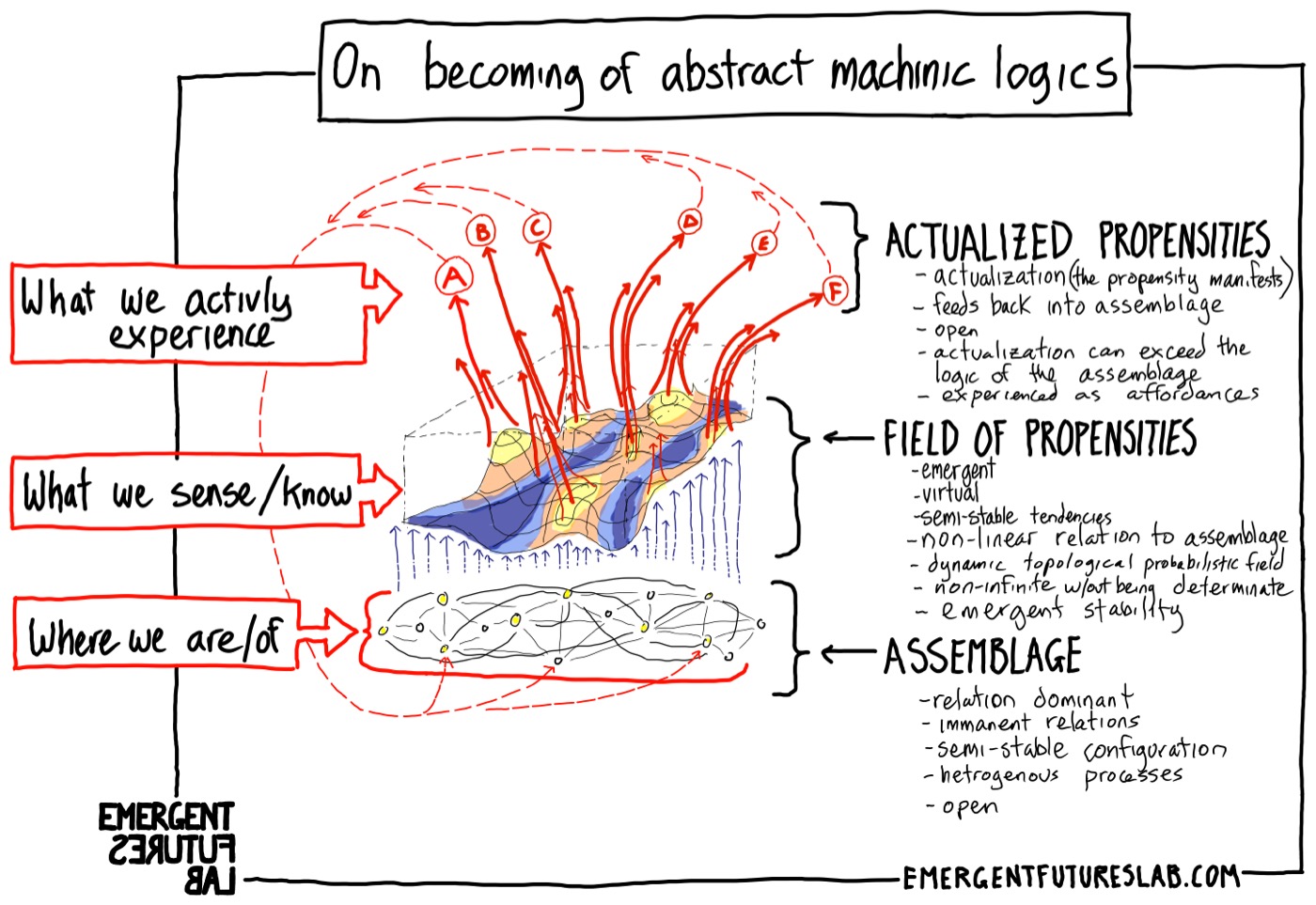
Let’s add to this and experimentally lay out further key aspects of Abstract Machines (see above diagram for details and reference):
Way-making being empty,
You make use of it
But do not fill it up.
(from chapter four Daodejing; trans. Ames & Hall)
Understanding Abstract Machines transforms how we approach creative practice by revealing creativity as fundamentally configurational and (quasi) spontaneous rather than individualistic, human, internal, and idea-driven. Instead of focusing on an atrophied creativity of generating heroic ideas within isolated minds, and attempting to absurdly project them onto the world's futures – we can learn to work with and of the assemblages that enable relevant spontaneous creative processes to emerge.
What is critical in such a collective ethico-aesthetic project is: co-evolving a creativity that involves attending to the configurations of practices, tools, environments, and relationships that constitute creative assemblages – and that we become active participants in Abstract Machines rather than their naively presumptive authors and operators, learning to sense and work with the relational dynamics that enable novelty to emerge.
Driving of the Empty-Fullness Highway
Last week, we ended the newsletter, as one would accelerate out of a phantom traffic jam:
“Who invented flight? That is the wrong question.
What are the multiple cascading creative configurations that gave rise to flight's ongoing becomings? From the perspective of creativity – perhaps this is a more helpful question.
Our speculative hope is that we gain agential insight into how creative action and agency are emergent processual relational outcomes co-constituted by highly distributed more-than-human processes.
Bravery, empathy, leadership, creativity – or the invention of human flight – these are not things we could possess or ever claim as our own – not because we lack some critical attribute – but because they are not things that could be possessed whatsoever. These are rather the ongoing dynamic emergent realizations of deeply intrawoven intra-activities of an assemblage. Yes, we are relevant – but our relevance and individuation are co-constituted by an assemblage. We creatively play in and of assemblages and their thick and wide transversal becomings.
We are not at the center of these – because nothing is. And because everything is active and collectively co-constituting, we matter – just how we matter is always a distributed relational and collective question…”
It is this last question that we want to pause on for a moment longer this week: how do we matter if we are not the heroic author? How do we participate effectively if there is no center? What does it mean, in a very concrete manner, to say, “We are relevant – but our relevance and individuation are co-constituted by an assemblage. We creatively play in and of assemblages and their thick and wide transversal becomings”?
It is a question worthy of more than one newsletter (and it will be continued next week). As we come closer to where we will end this newsletter, there are three broad things to experiment with:
In becoming of and in complex creative distributed relational configurations and their spontaneous agency, our story changes – it becomes a story where we stop searching for our great and heroic identity as the sole agent of (our) destiny – and rather orient – actively attune – with and towards minor fugitive assemblings of spontaneous novel and interesting fleeting becomings that we might collaboratively stabilize into a wide and rich (as yet unknowable) co-emergent futures…
This is the wondrous and astonishing story of human flight, traffic jams, getting the kid(s) ready for school, writing a poem, tripping on the carpet, organizing for immigrant rights, and co-shaping this newsletter…
Well – that is it for this week. We will leave you, as always – mid-stream (let's continue the discussion online – or perhaps drop us an email)
And in taking our leave, here is a leaf we find floating mid-stream – just within our grasp:
In Roger Ames and David Hall's translation of the Daodejing, they offer five differing translations of chapter 42 – the famous “a thousand things” section. Here are two:
Multiplicity gives rise to plurality,
Plurality to difference,
Difference to continuity,
And continuity to way-making (dao)
Way-making (dao) gives rise to continuity,
Continuity gives rise to difference,
Difference gives rise to plurality,
And plurality gives rise to the manifold of everything that is happening
(wanwu)
Until next week - keep difference alive,
Jason and Iain
Emergent Futures Lab
+++
P.S.: The question we hear most often from newsletter subscribers is: How can I participate more deeply in this work?
We have two ways:
1. Emerging Futures+ is where the newsletter becomes alive: post your comments, questions, or thoughts alongside practitioners across five continents, connecting each volume to their own work. Plus the extended audio version for a commute, join 2 live events per year, and the full searchable 250+ volume newsletter archive.
🧨 Start with a $1 trial for 7-days… Then $6/month or $60/year. Cancel anytime.
2. WorldMakers is where the newsletter gets practiced. Facilitators, educators, consultants, and researchers experimenting with emergence and change-making. In dialogue, in shared experiments, in the collaborative making of a different approach to creativity. Members have access to everything in Emerging Futures+, plus thirty-five live events a year, two weekly podcasts, bi-weekly creativity exercises, and the complete annotated bibliography.
💥 Start with a $1 trial for 7-days… Then $60/month or $597/year. Cancel anytime.


