
Why Are Traditional Models of Innovation Insufficient?
Traditional models of innovation are insufficient because they define creativity as coming up with ideas and then putting them into action, an ideate, plan, make model. If something is genuinely new, we have no words or images for it yet, so it cannot begin as an idea. Ideas emerge late in the process. At the start we may know what we refuse to do, and from there we experiment, co-evolve, and learn as we go. The ideate model goes back to Greek thought and the early Christian tradition, where God stands outside the world and ideates it into being. Adding empathy at the front, as design thinking does, still jumps straight to ideation. That improves things well and stops short of the genuinely new.
What Are the Steps of Engage, Disclose, Deviate, Co-emerge?
Engage, Disclose, Deviate, Co-emerge are four tasks that loop back and forward on each other. Engage means being embedded in something and understanding it in an embodied, experimental way, with people working on it together outside the boardroom. Disclose surfaces the underlying logic, habits, practices, and meanings of a situation and decides which of them to block, so the work cannot slide back to the familiar. It also looks for unintended possibilities to follow, the evolutionary process called exaptation: feathers that first kept dinosaurs warm, then attracted mates, were repurposed to parachute, glide, and fly. Deviate develops a new framework or logic, a new world, before any idea, solution, or practice appears. Co-emerge runs the whole time, bending what emerges toward the impact needed. Radar, Velcro from burrs stuck to socks, and Viagra, first a blood pressure medication, all came from following the unintended. Since the process is nonlinear, you can begin anywhere, including with a product that already exists.
Why Does Innovation Require Deep Engagement?
Innovation requires deep engagement because you can only block and follow what you understand. In the 3D printing lab we run at Montclair State University, visitors often arrive with a great idea for the printers, and within 18 seconds it is clear they have never designed, managed, or printed anything. The more you know a field's histories, cultures, and logics, the wider the range you have to refuse what has always happened and reach somewhere novel. Bill recalled an organization whose innovation space had fake grass, whiteboard walls, and beach chairs, cut off from the world it meant to change. Jason suggested a book on innovation theater, from beach chairs to palm trees, Hawaiian shirts, and idea management software.
What Is Worldmaking?
Worldmaking is our term for change that is embodied and engaged. Changing a worldview, or how we think about things, keeps change in the realm of ideas. The making part matters: we do things, and as we do things we change our environment and our environment changes us, a looping that gives rise to ideas. We are in the middle of ongoing worldmaking, and the aim is to shift the type of world we have so that new possibilities emerge. In practice, that means getting out to poke around, probe, stumble on things, follow hunches, block, push, and experiment with people, in experimental spaces that will probably never look like whiteboards and grass.
How Did New Jersey Transit Use This Process?
New Jersey Transit, one of the largest transit systems in the country, faced silos and a culture of "we've always done things this way," reinforced by long tenures. It identified about 20 people who act as nodes in the organization's informal networks, the people others go to for connections and influence, whatever their place on the org chart. They came from different parts of the organization, did not know each other, and committed eight straight Fridays as full days offsite, with their managers' support. We call these pirate projects: the stated project matters, and the deeper aim is for new methods, practices, and logics to seep into the informal pathways of trust. One challenge was the train car of the future, infrastructure with long lead times that the agency would live with for 20 years. An earlier design thinking process had concluded that the trains were too crowded. Riding the trains with super users showed that riders crowd into the car whose door stops beside the stairway at Penn Station, to avoid waiting 15 or 20 minutes to get out. Only a few key cars needed a different design, and the group carried back a more experimental approach and a wider view of the system, from home to workplace.
How Can Industrial Organizations Become More Innovative?
Industrial organizations can start by asking what things can do. We open workshops with the crow and the nutcracker: we show a four-way intersection and a holiday nutcracker and ask whether they are the same thing. Crows wait on the power lines, drop nuts in front of the tires at a red light, let the cars crack them on green, and collect them at the next red. For the crow, the intersection is a nutcracker. Asking what else something can do, again and again, pushes the boundaries of possibility and eventually gets you out of your head and engaged with the thing itself. Iain adds trust in your people and your ecosystem. Workshops that let networks of trust experience an emergent process perturb the system, the language, techniques, and tools percolate, and people begin to change HR, teams, and time to match. The goal is an ecosystem that generates novelty as well as the same every day, without handing innovation to a separate team.
How Did Iain Kerr and Jason Frasca Arrive at This Work?
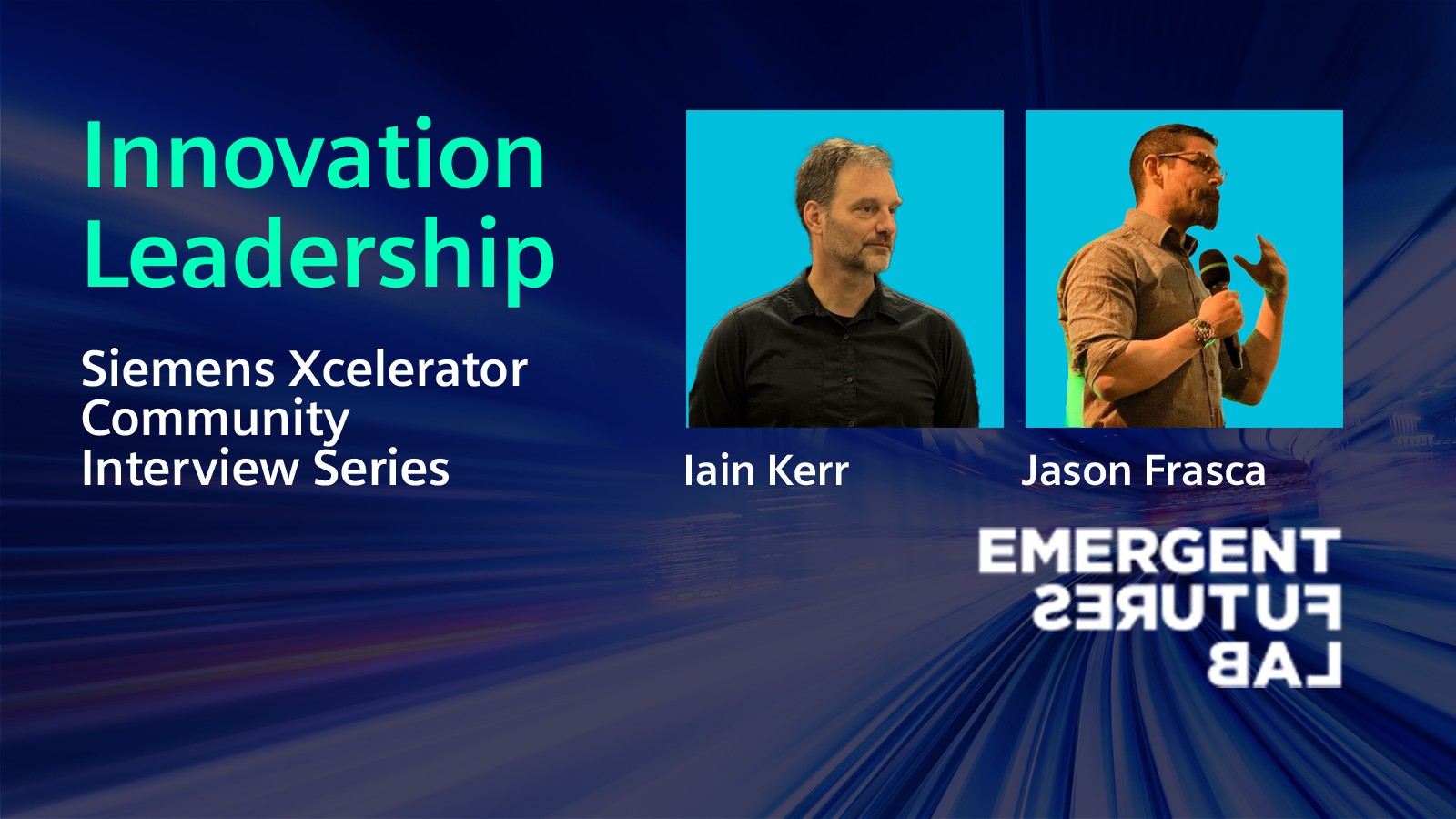
Iain grew up in Vancouver, Canada, the child of immigrants, and by chance attended an experimental high school where students set their own work. The plan was to climb mountains, with no thought of university, and then came philosophy, then architecture, then community design practice on environmental, social, and infrastructural issues. Frustrated by models that diagram a system and look for the idea, Iain began experimenting with new practices. Jason majored in marketing, worked in direct marketing, built software tools for sales, took over the family business, and after a successful exit became a professor. Jason never designed a career: following ideas never worked out, and following the opportunities that presented themselves always did. We met in the entrepreneurship and innovation program at Montclair State University, where we use 3D printing and digital design to teach the innovation design approach, and that partnership became Emergent Futures Lab.
Watch the Full Conversation
Watch the full conversation on the Siemens Xcelerator Community.


