Newsletter
Resources
Courses
Books

Welcome to Emerging Futures -- Volume 197! Summer Reading’s Creative Folds...
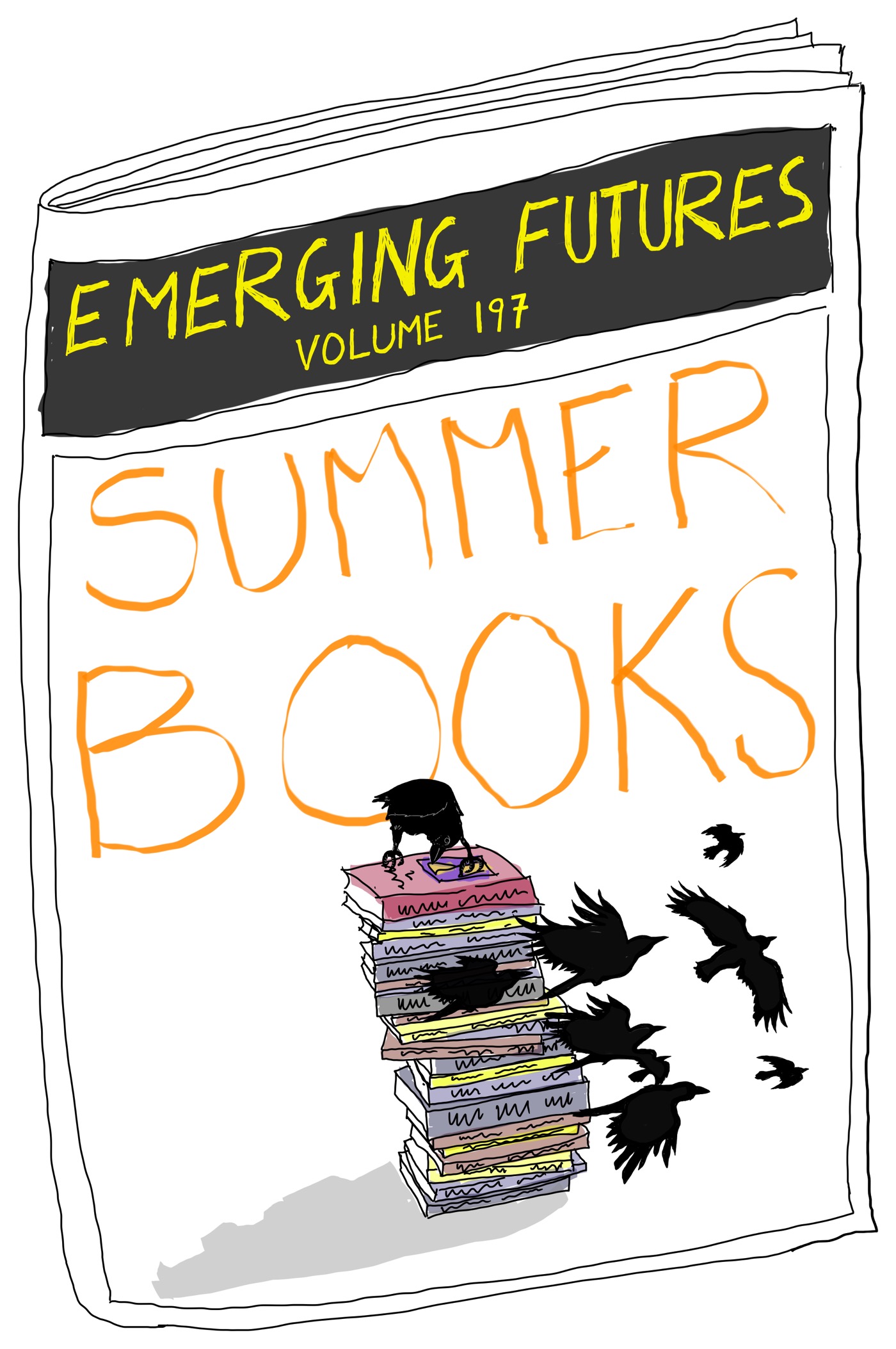
It’s our summer tradition to present a totally unscientific list of summer reading recommendations. These are not in any way our claim to present “the best reads of summer 2025.” How could we ever make such a claim? How can anyone make such a claim – outside of irony?
This year, unlike previous years, we (Jason, Andrew and Iain) thought less of “beach reads” – those wonderful books that sweep you away into forgetting to make lunch and then dinner as you are held in and swept along far into the early hours of the next morning when the birds begin to call just before dawn and the book sadly comes to an end.
But, because we cannot resist sharing such beautiful beach books, a couple of those for us recently were: Black Leopard, Red Wolf by Marlon James. It’s a narrative that resists linearity, instead embracing contradiction, multiple perspectives, and unreliable narration. Drawing from a wide array of cultural sources—West and Central African folklore, medieval history, queer theory, and epic fantasy—he constructs a world that’s ancient, futuristic, brutal and really beautiful. While his storytelling is a bit disorienting and challenging, as he forces you to navigate a world where myth and reality blur, it’s a fun and wild re-imagination of fantasy genres.
The second book that we could not put down was Mitiarjuk Nappaaluk’s Sanaaq. It is an astonishing first novel written by an Inuit who had never read a novel before (written between the early 1950’s and 70’s). It is a novel that I cannot figure out how to describe well – I fall too easily into anthropological tropes – suffice to say it is an astonishing experimental work of fiction that densely folds worlds, stories, landscapes and ways of being in a rapid kaleidoscopic movement – I read it this spring in one continuous breath.
As great as these books and the pleasures of summer fiction reading are – we ended settling on a different line to follow into this year's summer reading recommendations: we came to the thought that it would be fun to share some books that we feel catalyze novel ways experimentally engaging with the world we are of.
Books that shift our dynamic temporary assemblages in new ways.
Books that challenge and play with how we are embodied, embedded, extended, and enactive creative worldmakers.
In three weeks, we will publish our 200th Emerging Futures Newsletter! And because of this, to celebrate our two hundredth issue, we would like to publish some personal reflections from you, our readers, on how you have pulled the newsletter into your life. What do you do with it? How does it fold into your day or week? How have you made it your own – hacking, splicing, transducing, growing, braiding, composting…
If you wish, please take a moment to email us a creative reflection – it could be in any format (a letter, a video recording, an audio file, a drawing, a photo). And it could be any length – short or long. For our 200th issue, we want to focus on the life of this creature beyond our intentions!
Respiration is a great place to begin with books. Pages turn in a regular rhythm. The seas respire – breathing in and out with each wave and turn of the tide. Day turns to night. The pull and push from macroscopic to microscopic is everywhere, from the first creature to breathe on land – a small scorpion, to us, and beyond.
Dr. Belisa Vranich's Breathe: A How-To Guide stands apart from the typical breathwork literature. Instead of centering on calm, mindfulness, or meditative presence, Vranich's manual is rooted in the mechanics of diaphragmatic breathing as a foundation for health, performance, and overall body function. She challenges the modern tendency toward shallow, upper-chest breathing--a pattern shaped by our environments, sitting hunched over our desks and phones all day, and cultural norms around posture and appearance-- to stand erect, shoulders back, tummy tucked.
Vranich invites us to re-examine how we breathe, pointing to the spontaneous, expansive belly breathing we see in animals as a model for enacting a more embodied, functional approach.
What makes this book especially relevant is its emphasis on action and habit. Vranich doesn't just teach about the power of breath; she provides a clear, practical framework for training and integrating diaphragmatic breathing into daily life. Her approach is unapologetically physical: change comes not from thinking differently about breath, but from doing--through consistent, simple practice.
This is a manual for transformation through repetition and embodied engagement, making the case that profound physiological and psychological shifts are possible when we make breathwork a daily discipline. For anyone interested in transforming performance, health, or simply reconnecting with the body's alternative bio-enculturated intelligence, Breathe offers a direct, actionable path--one that is as much about building new habits as it is about creatively rediscovering this joyous, more-than-human practice.
What is our immediate environment? Have you ever informally traced out how you move, really meander through your house? It is surprising how much we move, how much we putter, how many things we touch, use, brush past, hear, and let our eyes settle on in passing. How can we understand this activity?
Michael Anderson, in a wonderful chapter “What Mindedness Is,” makes this wonderful claim: “it isn’t just that perception and cognition are action oriented but that they are interactive, exploiting properties of their environment to guide and simplify cognitive tasks. Thus to understand the character of (advanced) cognition one needs to understand not just the basic faculties that support and constrain it but also the nature of the environment within which an organism exercises those faculties… The overall picture that this suggests is of an intelligence that lies less in the individual brain and more in the dynamic integration of agents with and within the wider world. Mindedness emerges as – is– the activity of making the world a home”.
And this brings us back to how we drift into and out of various activities, zones, and habits as we are on the move in our houses – so what is this? It should be obvious: thinking… (and what is “thinking” but doing…)
Fumio Sasaki's Goodbye, Things: The New Japanese Minimalism is far more than a manifesto for decluttering--it's a deep exploration of how our environment co-shapes our actions, habits, and ultimately, our modes of being and thinking. Sasaki extends the enactive approach, suggesting that minimalism is not just an aesthetic or a trend, but an embodied practice. Our possessions, he argues, are not passive; they actively participate in our lives, shaping our routines, consuming our attention, and even dictating our energy. The intent of minimalism, then, is to become conscious of this dynamic: to question our habits, let go of the things that do not lend vitality, and focus on living experimentally, with curiosity, clarity, and purpose.
What's striking in Sasaki's account is his insistence that the effect of material possessions is not merely psychological--it is enacted through daily action. Every object we own transformatively demands something from us. Sasaki writes, "unnecessary material objects suck up our time, our energy, and our freedom." By repeatedly asking, "Do I really need this?" we interrupt the automatic impulse to accumulate and create space for intentional co-creative action with objects, spaces, and activities. This practice is not about deprivation, or even ultimately about “minimalism,” but about regaining a collaborative agency: the experimental freedom and autonomy to collaboratively direct our shared attention, time, and energy toward what truly comes to matter. Minimalism, in this sense, becomes a discipline of conscious and experimental action, a way to reclaim our creative lives from the distractions of excess and to rediscover rich potentialities in simplicity.
For anyone curious about the invisible agency of "things," Goodbye, Things offers both practical strategies and a philosophical shift. It's a call to recognize that every object is an invitation to act--sometimes in ways we never intended. By deliberately engaging with what comes into our homes – and perhaps paring down, we don't just clear our shelves; we clear the path to different modes of mindedness, and the possibility of living a life designed by experimental choices, not by default.
Fritz Haeg’s Edible Estates: Attack on the Front Lawn is part garden manual, part architectural manifesto, and part civic provocation. Through a series of case studies and poetic declarations, Haeg invites homeowners to rip up their pristine suburban lawns and replace them with messy, generous, edible ecosystems. Each transformation is more than a landscaping choice—it’s an act of resistance and reimagination. Lawns, after all, are ritually enacting modes of becoming conforming, propertying, and controlling; turning them into gardens invites other beings to join us in creative labor, sharing, and change. Haeg’s proposition is deeply embodied: it asks you to kneel, dig, plant, compost, and collaborate. You begin to see the garden not as decoration, but as dialogue and real conversation—with soil, water, neighbors, seasons. For your creative practice, don’t just read it—plant something. Better yet, invite neighbors – both human and non-human to follow what spontaneously emerges.
Ingestion. Transformation. Creative appropriation. This is a universal constant and is universally contested. Where do we sit at all the dinner tables?
Alison Knowles, by Alison Knowles. This isn’t even a book – it's just a mere pamphlet of sixteen pages, including covers. It is also not new – it's most likely older than many of us. It was first published back in 1965. Wonderfully, it is going to be hard to get a physical pre-made copy. But you can print out your own copy from here, which is so much better. And then you can bind it in your own creative manner (If you should want to purchase a copy, I suspect that Primary Information will eventually reprint it).
The title gives away nothing about the brilliance of this thin pamphlet. So what is in it that makes it perfect for your summer? It contains seventeen activity propositions. Most of these are very short – ranging from a single phrase to a single paragraph. Each asks you to do something. They are all from the groundbreaking artist and old friend of ours, Alison Knowles. What she asks of you are mainly mundane activities – but they gain their radical charge from being works of art.
My favorite is:
#2 –
Proposition (October, 1962)
Make a salad.
I’m sure most of you have “performed” this work many, many times. I just made a spicy tuna salad for lunch.
So, how is this art? I certainly don’t know.
But what I can say is that I have experienced the effects of art as a practice and an infrastructure: the effects of art I have experienced are to produce a very special and highly exclusive category of things and people that is claimed to have a far greater value than everyday experience or everyday people. And this most often happens in a physical context that strives to remove itself from the rest of the physical world (a hermetically sealed building of white walls with no windows, and where humans are reduced to a mostly silent roving pair of eyes). And it is in this context that these works are so astonishing. Why wouldn't making a salad be something utterly remarkable? The growing, harvesting, and preparing of living things with care, love, and creativity for meaningful others – this is something truly special.
At a White House celebration of poetry, surrounded by poets who personally had something of their own to say (under the auspices of being framed as highly unique beings), she simply presented:
#6
Shoes of Your Choice (March 1963)
A member of the audience is invited to come forward to a microphone if one is available and describe a pair of shoes, the ones she is wearing, or another pair. She is encouraged to tell where she got them, the size, color, why she likes them, etc.
Enough said. Seventeen exercises to do this summer.
A couple of years ago we had an odd and ultimately interesting online discussion with David Snowdon on exaptations (the co-opting of unintended capacities in things) where he was arguing that exaptations are singular moments in an adaptive process – and we were presenting the view that the emergence of qualitative difference happens via an exaptive process in which multiple exaptive processes come into relation (using the example of the dinosaur to bird transition where it is not just about feathers, but also hollow bones (which are exaptations of a type of lung), trees (their own exaptation), mammals etc. in conjunction with other transversal processes). The discussion went nowhere directly (we have since developed this conjecture with various other researchers). But we were reminded of this “exchange” last week as we wrote: “Everything is “reused” or “co-opted” without it ever having a fixed function. This means that exaptation is the rule, not the exception (this could be taken further to question the very logic of considering anything to be congruent with “its” function)”.
Exaptableness – co-opting something for novel effects is a quality of everything and an aspect of all activities. Rob Walker's The Art of Noticing is an invitation to turn everyday observations into creative exaptive practices. Rather than passively moving through our environments, Walker challenges us to notice everything--the overlooked, the mundane, the easily ignored--and to treat this act of noticing as a form of participation in the world. The book offers exercises and provocations, from drawing and photographing to annotating your surroundings, each designed to break habitual routines and engage both body and mind in direct experimentation.
It's not just about seeing, but about doing--transforming curiosity into creative action.
At its core, The Art of Noticing is a call to cultivate attention as a skill, habit, and mindset. Walker's prompts encourage us to spot something odd, slow down, and pay close attention, whether we're on a commute, in a meeting, or wandering through a city. He reminds us that creative processes are not reserved for special moments or exotic locations; it's available in every moment when we choose to look more closely and join in their becoming. By making observation an active, embodied experimental practice, we open ourselves to a deeper sense of connection with the world, people, creatures, and things around us – what else is possible? How they exist. What they feel. What they are up to. And how this co-emergent process can lead to genuine and astonishing differences that make a difference.
For those who, like me, are rooted in engaged observation as a primary mode of experimental learning, Walker's approach resonates deeply. By becoming more curious and attentive, we not only enrich our engagement with creative processes but also discover the extraordinary – the exaptive, in the ordinary.
Our modern aesthetic sensorium is centered on the activities of perception. What happens when we orient towards sound and listening? The worlds of sound and listening are astonishing. Where the eyes see forward, sound is surrounding and immersive. We often bring up whales and how they use sound to see, and what this means as a mode of being alive.
The Manual for the Construction of a sound as a device to elaborate social connection is a wonderful book that explores what it means to meet in sound, to discover in sound, to wayfind in sound, to inhabit trajectories in sound. What is a community in sound? This book pushes us to think of sound as not the background to our lived experience but as something very different (and certainly not simply the opposite of “background”). While it contains nothing that translates directly into an exercise – it is a catalyst to experiment with radically different forms of collective embodiment. PS – it contains a wonderful CD that has accompanied us in the editing of this newsletter – a silence that bubbles forth.
So often we stare at the blank page – screen – canvas…
But what if the “support” – the “ground” – the “blankness” – was the thing itself? Origami makes the material affordances of the seemingly blank sheet a flourishing empty-fullness: crease…
There are many astonishing how-to books on Origami (and we have, perhaps, far too many of them). But Tomoko Fuse’s Origami Art, takes us into a very different adventure from all of our other books. Here, scale changes: a wall, a room, an infinite topology emerges. This book is an ecstatic call toward a pleating that crosses scales, and formal logics with new possibilities of tesselation. Pick this book up to make mountains, interior landscapes, or perhaps a table in dialogue with Enzo Mari?
Cutting
to cleave
to think
to name
~ (Arakawa)
Enzo Mari’s Autoprogettazione is more than a manual; it’s a radical gesture in DIY. Originally published in 1974, this open-source booklet invites everyday people to build their own furniture using just hammer, nails, and off-the-shelf planks—no fancy tools or expert skills required. Mari wasn't interested in perfection or consumer gloss; he was after participation. Each design is purposefully simple, revealing the elegant intelligence of making with your hands. But at its core, Autoprogettazione is a provocation: What if building a table could build your capacity to see, feel, and think differently? Use it as part of a creative practice by making one of Mari’s pieces—or better yet, deviating from it. We have used this to spontaneously make tables for work and social gatherings, and chairs as needed – sometimes following Mari and other times just riffing in new directions.
We have a strange history in the West where somehow we came to produce a thing called “nature” in the 1800s – a thing that we should not interact with in any way (other than taking pictures and leaving with memories). How did we come to exile ourselves from this world?
Jason Logan’s Make Ink: A Forager’s Guide to Natural Inkmaking reads like a potion-maker’s field journal, precisely attuning you to the overlooked corners, cracks, and abandoned lots of our surroundings. Logan’s book takes you on a walk through urban streets, parks, forests, and markets, asking you to see the plants around you differently: black walnuts, rusted nails, avocado pits, and copper pipes become collaborators in a chromatic alchemy. The process is slow, messy, and unpredictable. Make Ink champions patience, observation, experimentation, and ultimately an act of sensing—of place, of time, of decay, and of transformation. Foraging will take you into your neighborhood or backyard, and ask: what else could it become with you?
***
Well, breathing, enminding, eating, exapting, listening, pleating, cutting, wandering – an adventure awaits us this summer!
Have a beautiful week, be active in keeping differences that make a difference alive from Los Angeles to Bella Bella. And as you experiment with these (or other) practices over the summer – share them with us – we would be so excited to see what you are up to.
Keep Your Difference Alive!
Jason, Andrew, and Iain
Emergent Futures Lab
+++
P.S.: Loving this content? Desiring more? Apply to become a member of our online community → WorldMakers.
Two questions, every Friday since 2020:
What is creativity? and How do you innovate?
A weekly experiment in emergence, creativity, and change-making.


