Newsletter
Resources
Courses
Books

Welcome to Emerging Futures -- Volume 198! Creative Activity: Creativity’s Emancipation...
Good morning followers of summer becoming beyond the self,
Last Friday, June 20th was the summer solstice (and winter solstice) – it is the period of long, lingering evenings in the northern latitudes stretching late into the night. Ideal for longer hikes further into the back country and scrambles into the mountain that push the 24-hour clock.
Last Thursday, on June 19th, here in Newark was the beginning of a weekend-long set of celebrations marking the great holiday of emancipatory creativity: Juneteenth. The holiday marks the end of chattel slavery in the United States and is a moment of profound celebration of what powerful creative acts it required then, and are still required now, to challenge the many equally creative forces of systemic oppression.
We hope that you have had the time this past week to get out in active, emancipatory and creative ways: picnics, walks, swims, community celebrations, demonstrations, naps, gardening, and perhaps some of these activities were inspired by last week's newsletter:
Did you try breathing differently? Did you enter into new conversations with your objects and domestic environment? Did you take a new approach to gardening or paper folding?
This week, we want to circle back to these activities – breathing, folding, gardening, and household organizing – that we suggested last week with our summer reading and explore them from a new angle.
The goal of this emerging series of three newsletters (197 & 198, and 199) is to focus on the meaning of activities, especially in the context of creativity. With last week’s newsletter, we wanted to both suggest some fun creative summer activities, ranging from bodily practices to material practices to social practices that are interesting in their own right, and that can also help us explore a profound “blind spot” in relation to creativity. And this blind spot is activity.
But before getting into “activity,” what do we mean by a “blind spot”?
A blind spot in this case is what Evan Thompson and his co-authors, Adam Frank and Marcelo Gleiser, in their wonderful book The Blind Spot, define as “something that we don’t see, and we don’t see that we don’t see it.”
The analogy they use is to the blind spot we have in the physiology of our vision. Inside our eyes, at the back of the eye where the optical nerve connects the eye to the brain, there is a small area without light receptors. Because of this blank patch, there is always a small area in our vision where we do not see anything. But, because of our binocular vision, we never notice that we have a blind spot.
You can easily see your optical blind spot: just take a normal-sized piece of paper and fold it in quarters. Then, with it horizontal, draw a plus sign on the left and one on the right side of the paper:
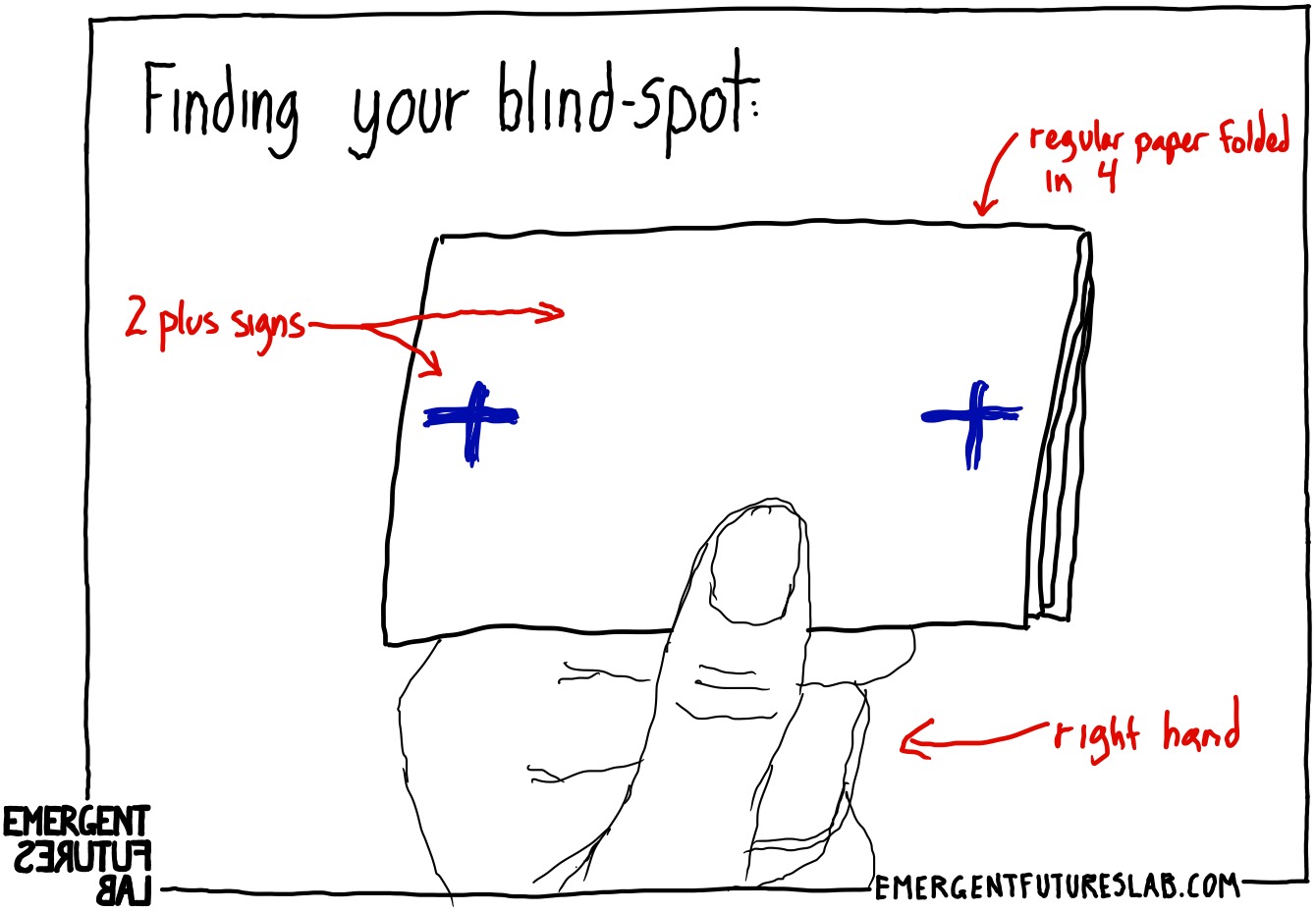
Now, hold the paper in your right hand, and cover your left eye. Hold the paper at arm's length, with your left eye covered, look at the left cross, and bring the paper slowly closer. At some point, the right cross will just disappear – that's the blind spot in your right eye!
But now do this again – notice how the cross disappears – but not the paper – it's not like some kind of cosmic void of “nothingness” appears:
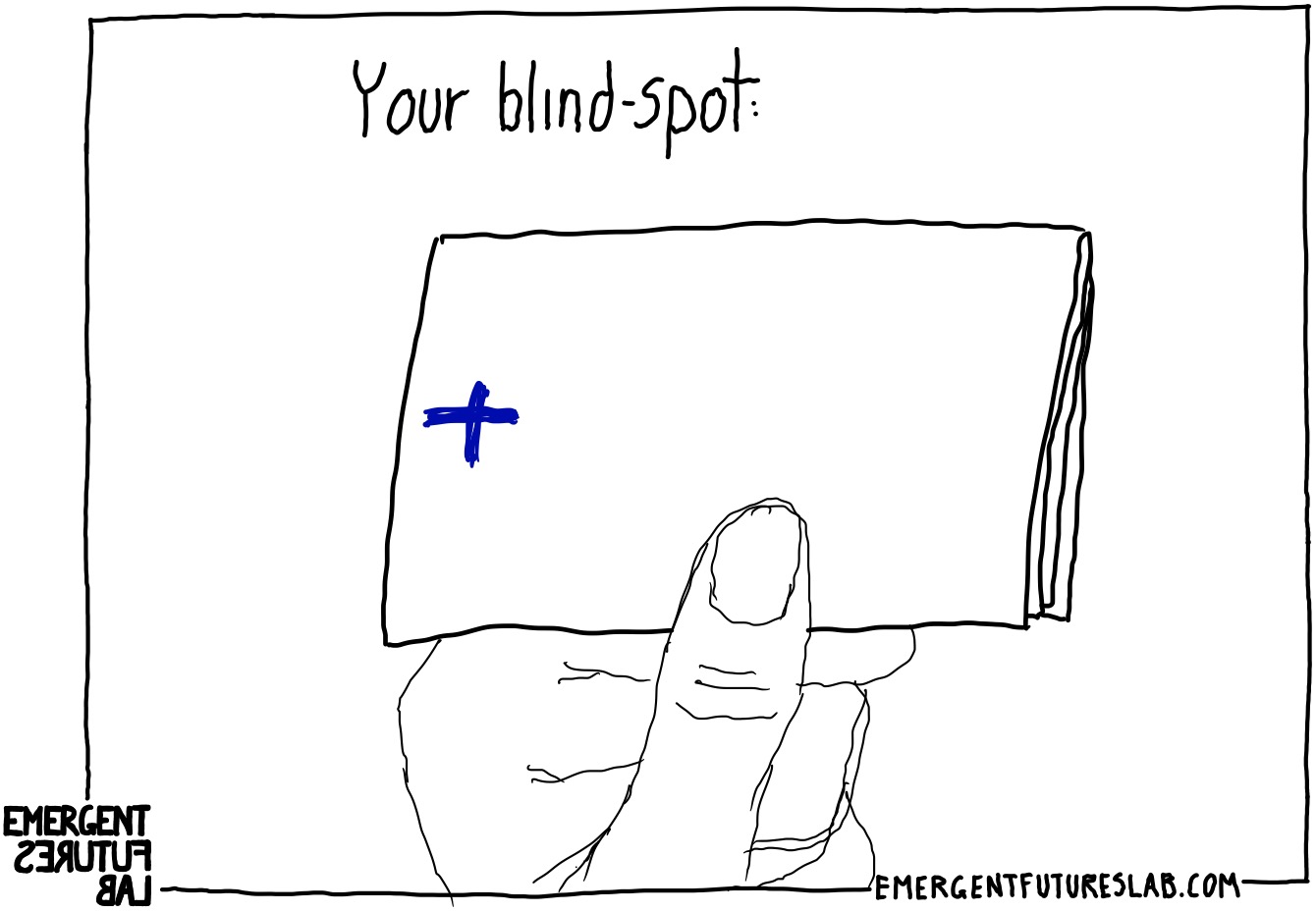
Rather, the configuration fills in the gap seamlessly, so you don’t notice that anything is missing. And this is what makes the analogy of the blind spot so apt: it is something that:
So, what is a non-physiological blind spot? It is when something in experience is hidden from us in such a way that we do not notice that it is hidden – as Thompson says it so nicely, “we don’t see that we don’t see”. Experientially, when operating in the blind spot, we never notice that anything is wrong or missing – everything appears to us as being exactly how it should be.
So what, for us, in relation to human creative practices, is the experiential blind spot? What is the thing that we both don’t see – and more importantly, don’t realize that we don’t see it – is… (drumroll please…): action – more specifically, enaction.
Really? Why is action in the blind spot of creativity? Well, that's the thing about blind spots – we have no sense that anything is missing. So, coming to sense action differently – this might require a bit of an explanation…
Let's, for context, start with our approach to creativity. If you were to really boil down our Emergent Futures Lab approach to human creativity – and to take this process of reduction a little too far (as an exercise), you might reduce it to two key aspects:
Before getting to understanding “action”, we need to start with world-making (which itself requires a slight tangent into exploring approaches to cognition, will bring us back to world-making, then action – and ultimately to en-action – we promise!).
World-making is, like its conceptual sister, Sense-making, a term that both intuitively makes sense to many of us and nevertheless remains hard to grasp conceptually. There are many ways to use these terms, and in the universe of business consultants interested in both the complexity sciences and changemaking, the concept of “sense-making” is often presented as having to do with understanding how people “make sense” of and navigate their complex lived experience via shared stories. While “world-making” in this context is understood as a form of one of three things: building a community culture, having a “world-view,” or speculating on alternative future cultures (world-building exercises).
Our approach to these terms does not come from these traditions of complexity sciences based organizational and business analysis; rather, it comes out of the Enactive Approach. The Enactive Approach is an approach to understanding cognition and what it means to be alive. It first emerged in the 1980s as a strong alternative to the consensus approach to cognition: Computationalism.
No, cognition itself can be a nebulous term, so let us, for the sake of this discussion of world-making, define it broadly as “the processes involved in experience and thinking”.
The consensus that developed in Western sciences in the mid twentieth century was that the best approach to studying cognition, consciousness, and what it is like to be alive was to focus on the brain as a computational system that generates internal representations from sensory inputs (to help us then act).
Computational approaches, while still the dominant approaches to cognition, have been critiqued from various perspectives, one of which has been to note how these approaches do not adequately consider the roles of our bodies and how strongly our actions are coupled with the environment. This has led to more “Embodied” approaches to cognition, approaches that, in general, argue that we cannot adequately make sense of experience/cognition if we do not consider the role of having a particular body and how it couples with a specific environment plays a significant role in cognition.
The Enactive Approach is a variant of these Embodied Approaches to cognition.
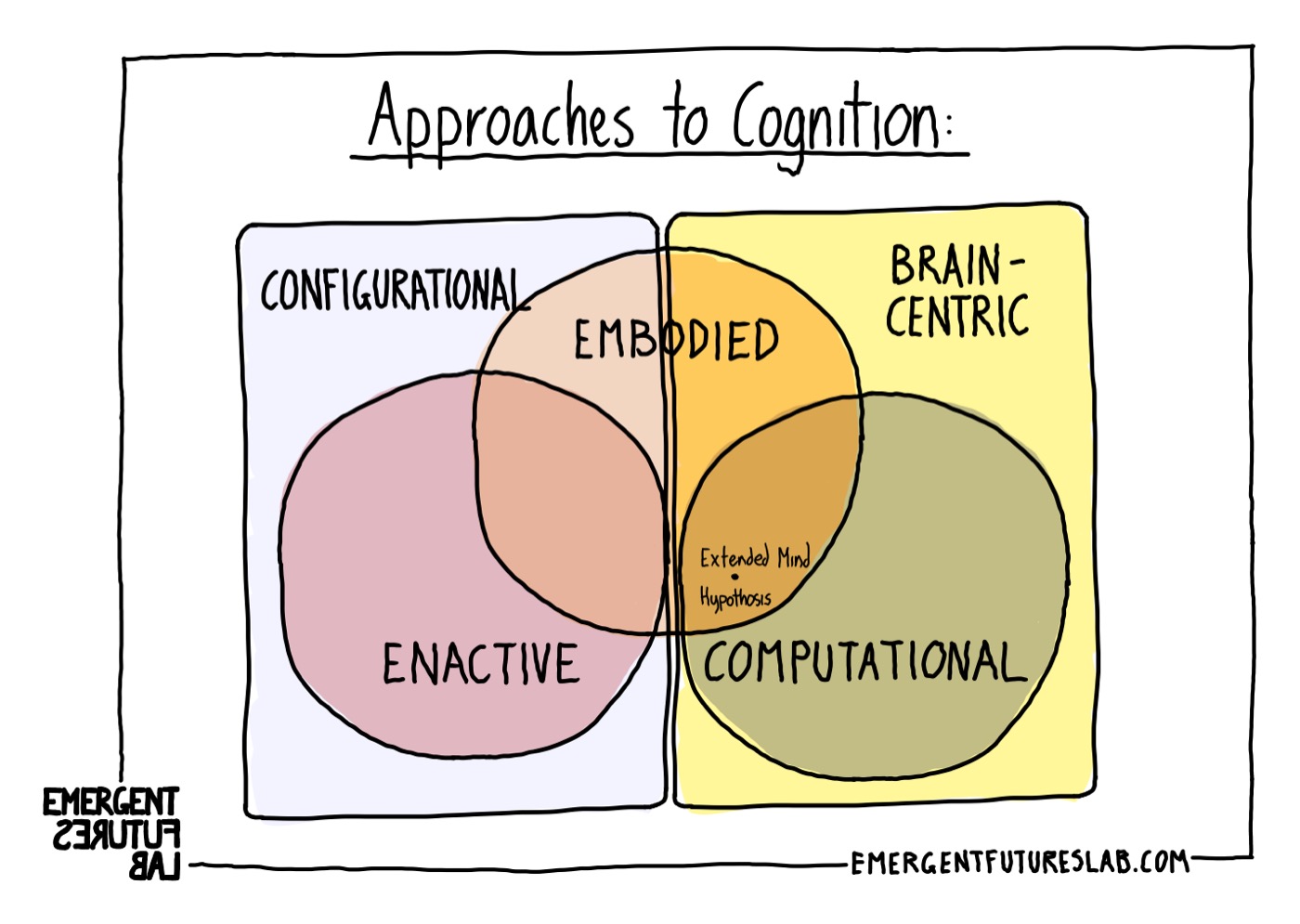
While many Embodied Approaches (such as, for example, the Extended Mind Approach) are still computational and brain focused (seeing embodiment, and environmental resources as being a necessary “support” to brain based computations). Enaction breaks free of computationalism and brain centricism by focusing on the activity of the specifically embodied living being and how they en-act their environment via distributed processes (see we are already coming back to activity).
Here we need to pause on this term “enaction”. We understand action – but what of en-action? The term “en-act” is used to stress that activity is not simply the carrying out of some pre-developed plan – rather the doing of the activity that is itself a creative act. Enaction is an odd word combination of two parts: en + action.
It is worth taking a moment to focus on the strange, powerful, and quite humble prefix “en” itself: “En” (or “em” – they both do the same thing in words) signifies to be “in” and “of” something: en-vironment, en-cased, em-bodied, en-livened, em-ancipatory, en-liven, embrace, etc. The term “en-action” and the wonderful prefix of “en-” allows the stress to fall not on just the action itself – but how – when we are “in action” (which we always are – and so too is everything else that is alive – we are all always in the midst of activity)-- we are actively shaped by the action:
EN-action.
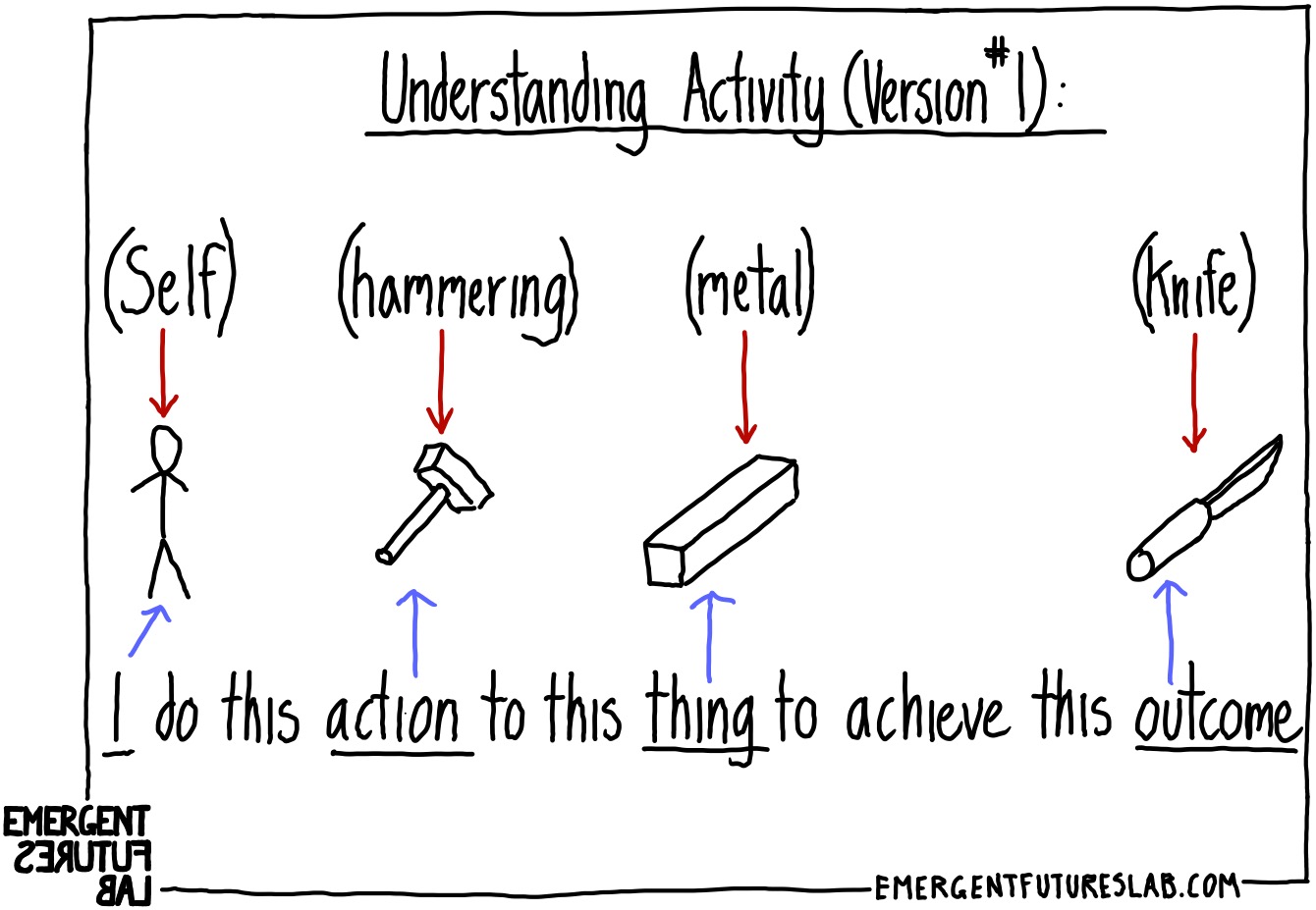
When we are in action, we are not just doing something, such as carry out an action with a tool on an object towards a known end in a passive and neutral manner like that of a robot carrying out a preprogrammed routine:
Rather, when we are in action (and this is always the case) – the action is also in us and changing us – it is an active loop and not a passive line:
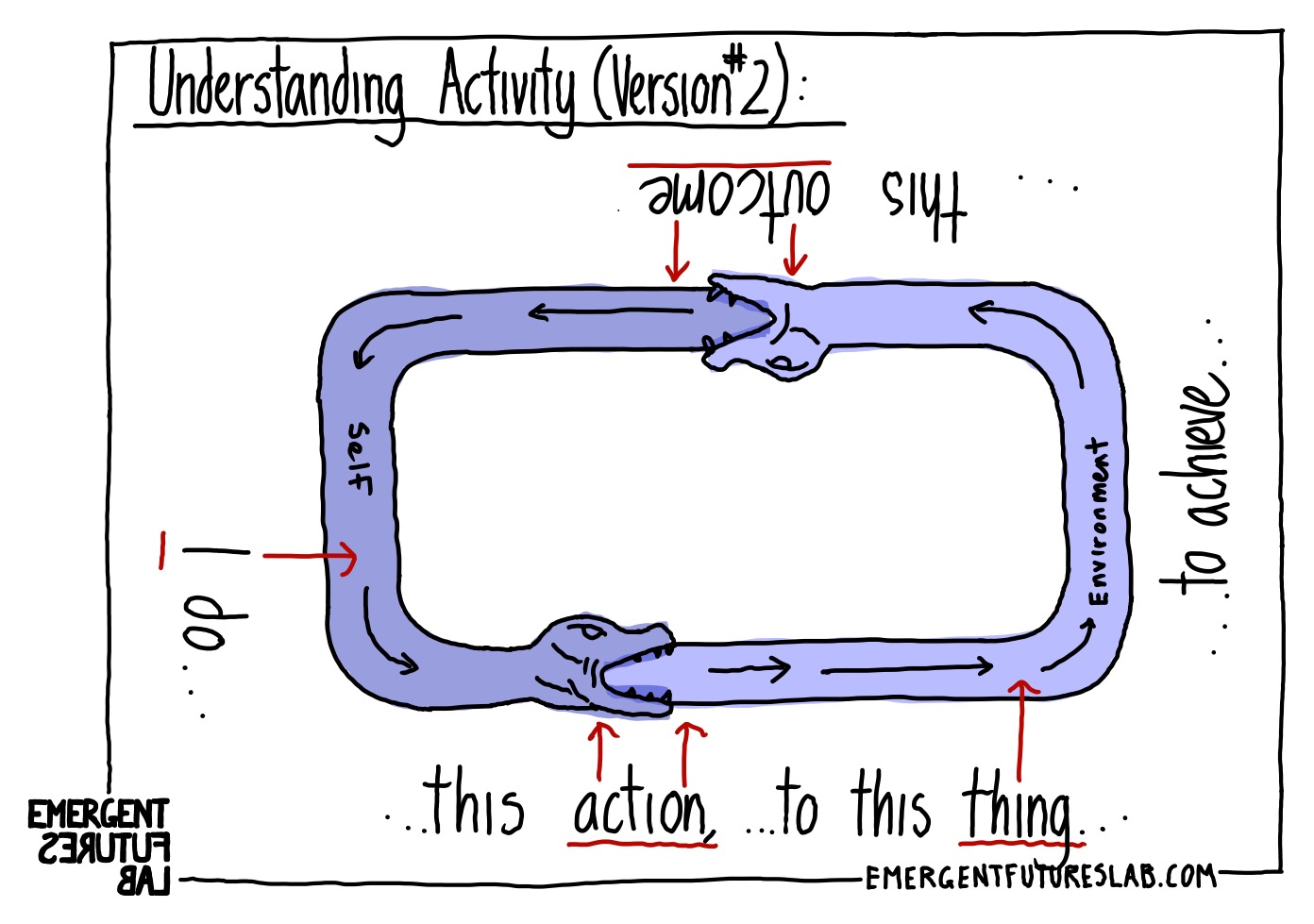
This is why we prefer to use the odd and awkward phrase where possible: “we are of our actions”. To simply say “in” would suggest that we come out of action unchanged – but the activity changes us, the environment – and ultimately the activity itself.
Action has a creative agency, and this is a creativity that is separate and different from our intentional logic in initiating the activity. We cannot stress this enough: Activity has its own unique agency and creativity (which is distinct from the purpose of the activity itself). Action always involves a creative transformative looping that is always there – what we have called elsewhere the “strange loops” – the orobourian loops of the dragon eating its tail):
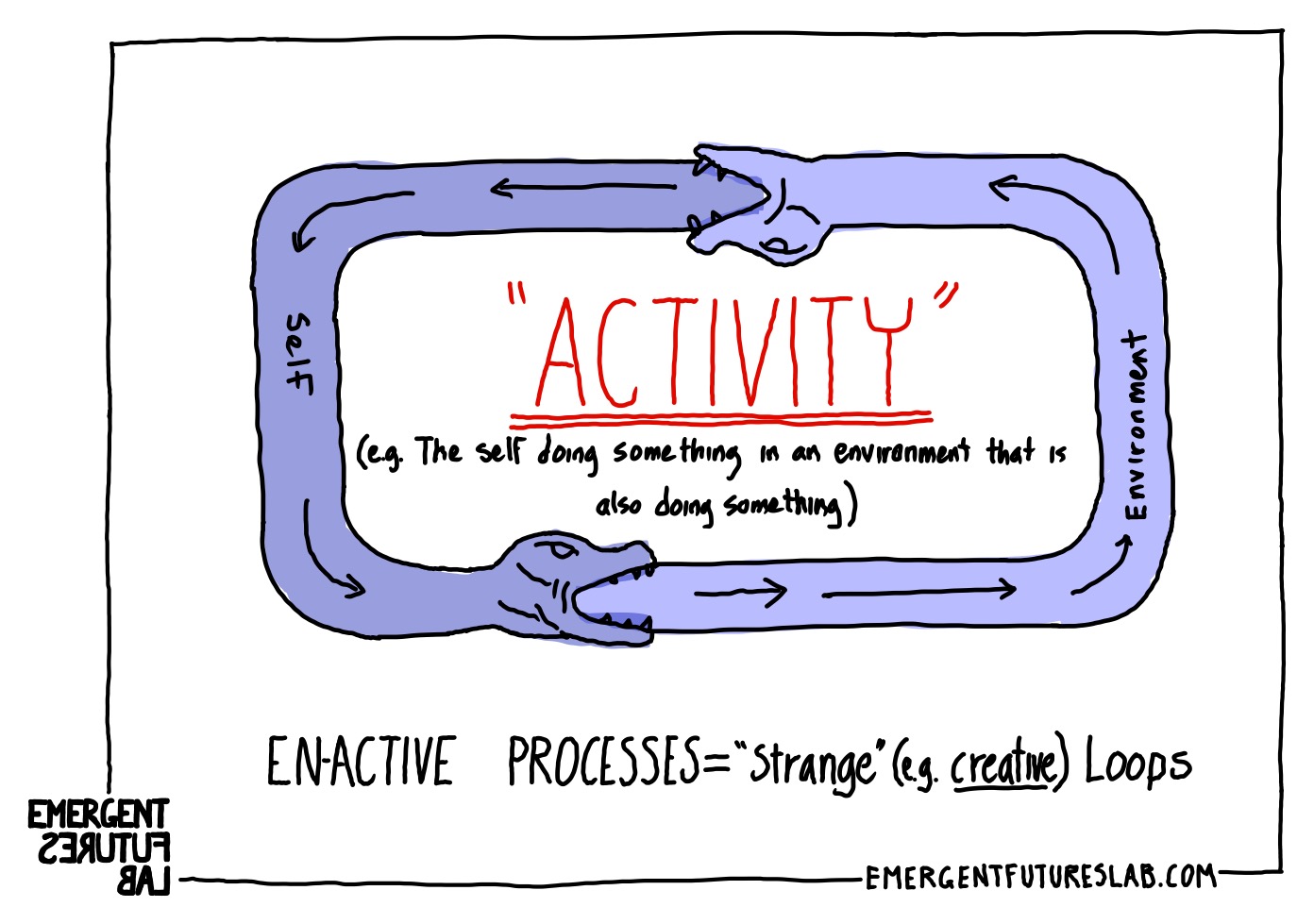
The En-Active Approach to cognition builds upon this logic of en-active activity to shift the locus of attention when we explore questions of “what is it to have an experience?" “What is it to think?” “What is it to be alive?” It is radically and critically shifting the attention away from answers like: we are computational brains processing external data to construct internal representations that we then can act upon – to ones that take into account what it means to actively make/create/sense via embodied and embedded action in a context where the activity has its own creative agency.
Enactive Cognition asks a new question – and one that is critical to understanding human creative processes:
And it understands that this activity is never an abstract thing: it is a specific relational – configurational – thing. The agency of the activity is creatively enacted by the relational activity of enculturated bodies + tools + environments and how they collectively-in-activity co-create and co-stabilize unique functional possibilities (the Janus-headed logic bodies + environments and affording + constraining):
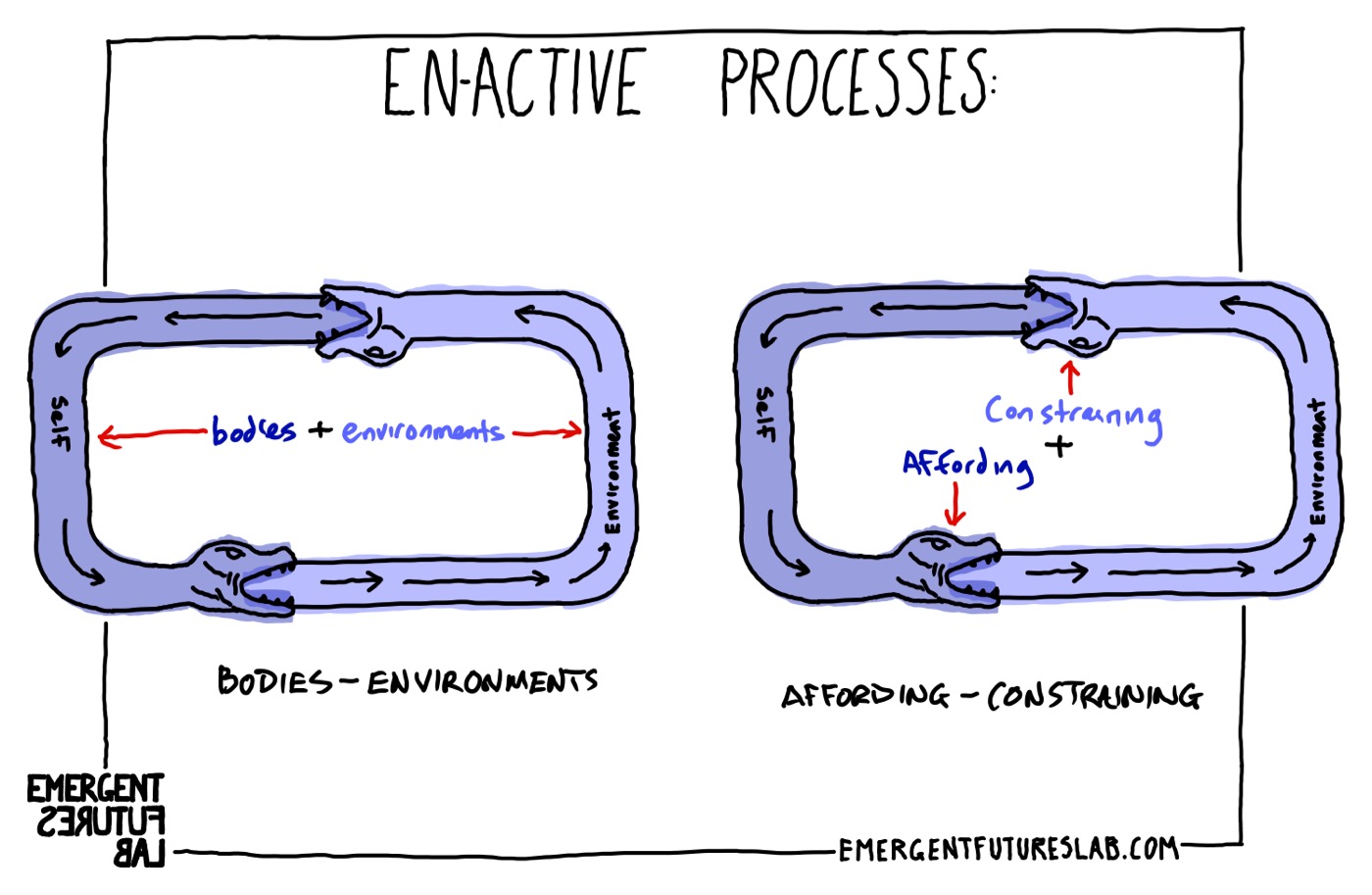
Thus, enactment, in Enactive Cognition, shifts the focus from studying how supposed internal thoughts, ideas, and experience-representations came about via internal computational processes, to exploring our fundamental ongoing collaborative activity of embodied and embedded creative sense-making, world-making, and life-making.
The usual emphasis in the term “sense-making” by business consultants is on “making sense of things” in the sense of a qualitative “understanding” of things by narrative means. And the usual organizational tools of sense-making are ones for the daylighting of actual complex and qualitative stories that individuals and groups in an organization are telling. While both of these are valid – and indeed important activities (albeit ones that do not need the absurd neurosis of trademarking supposed brands of sense-making) – it is not the same thing as what is meant by the term sense-making in this Enactive Tradition. Let's, for the sake of clarity, call this non-enactive sense-making: narrative sense-making. And let us remind ourselves – this is neither what we are discussing, nor is it an originary form of sense-making.
This is then the first aspect of the blindspot we wish to highlight: historically, we don’t see that the activity we are doing has a creative agency distinct from our own intentions, and we do not see that we do not see this. We think of creativity as coming from us, our intentions, and our actions. But this approach is profoundly blind to the creative agency of activity itself – a creative agency that changes us, our intentions, our actions, our outcomes, and the environmental context of these actions.
Speaking in general in regards to human activities: we have been trained to see ourselves as discreet agents possessing an internal rationality and free will, processing inputs from the world out there, making internal representations, considering these representations judiciously, developing a plan of action and then carrying out that action with the appropriate tools and techniques. And in the end perhaps we learn something from the activity if we carefully take the time to conceptually reflect on things – and only in this way would we say “we are changed by our activities” (and this process of narrative meta-reflection is what complexity informed business consultants are want to call narrative sense-making). But in this understanding of our activity – we don’t see or consider whatsoever how the activity as activity (and the relational configuration of the event) creatively made us (even as we made our actions). And this non-personal activity of the event is a more fundamental and more fundamentally creative sense-making.
Putting all of this as simply as possible: We see very clearly that we are acting, but we don't see that this action is also creating the “us” – the “I” who acts. And in our focus on ourselves, our intentions, and the psychology of our actions, we simply don’t see that we don’t see how “we” are an outcome of our actions’ creative agency.
We are not outside of the agency and creativity of the loopings of activity.
We are blind to the fact that our activity is making us as we sense what we are making.
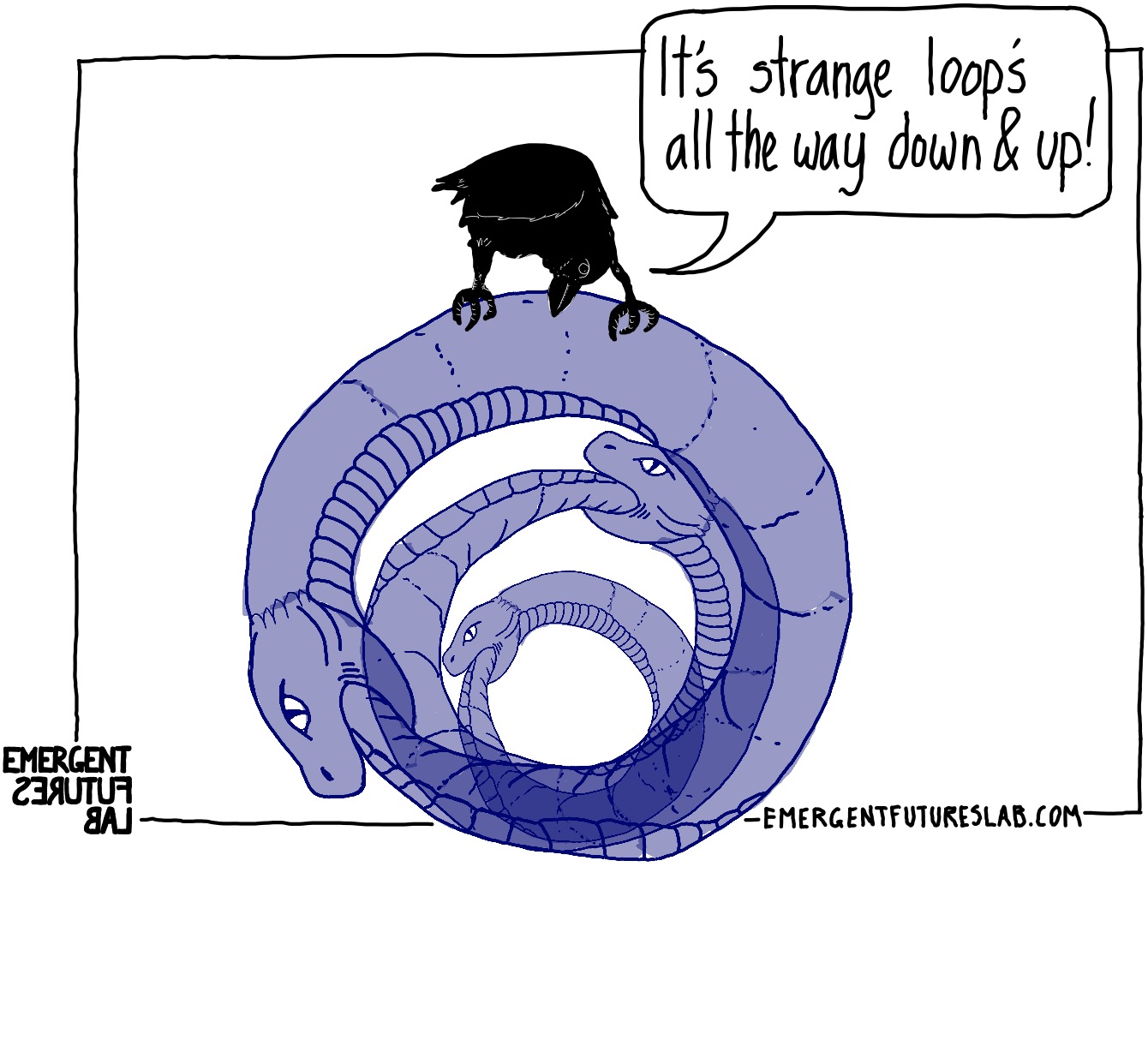
We are blind to the exact nature of the agency of the looping of activity: what we sense as the neutral background of an activity is, in fact, the emergent outcome of the distributed relational configuration of our activity’s agency beyond our intentions. This configuration is what is shaping/creating what is sensed. If what we sense is being made by the activity, then this is a more originary sense-making.
Well, this is where we are going to leave you this week. It is a good and important place to pause for the week, where we can begin to step out of the blind spot of action, to see action’s creativity – a creativity that works on us.
If you haven’t already, we would encourage you to try some of the suggested activities and take a look at the books that support them. And as you do these activities, try to fully and actively sense the en-active force of the creativity of the event itself.
Become of the strange configurational loop…
BUT – this topic, the blind spot of action and en-action is by no means fully explored. There is more to do to gain a larger and more complete grasp of action and enaction. That is the topic for next week when we will consider the three differing temporal scales of human enaction: life-making, world-making, and sense-making.
Till then – feel and follow creativity's emancipation in action...
Keep Your Difference Alive!
Jason, Andrew, and Iain
Emergent Futures Lab
+++
P.S.: Loving this content? Desiring more? Apply to become a member of our online community → WorldMakers.


