Newsletter
Resources
Courses
Books

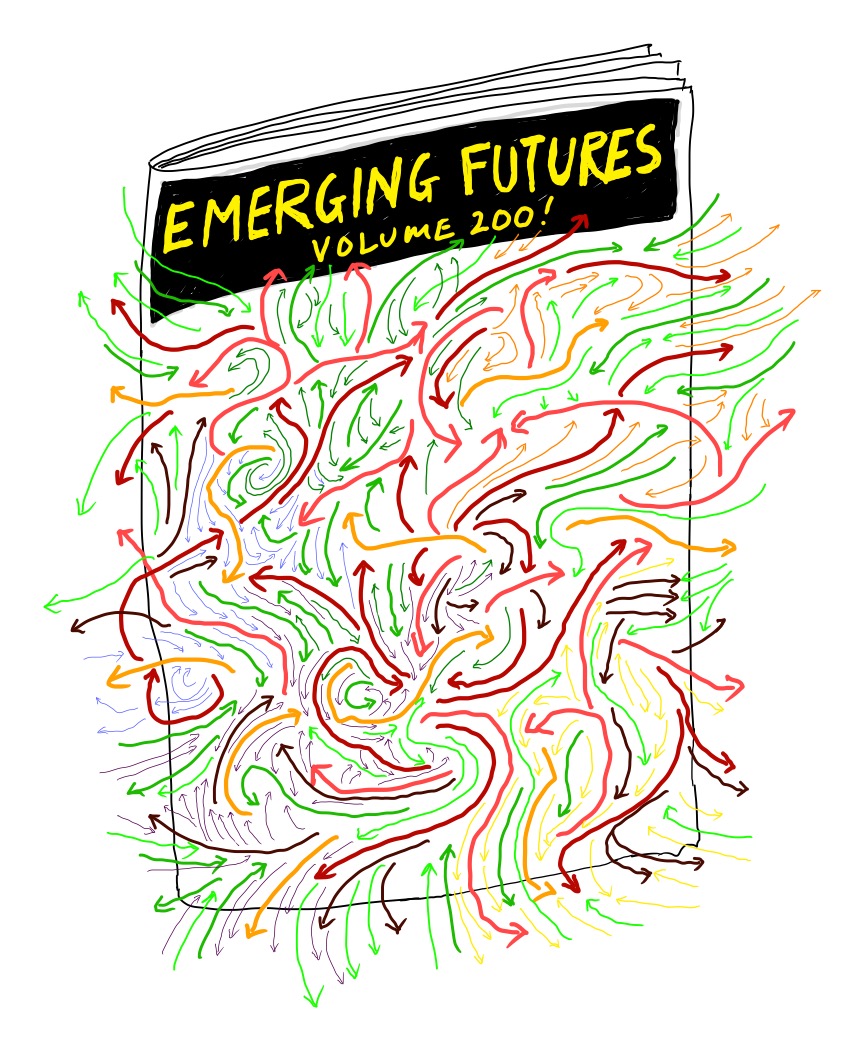
Welcome to Emerging Futures -- Volume 200! 200 Newsletters!...
Good morning Individuations of Change as Novelty,
It is the full moon of July that accompanied us working late into the night – and now it is Friday morning on the North-West Coast of the Atlantic, and the two hundredth issue of Emerging Futures Newsletter arrives in your inbox!
Perhaps this is your first time reading the newsletter or getting the newsletter is now part of your weekly routine – or maybe you have been with us from the beginning – however many you have read and however you read them – this is a very special moment for us (Jason, Andrew and Iain) – not so much because we have gotten to this admittedly arbitrary milestone, but because we, as a community (now numbering in the thousands), have done something noteworthy: we have collectively developed new paths and possibilities for ourselves, for this community – and for how creative processes are engaged as emergent practices.
The Emerging Futures Lab newsletter arrives like a breath of fresh air in my inbox, piquing my curiosity and sparking my creativity. Reading it supports my efforts to protect space for ideas that don’t yet make sense, for change that resists simple solutions, and for the slower, more relational work of emergence. If you’re tired of the usual conversations about innovation and change, this newsletter is a welcome invitation into more generative territory.
~ Katrina Donald
We heard from so many of you that the newsletter is a type of “breath of fresh air” that comes every Friday. And that you appreciate this even when some of the newsletters are long, dense, or on a topic far from your immediate interests, just getting the newsletter is catalytic.
For us, as writers, we strongly resonate with Katarina: “Reading it supports my efforts to protect space for ideas that don’t yet make sense, for change that resists simple solutions, and for the slower, more relational work of emergence”. We too go back to newsletters and series of newsletters at later dates to find that protected space for things that don’t yet make sense – to slow down, to resist our own solutions and let the “slower, more relational work of emergence” take hold and pull us into the new…
Writing the newsletters is a practice of relational emergence. We have never started with “This is what we want to say”. We might begin a series with “This is where we wish to experiment”.

But then, the collaborative experimental work of writing and drawing has its own logic – sometimes what was one newsletter becomes three, and sometimes all of it gets left behind.
The Emergent Futures Lab newsletter has been hugely influential on me.
Firstly, it can feel very isolating going deep into literature. Even colleagues in the field of innovation often seem to have little interest. So to come across this newsletter that connects such a beautiful, rich diversity of fields feels like finding a home.
It’s a refreshing rhythm, a personal coach in bite-sized format that kickstarts my weekends. It has helped shape not only my approach to innovation but also the evolution of my research interests.
It’s a great example of the value of stepping outside of disciples
Thanks for the continued provocation and inspiration, here’s to the next 200.
~ Steve (Steven Sullivan)
As Steve writes, reading the literature – and practicing/experimenting with and beside the literature can feel isolating. “Even colleagues in the field of innovation often seem to have little interest.” We have felt this for far too long. This was a big motivation for us, after working in and around emergent logics of creativity for decade, where few professionals in the creativity space understood or showed a deep interest in alternative practices – we hoped that the newsletter would make us all a little less alone. And it has, our rhythm is also a weekly one where your email responses begin our week, and reflections and thinking towards the next newsletter.
A significant part of how we write is through dialogue. For us, the emerging community is very real. Every week, we are talking, texting, and emailing with many of you as you read and experiment with the newsletter from within the context of your own creative life’s journey. Every week, it seems there is at least one response in the first hour – with a thought, a question, or an insight that takes things in a new direction. And all of these discussions feed back into our work:
Hi Jason and Iain, … About the milestone regarding approaching 200 newsletters and around four years of weekly co-creating and allowing for emergence.
I think this is so beautiful, and I'm very inspired by the milestone – this is something for me personally that I also hope I will do one day.
I also wanted to share a little story of how I came to know your work. It was on LinkedIn and someone, a friend who was into creative processes,. I think commented, and I subscribed, and it was from the first newsletters that really had this lightbulb go off:
The fact was that it's not about “you” being the creative hero. Actually, creative processes involve many beings and beings including non-human beings, and it was also going into the concept of something being wanted to be created through you.
I was at the time playing with this notion that maybe it was not only about “me as a hero” – and it's not that I have to take all the responsibility for doing and being and failing and sometimes achieving many things. And that was, I remember, a very beautiful moment – that I was being allowed to develop this feeling or a sensation that I was experiencing.
I think that it's beautiful that you are bringing this model – this notion of this interconnectedness and us being in constant co-creation with each other and with many beings that we don't give the credit to and we don't even sometimes maybe see those beings who are I don't know who are in this and about this.
Bringing this model into more formal environments like educational establishments and companies is important. I think it's highly important and it's high time for that.
So here is to you and to make more editions of the Emerging Future newsletter – and to a thriving community of WorldMakers
~ Yulia Bogdanova [lightly edited for context]
And now it is the work of Yulia Bogdanova (especially around environmental forms of being with more-than-human creativity) and Katarina Donald (in regard to taking actual concrete situated practices of relationality far more seriously) that is shaping our work. They will both be leading independent workshops for our WorldMakers community this fall.
We started 200 weeks ago – that's three years and ten months. Back then, we did not have a big vision, a clear sense of purpose, or a specific goal. We just started with something quite humble and not all that well worked out – trusting that things would emerge and we would follow.
We knew that much was missing from many of the contemporary approaches and discussions around creativity, and that others felt similarly, that there was a hunger for new emergent approaches:
For a while, the innovation scene felt a bit lacking for me. I was all into complexity science, especially when it comes to IT, Agile, and software development (Cynefin, Wardley… ), and I really craved that same depth in innovation and creativity.
Then, the first edition of the Innovating Emergent Futures book landed in my inbox (That's a story for another time), and it was a revelation
Then I discovered the newsletter from the same team, and honestly, I was completely hooked, issue by issue. It's actually been a massive source of inspiration as I started my PhD in the meantime, where the complexity perspective will be the core framework. This newsletter continually provides rich material and research directions, sometimes almost overwhelmingly so. And their book recommendations are always top-tier.
How I use the Newsletter: I do two things mainly: build software and teach people how to use software (generative AI, mostly). Your newsletter comes up very often when I teach people how to use genAI. There is always a discussion regarding creativity and the agency of genAI models. People usually consider creativity a personal trait so that is where I start introducing ideas I got from your newsletter.
~ Miodrag Vujkovic
Let’s take a moment to dwell on the wonderful statement: “This newsletter continually provides rich material and research directions, sometimes almost overwhelmingly so.”
Early on, we knew that what frustrated us was the depth of coverage in the emergent creativity terrain (and this was already thirty years ago when we were first experimenting with exaptive practices). We found that even if the material came from an interesting place, it was more often than not short, generic, and ironically opaque, with far too often an undercooked use of jargon. We wanted to do something different: treat our readers as partners on a journey that could go long, deep, and occasionally dense – and that everyone would figure out, as Miodrag notes, how best to experiment with this.
For us, the “sometimes almost overwhelmingly so” is a critical feature of emergent creativity itself – we are in a place of generative abundance – that we can explore and experiment with, however we wish.
One great example of this practice of figuring out the right approach individually is how our colleague, the early childhood math+creativity researcher Steven Greenstein, approaches the newsletters:
Taking an enactive phenomenological perspective has radically shifted the foundations, directions, and orientations I take to my research on the shape and nature of mathematical experience and how to design for its emergence. I’ve read a thousand pieces on this perspective and stumbled through a few projects of my own as I’ve learned to apply it. But no one or thing has shaped my understanding of the perspective and its implications more than the work of the Emergent Futures Lab. With their words and moves and sounds and sketches, these folks have been my mentors through the most interesting, inspirational, joyful, and consequential phase of my work.
How I use the newsletter: To varying extents, I’m always working on my research project of enactive deep creativity (which we call “Stretchy Minds”) – and this involves experimenting with the enactive design of ecosystems for learning math and other things. That includes reading enactivist research and writing up our findings. I take a look at every newsletter announcement, but due to limited bandwidth, I can only go deeper into the ones that strike me as relevant to the work we’re doing. I do that because I’m always refining and elaborating my understandings of this work, and the newsletter tends to help me do that: new language, new images, other interactions I hadn’t considered, and so forth.
I have also made PDF’s of all the newsletters and then searched them in regards to key concepts I am interested in investigating such as “how do we sense qualitative thresholds?”
We often hear this, “I take a look at every newsletter announcement, but due to limited bandwidth, I can only go deeper into the ones that strike me as relevant to the work we’re doing…” For us, this has always been a big plus of the format. Much like a newspaper, which is designed to be skimmed and when the right article is found, read in depth.
We have deliberately made it so that you can easily go back to our website, search the newsletters via the provided tags or the query function, and find which ones to read/research. Or you can go further, as Steven and others have done, and make your own archive out of them to suit your practice. We love this – with the Newsletter, and the other resources (such as the glossary and bibliography), or our websit,e the goal is to experimentally participate in a genuine community-based movement of change-making in the space of creative practices.
One part that really pleases us in regard to the co-emerging community is how diverse the community around this work has become – we now have readers, friends, and collaborators on every continent (except Antarctica). Many are coaches, consultants, facilitators, researchers, seekers, and teachers – in fields that range from healthcare to engineering, to ecosystem management, to product design, to community change-making and far beyond in a rhizomatic web of activities, experiments, and curiosities.
The beautiful and remarkable aspect of this is that what connects us is a shared experimental curiosity in furthering a broad and welcoming alternative approach to creative processes:
As a cognitive scientist and researcher in innovation working on both 4E cognition and future-orientated innovation, your Emergent Futures Lab and newsletter have been something of a revelation to me.
Not so much in the sense of a „surprise", as my own research is positioned exactly in this field, but how Iain, Jason, and Andrew manage to sharpen this approach, take their readers on an intellectually stimulating journey, break patterns of thought, develop their concepts consistently further by pushing them into their extreme, as well as make them actionable for practice. The Lab’s emphasis on radical novelty and emergence strongly complements a future-oriented innovation agenda which has become so vital in today’s world that is characterized by unpredictability and disruption in almost every domain. The illustrations accompanying your writings go far beyond classic formats and patterns; they are themselves future-oriented innovations that are extremely insightful- and helpful in supporting a deeper understanding of these sometimes rather abstract and complex concepts.
What has become even clearer to me through your writings and reflections/thoughts in action, is the importance of taking seriously and developing further what I would refer to as the creative agency of the world—both in my theoretical and practical work…
~ Markus F. Peschl
It is great that Markus picks up on both the importance and innovative nature of our use of drawing and diagramming. We have been working with drawings and diagrams for the last thirty-five years. But drawing digitally was a whole new adventure – as you can see if you go back to the early newsletters. When we began, we had a great software suggestion (Nebo), purchased a iPad and Apple Pencil, and just started experimenting. We are still using Nebo – mainly because it keeps it simple (no layers, rotations, etc.). That it keeps it simple is a function of not being designed for drawing (drawing is an exaptation).
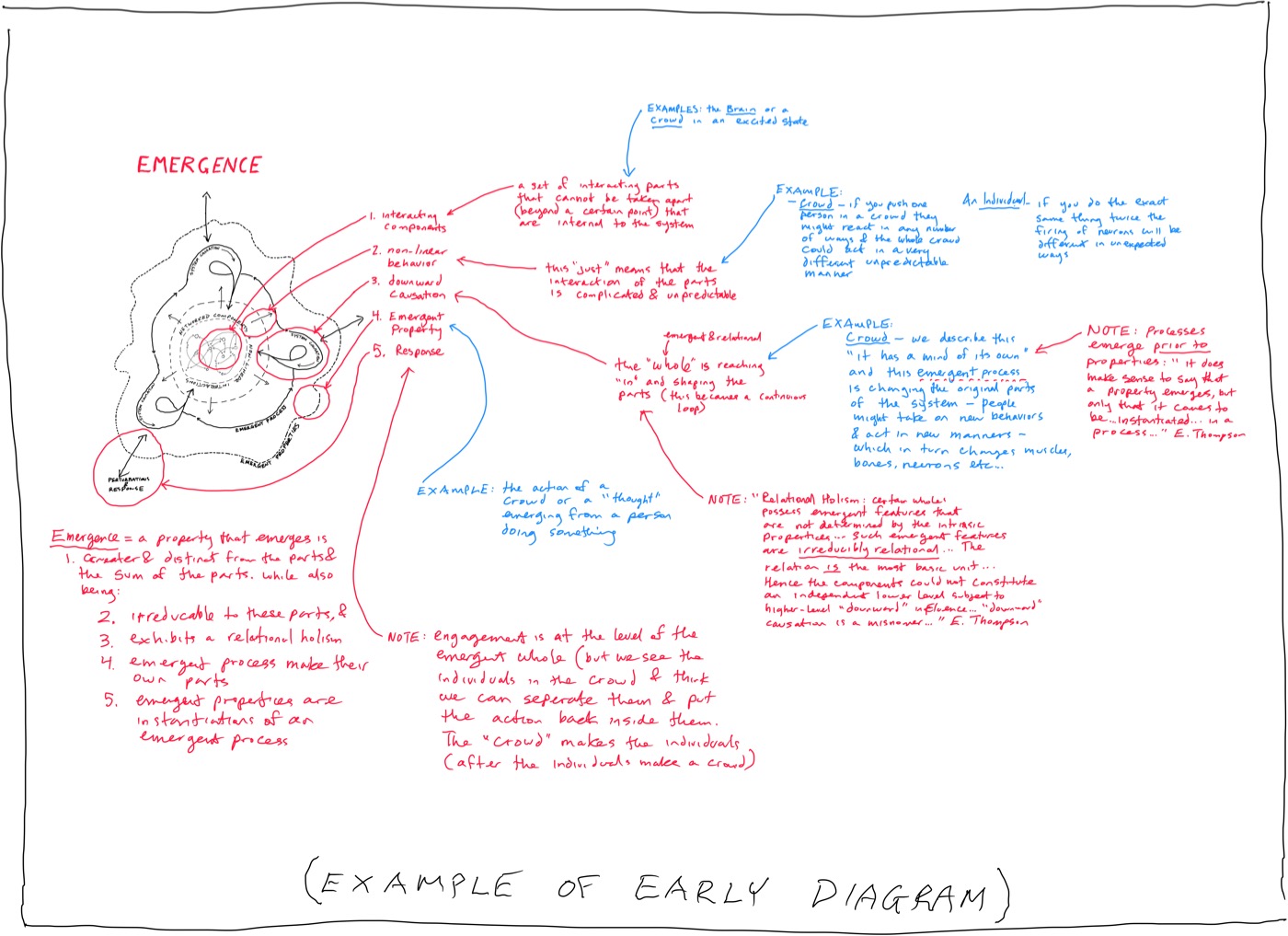
The reason we use drawing (other than for the embodied joy it brings to work this way) is because the format is so much more responsive and open to creative transformation: we can think responsively via the embodied act of drawing.

If we had to turn these into carefully rendered products in design software, we would lose this dynamic, responsive creative dialog of thinking-in-drawing. Drawing – the pull of a line draws the hand out – pulls it elsewhere – far beyond the initial hunch or impetus.
For us, drawing is never the act of making visible some pre-existing representation – but it is a creative act of making-doing-thinking where the line teaches us and the emerging form forms us.
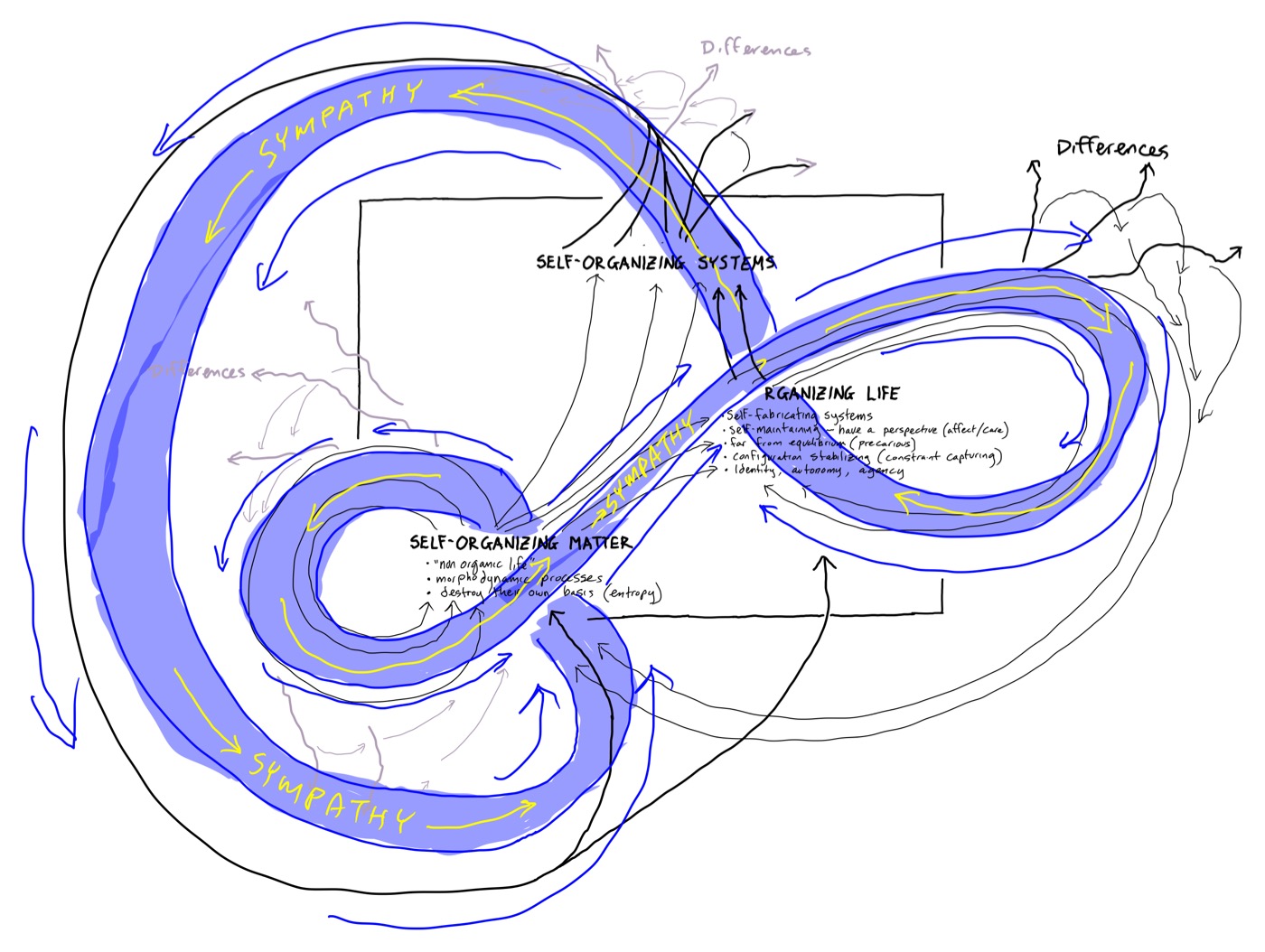
It is also important to note that another reason we use drawing is to not fall back into cliches and the generic that finding photos and clip art online has a strong propensity towards. And this refusal of the generic, of convention, and the given is:
The Emergent Futures Lab offered me a perspective that I saw nowhere else and didn't realize how much I needed it until I started meaningfully engaging more with the community. Their approach to innovation is novel and breaks so many of the conceptions that we typically hold about what constitutes creative breakthroughs.
How I use the Newsletter: I use the newsletter partially as a reflection on my practices around innovation (the newsletter is one of many things I try to read, although most other stuff is in book form)!
~ Stephen Robins
If you have fallen in love with the perfection in the imperfection, you find a home in this work. Every experience feels like an invitation - to be of the world with a humility that asks you to become lost again in finding your way.
How I use the Newsletter: Like a map without a destination. A wayfinding in a world that has no edge. I let it use me.
I use it to notice what is unseen.
It is hard to pin down. It’s like Will Wonka’s chocolate factory; you come for the chocolate and you leave in a flying glass elevato
~ Mark Stollow
For us, the newsletter is not a thing in itself or an end in itself. It is part of the collaborative work of experimental building and being a part of a rich, diverse, complex, and open community. We are writing together, working together, and evolving together:
Emergent Future Labs - 200th Newsletter Edition
Wow - every single one I read is a Gem. Every single one I didn't is a missed Chance to Grow.
When I started reading them, it did something to me; at times every sentence challenged me, my coordinates to see and evaluate things, and then I started to understand …
... admitting, it wasn't always easy to learn that what I did in the past, the approaches I chose had often missed central important points, covered by unquestioned common viewpoints so I often shot (still do, hopefully far less) too low or at the wrong target.
As I am deeply aware that everyone, every community, every organization is on a journey, it is on me, on us, on everyone that wants to help co-create, co-guide such a journey to be obliged to critically reflect on what to-do next, reflect and shine lights on aspects and dimensions that seem secondary or invisible – question, do and experience. Every edition is such a spotlight.
Bayo Akomolafe quoting an old African proverb: Times are urgent, so let us slow down – every edition is a wonderful invitation for just that – slow down to think, do, co-create, and co-evolve.
It matters; how deeply it matters is wonderfully packaged in the work of Iain, Jason and Andrew.
Side note: I was initially quite intimidated by their deep, grounded, and impressive work, but I am not anymore; my intimidation transformed to admiration into a camaraderie to jointly walk and experience a path. I am way faster out of brain-steam, need way more digestion breaks, but it is utterly rewarding being part of their/our journey.
~ Tom Pauly
There is a wonderful moment in Gilles Deleuze’s great book on creativity, Difference and Repetition, where he discusses the process of engaging with creative processes. He says that there is always a moment of realization in each of us that the new “is too big for me”. And at that moment we enter a new process: “a present of metamorphosis, a becoming-equal to the act”. This is a daily experience for us, and a daily practice for us – to let go of what we already know and expect and become-with the animate aleatory energy of what is emerging as novelty-from-the-middle. And at the heart of this is what Tom calls “a camaraderie to jointly walk and experience a path”.
We too are always experimentally – and as best we can – finding ways of “becoming-equal to the act” that we too cannot know and is “too big for me”...
I started reading the Emerging Futures Newsletter a couple of years ago and found it to be informative and original. Then I read the book Innovating Emergent Futures and joined the Worldmakers group.
The Emergent Labs community are original thinkers and always provide thought provoking content and spirited discussion. The newsletter was my gateway into this incredible ecosystem.
~ Joe Cullinane
I am relieved not to be the source of innovation in my life, homestead and neighborhood. I am delighted to live the experience with a growing assembly of co-agents.
My quest to build a chicken coop set me in motion toward a circle of 5 sabal palms that offered a spot. The initial structure that interlocked the circumference was leveled to support roof rafters for both coop and the outlying run. But this simple structure was also a platform on which to stand (in awe) and explore other possibilities. Thus began a respectful collaboration that is currently acting like a three-story treehouse. And the chickens are securely housed 90 feet to the west.
~ John Rogers
In a world awash with talk of innovation, Jason and Iain’s work offers something far rarer: a truly liberating reframing of what innovation is. Their writing helped me understand that real transformation doesn’t come from grinding harder, but from blocking familiar patterns and engaging differently — with others, with materials, with the world. Their distinction between incremental and qualitative change cracked something open in me. And beyond the frameworks, what keeps me reading is who they are: thoughtful, generous, and genuinely curious. The newsletter may be the container, but the real gift is the intelligence and presence they bring to everything they seem to do.
~ Dan Nietz
I have known the Emergent Futures Team for over a decade, and admire their ingenuity and ability to make ways to make complex issues into activities that illustrate the deeper principles of their approaches to creativity. In doing that they engage many people with varying perspectives and backgrounds. The biggest thing I have taken away from my engagement with them and their community is how different working in the unknown and non-deterministic world from the known and deterministic world we often assume we live in.
~ John Lovitt
For us, as we read these and reflect on two hundred issues, we feel recognition, not the recognition of a shared identity, but the recognition of something else: We are all curious, passionate, engaged humans striving to collaboratively make novelty and beauty to co-emerge in this world. And to this, we feel a deep sense of shared belonging and joy – this is something we are collectively doing – it is about us – and it is not about us. This newsletter and this community have a creative life of their own – a creative emergent rhizomatic middle of its own – that is, perhaps, what two hundred issues begin to bring us towards…
78 Fridays
I can’t quite remember how I first discovered Emergent Futures Lab and their work, but when I look back, I see that I got my very first newsletter on January 14, 2024—Issue 123. Mid-June, I shared a post on LinkedIN about how much I enjoyed their ideas, and soon after, they reached out. We scheduled an online call, and by July, we were organizing a workshop at Metropolitan Museum of Art, followed by other collaborations since.
Now, reaching the 200th issue, I’m deeply grateful for the journey we’ve taken together. I want to celebrate not just the newsletter itself, but the profound impact it has had on my life and work, building bridges to new relationships, fresh practices, and transformative ways of seeing the world, expanding my perspective beyond what I thought possible.
Every Friday (well, almost), I tried to end my work week by reading the newsletter. As I prepared to write this reflection, I looked back through the notes I’ve been keeping, trying to understand the many ways your work has impacted me both on a personal and professional level, along with some key takeaways. Jason, Iain, and Andrew - I can’t thank you enough, and I know that whatever I say will fall short of expressing my gratitude.
In a world that often asks us for quick answers, you’ve reminded me of the beauty in slow questions, deep connections, and shared wonder. Thank you for being a constant source of inspiration. Here’s to many more Fridays of learning together.
~ Ozgen Bagci
We could not say it better – here's to many more Fridays experimenting and co-evolving with all of you!
Please keep reaching out and keep the creative dialogues going.
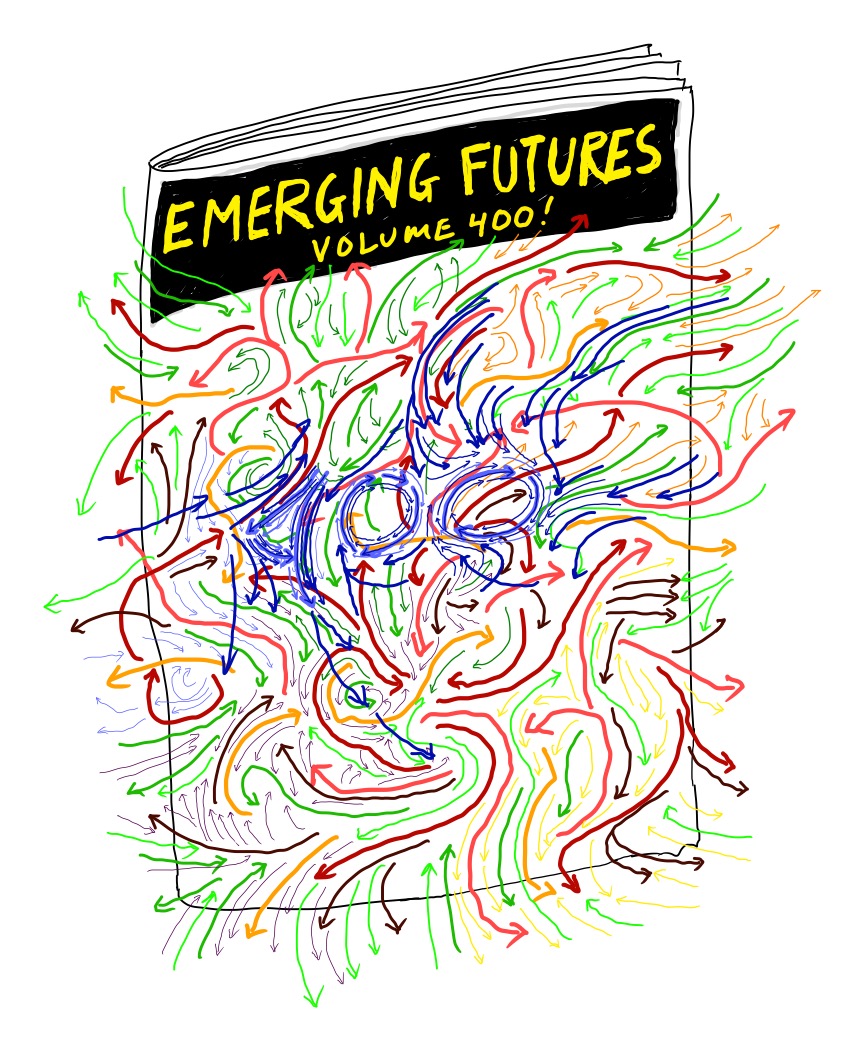
And: let’s all do the creative work to keep difference alive. To the adventure of the next 200!
Keep Your Difference Alive!
Jason, Andrew, and Iain
Emergent Futures Lab
+++
P.S.: Loving this content? Desiring more? Apply to become a member of our online community → WorldMakers.


