Newsletter
Resources
Courses
Books

Welcome to Emerging Futures -- Volume 205! Creativity – A New Operational Language in Four Concepts...
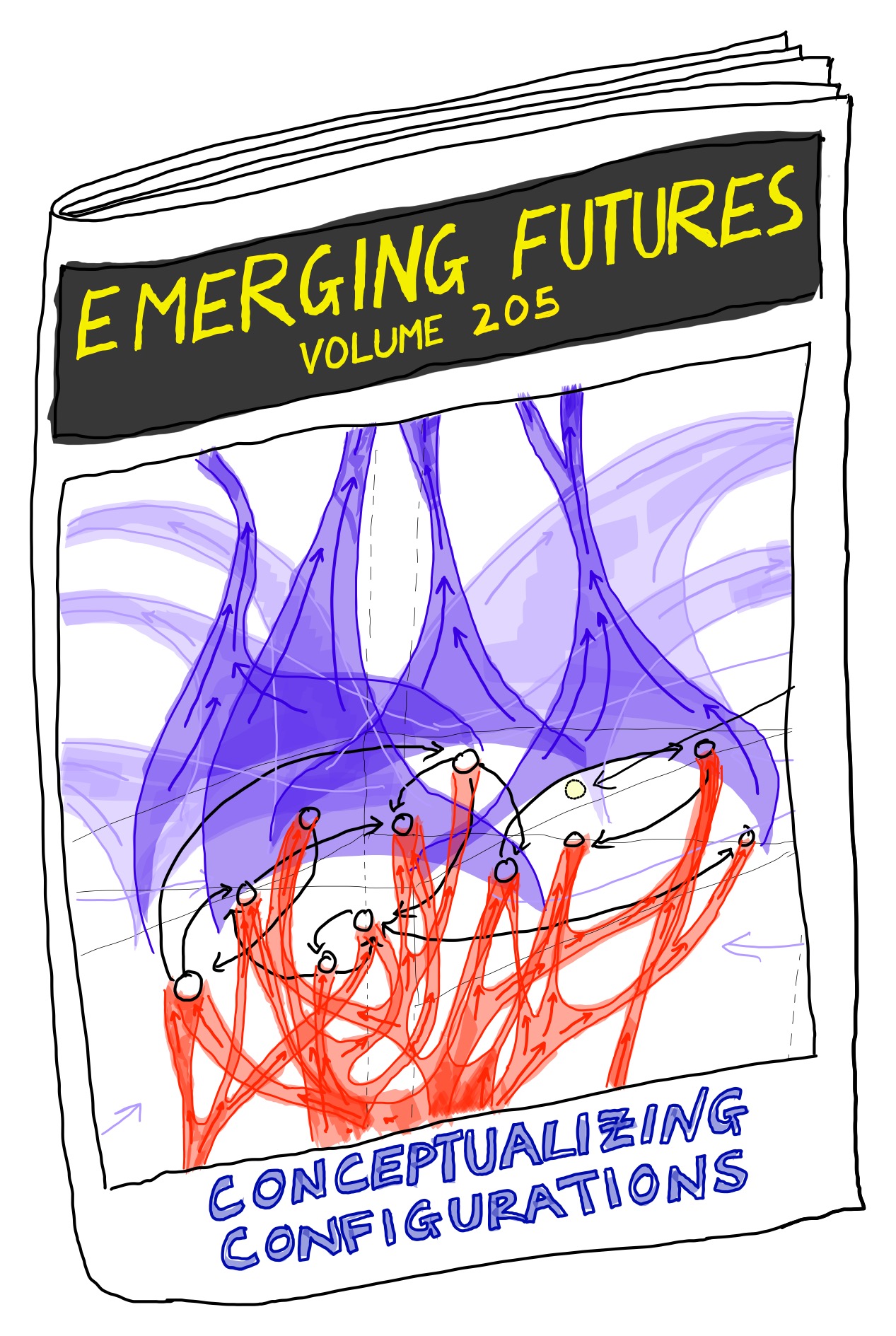
Good Morning distributed becomings of emergent propensities,
It's mid-August, and for us it begins a phase of transitions – traditionally from summer to fall – but now deep into a century of industrially driven climate change – it is still high summer here. Perhaps we are in need of new seasons?
Our big work transition is that school is starting back up. Jason, Andrew, and I are excited to bring into the classroom and into the ongoing research projects we are engaged in with University colleagues what we have learnt over the summer working with and within the intentional community of creative practices: WorldMakers.
One of the big projects that we have spent the long hot summer months exploring and experimenting with is a set of practices and concepts that circle around an experimental movement to radically re-evaluate causality. These questions, experiments, and concepts have shown up in the newsletter and elsewhere over the last couple of years (and were first experimented with in Volumes 129-146). And so we thought it was time to formally introduce the four key concepts involved in this experimental pivot away from causality in our engagement with creative processes – and to attempt our own creative definitions.
These are four linked concepts:
What connects these terms is that they move us beyond – and even outside of the logics of causality. The experimental proposition that we are testing is: Perhaps, we don’t really “cause” anything except in the most narrow sense of the term. Perhaps events are without cause? Our sense is that this is especially true when we engage with the processes that might give rise to qualitative novelty. Perhaps at best we can speak of forms of “quasi-causality”?
In this experiment, we have been initially greatly inspired by the work of Francois Jullien:
“To summarize the difference between Western and Chinese thought: one constructs a model that is then projected onto the circumstances, which implies that the situation is momentarily “frozen”. The other relies on the situation as on a disposition is known to be constantly evolving. It is a disposition that functions as a device… this disposition-device does not carry the same meaning as we in the West ascribe to it… Rather, it means something that we now see to be back-to-front (from the Western point of view): namely a particular configuration that can be manipulated and that in itself produces an effect.”
We draw inspiration for the concept of an Abstract Machine from the work of Gilles Deleuze and Felix Guattari:
"We define abstract machines as the aspect or moment at which nothing but function and matter remains, A diagram has neither substance nor form. Neither content nor expression…"
An Abstract Machine is a configurational process that has distinct propensities. These propensities emerge from the dynamic interplay of discrete processes working together without predetermined relationships or central control.
This can seem very opaque and difficult. Let us quickly introduce an example:
An example would be Darwin’s realization that the evolution of life operates via a process of variation in offspring plus a variation in survival because of environmental challenges. This is nothing other than the stable relation between processes (of birth + variation + environment + survival). And it leads to outcomes such as the generation of novel features and speciation without any imposition of outside order or planning.
This process of natural selection exists only through the ongoing relations between variation, inheritance, and environmental pressures. No single element controls the process, yet together they generate the evolutionary creativity we observe throughout the living world. Similarly, human creative processes operate through Abstract Machines that bring together bodies, tools, environments, and practices in configurations that enable novel possibilities to emerge.
Abstract + Machine: The term combines two essential qualities: they are "abstract" because they are nothing other than the relational dynamics themselves, and they are a "machine" because they consist of discrete processes that function together in coordinated ways. Once a stable configuration emerges, these machines set particular processes in motion autonomously, without anyone guiding or controlling the outcomes.
Unlike physical machines with fixed parts and clear operators, Abstract Machines are composed entirely of immanent relations - they exist only in and through the actual connections between their components, not as separate entities that could be isolated or possessed.
Abstract Machines reveal how creativity operates through configurational agency rather than individual intention. They help us understand that creative processes emerge from assemblages of technologies, techniques, subjectivities, and environments working together in ways that exceed any single component's capacity. This challenges the heroic model of creativity by showing how innovation arises from relational dynamics rather than isolated genius.
We might think of Abstract Machines as “configurational technologies” or “relational engines”. They are the invisible assemblages that make things happen – the underlying patterns of connection that give rise to stable processes without requiring central coordination. They represent what happens when discrete elements achieve sufficient coherence to function as integrated emergent wholes while maintaining their dynamic, processual nature.
Features of Abstract Machines: Abstract Machines operate creatively through several key characteristics that distinguish them from mechanical, hierarchical or intentional models of creativity:
Understanding Abstract Machines transforms how we approach creative practice by revealing creativity as fundamentally configurational rather than individualistic, internal, and idea-driven. Instead of focusing on generating ideas within isolated minds, we can learn to work with and of the assemblages that might enable creative processes to emerge.
What is critical is co-evolving a creativity that involves attending to the configurations of practices, tools, environments, and relationships that constitute creative assemblages. We become active participants in Abstract Machines rather than their operators, learning to sense and work with the relational dynamics that enable novelty to emerge.
Abstract Machines also help explain why creative processes often exceed our intentions and control. The configurational logic of these machines generates outcomes that emerge from the relations themselves, not from predetermined plans or individual will. This understanding can free us from the burden of trying to control creative outcomes while developing greater skill in participating with the processes that enable them.
The concept ultimately reveals creativity as a more-than-human phenomenon, operating through Abstract Machines that include but extend far beyond individual human agency into the broader assemblages of which we are always already part.
See also: Configuration (below), Dispositif, Emergence, Assemblage, Propensity (below)
Configurations – or to give them their full conceptual terminology: Creative Enabling and Stabilizing Configurations – are the dynamic relational arrangement of components—tools, practices, environments, concepts, and beings—that gives rise to emergent properties and novel possibilities. Rather than a static structure, configuration describes the active, ongoing process by which diverse elements come together to create something qualitatively different from their sum.
In more technical terms, configuration operates as what Deleuze and Guattari call an "Abstract Machine"—abstract because it exists only in relations, machine because it coordinates discrete processes working together. It's the configurational nothing that is simultaneously a relational something with profound creative power.
The term comes from translations of Chinese and Japanese philosophical concepts (see Francois Jullien: The Propensity of Things, Dogen: Shobogenzo, Ames & Hall (trans): Dao De Jing). And the term is intended as a deliberate alternative to the widespread use of the term “Constraint” in the Complexity Sciences (for popular examples see Deacon: Incomplete Nature, and Juarrero: Context Changes Everything).
Configuration is the relational pattern that emerges when multiple components—whether material or immaterial—organize themselves into a coherent assemblage that exhibits its own agency and creative capacity. It describes how things, practices, environments, and concepts arrange themselves in ways that generate new possibilities for action, thought, and being. A configuration is not designed or controlled by any single element; instead, it emerges from the dynamic interactions between all participants.
Think of configuration as the invisible choreography that coordinates seemingly disparate elements into a creative whole. When yeast, grape juice, temperature, and time configure in a particular way, wine emerges—a transformation that is non-decomposable, non-additive, and non-proportional. The configuration itself becomes the creative agent, not any individual component.
Configuration possesses what we might call configurational agency—the capacity to shape and constrain the possibilities available to its components. This agency is neither mystical nor mechanical; it emerges from the relational dynamics between elements. As these relations stabilize into patterns, they create feedback loops that influence how each component can act and what it can become.
Configuration might also be understood as relational architecture—the dynamic structure of relationships that enables certain possibilities while constraining others. It's the emergent logic of how things organize themselves when they come together in creative encounter. We could speak of it as the invisible infrastructure of creativity, the pattern that connects diverse elements into a coherent creative process.
Features of Configurations:
For creative practitioners, understanding configuration shifts focus from individual genius to ecosystemic creativity. Rather than asking "How can I be more creative?" we might ask "What configuration am I part of, and how might it be shifted to enable different possibilities?"
This perspective reveals creativity as fundamentally collaborative—not just between humans, but between humans, tools, environments, concepts, and practices. The creative process becomes a matter of caring for the configuration—attending to how elements relate and experimenting with new arrangements.
Working with configuration requires developing sensitivity to relational propensities—the tendencies that emerge from particular arrangements. It means learning to read the emergent logic of assemblages and discovering how small perturbations might open new creative territories.
Configuration reminds us that we are never creating alone. We are always already embedded in configurations that shape what we can think, feel, and make. The art lies not in transcending these configurations but in learning to work skillfully with their creative potential—becoming, as one might say, helpmates to the new rather than heroic creators.
See also: Abstract Machine (above), Constraint, Relations, Emergence, System Causality
What draws a system, a material, or even a person to act in one way rather than another? In creative practice, a tendency is not a fixed trait or a preordained path, but something like a statistical pull—a propensity for a system to settle into certain patterns, actions, or outcomes over others. Tendencies are the subtle, often invisible, regularities that shape what emerges, how, and with what likelihood. They are not laws, but leanings; not rules, but drifts; not destinies, but inclinations that arise from the dynamic interplay of constraints, affordances, histories, and environment.
A tendency is the emergent bias of a dynamic system—human, material, or ecological—towards particular patterns of action or states of being. It is not a thing, but a relational process: an outcome of how components (tools, bodies, habits, environments, histories) interact, constrain, and enable each other as a configuration. In creative processes, tendencies often first manifest as the “usual ways” things unfold, the grooves worn by repetition, habit, and structure. Yet, these grooves are never absolute; they are statistical regularities, not certainties. A tendency expresses what is more likely to happen, not what must happen.
See also: Propensities (below), Dispositif, Configurations, Epicycles, Feedforward
“Furthermore, a situation can never be pinned down. It is not a place, not a site. Pulled this way and that by its polarity, its configuration is constantly changing; it is always oriented by a propensity.” (Francois Jullien).
What happens when we shift our attention from what things are to what things tend to do? Propensity is a concept that invites us to sense the active tendencies, inclinations, and directional pulls of systems, situations, or assemblages. Rather than focusing on fixed properties, meanings, uses, functions or intended purposes, propensity draws our attention to the emergent likelihoods—what is more probable to happen, given the specific configuration of relations at play. In short, a propensity is the statistical leaning or shaping force of an assemblage: the way a situation, through its very makeup, bends reality toward certain outcomes over others.
Propensities are the emergent, statistically weighted tendencies of a system or assemblage to afford certain actions, outcomes, or events rather than others. They are not properties of individual parts, nor are they reducible to intentions or purposes. Instead, propensities arise from the dynamic, relational interplay of materials, practices, histories, and environments. They shape what is likely to occur, often irrespective of anyone’s intentions, by enabling and constraining the field of possible actions and outcomes.
In creative practice, propensities are the invisible currents that shape what is possible, probable, and even thinkable. They are not deterministic laws, but fields of likelihood—what the system is “inclined” to do, given its current configuration. Creativity, then, is less about imposing ideas and more about skillfully sensing, experimenting with, and modulating these propensities.
Features of Propensities
To engage creatively is to sense, probe, and experiment with the propensities of the systems we inhabit and co-create. This means:
Understanding and working with propensities is central to creative practice. It shifts the focus from ideation and intention to active experimentation with the relational dynamics of configurations. The creative act becomes one of sensing, probing, and modulating propensities—surfing the emergent currents of possibility, rather than dictating outcomes from above. In this way, creativity is less about being the author of novelty and more about participating skillfully in the co-emergent unfolding of novel worlds.
These four terms are, for us, very much part of an active experimental research project. And as such, they are not something that is fully worked out. And we invite you, our readers and collaborators, to experiment with these – evolve them, transform them, and be in touch with us. How can we utilize these tools in our creative practices? We will be further utilizing these concepts and evolving them over the fall, and we look forward to your input.
And with this, we are signing off for the week. Stay active and creatively changing this co-emerging world – Keep difference alive...
Keep Your Difference Alive!
Jason, Andrew, and Iain
Emergent Futures Lab
+++
P.S.: Loving this content? Desiring more? Apply to become a member of our online community → WorldMakers.
Two questions, every Friday since 2020:
What is creativity? and How do you innovate?
A weekly experiment in emergence, creativity, and change-making.


