Newsletter
Resources
Courses
Books

Welcome to Emerging Futures -- Volume 210! Creative Processes: Blocking Expansive...
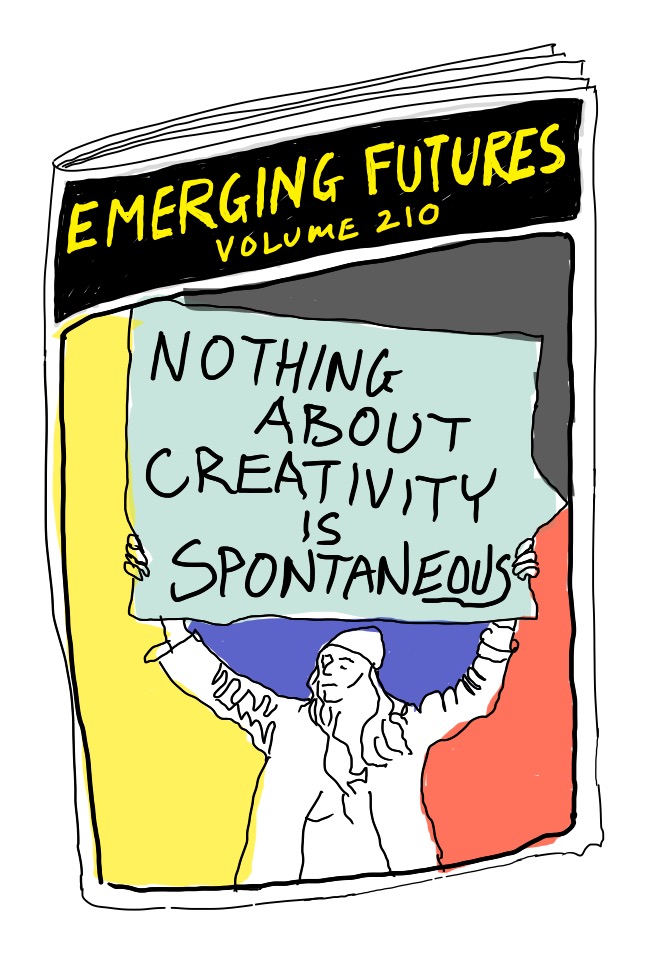
Good morning edges and accelerations of forces and consistencies,
This week, we are back with the second of a longer series of newsletters experimenting with one of the key processes involved in the ways that living beings engage with creative processes: “Blocking.”
Last week, we offered a general introduction to this practice – starting with our creative transformation of Deleuze and Guattari’s own concept of Blocking: “ N minus 1” (or: “N-1”). Which we dug into and developed in our previous series on their book A Thousand Plateaus – Volumes 206, 207, 208).
We ended the newsletter with a simple version of this process that focused on experimental making and iteration involved in this process (a big thanks to those who shared their experiments with us):
The Blocking Process (the simple version):
“Block These”
Isn’t the fourth step wonderful: “Block these”.
Two words. That’s it. Just “block these”.
But what does this really mean – what exactly are we blocking?
And why, of all the possible things we could do to begin a creative process, do we want to start with a negative and subtractive process?
These are two critical questions – let's tackle them in reverse order: What blocking is and why we do it is not entirely obvious or consistent with most of the advice out there about how to begin a creative process. In fact, this approach is quite a counterintuitive approach to developing a creative practice because it begins by subtracting or removing something.
Traditionally, most creative approaches begin in an additive and expansive fashion: The now ubiquitous Double Diamond approach starts with exploring an issue in a wide and deep manner. Other classical approaches begin with Brain Storms and Brain Dumps – getting lots of options on the table. And the much hyped approach of Design Thinking begins with expansive practices of Empathizing and Exploring. Even looking at other more tangential practices to creativity, like the wonderfully comforting Cynefin Framework, nowhere in their charmingly curt list of “probe-sense-respond” or “sense-analysis-respond” etc., do we find any key role for the negative.
And all of this makes intuitive sense – after all, if we are trying to do something new and different, it feels like we need to get expansive early on – to explore and add new ideas, tools, and concepts to the mix. This is reflected in the arguments made for these approaches: we should begin by gaining a broader perspective (divergent thinking), empathizing and understanding, and then we can converge on a solution (convergent thinking).
But, all these approaches begin from a set of unexamined beliefs – that we (1) start from a neutral place, (2) act without bias, and (3) can move freely to wherever our spontaneously arising ideas take us. But these assumptions constitute a problematic illusion that stops creative processes from even beginning.
The first challenge to any creative approach is not to come up with a new idea, but to understand and break free from the vast sedimented morass of self-reinforcing, existing tacit assumptions, enacted clichés, embodied habits, and invisible environments that form a powerful, self-reinforcing cycle of sameness. And this is no easy task.
If we explore, brainstorm, empathize, probe, sense, or act with the same logic we have always used while using the same tools, networks, environments, habits, and subjectivities – how could we expect anything qualitatively new or different to emerge?
Because of this, the logic of the Double Diamond, Design Thinking, and all of the wonderful brainstorming and idea pitching exercises only lead us back into narrow variations of the known (change-in-degree). As Samuel Beckett reminds us, reflecting on the achievements and limits of this logic:
“Habit is the ballast that chains a dog to his vomit. Breathing is habit. Life is habit. Or rather life is a succession of habits…”
If we don’t begin in a neutral place in a neutral system with the freedom to go in any direction, where do we actually begin?
Deleuze talks wonderfully at length about this problem in his writings on painting.
“Where does a painter actually begin a painting?” For Deleuze, the painter never begins by confronting a blank canvas. While nothing is literally on the canvas at the beginning it is always already virtually overloaded with the historically deep sedimentation of habits: Histories of practices that are streaming into the studio via embodied learnings, the shape of tools, the concepts, techniques and debates of art, the shape and logic of a canvas, – and even the shape and form of the studio itself. These forces are already moving the artist as well as moving through the artist – and making the artist – long before she makes her first mark (On Painting: Courses March-June 1981, Gilles Deleuze).
The problem of creativity is never one of how to make something from nothing, but how to work one's way out of sedimented systems long enough to experimentally invent and co-emerge with new, different processes.
So what to do?
“Explore?”
“Brainstorm?”
“Experiment?”
“Act?”
Without ever challenging the given – and especially the givens that make up the self and its sensibilities our great experiments will give rise to nothing other than variations of the given.
To initiate a genuinely qualitatively creative process, we need to invent a way to begin by actively finding ways to creatively say “No.” We start by developing a process of Blocking.
Now, all of us say “No!” all the time – and we say it in profoundly important ways: no to social media, no to plastics, preservatives, and pesticides, no to working on weekends, no to the loss of free speech, no to a loss of rights, no to hate, no to genocide.
These ethical responses to what is intolerable are all critical practices. And while there are essential connections between the ethics of saying no to the intolerable and the no of creative blocking, it is important to recognize that the No of creative blocking is different from the No of the intolerable.
While the ethics of saying no to the intolerable needs no other reason or purpose beyond that it is unacceptable to us. The goal of the No of blocking in a creative process is to open up a radical field of unknowable emergent potentiality (and as such might even involve blocking things we like or find to be good).
The formula “N minus One” is a very helpful beginning to understand blocking and the no of creativity. Let’s again take a close look – one word at a time – of this equation from Deleuze and Guattari – but this time with more detail:
Thus, the basic activity of N-1 is Blocking – the disconnecting and removing of things from structures that bind them to a very limited range of possible effects – with the goal of creating new and different effects, things, and practices.
Let us remember that this is NOT a static activity. Once we remove this overcoding, a wild rhizomatic world of horizontal possibilities begins to shift, oscillate, find new rhythms, and multiply:
and? and? and?
But – let's not get ahead of ourselves, what exactly is being removed or blocked? Where and what is this “over-coding”?
The answer to this question will make little sense in the abstract, so let's get concrete with an example:
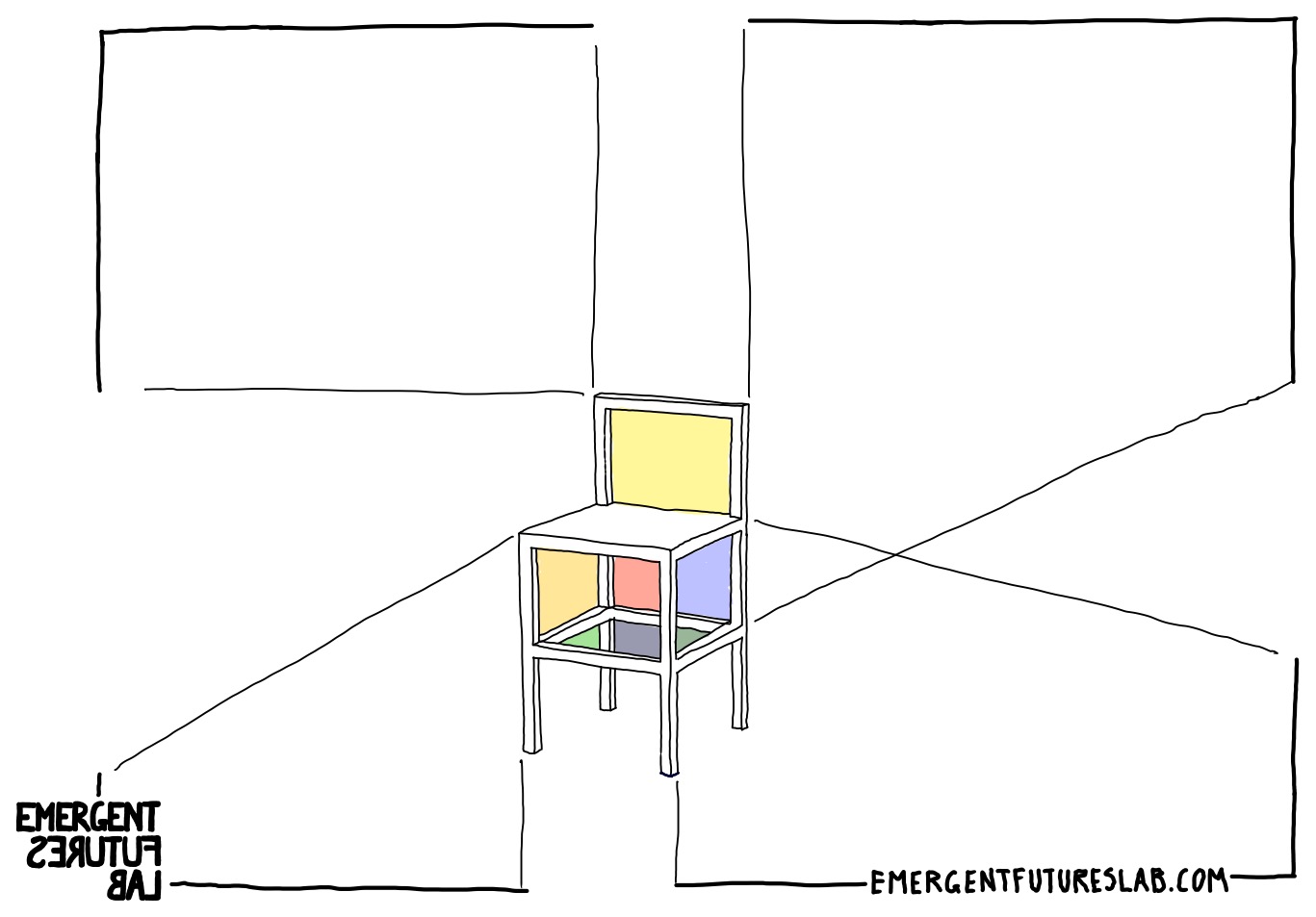
We will continue with last week's example of the chair.
What constitutes a chair's identity, purpose, and meaning?
A simple answer to this would be:
“A chair is a tool to support one person sitting, which generally has legs, a seat, and a back”. Now, let’s call this identity + purpose + meaning of the chair, for the sake of simplicity, “sitting.”
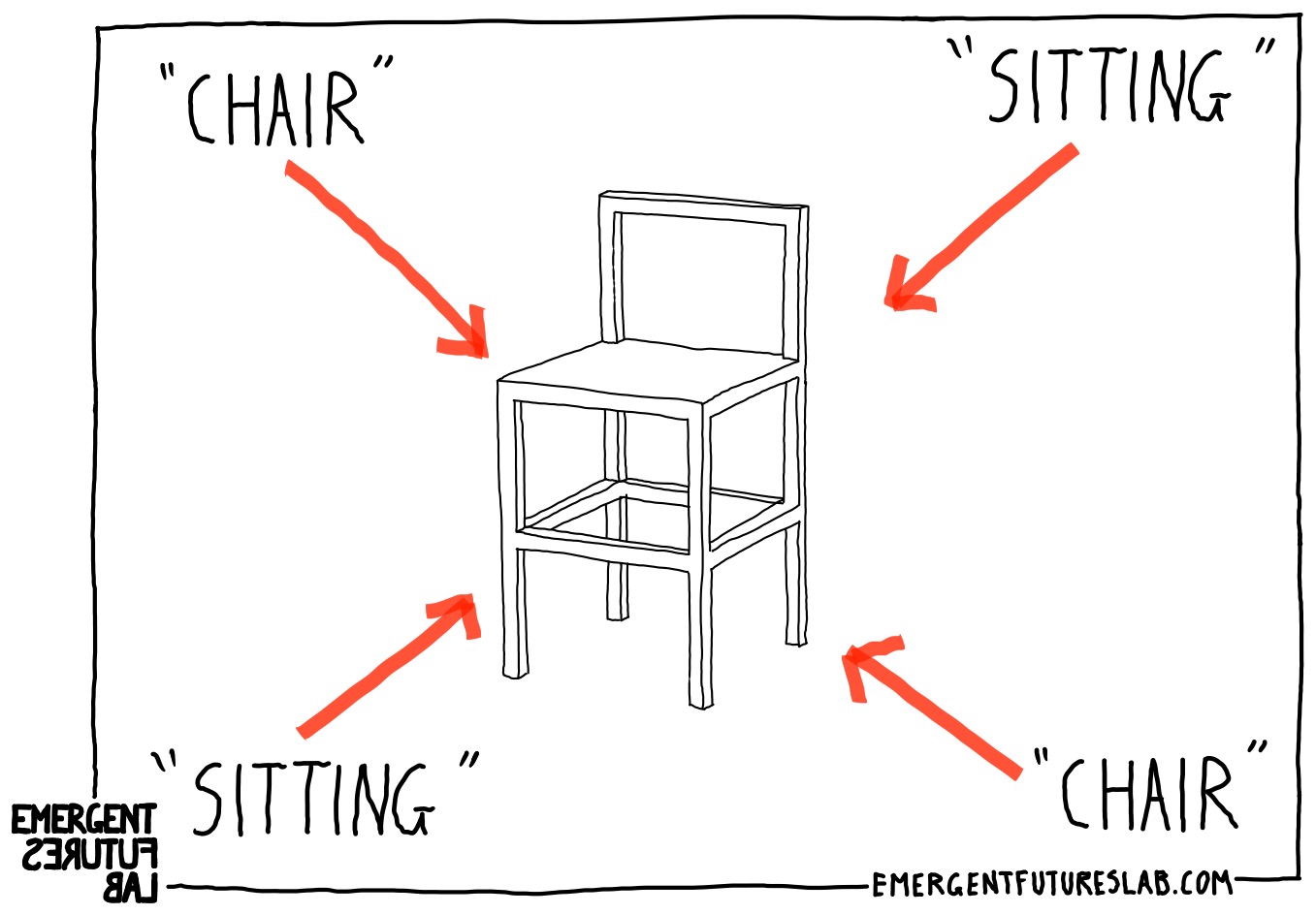
Now, let’s explore what it would mean to block this form of sitting.
To answer this, we first need to engage and disclose: what is this form of sitting?
But to do this well, we need to make a short detour into two helpful terms: Effects and Affordances:
The Sitting Effect: Sitting is an “effect” that the chair participates in realizing. Why call sitting an “effect” – why not just call it a type of activity?
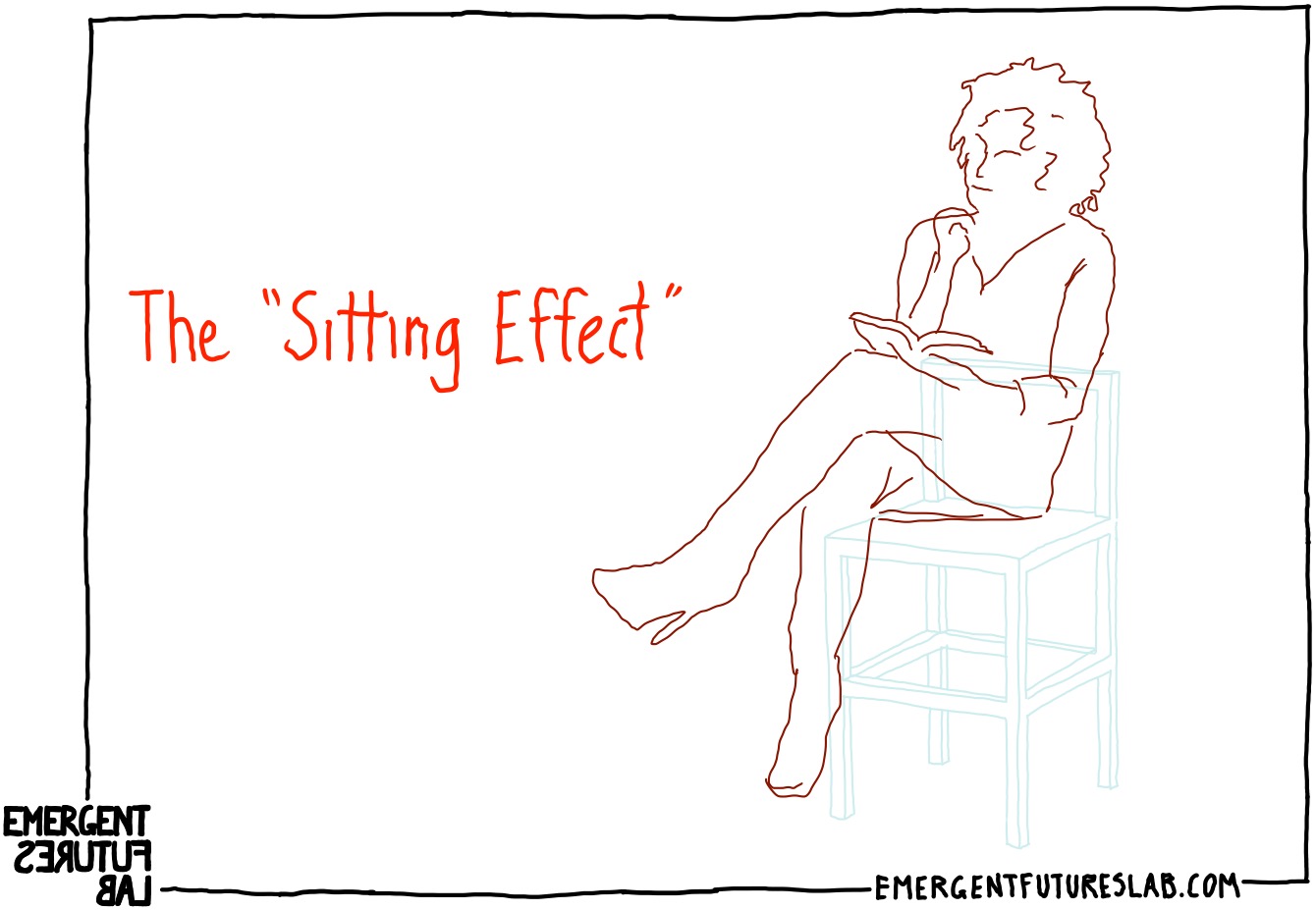
When we term sitting an activity, it becomes something natural that the person just does, and we lose sight of the role of the chair and much else in making this form of sitting emerge as a possibility. To call it an effect is to highlight the relational nature of sitting.
And this gives us our first clue into what blocking will involve: it will involve disclosing and blocking relations.
But the type of effect of “sitting” is quite different from the effect of a wave crashing on a beach – sitting, after all, involves a subject with agency and autonomy…?
Yes. We need to inquire into the exact kind of effect that is happening here with a system in which there are autonomous, independent agents (a living system). Here, the type of effect is best understood as an “affordance”.
While a wave hitting a beach has the effects of making ever finer sand, beach erosion, and the cycling of micro nutrients, the chair in the proper context with the right agent “affords” certain specific possibilities for action: sitting, leaning back, hunching forward, elevating off the ground, etc. It affords a type of sitting that relieves our leg and back muscles from working so hard to keep us upright and still…
Thus, blocking in the human context is about blocking specific affordances (e.g., certain relational possibilities for action) that have become conflated with the meaning, purpose, and identity of something or some event.
In the case of the chair, we are blocking the affordance of a unique form of “sitting”.
But the generality of this answer brings us to the real issue we want to focus on this week:
Where and what exactly are we blocking in a creative process? – If we cannot accurately answer these questions, blocking can never be anything more concrete than a vague aspiration.
Let’s get back to our case study: Where and what is this “sitting” we wish to block?
1. The Body-Chair:
Is sitting in the chair itself?
No – this effect only holds if the right kind and size of body comes into relation with it. The height and position of the seat correspond to the height of our lower legs and the bending direction of our knees.
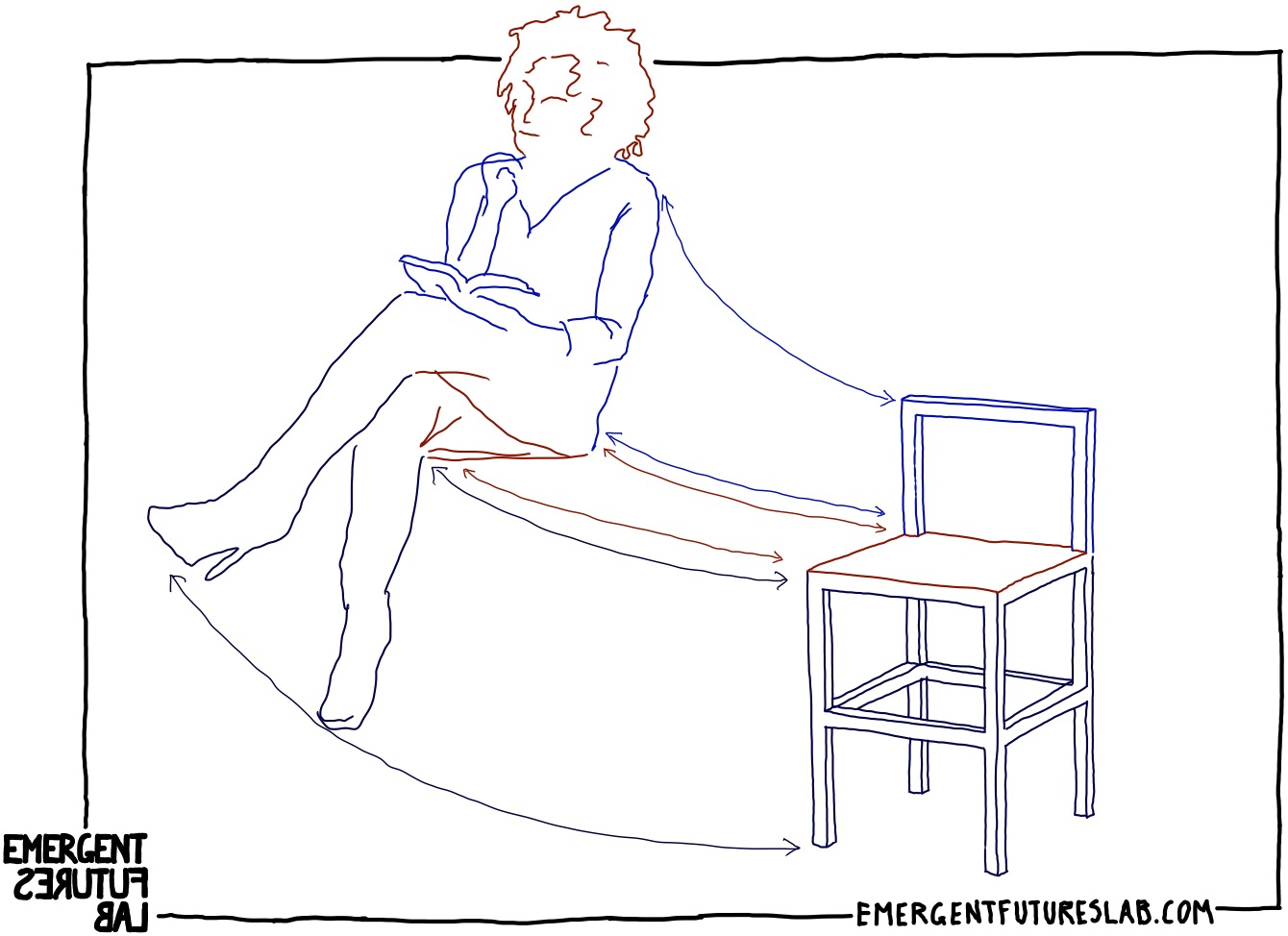
The strength and direction of the chair legs correspond to our weight and the forces our bodies can exert. The overall weight and height of the chair correspond to the length, location, and strength of our arms.
In blocking sitting, we potentially block – or at least challenge a certain correspondence between chair parts and body parts.
A POTENTIAL BLOCK: Stop making sitting systems that directly correspond to the body.
2.The En-chaired body:
And just having a certain body is not enough – it requires many, many years of training that starts at birth to develop the bones, muscles, and physical co-ordination to both effectively use and become comfortable with a chair. We are not born ready for chairs – we become “chairable” over time and with great, mainly invisible effort.
In blocking sitting, we are potentially blocking – or at the very least challenging a specific physiology.
A POTENTIAL BLOCK: Stop allowing sitting to rely on a static and stiff back and legs.
3. The Discipline of the Chair:
The art of sitting in chairs is the focus of intense regimes of behavioral shaping. No one just sits up straight, and no one just sits still – these take serious social investments of intensive disciplinary techniques. The outcome of which is equally loaded with intense meanings and deep embodied affective sensibilities.

Class, geography, and history can be read directly from how one sits. These distinct signatures are everywhere and everywhere denote the complex, enmeshed practices of producing complex affordances that are always more than just material.
Thus, to block “sitting” is to potentially take on and refuse a lifetime of profoundly embodied ways of moving, sitting, gesturing, and feeling.
A POTENTIAL BLOCK: Block all styles of “proper” sitting
4. The Dematerializations of the Chair:
But – we cannot stop here: If the chair stabilizes, constrains, and even replaces parts of the body (primarily the lower body, but even the torso) – what parts of the body does it free up to move and why?
Chairs turn us into frozen bodies with mobile heads and arms. We have a catetonic body and an activated head – a logic that (re)produces the historical cultural dichotomies of mind vs body, active vs passive, and immaterial vs material.

The chair assemblage is a simple machine for separating mind from body and for the joining of a disembodied sight and speech to symbol-making (writing, typing, drawing, etc.).
In blocking sitting, we are potentially blocking – or at the very least challenging a particular set of processes to make/reinforce a specific set of binary operations centering on mind vs body.
A POTENTIAL BLOCK: Block systems of sitting that pacify half the body and activate the other half.
5. The Levitations of the Chair:
The chair does not show up alone as an object to meet our bodies – it comes along with a complex assortment of surfaces and surface mediators. Chairs, it turns out, actually work on a minimal set of surfaces – outside where the ground is damp, sandy, rocky, and uneven – i.e., most of our natural environment – is unsuited to chairs and their styles of sitting. Outside with a chair, we are forever off balance, sinking, rolling, and tipping. Then, inside, a soft wooden floor will be quickly dented and marked. In fact, pretty much any floor will be quickly marked. So we need a vast array of sophisticated mediators in between ground and chair – hard floors of all kinds, carpets, mats, and a wide range of chair leg protectors for floors.
This brings up the next affordance– the chair affords us a way of being off the ground. Why is sitting raised off the ground by the chair? The It does not need to be this way. Sitting effects could quite easily happen with direct contact with the ground.
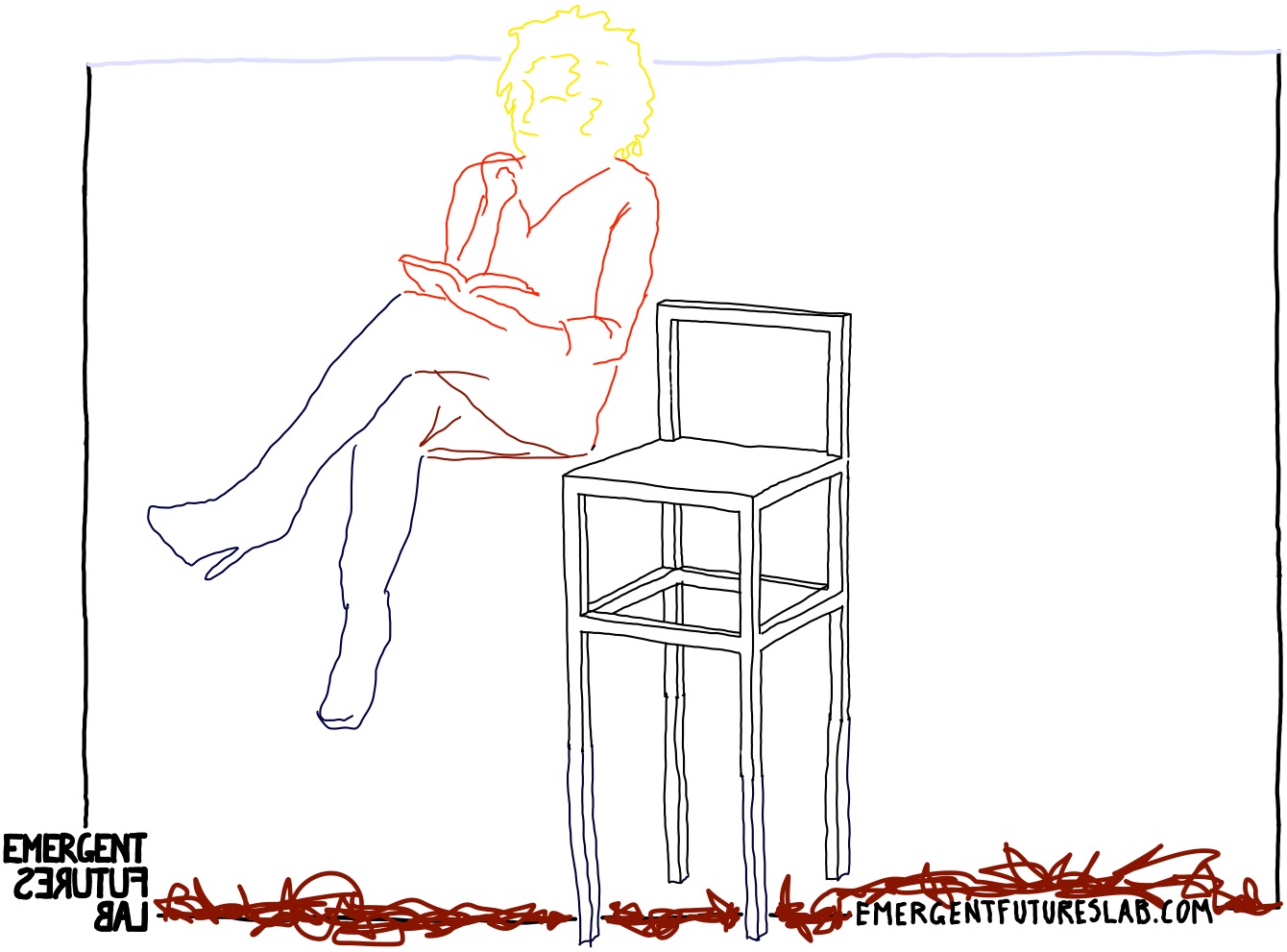
The chair is (re)producing another set of dicotomies – the clean and the dirty, the low and the high, refined culture and brute nature. The chair elevates and removes us from the vagaries of the ground.
In blocking sitting, we are potentially blocking – or at the very least challenging a certain set of processes to make/reinforce our separateness and distinctness from the world.
A POTENTIAL BLOCK: Block forms of sitting that separate the body from the ground plane.
6. The Loneliness of a Chair:
The big mystery of the chair is why not a bench?
Why the equation one body = one sitting system?
The chair is the great mundane machine of individualism. And the thousand-dollar office chair is the incredible active fetish of radical individualized disembodiment. It rolls, swivels, tilts, raises you to a custom individualized arch of freedom — I will go, do, and be wherever without having to feel any connection. Everything is at your app's fingertips to enact your modern hyper-individualistic subjectivity.
In blocking sitting, we are potentially blocking – or at the very least challenging a particular set of processes to make/reinforce an individualism.
A POTENTIAL BLOCK: Refuse to make sitting systems that separate bodies in units of one.
Here, with the disclosure of these seven affordance complexes, we can see an outline of an ecological network. The chair and the related regimes of sitting form an embodying and territorializing network ,giving rise to a world and a worldview.
To which the practice of blocking responds via Deterritorialization. It strives to strategically rupture some or all of these territory-making – world-making relations.
“Block This”
We are moving bodies, things, and even affordances out of a territory and back into a space of open becoming. But how far do we need to go?
Do we need to block everything? Or would blocking something be less work?
These are questions for next week. We are going slow to go well.
This week, we can be satisfied that we can sense an answer to the question, “what does it mean to say block identity, purpose, and meaning of some thing (such as a chair)?”
The answer will involve blocking physical aspects of the form of the chair – formal qualities of height, width, and stability. But it will not be limited to that – it will ask us to reconsider our muscles, bones, and physiology. And what we have to desire and what we have come to be repulsed by. It will ask us to consider refusing techniques of social forming, specific environments, and many habits.
The active work of disclosure that is central to the processes of blocking always discloses a vast but specific network – a dynamic territory and territorializing system.
Creativity begins not in the spontaneous but ultimately highly overcoded and co-created gestures of an illusory “free” exploration, “free” action, and “natural” curiosity. Rather, it begins in the middle of a vast territory of habits with the willingness to experimentally engage with an active process of disclosure so as to produce a productive negativity of blocking and deterritorialization.
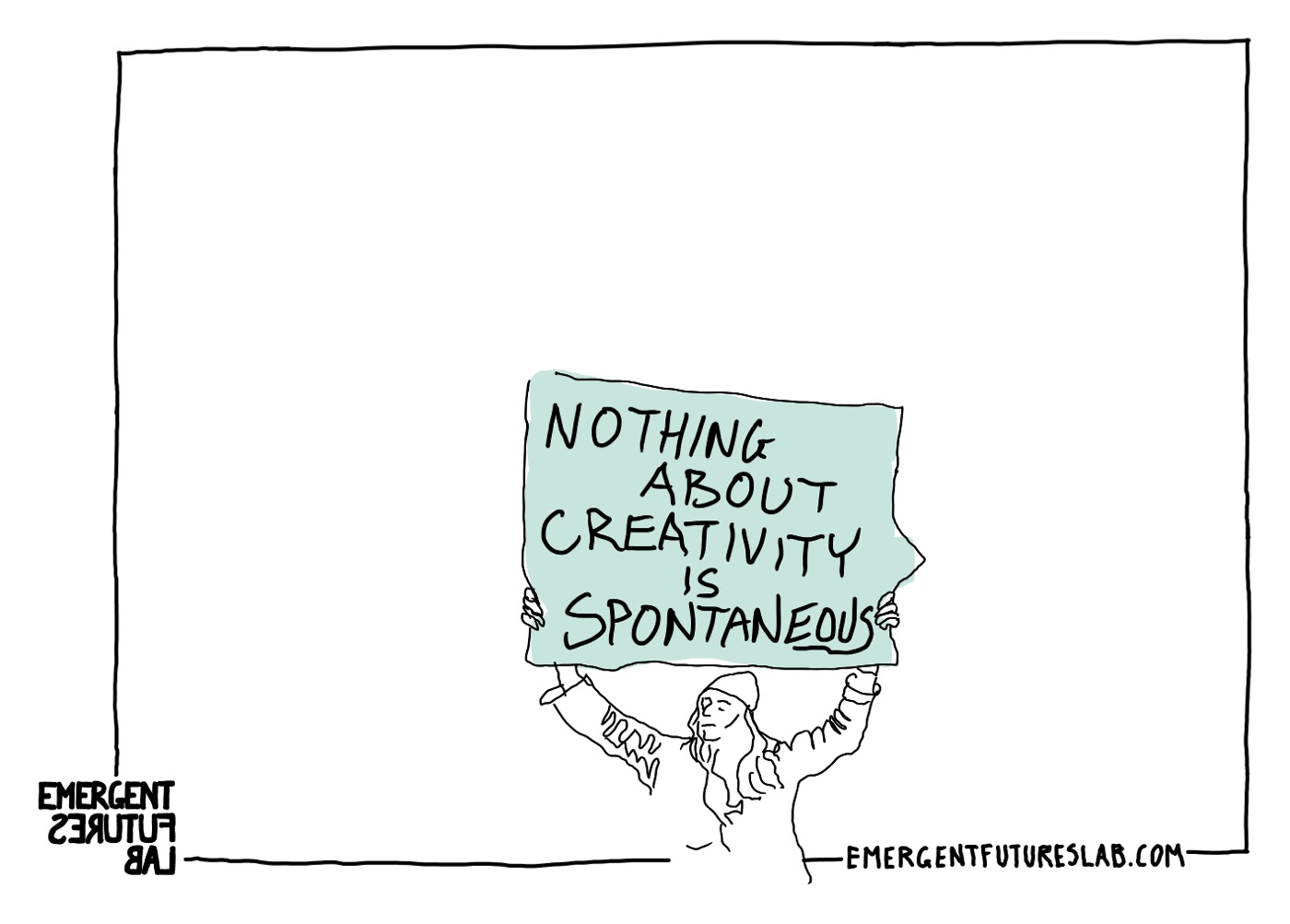
In short, be skeptical of any creative process that does not begin with a creative no. Something has to stop so something else can begin. And it will take some creative and experimental effort to figure out what must be blocked.
That is it for this week – for next week, try playing with these blockings of chair-sitting and let us know what emerges.
Keep Your Difference Alive!
Jason, Andrew, and Iain
Emergent Futures Lab
+++
P.S.: Loving this content? Desiring more? Apply to become a member of our online community → WorldMakers.


