Newsletter
Resources
Courses
Books

Welcome to Emerging Futures -- Volume 211! Creative Blocking is Configurational...
Good Morning becomings of a season feeding forward into us,
Monday marked the fall equinox, hurricanes are far offshore as we write and interact in ways that are very interesting from a dynamic systems perspective. Much is afoot on all fronts (we are big supporters of Medicin san Frontiers – if you can participate or donate, we would suggest it).
Over the last two weeks, we have been going deep and wide into the powerful creative processes of “Blocking.”
At its simplest blocking emerges from the realization that as we said last week: “The first challenge to any creative approach is not to come up with a new idea, but to understand and break free from the vast sedimented morass of self-reinforcing, existing tacit assumptions, enacted clichés, embodied habits, and invisible environments that form a powerful, self-reinforcing cycle of sameness…. If we explore, brainstorm, empathize, probe, sense, or act with the same logic we have always used while using the same tools, networks, environments, habits, and subjectivities – how could we expect anything qualitatively new or different to emerge?” (Volume 210).
One of the dangers in thinking about and applying Blocking is that it can be easily conceived of as a solitary act – “just block something – and we will be creative”. It is not a solitary act but a set of connected processes.
Nothing about creativity is ever a “one and done process. And this is undoubtedly true of blocking.
From a logical perspective, the most obvious of these connected processes are the processes of engagement and disclosure:
Disclosure: You cannot block anything if you have not slowed down long enough to figure out what needs to be blocked. Disclosure is the careful multi-scalar analytical practices of revealing the vast sedimentation of existing practices, concepts, tools, and environments that are giving rise to the current spaces of possibility. Disclosure is the act of taking the time to thoroughly understand what they are and how they work, as an integrated, relational, and emergent logic.
Engagement: You cannot sense these emergent logics without fully engaging with the “effects” yourself. These emergent logics are not things you just organically see – this takes a very active practice of skillful probing such that the system responds in ways that reveal these mainly invisible (until perturbated) patterns and logics.
Thus, there are always two critical processes involved in blocking (1) a highly immersive Engagement and (2) a multi-modal and multi-scalar Disclosure.
Two weeks ago in Volume 209, we outlined the processes of blocking in a very simple, rough, and ready form as seven cyclical steps (see below). The first three steps can be considered processes of Engagement and Disclosure:
The Blocking Process (the simple version):
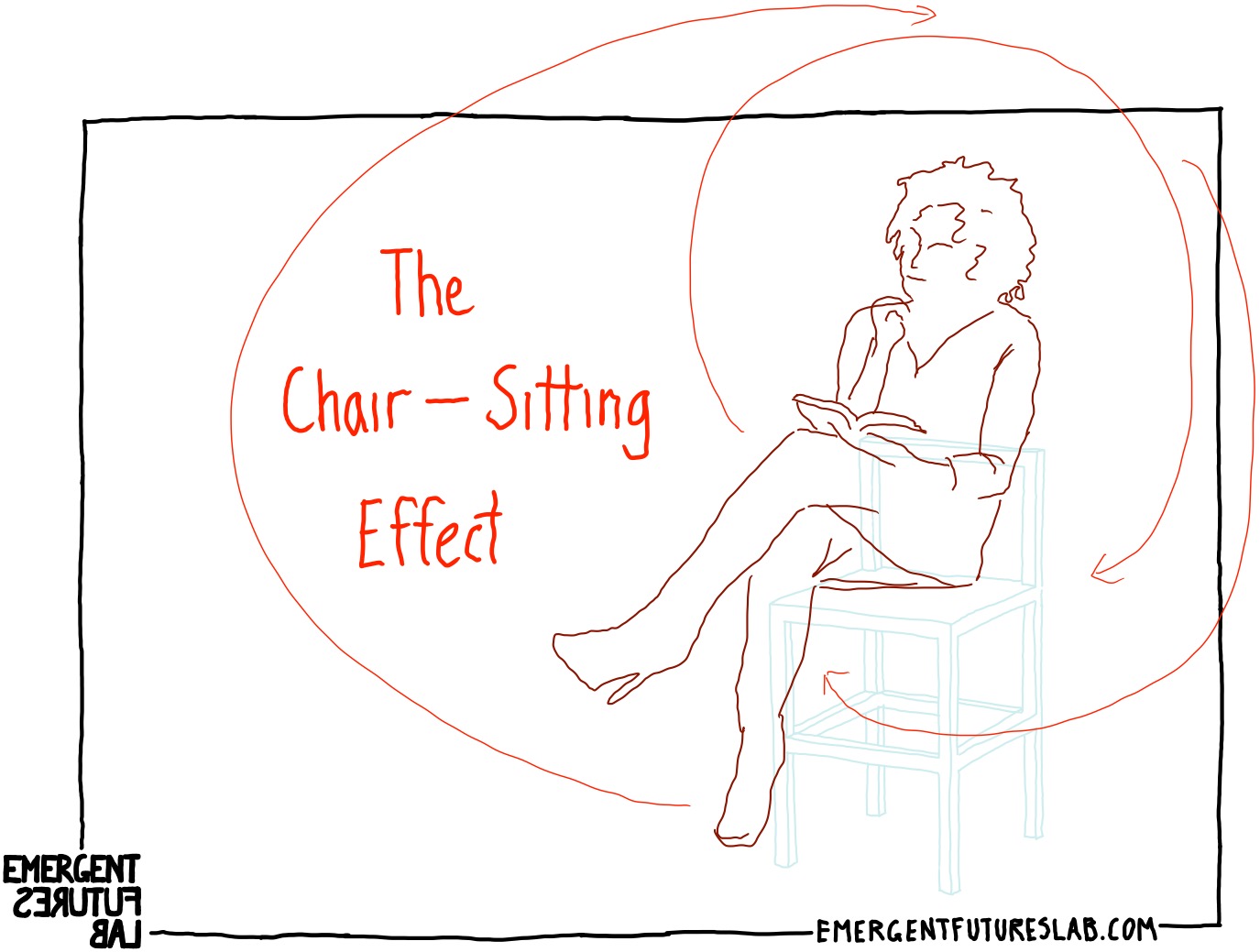
To make things more concrete in this series on Blocking, we have been using the seemingly ubiquitous chair and the integrated logic of the “chair-sitting effect” as an example to investigate the processes related to the practices of blocking. Let's continue this.
If the first danger of using blocking processes is to mistakenly understand them as a solitary act, the second danger is to view blocking as focused on a single, material aspect of something (the material fetish problem).
For example, we could just focus on the matter and form of the chair itself and block some material aspect of chairs, such as having a back or being made of stiff materials.
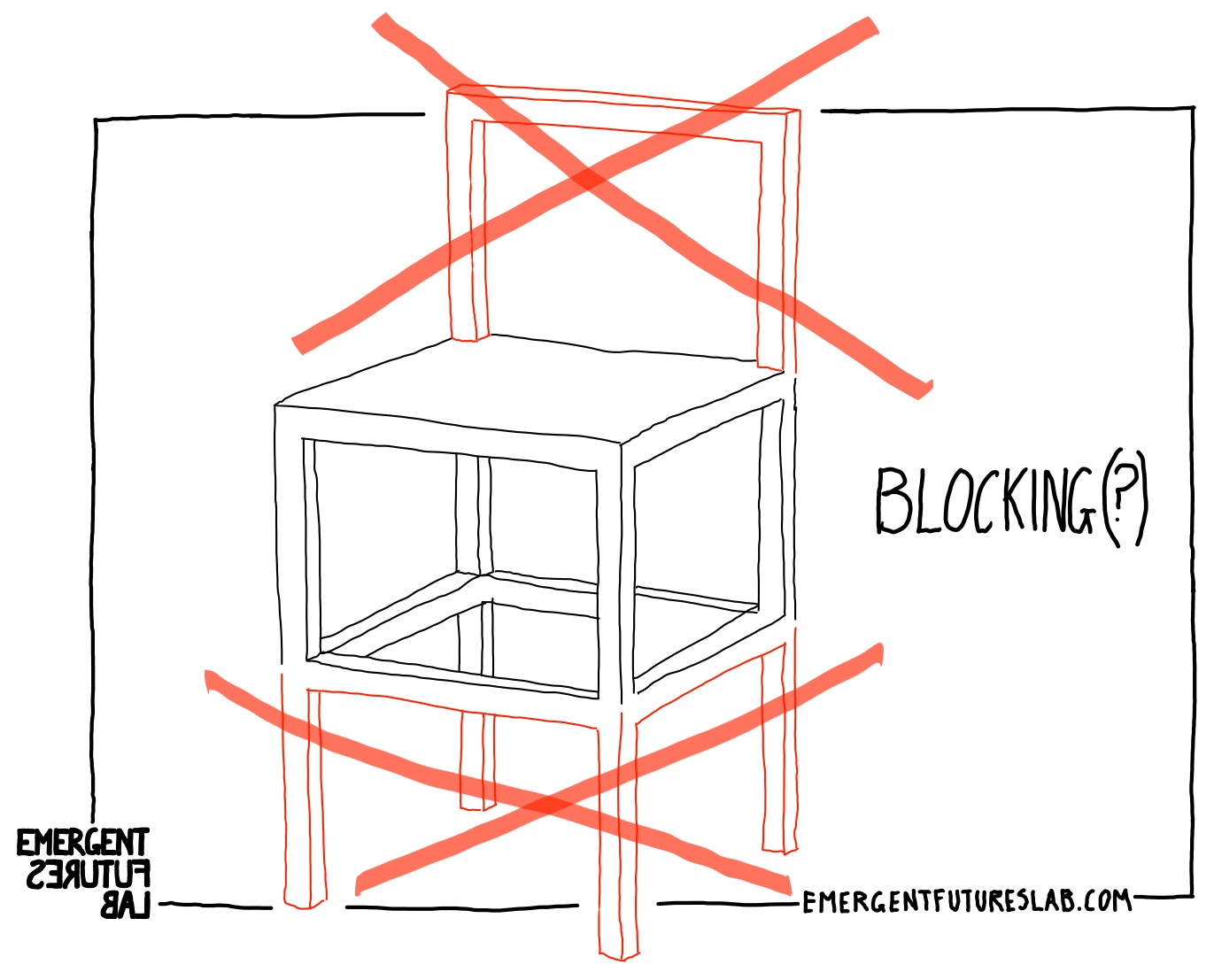
Now – don’t get us wrong – this could potentially lead to very interesting outcomes. But in focusing exclusively on material properties, we would be missing how the chair gains its identity, function, and purpose by being part of a specific integrated relational configuration of agents, practices, materialities, and environment:
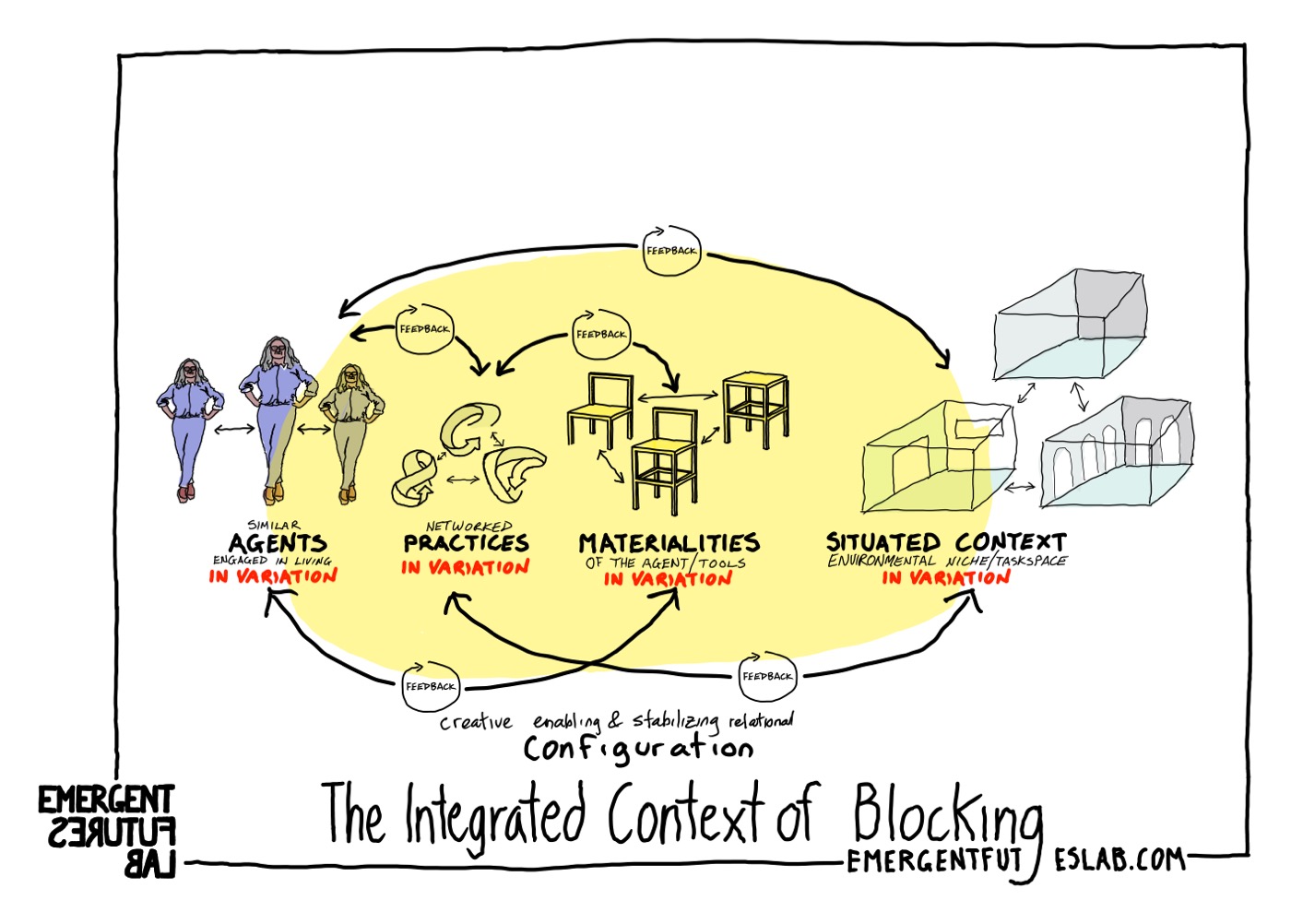
Stressing the importance of relational configuration is not about being overly pedantic and obsessing about getting things theoretically correct. There are two key issues:
The first danger with exclusively focusing on a specific material blocking without considering the larger and more abstract logics of identity, tacit meaning, and purpose is that once these (identity, meaning, and purpose) emerge and stabilize, they are inherently multiply realizable.
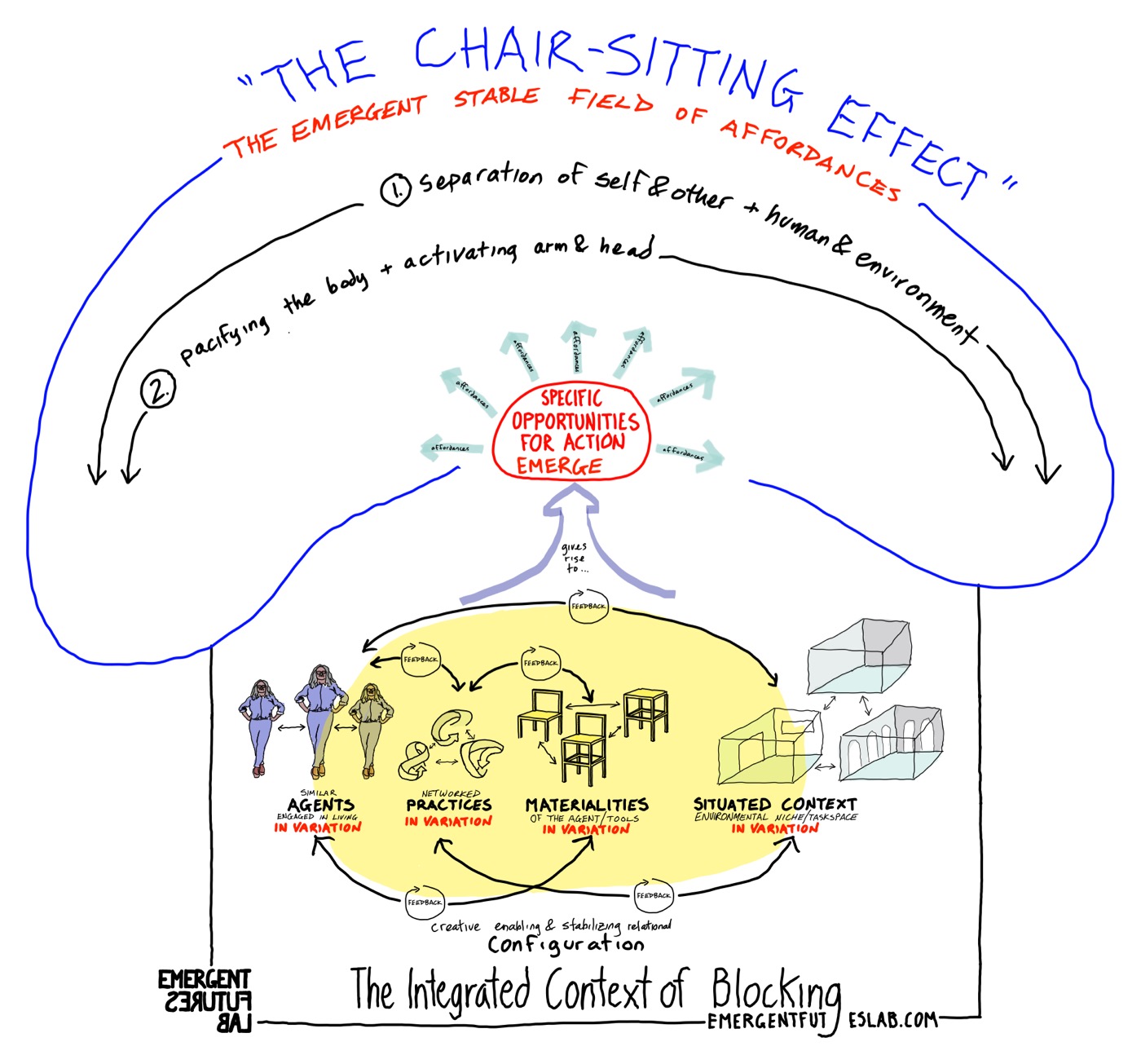
For example, last week we disclosed that the expanded emergent identity, purpose, and meaning of a chair coalesce around the two poles of (1) practices of pacifying the body while activating arms and head (a specific type of mind-body divide), and (2) practices of separation of self and others and self and environment.
These effects are not in the chair itself but an outcome of the configuration. And if we just change or block an aspect of the physical chair, the effects can still emerge via other means. To take an extreme example from biological evolution, the “flying effect” can be realized by the relational logics of small spiders casting out long threads of silk, squirrels stretching their underarm skin, birds developing feathered arms, or dandelions developing a parasol-like seed fluff…
The inherently open multiply realizable logic of emergent affordances (potential for specific actions) is one of the most astonishing aspects of effects in relation to creative practices. And this is something we will cover in greater detail next week when we focus on blocking and evolution. For now, what matters is that we begin to see the profound importance of disclosing the relational and configurational logic of all things.
If the multiple realizability problem awakens us to the importance of not fetishizing things but instead focusing on relational configurations, the key reason why this is important is that these integrated components give rise to an emergent pattern of possible practices (affordances).
Lets unpack and explore this: as we noted above – what we are calling the “chair-sitting effect” is an emergent set of possible actions (affordances) that coalesce around (1) practices of pacifying the body while activating arms and head (a specific type of mind-body divide), and (2) practices of separation of self and others and self and environment – which emerge once a relational configuration stabilizes:
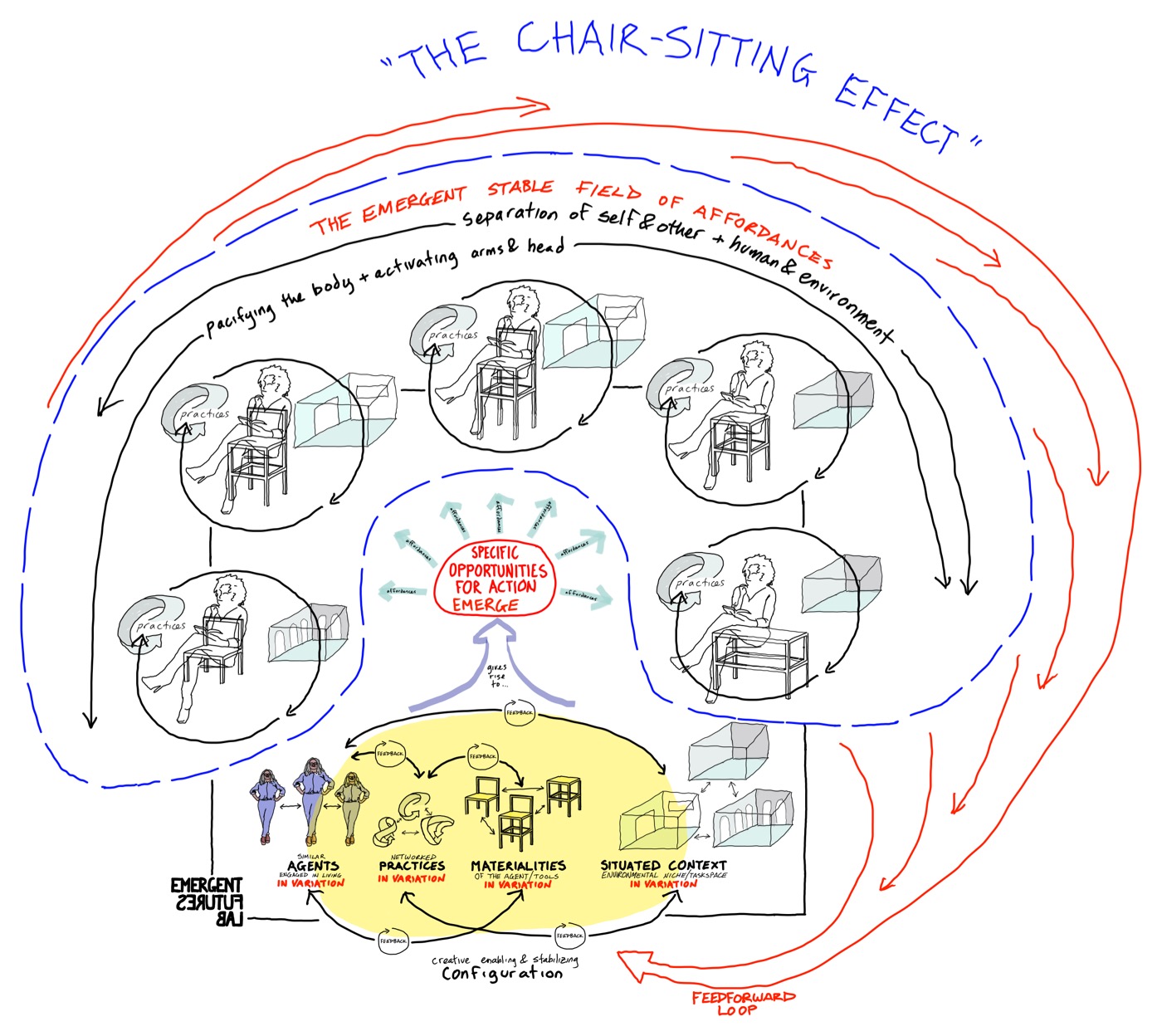
And in pragmatic terms, each realization of a potential of action within this stable space of possibility is done via the experimental but circumscribed varying of the configuration:
And ultimately, it is these emergent and relational possibilities for action of the “chair sitting effect” that we wish to block.
Thus, blocking is always a configurational blocking focused on blocking a distinct set of affordances (opportunities for action)-- and the world they co-create via feedforward loopings.
But there is more to say here. The configuration (of diverse agents, practices, tools, and environments interacting) gains autonomy and creative agency as a pattern of specific affordances stabilizes. As practices like sitting in a certain way gain traction, the affordances of the configuration begin to feed forward, changing the components of the configuration without themselves changing. Thus, our bodies come to only really be comfortable sitting with variations of chairs. And the physical tools for sitting come to take on ever more chair-like forms (in all their variations). Practices, habits, rituals, and concepts emerge that also have an autonomy and reinforce the scope of what is sensed and produced. Environments transform to be ever more suited to disembodied and semi-passive logics of chair-sitting effects. An ever-expanding but tighter integration of body, feelings, values, tools, practices, and environments evolves. The cyclical and iterative process drives the processes in certain directions that bias the outcomes.
As this integrated relational system evolves with an ever greater autonomy and agency, we take this constructed emergent logic of affordances to be natural – a given that we build our human creativity on top of – all the while happily unaware of its creative role in shaping us to be the kind of embodied and enactive subjects that can activate and realize this world as the world.
Another far simpler way of saying all of this is:
Once a set of conditions is met, a creative process spontaneously comes into being.
What are the conditions? With our example of the Chair-Sitting Effect, it is: Agents with bodies that flex and bend (People) + Resting Practices (“sitting”) + some form of elevated individualized tools or objects for resting (“Chairs”) + Suitable Environments (rooms of various kinds).
What is the creative process that emerges? A field of possibilities organized around the abstract creative possibilities of: (1) practices of pacifying the body while activating arms and head (a specific type of mind-body divide), and (2) practices of separation of self and others and self and environment.
What is so radical here is that the creative process itself does not need to be invented, developed, refined, and then imposed on anything. Which is to say – no one needs to first invent the idea of mind, and body, and then treat one as active and the other as passive – and from this develop a cultural opposition between mind and body. No. All that needs to be done is to get the right conditions to be in place. And the evolving cyclical feedforward process will do the rest.
Tacit dispositions, mindsets, and ideologies are not things that are developed first abstractly and conceptually and then imposed on bodies, things, and environments, which then could be said to merely “express” them.
In a very real sense, when we imagine that underlying all actions, dispositions, systems, and practices is some mindset, we are radically inverting how we come to have a worldview.
Dispositions, ideologies, mindsets, and worldviews are the emergent outcomes of a set of conditions that give rise to a specific field of creative possibilities for action, that, as they are realized, feeds forward into the initial conditions to transform them into ways that further stabilizes a set of possible actions and our subjective dispositions.
“Once a set of conditions is met, a creative process comes into being.” (Note: the two authors who really explore this and have contributed significantly to our work are Gary Tomlinson and Terrence Deacon.)
As we come to sense this, we realize that so much of the standard approaches to human creative practices are focused on the wrong thing: the outcome (the emergent space of creative possibilities), and not the conditions and the processes of conditioning (the relational configuration).
Creativity is a dance between these two unlikely partners… and we need to participate on both sides.
Deleuze and Guattari, in A Thousand Plateaus, via countless examples from the geological to the biological to the technological, explicate this process, which they term an “Abstract Machine”.
As strange as this term might first sound, it is a really helpful term.
The creativity of emergent possibilities for action is “Abstract” in the sense that they are not a discrete thing of any kind – they are only visible as an abstract process that arises when a certain set of relations holds. Consider: when the specific relations of bodies + chairs + practices + environments holds, a set of possibilities emerges that coalesce around the two poles of (1) activated mind and pacified body and (2) self separated from others and environment.
It is a “Machine” in that when conditions are connected in a stable way, specific outcomes happen reliably (see above). Obviously, our “chair-sitting complex” is not a literal machine in the way a Diesel Engine is a machine – rather, it is machine-like in its operation. It is “machinic”.
What the term machine also gets at that is critical is that it is not an agent-directed process (individual creativity emerges from and surfs these more fundamental machinic processes). The field of affordances happens (emerges) and continues to happen – running along like a machine as long as the preconditions continue to be met (the feedforward loop).
The important thing for engaging with creative processes is to understand that once the right set of conditions is in place, a creative process will be set in motion.
Let’s consider one last and truly fantastic example: Evolution and Natural Selection. The process of “natural selection” is not some “thing” that is imposed upon anything – rather, it is a process that kicks into action spontaneously when a set of conditions is met.
What are these conditions? There are essentially just two. You need the condition of:
Once these two conditions are met, a process spontaneously emerges and kicks into action: some offspring, because of their inherited variations, can take advantage of unique and limited resources to survive and have varied offspring, while others do not. Generation after generation – cycle after cycle of variation in success leads to profound changes in organisms.
Natural selection is not something “extra” that is added to existing things – some special recipe that is imposed upon living beings – rather, it is the processual outcome of the relation between conditions that spontaneously leads to a process of selection and change. And what a truly astonishing field of creative possibilities emerge!
For blocking: we want to understand both the configurational conditions and the specific emergent field of creative potentials for action that they give rise to, such that we can effectively and experimentally strategically block aspects of this so that a qualitatively new field of creative potentials might emerge.
And it is here that we wish to leave you for this week:
Consider in your own daily practices: what are the conditions that give rise to the fields of possibility that you explore when you engage in all of the astonishing and mundane activities of daily life? How can you play with these relational configurations such that qualitatively differing fields of potential action can emerge via strategic blockings?
Have an astonishing and experimental week.
Keep Your Difference Alive!
Jason, Andrew, and Iain
Emergent Futures Lab
+++
P.S.: Loving this content? Desiring more? Apply to become a member of our online community → WorldMakers.


