Newsletter
Resources
Courses
Books

Welcome to Emerging Futures -- Volume 213! Creativity’s Cycles...
Good Morning becomings inflecting multiple intrawoven loops,
It was great to hear from many of you this week, on both how much the critique of “one and done” resonated with your experiences and how helpful this series on the processes involved in the creative practice of blocking is for your own creative practices.
This led to some great conversations in our community of practice (WorldMakers), which in turn is reflected in the creative evolution of key aspects of this week’s newsletter.
What we have found is that almost everyone we have spoken with has been in countless situations where the deep unspoken (and often unrecognized) assumption is that the key aspects of creative processes are simply “one and done.”
A Eureka is expected.
And because of this, we are being all too often asked to participate in doing something “creative” in structures that simply cannot support the conditions for creative becomings.
The frustration with the ubiquity of “one-and-done” is very real.
“These things happened, but not as described.” Lisa Robertson
And the hard part is that for those initiating these processes, everything is working as it should. In our experience, often those who are enacting one-and-done processes will echo our critique of one-and-done approaches as they foster an environment of ideation drives, double diamonds, pitch contests, hackathons, and other implicitly one-and-done approaches.
The challenge is that there is no easy answer in terms of shifting organizational approaches towards how they engage with creative processes. The one-and-done configuration is not going to be solved by another keynote presentation or longer “master-class” session with just the right experts explaining alternatives. After two thousand plus years, these are deeply embodied and embedded practices that entangle with our deep emotional valences and organizational ecologies.
The good news is that there are many pragmatic things that can be done.
For us, despite how dense and theoretical this newsletter is, we never begin any of our in-person work with organizations with dense, knowledge-heavy, and theoretical one-way engagements. The “educational fallacy" (e.g., “if people only knew more – knew the truth – things would be so different”) is part of the magical thinking of the one-and-done logic. Our approach to creative processes is an embodied and enactive one: We need to experience something different in a way that leads us to conceptualize ways that lead us – on our own terms, beyond one-and-done logics.
Part of our early practices of engagement with anyone, or any organization, is to build up the capacities to autonomously move out of one-and-done approaches. At the core of this is developing a capacity to sense and engage with configurations.
Configurations and Conditioning 1.0
The one-and-done approach pivots around the logic that:
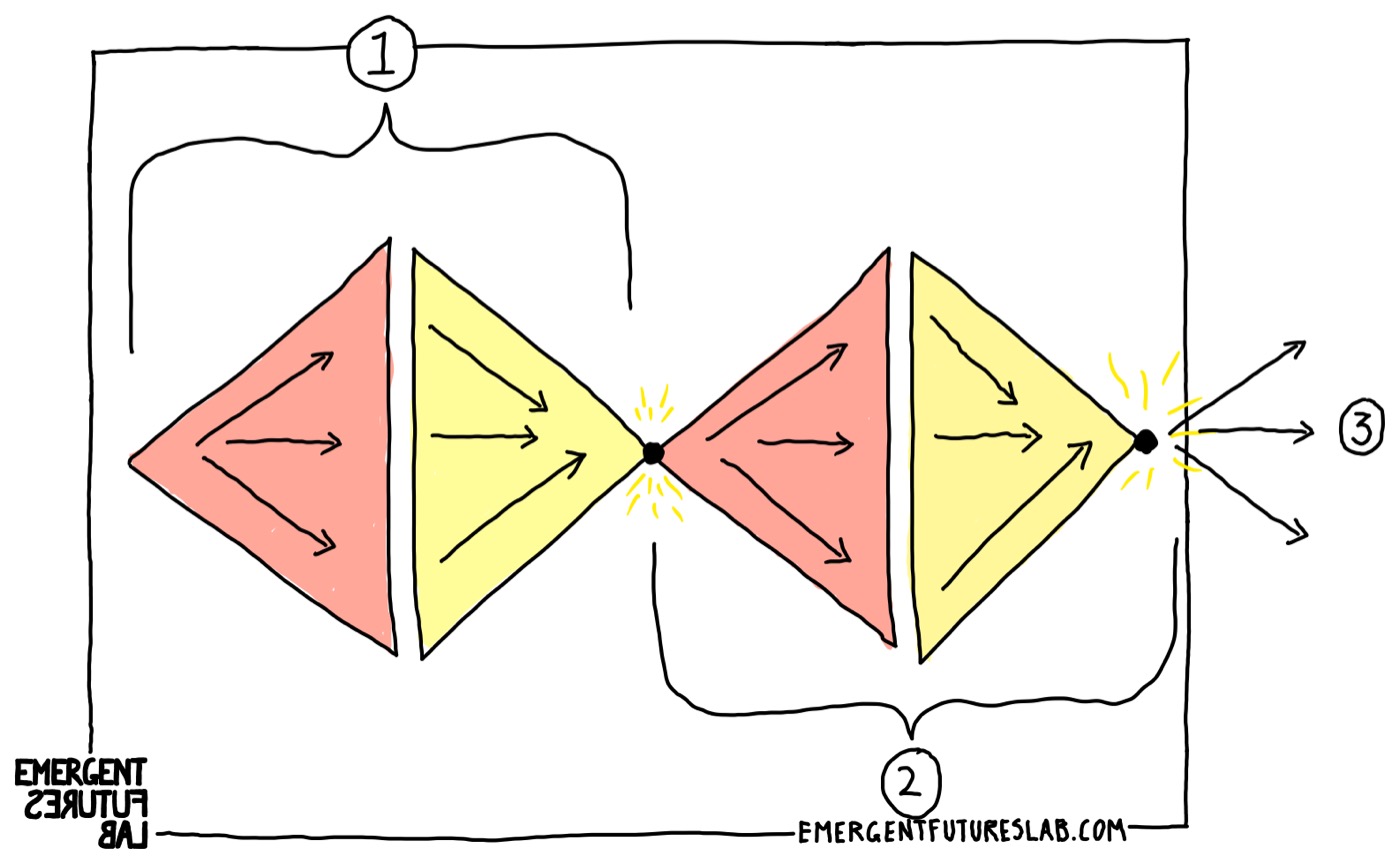
For us, a practical alternative is to pay attention to the specifics of the relational network—the configuration—and what it enables and stabilizes (see below).
Many – if not most of the organizational ecosystems we have come to work in are configured to consistently spontaneously produce opportunities for one-and-done forms of action far more often than other action pathways. And this is the challenge – we have to change the organizational conditions to allow for new fields of possibility to emerge, and this brings us back to questions of blocking.
And this brings us back to the central precondition for doing blocking well: and that is understanding how the possibilities for action are shaped prior to us acting by the conditions:
“Once a set of conditions is met by a configuration, a set of creative affordance-based processes spontaneously begins to come into being via exploratory actions.” (Volume 211, modified)
Last week in Volume 212, we told a simplified story about the processes by which dinosaurs came to have wings and how wings were eventually utilized as part of a way of living that focused on flight:
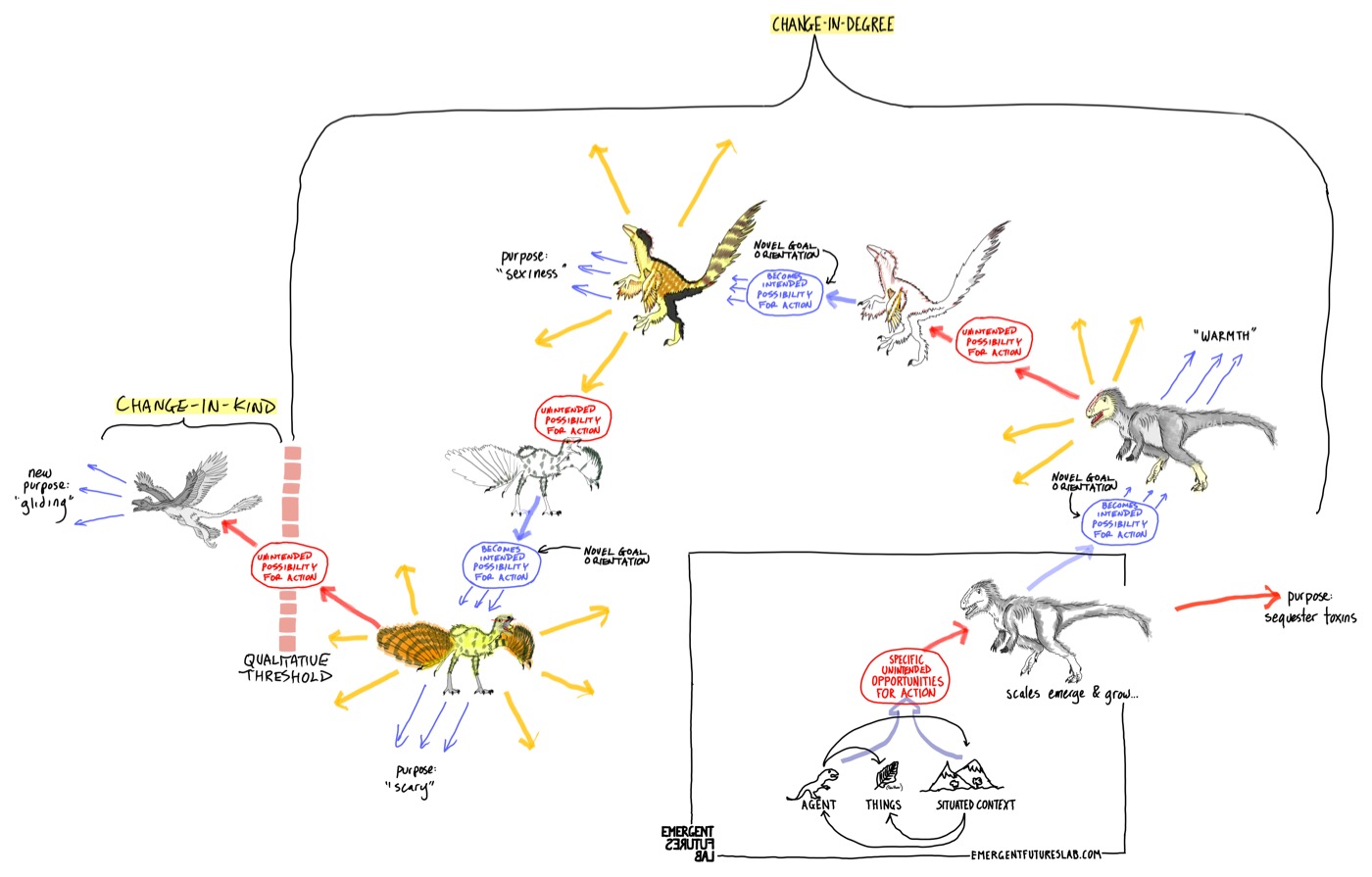
And while it was radically simplified, it was rich enough to help illuminate how such creative processes are never “one and done”. In its twists and turns, it gives us a sense of the radically contingent meandering process of multiple exaptations and stabilizations that is ultimately without end. (NOTE: If you are new to the newsletter this week, what follows will not make sense without reading last week’s newsletter.)
But – while it makes this point effectively – it leaves key aspects of the process underdeveloped and over-stresses other aspects.
This way of telling the story almost fetishizes the feather – as if it alone were the causal agent of creativity in this process. And if taken too far, we are back in the throes of another one-and-done process that fetishizes the object/technology/thing.
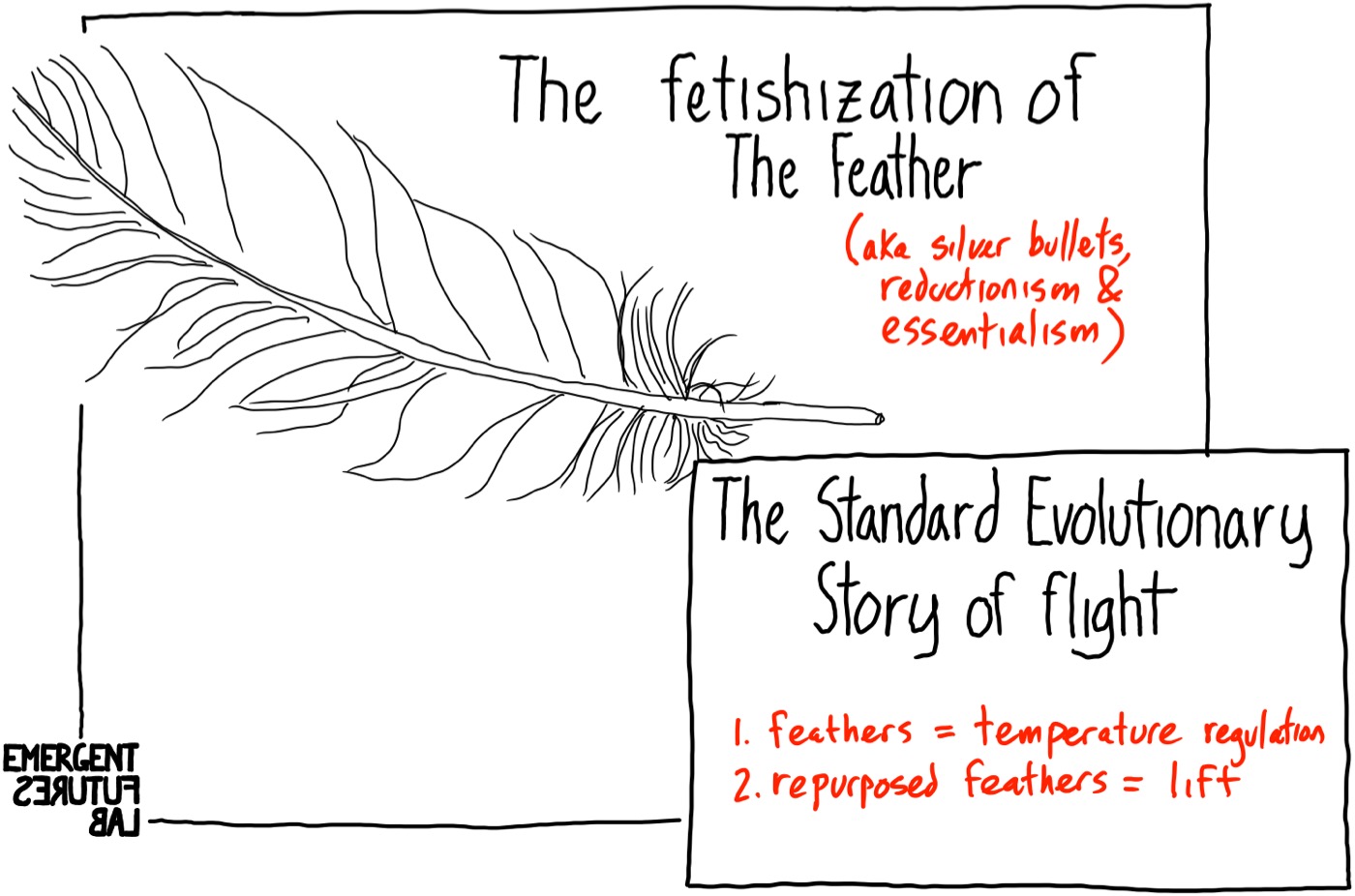
As if the feather alone is the agent of this process. But flight is neither in the feather nor because of the feather.
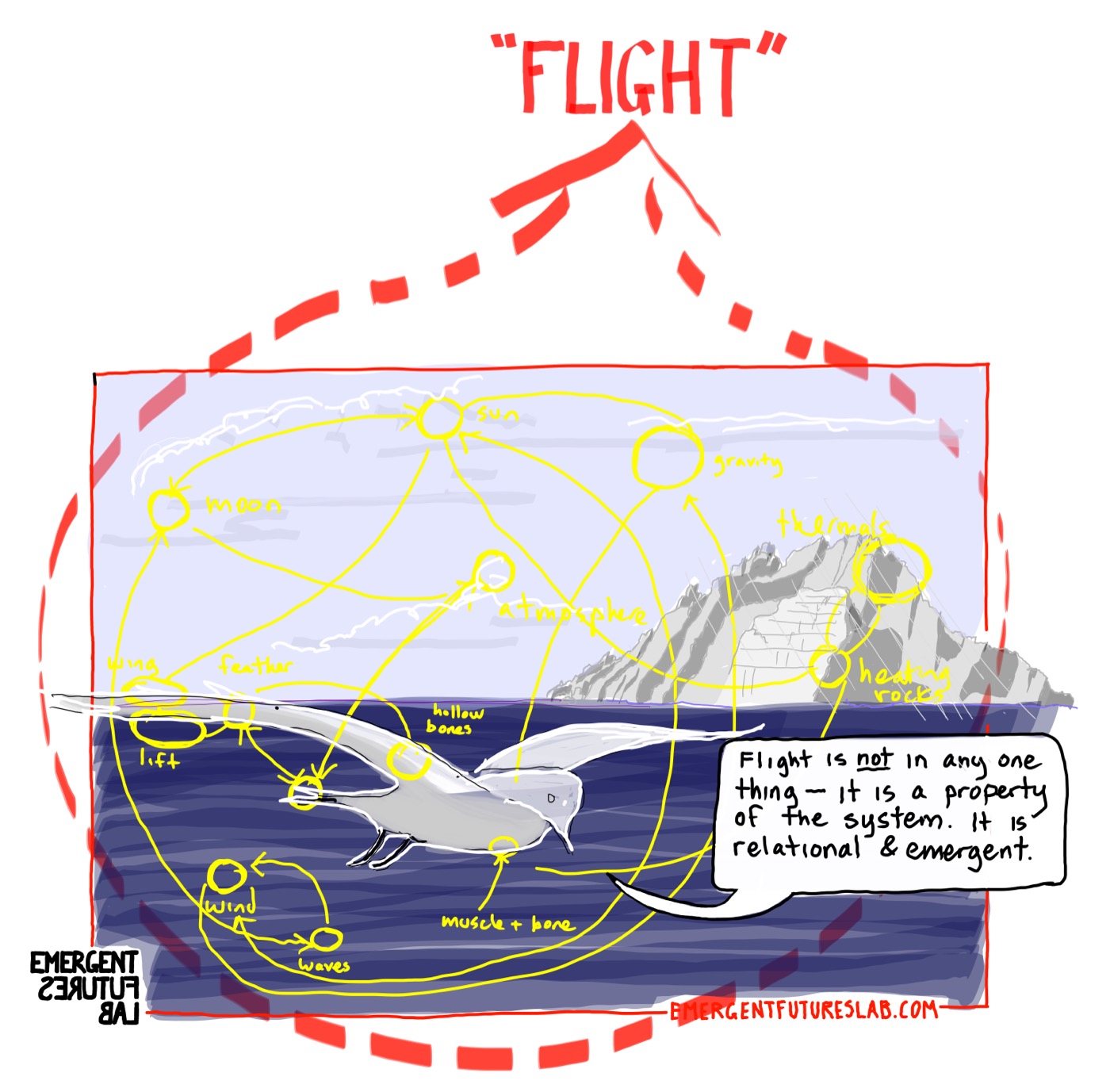
And this brings us back to configurations: Flight is the affordance (the specific emergent opportunity for action) of a configuration (of diverse agents, practices, tools, and environments interacting) that gains autonomy and creative agency via a cyclical process.
Going back to our diagram from last week – what is important is not the feather alone – but (1) the configuration of relation dominant components in variation and how they give rise to (2) a heightened likelihood of certain trajectories over others:
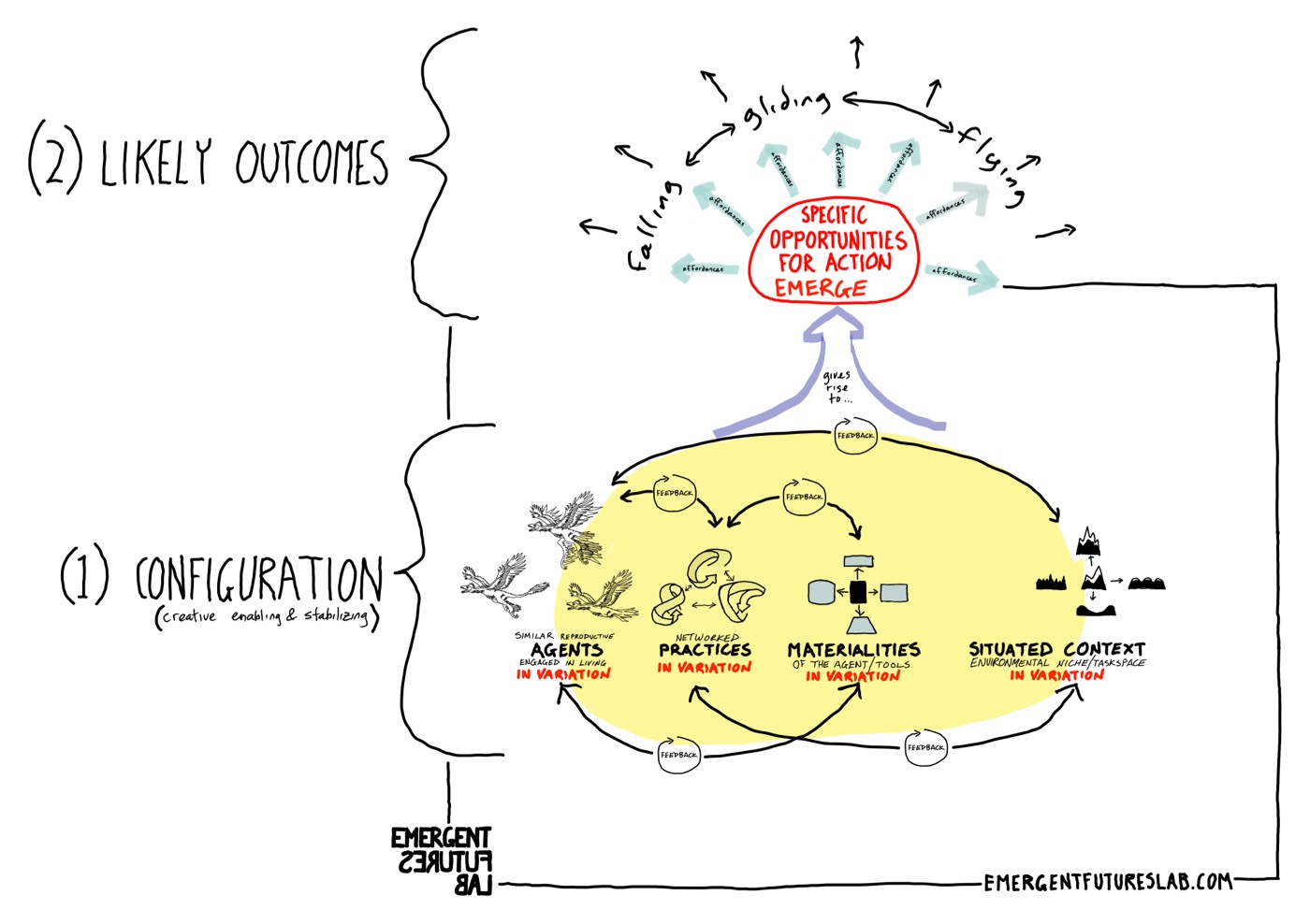
What’s important is to recognize that “outcomes” like semi-controlled falling, parachuting, gliding, and flying make up a general space of possibility that emerges when certain conditions are met by a configuration of agents, practices, materialities, and contexts (see diagram below).
Simplifying things radically – we are talking about two spaces that we need to pay attention to, both of which are real, where one is actual and the other is virtual:
The Configuration (actual, relational, enabling of possibilities, and stabilizing of some over other possibilities)
The Field of Possibility (virtual and emergent)
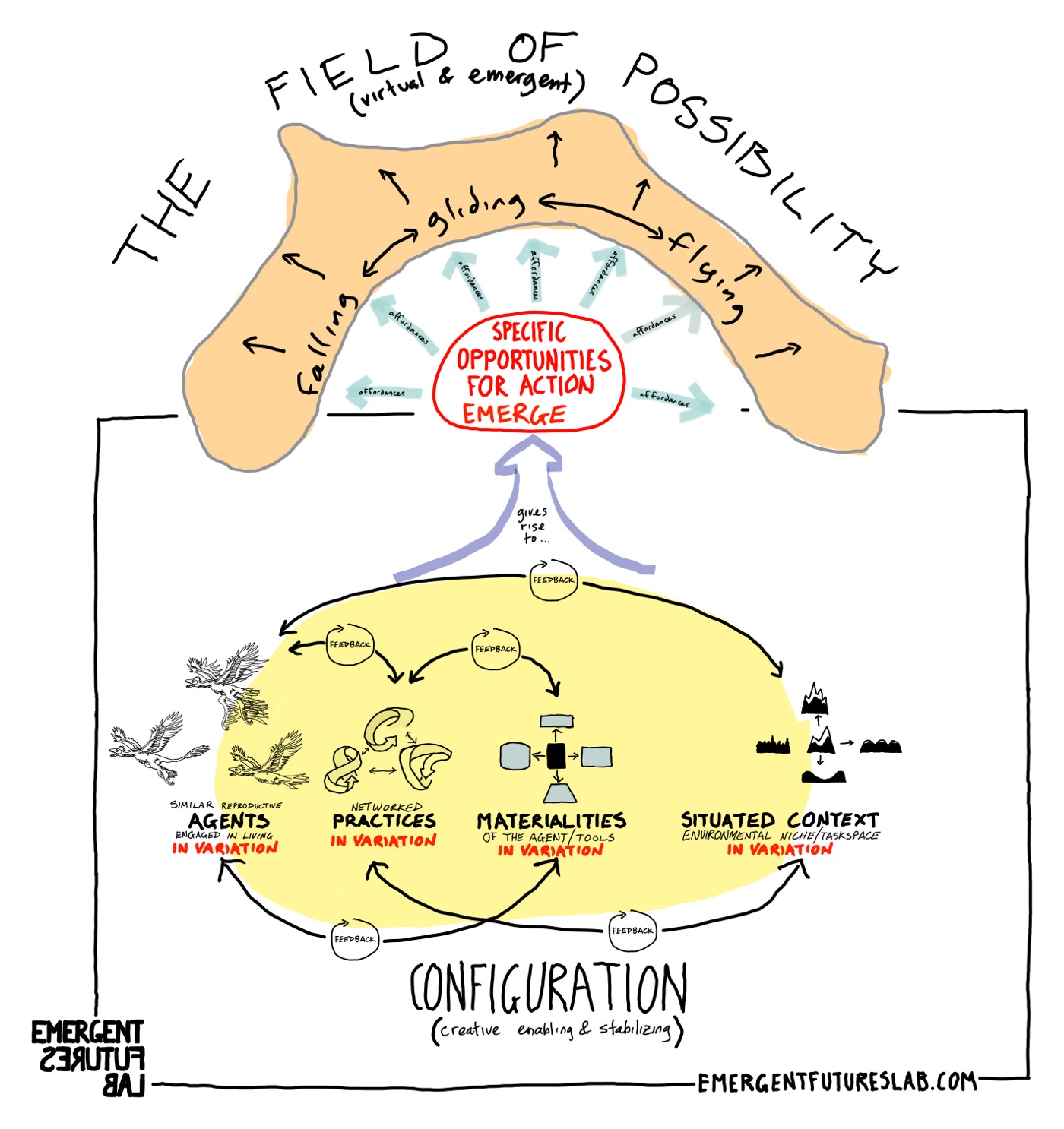
As configurations change in part or whole, then the space of possibility changes (these changes can be the work of blocking).
And as practices like semi-controlled falling, quasi-gliding, and proto-flying, among many other emergent affordances, gain traction, the affordances of the configuration (the field of possibility) begin to feed forward – changing the components of the configuration without themselves changing.
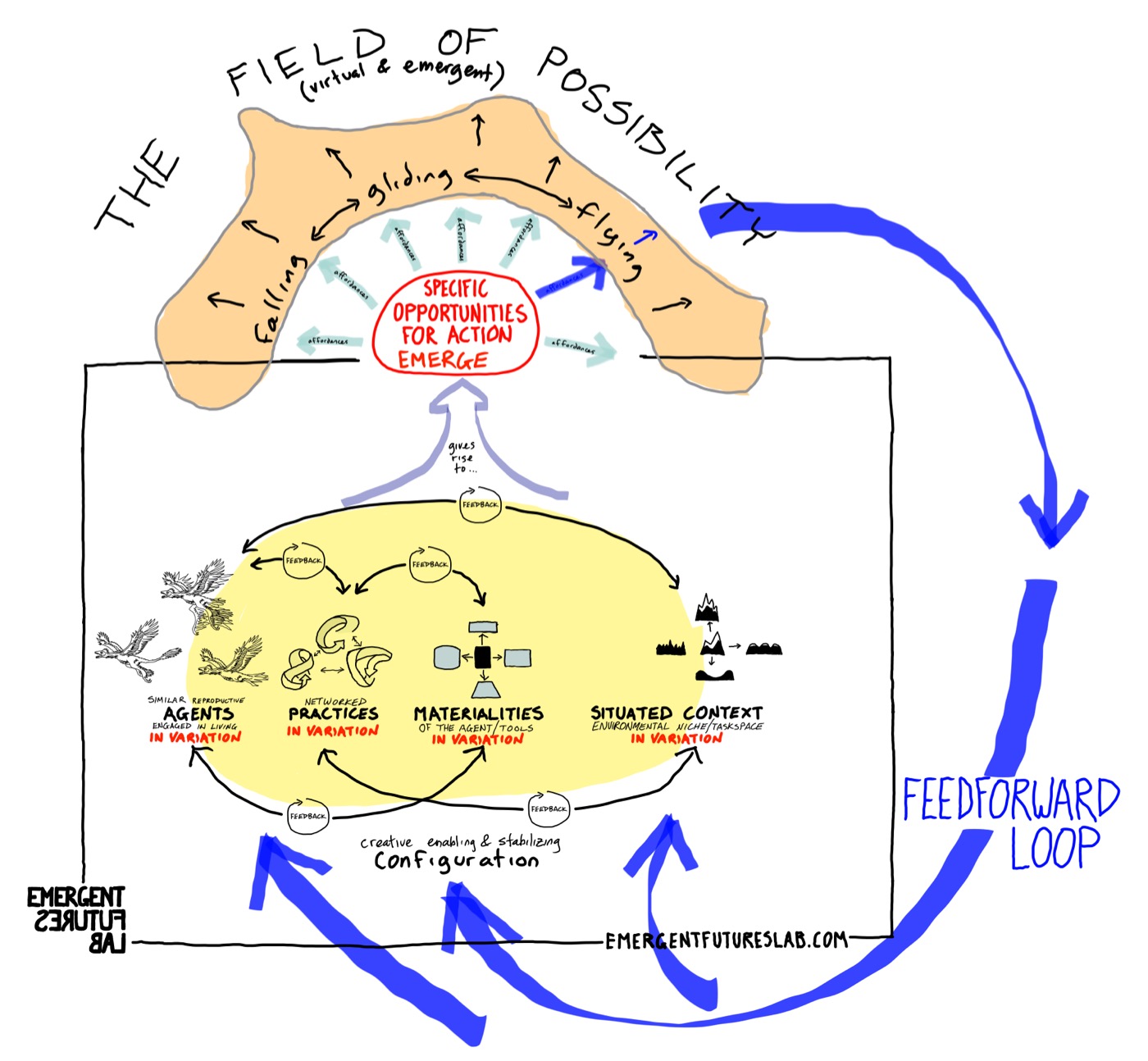
For example, as dinosaurs begin to do things that would constitute “proto-flying” more than falling or gliding, then this embodied, embedded, and extended activity feeds forward to change key aspects of the configuration to make flying ever more likely:
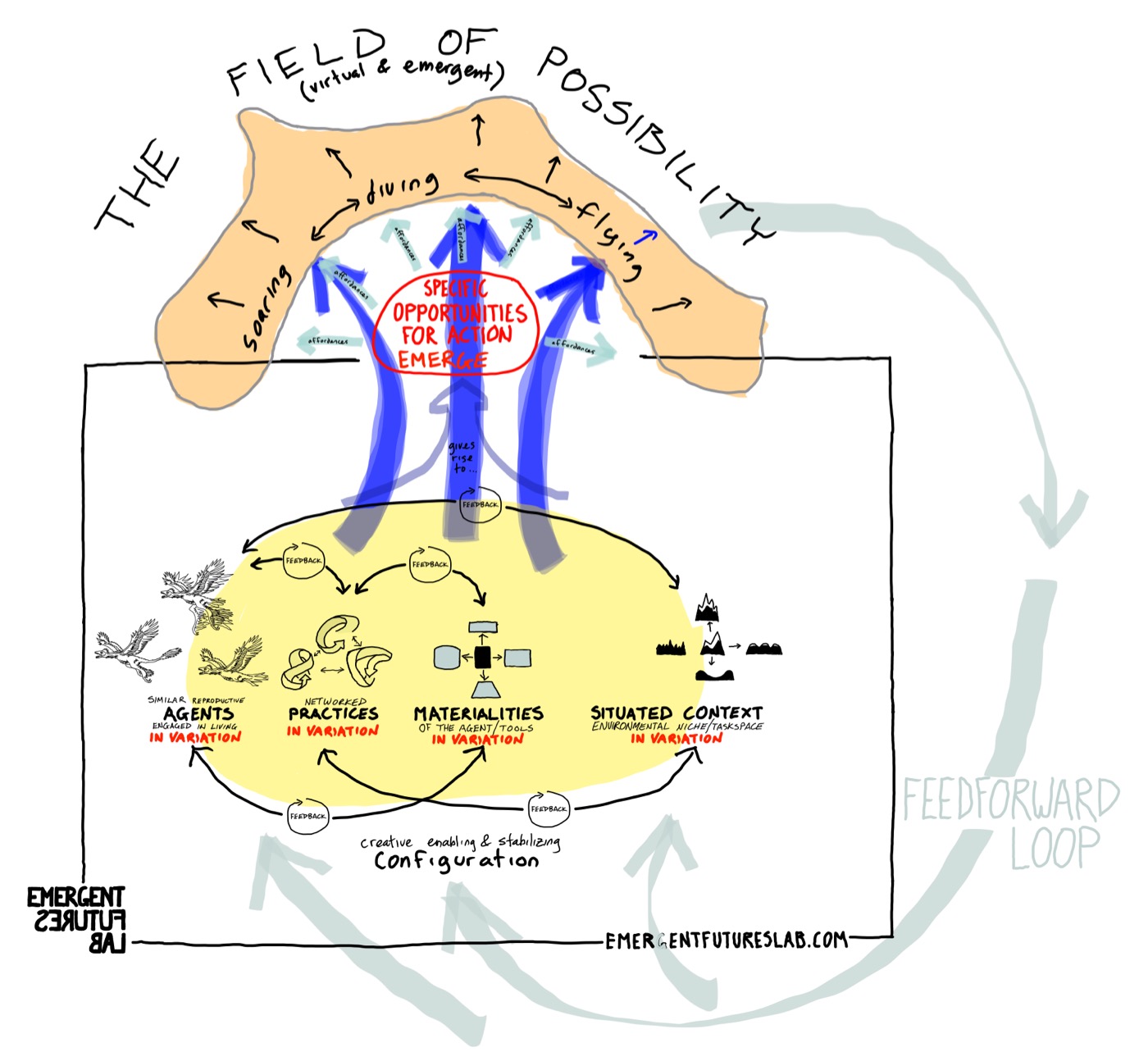
What matters is not the variations in the scale-becoming-feather alone. But the relational dynamics of a configuration that is enabling of emergent affordances and can selectively come to stabilize some of these affordances over others by itself transforming.
Thus, the first pragmatic answer to a one-and-done approach to creativity is to shift towards configurational approaches that give rise to emergent fields of possibility (virtual affordances) and feed-forward cycles of configurational change.
But – in our stress of configurations and conditions – it is not to say that things – that the feather is nothing. Things, like the feather, can come to play a pivotal role. But this is not because they have some deep intrinsic meaning (that the feather, for example, has within it the “trait” of flight) – but precisely because it is so rich in excessive contextual, unintended possibilities that are re-enacted via varying configurations.
“Once a set of conditions is met by a configuration, a set of creative affordance-based processes spontaneously begins to come into being via exploratory actions.” (Volume 211, modified)
What is so radical about this approach is that the creative process of flight does not need to be invented (via a one-and-done approach) and then imposed on anything. All that needs to be done is to get the right conditions in place (the development of a specific configuration). An experimentally varying process and cyclically feeding forward process will do the rest.
There is obviously a very big but here that should give us pause:
If this feedforward looping happens often enough in an ever-narrowing manner, then things can get quite strongly configurationally stabilized. And this is where the process of engaging with all aspects of the configuration in robust and experimental ways via blocking comes in. It allows for both a disclosure of the highly stabilized network of normal affordances (those things we simply take as givens – “natural”), and it allows us to disclose the marginal unintended potentialities in the extreme enactive play of the configuration. We can begin to block aspects of the configuration and follow unintended leakages and connections.
And because configurations are integrated, a shift in one aspect leads to a transformation in another. (It is not first and foremost abductive reasoning that moves creative processes sideways – but that the process itself is inherently and necessarily transversal and transductive).
A big part of the fetishization of things in creative practices is that we ascribe to the interior of things what we should ascribe to the relations of a configuration.
We say that “this does that” because of some internal quality:
In the early twentieth century, theories of evolution, this was the logic of “traits.” Traits in evolution are said to be physical features that do something specific: feathers evolved because they provided thermo-regulation. The hand evolved for grasping, etc. And because feathers or hands did x, y, or z that was beneficial to an organism, it was thus passed on to offspring as an adaptation. But if it is not about things and their supposed internal properties but the emergent logic of configurations, don't we need to rethink all of this in relation to both agency and creativity?
This radical and critical rethinking of “traits = inherent purpose” has become a hallmark of current approaches to evolutionary theory.
This is where we began to wrap things up last week. We concluded with:
“It is not a process where one unique exaptation happens and then a long process of adaptation takes place. In fact, it is problematic from an evolutionary perspective to talk with certainty about what an “adaptation” might be – as Gary Tomlinson argues,
“The deepest, hardest to eradicate flaw in adaptationist thinking may not be its imagined, temporal causal chain where there is none, but instead its abiding belief in the discrete, readily identified trait-for-a-purpose”.
How could we say this more clearly from a creative perspective?
Because everything is relational, nothing is composed of “traits.”
Why? Once a relation changes, novel aspects in things become salient in emergent and relational ways: That blood is red is of no consequence until it is. The resistance of air is of no consequence until you tumble out of a tree with long, sexy WAIR transformed feathers. That dinosaur bones in the spine and ribs are hollow as part of breathing sacks does not matter until weight and strength become conjoined concerns for arm-based flight… That trucks have a “container box” of a certain size and form does not matter until a new configuration of shipping begins to emerge…
What matters is that there is absolutely no way to pre-specify what might come to matter to a novel creative configurational process. There are no traits in things waiting to be discovered…
So while it is true that you take what you have to make the next thing possible, but you neither know what you have – nor do you have it until something is actively done configurationally.
And because it is always a configuration, it always involves many transversal movements (connecting radically unlikely equally exaptive and emergent things). An experimental configurational creativity of the likes of our dinosaur story or any other surf's emergent connections and emergent co-created adjacencies:
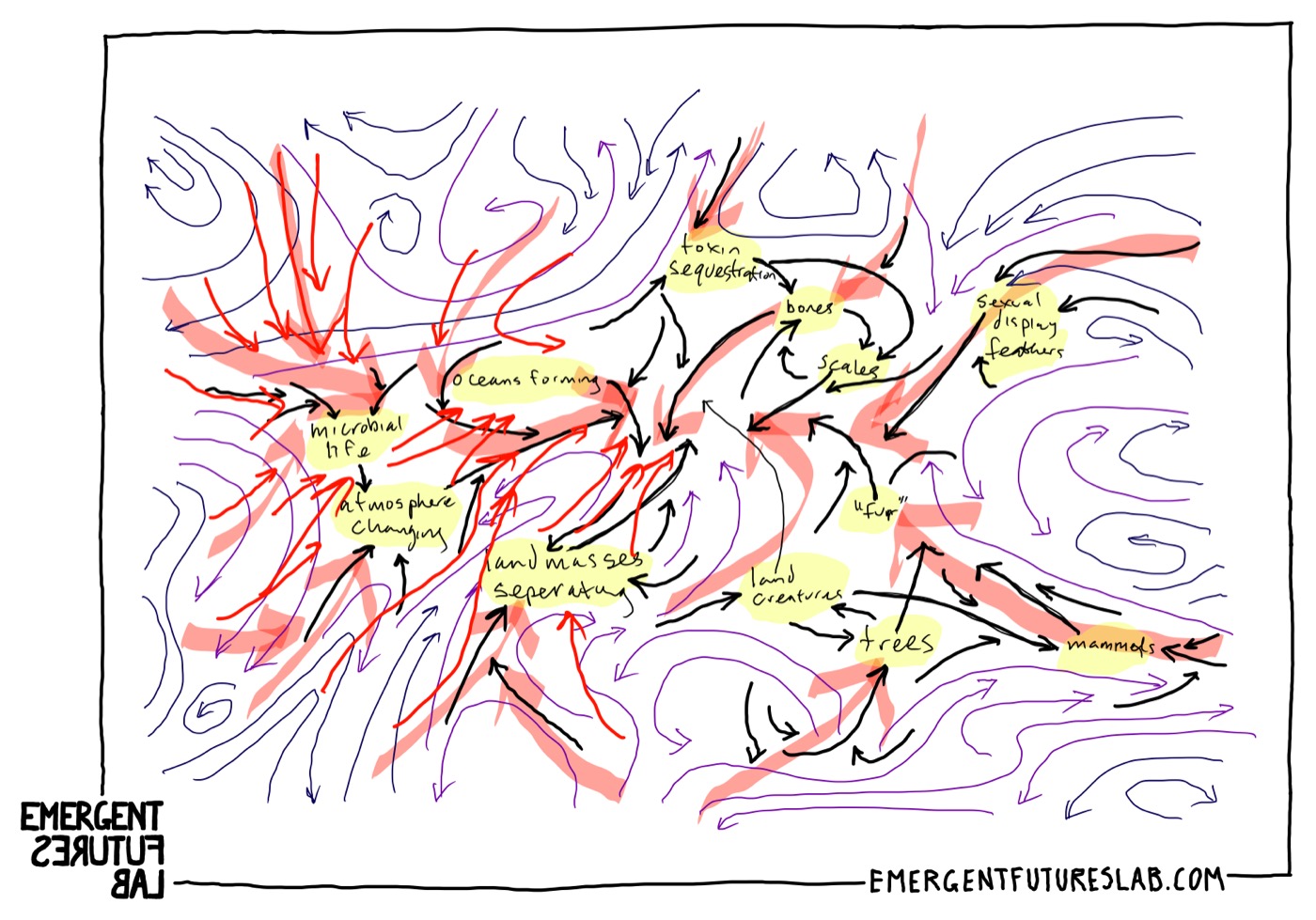
One way this is discussed, after the work of Stuart Kauffman, is that (evolutionary) creativity explores the “adjacent possible.” For example, besides the feather for thermal regulation, there is the feather for flight. But the metaphor of “exploration” is misleading. This suggests something already in existence and simply unknown to us. The possibility of flight is not there awaiting discovery – it must be cyclically co-created.
Because of this, purpose, meaning, and identity are always an Ex Post Facto designation – a designation that can only be seen/recognized/understood after the fact – in retrospect. In creative practices, we must co-create and co-emerge with adjacent novel possibilities – first in an unknowing manner and then only later in a knowing manner…
This is why we in the creative process of blocking that we have been evolving over the last four newsletters. Step number seven is:
“And then repeat the process using this new design, starting from step 2 – until a novel qualitative threshold emerges and can be crossed.”
Let's bring back this process:
The Blocking Process (the simple version):
Last week, we laid out this exaptive creative story of how the dinosaur co-evolves and co-emerges towards a novel “bird-becoming” as a type of erratic, contingent, and bifurcating line without end:
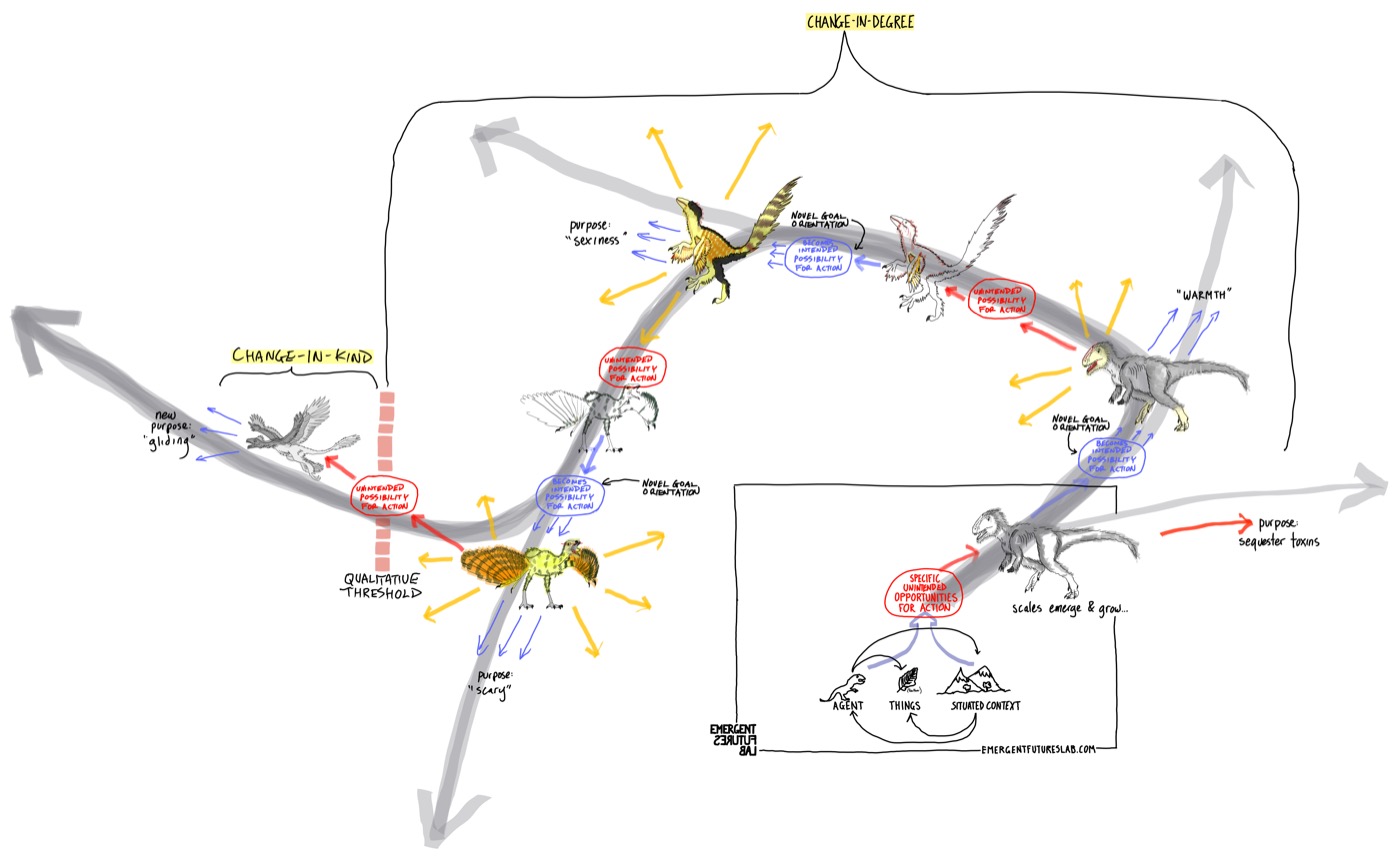
This week, to get at the configurational logic, we want to stress how this is a looping process.
Let’s quickly return to the early part of the story: Variations of active dinosaurs in a specific ecological context come to sequester toxins via scales that also have many other emergent possibilities for action (depending on variations in relational development and activities):
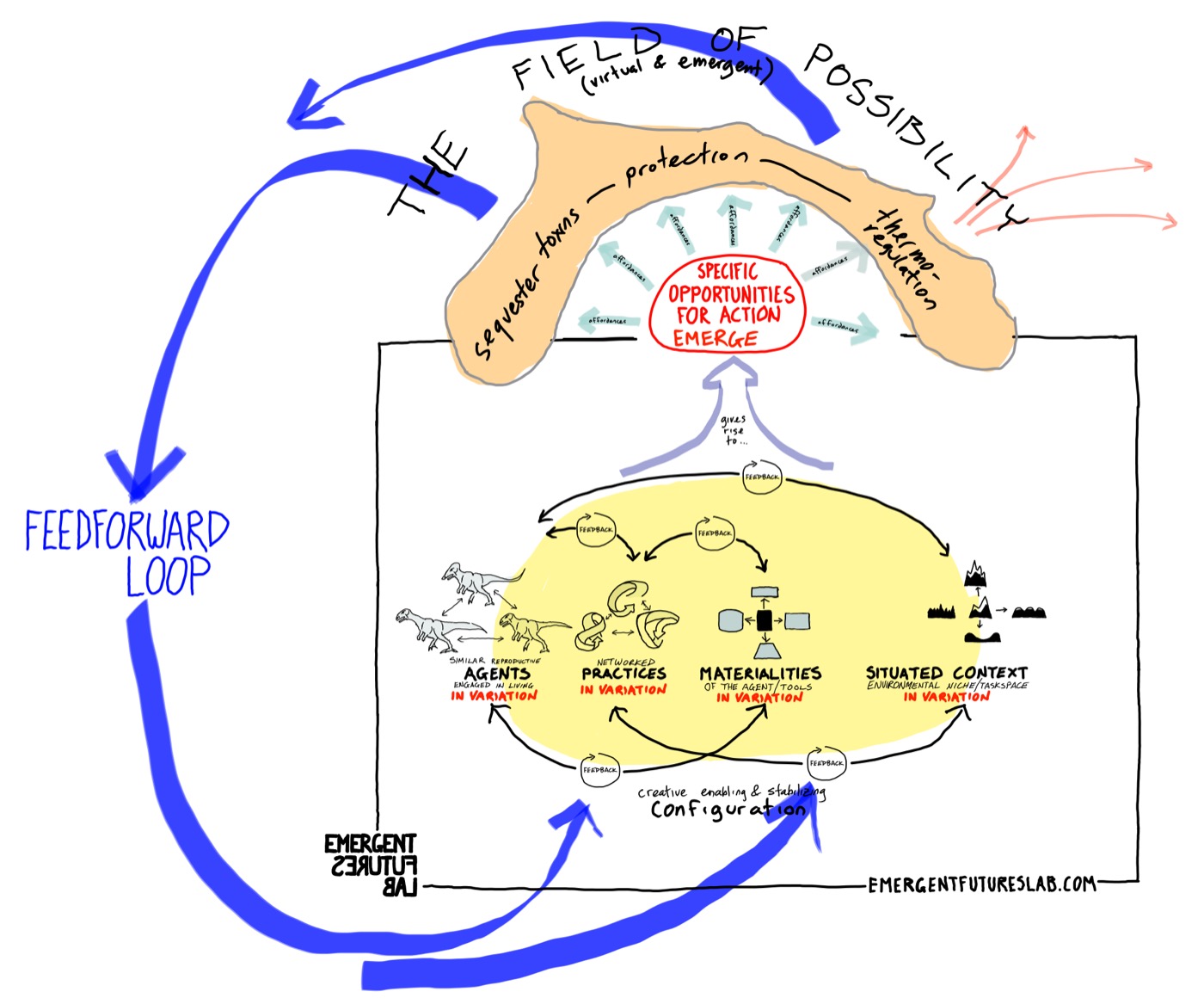
One of these other possibilities for action is thermoregulation. As this possibility stabilizes via feedforward loops…
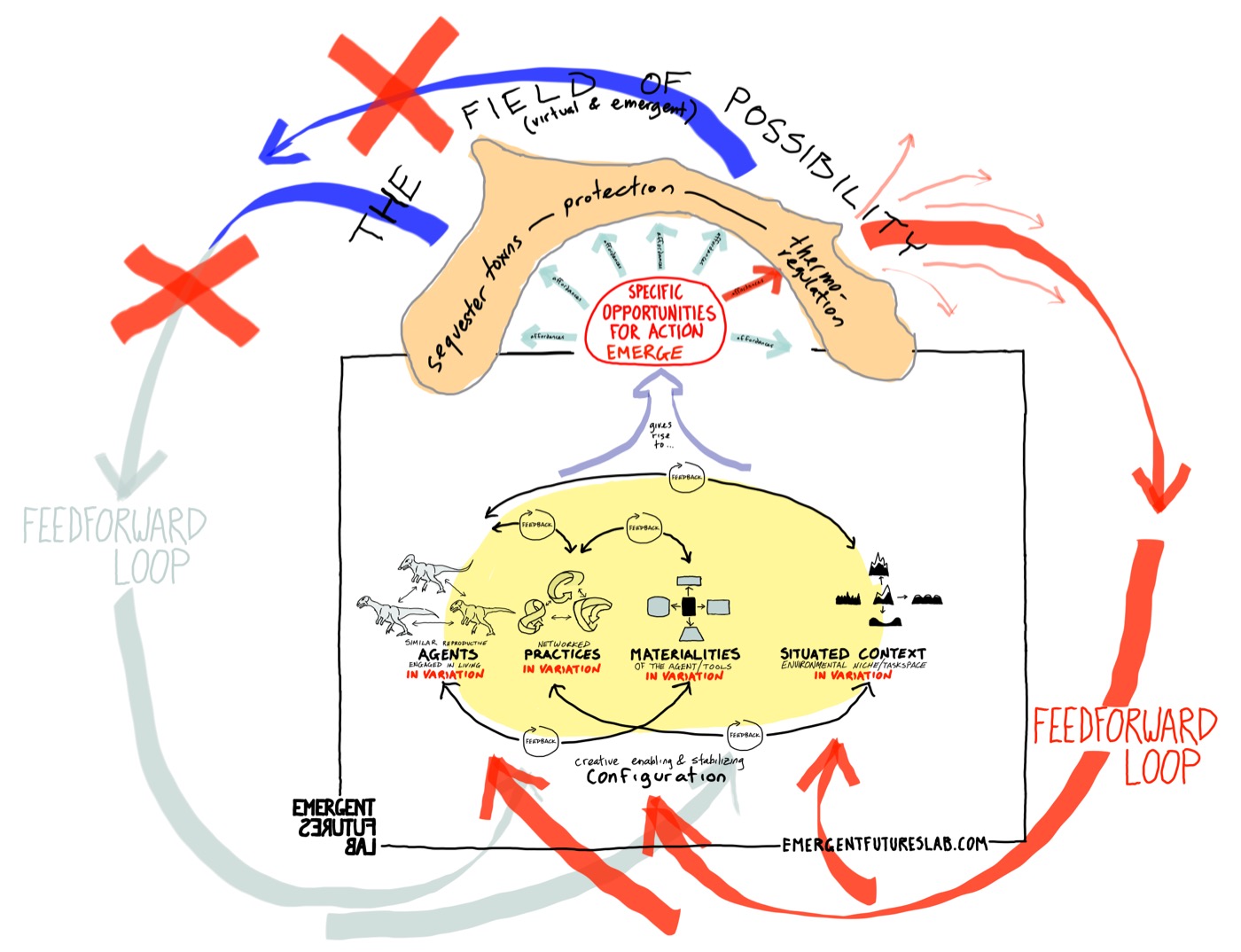
…The configuration shifts – both in specific forms (of bodies, physical properties, habits, practices and environments) – and relational logics such that a new configuration with new emergent opportunities for action emerges and stabilizes with a new identity, purpose and function…
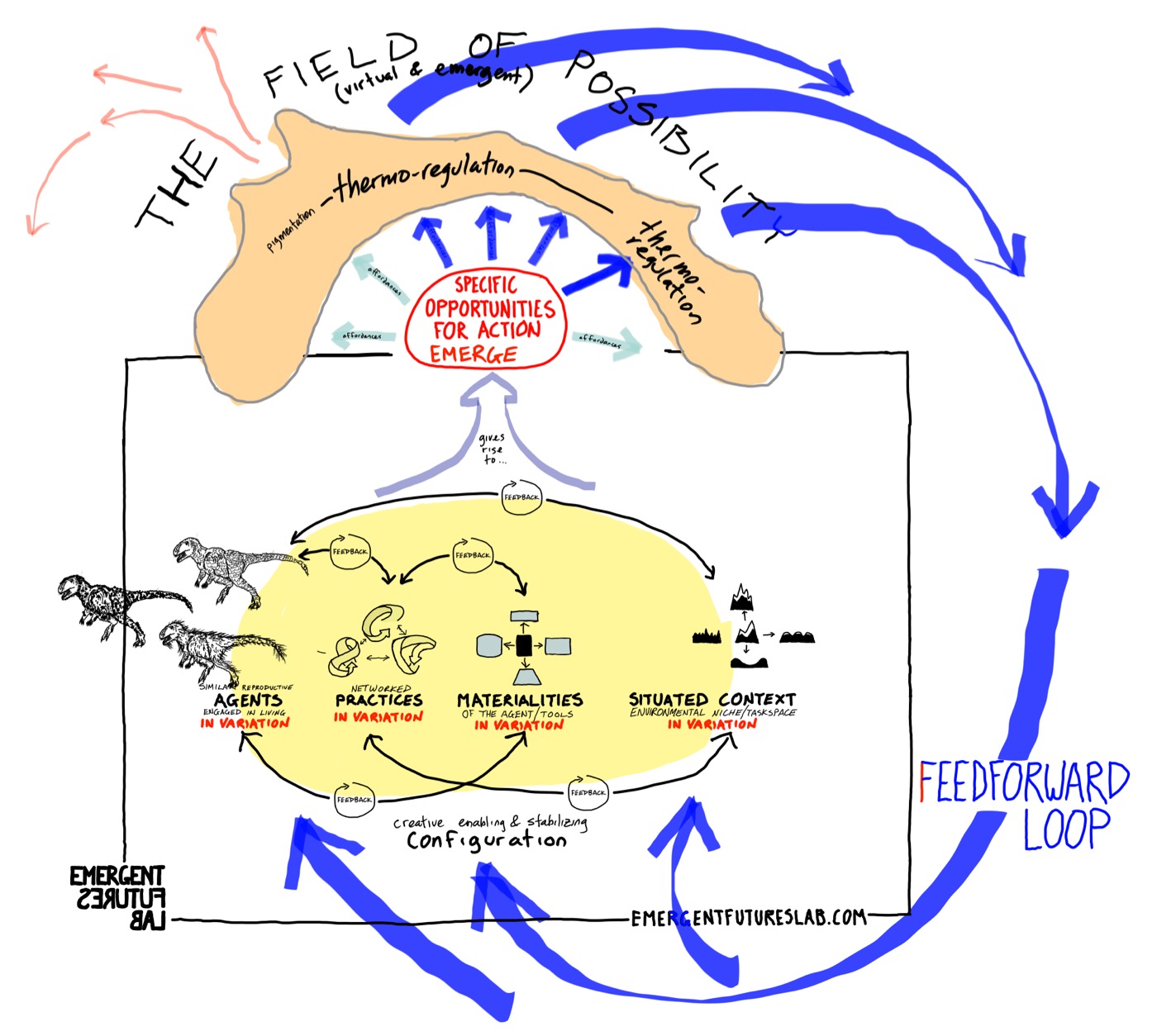
…But this function never fully accounts for all of the enactive possibilities – there is always many a marginal slippage and excess of possibility. And then as these become emergent pulls – process loops and loops and loops….
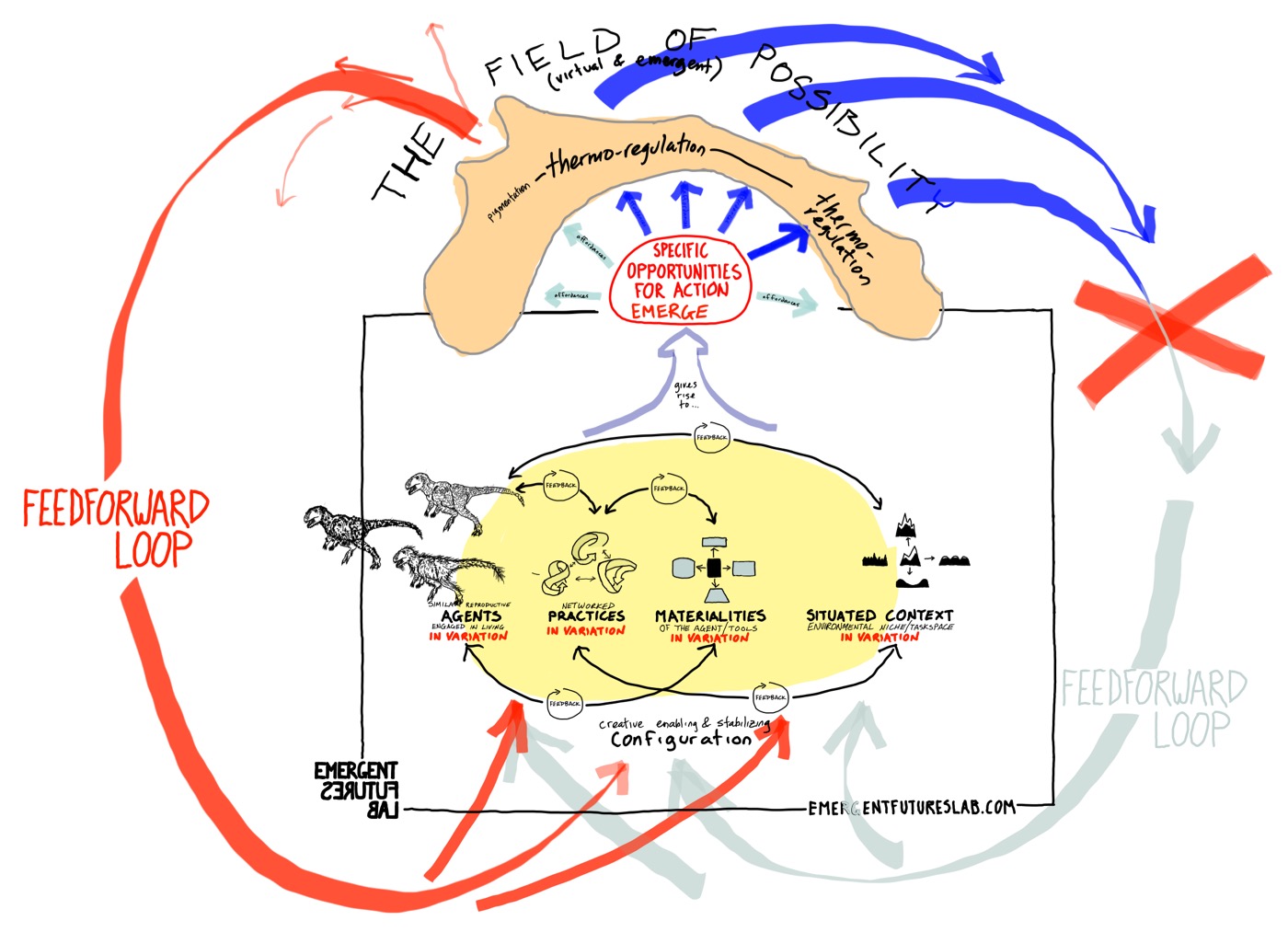
The creative dynamics are in the looping of configurational relations and their emergent specific fields of possibility: Engage, Disclose, Block, Experiment, Stabilize, and Repeat:
The Blocking Process (the simple version):
As we leave behind the one-and-done of a magical god-like creativity, things get complex. We need multiple different approaches to understanding what is happening. One narrative technique or one visualization technique will not cut it. We need helpful abstractions that catalyze experimental becomings.
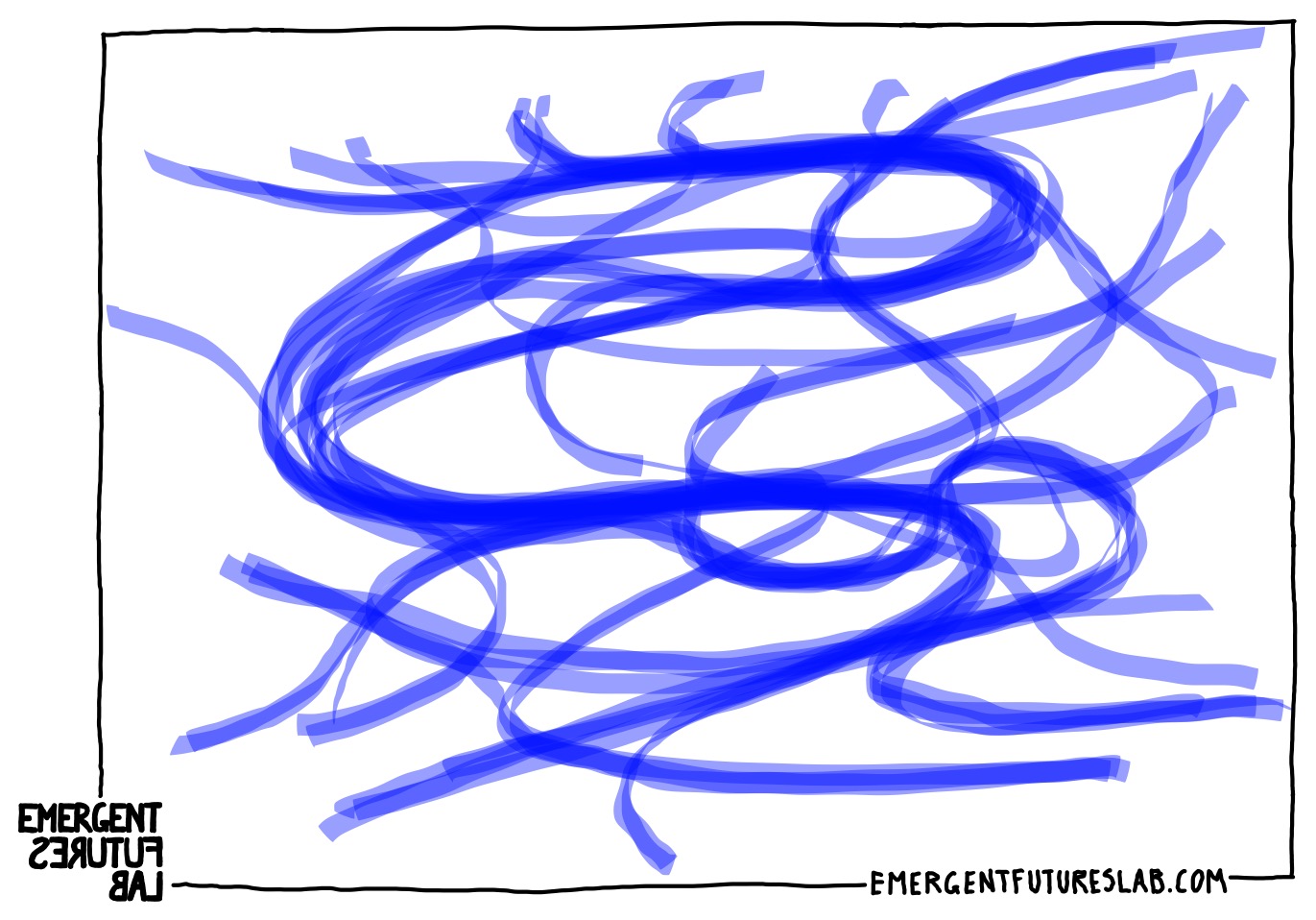
Lines, thickets, blockings, loopings, and emergent othernesses – let's play in these processes this week.
Next week? We’re dreaming of experiments with thresholds… But is that what will emerge? Experiments and experiments in writing have an emergent mind of their own…
Keep Your Difference Alive!
Jason, Andrew, and Iain
Emergent Futures Lab
+++
P.S.: Loving this content? Desiring more? Apply to become a member of our online community → WorldMakers.


