Newsletter
Resources
Courses
Books

Welcome to Emerging Futures - Volume 214! Creativity’s Contingency and Ongoingness...
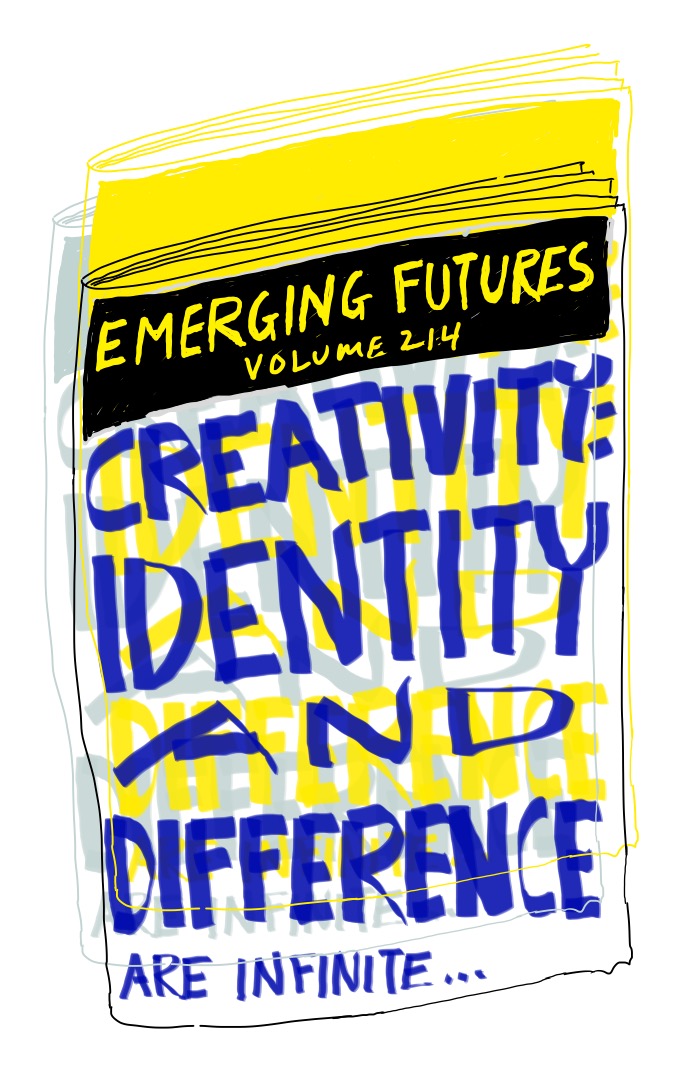
Good morning becomings who will always know “the day after” what their futures are. Our question this week is: when is this “day after”?
This week, we are going to explore two topics related to the powerful creative processes of blocking.
To get to these two topics, we first need to return to Identity – the process that creativity precedes, produces, and ultimately always challenges.
From the perspective of creativity – identity is never something that is originary. Identity is always a temporary situational achievement of a creative process. Creativity always begins in and of a state infinitely far from identity – difference.
To sense this distance, it is critical to understand that this form of difference is a “positive” difference – a difference that is irreducible to our standard sense of the term difference – which is what is best termed a “negative” difference.
This begs the question: What is a negative difference?
A negative difference is when some thing is different from some other thing else because it is not that thing. With a negative difference, the identities precede the difference: this identified thing, say a bean bag chair, is different from this identified thing, say a wooden Donald Judd chair, because it differs in hardness and shape. The difference can only be determined in relation to the two pre-existing identities.
But if given Identities always preceded difference, then how could anything genuinely qualitatively new and different emerge?
Conceptually, at least, a more radical positive difference that exceeds any and all identities must precede identity.
This means that for creativity, identity is a temporary goal – or better said, it is a “perspectival resting place” (e.g., the invention of new identities and purposes as part of the creation of very different ways of being alive). But it is also something that, if taken as final, unchanging, and given, becomes the obstacle that creativity must proceed through and beyond.
Identities, from the perspective of creativity, are always partial, relational, temporary, and perspectival.
Too often, we take identities for granted – and even when we question specific identities, we rarely question the logic of identity itself.
Identity connects a thing – it could be any “thing”: an object, a process, an event – to a concept with the logic of “this is the same as that.”
When we say, “This is a chair”:
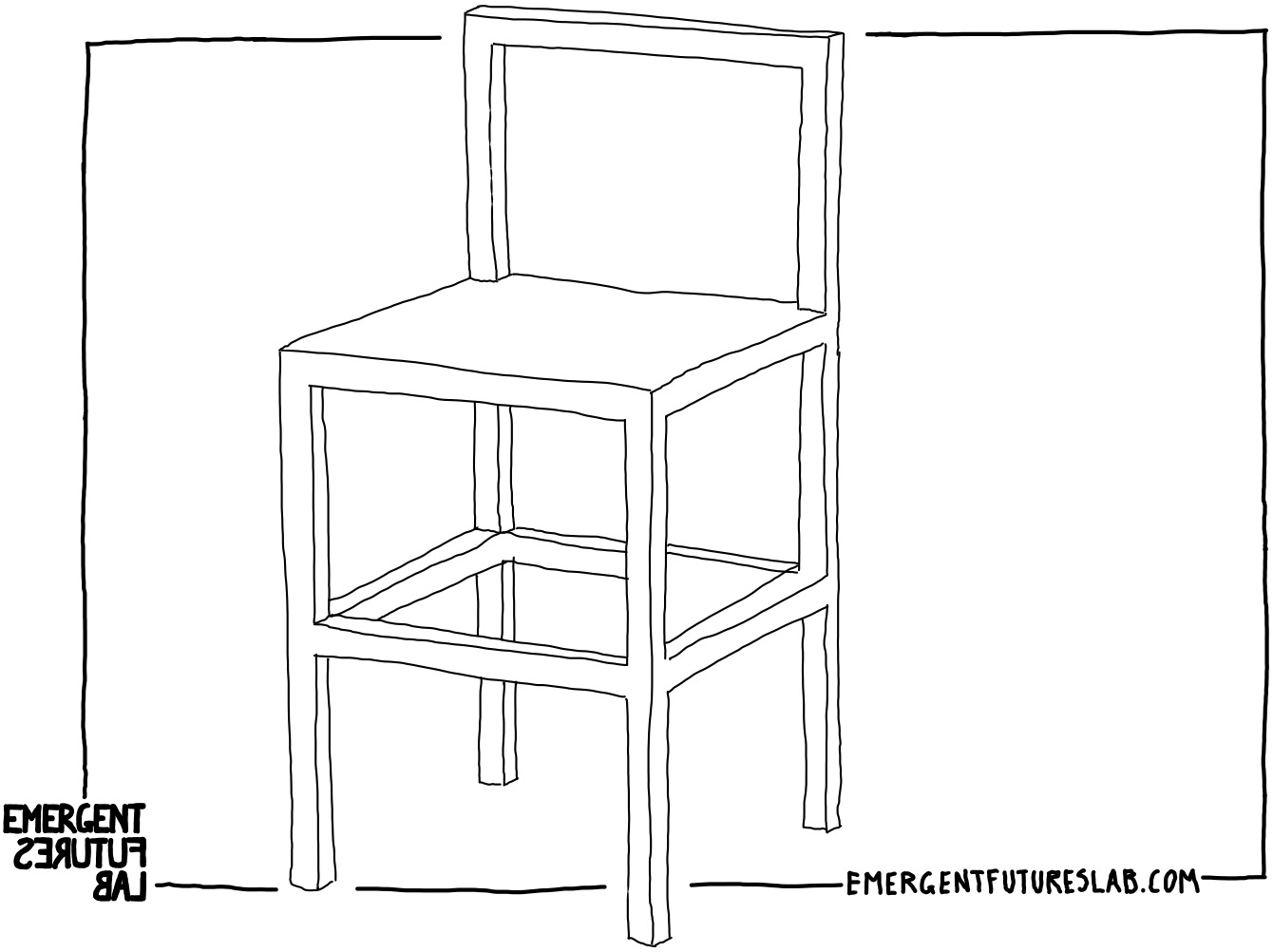
– what exactly is being identified as “the chair”?
We find this helpful definition in the Oxford Dictionary: a chair is “a seat for one person, typically with four legs and a back”. And this meets that definition:
This is, so to speak, the same as that.
But, then so is this:
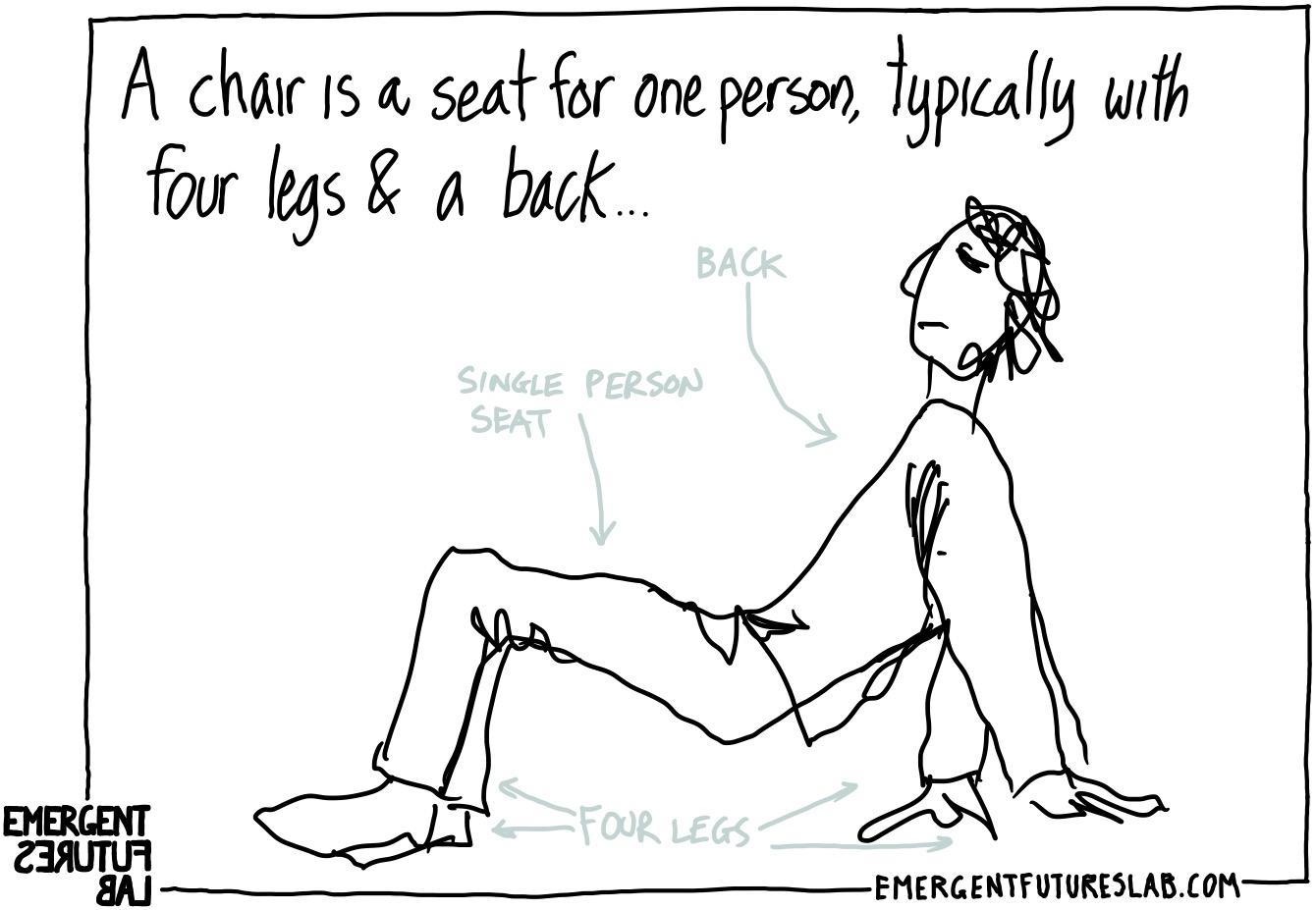
What ultimately makes creativity possible is that “sameness” – an actual total “Identification” between one thing and another cannot exist. Every thing always exceeds what it “is” in countless ways. Every thing is always in variation internally and relationally. Additionally, every thing ultimately participates in potentially infinite other perspectival identities. Difference is differing without end.
There is no sameness – ever. Everything everywhere at all times involves change – there is only variation – difference differing…
The chair, for example, can also equally be identified as a spider home, a tool to smash windows, and a sophisticated musical percussion instrument, a way to fend off bears, a mode of producing the mind-body problem… (ad infinitum)
As we explored in Volume 209, when we began this series on blocking – what makes something a chair is less exactly how it looks or what it is composed of – but rather, how it participates in a specific networked practice of a certain human historical cultural logic of sitting.
Now we bring all of this up not to get permanently lost in debates about identity or how it works, as interesting and important as these are. We bring this up to explore exactly how – and to what degree identity emerges in creative processes.
The first thing, and perhaps most important thing that we can say is that identity always comes long after the creative practices have been at work. And this is our first topic – or curiosity:
When the practices, concept, and finally the logic of an identity are well established, we can look back and “back cast” this identity onto earlier moments in its process of creative emergence. For example, after dinosaurs had evolved to fully become birds, now, from this comfortable position of knowing and identity, we can talk about birds with great certainty.
But, as a thought exercise, let's rewind the creative clock: think of the dinosaur running up the tree with its feathery wings flapping sideways (not down) and pushing its hind legs into the tree – is it a bird?
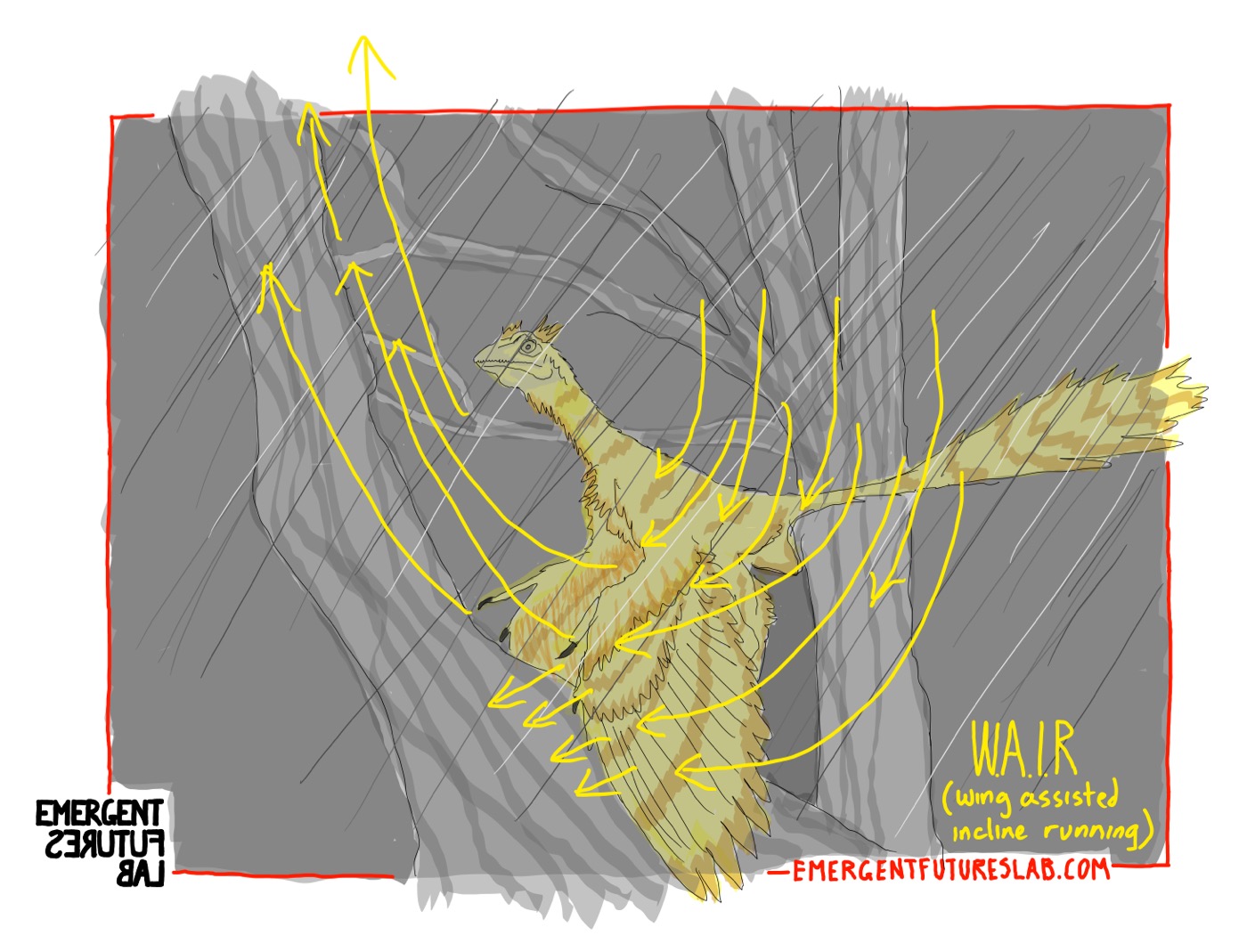
What about the feathery dinosaur tumbling off the tree branch – is it a bird?
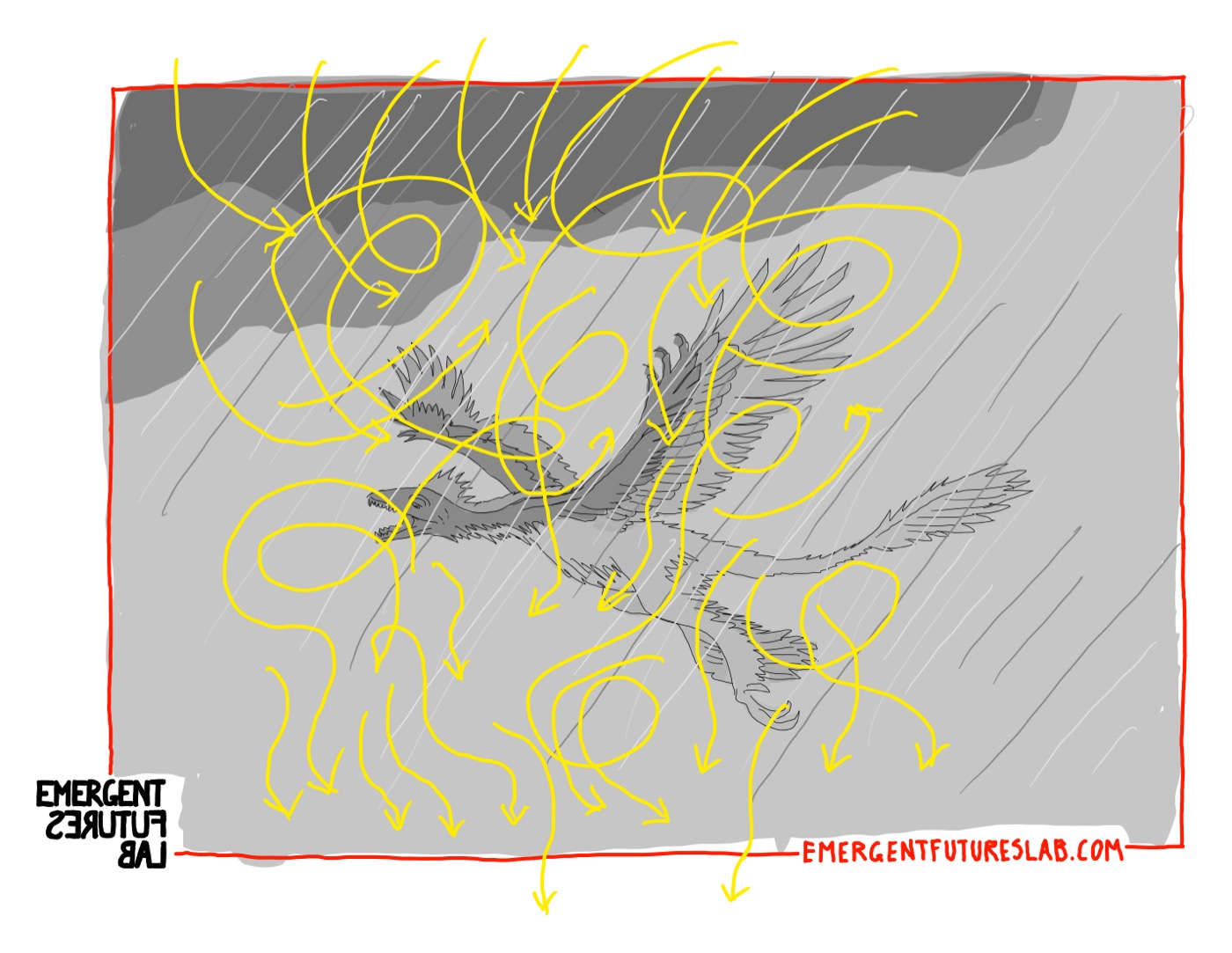
Is it a bird if it falls and tumbles to the ground without injury or death?
If a bird is a type of creature that participates in “flying,” when does tumbling and falling become proto-flying?
From a classical evolutionary perspective, it is profoundly hard to know – there has been an ongoing debate since Darwin’s days if the famous Archaeopteryx, for example, is indeed a “bird.” Did it flap? Did it even really glide?
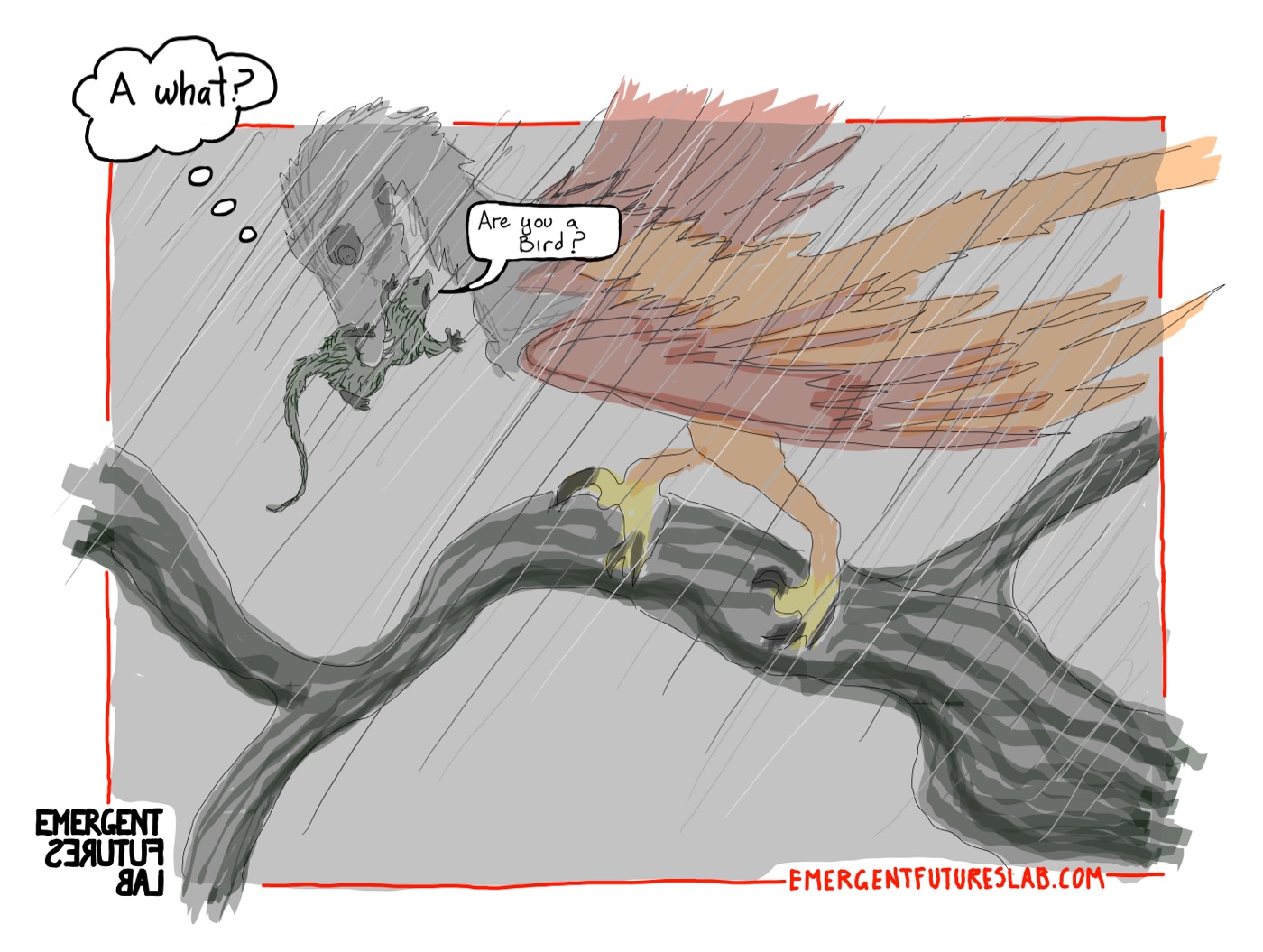
Now, if we imagine we existed back when this falling and tumbling was happening, how would we understand this creature in the moment? Would we not see this “tumbing-without-dying” as a successful end in itself? “These wings evolved for controlled falling!” – we would exclaim with great excitement and clarity of insight!
“What an amazing achievement! A creature that can fall in such a special way that it is never injured!”
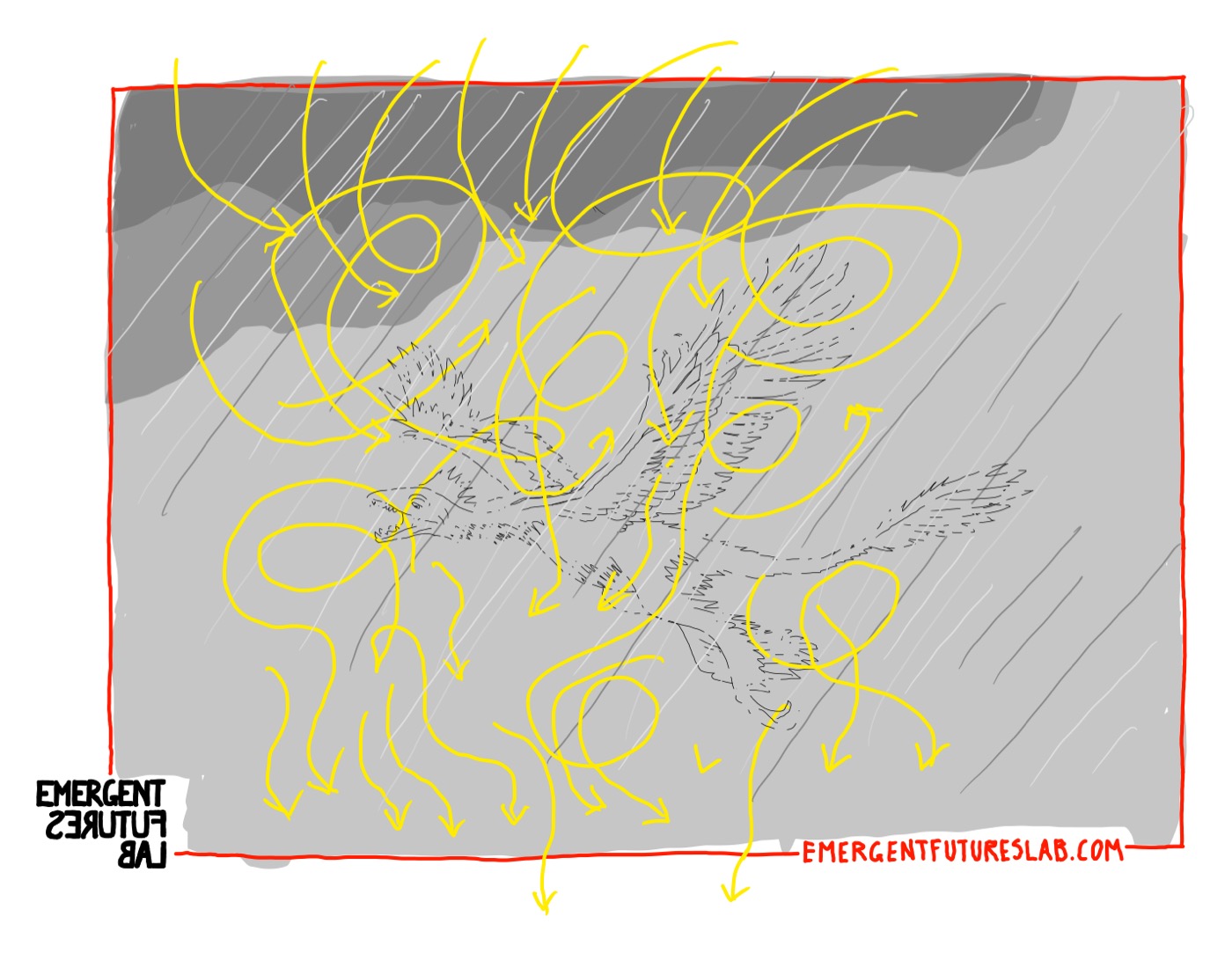
Now imagine we are in the same historical moment but a few hundred miles away, and we come across a dinosaur who parachutes with these tree-running wings – would we not say the same thing?
And then, at a similar moment, further away we come across a dinosaur who glides from tree-tops – would we not say the same thing?
It is only in hindsight that we favor this last one as the “true” evolution of the wing for tree-running (wing-assisted incline running).
From a creative perspective, our answer is Janus-faced: it is only looking backward from some distance that we can say that something is something, or more importantly, that it is “becoming something” with a clear identity. But this is only possible much later, when we are looking far, far back.
But if we are not looking back but are firmly lodged in the moment and are instead trying to look forward, what do we see?
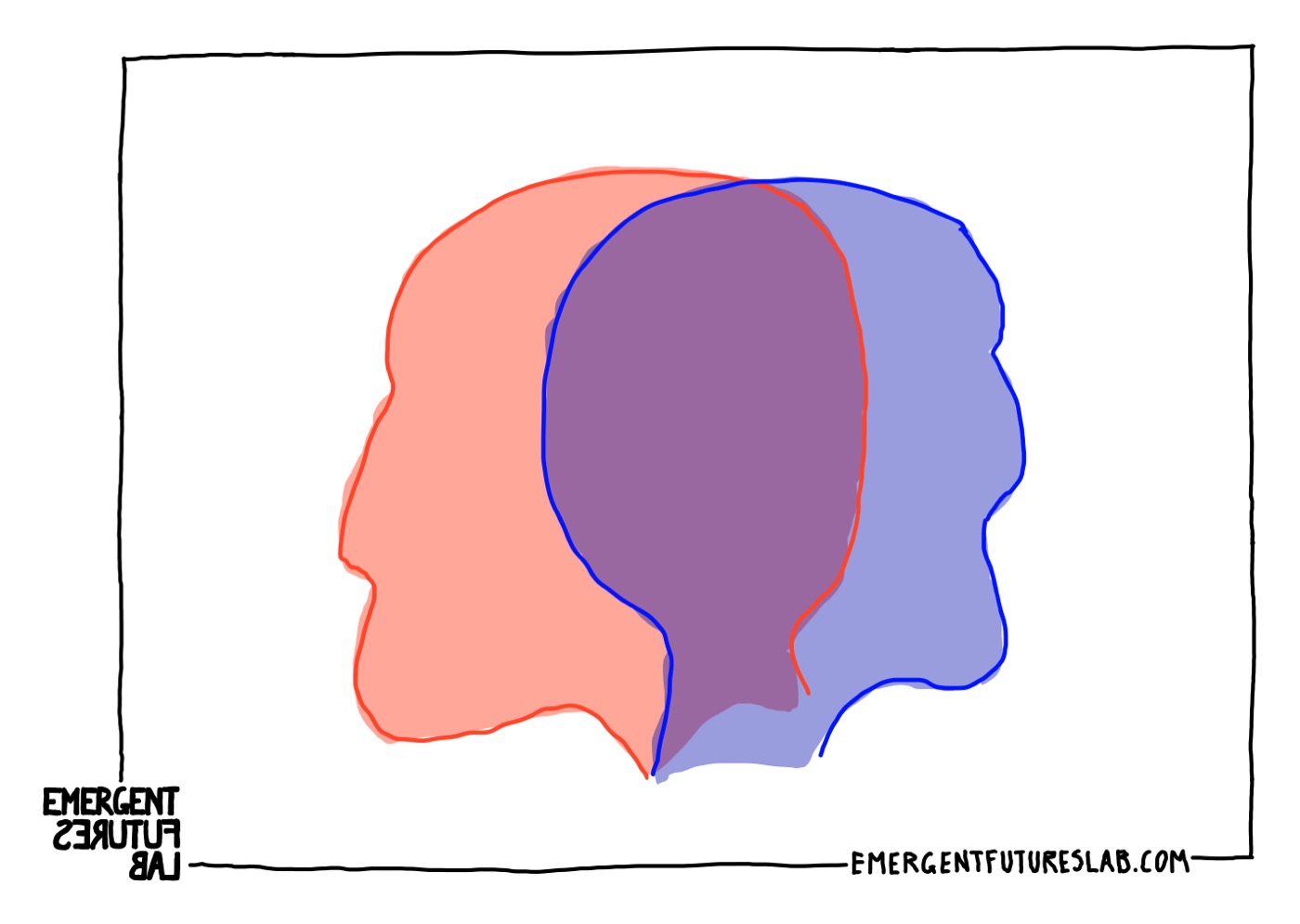
Janus is indeed a strange Roman god – the god of portals and passages. Where is the continuity (passage) and where is the change (portal)?
The god with two faces – where does each of these sit?
If both faces are always there in every moment, then how can we ever distinguish between continuity (change in degree) and transformation (change in kind)?
The hard answer for innovation is that in the moment, we cannot. It is only much later.
But this is a profoundly unsatisfactory and misleading answer.
From a creative perspective of becoming, when are we not “in the moment”?
From a creative perspective of becoming, when are we not “looking back from a distance”?
The god’s two heads are always fully present: at every moment we always have enough distance so that we can look back to identify some truth: “this is X” – and at the exact same moment we cannot say anything concrete about what possible becomings might emerge…
This is never more true than when an identity is established.
“Look,” we might exclaim – “now it has become some new identity – it is a flying creature – it’s a “bird”!”
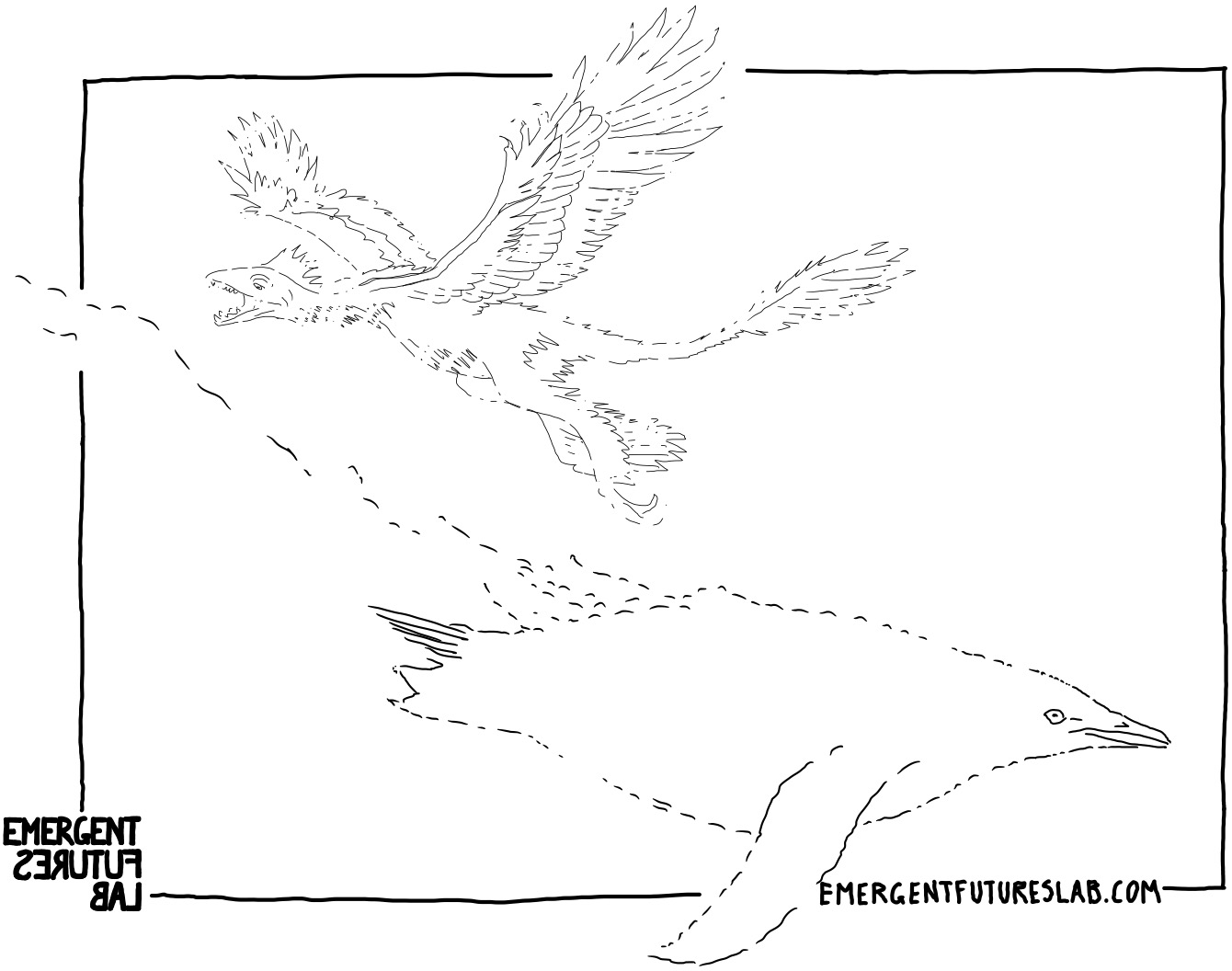
But, as we know, that flying creature plunged into the polar oceans and became a penguin. With wings that “evolved for flight” no less!
The question we are hinting at is: Would we actually see anything new in the moment – in this moment?
Would we “see” what things will become?
We don’t fully recognize how contingent things are – because they only appear in retrospect (ex post facto).
This leads, from the perspective of creativity, to a dangerous condition of a radical, purposeful backcasting of causality. We imagine that we can see a clear step-by-step development from dinosaur to bird – and anything else…
But as the great historian of the end of the “classical” age in West-Asia, Peter Brown argues, the greatest error a historian can make is anachronism – applying our contemporary logic back onto the past where it did not yet exist – so too is this a profound error when engaging in creative processes. In creative practices, this error of anachronism shows up as a belief in a causal chain where, as Gary Tomlinson notes, “there is none”.
The reality is that once wings for flight emerge – that is not the end – it's not the “meaning of wings.” At every moment the meaning of anything is always “whatever it can do” – what ever it can participate in… (Here is a wonderful moment in Derek Jarman’s astonishing film Wittgenstein that explores this, plus…)
From an ontogenetic perspective, at every moment, there is the equal potentiality of a radical qualitative change as there is for a slight change-in-degree.
It is easy to have a mistaken fixation on identity – the equating of some thing with some singular function. But in this, we fundamentally lose sight of the fact that there are no fixed functions that equate with the identity of anything. Wings cannot be fully equated with the function of flight, or tumbling, or sexiness, or underwater swimming, or any known thing. What we consider in the context of the moment to be a stable outcome (e.g. function – such as flight or swimming) is the product of a dynamic, temporary, and always hugely multiply activated configuration that is without end.
The even more radical – or problematic thing – depending on how you want to look at it (!) is that we cannot even pre-identify what will come to matter in things. The underlying emergent and contingent functional contribution always varies based on which aspect is co-opted by the configuration. This itself is a radical creative act.
So, what then does blocking actually accomplish?
Yes, blocking serves many functions, and in this contex,t it accomplishes the blocking of identity.
But what we must remember is that we are blocking an identity that never really existed in the way we might have imagined it did.
Identity is both perspectival, contingent, temporary, and never final.
Blocking is an opening up to this astonishing reality: Now we can begin to sense that a living and dynamic configuration is creatively selecting out the as-yet-non-existent aspects of things that are most relevant for the task at hand (in the context of the other aspects of the assemblage). E.g., When falling out of a tree… When in a mating occasion… When diving into water… When sitting on eggs… When…
And as non-pre-identifiable aspects are contingently selected by these novel occasions, these newly creatively formed aspects are stabilized to act as contextually “primary” for the duration of the assemblage.
Identity is nothing more (and nothing less than this)... (from the radical perspective of creativity)...
This is the looping we focused on in last week's newsletter – the looping of feedforward logics.
But this is never the end of the process – nor is it even from an ontogenetic perspective an objective resting place in the ongoing creative process of becoming: The role demanded of the selected/created aspect by the dynamics of the relations forefronts and transforms the relevant aspects/attributes. Which then has multiple new, additional positive, neutral, and negative effects. And these changes and their effects will shape the affordance propensities available to the other co-options (configurations).
New propensities in these other temporary configurations will become possible, some very likely and others as faint possibilities (so-called weak signals) because of what is happening in one temporary assemblage.
What we really, really wish to stress as we come to the end of this newsletter is that:
In creativity (e.g., everyday life) – everything is “reused” or “co-opted” in novel and un-pre-predictable ways – without it ever having a fixed function (identity).
This means that exaptation is the rule, not the exception. And this means that we need to question the very logic of considering anything to be congruent with “its” function – it’s identity…
What any blocking should help us experience is how the Janus face must inevitably turn from looking back to looking forward – and in doing so we come to sense a world in which every thing is already infinitely co-opted beyond what ever we may have proscribed as its “identity” – our definitions, congruencies, and correspondences are ultimately just one of an infinite and open set of already enacted exaptations…
Wonderment in and of a ceaselessly co-creative reality.
Our modest blockings produce a commons where there is nothing – and everything, in common…
Keep Your Difference Alive!
Jason, Andrew, and Iain
Emergent Futures Lab
+++
P.S.: Loving this content? Desiring more? Apply to become a member of our online community → WorldMakers.


