Newsletter
Resources
Courses
Books

Welcome to Emerging Futures -- Volume 216! On the Tasks of Engage...
Good Morning active flows in a flowing and active world,
Many of you have commented over the years that we don’t seem to like to phrase things related to creativity in terms of “being creative” or “doing creativity.” That is very true; for us, phrasing things this way is too close to thinking that creative processes begin and end with our engagements in them. We do not feel that we can draw such a neat boundary line around human creative practices and separate these cleanly from everything else.
Why? Because the “everything else” is also intrinsically creative. And given how the creative agency of the so-called “every thing else” is shaping us, our environment, and our practices long before we ever start “doing creativity” – how could we ever claim that creativity begins once a creative workshop begins, or a creative session begins, or when a so-called creative starts working?
Creation is the ongoing quality of all reality. Everything is always part of active processes of creation. There is no on-and-off switch for this ever-ongoing process.
Part of the problem is that many of us (including Andrew, Jason, and I) come from worlds where we were born into ways that collectively enact modes of becoming that give rise to the sensing reality from the perspective of stasis and completion (being). Our general everyday collectively enacted perspective is one in which everything we see is felt as complete, discrete, identifiable, and already made (finished). And from such a perspective, it is an easy step to think that creativity is an action that we add to a stable, mute, and non-creative world.
Let’s pause and reflect on how we sense things: I, for example, at this moment of typing on keys, fully and wholly explicitly sense that I am sitting on a finished chair, writing at a completed desk, using a perfectly made iPad. Around me are countless finished, discrete and identifiable objects – books, a coffee cup, wires and plugs, lights, a phone… In my immediate conscious experience, I don’t sense anything as being in a state of becoming, or in a state of making, and certainly not of ongoing creativity. Things feel pretty stable and static to me.
But, it would be a mistake to naively accept this as simply “how things really are.” This perspective is the emergent outcome of a long-evolving configuration of enacted intra-active habits, practices, concepts, tools, and shaped environments.
And while this perspective is explicitly felt as something obvious, inherently right, and profoundly practical for navigating the world, it involves types of abstraction that allow us to skip over how everything is in-the-making without us ever realizing that we are actively engaged in specific practices of abstracting away these dynamic agential creative processes of our world-in-the-making.
It is the brief moments when deep feeling and lived awareness for how everything is in the ongoing active making leaks through our historical abstractions that we are brought back in touch with the reality of everything being in and of an active “ever ongoing process of creation”.
While this can sound like a vapid cosmic mysticism: “feel the becoming of the world!” – or what we called last week the obscure – striving towards gaining such an enactive sensibility is anything but vapid and anything but impractical from the perspective of creativity.
For example, as I begin to actively pay closer attention to my direct experience and surroundings in a highly embodied manner I can already sense that the sweater that is actively wearing me and that I just put on as I felt the becoming colder and darker of the seasonal shiftings (which are in and of the creative becoming of our earth's wobbly process of spinning around a moving and dynamic sun) is different from the one I put away in early spring. Last year's firm grasping of the elasticity of the knitting in the cuffs and collar is a little less active in its hold of my arms as the wool ages towards a new way of wearing me. The moths have been busy over the summer, and there is a hole opening up with the shared movements of my arm, such that the sweater on my left sleeve and near the bottom hem is now very much in need of mending. As I type, and my fingers rub into the second keyboard I purchased for this tablet (now telling me my battery is at ten percent) and the twinge of pain in my index finger joints is reminding me of the decades of embodied joy in pulling on small fissures in rock walls sheared up by the moving of a molten earth. As I pause in typing, I reach out to hold and feel the warming comfort of my favorite coffee cup. As I tentatively sip the fast-cooling but still quite hot coffee, the missing divot in the cup's lip rises back to my attention – I love this cup, and that chip calls to me to be glued on. The desk is creaking from a summer of the wood drying and meeting my arms' weight as I sketch – it needs a wipe, the floor a vacuum, and the iPad needs to be cleared of unnecessary files—all things I just did. A world is endlessly active – a creation and a creativity is ceaselessly making and remaking us and everything else.
It is not that difficult to attune to creative becomings and to feel into their propensities to take me actively and creatively elsewhere…
But more than such a description might suggest, I am interacting with my world directly, such that my collaboratively active embodied embedded and extended selfing is just in a bio-enculturated flow of doing with and of a worlding: my experience of typing and coffee drinking is the event of morningness-in-becoming. I am not staring “out” at a world from somewhere deep inside my brain busily attempting to process incoming data into salient predictive abstractions about the status of a distant ultimately ungraspable “outside” environment to which I then instruct my distant and also abstract body to respond as best I can – all the while hoping that my abstractions are good guesses and trying to react quickly to new noisy incoming signals.
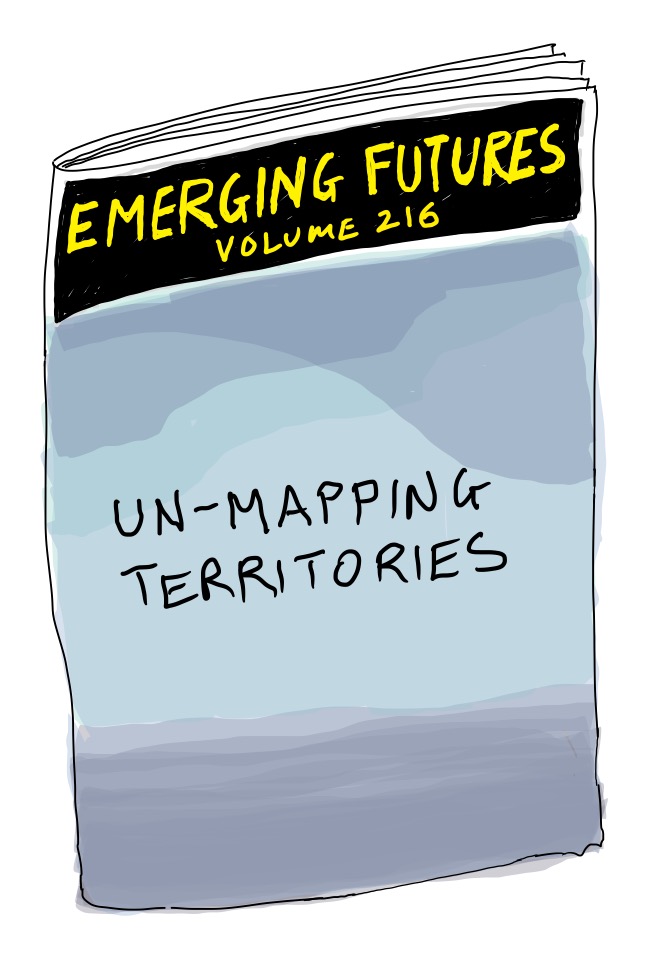
No – as we come to actively, collaboratively, and embodiedly feel our way into a more-than-personal experience, we sense how we are of an astonishingly creative world-in-becoming. To collapse experience into data, information–abstractions, all of which are supposedly happening in some “thing” (such as the brain), is to confuse the creative dynamic emergent intra-dependent relational reality of experience with one of its necessary nodes (the brain). We are surreptitiously replacing the territory (the creative worldly becoming of experience) with the map (abstractions of identity and stasis)…
We commonly recognize that “we cannot stop time” – that “change is everywhere” – and that our immediate experience is one of flow. But we all too often see this much more as our subjective and “internal” experience rather than as an attribute of the world “out there” that is itself always in the making.
The challenge is that in sensing this as “only” a subjective experience, we remove it and ourselves from an interdependent reality that we are wholly of and that is ceaselessly creative. We can – and often do, unconsciously, surreptitiously substitute our static and explicit cultural abstractions and identities for the much richer and far more dynamic and entangled concrete world-in-the-making. We abstract out of the richness and profound variability of the ongoing creation of immediate experience generalities, patterns, and consistencies:
“We need brains to perceive, but perceiving isn't inside our brains. Perceiving is a relation between ourselves and the world. Once we collapse the distinction between ourselves and our brains, we create a false image of ourselves as trapped inside our heads, as if in a windowless room, having to guess what's going on outside, and working only with the discrepancies between what we guess and the sounds we hear coming from the other side of the wall. But we're not inside our heads. We're not reducible to our brains. The brain is an organ of perception, not the perceiver. The perceiver is the whole person or animal, geared into its world”. (The Blind Spot; Frank, Gleiser & Thompson).
We take the abstract achievements of identity that arise from and depend upon becomings/things to be more real, more concrete, and more usable than the infinitely rich and ultimately unfully knowable thing-in-becoming.
Thus coming back to where this newsletter started – for us it's never about a stand-alone activity called “doing creativity” or “being creative” – but our creative practices always require, as we begin, a skillful, complex, and critically aware re-engagement with ongoing creative process that we are already enmeshed within and of– in new ways.
This week, we are beginning a new series in the newsletter to explore these processes by which we begin our deliberate engagement with the already ongoing processes of creation and creativity. We call these tasks, broadly speaking, the tasks of Engage.
Often the first “step” in a human creative process is presented to us as one of ideation, or research or empathizing – but for us these already begin far too late – and because of this they ask us to agree to a very impoverished scope of practice that ignores in a profoundly detrimental manner how we are already of an ever active agential and creative reality.
We would argue that the first aspect of deliberately engaging with ongoing creative processes is to stop the headlong rush to be creative, and to slow down enough to develop a way to actively probe and enactively attune to the specific propensities of an already active and creative configuration that includes us.
This cannot happen via a disembodied survey or the taking on of practices that enact a “view from nowhere”. The dynamic propensities of our specific creative reality won’t be found in reports, statistics, org charts, or survey numbers.
Our explicit knowledge acts as a type of “surreptitious substitution” of abstractions and identities for the dynamic and creative being of immediate reality. We need to slow down, push aside our abstractions, and attune to what is emerging between us and with our environment already. This is an active embodied being-with (and “of”) each other (the emergent collective) – plus a being-with (and “of”) a dynamic environment.
We can approach the tasks of engagement in many different ways. But perhaps the first way needs to be via an experimental enactive attunement. This is what we mean by engaging with direct experience. For us, such an embodied and enactive nearly abstractionless attunement precedes and grounds more explicit forms of knowing.
We will be exploring these critical practices from many different perspectives over the next few weeks. This week, we leave you with a question: how do you personally develop practices that take you away from the map and back to the direct experience of becoming of and with a creative territory?
Keep Your Difference Alive!
Jason, Andrew, and Iain
Emergent Futures Lab
+++
P.S.: Loving this content? Desiring more? Apply to become a member of our online community → WorldMakers.
Two questions, every Friday since 2020:
What is creativity? and How do you innovate?
A weekly experiment in emergence, creativity, and change-making.


