Newsletter
Resources
Courses
Books

Welcome to Emerging Futures -- Volume 220! Experience Education Creativity...
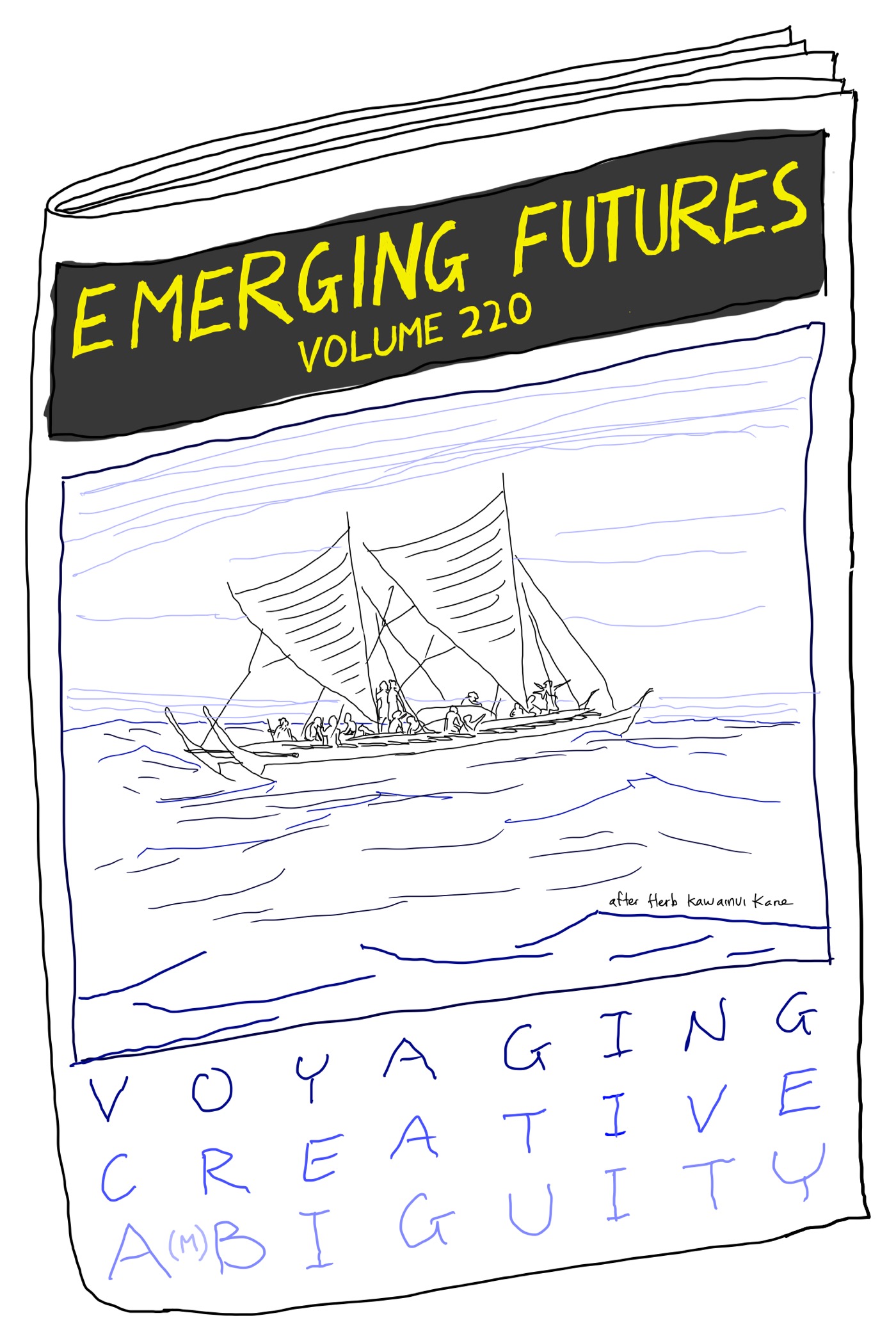
Good Morning aspirants to the holiday nap,
I have been watching the moon – with the sun behind it, come back into visibility this last week. It rises now in the mid-morning and accompanies the day – visible between clouds.
Seeing the moon for these brief afternoon moments over the last few days between the clouds and rain – finds me pulling down from a high shelf the work of the eleventh-century Japanese monk and poet Saigyo.
Turning pages, searching for this poem: Tsuki o matsu – Waiting for the moon.
Tsuki o matsu
takane no kumo wa
harenikeri
kokoro arubeki
hatsushigure kana
~ Saigyo (1118-1190)
Burton Watson (1925-2017) translated it in this manner:
Clouds have all scattered
from the tall peak
where I wait for moonrise –
what kindness in the first
of those early winter showers!
But something makes me turn back to the Japanese – perhaps it is how the poem in this English translation literally pivots around the “I”?
Staying “closer” to the Japanese, It could also be translated:
Waiting for the moon
mountain’s clouds
cleared up
feeling how it is
first rains of winter!
I am always struck – how does one know which are the first rains of winter? Here in Newark, I am not sure if they have arrived yet – or if they have, I have not experienced them. What makes a rain – a winter rain?
While such questions are interesting, what is powerfully ambiguous in this poem is that it is undecidable who is having the experience of waiting for the moon? Is it the mountain’s clouds? Or is it the writer? Or is this written from the perspective of the event itself – in a way that includes all relational aspects?
The translator of Japanese to English, and the work of Saigyo, Merideth McKinney, writes this of translating Classics,
“Ambiguity, imprecision, vagueness, suggestiveness - these are fundamental to the Japanese language even today, and they impart an elegance to classical Japanese that is the essence of its literary tone. It can be heartbreaking for the translator to be forced to reduce to a single, unequivocal meaning the floating filaments of a classical Japanese sentence.
What a classical Japanese literary work usually aims at above all is the subtle evocation of feeling, felt to lie as much in what is unspoken as in the words themselves.”
This ambiguity – these floating filaments – are certainly present here – especially in regards to where agency lies – is it with the individual or with the event? The ambiguity of agency is a critical, and perhaps irresolvable ambiguity and key question in the exploration of creative processes. And it has been a critical unspoken ambiguity in our last few newsletters, where we have been experimenting with the question:
Where is creative leadership when the ecosystem already leads?
Or to put it another way:
Where are we in a creative process that always exceeds us? (And all creative processes exceed us)
This week, being a holiday week, is a good week to reflect on and review, with a light touch, how we have been approaching this question of individual and/or ecosystem over the last couple of newsletters.
On Monday, we did a big Keynote presentation and Workshop for teachers on Creativity and Experiential Learning:
Much of what we presented was close to what we have been experimenting with in the last two series in the Newsletter:
These two practices are critical to experimentally wrestling with this question of: how can we effectively participate in already ongoing creative processes that have their own emergent agency and propensities?
When we are involved in – participating in something that is happening – especially something novel – we are faced with Saigyo’s ambiguous question: who or what led to this outcome and how? And this question is always, as the poem perhaps suggests, connected to a second question: since we cannot remove either ourselves or our experience from the equation (there is no possibility of having a “view from nowhere”) – how do we take our experience of what unfolds into account in our creative engagements?
What made this keynote and workshop special for us was that it was a chance to explore these questions with a group of seasoned educators passionately engaged with experiential learning in diverse ways.
It was a true meeting of shared interests: The practices of doing, making, and experimenting that are fundamental to experiential learning are also critical to engaging with creative processes. But things are always more complex, nuanced, and ambiguous than they might first seem…
And so this is where we began with our educators: Yes, Experience and experimentation are critical to creativity.
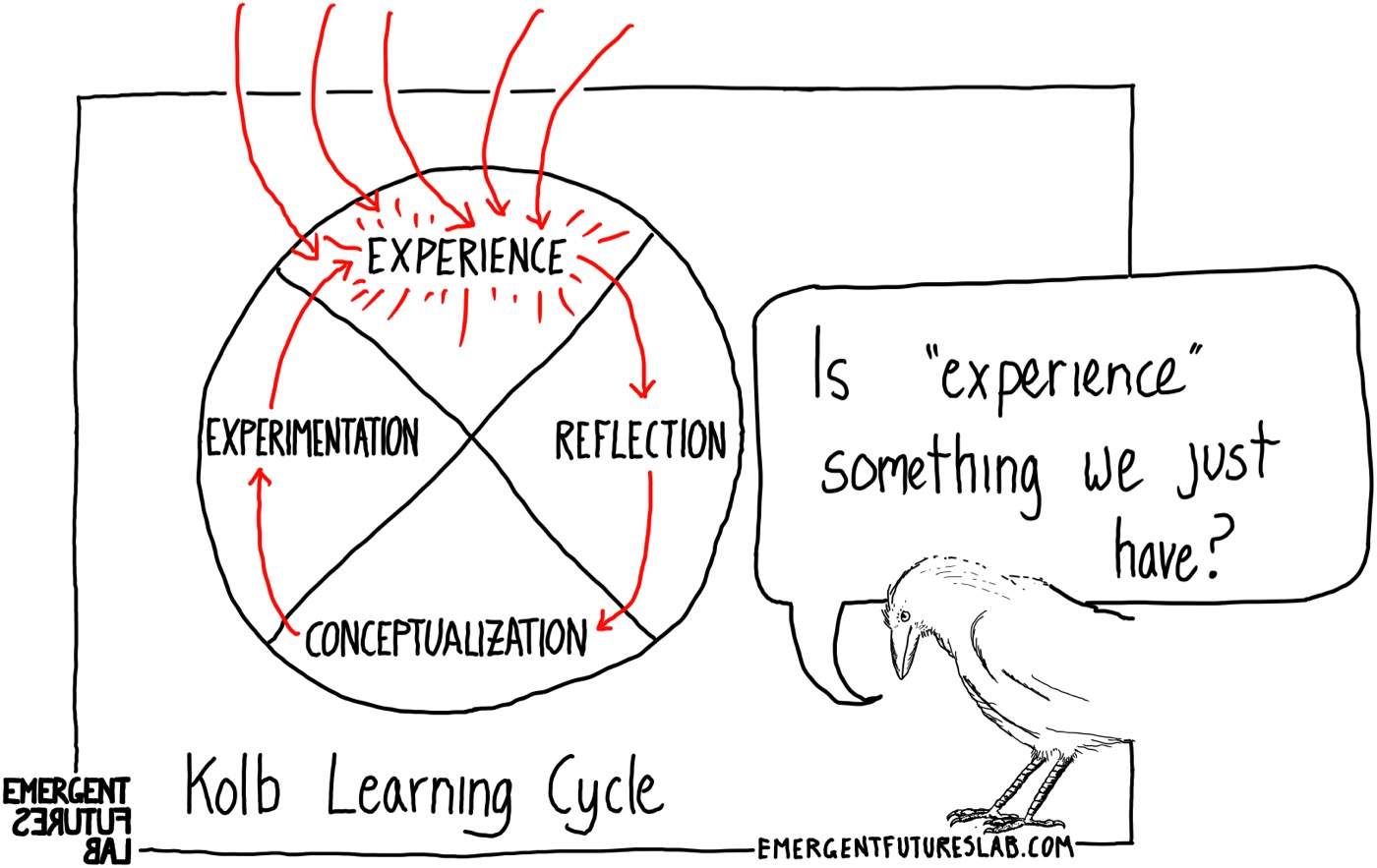
But the challenge of starting directly from experience, an open mind and curiosity, and hoping to see and do something different directly, is profoundly difficult. It is nearly impossible, because of our embodied, embedded, and extended practices – we always already see things as things (see volume 218):
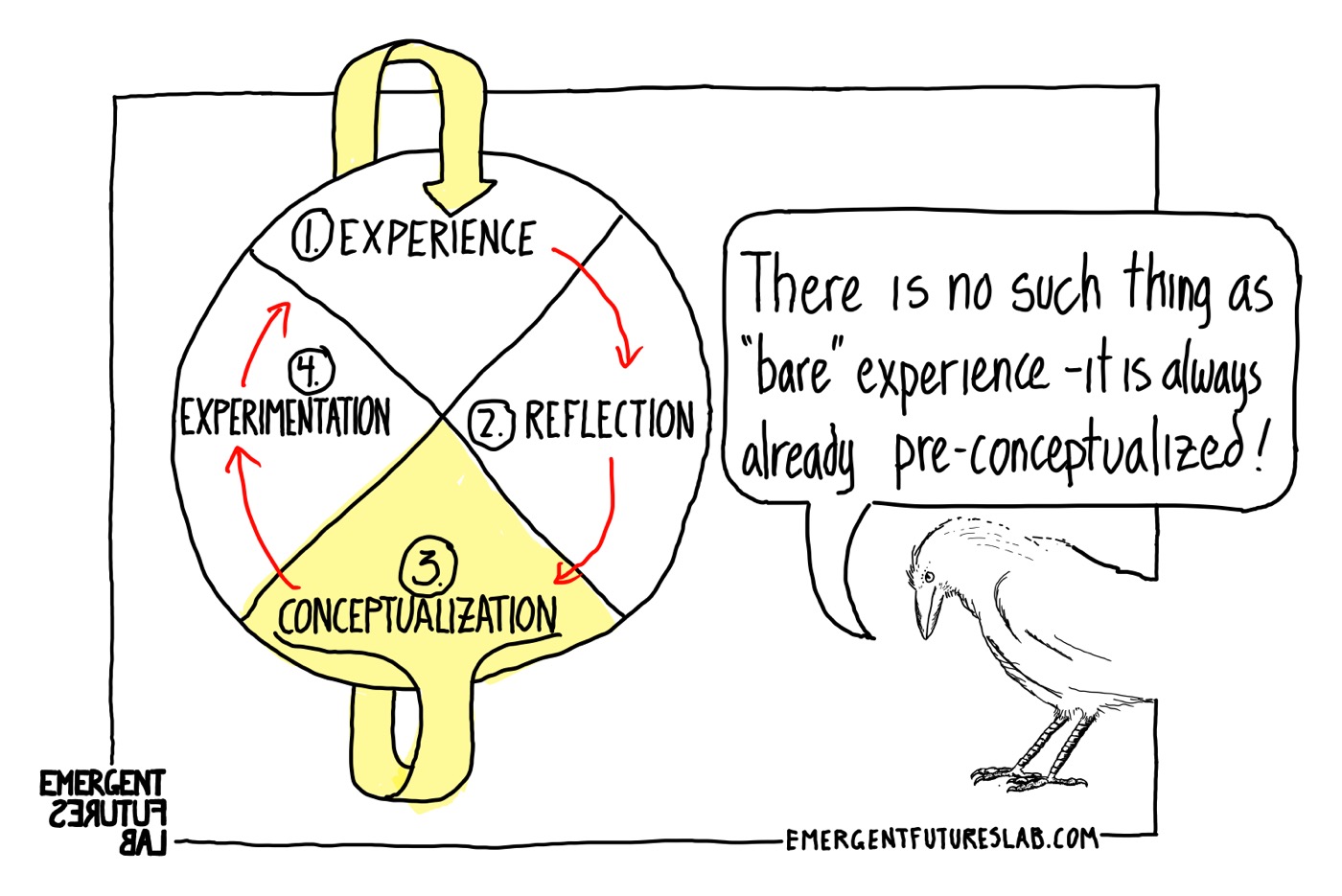
Being curious is alone, never enough. To develop a creative practice, we need to go experimentally beyond our embodied habits, embedded and extended practices, and what we actively see, sense, and know. To do this requires that we slow down and take time to critically disclose the entangled underlying infrastructural logic, assumptions, and embodied practices involved in how things have emerged into the way we pre-conceptualize things:
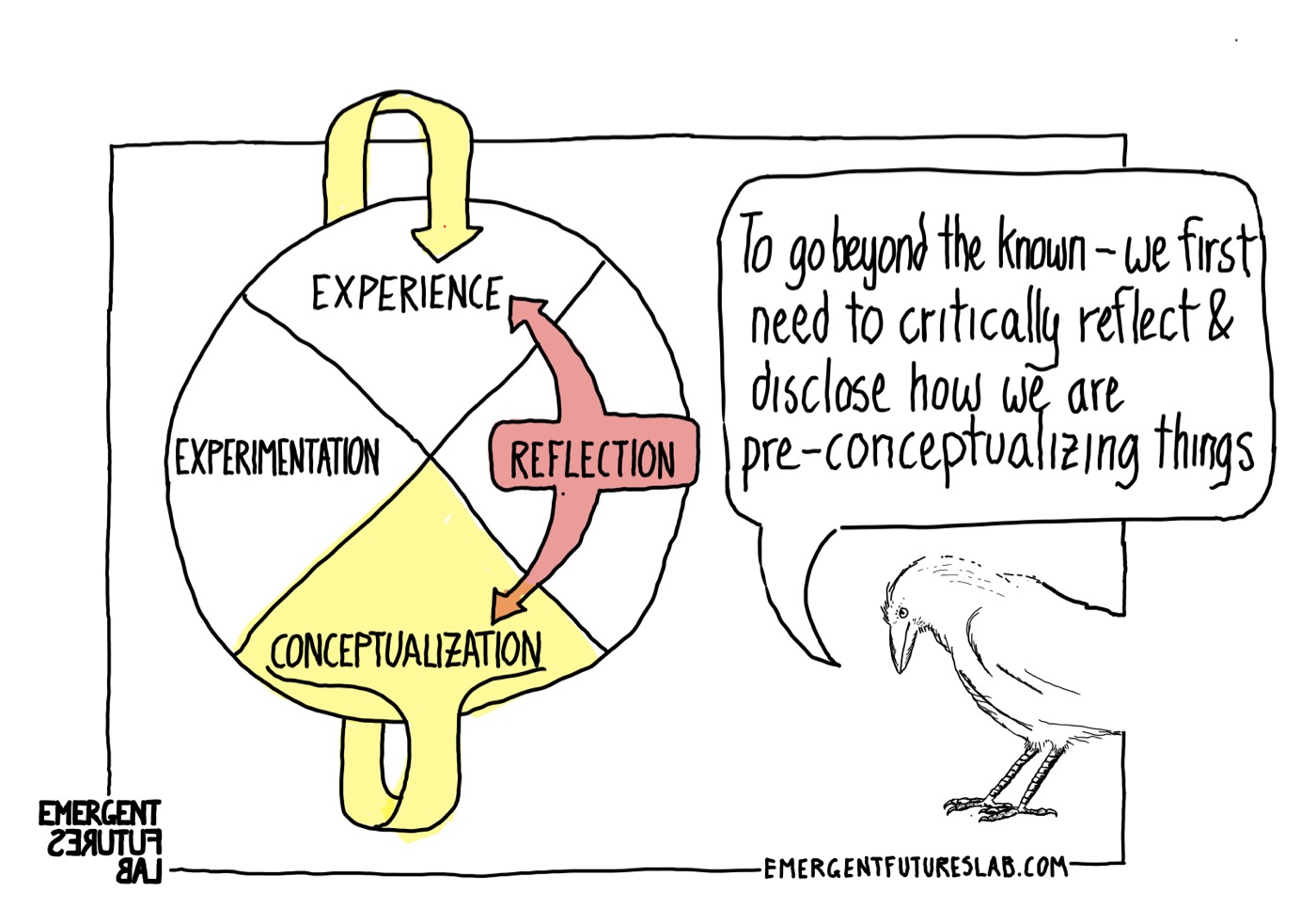
And only then can we ecosystemically disrupt the loop between how we have come to invisibly and habitually enact things (pre-conceptually) as things (what we call “blocking”):
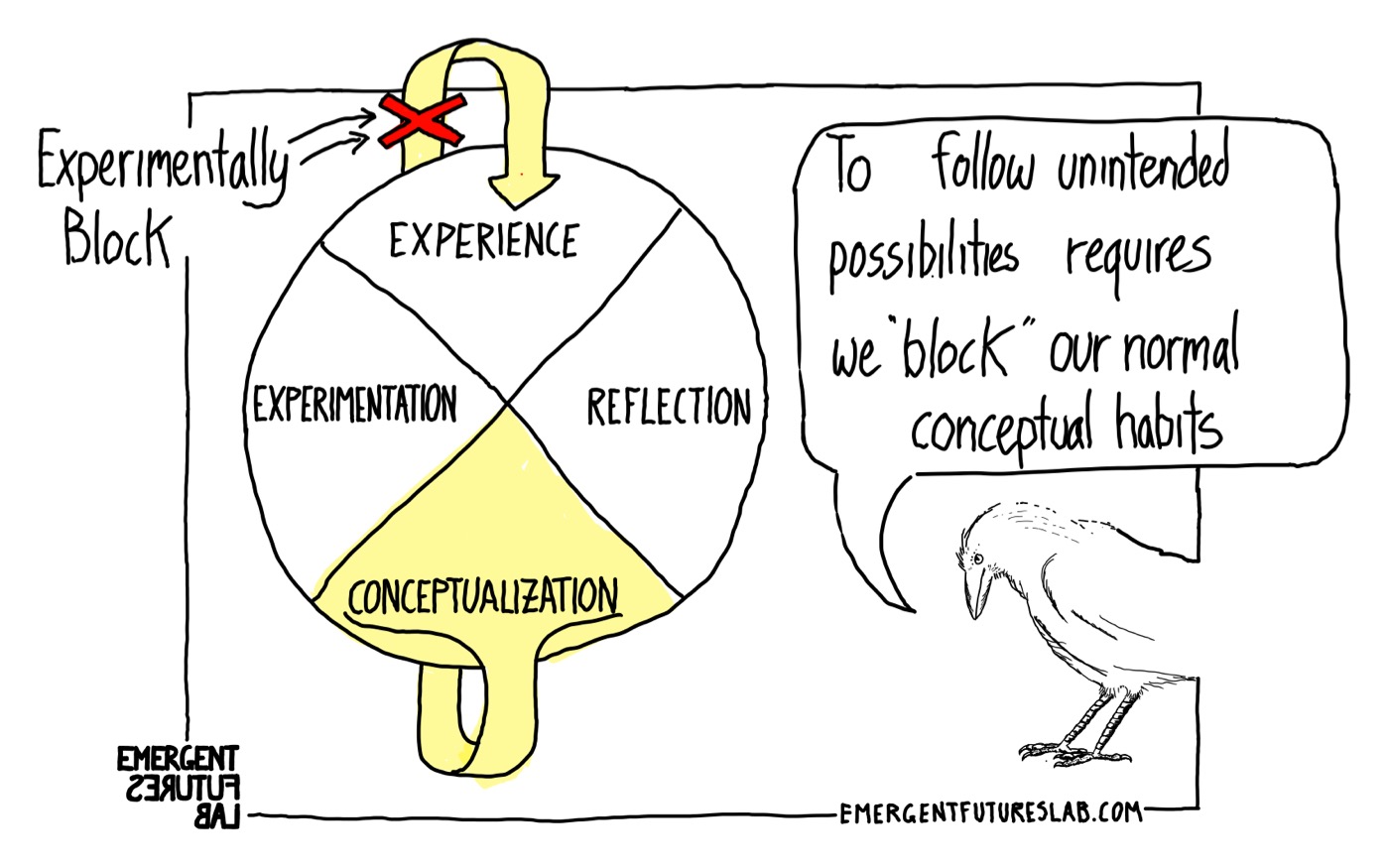
Blocking can be tightly circumscribed – as we see in the addition of limitations or rules to how one writes in the literary device of the Tanka, or short poem that Saigyo uses. The Tanka form has a five-line structure with the lines having a limited set of syllables (5,7,5,7,7). Or by blocking, they can cut across a larger scope of practices, tools, and environments. In either case, they act to force us out of habits, practices, and seemingly natural conceptual environments.
The challenge of direct experience and how to critically and creatively engage it should be clear to those who have read the last few newsletters. And these challenges are even more pronounced in the educational context, where so much of the focus is on forms of transferring pre-existing explicit conceptual knowledge. In such circumstances, it is hard to have a lighter and more experimental engagement with the known, the certain, and the well-established.
And – to make things even more challenging – the most common operating definition of creativity at work in our schooling system is that which is all about the development of original ideas and images – which is to say concepts! Thus, the unchallenged assumption is that creativity does and should start in a conceptual realm:
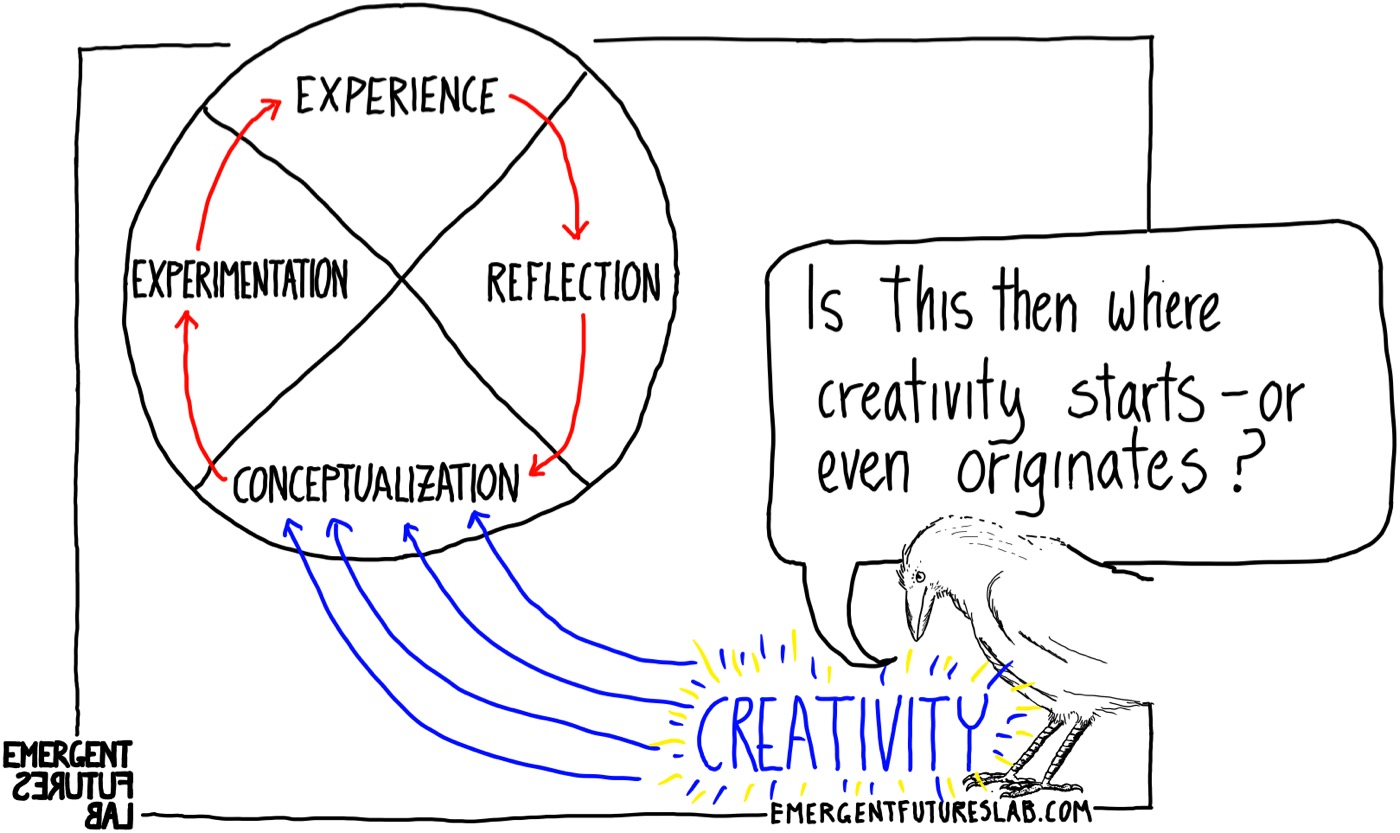
Hand-in-hand with this approach is the co-shaping of an environment and set of tools (the buildings, classrooms, desks, etc.) that act as a ratchet effect to stabilize these profoundly disembodied conceptual propensities.
The fundamental problem and blind spot in this approach is that there is no awareness that our experiences, which are giving rise to what we believe are new concepts via conceptual activity (brainstorming and the imagination), are already pre-conceptualized by a robust, standardized, and conservative ecology of practices, embodied habits, tools, and environments…
In our education system – perhaps even more so than in our corporate worlds – one of the most overriding, already ecologically shaped and pre-conceptualized logics is that of the intrinsic, unique individual.
While it can feel like our education simply takes for granted the existence of the natural and pre-given discrete and trait-based individual, it is an ecosystem that co-enacts such an experiential being.
If experience, identity, agency, and creativity are irreducibly emergent relational qualities, schooling is set up to shape us to feel experience quite differently. It is set up to make us feel like these relational qualities are emanating from deep within us: my grit, my creativity, my personality, my intelligence…
Consider one aspect of the school ecosystem: Assessments. From the moment one enters our educational system, assessments – both quantitative and qualitative are laser-focused on the individual, fundamentally internalistic and trait-based. How does this pre-form experience? How does this shape our internal and external affordance landscapes? How does this shape the forms our curiosity takes? How does this shape what we sense?
And this is the challenge of standing up a different experiential education focused on working explicitly with the reality that creativity is relational, more-than-human, distributed, intra-personal, and emergent. How do we get to such a directly felt experience? This is an infrastructural or ecosystemic challenge.
Last week in the newsletter, we went into the profound problems with this “fundamental attribution error”:

We are attributing emergent ecosystemic outcomes solely to the individual and their internal qualities. Our emergent sense-making outcomes of this ecology are so focused on the “figure” that we cannot see the “ground.”
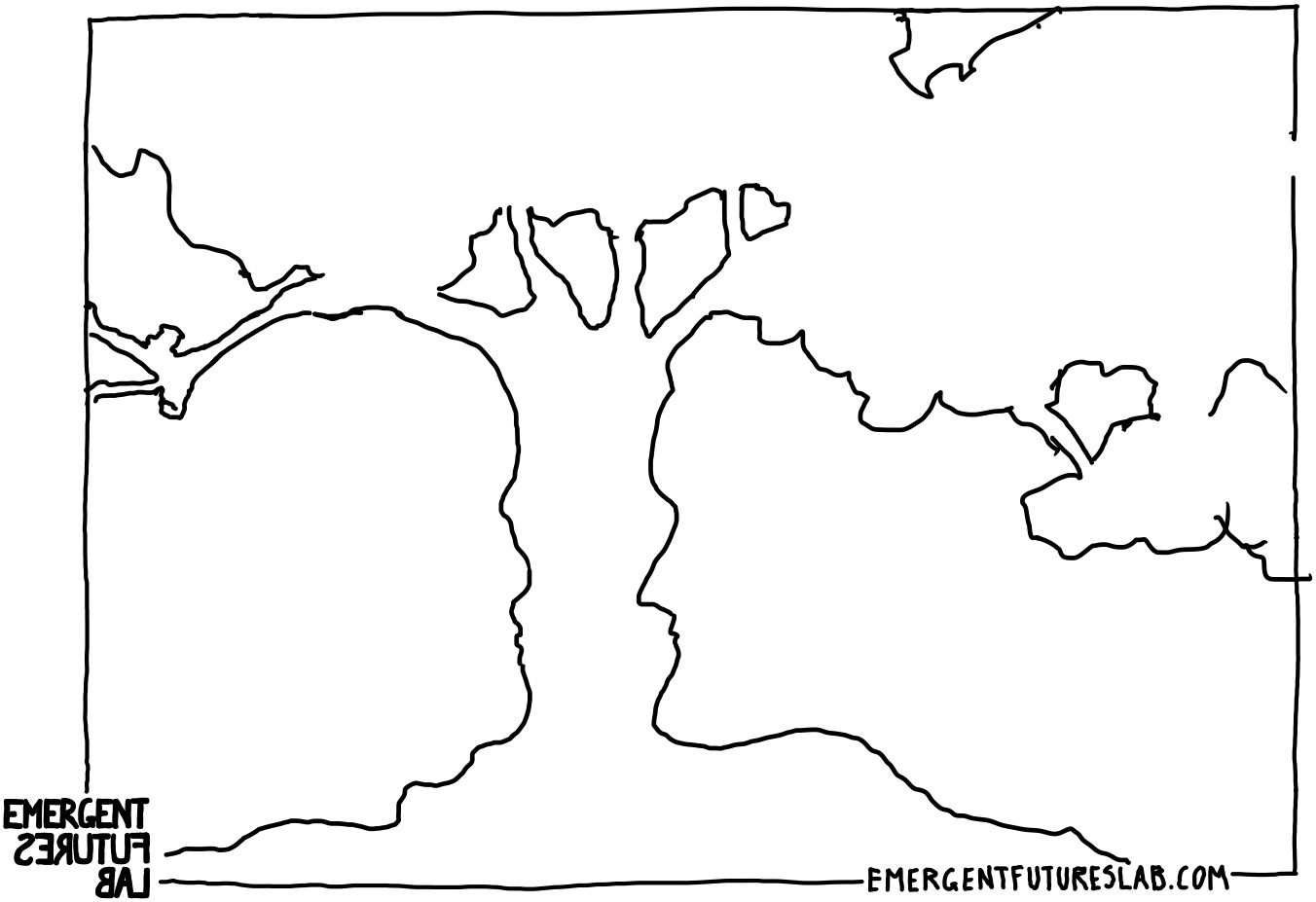
It's not that we don’t exist – that we are just an epiphenomenon of the highly distributed relational dynamics of some system. It is simply that we exist of and through intra-dependencies that can be profoundly changed but cannot be removed.
“There is no autonomous subjectivity… Agency, when embodied in living beings, can acquire experiential content… but this awareness of agency, characteristic of human bodies, is largely an illusion. There is no agent apart from action. Agency is not a permanent feature or property that someone has independently of situated actions, but the emergent product of material engagement… as a creative tension of mind and matter or flow and form.” (Malafouris)
Saigyo’s ambiguity – is this ambiguity. We exist and have agency – but it is not that of a sovereign – it is not the agency of a being who floats above it all – for us figure and ground – self and ecosystem are joined, reverse, multiply – and are forever ambiguous.
“Waiting for the Moon” should not be reduced to only “where I wait for the moon.”
There is a necessary ambiguity in Saigyo’s poem – as in our lives: the position and agency of the “I” cannot be separated from the position and agency of the event (the mountain, the moving of the moon, clouds, and winter rains).
For educational organizations, the challenge is that in many areas of educational systems, very little of the infrastructure can change to any meaningful degree. Rooms, tools, campuses, classes, timeframes, assessments, laws, locations, roles, rituals, practices, habits, and sensibilities – these are all pregiven and almost no one —especially not the students—has the collective agency to make changes in a meaningful and responsive timescale at these levels such that they could co-evolve with what novelty might be co-emerging. Figure and ground are far too fixed. And the aesthetics of how to experimentally come to genuinely novel experiences are far too often not on the table.
But as many educators pointed out to us – in every system there are many “temporary autonomous zones” – where unique degrees of freedom, novel collective forms of becoming, and relational alternative ecologies are being invented, supported and even expanded: clubs, societies, marginal sports, travel programs, drop-in-labs that host no official classes, and much else are both inventing differences that make a difference and keeping differences alive.
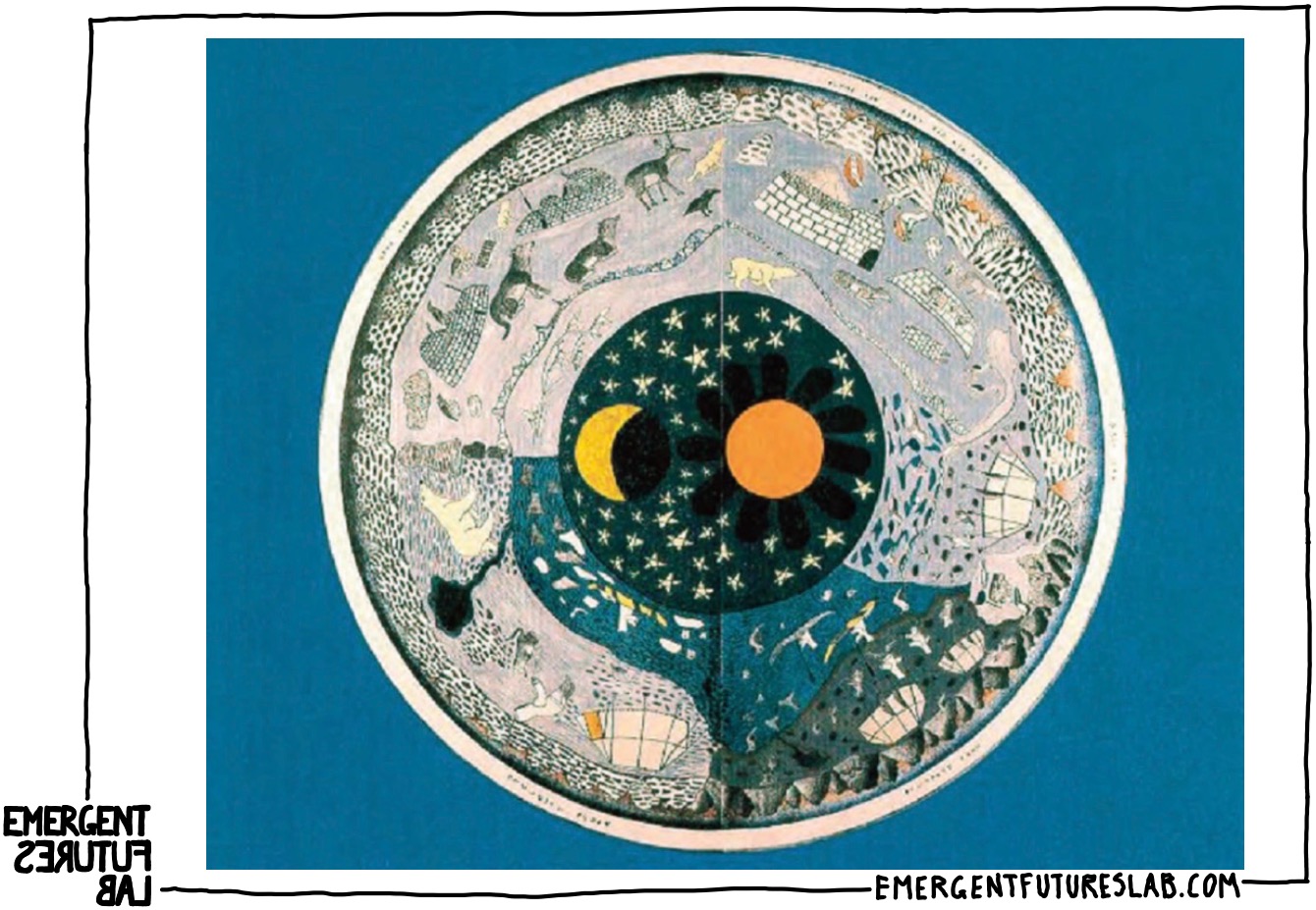
There are, of course, many more formal experiments that move in this direction, such as the Reggio Emilia Approach. Some of our many favorites – that feel especially relevant during this American Thanksgiving week include the development of Nunavut’s Inuit Qaujimajatuqangit (Inuit traditional knowledge and principles) that will shape their entire experiential education system by 2036. And the astonishing evolution of the Polynesian Voyaging Society and how it has co-evolved with a new Pacific-wide approach to experiential learning: the classroom is our world – and our collective creative world-making is our education…
What has arrived is American Thanksgiving week. Here it was Thanksgiving on Thursday, and America has been on the move. All the roads to the airport were already at a standstill last Sunday evening. And this will continue through this Sunday.
While none of us at Emergent Futures Lab will do anything crazy for this holiday, we are taking this creative transformation of roads to parking lots as an emergent opportunity to slow down this week. Definitely not travelling far. And definitely getting a nap or two in. We hope your week also affords similar emergent propensities.
Till next week – voyage far in creative ambiguity… and
Keep Your Difference Alive!
Jason, Andrew, and Iain
Emergent Futures Lab
+++
P.S.: Loving this content? Desiring more? Apply to become a member of our online community → WorldMakers.


