Newsletter
Resources
Courses
Books

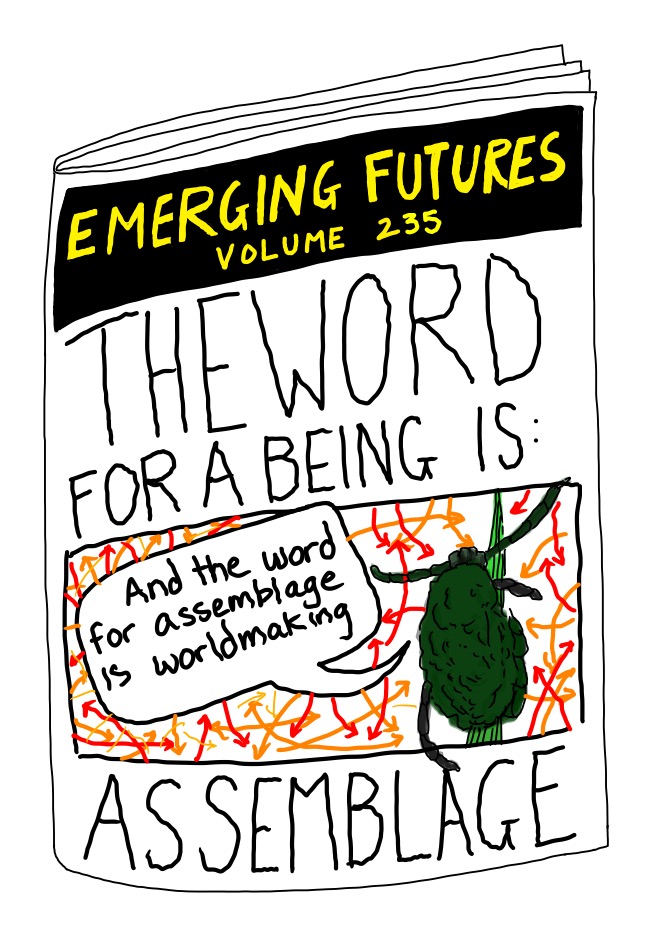
Welcome to Emerging Futures -- Volume 235! The Word for a Being is Assemblage...
Good Morning becomings of the event “Friday the thirteenth,” the moon is waning, and next Wednesday will be the new moon.
We are on the road this week in Graz, Austria, leading the second week of an intensive on Green Changemaking. It has been nice to be waking up very early (we are kind of on mid-Atlantic time – not quite in this time zone) and watching the moon disappear as it moves across the early morning sky as the sun just begins to rise.
As you read this on the morning hours of the eastern seaboard, we will be flying thirty thousand feet above the North Atlantic, going opposite to the rotations of the earth – heading home to put our feet up for a few hours.
The writing of this series on worldmaking has coincided with the weeks of this intensive we have been facilitating with our dear friends and colleagues at the University of Graz.
We are now three weeks into this series. Last week, in our online community of practice (WorldMakers), we did an experimental walking event to explore the connection between affordances and worldmaking. The event, with participants beaming in from diverse locations across the globe as they walked, allowed us to collectively experiment with enactive exercises. The discussions during this event and those that followed on WorldMakers led us to realize that we were still moving too fast and skipping over a critical aspect of worldmaking and what it means to “have a world”.
The irony is that part of the problem is in how we have framed our guiding question in developing this series on worldmaking: “What is it to have a world?”
But, when we put it this way, it can make it sound like it is something extra – something that you could not have. That “having a world” is an option.
Perhaps to say “I have a world” gives a false sense that there is me, there is a world, and then there is me and that world. But this independence between self and world is precisely what we are trying to challenge.
And this brings us to a bigger problem lurking – hiding in the implicit background: the classical Western approach to the individual. In this approach, we do imagine that individuals don’t have worlds – in fact, they have and need nothing extra (and perhaps even less than nothing).
The classical modern Western image of individuals is that they can be understood alone, naked, placeless – even genderless (which is synonymous with male) – and everything else is a bonus. This can be taken further (the “less than nothing” we intimated towards above), as Descartes does with his famous proposition:
I think therefore I am.
Here in this proposition, the world is gone, surrendering to an all-corroding doubt – and so too is the body. All that is left is the immaterial world of pure thought. And as such, this becomes a proposition much loved by the dangerous class of billionaire tech bros who imagine that at any moment we will have the ability to vacuum out our consciousness from our mere “meat sack” and download it as a series of zeros and ones into silicone.
We find this proposition and image everywhere we look. A non-classic example is that with the launch of the Voyager satellite onto journey far beyond our solar system, we sent this image out into deep space:
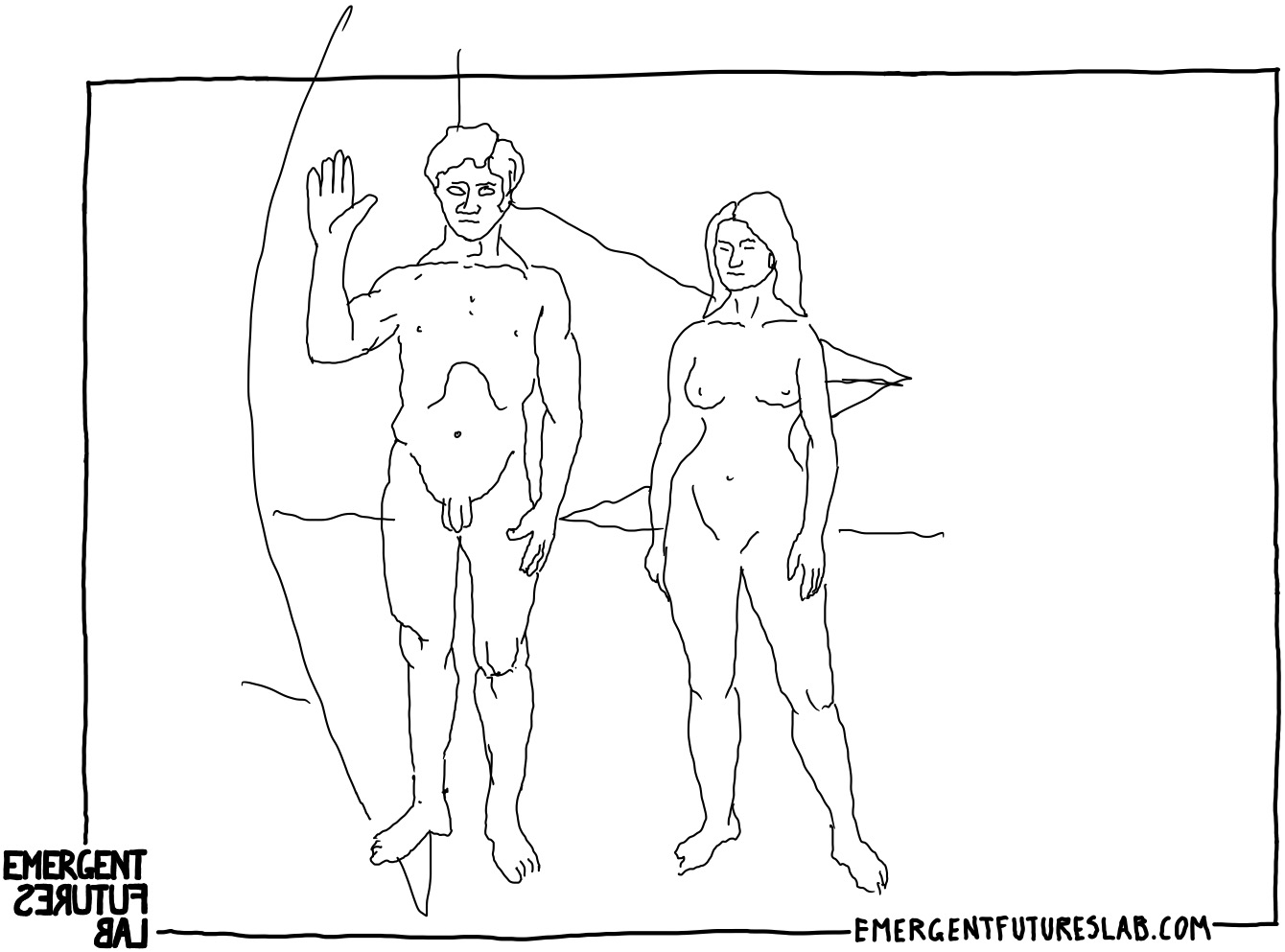
A naked white guy standing equally balanced on each leg, looking forward with his right arm raised beside a white woman with her weight on one leg, hands at her side, looking down and to the side. Putting aside the racial and patriarchal absurdities of this image standing in for the radical diversity of all beings that are considered to be humans, how would this image ever make sense?
Notice how even these seemingly far-fetched questions imply so much of an implicit background of knowledge of the environment, the specificity of embodiment, and the practices of these beings. If we imagine ourselves to be truly alien, we could not say a single meaningful and correct thing about this image – even after being told that these are “earthlings” – without knowing so much about their embodiment, environments, and actions. In short, their mode of worlding – their modes of worldmaking.
This image – and Descartes’ proposition are responses to the important and surprisingly difficult question:
What is the absolute minimum that can be said to constitute a human?
For Descartes – and far too many a tech bro the answer is simply “the mind” – some kind of immaterial internal subjective “content’. And for the designers of the Voyager project, it is not much more than a naked prototypical body floating in the ether. For both, the approach is reductive and essentialist. They strive to get it down to one singular, solitary thing.
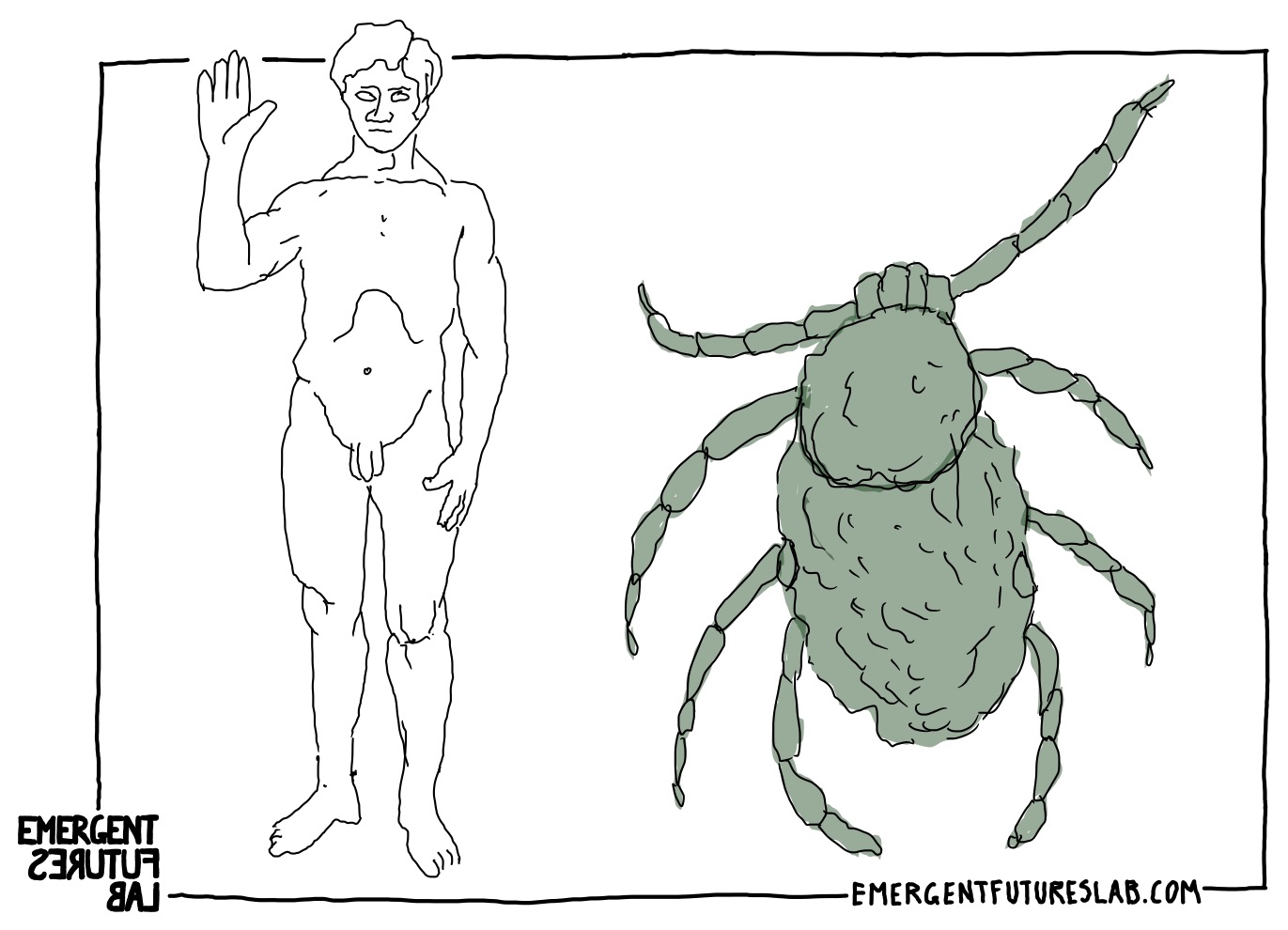
Such an approach is also found in our approach to the wondrous diversity of living beings. The Victorian beetle collectors pinning one tick beside the next in endless, neatly labeled rows, take this to a logical conclusion.
But what if the smallest – the absolute minimum that constitutes a singular living being is not singular – is not in-dividual (an indivisible singular unit)?
But what if, as our exploration of the world of the tick suggests, the smallest “unit” is an assemblage? A world-in-the-making?

And what if this assemblage is what we mean by “having a world”? Then there is no opposite to “having a world.” It is not an optional thing or choice we can make. To be alive is to have a world – to be of a world.
To be alive is to be dependent on other beings, and environments – to be emergent beings arising from the middle of an assemblage. Intratwined. Enknotted.
An important way to understand last week’s newsletter and our careful description of the environmental niche + abilities + bodily features + affordances/experience of the tick is that this is an exemplary example of the “smallest unit” of individualism. To cut the assemblage away from the tick would lead to there not being a tick.
But we cannot stop there. There is another danger that we could fall into: that we could make this assemblage a fixed thing – a fixed “world”:
The “World” of the Tick.
The “World” of the Human.
Then the world – this fully intrawoven world-in-the-making would simply and silently recede into the background – a mere stage that the tick struts and frets his hour upon. The “ground” – the background environment that is merely there. This is the world of Nature programs and Caspar David Friedrich:
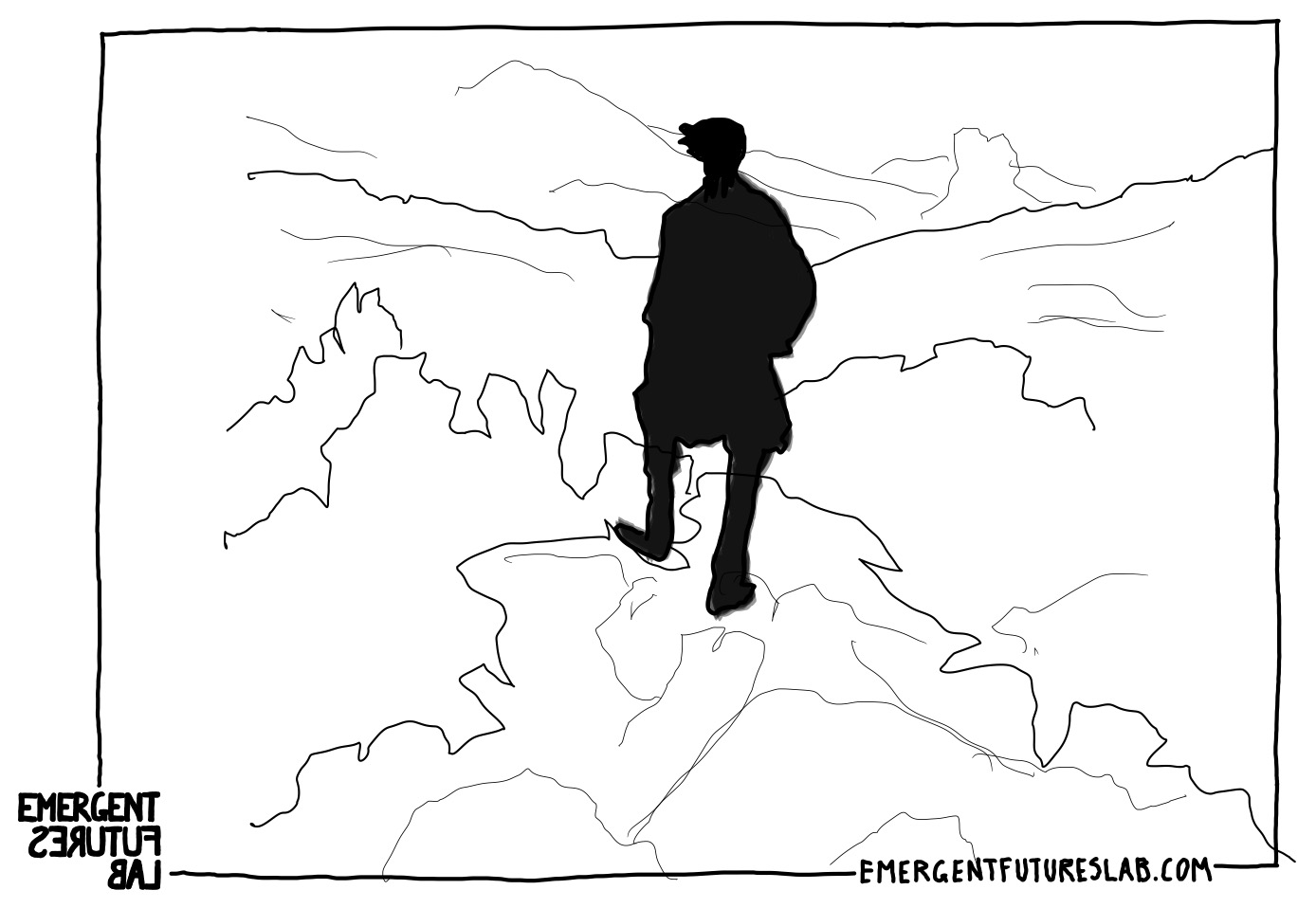
But each and every part of the assemblage is equally important to what is experienced, afforded, and lived. It is not that things can’t be taken away from the assemblage or that new things cannot be added, but:
The mutability – the changeability of an assemblage does not speak against its essential nature – it just alerts us to its inherently creative and experimental logic – that it is always in-the-making – a world in the making. A living worldmaking.
A final question – why not just stick to the word assemblage? What is added by terming all of this a “world”?
The tough part of using network-type terms like “assemblage” is that it does not convey the emergent and felt holism of experience. We, as living beings, don’t sense life as an assemblage of connections and relations between many discrete but relevant things – we sense it as a holistic experience. The relations give rise in an emergent, irreducible, and untraceable manner to experience – to a “world”…
It is always both an assemblage and a world(-in-the-making).
And this is where we leave you, our dear equally intra-woven assemblage-beings in worldly creative becoming.
Until next week,
Keep Your Difference Alive!
Jason, Andrew, and Iain
Emergent Futures Lab
+++
P.S. This newsletter continues in our community—where you can comment, question, and explore further. Emerging Futures + brings you into the conversation. Join here
P.P.S. WorldMakers goes beyond the newsletter: 40 live events annually, weekly podcasts and exercises, our annotated bibliography, and practitioners across diverse fields reimagining creativity together. Discover WorldMakers


