Newsletter
Resources
Courses
Books

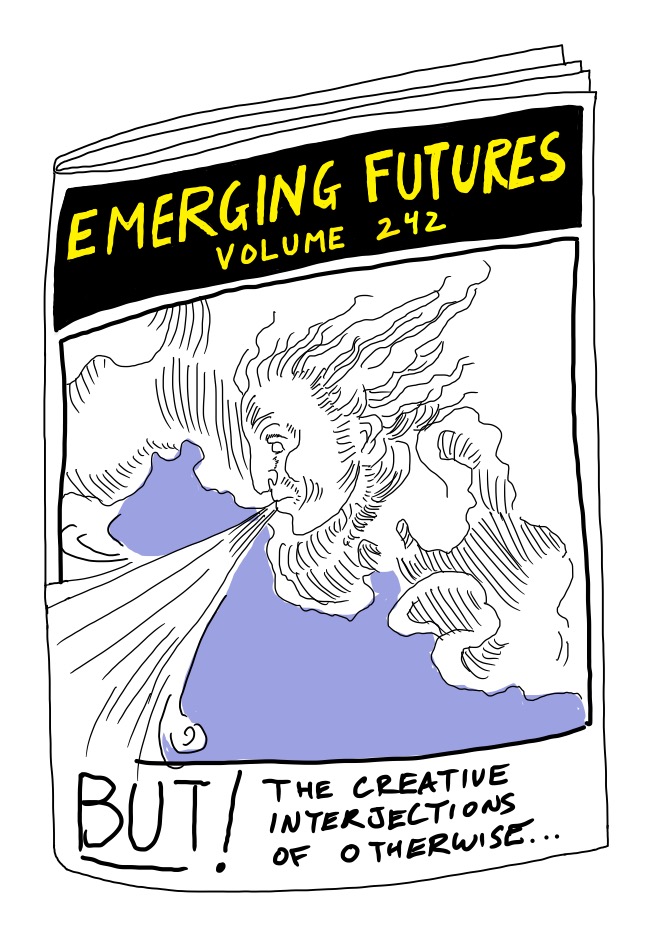
Welcome to Emerging Futures -- Volume 242! But – The Creative Interjections of Worlding Otherwise...
Good morning productive multiplicitous weavings of the far more-than-human,
May first – It is a grand day to celebrate all things labor – the forces, lives, and systems involved in the actual creative production of our contemporary reality – of everything.
But, as it is also the first full moon of Vaisakha – Vaishakha being the second month of the Hindu lunar calendar, which is the birthday of Siddhartha Gautama (the historical Buddha) in South Asia.
And this will not exhaust the other worlds that have this day in common – but not for the same interests… (Isabelle Stengers)
This Friday morning, under the setting full moon – the “flower moon” – the smallest full moon of the year – we are celebrating in our own way the creative forces working alongside us and countless others, both human and other-than-human, to give our most basic sense of experience the form that it has.
Creative labor indeed.
Last week, we ended mid-stream.
But – how could we not – when what we are investigating is a very hard to get a hold of question?
“What sort of enactive beings are we – such that both ourselves and things that are not us show up for us as being of a particular selfhood and thingness?"
It is a particularly hard question to get a grasp on – and to even put into a somewhat coherent sentence!
Developing from last week’s newsletter: We live in and of a historical way of being alive (a world or better said a “worlding”) that has creatively developed and stabilized a mode of being that senses, engages, and knows that the self and the world in its most important features to be universal, neutral, and ahistorical. In the modern West, we term these historical achievements: human nature and the factual basis for reality.
But, as the careful work of historians/anthropologists such as Peter Brown, Carolyn Walker Byman, Michel Foucault, and others has argued: what exists – must be produced – must be created. Things – human things – whether they are sensibilities, concepts, social regularities, embodiments, environments, or tools don’t simply exist and then come to be known, regulated, suppressed, or extended. Concepts and their vast network of practices and affordances, such as Human Nature, Psychology, Populations, Sexuality, the self, subject, and object, do not simply describe and then regulate something that was simply discovered out there. What is seeable, sayable, sensible, and knowable is rather co-created.
But this does not mean that they are fictions – things that are wholly subjective and purely relativistic – no, for that would mean that they are created solely “in our heads” from a mute and passive reality that is “out there”.
Rather, our most basic experience is the emergent outcomes (achievements) of assemblages that creatively loop through our bodies, our environments, our sensibilities, such that we are fully emergently bio-eco-enculturated.
Often this question of how we and things show up is framed as an Epistemological question – a question about what is knowledge, how it is acquired, and how it can be justified (truth vs belief, etc.).
But – these are not first and foremost epistemological questions about what and how we can know what we know. What exists and eventually becomes an object that can be known must first be co-produced (ontogenesis). Before it is “known” in a way that can be defined, circumscribed, and debated – something has to show up as experience – it is thus an ontological question. It is a question of worlds and worldmaking.
Our everyday experiential understanding is far broader and more primordial than what can be rendered explicit (knowable). Our general situationally embedded shared everyday enacted habits, embodied skills, and always already social practices give rise to the stable propensities in activity that allow things to become what “they are” and persons to become the historical situated subjects that can have those experiences that could give rise to ways of knowing. The ontological (our practices of being-of-a-world) precede our epistemologies (how we come from in a world to knowing what we know).
But – this distinction – and the lived quality of having a world is hard to fully hold onto. Perhaps a proposition to help us feel our way into this is “comportment”.
Comportment = our general bearing in most situations. Perhaps paying close attention to this can give us a sense of our immediate non-mentalistic stance as part of the “way of being” of a world?
An experience springs to mind: when we were in Alaska working with an Inupiat community on a project involving foodways (as introduced in the last newsletter) we cooked and served a dinner that we had collectively hunted and prepared. As the dinner is winding down and we are all sitting around and talking, Brian Weyauvanna says to me: “In our world, all of the animals speak – In the bible only one speaks, and he is evil…”. This is comportment – here is a stance towards a world: how do we act in a world where all creatures are speaking to each other, to other “species” and to us? Reflecting on this without judgment, it is certainly a very, very different stance from a comportment in a world where only humans speak and most of the world is absolutely silent. We act, sense, perceive, intuit, and conceptualize so very differently in general.
This conversation continued:Petia, who was part of our team (coming from the “south”), asked, “ If everything speaks, really speaks – are they talking just like us?”"Yes, but in their own language."She continues, "Do other parts of the world also speak?""Well, clouds can speak, as well as fire or trees, for example—in our world, everything speaks”."Then people, clouds, and seals are the same – they just have a different outer form, community, and language?""That's one way to say it."There is a pause, and now everyone is listening, and Petia asks one last question, "If all the animals speak like us, that changes everything—we have basically the same makeup as a salmon—no humans or animals, just communities of speakers and differing ways of life…?""I was always told that everything has the same soul, or spirit— ilitqun or breath. We eat spirits...""...Eating is the careful releasing of breath for rebirth?""I was taught that if you are deserving and a good hunter – that you share and are not greedy you'll continue to be successful," Boogles added.*"For us, all creatures hunt the same way, and the hunted chooses to be killed by good hunters. If you hunt poorly the departing spirit will tell others to go away and your hunting will be poor..." (*From Eat Your Sidewalk)
Such a profoundly qualitatively different comportment.
And also – here we sense how worlds are made – and this brings us back to the question of labor – and questions of making and labor bring us back to a politics (how all of this is organized, stabilized, and given form). But this will be a unique and odd politics – it is an ontological politics that considers how a world and worlds are produced such that experience, really, “an experience” is possible whatsoever.
But, this too is getting ahead of ourselves. Let’s stay with creativity and the labor in and of creativity for a moment longer.
Creativity is a ubiquitous worldly process – really multiple processes – and not something found in the heads of some humans (or perhaps all humans).
Creativity is everywhere and everywhere ongoing.
And this asks of us a new type of aesthetics and ethics – a new comportment – a new form of a collective activist care for what shows up and how it shows up. Gilles Deleuze writes quite beautifully of such an experimental aesthetic ethos as a form of empiricism. Empiricism is often seen as simply a view that all knowledge comes from actual experiences and is associated with a scientific experimentalism that is contrasted to more rationalist approaches to knowledge that argue truths can be derived logically. He offers an important and unique creative take on this stance:
“I have always felt that I am an empiricist, that is, a pluralist.But what does this equivalence between empiricism and pluralism mean? It derives from the two characteristics by which Whitehead defined empiricism: the abstract does not explain, but must itself be explained; and the aim is not to rediscover the eternal or the universal, but to find the conditions under which something new is produced (creativeness). In so-called rationalist philosophies, the abstract is given the task of explaining, and it is the abstract that is realized in the concrete. One starts with abstractions such as the One, the Whole, the Subject, and one looks for the process by which they are embodied in a world which they make conform to their requirements (this process can be knowledge, virtue, history...)...
Empiricism starts with a completely different evaluation: analysing the states of things, in such a way that non-pre-existent concepts can be extracted from them. States of things are neither unities nor totalities, but multiplicities.” (Gilles Deleuze, from Dialogues)
We could call this stance or comportment a particular aesthetics and ethics of an all-encompassing processual creativity – one that always starts with the actual and particular state of things as the creative outcome of contingent historical forces and not the mere expression of universal laws.
But it does not end there – intimately tied to this comportment is the realization that things will always creatively exceed the given – and that we are not outside of this. We are always an active part of the emergence of “non-pre-existant concepts” – a radical creativity.
Considering our contemporary realities from an ethical perspective – we need new lived practices – a new comportment that can meet this moment and take seriously the state of things from an aesthetics of “the abstract does not explain, but must itself be explained; and the aim is not to rediscover the eternal or the universal, but to find the conditions under which something new is produced (creativeness).”
But – is this enough?
The hidden difficulty in coming to terms with “the state of things” is that, as we wrote last week:“Over the last five hundred plus years, the 'global west' has developed a mode of being-of-a-world (worldmaking) that has come into its own in the modern era: it is a form of knowing/feeling/sensing/experiencing that transcends all particulars. There is an experience available to “moderns” (as the philosopher Bruno Latour has come to call those co-created of the West) that is placeless, timeless, universal, and transcendent – ultimately actively worldblind and world refusing.”
Deleuze’s call to be a particular kind of empiricist and pluralist takes on a very different urgency in this contemporary context.
But, first, what is the danger in being world-blind, world refusing universalist? Here, let us turn to Isabelle Stengers:
“The global West is not a "world" and recognizes no world. Referring to Deleuze and Guattari, I would rather characterize it as a "machine," destroying both politics and ontologies. No peace is possible with this hegemonic machine, because it knows only, as Bruno Latour emphasized (using another of its names: the advancing front of modernization), "pacification," or police operations. Those who oppose modernization are just "backward" or "misled." The agents of modernization do not wage war against such "bad pupils" and cannot imagine a peace settlement with them. At best, they will tolerate them up to the point when they make real nuisances of them-selves. As Latour concludes, "Yes, their wars, their conquests, were educational! Even their massacres were purely pedagogical!"
A world-destroying machine cannot fit with other worlds. Whatever its meaning, ontological politics is thus connected with the possibility of resisting our worlds ongoing destruction.” (Isabelle Stengers, The Challenge of Ontological Politics)
But, we are less certain about claiming that the global west is not a world – perhaps it is better to say that it is a world – and that it is an actively worldblind world – what Stengers defines as: one that neither recognizes worlds and is destroying ontologies (worlds) and the possibility of a politics of many worlds as its basic stance (comportment).
Thus, the ongoing world-making practices of the global West are ones that develop a primordial mode of experience that is worldless. And perhaps those of us in and of this worldmaking have as our most basic form of being-with-things (that is irreducible to explicit knowing) a feeling that a sameness always precedes and exceeds differences. That difference is always a difference in degree – a variation, ultimately of the same.
But – as Deleuze suggests – We need a new aesthetics of difference – one that, as its most basic form of being-with-things, senses and feels and acts such that qualitative difference – difference-in-kind is primordial.
This is, to paraphrase Stengers, the comportment of “how do we feel, sense, dwell in such a way such that We have interests in common which are not the same interests…” – Rather than a comportment of “we have interests in common because deep down we are all the same”?
This is our creative challenge – both as an ethico-aesthetically engaged “stance” – a form of lived practice (labor) – and as an ontological politics.
But, we still should not rush into a “politics” without some sense of how our primordial everyday non-cognative way of being-of and being-in a world (this general comportment) comes about.
But – this question cannot simply be asked in general, to do that is not enough because worlding is never “in general” as we have seen both in terms of Stengers diagnosis of the contemporary global west and in our meeting the equally contemporary Inpiaqut peoples – or the Na̱mǥis First Nation, one of the hereditary chiefs Don Svanvik, and the Kwakwa̱ka̱ʼwakw peoples in general (from last weeks newsletter).
How do we come to be the kind of beings we are today? How did we come to have our explicit and implicit sensibility, embodied habits, concepts, and practices?
Every aspect of who we are, what we sense, and what we do has a history, and every aspect of this could be otherwise. Thus, we need a critical “history of the creative ontological genesis of the present.”
A history of the mechanisms of the ontogenesis of our world.
This will not be a progressive history (how we uniquely shed the shackles of some primitive and superstitious past, unlike other cultures), or a history of the great actors/agents (how certain human agents by dint of their genius uniquely transformed the world) – for both of these approaches are profoundly worldblind and ultimately world erasing. Rather, what is required is a situated active uncovering of the interwoven processes, concepts, developments of embodied habits, tools, infrastructure, rituals, and environments that are co-shaping us into the ontological/worldly beings that we are.
For this task, Deleuze turns to the work of his colleague and friend Michel Foucault (1926-1984). Foucault, a philosopher and historian in equal measure, took as a primary concern: to understand historically how we became the subjects that we are (questions of ontogenesis). Deleuze understands this investigation to pivot around the systematic processes that Foucault termed in French a “dispositif.” This word is often translated as an “apparatus”.
“We belong” Deleuze says, “to social apparatuses (dispositifs) and act within them” (What is a dispositif?)
But – as insightful as this is – the English term “apparatus” does not do justice either to the word or the concept (It has also been oddly translated as “deployment,” and “layout”). Other common French meanings are: device, construct, and organization.
So what exactly does Foucault intend with this term?
As Stuart Elden, a political geographer and Foucault scholar, notes a dispositif “is more than just an apparatus or mechanism” for Foucault. It is best understood as an evolution of his own thinking about how we become who we are. A quarter century earlier, Foucault would have termed what we are an “Episteme” – which he understood “as a collection of rules for the formation of knowledge” of the sayable, seeable and doable. But this lacked “relations of power, practices and actions… [A dispositif] provides a context, framework or, even, a structure within which individual instances of behavior, pieces of knowledge and acts of resistance find their place and meaning” (Elden from Foucault’s Last Decade).
In an interview on his work of this period, Foucault has this to say about the concept dispositif:
"What I'm trying to pick out with this term is, firstly, a thoroughly heterogeneous ensemble consisting of discourses, institutions, architectural forms, regulatory decisions, laws, administrative measures, scientific statements, philosophical, moral, and philanthropic propositions–in short, the said as much as the unsaid. Such are the elements of the apparatus. The apparatus itself is the system of relations that can be established between these elements."
A “dispositif” is, in short, the co-constructive relational web of heterogeneous practices for the creative production of our becoming of a being-of-a-world.
But – we have to understand this assemblage of practices to include a heterogeneous mix of everything from environments (architectures), to laws, to institutional practices, to basic tools, to learnt embodied skills, and more. This gives us a way to understand how we come to have a world via heterogeneous systems. And equally importantly, it also is not something that dissolves into a thousand tiny worlds – the world of watchmakers, auto mechanics, ballet dancers, etc. – it allows us to sense how our general socio-cultural comportment emerges in specific and concrete creative ways.
Equally importantly, for Foucault, a dispositif is not an iron cage – it has a diverse breadth of differing affordances and becomings – novel lines of flight:
“The different lines of an apparatus (dispositif) divide into two groups: lines of stratification or sedimentation, and lines leading to the present day or creativity… What new modes of subjectification can be seen to appear today…” (Deleuze)
So – now how can we come to terms with the concept of “world” with these insights? The first thing to do is to note that a world is the nearly invisible shared emergent background of experience and intelligibility that arises from the interactions of those within a specific dispositif.
But – let us extend this in an enactive manner: an “apparatus” (dispositif) is any relational assemblage of things that that we are an active participant in and of – that has in some way the capacity to stabilize, emergently orient, and specifically afford an open but discreet set of potential sensibilities, dispositions, comportments, behaviors, understandings, of a collective of living beings that we become.
An “apparatus” in this sense is an open heterogeneous multi-scalar responsive system that has the capacity to stabilize and enable the specific historical creative practices of a community and transformatively shape/create these practices in a different and unique enactive manner. It is how our “watery souls” (Marshall Sahlins) – which are flexibly equipped to live a thousand different lives – end up living one. End up of “a world” – even if we mistake it for “the world”...
The contemporary western universalist anti-worlding logics are best understood as a specific historical example of an apparatus or dispositif – it is more than just an idea, worldview, or mindset – it is, as all modes of being-of-a-world are – literally the entangled emergent outcome (comportment) of “discourses, institutions, architectural forms, regulatory decisions,” etc., etc.
But – the critical and creative question – and comportment from within this – and any dispositif and its mode-of-being-of-a-world is:
To start with a completely different evaluation: let us analyse the states of things, in such a way that non-pre-existent modes-of-being, affordances and concepts can be extracted from them – such that other worlds become possible…
Until next week,
Jason, Andrew, and Iain
Emergent Futures Lab
+++
P.S. This newsletter continues in our community—where you can comment, question, and explore further. Emerging Futures + brings you into the conversation. Join here
P.P.S. WorldMakers goes beyond the newsletter: 40 live events annually, weekly podcasts and exercises, our annotated bibliography, and practitioners across diverse fields reimagining creativity together. Discover WorldMakers
Two questions, every Friday since 2020:
What is creativity? and How do you innovate?
A weekly experiment in emergence, creativity, and change-making.


