Newsletter
Resources
Courses
Books

Welcome to Emerging Futures -- Volume 243! World-Making – A Review Discussion - Part One...

Good morning wide tendrils of ontogenetic possibilities,
This week begins our “wrap up” of our ten-plus volume series experimenting with World-Making.
While we have now done many multi-newsletter series exploring topics from Affordances to Visualizing. In those series, we explored the topic deeply, but we did not add supporting materials. In this series, we are trying something different – looking ahead over the next seven newsletters, we are going to provide exercises, a glossary, and a bibliography/introduction to key figures. This will bring the series to seventeen volumes of the newsletter – quite a long and interesting experimental run! And given that this approach fully weaves, supports, and is active throughout all of our work, the length is only fitting.
We will begin this review phase of the series this week with the first part of the edited and augmented transcript of a discussion Jason and Iain had reviewing Worldmaking as an approach, covering the whole ten-volume series.
Over the last week, Jason and I both reviewed all of the newsletters – as well as all of the associated events that we did in our community of practice, WorldMakers (live events, collective exercises, podcasts, and online conversations) and then sat down for a few hours to have a lively discussion (over much coffee) on the critical importance of the worldmaking approach and the series..
Below is a lightly edited and augmented version of this conversation (note that the full, unedited conversation is available as part of worldmakers). As it is a long conversation, we have broken it into two parts. Below is the first part; next week, the newsletter will contain the second and concluding part of our discussion.
---
Jason: Welcome, everybody, to a special discussion digging into our ten-volume series on World-Making.

Today, Iain and I will be discussing Volumes 233 through 242. It's been a 10-week journey where we've been working through world-making and worlding. There are a number of really interesting themes and topics that came out of this newsletter series: from subjective-objective to transjective, individual to assemblage and individuation, and from embodied mind to enminded world.
We went from static images to lines and loops, ontology to ontogenesis to an ontological ethico-aesthetics and politics, and a lot of really fascinating glossary terms in the middle to help figure out how to articulate all this. All the while connecting world-making intimately to a new approach to creativity.
So, Iain, let's start. What is the series about? World making – we’ve certainly defined it in the newsletters a number of times, in a number of ways. But, as we said in volume 242, this is a really hard topic to understand – it's also a really hard topic to articulate, right? And you expressed that it is a challenge that you were wrestling with yourself, even after nine newsletters.
This is still hard for me. I know it's hard for you. What was the goal here? What were we trying to get to?
Iain: There were really two goals. One was a synthetic goal where all of the things we've been talking about for the last few years in the newsletter: affordances, emergence, enaction, exaptation, sense-making, complexity, processes, blocking, probing – as well as the experimental practices of engage, disclose, deviate, co-emerge – they all are not just useful tools and concepts that are entirely distinct from each other. They're really of a piece, and they're of an approach to engaging with creative processes. And that approach, world-making, is what we were really trying to get at with this world-making series.
And secondly, to dig into what's behind this approach. And what's behind it is an active collective perspectival approach to reality, which understands how we actively sense, feel, and experience is grounded in the dynamic relations between environments, practices, assemblages, others, and collective things. This situated direct experience can't be reduced to the truth in a scientific sense of a view from nowhere that discovers the essence of everything. Where either your experience is closer to it, or you're further from it. And if you're really far from it, it's just superstition, and if you're close, you've got it “right”. It is an approach that frames experience and reality as one where we are living in a universe where there is, in general, one proper way to access reality – and thus generally speaking, one way to be alive in general – and if you differ to far from this, as interesting as it might be, it's a lot of superstition and inaccuracies. But rather, worldly approaches are grounded in the logic that many worlds exist – that we live in a pluriverse where there are many ontologically different collective ways to be alive, each given rise to a qualitatively differing mode of direct experience.
So it's combining all of these parts into a synthetic understanding of what world-making means and worlding means, and how it really transforms one's stance to others, experience, consciousness, daily life, and creativity.
Jason: That idea of the pluriverse really opens things up. I think that in a very challenging series, with a lot of philosophers and a lot of new concepts – the pluriverse is the wedge in. It's because it’s not a universe. One universe versus, there are many “verses” – there are many worlds. There is a pluriverse.

There are multitudes in all ways, in all places, in all spaces. And in fact, if I were to boil world-making down to its simplest form to allow one to explain it to a five-year-old, that might be the path that I would choose to articulate what this was about – the content, the purpose would flow through a discussion of a pluriverse.
Iain: Yes – I feel that too. And this is why we began the series with a story of the tick and its world – and we expanded from the tick to the example of multiple ways of engaging with water.

The tick example is a really great one because it's so odd to us as humans, that the tick senses four things and through these engagements experiences and lives of a unique world. And here, I think the word “sense” is really important. It's really another word for experience. We think of our five senses as independent, but how you have an experience is always synthetic. Sense-making is ultimately world-making.
The ticks' experience is in the same environment as us. We could be walking through grass, feeling the sun, and that's our experience. But the tick is having an entirely different one. Because it has a different mode of being alive, it's not seeing things, but it's sensing things in other ways. It's responding. It's hard to know if it has anything that you'd call objects in its world, as we have. And so understanding the ticks world starts to estrange the idea of experience from us – that it's all just variations of something similar.
And then when we get to our water example, where we're talking about something, again that feels so familiar to us as an experience: of wading in water, jumping in water, floating in water – all of those things, and because of this intimacy, we feel that this is what water “is”. Additionally, we might be able to say scientifically, it's H2O – these molecules that are bonded.
But then, when you get to something like a water skimmer and all of those insects that skim on top of the water, their experiential reality of water isn't of a “liquid”, it's of a kind of tensile surface. This skin, this membrane that they're attached to – bonded on a surface – they figured out a way of electrostatically moving on it. And it's something we have no experiential connection to – even while we can see it.
Then, if you think of something smaller like a paramecium, it's basically having some type of experience, like if we were in maple syrup or something thicker, so it's not in a liquid the way we think of it that splashes and moves, it's something very different.
And if you go down all the way in scale to the smallest bacteria, none of those things hold true to their experience – to their sense-making. They're being bounced around as if by marbles.

Water striders, paramecium, and bacteria – all share a “common” water – but live in very different and very real worlds.
One common, but problematic way to think to understand these qualitatively different experiences is that you could say that's all just “relative to them” – then you make experience subjective: "I feel this way” and “They feel that way."
But it's important to say, they don't feel it subjectively. It is what it is.
And by “is” – water is “for us” a liquid such that the body floats. It's not up to you to decide subjectively what it is. It's relationally because of the density of water to the density of your body, to the amount of things that are lighter than water with gravity, and what have you, the social practices that you are of – it emerges relationally as this experience that's physiologically real.
Physiologically, it's entirely different for another creature. So it's not subjective, but it's lived, and it's 100 percent relational, it's entangled and involves habits, skilled practices, others, social systems, how you're embodied, the scale, the environment, and then floating emerges or being bounced around emerges.
I think it really becomes clear when you just stick to the human with our second water analogy: Is water a liquid? It behaves like a liquid that supports our body, slows your fall down when you're skilled in certain ways, and jumping in from a few feet or meters. But if you climb up some magical diving board that's, I don't know – 1,000 feet tall and you jump in, it doesn't matter what you subjectively think "Oh, I can make water do whatever” – the water will now relationally emerge experientially as a solid.
And God forbid that we're pulling your body out, but if we did, the injuries that you would've sustained look exactly the same as if you had landed on concrete from a great height – because essentially you have landed on a relationally solid medium. But, if you look at the water molecules, they're the same in all these cases – but they're relationally emerging as totally different things.
And this is what it means to live in a pluriverse. It's not subjective. It's a relational assemblage that's giving rise to this experience, and experience isn't subjective in the sense that it's just in your head. It's very real when you hit water as a concrete. It's solid. And it is equally very real when you hit water, and it slows your body down.
It's very real when you float there in the sunshine. It's not subjective in the sense that you make up what you experience “in your head”. And I think this is the really important part, and it shifts everything about how we think about being in a world and having experiences. In the first instance, this is what it means to “make” a “world” – world-making.
Jason: Yes. And the word that we like to use there is “transjective” to get out of that subjective, objective divide, right? That direct experience is neither purely objective “out there” nor purely subjective “in our heads”, but transjective arising through the relational interactions of our skilled embodied being with an environment, with an assemblage, with the doing. With these mediums that, as you said, are not purely up to us.
Iain: The word transjective is super helpful. I think both subjective and objective are not helpful terms. The subjective puts it just inside your head, and the objective makes it as if it's just out there. But with such an approach, we don't see that they loop through each other and that our emergent relational experience of water shapes how we engage with water, which changes water, and then that changes us too.
So it's not like water is “out there” and humans have this kind of experience and water striders that and paramecium, another – but the “objective” thing stays unchanged – untouched. I think it's really important to see that all of these creatures are changing things – co-shaping – really co-creating this “common” environment.
It is as we were saying, quoting Isabelle Stengers – “things can have interests in common, but they are not the same interests”. It's different for each being, and way of being, and because we're each active, all living things are co-creative.
That's why I think the tick is such a good example, because we know the tick changes us when we get Lyme's disease. It's not merely out there. And if our industrial practices change, the temperature changes, if it's too cold, ticks come out later. And then the tick – they're shaping how grasses form versus trees because they're changing the behavior of deer – the deer are eating plants in one area more than another. Where they eat and what they eat is shifting the so- called out there – and it is all entangled with qualitative differing experiences and conjoined actions.
So that's why subjective and objective aren't really helpful, and that's also why it's not a mental world-view, and it's not just a world, but world-making. There's always making here. And this is why we also could say worlding, and we're co-worlding in different ways with all of these beings, and it's all looping through each other – and thus it is correct to say that there is a pluriverse.
Jason: And I think there's no surprise that we use non-humans as the examples in the majority to demonstrate that this world – worlding is taking place – that these creative acts are taking place external to the brain-bound individual human at the center.
What you're just describing is the niche construction, right? The evolutionary process by which organisms do not simply adapt to preexisting environments, but are actively modifying and co-creating their environments in ways that feed back into their own evolution.
I thought of this concept just now, as you were saying the deer are eating this over here because that's where it's growing, and then they're moving around…
Iain: …that's a hugely critical part of it – why there's grass for ticks in New England is because we've created meadows for sheep and cows. We've cut forests. We’ve developed a system of meadows and urban parks as we have made a series of novel multispecies niches – all these entangled mutually co-shaping systems…
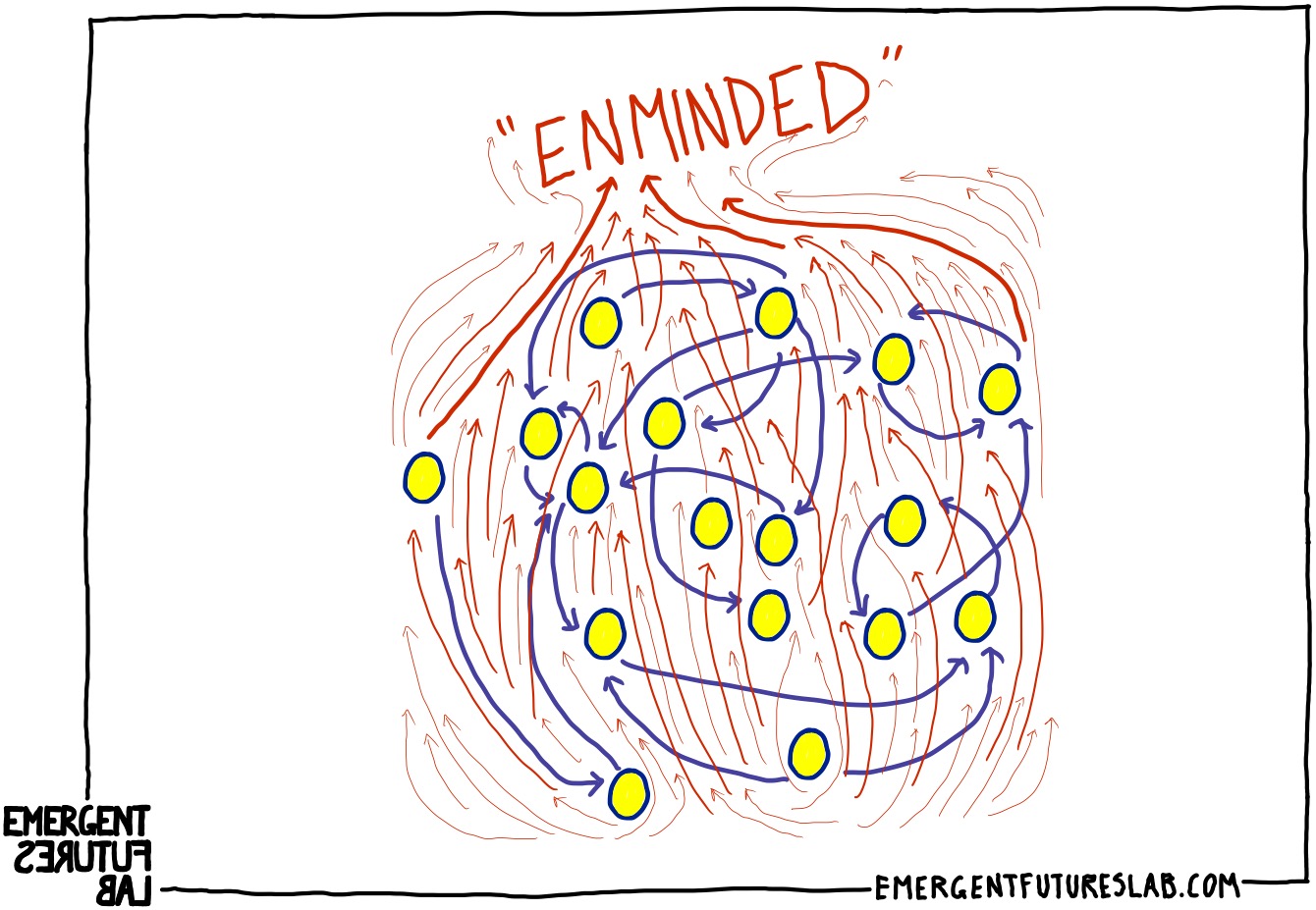
Understanding the role of the overlapping niche constructions gets at the next really important analogy and shift that you were mentioning at the beginning: from being a mind that is embodied, embedded, and extended to differently conceptualizing ourselves as a particular kind of assemblage that is enminded.
This can sound really peculiar – like an overly complex way of saying something that's very simple. That's where our analogy – that we borrow from Evan Thompson, about “Where is flight in a bird?” – that flight is not in the wing, it's not in the feather, it's not in the bird.
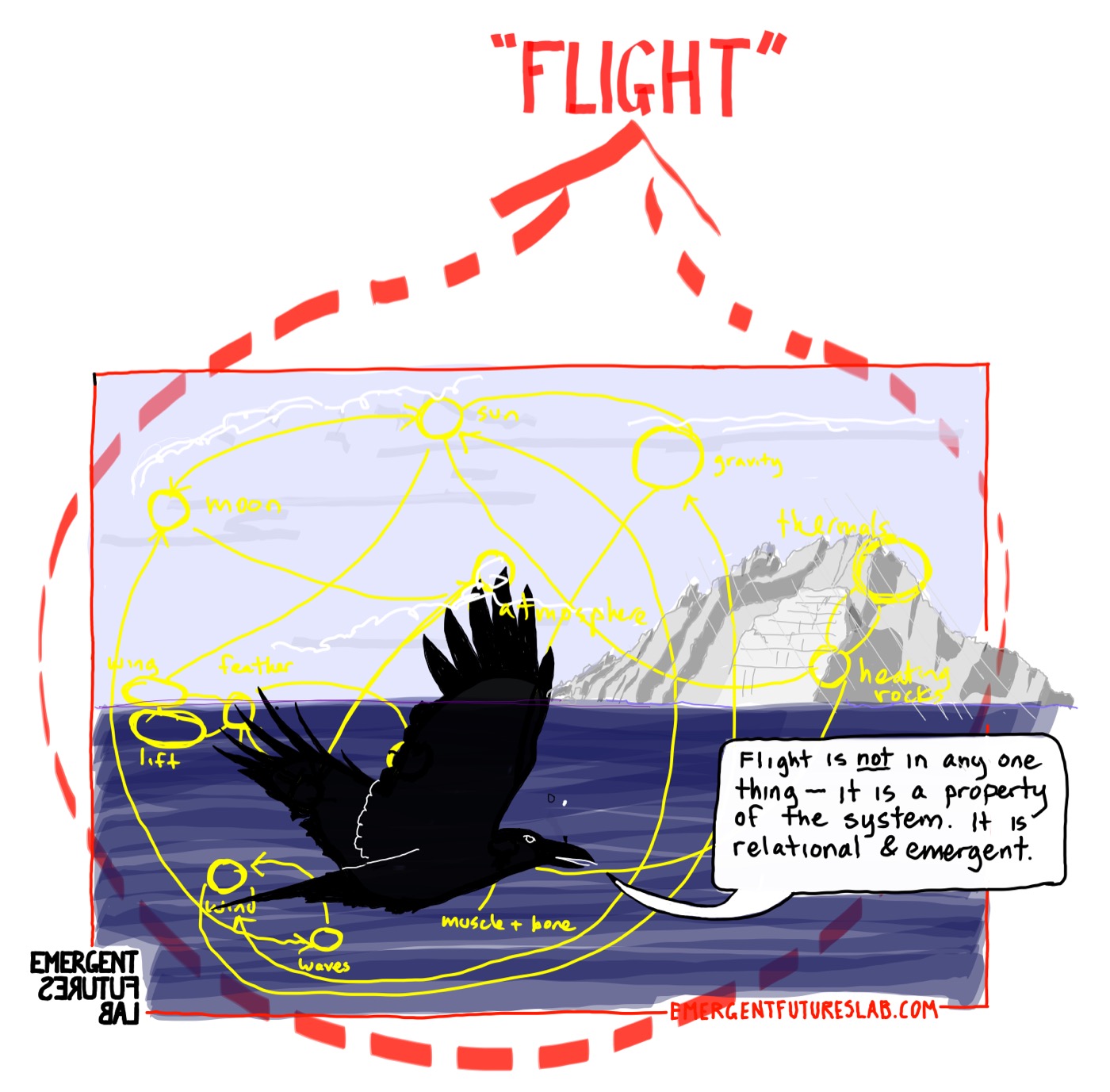
Rather, it's relationally emergent from a skillful bird, its anatomy, feathers, muscles, lungs that's co-evolved with an environment where there's an air density, there's thermals, there's things to land on, there's sun and wind, and what have you. And so you have to take all of that into account. And if you can understand that flight emerges in a non-linear manner from that relational assemblage that extends far beyond the limits of the body, then can’t you say the same of thinking and experience? – that thinking's not reducible to an individual human, naked, alone, and floating in outer space.
It's emerging in a non-linear manner from an assemblage of whatever might be there – a specific co-created environment or niche, the tools, the practices, the habits, the relationships, the histories, the many other people that are part of it. And so it's more useful to say that this extended assemblage is “enminded” – rather than saying that thinking is embodied, embedded, extended, etc. – because we start with the relation – the worlding.
This is the other part that's very beautiful with the term world. You start with the emergent world, and its relational engagements – that you simply cannot get rid of, rather than starting with, say, with the individual, building up to the social, and then adding the environment, and adding the tools, and then getting to something like a cultural mindset.
That progression is false, because it doesn't get at the distributed, entangled, enactive, and emergent quality of experience.
And so I think that this bird and flight story that helps us really see what we're trying to get at with world, worlding, and world-making.
Jason: Yes. And I think we were calling it “enflighted”, as a result. And there is something interesting here about Enmindedness –and that is that it is a supportive critique of the enactive approach and the enactive language, which we've been using up until this point. Enminded sort of came forward in recent newsletters, where it's a pushing beyond, right?
We're not saying “embodied” because it's still putting the mind/brain at the center, right? It's still putting the fixed mind in the middle, but “enminded” is pushing things into a more relational configuration, we, as an assemblage, become enminded.
It is through distributed relational events and not forcing that fixed location within the self, but that it's it's assemblage of all the things in the parts out there.
Iain: This is so important. I think, in a way, we were okay with the enactive tradition’s language of embodied, embedded, extended, and enactive because it's something that already exists, people are familiar with, and it does make sense. (And to be fair, Evan Thompson has similar things).
But if you think about it, it's still brain or mind-centric. It begins with: The brain needs a body to think. The brain needs a body in an environment. It needs habits and practices and tools, and then it can think. But it's still centered on this immaterial mind or brain, rather than being a truly dynamic non-linear relational system that something emerges from.
The second really important part when you move to experiment with an enminded approach is you see that it's irreducible to a location or any essence like the brain, or even an individual. Rather, we think because we're social entangled assemblage-beings.
The social is profoundly important here: we think with and of others even when nobody's around. So what's enminded is always an eco-social relationship. And what's enminded is social practices and habits and environments – even when we're talking individualistically. We become the individual we are because of others – the social – the world – the worlding precedes the individual.
And this is where, in the later newsletters, we start to look at Worldmaking as a collective, historically and ecologically situated practice. We turn to examples from our engagements with First Nations communities along the North-East edge of the Pacific and in the High Arctic, where it's not that they have a different cultural mindset, but that their experiential world is enminded – really enworlded qualitatively differently.
There is one last general thing to say on this. This approach allows us to think of groups, organizations, teams, family dynamics, and individuals much better because now we can talk about them as all being distinct forms of enminded relational assemblages rather than the classical Western individualistic logic that starts from individuals who come together and negotiate their differences to form groups. Rather, the order needs to be more than simply reversed: there's always an assemblage – a collective from which something emergent in the dynamics of the collective – whatever that collective might be, that gives rise to an emergent shared way of feeling, sensing, doing, knowing – in short, experience itself. Individuations at multiple scales rather than individuals at one scale.
Importantly, in this approach, there is nothing that makes the individual radically distinct from a team, a family, or a culture. In all cases, there is a process of emergent intra-woven enminding of a more-than-human assemblage enminding. They are all individuations
All of this gives us an experimental language to explore those things that I think are really important when we're talking about creative practices.
Jason: That's really interesting because I'd not associated the enminded at the group level of organizations, of people, of teams, of cultures in that way. But we've had a lot of unwritten, unrecorded, undocumented conversations and debates around sports. We've talked a lot about American football, regular Football – what the rest of the world would call Football. Basketball, Hockey, Baseball.
We've talked a lot about how the teams are enminded. You like to use Total Soccer as an example. I like to use baseball. We love to get into hockey, and how it's so given to chance and randomness because of the variables, the assemblage of ice and a frozen rubber puck and skates and water and humans, and there's ...
Iain: There's pinball in hockey.
Jason: Pinballing and hockey, yes.... So I guess I've always understood this inherent collective logic to enmindedness in the conversations that we've had. But you've not been this explicit until this moment, really. So there was something really interesting about that, the way you were articulating societies, cultures, even family emerging as a temporarily minded group with the same logic as an individual. Is there something else there?
Iain: Yes. This really comes from the work on distributed cognition – the work of Edwin Hutchins and others. Where he was looking at a large military ship with all of the people who are doing different tasks with distinct tools and environments – no single person really “knows” what at a meta level is going on – but nonetheless a sensibility emerges, propensities develop, actions are carried out, and outcomes emerge.
And so you can say, following Hutchins, that cognition – sense-making is always distributed. He makes the caveat that this is only true of “cognition in the wild”. If you only study cognition in the laboratory with solitary individuals, you can fool yourself into believing that you can narrow it down to a singular brain-centered essence.
But, if you think about a sailboat or something similar – sure, you could have one individual on a boat – but the cognition – the sense-making is always distributed. The boat is a type of sensory apparatus where the flapping of a sail or the twitching of something is both an effect and a sign that co-creates you and your actions in it, becoming something relationally relevant.!

And the boat's movement is correcting itself the same way thinking corrects itself. It's all distributed, relation dominant – it's entangled, and it's emergent.
What is really important is that this logic is inverting the modern Western logic that everything builds from the pregiven ahistorical universal individual (really the brain and the mental), and then you add an environment, and then you add other people, etc., etc.
One of the key aspects of the analysis of the tick and its world/worlding is that the smallest unit of life is in assemblage. And for humans, that assemblage will always have others in it. The smallest unit isn't the naked person floating in space – it isn’t the lone genius. That's a profound type of illusion.
This is a radical shift in how we approach all of this: the smallest unit will always be an assemblage. What throws people off is that assemblages are flexible and many parts are temporary: you could be connected to your blender, but it's not permanent. And because we think that “if I can disconnect from some part of an assemblage, then I could disconnect from all of an assemblage,” – but you can’t. You're always connecting and connected – in the active process of connecting to other things, other people – and that's leading to different enmindings – differing scales and temporalities – a different sense of agenthood of the system.
Jason: And in regard to that enmind distributed system, we used the thought experiment of the blind person and a stick as a means to articulate this as a very concrete approach. A lot came of that blind person in a stick. In fact, in Worldmakers we did a live participatory event where the requirement of that walk was to have a stick, and we all closed our eyes. Certainly, we could never pretend to be blind because no matter how hard you try, you're never gonna get there. We did our best to sense how a specific experiential world emerges via our use of a stick to sense our way forwards.
That also led to some interesting diagramming exercises around loops and lines, which also tried to experimentally explore what enminded distributed selfhood was through the stick.
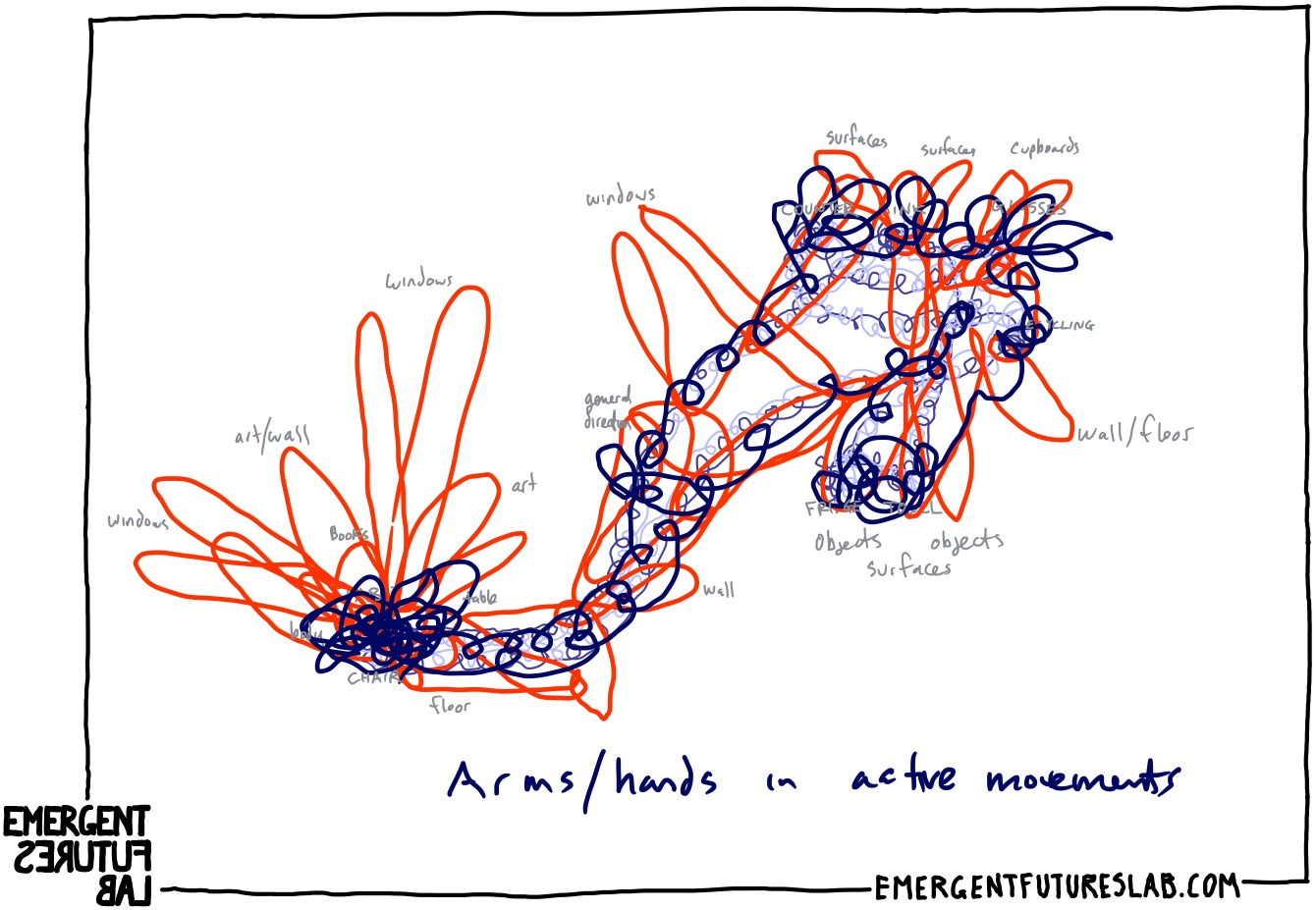
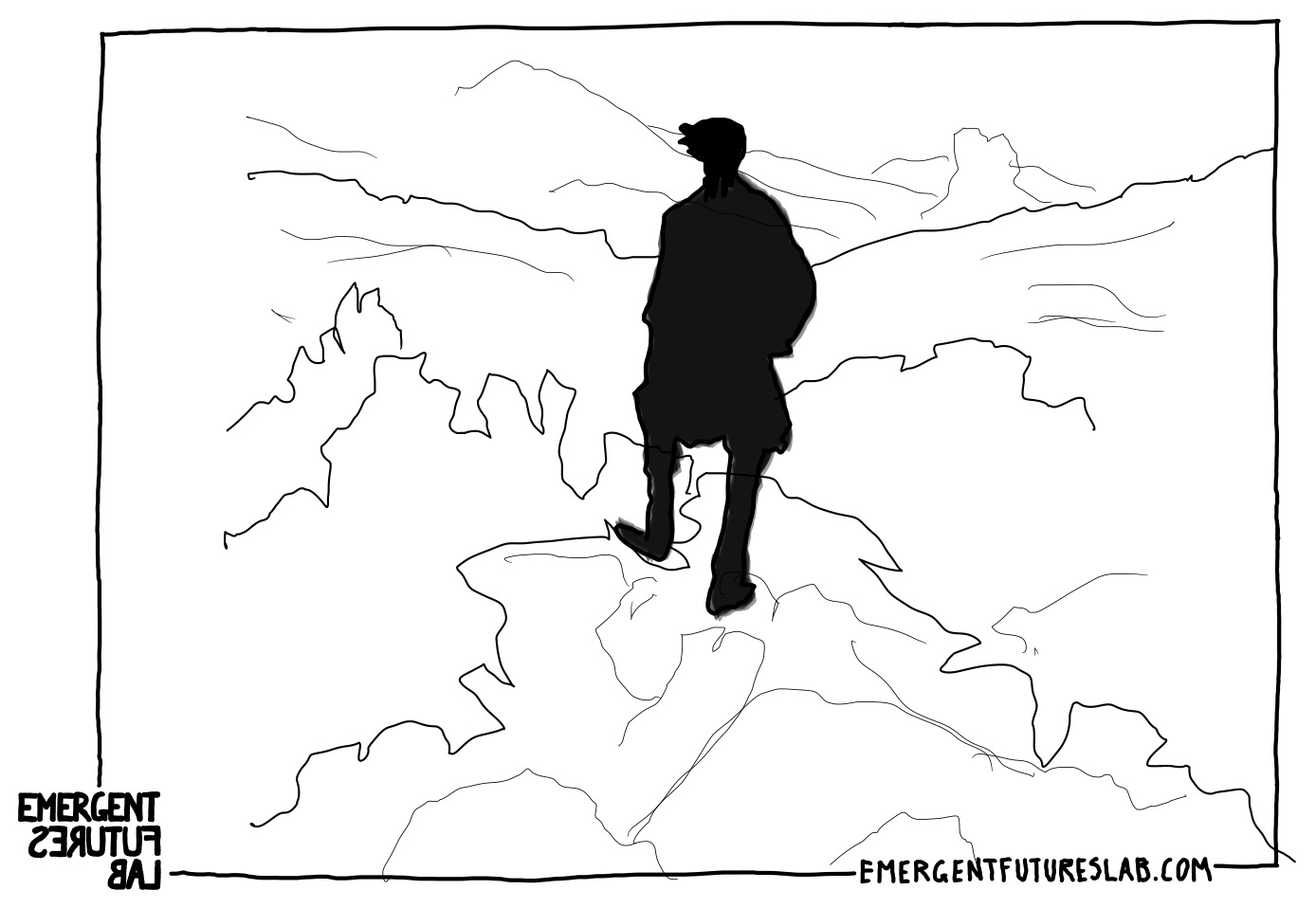
It is Bateson who asks: where does the stick end and the body begin? The loop and the lines of engagement show how the stick based sense-making extends far beyond just the end of the stick, and the seeing isn't just through the stick anymore, right? If we have the feet, we have the surface, we have the what's underfoot, grass, concrete, gravel, dirt, mud, water, on and on…
Iain: It's such a helpful analogy where Gregory Bateson is asking, “Where do we say the body ends?” And he says, "If we want to explain how a blind person navigates the world successfully, then we cannot say that the blind person ends at the tip of their fingers and their toes. To cut the loops of “differences that make a difference” at this point would be to render sense and experience both constitutively impossible and impossible to explain."
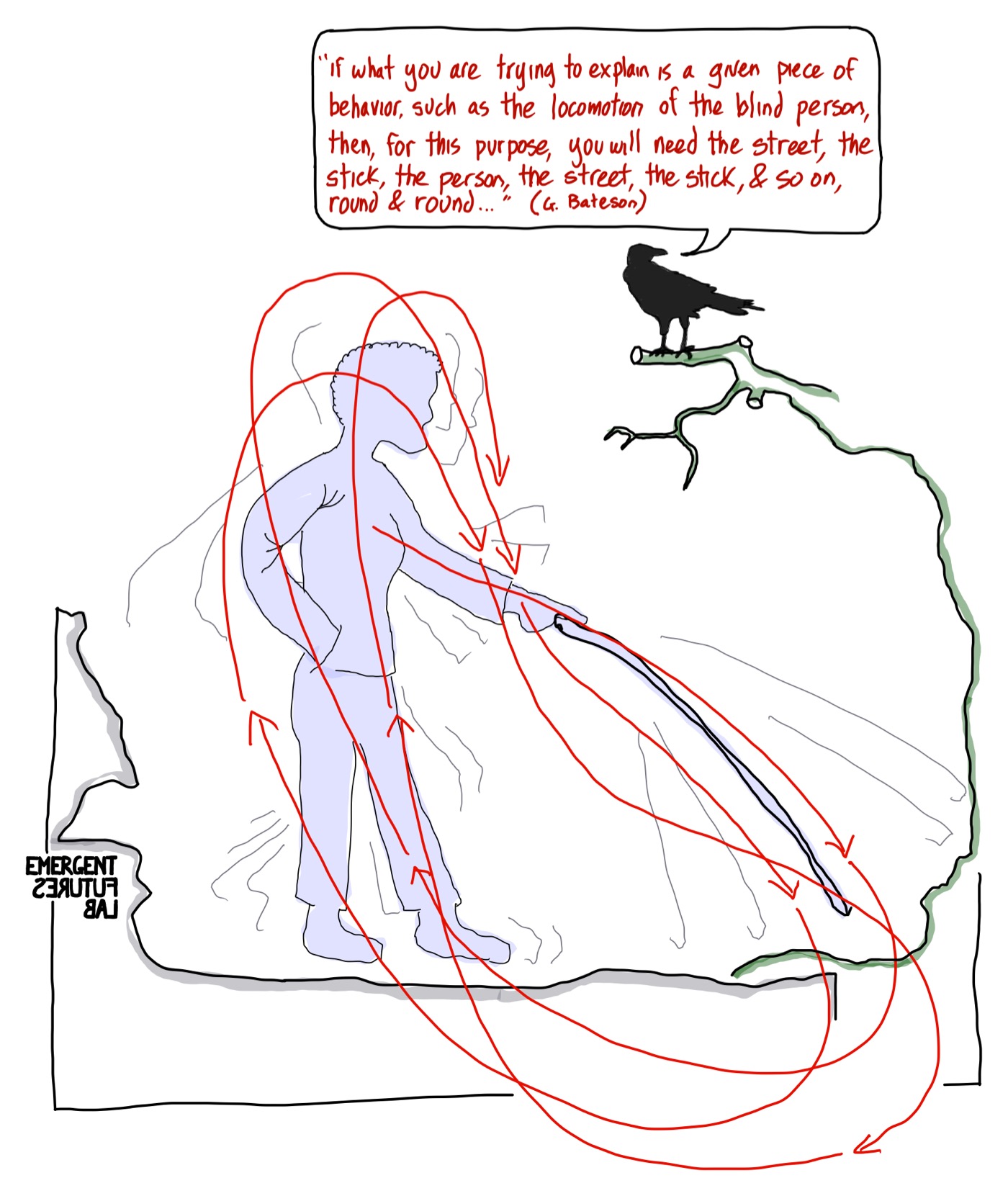
To understand the sense-making of the blind person, the stick, the cane they're using has to be considered. And then if you were to ask where does experience 'begin'? Is it partway down the stick? Is it all the way down?" – That would also not get at it. We have to see that, as you're saying, it loops through the world, the grass, the concrete, and he has this really helpful phrase for when you want to demarcate the end of things – it should not be where you visually see you could trace the edge of your skin or that you could trace around a whole stick, but it has to be, he says, “where you don't cut the differences that make a difference out of the system”.
This is where the concept of individuation helps reconceptualize the individual, the group, and even events. What we understand as an individual – literally something that is indivisible and singular – is better understood as an individuation – the unique individuation of an assemblage. What allows us to individuate is looping system of differences that makes a difference – and this will always involve, say in Bateson’s example, an assemblage of skilled practices, our encultured embodiment, the stick, and the environments that works in of concrete and grass and hallways and tactile surfaces that help, and that allows an individuation to happen, etc.
And this logic equally applies to organizational individuation, an event, or it could be a family individuation, and it could be at the level of one person to stick in an environment.
Jason: These concepts are all starting to work together. I think the concept of affordances is really important in this context – and for this approach to world-making. Affordances are the emergent relational potentials for action that we sense directly in our environmentally embedded experiences. They could be conceptual actions and thought actions, or they could be physical actions like walking in a certain manner. Or it could be the potential to float, dive, swim, or break bones… A specific open set of affordances are always part of the emergent logic of a world.
Because of an assemblage that has an agent in it, there's always a set of affordances potentials for action, which is to say, if you're sensing the world through a stick and your eyes are closed or you're blind, a unique field of potentials for action emerges. So too with the Tick and its worlding.
Iain: Another related concept here is how the stabilized configuration of an assemblage acts towards both the creation of potentials for action and then constrains the field of possibility such that certain potentials are far more likely than others. For us, the question is a creative one: What has created this set of possibilities where certain things are more possible in the manner they're generated by the assemblage than other things?
This is the real creative question. You're always playing with specific assemblages – what they enable, and what they stabilize (e.g., constrain). In action, you're not playing with something one might call a mindset, and you are not ideating in a removed manner – rather, you are directly playing with affordances: what if I change the stick in this manner? What if I change my actions and habits to that? What if we change the environment? What novel affordance possibilities will emerge – conceptually, physiologically, action-based?
Then we actively start to live in a field of multiple affordances that are all looped, nested, and connected to others. And I think this is where you start to see all of the concepts and terms and practices we've been talking about as Emergent Futures Lab in this series on world-making starting to come together.
Jason: That, and that idea of cutting really cuts. It really hits you when you say cut, it's like you realize how extended everything truly is, the loops and the looping and how there is no real hard end or edge to any of our co-creative realities.
Iain: I think that's so important. We feel this all the time, every day. For example, when something stops working – the screen on your smartphone, for example, it just, for whatever reason, dies. We can feel the cutting of the extended loops of differences that makes a difference. It is very real – say, for example, you are driving on the freeway when your screen dies – now you have no idea where to go. The relational loopings that give rise to the actual practices of a way of being are momentarily gone… worldloss
These moments when things break – when a cut in the wrong place happens – are really useful to help you see that you have a world – that you are of world – and that you are always actively worlding – world-making…
Jason: Well, this is where we are cutting the conversation – but only until next week. Have a wonderful week experimenting with worldly practices of creativity. Keep difference alive – and we look forward to your thoughts and sharing the second half of the discussion next week.
Until next week,
Jason, Andrew, and Iain
Emergent Futures Lab
+++
P.S. This newsletter continues in our community—where you can comment, question, and explore further. Emerging Futures + brings you into the conversation. Join here
P.P.S. WorldMakers goes beyond the newsletter: 40 live events annually, weekly podcasts and exercises, our annotated bibliography, and practitioners across diverse fields reimagining creativity together. Discover WorldMakers


