Newsletter
Resources
Courses
Books

Welcome to Emerging Futures -- Volume 248! Exercises towards Worldings...
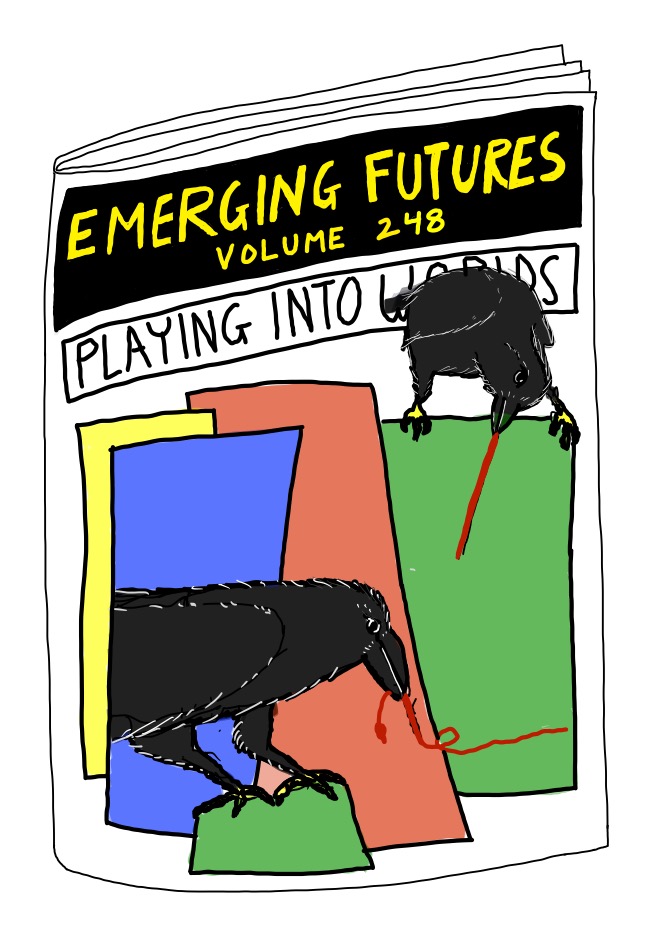
Good morning becomings of northern summer sun,
Here in the northern hemisphere it is getting hot – for us it is a time to get outdoors and enjoy some experimental adventures. As we come to the end of our long experimental series with Worldmaking, which started all the way back in Volume 233, we thought we would share a few fun exercises that will get you out of doors and drop you right into ways of sensing how we are of a world over the next two newsletters.
This week we have three adventurous experiments for you. You can do these alone – but they really come to life with others. If there is one thing that we do recommend that you do at the beginning of each exercise – read how we describe WorldMaking in Volume 246. It is a few paragraphs, and reading it will ground you in the question. Perhaps you print it out and annotate it as you do these exercises?
Let's start with a very simple but challenging experiment:
The premise of this exercise is as simple as it is profound: we most directly sense we are of a world when something breaks. We see our world – our mode-of-being-alive more clearly when critical aspects of the relational assemblage are cut:
“An assemblage is the first and last word of existence. I do not exist, and then enter into assemblages. The matter of my existence is my very participation in assemblages.”
Often in our daily lives this is quite difficult to recognize as we are so of a way of life that stresses and reinforces that we are purportedly separated and independent – that “I exist and then enter into assemblages” as Stengers puts it – but how do we feel that “the matter of my existence is my very participation in assemblages”?
When some critical tool or aspect of the environment is not available to us – it is then that we most often directly confront how, ”I am not gifted with agency, the possessor of intentions or initiative. Animation, agency, intentionality… belong to the assemblage as such.” (Isabelle Stengers).
This is a very simple exercise: spend a day without using your smartphone or any similar device. Now, of course, if you stay at home, reading a book on a quiet Sunday, this exercise will have little impact. Choose a day when you are going somewhere somewhat new, doing something unique and meeting with others. Leave your phone behind. You can (and should) use other tools – maps, guidebooks, speaking with strangers, signs, etc. But avoid using the phone or relying on others who are using their smartphones.
The goal isn’t to see if you can master being phoneless for a day – or that you can prove to yourself that you really don’t need your phone. That might be a worthy goal – but it is not the goal of this exercise. We are of our tools – we are of our assemblage, and here the goal is both modest and quite profound: to sense, as Stengers writes: “I am not gifted with agency, the possessor of intentions or initiative. Animation, agency, intentionality… belong to the assemblage as such.”
Take this phoneless adventure as an opportunity to be curious about how we are co-creatively of assemblages – of worlds. Sense what happens when this key aspect of an assemblage is missing. You don’t need to do anything else – you could take notes if you wish. The key is that for a whole day – from when you rise to the end of the day you have put aside your smartphone while going out on an extended adventure.
In this exercise we’re walking, but not to get somewhere.
This walk invites you to block one dominant sensory modality, something fundamental to walking, to see what else becomes possible. The exercise starts with blocking sight, and then where you take it next is up to you (and if sight is not one of your sensory modalities, focus on experimenting with the one that is most central to how you move).
It is an exercise best done with a partner in a park-like setting that has both open areas and some trails. Additionally, you will need a walking stick and, if you wish, something to act as a blindfold. Any stick or stick-like thing will work; it just needs to reach from your hand to the ground at an angle and be somewhat sturdy. We have used everything from quarter-inch dowels to ski poles.
The goal is to both explore how a world shows up for us because of how we intra-weave ourselves with our environment and have fun. We find this is a great excuse for a picnic – pack a blanket, a light meal and perhaps a bottle of wine and make a leisurely afternoon of it.
How to do this experiment:
Start in a semi-open area that has some scattered features – trees, bushes, changes in paths, grasses, flower beds, etc.
With your stick in hand, close your eyes or put on a blindfold.
Spin around a number of times so as to lose your clear orientation to your immediate environment.
Now start walking slowly in one direction. Use your stick to feel into the environment. After a set period of time, change directions. Do this for ten minutes or longer.
Your partner should be silent and only be there to stop an accident from happening.
After the walk, it is good to talk: what this configuration afforded one – what new ways of perceiving-acting developed? What became salient? How did an experience emerge as reality?
Then switch roles with your partner. Do this a few times in differing settings. Talk between sessions. Remember your picnic – enjoy the afternoon.
This initial experiment is just the start of an ongoing experiment. Attune to the way new assemblages arise as you “block” differing practices and sensory modalities. Experiment with different blockings, or combine multiple. Then follow these.
For inspiration: This is a great video of artist Pope.L talking about his crawling performances, how it changes one's relation to space, and the unintended novelties that arise.
To be alive is to inherently live in a manner that involves on-going practices of creative “making-relevance”. We are so of a world that we lose touch with the ongoing processes of how it joins us and co-shapes our practices. Think of the sidewalk or a handrail – these fade into the background of whatever we are doing. And if asked, “what is this?” We would most likely have a very clear definitional answer: “Oh, the sidewalk is…..” It has become a “thing” for us.
The question this exercise plays with is, “how does anything become a thing for us?” We get that this can sound a little absurd and very abstract. But all of this changes the moment we change our practices and modalities:
If I was riding a skateboard, that stair railing becomes what?
If I was unhoused, that steam vent is relevant how?
If I was a plant, that crack in the sidewalk is fertile ground for…?
This weekend, make plans to visit a dense urban area and start by hanging out in or at the edge of a very active public space. Grab a coffee or a glass of wine (or bring a thermos of tea). Slow down and observe everyone. How is relevance being co-created? How are the skateboarders co-creating a directly meaningful landscape that is distinct from the walkers? What are all the ways that a curb or a stair meets bodies or activities?
Then try joining in some of these practices. Walk, sit, stand, move in ways that enact new relevances of things you have taken for granted.
Play with how this relevance is creatively enacted. It’s transjective: showing up in the space in between an agent (subject) with a specific concern and the arena (environment). Notice how distinct groups have “Interests in common – but they are not the same interests” (I. Stengers).
Consider frequenting this spot over the summer. Bring others. Play in different ways. Talk to the skateboarders, and anyone else. Join them as you can. Make notes, drawings, and take photos. Try producing a little “zine” that can articulate how the “same” space is participating in the co-creation of qualitatively different direct experiences.
Well – it is Friday, and we are off to experiment and engage with ways of worlding in novel ways. We hope that you can try one of these fun experiments in your own manner. If you do – please drop us an email.
Happy differencing-in-worlding!
Until next week - keep difference alive,
Jason, Andrew, and Iain
Emergent Futures Lab
+++
P.S. This newsletter continues in our community—where you can comment, question, and explore further. Emerging Futures + brings you into the conversation. Join here
P.P.S. WorldMakers goes beyond the newsletter: 40 live events annually, weekly podcasts and exercises, our annotated bibliography, and practitioners across diverse fields reimagining creativity together. Discover WorldMakers
Two questions, every Friday since 2020:
What is creativity? and How do you innovate?
A weekly experiment in emergence, creativity, and change-making.


