Newsletter
Resources
Courses
Books

Welcome to Emerging Futures -- Volume 233! Creative Worlding...
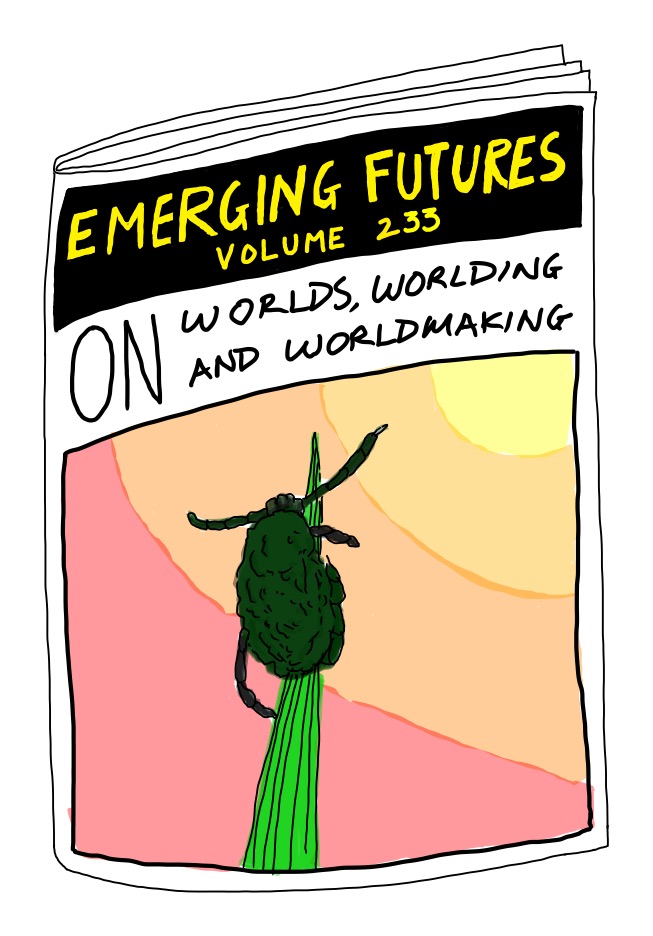
Good Morning en-worlding becomings,
It is already the end of this, the shortest month in the Gregorian Calendar year: February. March is just the weekend away! It feels kind of crazy…
Especially because we had a big Nor’easter with over sixty centimeters of snow starting last Sunday. And because of this, here at the center of the North East Megalopolis, earlier in the week, we had an actual old-school Snow Day – not “remote schooling”, but an actual day off school entirely.
I remember vividly, as a child in elementary school, sitting at my cramped desk midafternoon, looking out the school window with such joy as the snow fell thick and fast. The joy was so visceral – we knew long before it was announced that “tomorrow must be a Snow Day” – and that we would be tobogganing like crazy on our local grass hill madly all the next day.
Tomorrow we would be bone cold, soaking wet, and giddy with an ecstatic pleasure – sticking out our tongues to taste the snow, building strange forts, sliding across massive ice puddles, throwing snowballs at each other, and passing cars as we ran with a motley assortment of plastic toboggans for the hole in the fence that led to our local hill. Yes!
Hearing Mayor Mamdami announcing a “Snow Day” brought this distant world rushing back into the far more complex and fraught present…
For us now, there have been many walks in the snow – but this week has been far more lived-in catch-up and planning mode: The first part of our Green Changemaking Intensive ended really well last Thursday. But exhaustion, sickness, and preparing for the next phase were the operative terms of this week. While much of the experience of a flu or cold can be hard, it is also astonishing to sense the eruption of the multi-species ecology that is the self that happens in these processes. It is, afterall, one of the multiple normal (if less frequent) states of our mode of being alive: sneezing whole novel ecologies into becoming…
This week, we are beginning a new series on worldmaking. While we have done three series in the past on WorldMaking:
The reality is that none of these were comprehensive – or even introductory, in their scope. In reviewing our newsletters as part of our celebration of 200 issues, this came as a shock to us (the overview came out in Volume 202 and has links to all of these newsletters). We had expected that we would have written far more on this theme.
Why? While we are loath to ever use the word fundamental, in everyday parlance, world-making is fundamental to everything we do. And given that this, now we are hoping to more fully and experimentally engage with this aspect of our practices over the next handful of newsletters.
Perhaps, because it is so ubiquitous and everywhere in everything we do, it has been hard to write about in a clear and basic manner.
What makes this even more challenging is that Worldmaking is, for us, not a concept, or a method, or even a key facet of how we approach all things creativity. Worldmaking is something far more all-encompassing – and because of this, also far more nebulous.
Hopefully, over the next weeks, with our collaborative engagements in newsletter writing, we will get to a new and interesting collective place with you, our readers (in this regards we are always directly catalyzed and writing in a creative response to those who reach out to us via email, Zoom calls, and especially via our community of practice, WorldMakers).
Part of the difficulty with the term “worldmaking” is that the word “world” is a term with an astonishing and contradictory breadth of uses and meanings – let’s just consider a few:
In all four of these examples, the word world is playing a very different and contradictory role.
So, where does our use of the word fit into all of this?
Let’s start by saying that it is in dialogue with these meanings of “world”, but it is at the same time very different. Given this, we need to begin by putting aside what we might assume by the term “world.”
That said, our use of the term is not a radically eccentric outlier use of the term. Our practice in general, and our use of this term in particular, is part of a series of interwoven historical approaches and practices. The work of the Zapatistas, Arturo Escobar, the Ontological Turn in Anthropology, and the work of Isabel Stengers, Gilles Deleuze, and Felix Guattari are all related experiments with Worlds and Worldmaking.
We promise that we will get into all of this in due time (much of this should be apparent in our previous newsletters on this topic and in our bibliography). But this is not where we will start – nor is it that relevant to understand things.
It is also important to say up front that “worldmaking” is not, for us, a “position,” a “method,” or something that could be owned and trademarked – for us, it is best understood as a loose approach – a vital and living way to collectively experimentally approach things. We do not want to own this (or anything else) – our hope is rather to meaningfully and actively participate in an open community that takes seriously (and playfully) these experimental trajectories. We are, as we have said elsewhere, interested in participating in a movement towards a new creativity.
The last thing to sense in the term “worldmakers” is that “world” should not feel like a static thing – something given, fixed, and “out there.” It should not feel like “world” and “making” are in any way distinct. Internally, at Emergent Futures Lab, we go back and forth on this: is it better to write this as “worldmakers” or “world-makers”?
Neither quite activates the powerful active resonances we wish to be felt…
A “world” is not something static or fixed: “worlding” feels more appropriate. A “world” is an ongoing activity – thus worlding would be more accurate (if perhaps too peculiar – who is willing to say “worldingmakers”?).
Then “making” has its issues as well: making far too easily assumes a maker – and we far too often assume that this maker is us.
Perhaps the hyphen strengthens this? World-Makers?
The emergent systemic processual activity of worlding is worldmaking – there is no “maker.” But if there is no grand author – no divine maker – that does not mean there are no agents involved in the making!
There are makers – agency – everywhere in this process: events, forces, relations, and processes are everywhere active and everywhere involved. This is what we should sense in the term “makers” in worldmakers. It is a world of strange loops (dragons eating their tails) and equally strange spirals…
And it is here that the term “making” should point in two directions: the world is always actively “in-the-making” – it is neither something with a pre-ordained end nor a fixed direction. And our activity – our ongoing activity (making) matters – but is never independent of the activity of our relational milieu and its worlding.
Perhaps the last thing to add to this – the semi-pre-emptive “fine print”: creativity is not in opposition to stasis. There is no stasis. There are no static “worlds.” There is no opposite to “making.” Everywhere is ongoing activity – ongoing processes. What we might consider to be stasis – the “same” (the seemingly unmade) is equally an active process – and a creative one – it is just a process that creatively strives to keep things with great effort moment-to-moment similar: worlding and worldmaking…
Not ontology but ongoing self-creative ontogenesis…
OK – so what of “worlds” – what of “worldings”?
Let’s start “simple” by introducing and beginning to experiment with three entry trajectories:
To consider what this might mean, let’s actively experiment with an initial case: Gilles Deleuze, in a wonderful interview, describes what it is “to have a world” by discussing how the tinny tick has a world:
“The first thing that impresses me is the fact that every animal has a world… What is an animal world? It’s sometimes extraordinarily limited… animals react to very few things…
For example… the tick responds, reacts to three things, three stimuli, period, that’s it, in a natural world that is immense, three stimuli, that’s it: that is, it tends toward the extremity of a tree branch, it’s attracted by light, it can wait on top of this branch, it can wait for years without eating, without anything, in a completely amorphous state. It waits for a ruminant, an herbivore, an animal to pass under its branch, it lets itself fall… It’s a kind of olfactory stimulus… The tick smells, it smells the animal that passes under its branch, that’s the second stimulus: light first, then odor. Then, when it falls onto the back of the poor animal, it goes looking for the region that is the least covered with hair… So, there’s a tactile stimulus, and it digs in under the skin. For everything else, if one can say this, for everything else, it does not give a damn… That is, in a nature teeming [with life], it extracts, selects three things…That’s what constitutes a world, that’s what constitutes a world” (Gilles Deleuze)
It is worth considering this initial case carefully and deliberately over the next week before we add to it. To help with this activity, we wish to point out a few aspects that we feel are important:
There is much to consider in this seemingly simple proposition of the tick’s world offered by Deleuze in regards to worldmaking. Let’s take the next week to live with it and push it in various experimental directions – how does it entangle with affordances? How does this push an enactive approach in new directions? How do you experience any of this directly in your daily life?
Next week, we will go further: inviting spiders and others into our experiments. We will spin webs in resonance with the melody of flies. We will connect this to our relational and experimental lives. And we will follow the creative possibilities of worlding and worldmaking further – in ways that are direct, pragmatic, and speculative.
Till then, experiment with this first proposition. We would love to hear from you – drop us an email with your thoughts, or join the discussions in Worldmakers.
Until next week,
Keep Your Difference Alive!
Jason, Andrew, and Iain
Emergent Futures Lab
+++
P.S. This newsletter continues in our community—where you can comment, question, and explore further. Emerging Futures + brings you into the conversation. Join here
P.P.S. WorldMakers goes beyond the newsletter: 40 live events annually, weekly podcasts and exercises, our annotated bibliography, and practitioners across diverse fields reimagining creativity together. Discover WorldMakers
Two questions, every Friday since 2020:
What is creativity? and How do you innovate?
A weekly experiment in emergence, creativity, and change-making.


