Newsletter
Resources
Courses
Books

Welcome to Emerging Futures -- Volume 250! On The Pillars of Disruptive Creativity - Pt II...
Good mornings becomings of the long summer evenings,
This week we are jumping straight into part two of our presentation: “The Pillars of Disruptive Creativity” (Note: The full session – including the member questions and the discussion that followed – is available in its entirety on WorldMakers).
This lecture, which we have turned into a two-part newsletter, covers three key concepts of how to engage with creative processes: Qualitative Change, Enactive Assemblages, and Feed-Forward Epicycles. A quick note: This newsletter really relies on the careful reading of the images/diagrams – they contain a lot of information that is not in the text itself.
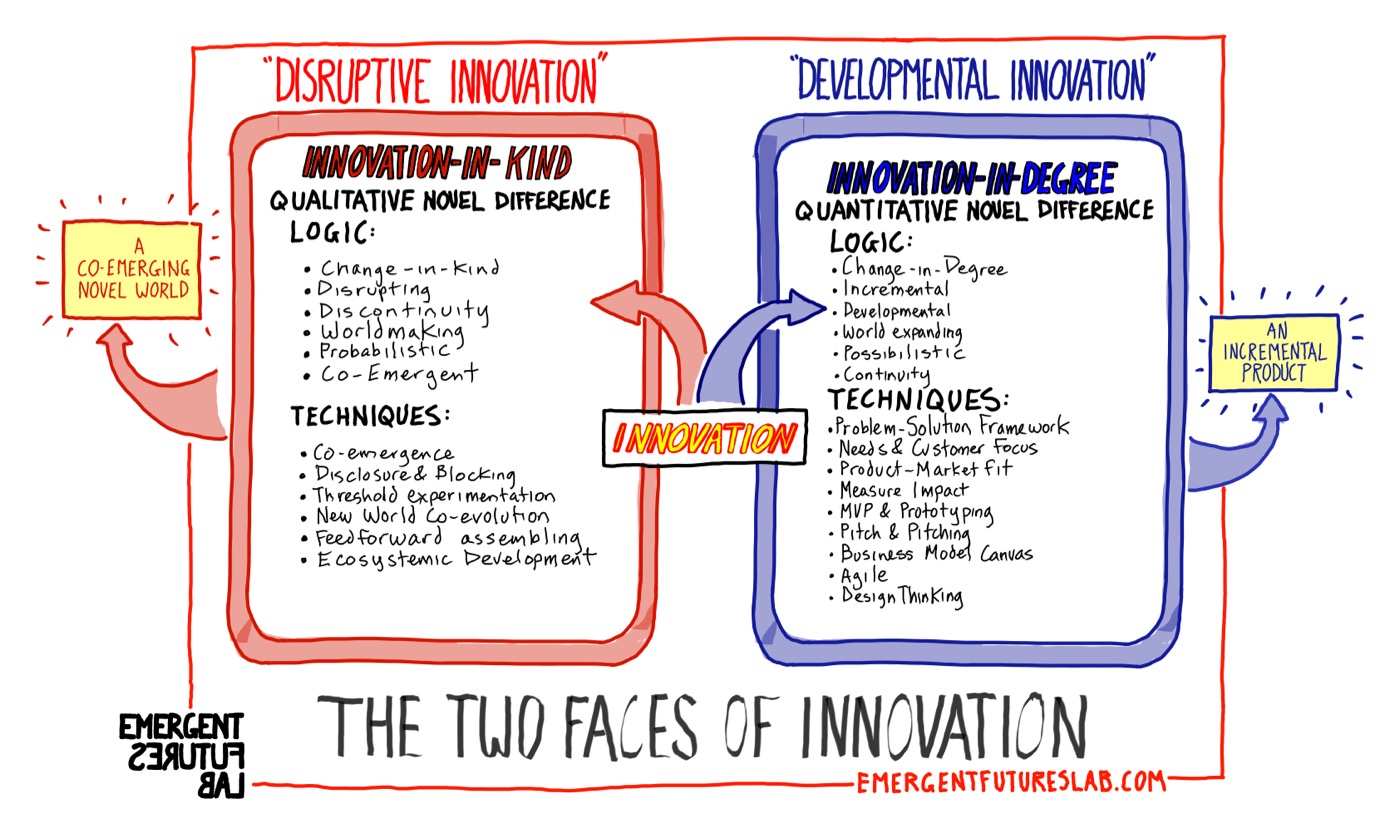
Last week in Volume 249, we focused on the first pillar: Qualitative Change – and the difference between this and quantitative change:
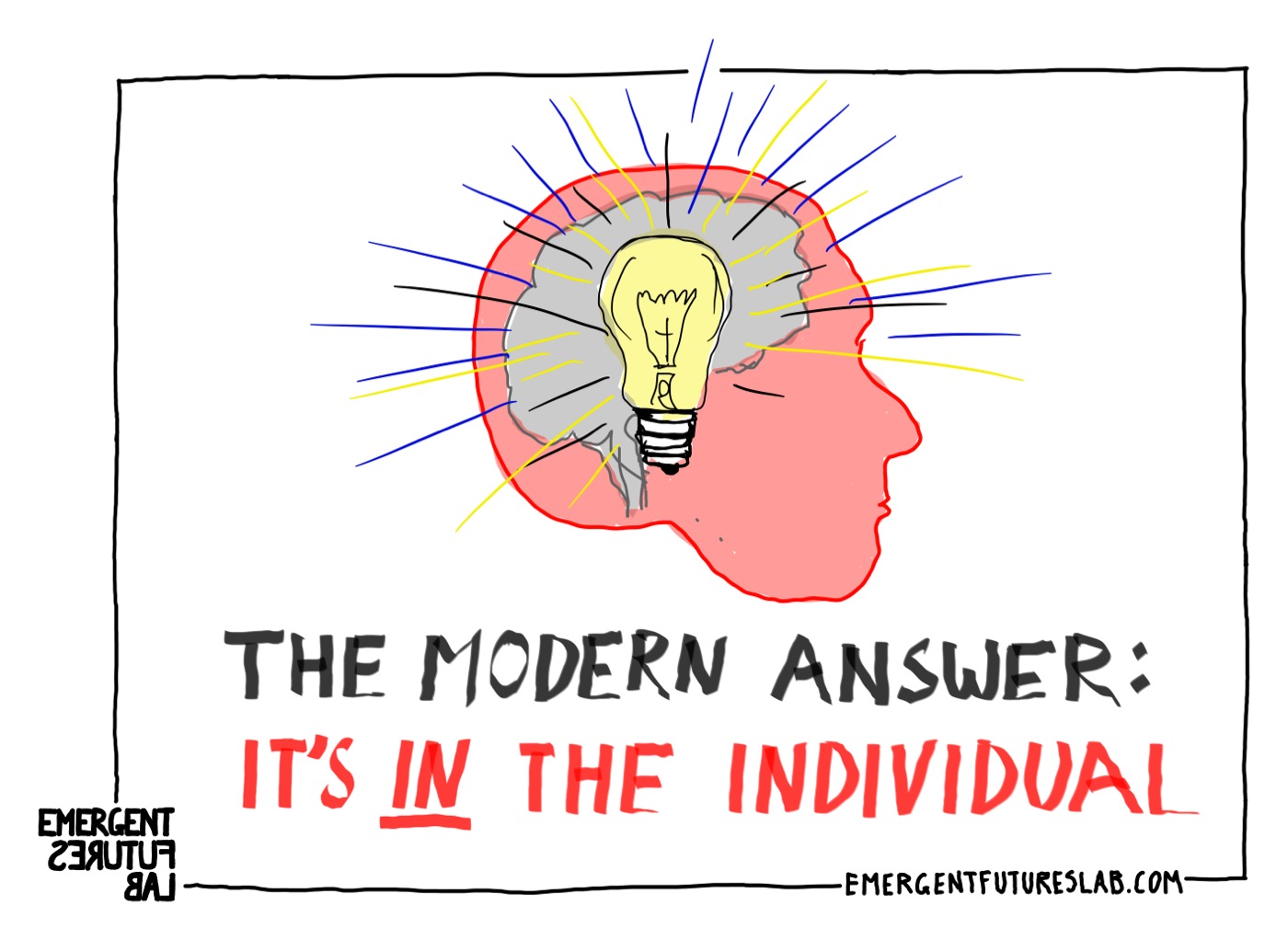
Along the way we deconstructed the individualistic human-centered approach to creativity,
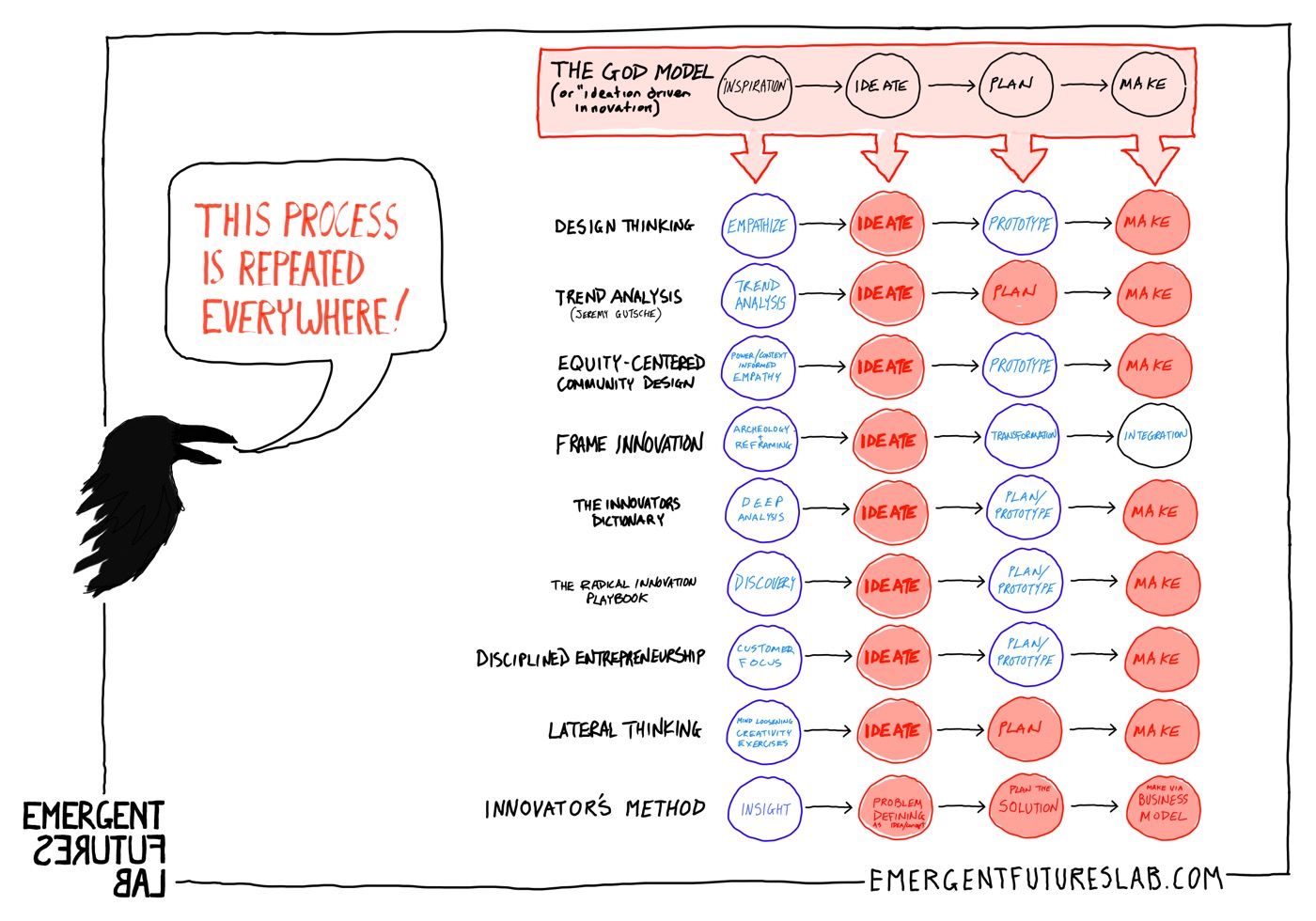
… and how this logic plays out as a four-part problematic method found in many existing approaches to innovation:
We ended by arguing for the importance of an emergent ecosystemic approach to creativity:
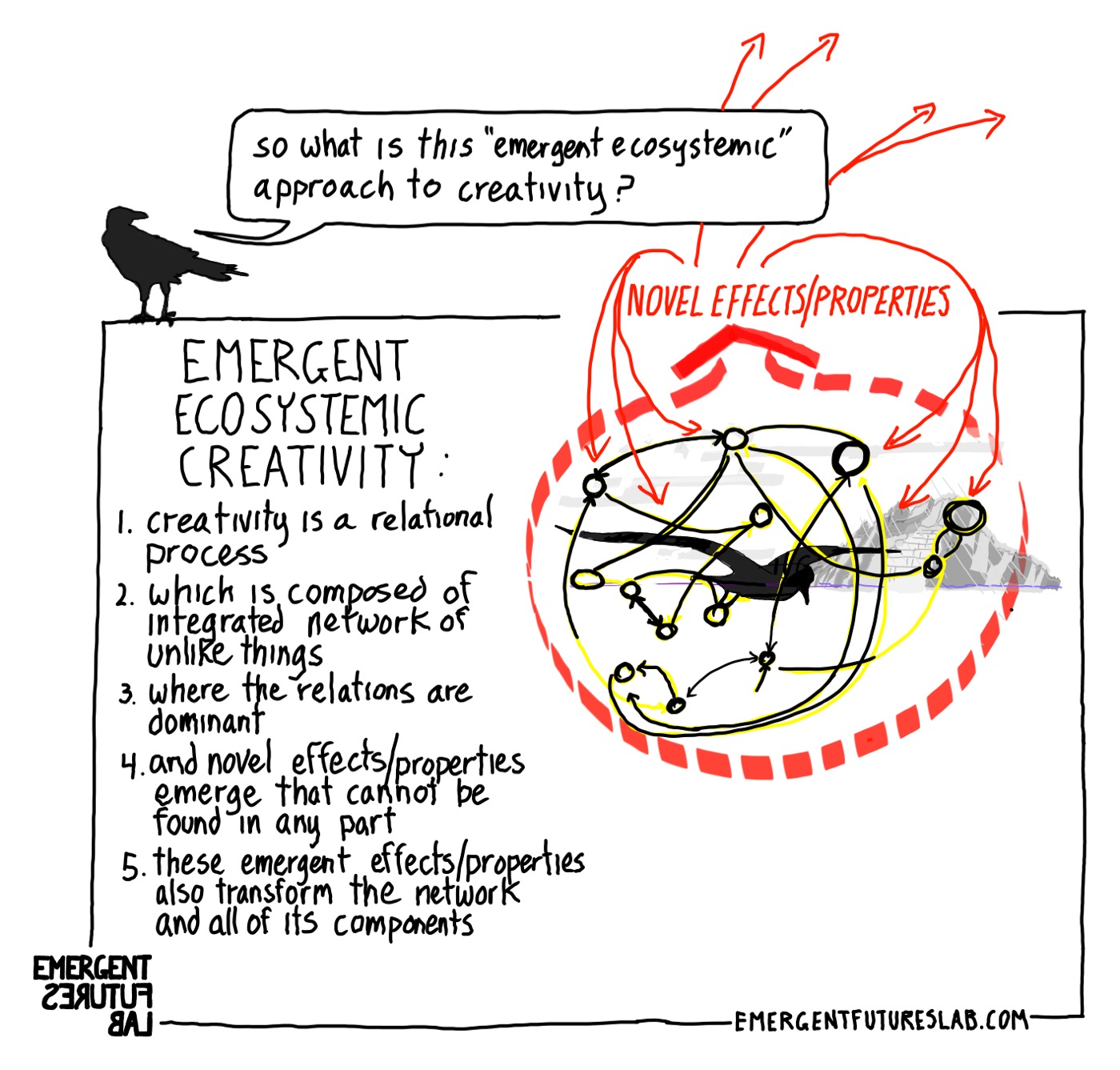
All of which brings us up to the second pillar, Enactive Assemblages – and this week's newsletter:
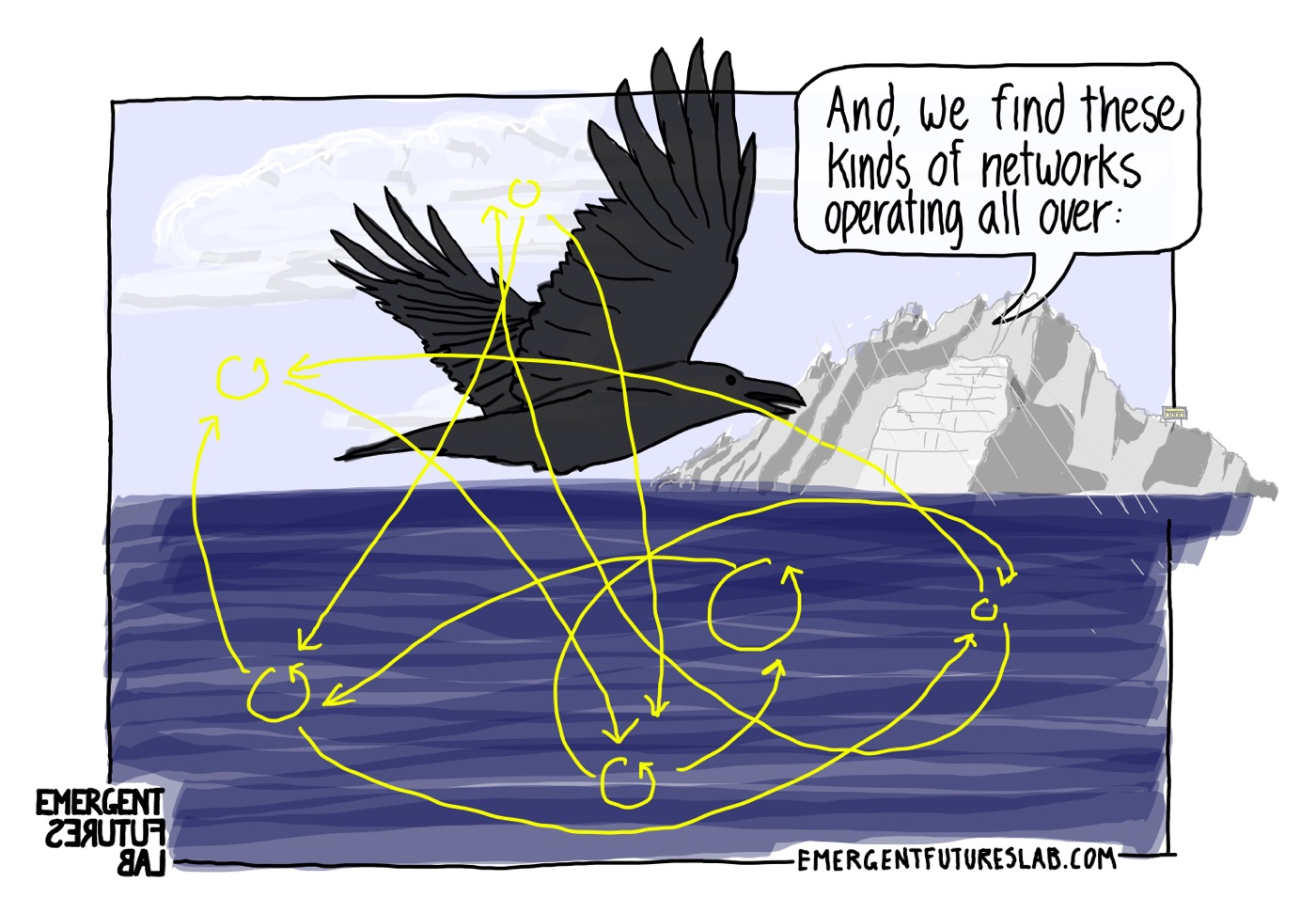
If novelty is an outcome of Emergent Ecosystemic Creativity – then this is something operating everywhere.
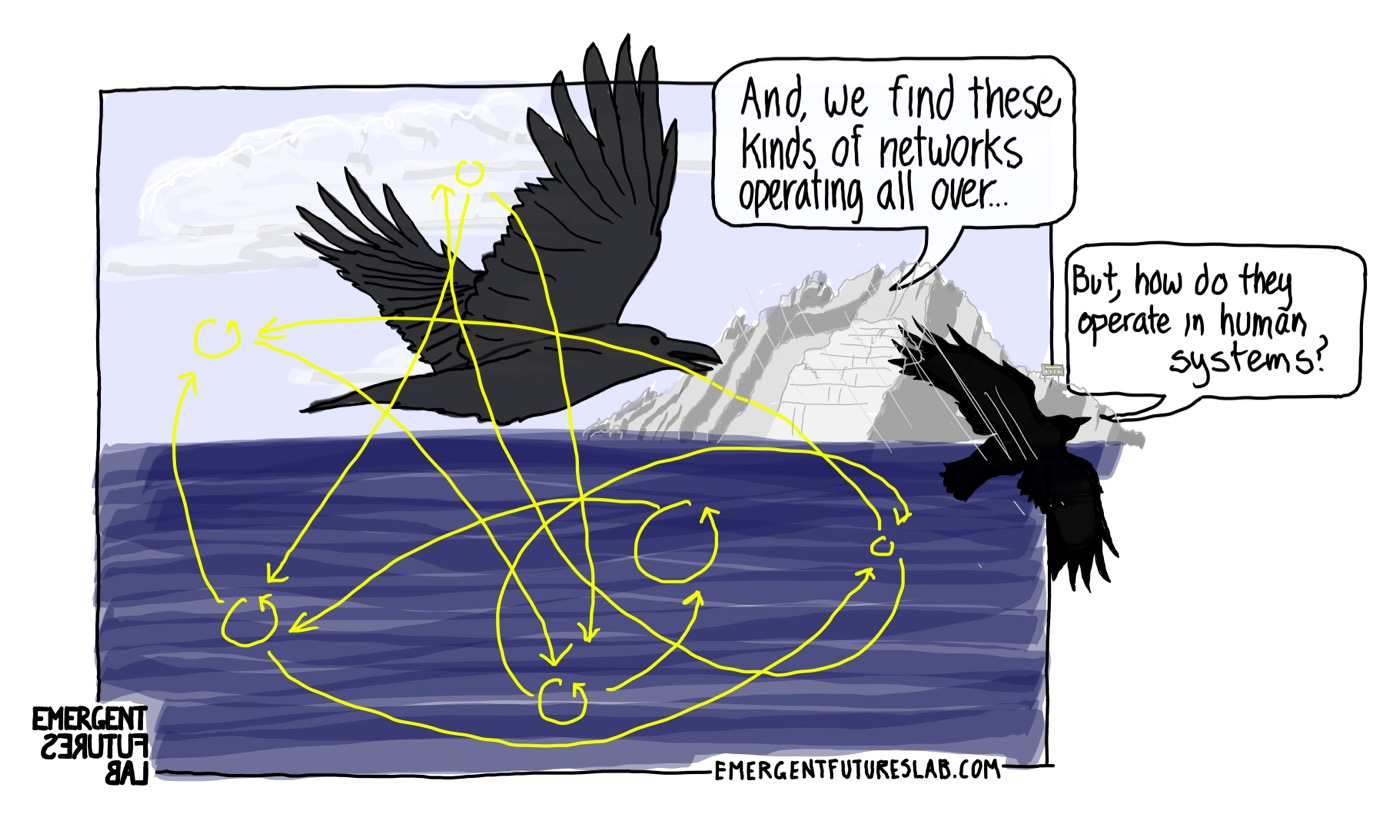
But how, specifically, do they operate within human systems?
The first intimations of an answer comes from what is called the Enactive Approach (to cognition) – an understanding of human beings as more than minds generating representational outputs inside bodies. Which, if you remember from last week – is the problematic core of the “god model” that gives rise to ineffective essentialist and linear approaches to making:
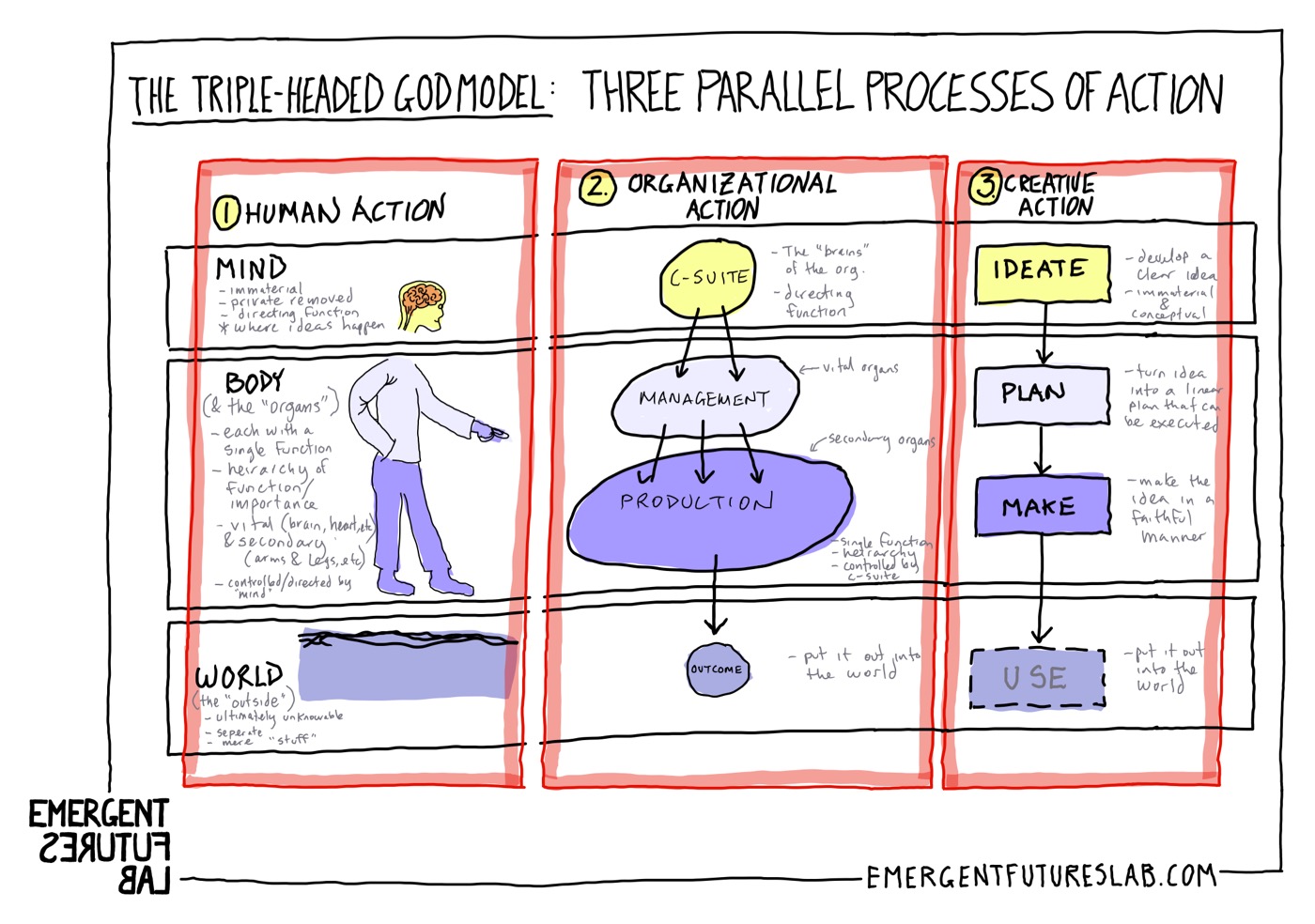
And it is this radical reconsideration of how to approach both our activity and thinking as co-emergent from a far wider relational ecosystem than our brains that will give us a way out of the “god model”.
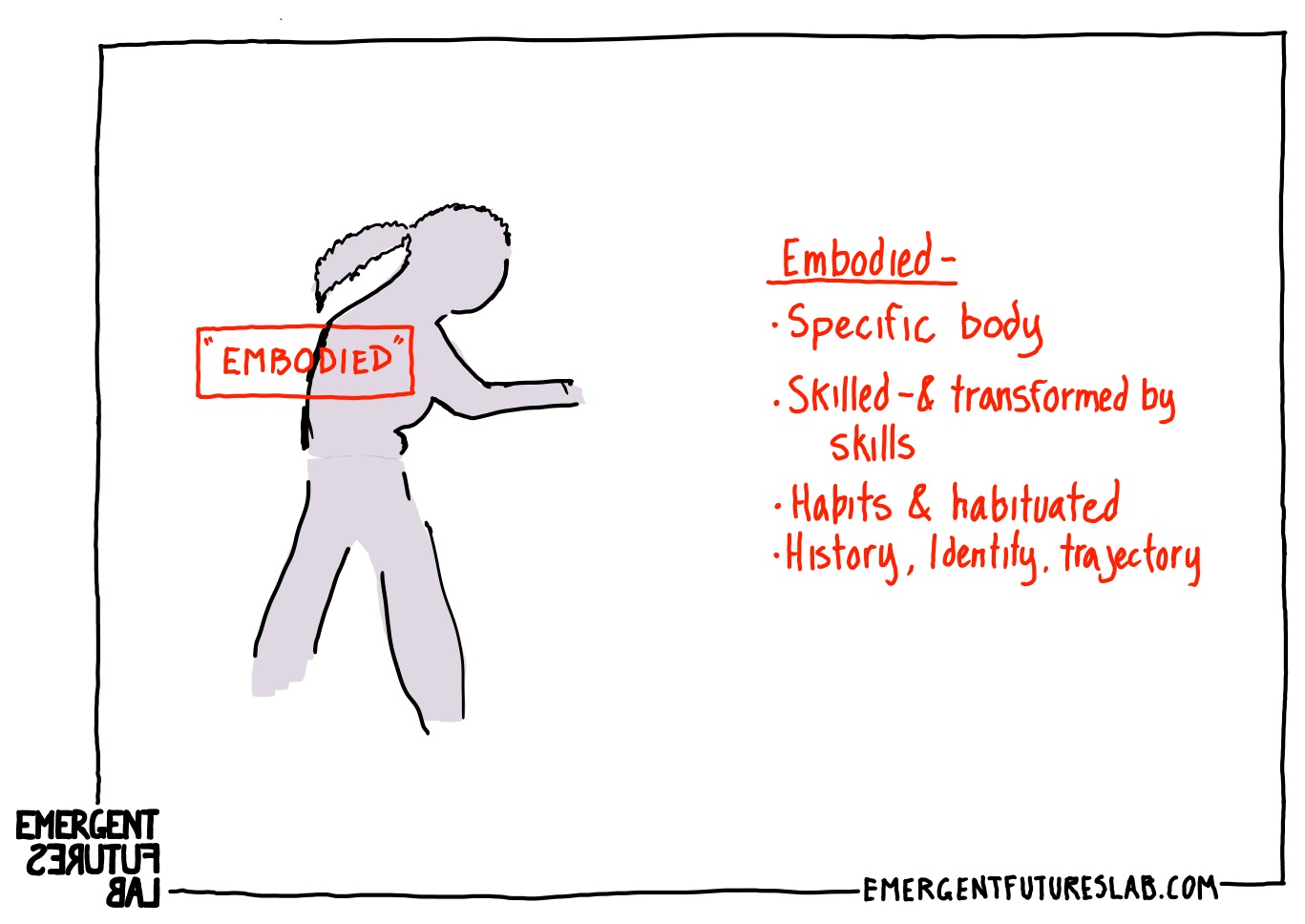
To understand how we as humans engage with creative ecosystemic processes, we need to begin with the fact that we are fully embodied beings – where our body is not the mere housing and support of our brains.
We have a specific body that is always active, skilled and transformed by skills, shaped by habits and habituated routines, and through this carrying histories and identities. It is a body that is meaningfully acting in a context, along an open trajectory towards a future.
Changing how you create does not begin as a matter of adopting a new mindset. It first involves changing what is possible for your body – how your body does things – the deeply embodied habits, the rituals, the practiced responses.
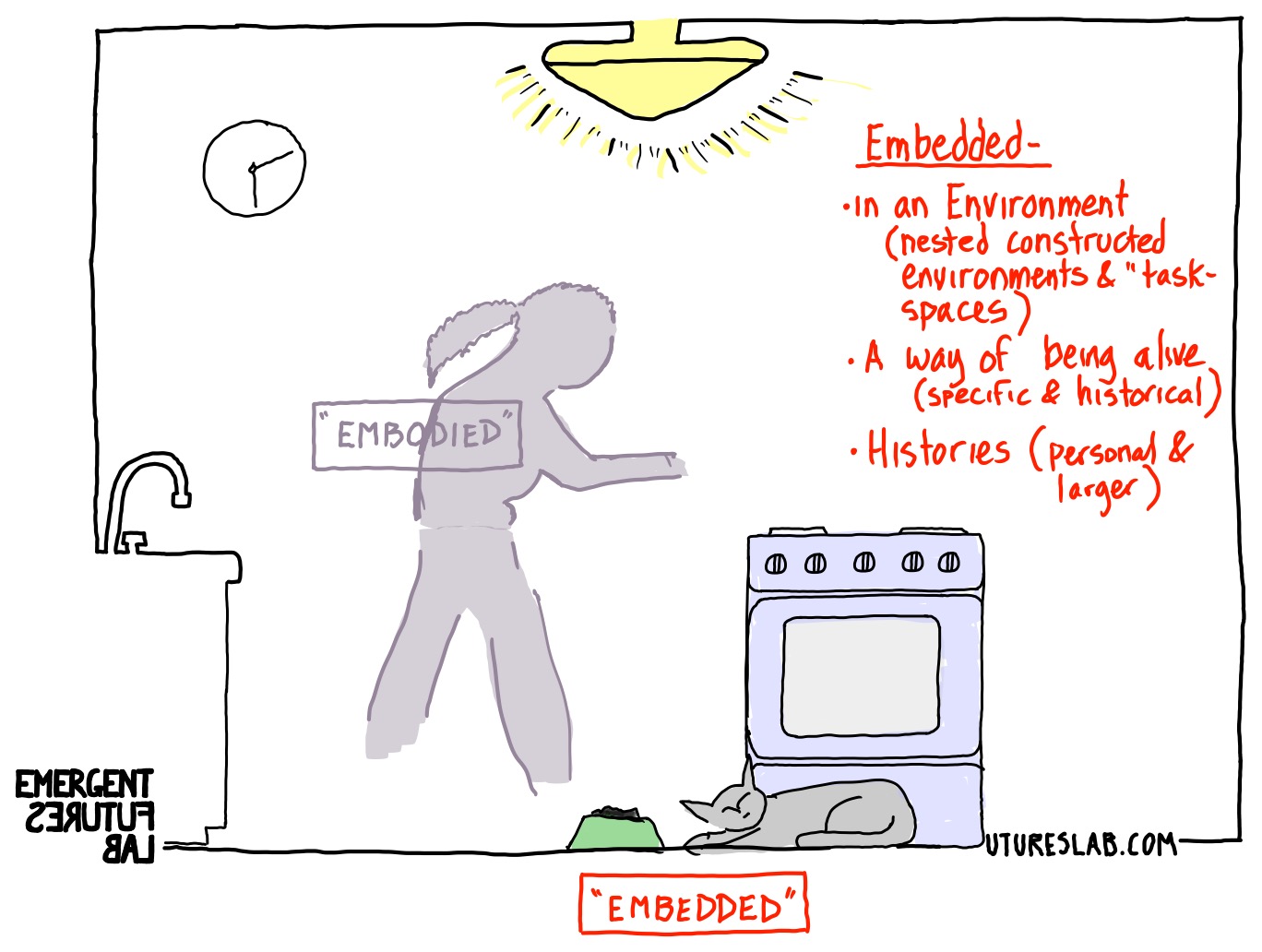
Second, we are embedded. We are always already in and of an environment – these are constructed, layered environments and task-spaces. In the broadest sense, we are of a specific and historically embedded way of being alive. We are the co-created outcome of shaped environments as they in turn shape us. The second way you engage with creativity is by changing environments (in evolutionary ecology this is termed “niche construction”).
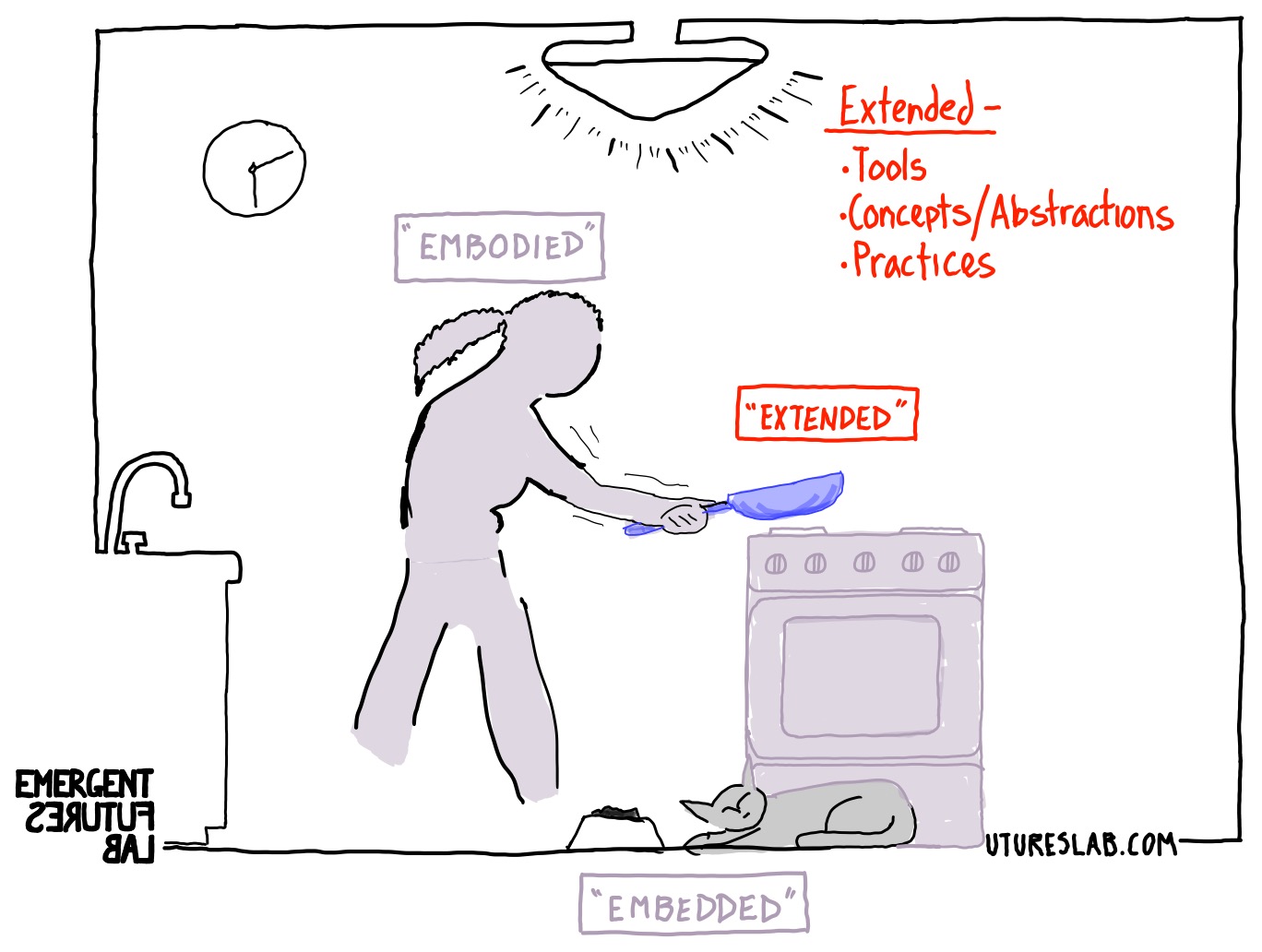
Third, we are extended beings. The tools we have extend our reach. Cars extend our ability to move, phones extend our ability to communicate, and hammers extend the force of our arms – they radically remake our environments. And in doing so they creatively make us who we are. Tools are not just physical – concepts, abstractions, and practices are also tools. Change the tools in your assemblage, and you change what is possible within it.
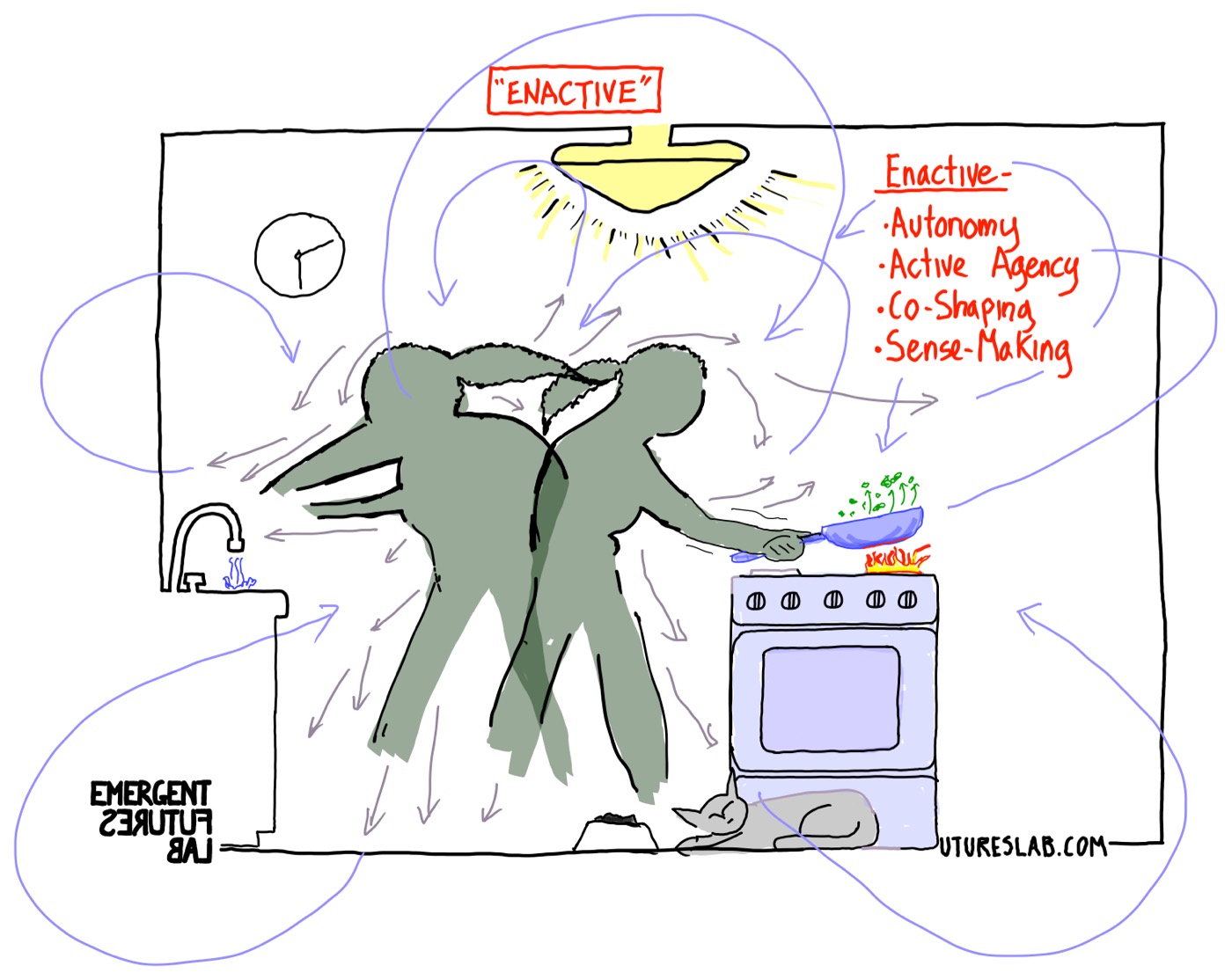
Fourth, we are enactive. We are not passive recipients of a world that simply acts on us. We have a relational autonomy and a situated form of active agency. From within – and while being of an assemblage – we co-shape our situation as we move through it – here is where novel concepts arise – in doing and making we enact new conceptual possibilities alongside other emerging possibilities.
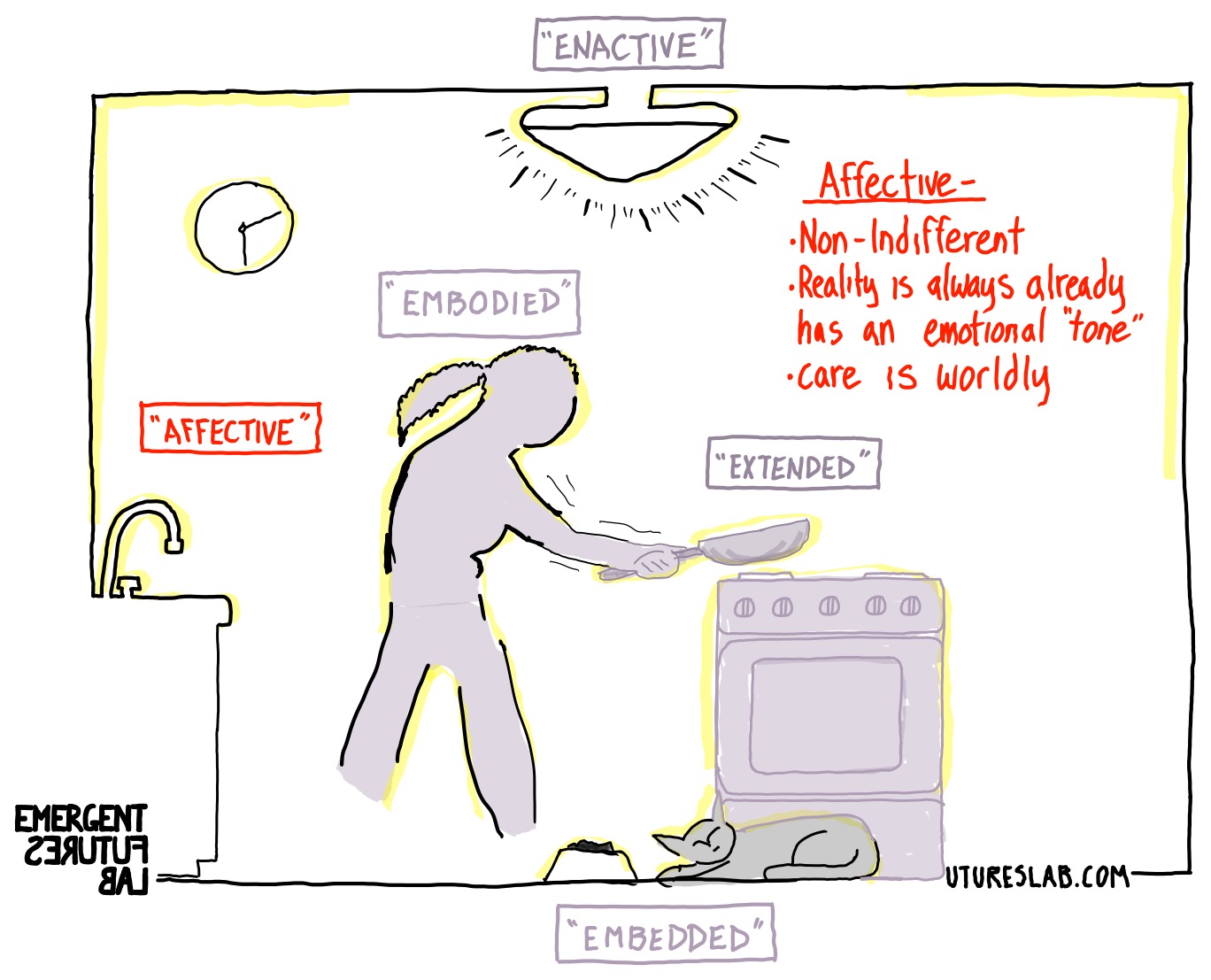
Fifth, we are affective beings. Affect is the more general term for how we deeply and broadly feel/sense in all activity. To put it very broadly – we are non-indifferent to reality. The world we inhabit always already has an emotional tone (valence). Care, value, and concern are worldly, not merely personal. We experimentally and experientially feel our way into and through a meaningful environment, not a neutral one.
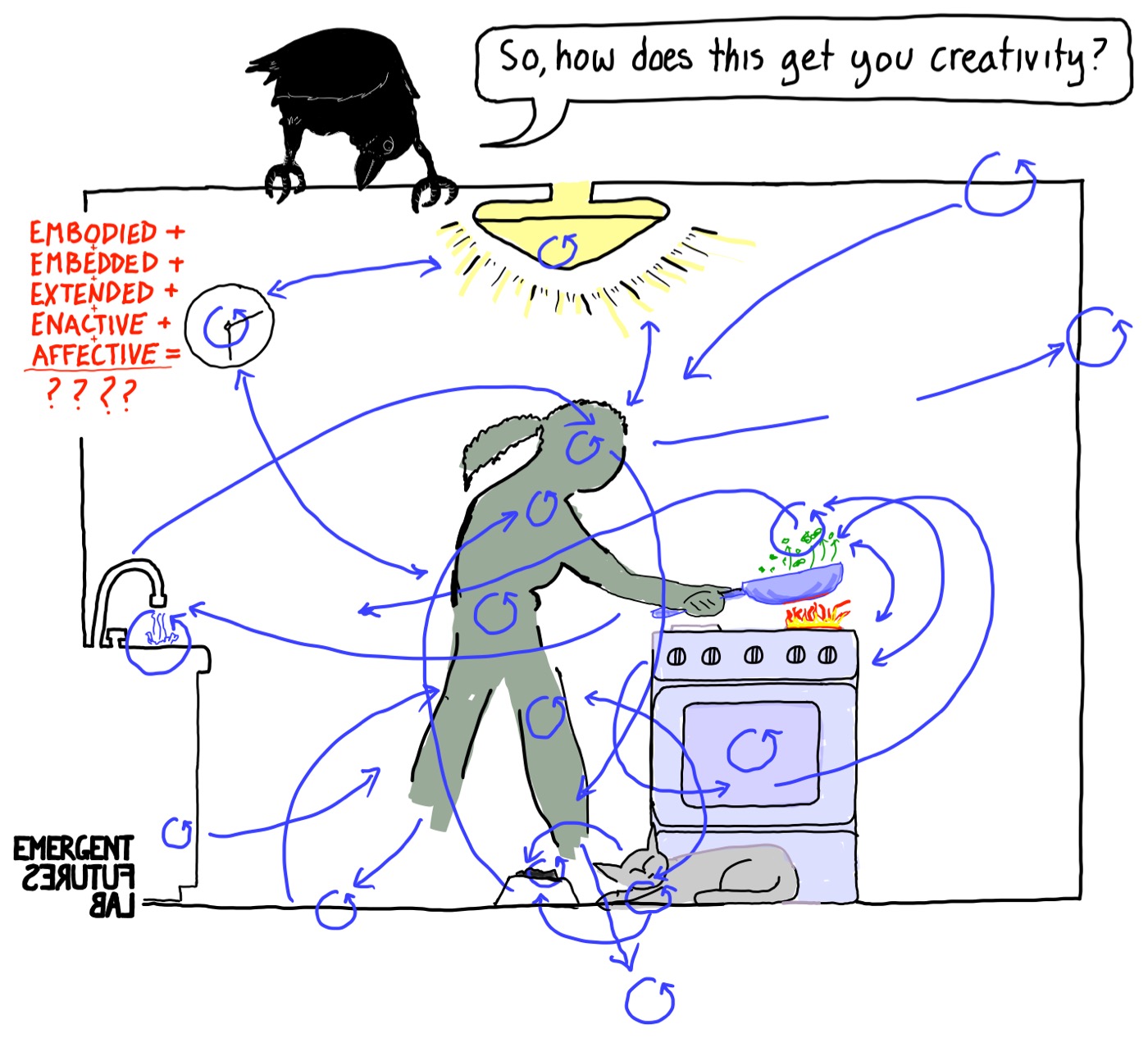
So rather than being a mere “meat sack” for an independent thinking brain and its abstractions – we are ecologically distributed relational beings – Embodied, Embedded, Extended, Enactive and Affective beings.
But –what does this combination add up to, practically speaking, for creativity?
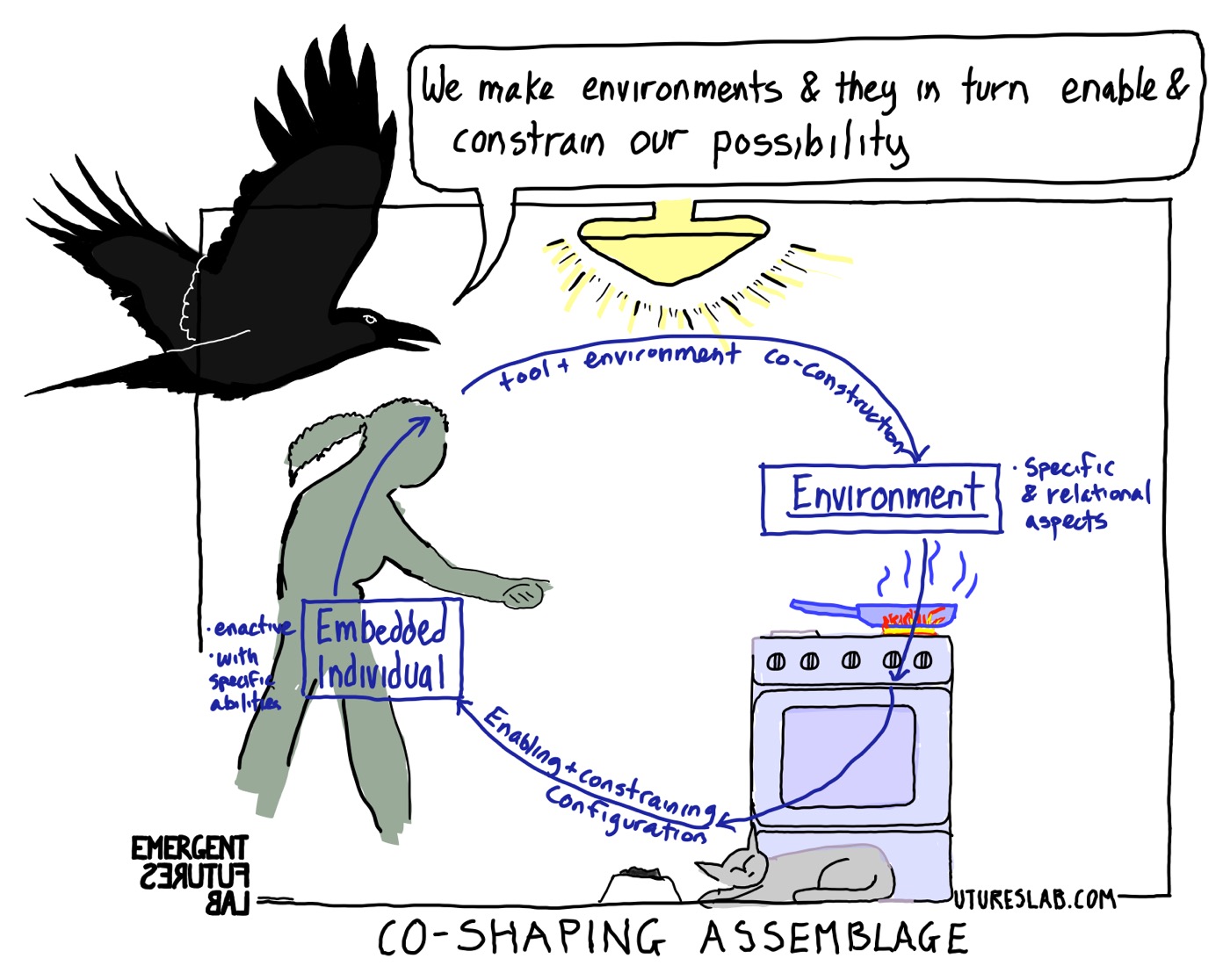
Here is what it gives us from a creative relational ecological perspective: we make environments, and those environments in turn creatively enable and constrain our possibilities. There is a continuous loop of embodied tool use and environment co-construction between the embedded individual and the configuration of their world.
This is what we call the co-shaping emergent assemblage – this has four key aspects:
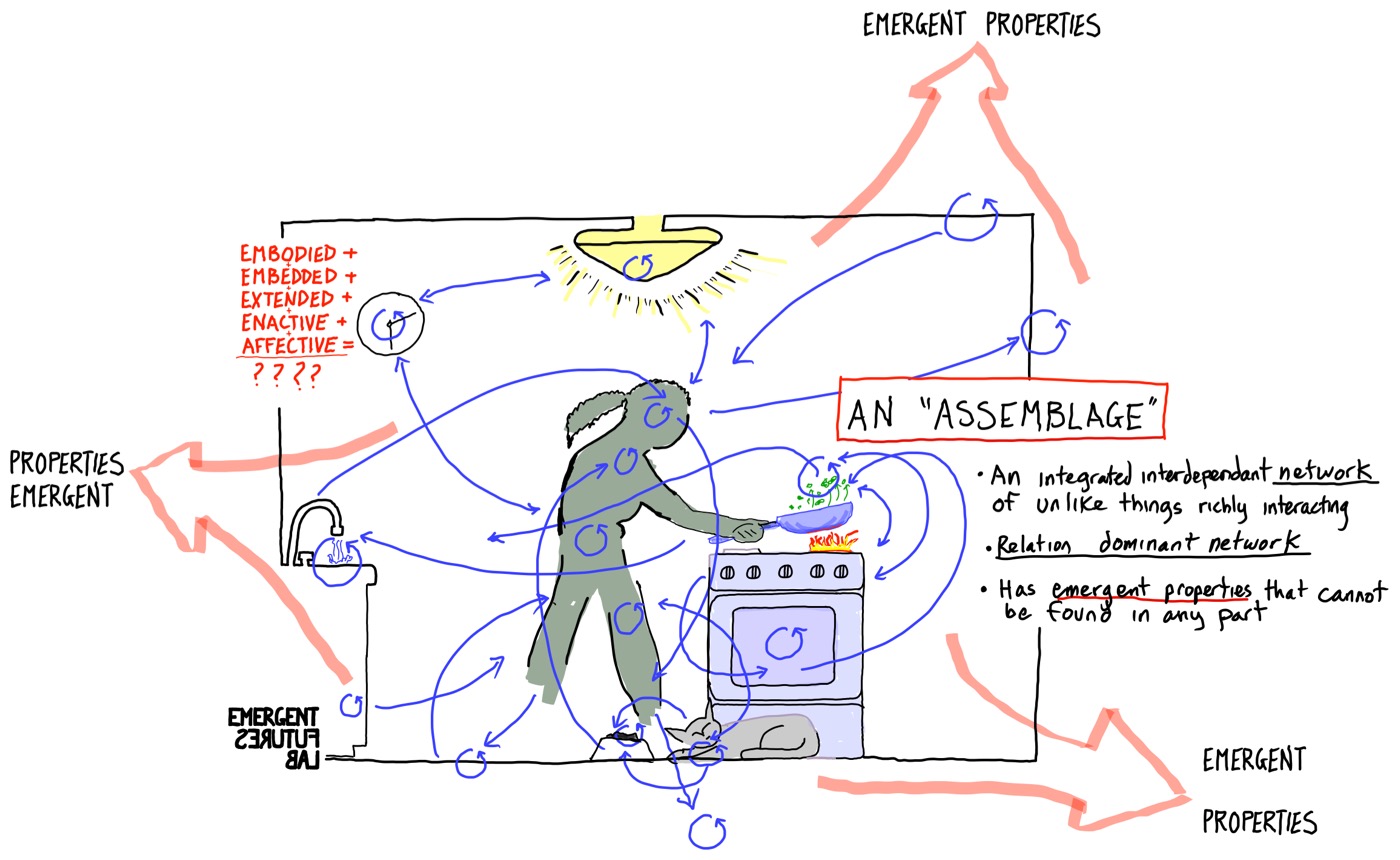
One: An assemblage is an integrated, interdependent network of unlike things, richly interacting and richly feedbacked. It is relation-dominant – where the relations take precedence over the parts.
Two: it has emergent properties that cannot be found in any part.
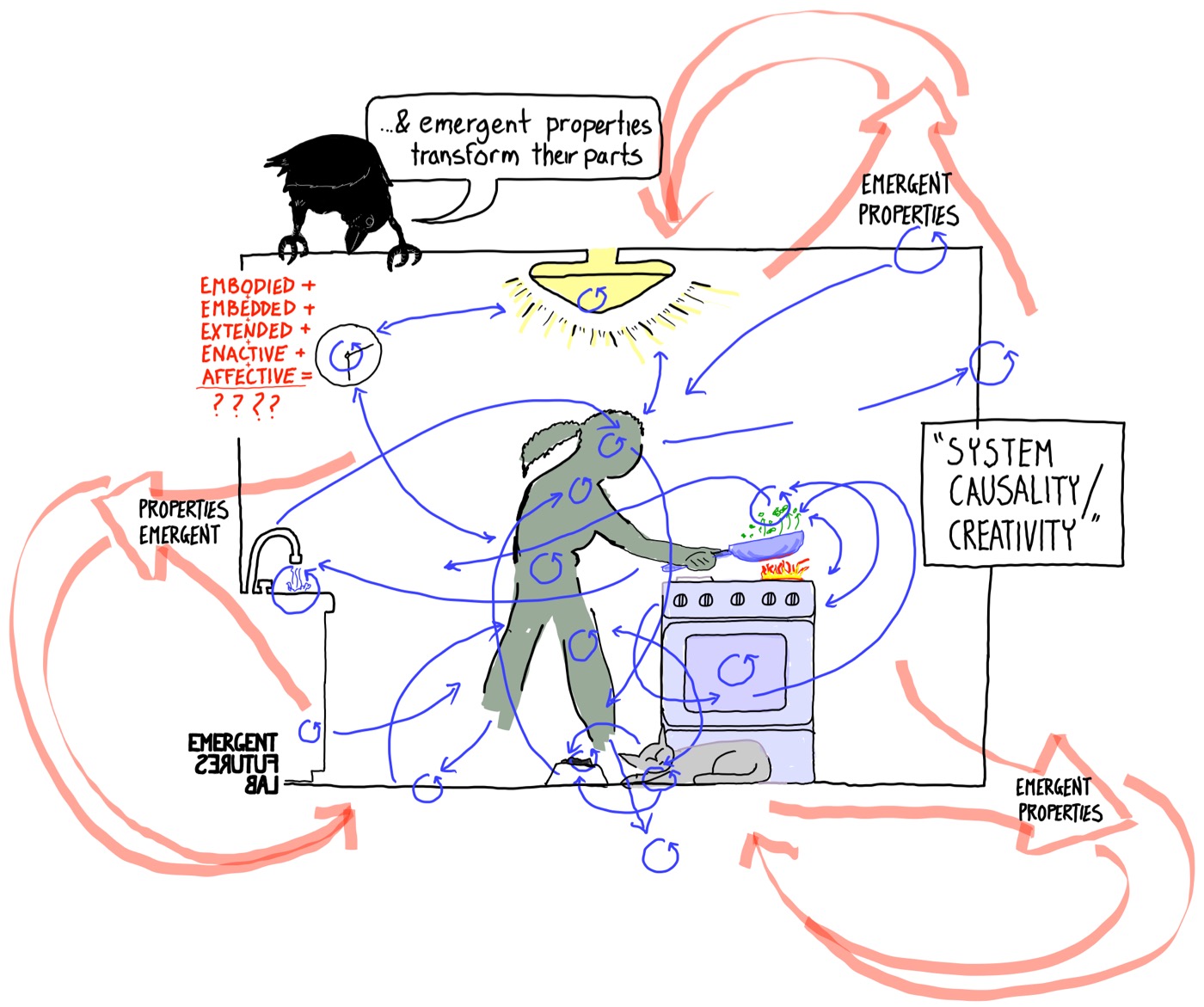
Three: those emergent properties transform their parts in turn. This is system causality, or system creativity: the whole makes the parts, which is the reverse of how we usually think causation works. The assemblage is creative, not the individual standing apart from it (which is itself an impossibility).
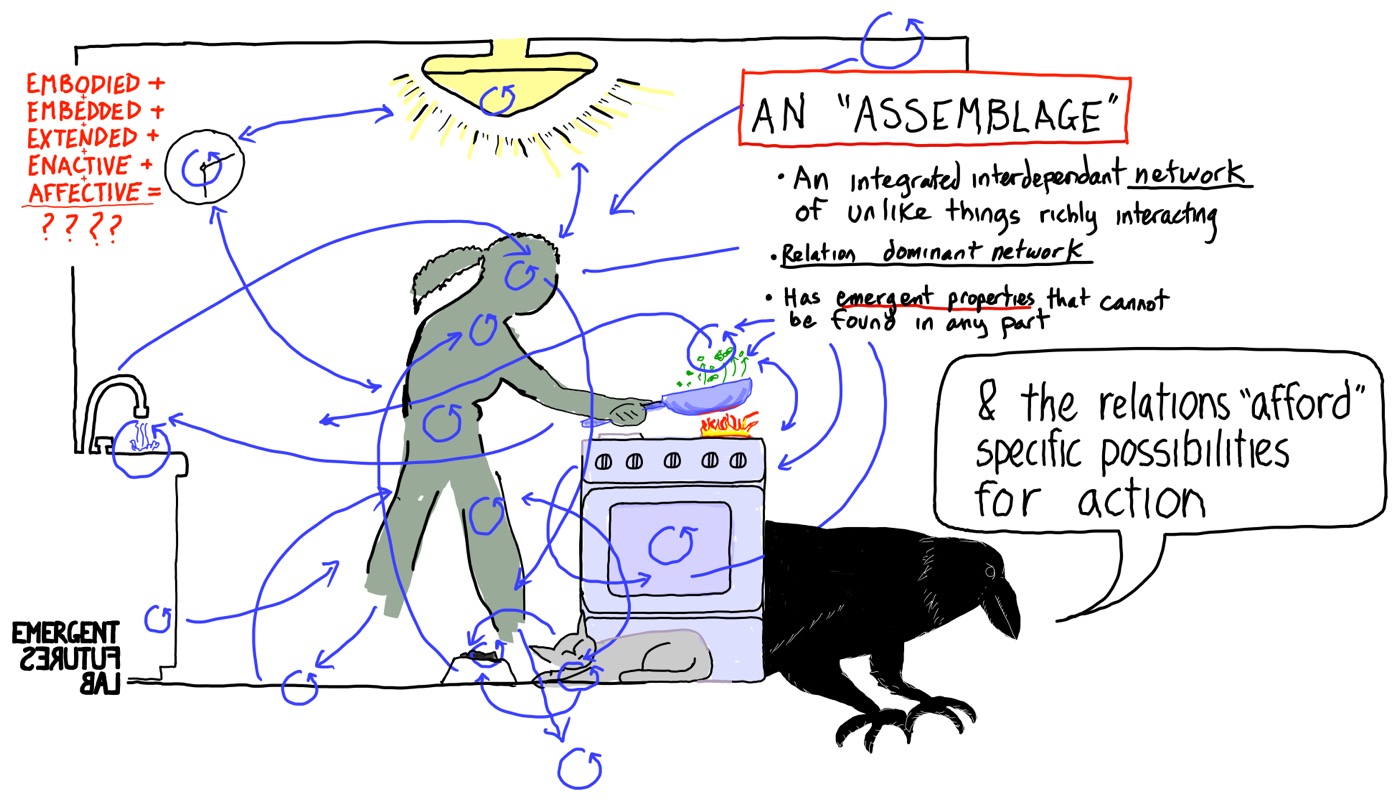
Four: The assemblage as an assemblage creatively“affords” certain possibilities for action. Which is to say the relations within it creatively generate specific emergent possibilities for action.
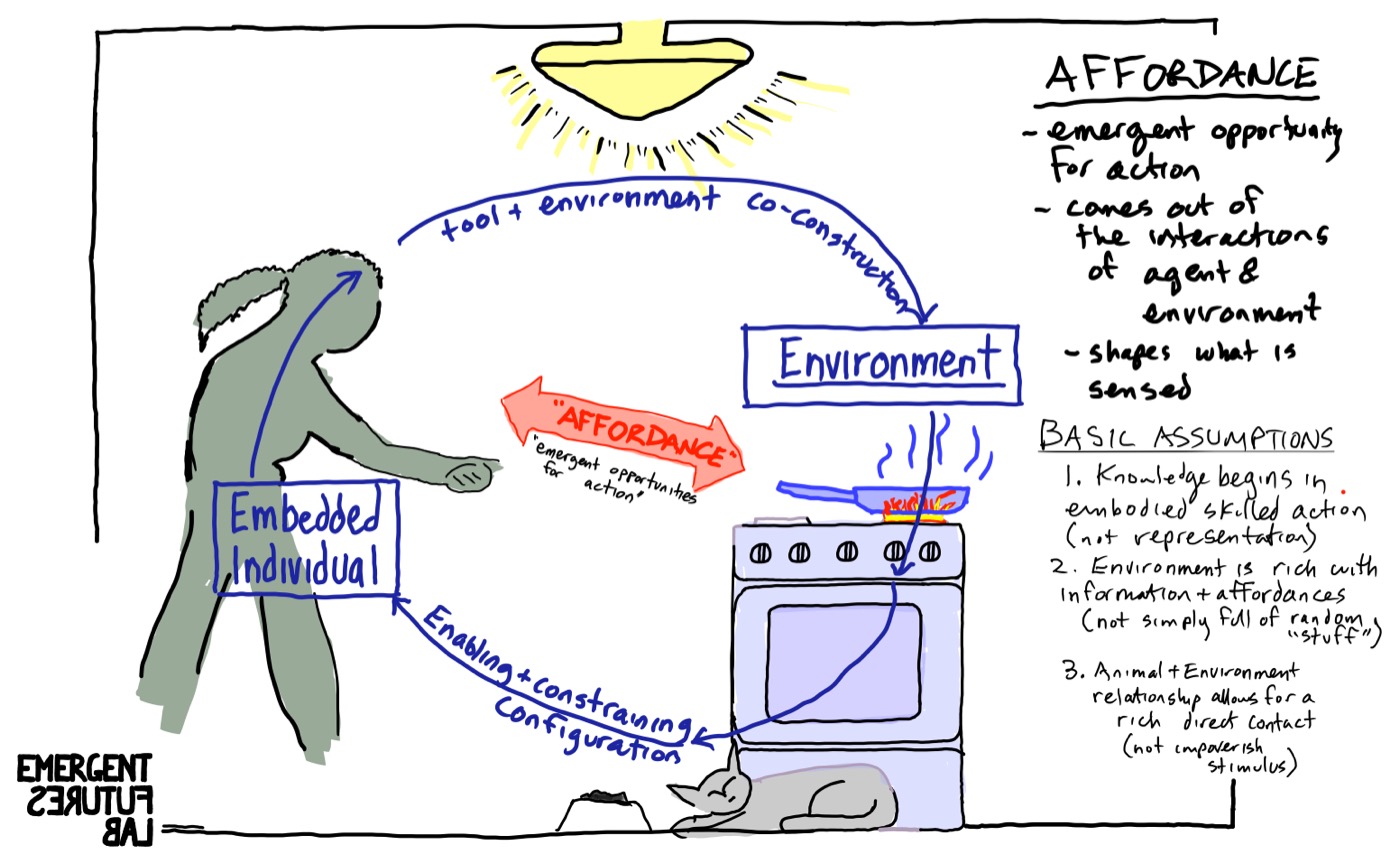
This is the concept of affordance – an emergent opportunity for potential action. An affordance comes out of the interactive relation between agent and environment. It shapes what is sensed. It is not in the object alone, and not in the perceiver alone. It lives in the active relation between them.
Three basic assumptions follow:
Knowledge begins in embodied, skilled action – not in representation. The environment is rich with information and affordances – not simply full of neutral stuff. And the relationship between a skilled embodied organism and its environment allows for rich, direct contact.
From a creative perspective, we now have a non-ideation-centric way towards the emergence of ideas. And this is the combination of Enaction and Affordances.
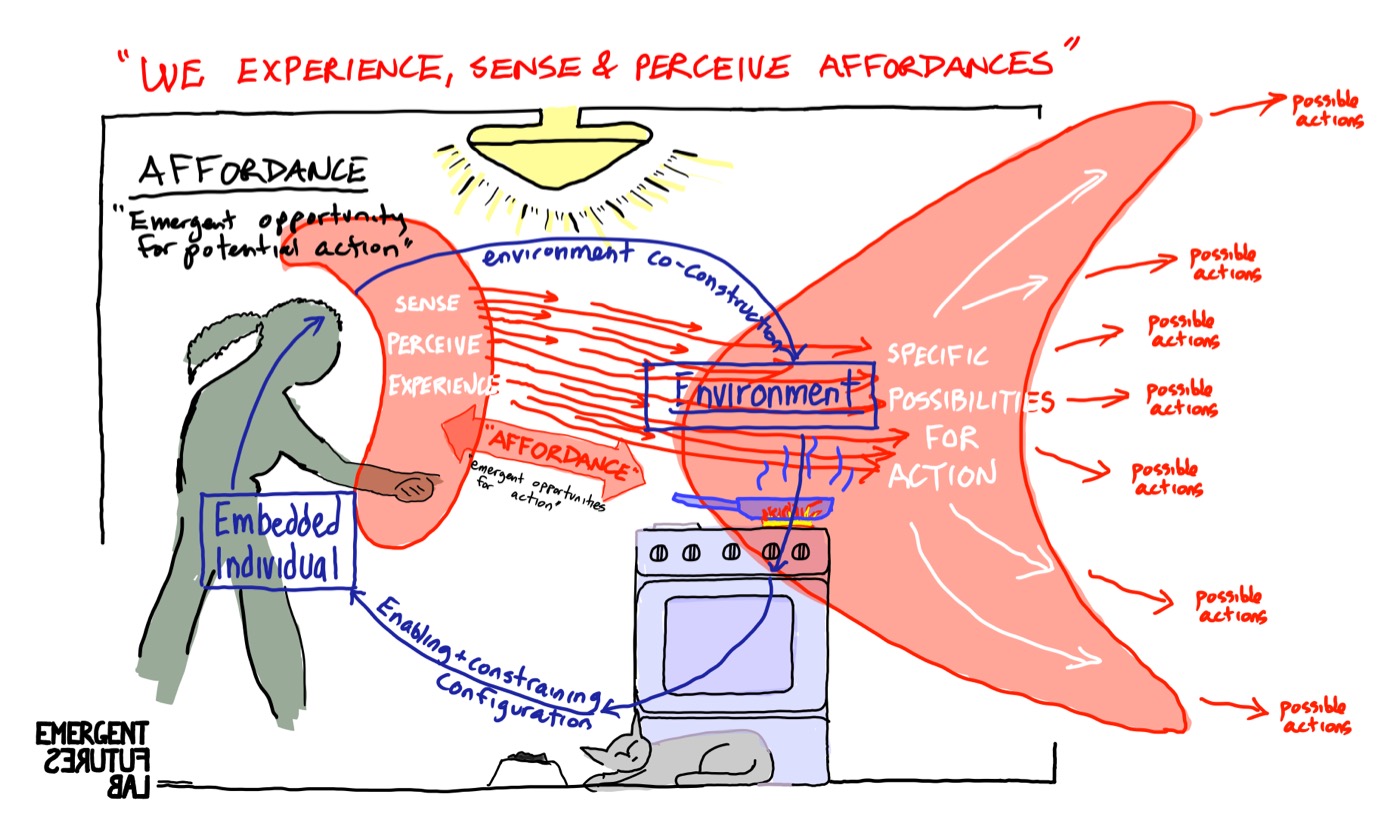
We experience, sense, and perceive affordances. Walking, we non-conceptually know the floor affords stepping. Sitting, we non-conceptually know the chair affords sitting. We feel this before we think it. We live inside a world of co-shaped possible actions, not a world of alienated, distanced matter.
Change the dynamics of an assemblage, and you change what is afforded – which changes what is possible – which changes the world you're operating in – which changes you.
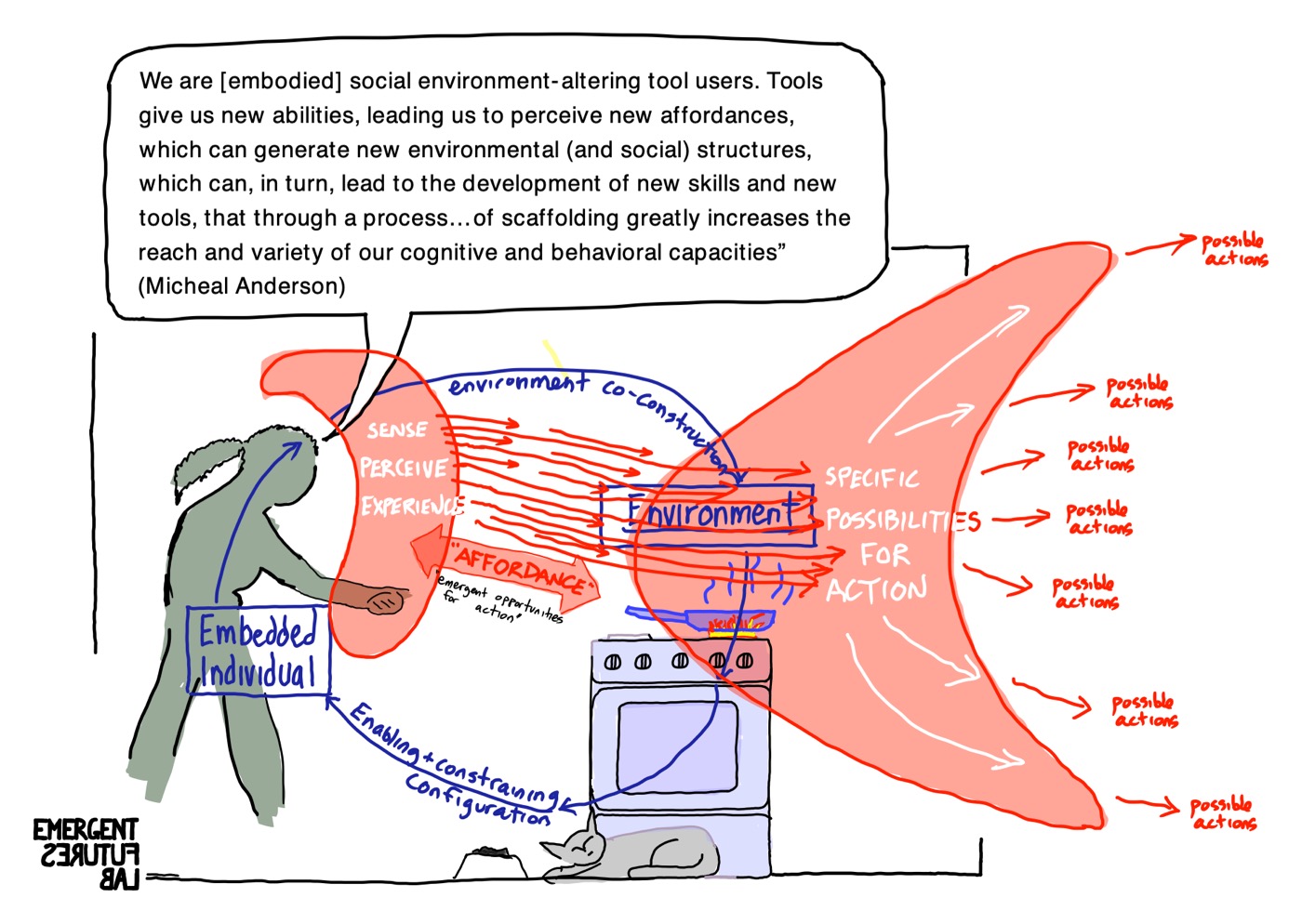
The enactive neuroscientist Michael Anderson puts it precisely:
“We are embodied social environment-altering tool users. Tools give us new abilities, leading us to perceive new affordances, which can generate new environmental and social structures, which can in turn lead to new skills and new tools – a looping process of scaffolding that greatly increases the reach and variety of our capacities”.
This is the creativity of living beings like us in a nutshell. Not brainstorming. Not ideating. Environment-altering. Changing what you sense, feel, and perceive by changing the assemblage you are working inside of…
It is from this logic of an Enactive co-creating Assemblage and what it Affords that the challenge of disruptive creativity can be made most concrete.
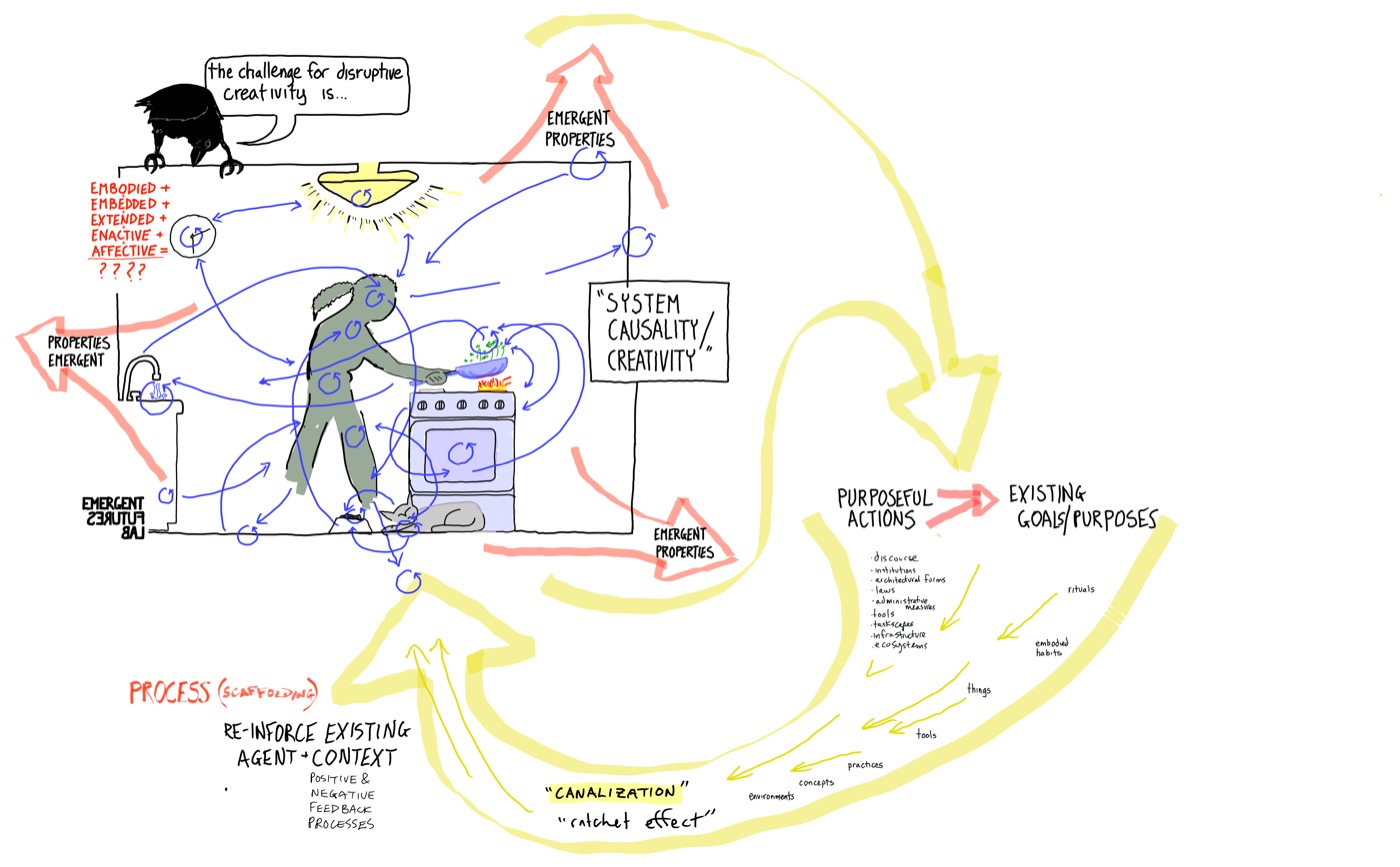
Let's turn to this question next: How can we engage with creative processes toward novel qualitative change?
If you remember from last week, it is these forms of disruptive change that we argued cannot be approached effectively from our most common linear models of creativity (such as Design Thinking or the Double Diamond). Here is how we can approach this:
We are living inside heavily scaffolded systems. Every environment we inhabit – institutional, cultural, physical – is a structure that has been layered over time to create, stabilize, and reinforce existing ways of operating. Positive and negative feedback processes continuously pull things back toward their stable states. There is a name for this in complexity science: canalization, or the ratchet effect. The system has multiple stable states, and almost everything in it – the tools, the practices, the concepts, the laws, the infrastructure, the embodied habits, the rituals – acts as a corrective force. Every time you poke the system, it adapts – it creatively restabilizes. This is not “resistance to change” being generated by recalcitrant individuals. It is how complex adaptive systems work.
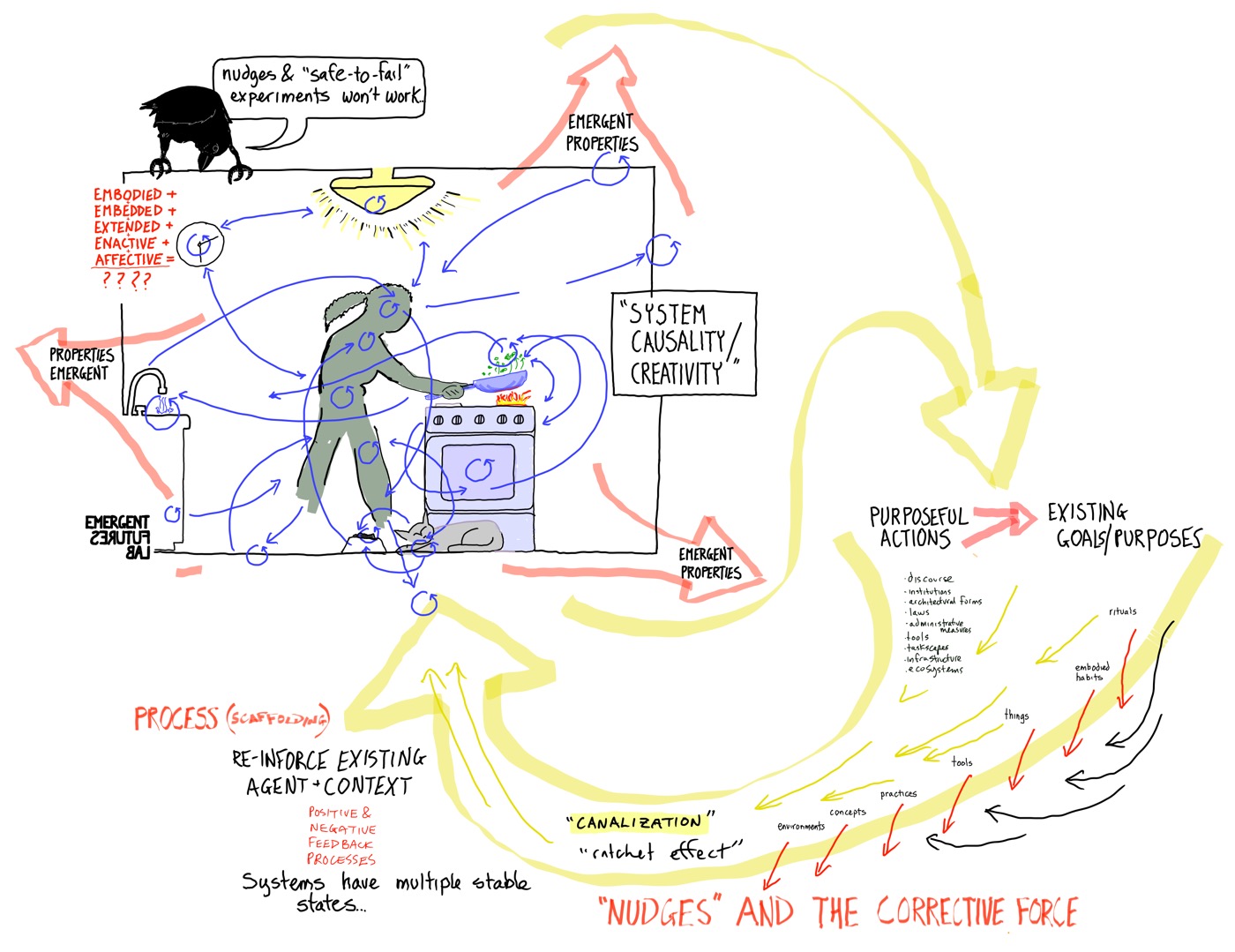
This is why nudges and safe-to-fail experiments are of limited value for disruptive change. A nudge generates a nudge's worth of response, and the system absorbs it. You end up back where you started, maybe fractionally adjusted – or in another of the system's multiple stable states…
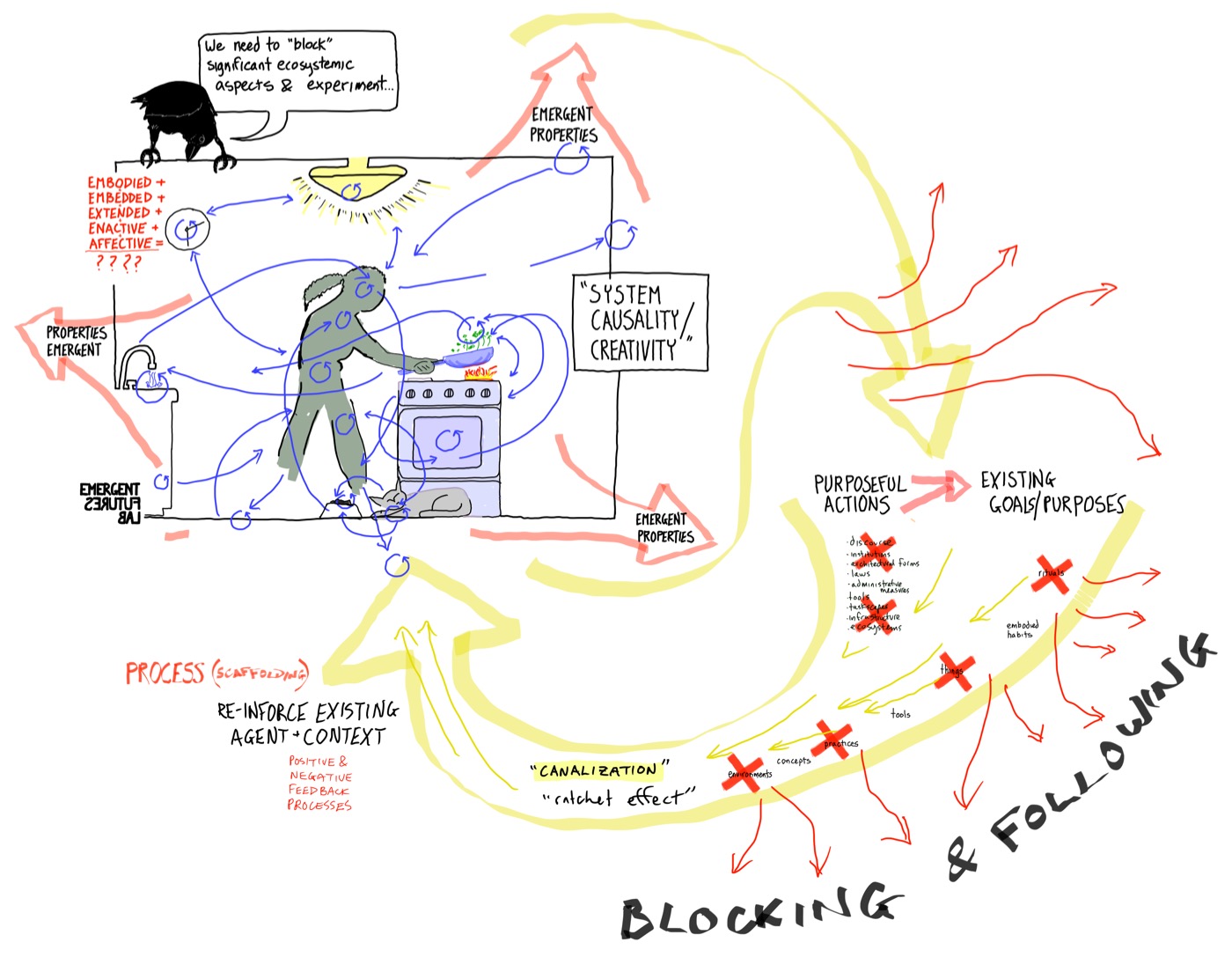
To generate qualitative change, we have to block significant and relevant aspects of the existing assemblage and experiment within those blocked conditions. Not nudge – block and probe. We interrupt the feedback loops. We deliberately set aside practices, tools, concepts, and environments. And then we follow what emerges from those interruptions (what is now afforded). What appears in the gap opened up by blocking what was previously automatic – that is where the new begins to show itself. Here nothing is certain. We cannot accurately predict what will happen. This is why we talk of following. And in following we are developing new tools, habits and practices – in essence co-emerging alongside the changes in ways that profoundly change us.
If we can develop novel practices to co-emerge with the new (while holding true to what is blocked) – we will begin the building a novel assemblage that can stabilize as its own semi-autonomous system. This is what Gary Tomlinson has termed a novel “epicycle.” (Note: Epi – here meaning that it comes from an existing cycle or system. Conjoining the prefix epi to cycle points to how a novel system “buds” off the existing system).
The qualitatively new first emerges as a budding novel epicycle that we are co-emerging alongside – both within and of it.
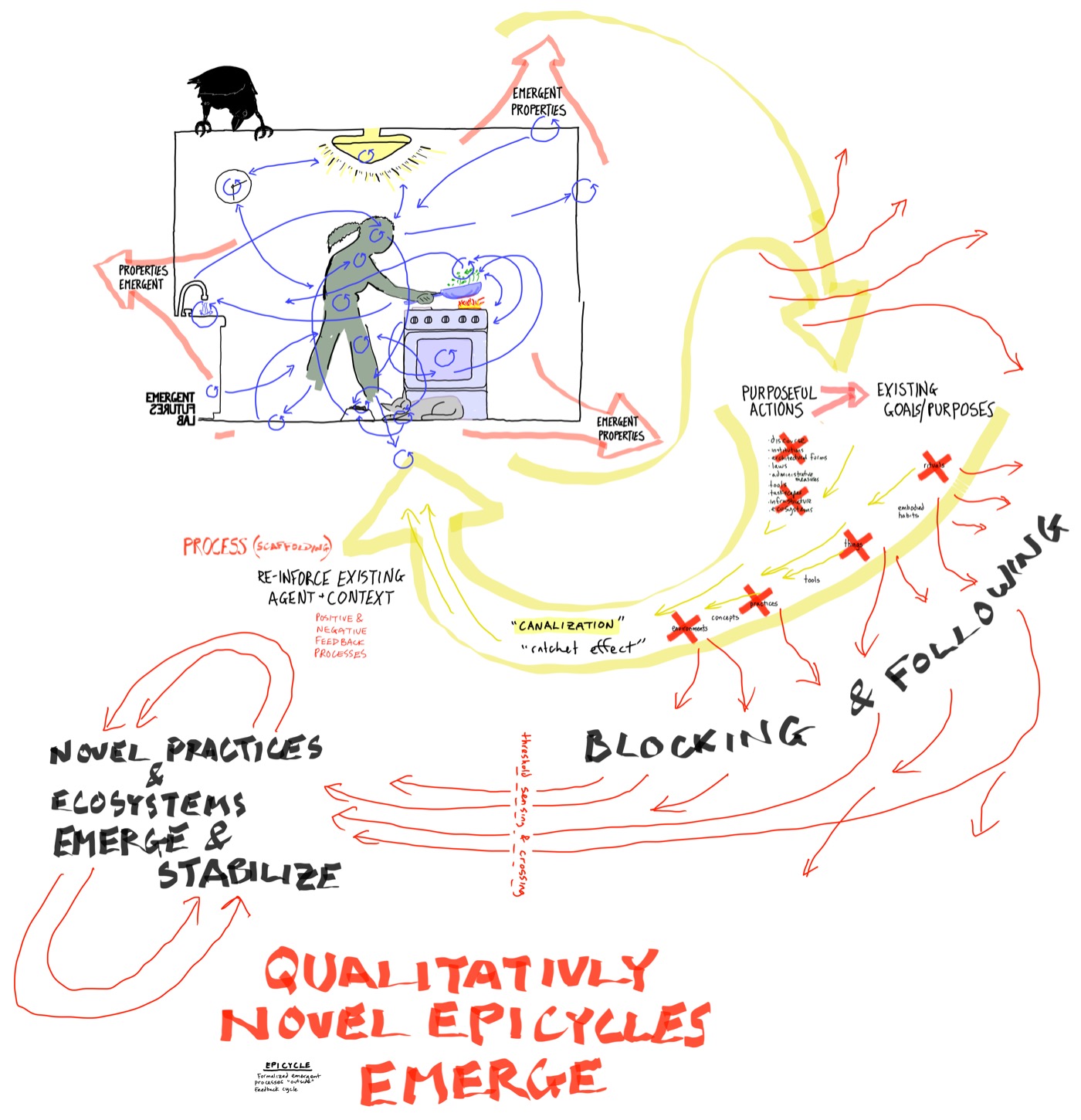
When you block and follow, you make it possible for the semi-autonomous creation of the conditions for qualitatively novel epicycles to emerge (but nothing is certain and nothing is given). Novel practices and ecosystems can develop and stabilize. Something might begin to have its own coherence and agency (you are not passive in this – but you are also not in control of anything).
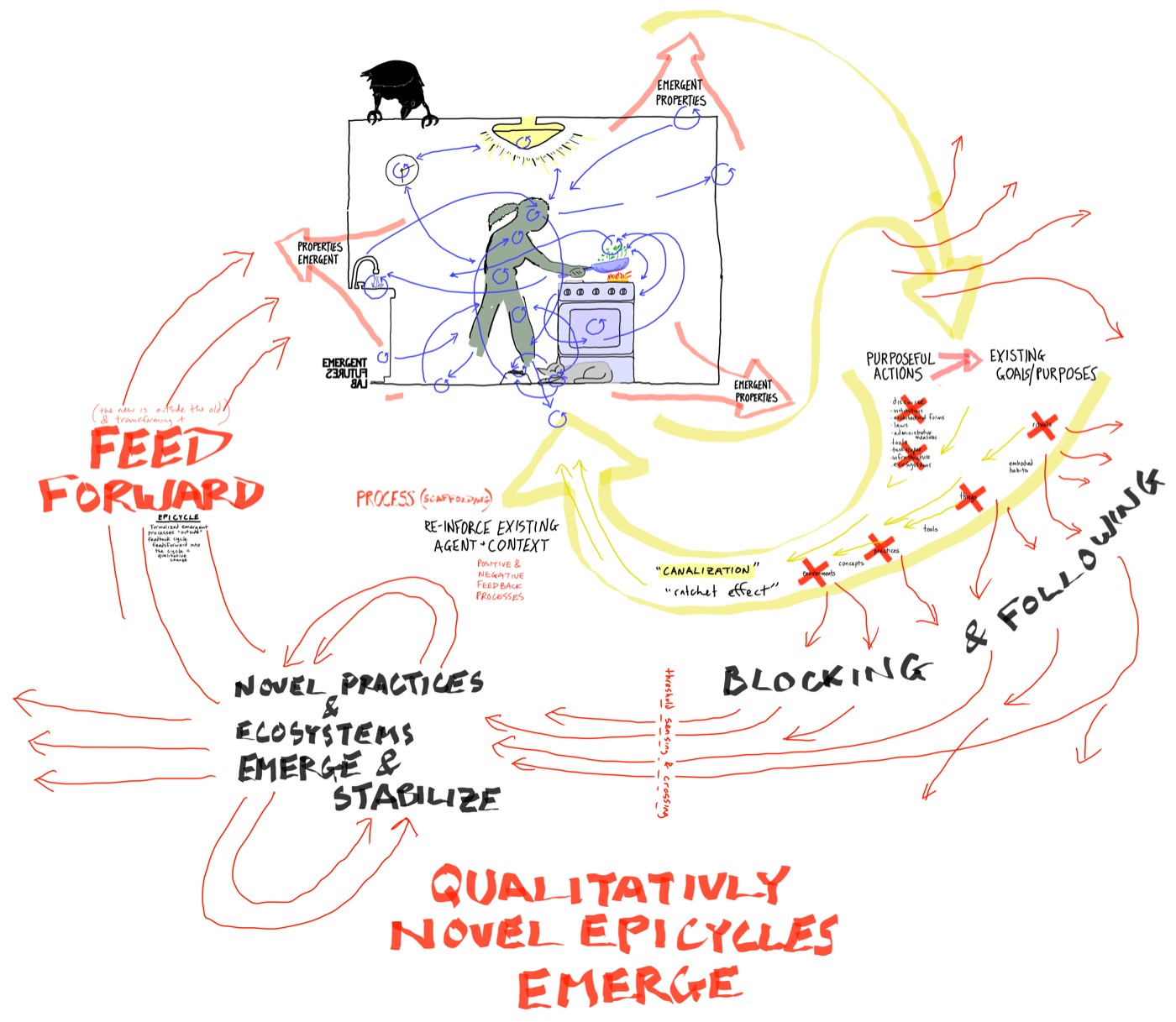
That is when a feed-forward transformative process becomes possible.
Feed-forward is distinct from both positive and negative feedback. Feedback – in both directions – operates within an existing system.
Feed-forward involves something that originates outside the existing system, something the system cannot simply absorb or neutralize – something that transforms the system rather than being transformed by it. Mountains are an example: they change the weather, but they are not changed by the weather.
When genuine novelty stabilizes into its own system (a novel epicycle) with its own agency, it begins to act as a feed-forward force on the world it emerged from. The new comes to be semi-outside the old, reshaping it from this quasi-outside position.
And this in the broadest of terms is how one can conceptualize the emergence of qualitative novelty.
As we come to the end of this newsletter, let us conclude by contrasting the logics of ecosystemic or worldly creativity with our more linear and essentialist approaches.
Last week, we described the logics of linear individualistic creativity as,
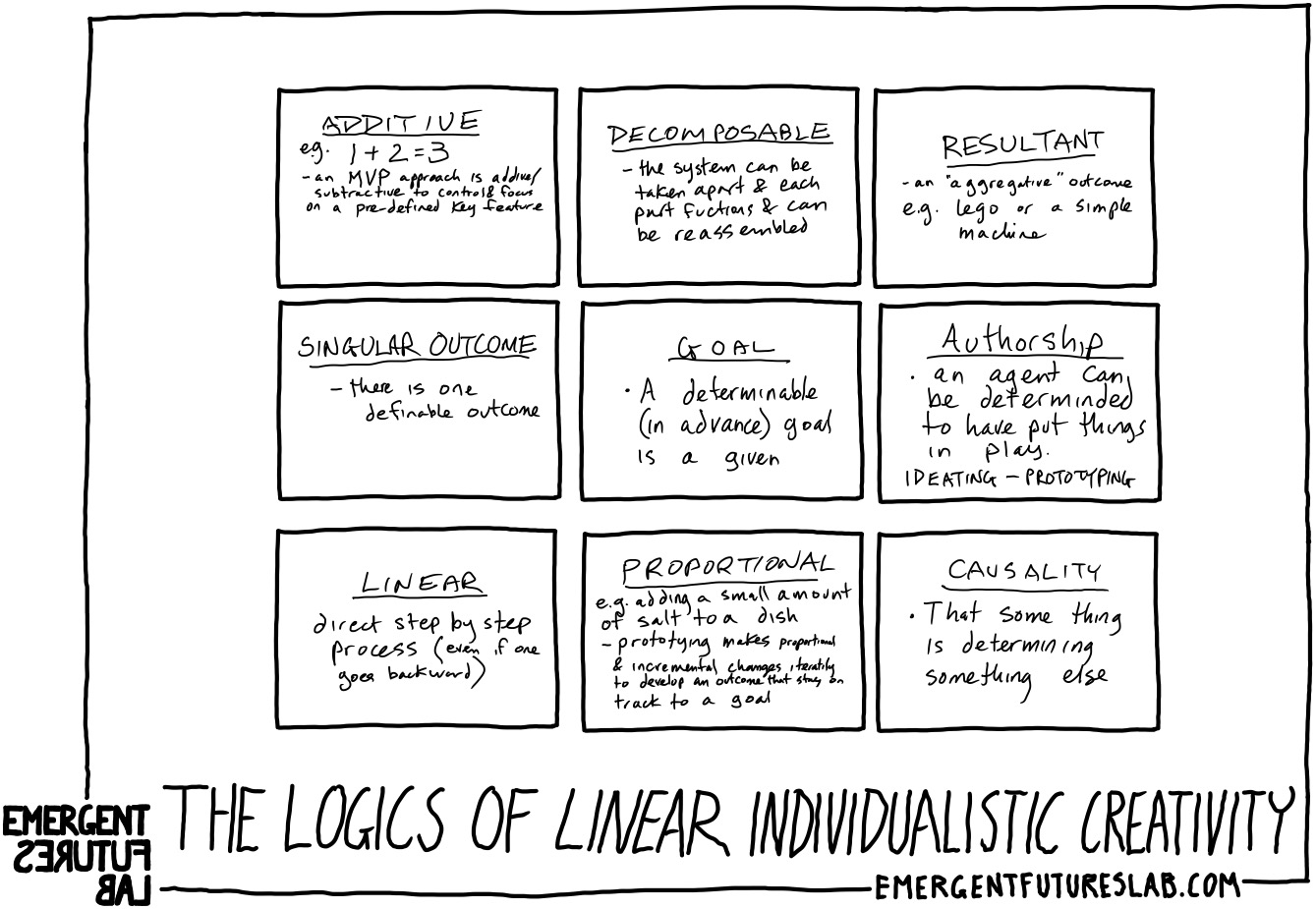
Linear, additive, goal-oriented, having a singular outcome, decomposable, authored, resultant, proportional, and causal.
The logics of emergent ecosystemic creativity are the inverse of the linear individualistic model; they are:
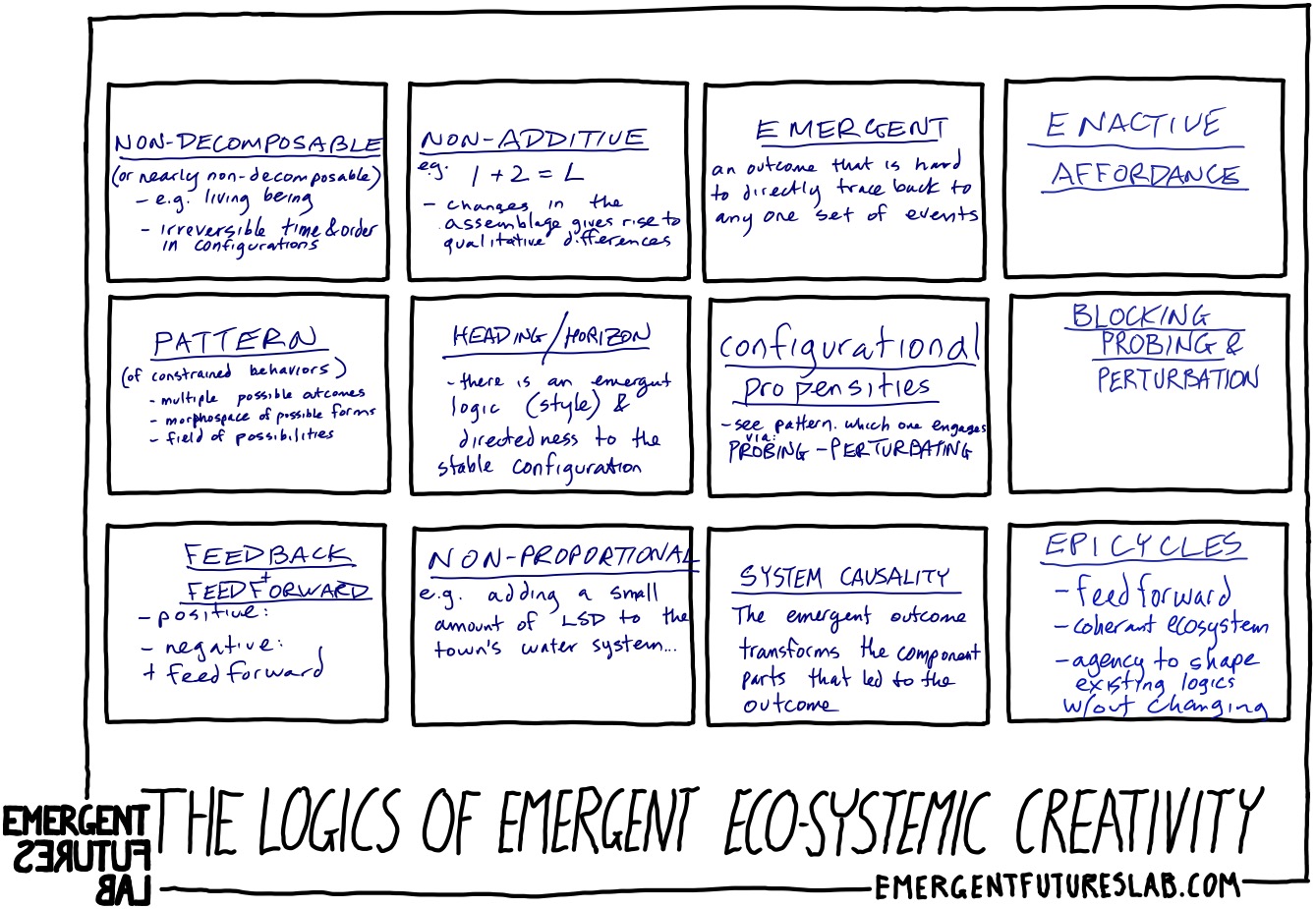
Non-decomposable: (or nearly so) assemblages that are irreversible in time and configuration
Non-additive: 1+2=L – changes in the assemblage give rise to qualitative differences, not proportional ones
Non-proportional: A very small addition can have a disproportionately large effect (think a tiny drop of LSD in the regional water supply).
Emergent: an outcome hard to directly trace back to any single set of events
Enactive affordances: direct experience – and potentials for action are the relational outcome of a skilled embodied being engaging with relevant aspects of the environment
Configurational Propensities: of enabled and constrained behaviors – multiple possible outcomes, an emergent morphospace of possible forms, a field of possibilities
Heading/Horizon: there is an emergent logic, a style, a directedness to the stable configuration
Fields and Processes: Reality consists of fields and processes at all scales
Blocking, Probing, and Perturbation: Key techniques to generate novel ecosystemic affordance possibilities
Feedback and Feed-forward: feedback loops are adaptive; feedforward is transformative.
System Causality: the emergent outcome transforms the component parts that led to it
Epicyclical: How a novel assemblage emerges and feeds-forward to have an impact on what exists.
The final comparison in the diagram below tells the whole story in one frame:
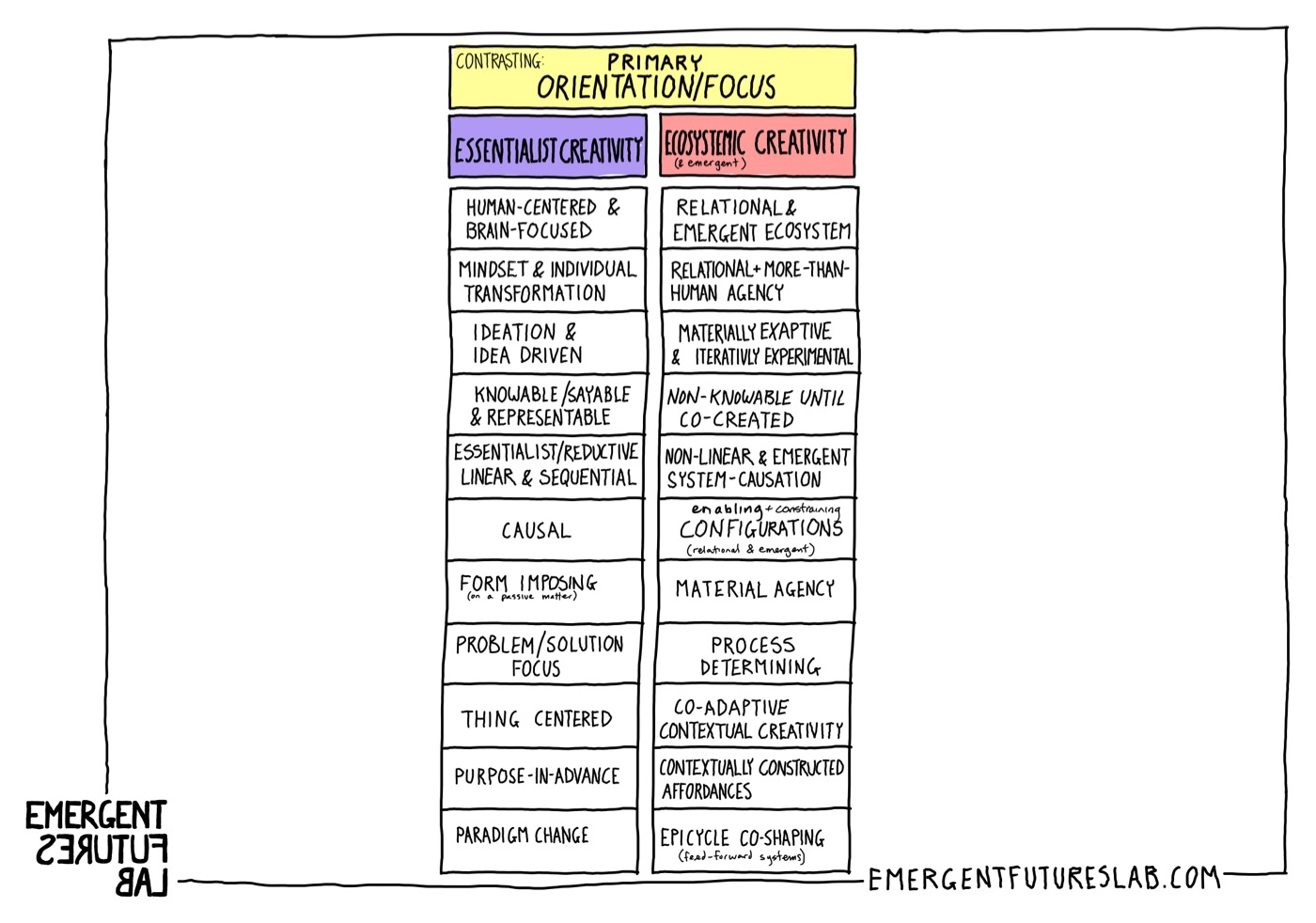
Essentialist creativity is human-centered and brain-focused; ecosystemic creativity is relational, operating within emergent ecosystems. The former requires mindset and individual transformation; the latter requires relational, more-than-human agency. The former works with ideas and ideation; the latter works materially, exaptively, iteratively, and experimentally. The former requires knowable and representable things in advance; the latter is non-knowable until co-created. The former is linear, sequential, causal, problem-solution focused, thing-centered, purpose-in-advance; the latter is non-linear, process-determining, co-adaptive, contextually constructed, configured around enabling and constraining possibilities, moving toward epicycle co-shaping via feed-forward systems.
These then are the three pillars: Qualitative Change, Enactive Assemblages and Feedforward Epicycles. These are not a new set of techniques to add to our existing tool kits – they constitute a paradigmatically different way of engaging with ongoing creative processes. Everything we do in creative practices engages with these three processes.
OK!
This ends this broad overview of three critical practices for developing an alternative approach to creative practices. We hope that in spending time with these two newsletters you can get a broad sense of how very different practices can be developed to engage with creative processes — at whatever scale you are operating.
Have a great last week of June!
Until next week - keep difference alive,
Jason, Andrew, and Iain
Emergent Futures Lab
+++
P.S. This newsletter continues in our community—where you can comment, question, and explore further. Emerging Futures + brings you into the conversation. Join here
P.P.S. WorldMakers goes beyond the newsletter: 40 live events annually, weekly podcasts and exercises, our annotated bibliography, and practitioners across diverse fields reimagining creativity together. Discover WorldMakers


