Newsletter
Resources
Courses
Books

Welcome to Emerging Futures -- Volume 256! Visualizing the Propensities - PT VI...
Good Morning co-becomings of the enactive signs,
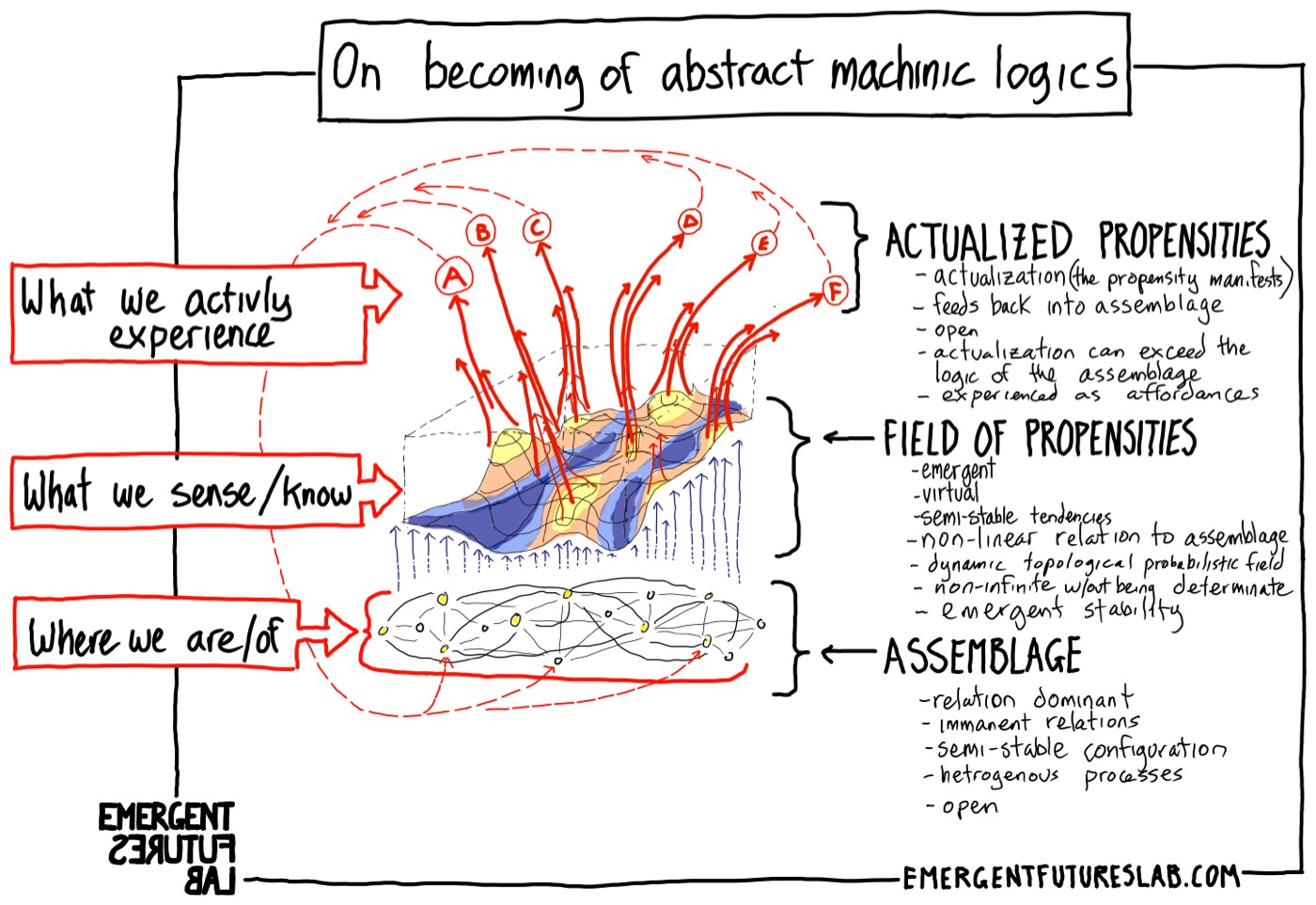
This week of high summer is a practical one in the world of the newsletters' experimentations. We are experimenting with ways of sensing and visualizing the dynamic relation between assemblages, virtual fields of propensities, and their creative actualization.
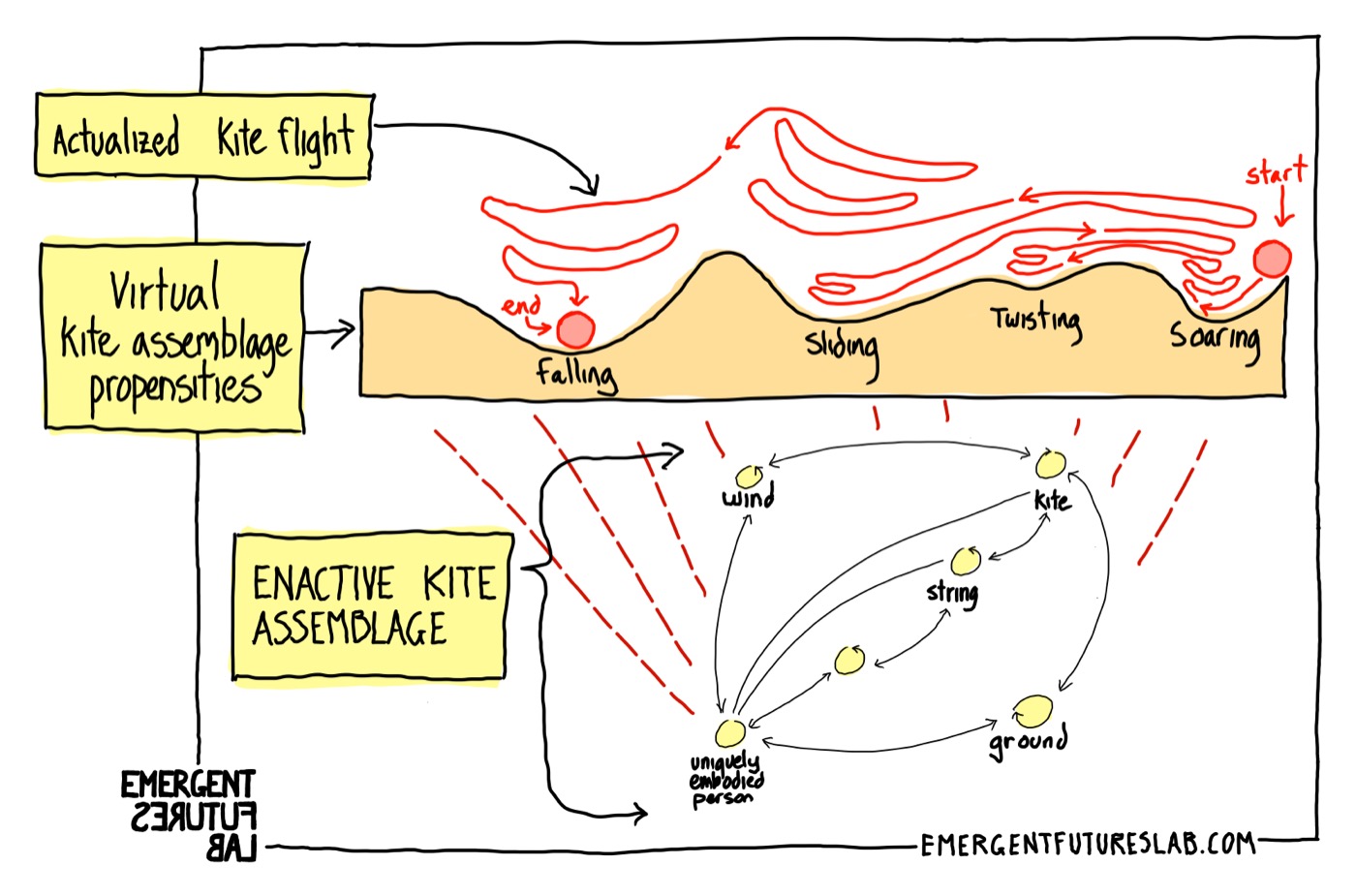
Two weeks ago we introduced this with a diagram:
You might have wondered:
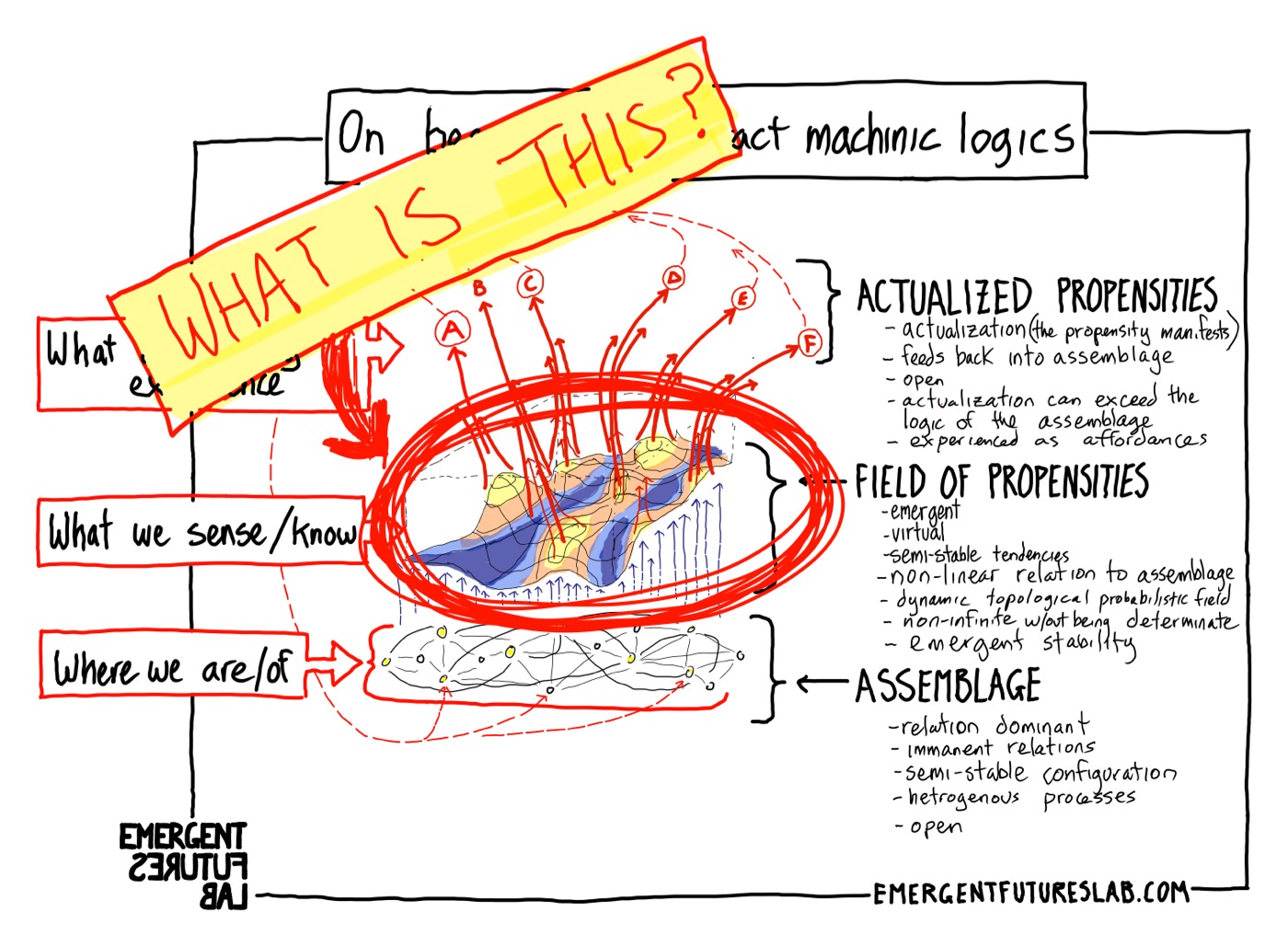
How should I understand this diagram and its strange flying carpet?
And while we have introduced this visual language earlier in a number of series in the newsletter – most recently in Volumes 125 and 126 – but that was over 100 newsletters – and over two years ago!
What exactly is this concept – a “field of propensities” and why does it look like an odd magic carpet or overly colorful topological map?
Often our sense of what is real is circumscribed by the physical. Other non-physical entities have the unfortunate tendency of being explained away as types of abstractions.
But from the perspective of engaging with creative processes, this will not do. We need to engage with things that are “real – but not actual”. This wonderful phrase from Gilles Deleuze can sound either outright absurd or merely paradoxical. How can something be real but not actual?
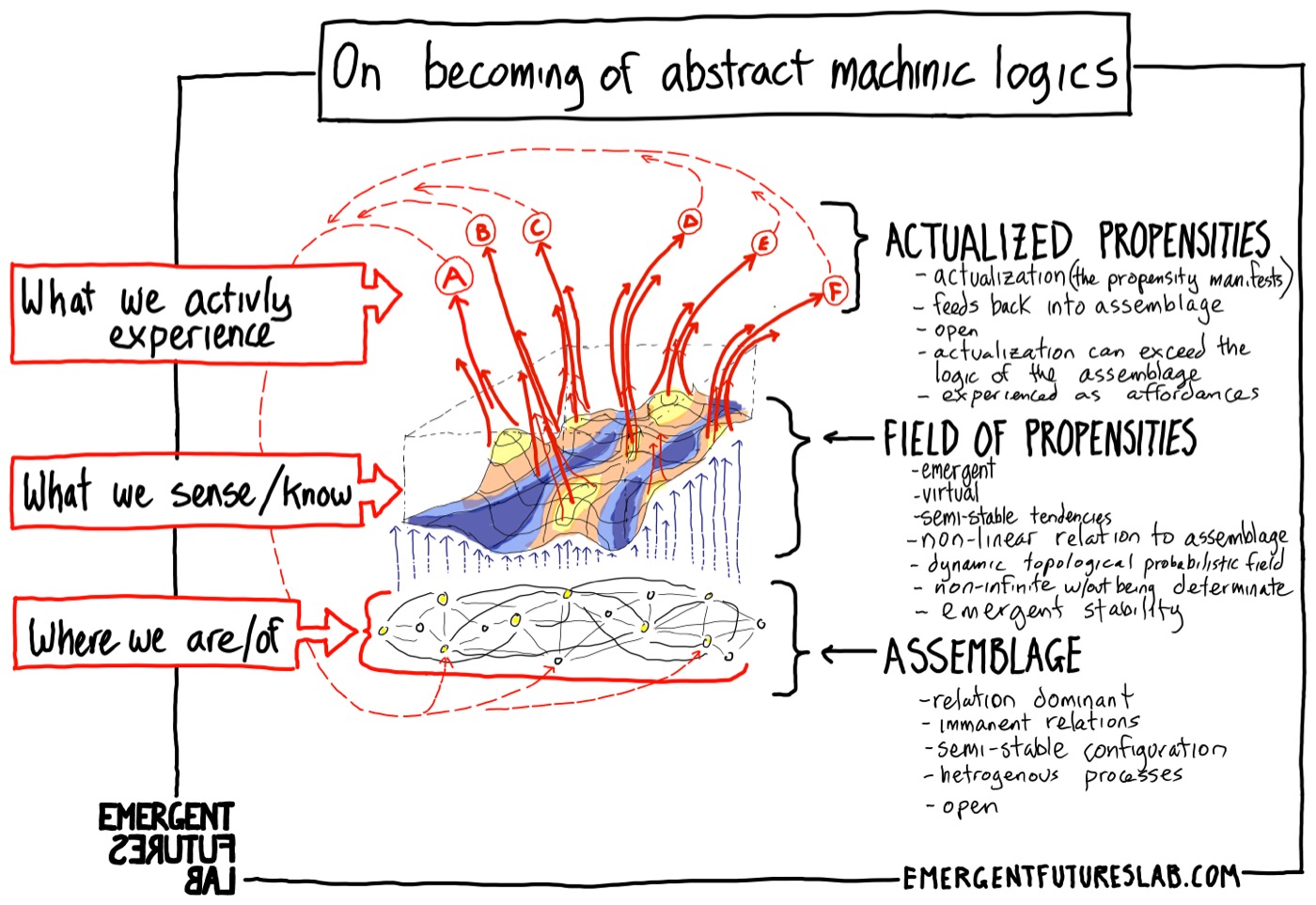
This is the creative process that we have been experimenting with over the last few weeks: how a relation-dominant assemblage of heterogeneous component processes in the right stable but open configuration will emergently give rise to a dynamic semi-stable field of virtual propensities that are actualized by experimental practices.
The first example we use to introduce this was the propensity of crowded freeways to spontaneously produce a phantom traffic jam.
We extended this to look at the invention of modern flight and flying a kite – each processual assemblage gives rise to a semi-stable set of propensities.
The importance of this is that it allows us to understand and engage with the spontaneous, semi-autonomous nature of creative processes – what Guattari and Deleuze termed its “abstract machinic” qualities. These qualities are found in how an assemblage semi-autonomously gives rise to a field of propensities – even before any of them are actualized. And this is what is meant by the wonderful concept of the virtual – these emergent propensities are very real but not actual. Which is to say that once there is a freeway + lots of cars driven by people, there will be phantom traffic jams – they are a real virtual possibility of this assemblage.
There are a myriad of ways we could conceptualize and engage with these virtual propensities. For us, what is important is to sense how they emerge from and dynamically connect to an assemblage. Propensities are neither singular nor are they ever fixed. If, for example, there is a freeway but only a few cars, then the virtual field of propensities will not include a phantom traffic jam. In this manner, the virtual is topologically varying.
One useful way to get a sense of this quality of propensities is to understand the assemblage as giving rise to a malleable surface that it pushes and pulls into a form of valleys and hills:
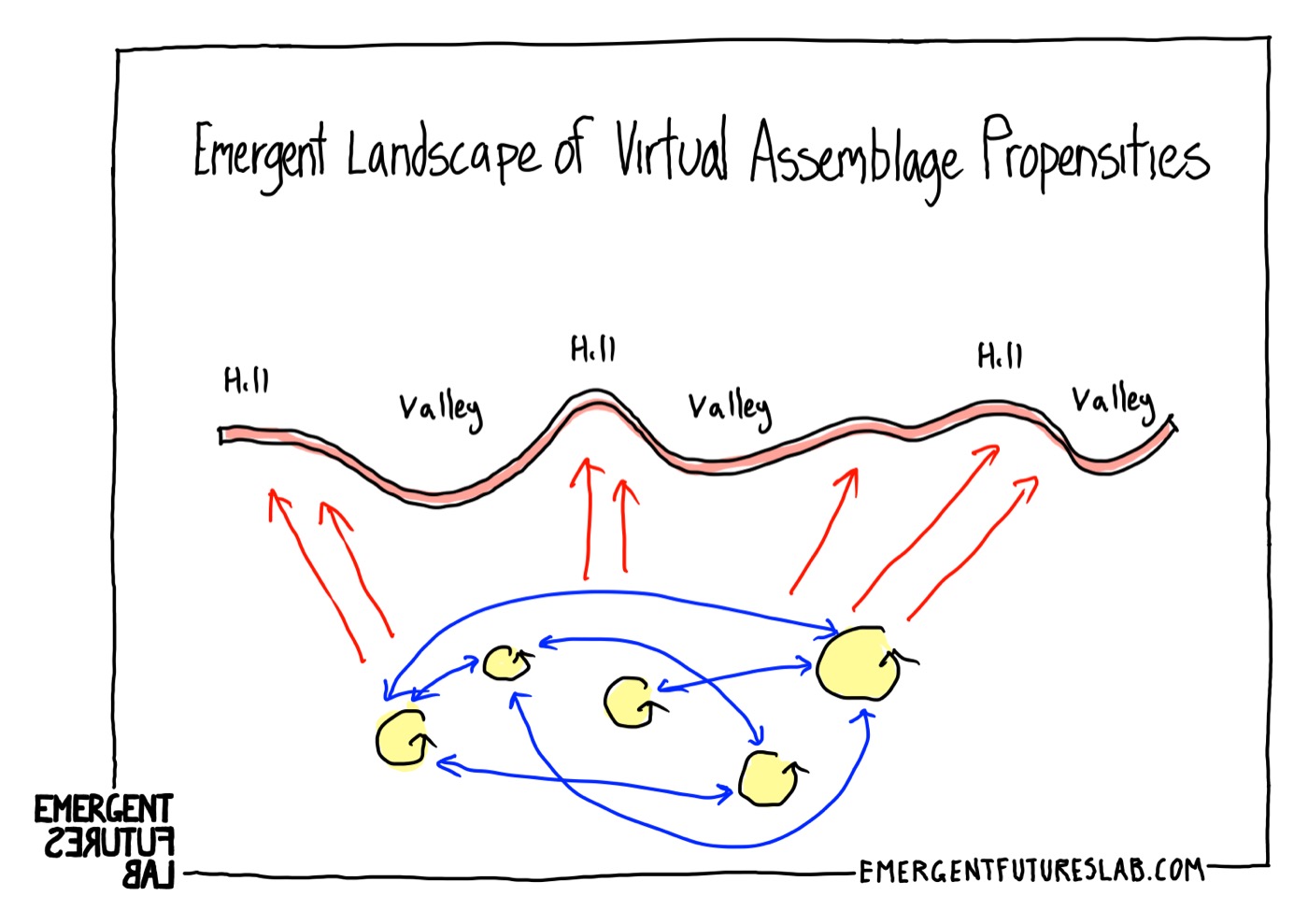
And that each valley is a virtual propensity that the system could “settle” into. This process is often pictured as a ball rolling across this uneven topology: it will roll down hills and settle into valleys – and depending on how steep or large the hill is, it gives one a sense of the energy needed to get the ball to move into a new valley or stable state:
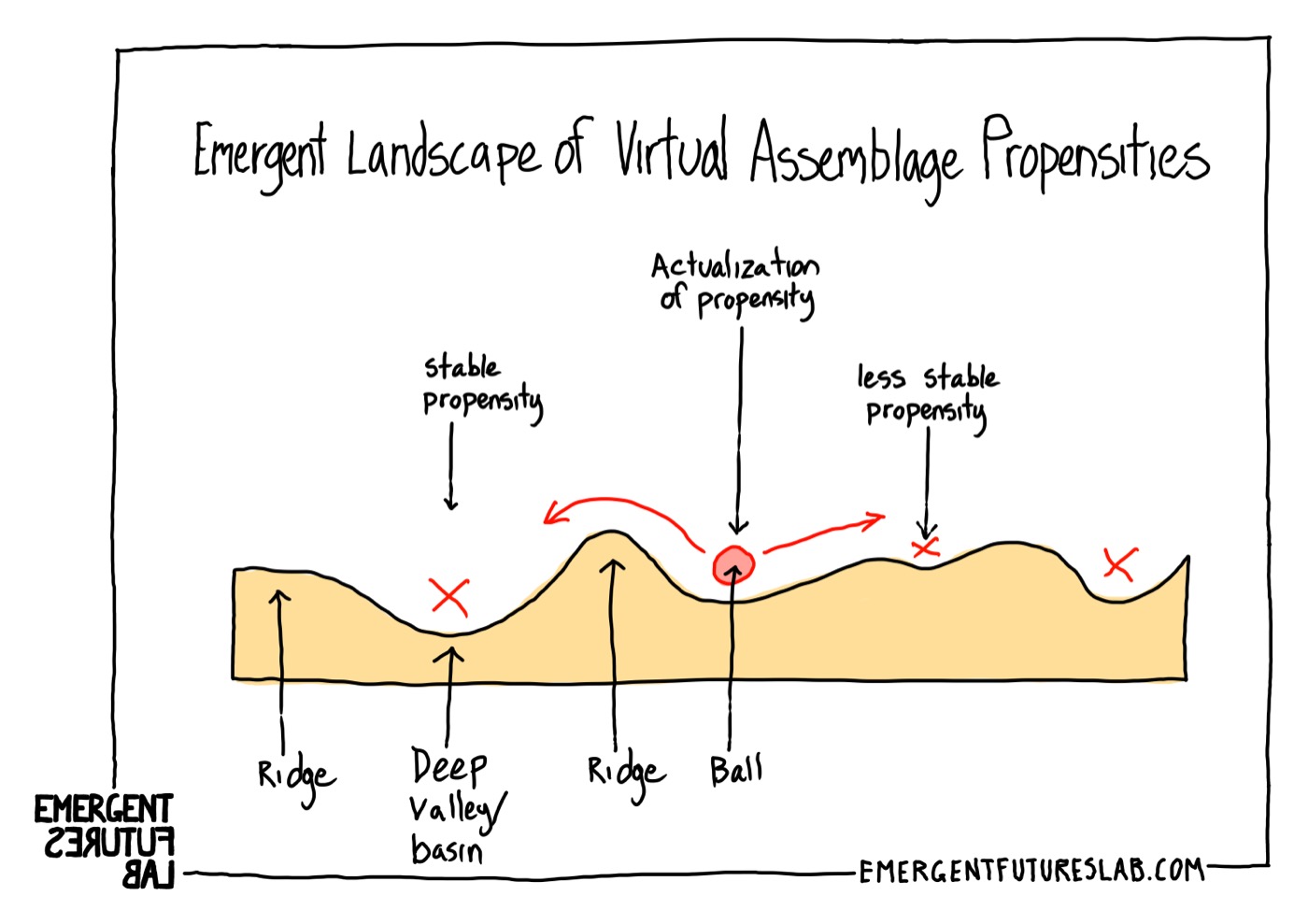
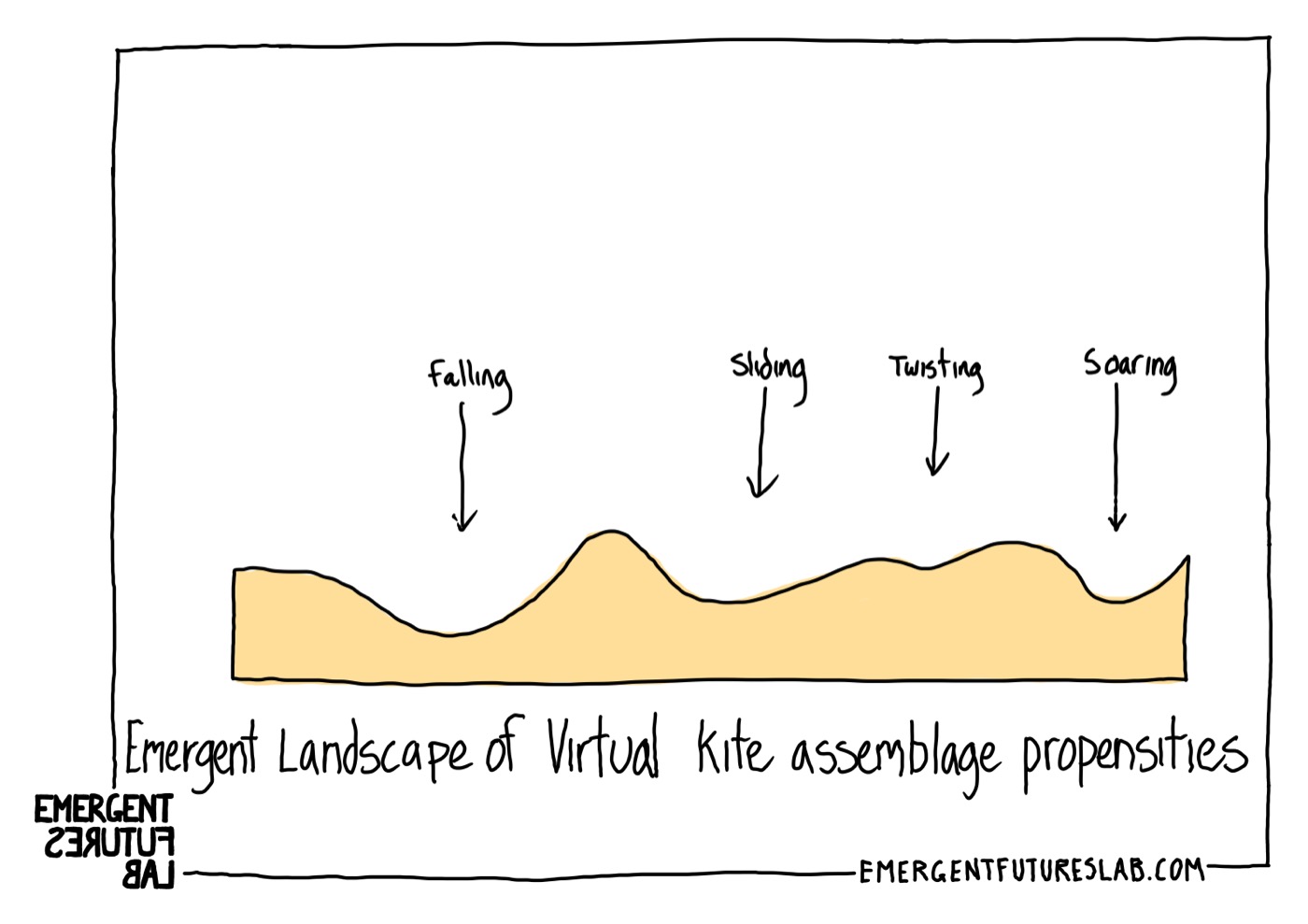
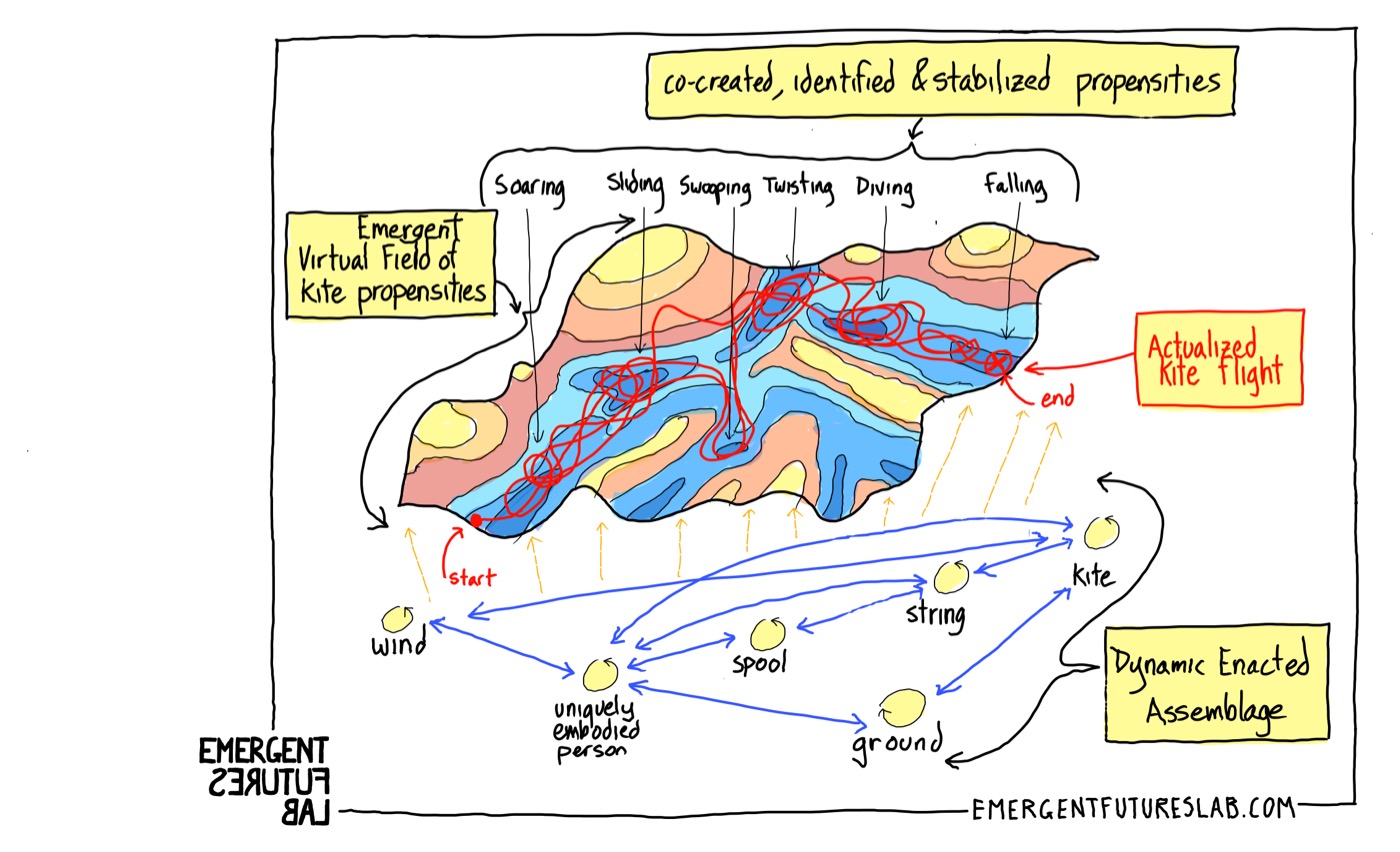
The emergent semi-stable topology – with the depth and variability of the valleys gives one a sense of how propensities can shift – to where/what – and how easily. Taking last week's example of the kite assemblage and its virtual propensity to soar, twist, slide and fall – we could translate this into a topological landscape:
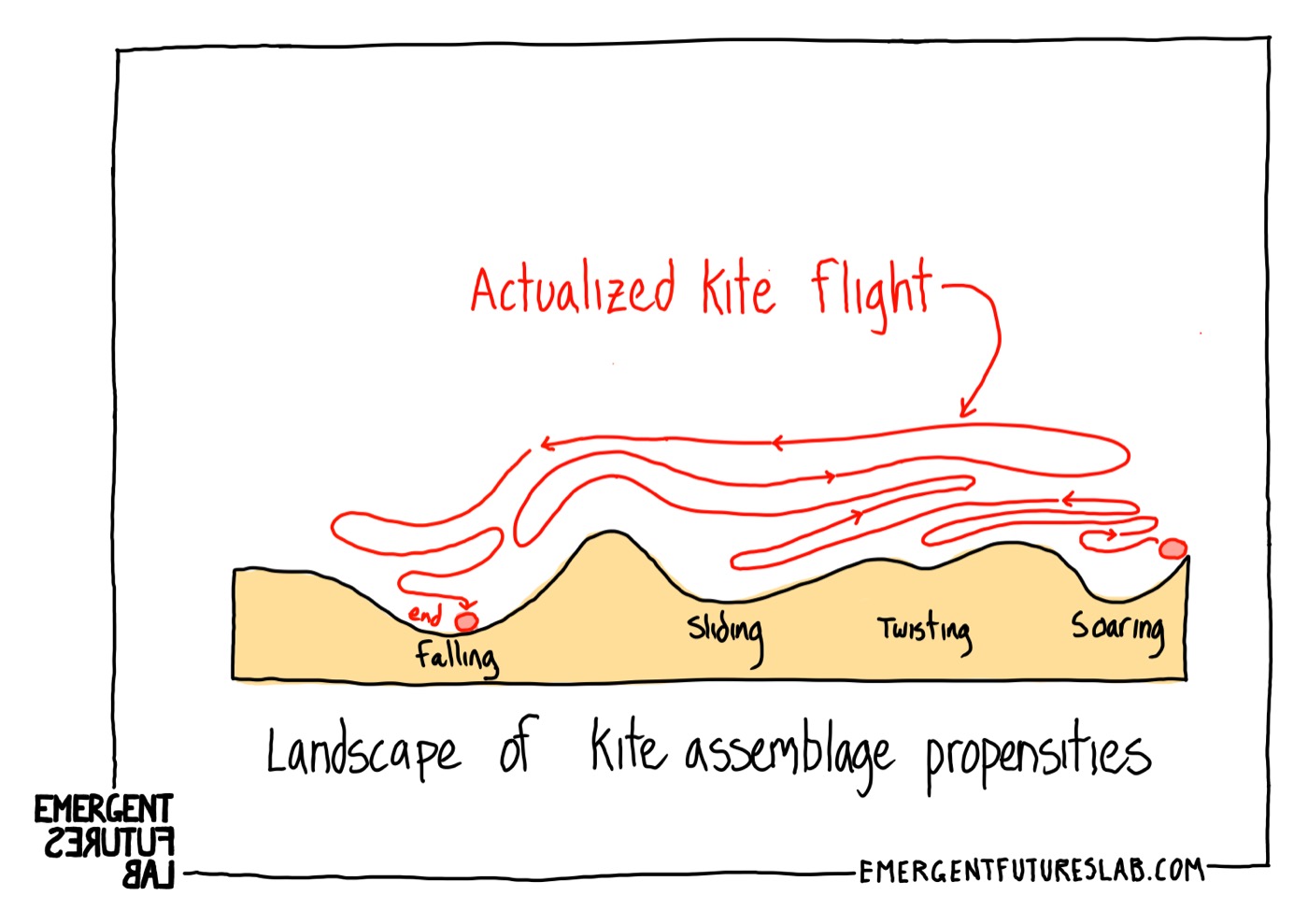
Where the actualized flight of a kite would move across and settle into multiple stable states (emergent propensities). It begins to soar, twists, and slides – and almost crashes – but is pulled back to soaring – and finally the inevitable happens and it falls to land:
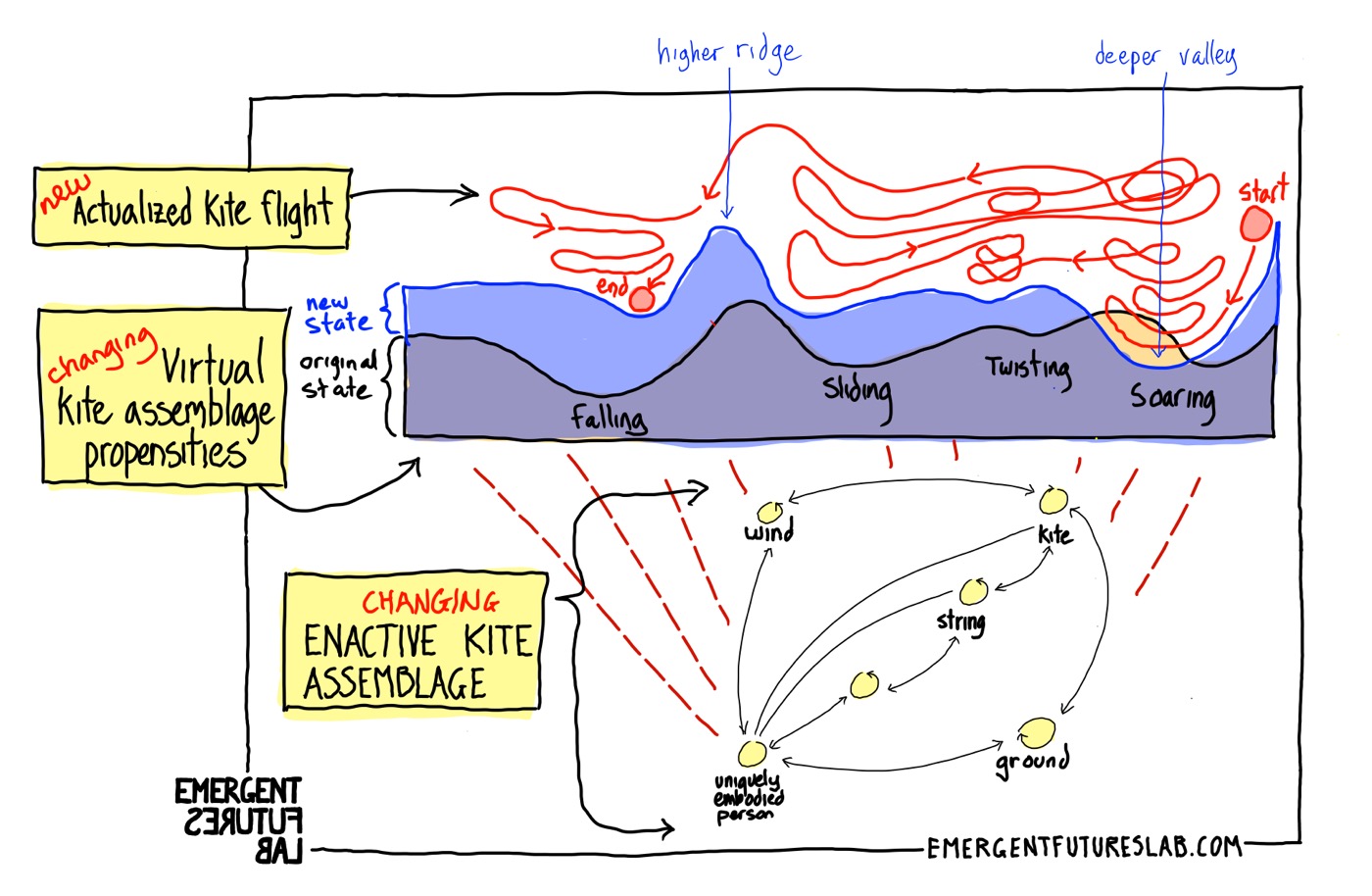
Here it is critical to never separate the dynamics and shape of the virtual field of propensities from the dynamics of the assemblage:
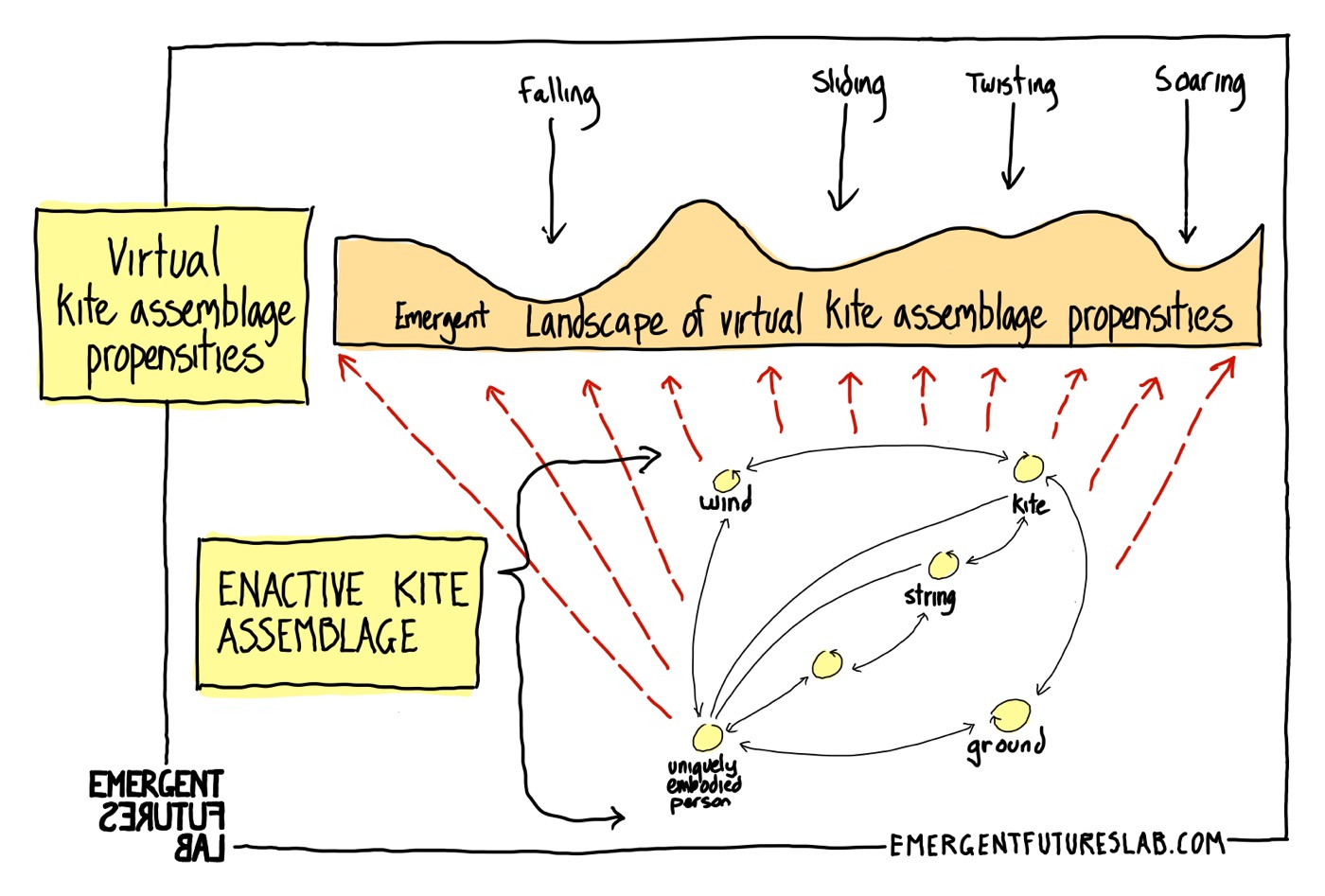
To separate and reify the field of propensities as a distinct “thing” or set of things – is to make the error of misplaced concreteness: propensities become context-free abstractions – and these become the real (the classic examples of this are the Western concepts of “space” and “time” – two very high-level abstractions that are taken as foundational).
The assemblage and the virtual field of propensities are one dynamic intra-connected thing. Here our static visualization has its limits:
When flying a kite, we are gaining the capacities to creatively adapt to the assemblage's propensities, sense their becomings, and modulate these by varying aspects of the assemblage (more, less + new additions/subtractions). Thus the topology of the virtual field is always in continuous variation (that only matches the assemblage in a non-linear manner):
And here is where it becomes helpful to move into a fully three-dimensional version of this visualization:
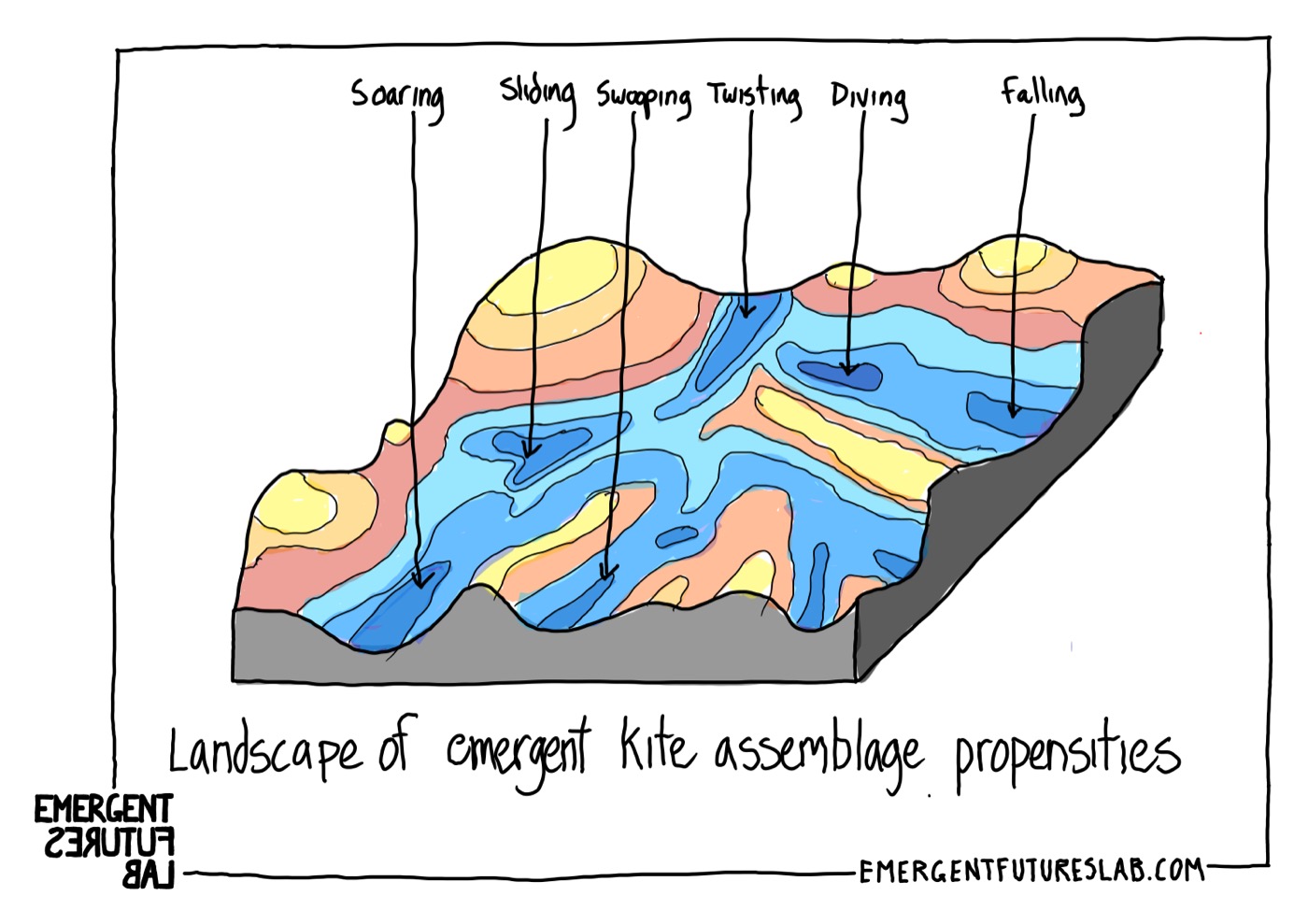
The “ball” is not moving in a simple two-dimensional space of possibility – but in a fully multi-dimensional space:
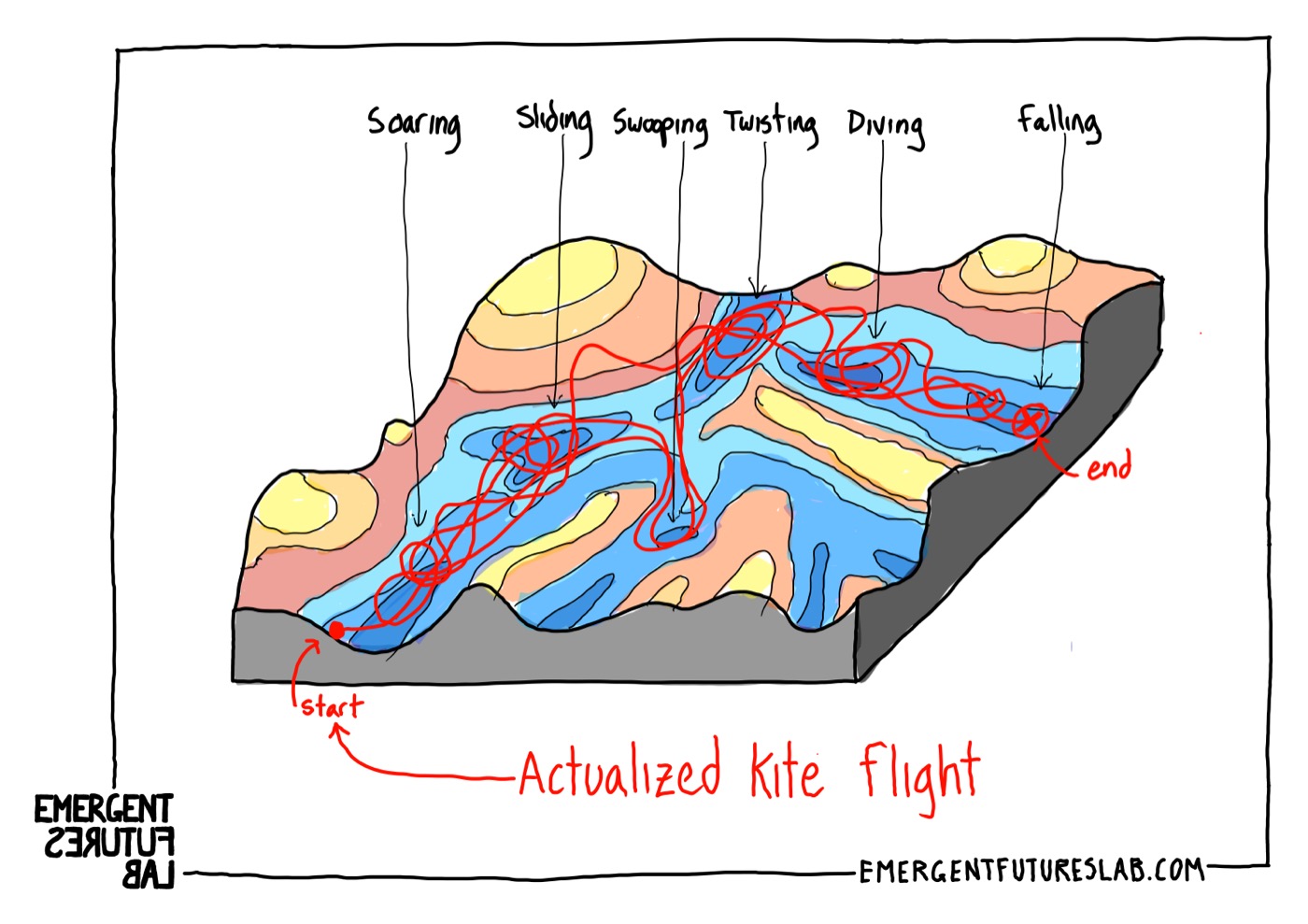
The language of fields and topology can also give us a far too stable sense of this terrain. While sometimes it can be quite stable via enormous creative efforts to regulate and fix the assemblage – really organize the meta-relation of multiple assemblages into a co-ordinated whole (what is also termed an apparatus/dispositif).
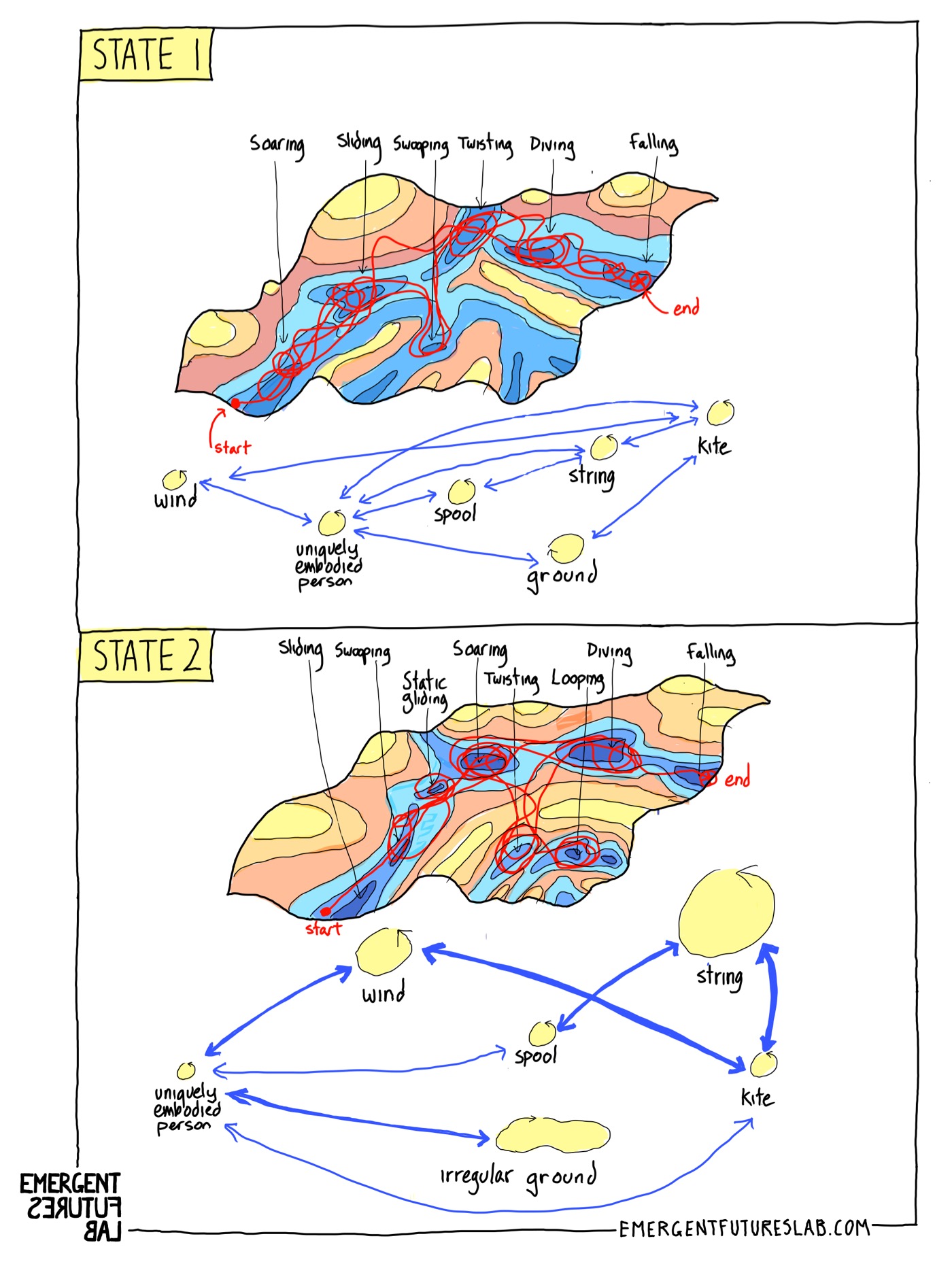
To sense and feel the co-varying dynamics of the virtual field, it is helpful to imagine it as a highly malleable sheet:
This is a sheet in continuous co-ordinated modulation. As the enactive assemblage shifts (and it is always in variation), so too will the virtual field of possibility:
The process of creativity is one that moves directly across and through these profoundly conjoined aspects of the multi-perspectival real:
How do you know what these virtual propensities are?
They can only be known by doing things – experimental probing. Obviously, if you could stabilize every aspect of the assemblage and you could fully map out all the virtual propensities – then these could be known abstractly without experimental action. With great experimental caution in limited context (with only the vaguest sense of accuracy), this can be done – we often term the desired propensities “best practices.” But these – so-called best practices approaches – are prone to slipping into the logic of surreptitious substitution of misplaced concreteness…
The error of misplaced concreteness – mistaking our useful abstractions as being more real than the processual logics of reality’s creative emergent unfoldings – is a very serious danger in creative practice. The danger is that we begin to take things for what they have come to mean in a stable practice: a chair \= that thing for sitting. But nothing is reducible to what it means – or how it is practiced– or what its purpose has become in a stable enactive assemblage. Relevance is never fixed – everything is open to new becomings, and in the ongoing of the lived adaptive dynamics of our ecological becomings we are continuously co-opting things with intended purposes for wholly new and novel affordances that will lead to novel propensities. This exaptive perspective is a fundamental mundane part of our ongoing inherently creative ecological lives and needs to be actively sensed as such.
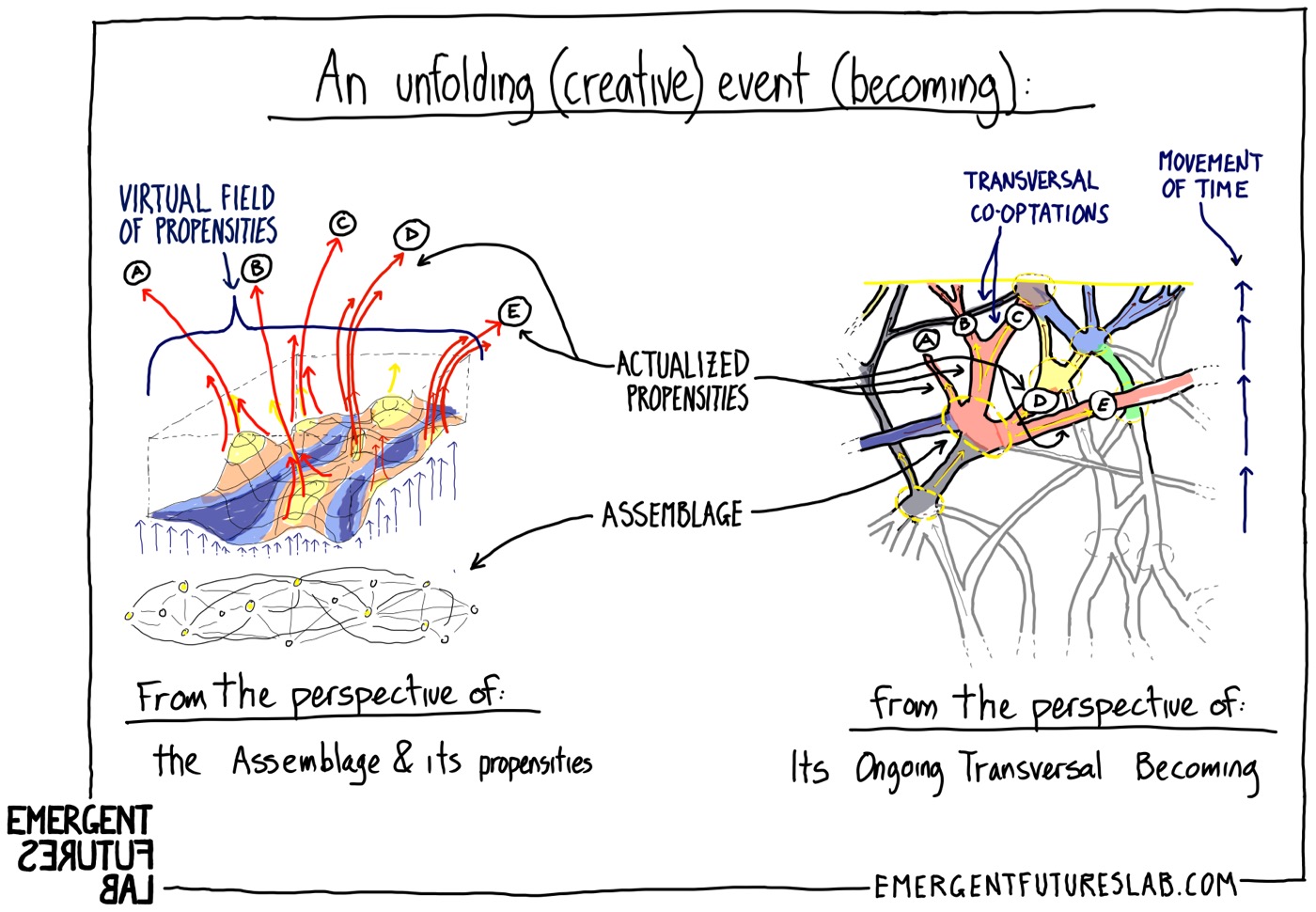
But that is an experiment for next week…
Until next week,
Keep difference alive,
Jason and Iain
Emergent Futures Lab
+++
P.S.: The question we hear most often from newsletter subscribers is: How can I participate more deeply in this work?
We have two ways:
1. Emerging Futures+ is where the newsletter becomes alive: post your comments, questions, or thoughts alongside practitioners across five continents, connecting each volume to their own work. Plus the extended audio version for a commute, join 2 live events per year, and the full searchable 250+ volume newsletter archive.
🧨 Start with a $1 trial for 7-days… Then $6/month or $60/year. Cancel anytime.
2. WorldMakers is where the newsletter gets practiced. Facilitators, educators, consultants, and researchers experimenting with emergence and change-making. In dialogue, in shared experiments, in the collaborative making of a different approach to creativity. Members have access to everything in Emerging Futures+, plus thirty-five live events a year, two weekly podcasts, bi-weekly creativity exercises, and the complete annotated bibliography.
💥 Start with a $1 trial for 7-days… Then $60/month or $597/year. Cancel anytime.


