Newsletter
Resources
Courses
Books

Welcome to Emerging Futures -- Volume 257! Creativity is Burning...
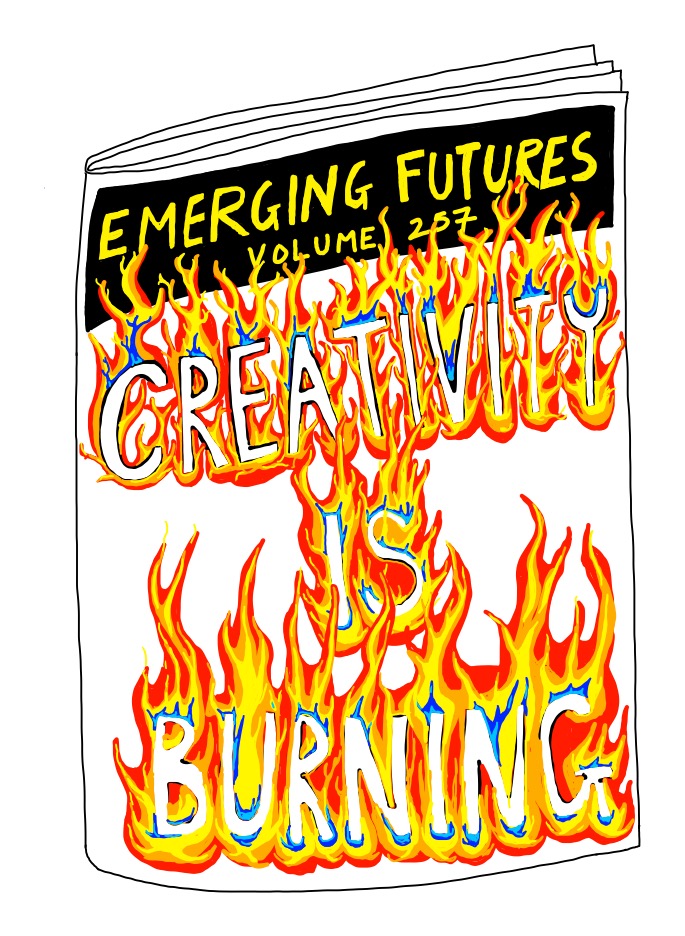
Good Morning heat adjusting becomings,
Suddenly it is mid-August. Growing up on the North-East edge of the Pacific, these were the real days of summer. By August, as kids, we had settled into the patterns of summer’s possibilities for us. The days were still long, and the pull of the ocean and high mountains kept us cool, bright-eyed with delight and deep in the useless adventures of whatever creative mischief we stumbled upon.
Summer still has these potentialities. Last week, back home to this same edge of the Pacific for a visit – hours were spent on the seashore, looking into tidal pools, turning over rocks in amazement at the long, complex co-shaping of the life of the Salish Sea with the visiting nieces and nephews. Eagles struggled to lift captured salmon from the waters, occasionally an Orca pod appeared in the distance, and the local Nisga’a kids were getting into cosmological mischief at the skatepark. And at night on the water's edge, beside a fire roasting the salmon caught off the local dock, the stars came in close.
Woven into this long summer we still happily had the folds in life’s dense weave to slow down enough to read books (Ray Naylor’s Palaces of the Crow is one that really stands out), picnic in the late evening light with dear friends, sit for extended periods experimenting with drawing (we wrote about these exercises a couple of summers ago and experimented with these in our community of practice, Worldmakers this week), and visit various expansive exhibits and performances (Pope L, and Clinamen are two recent ones).
But it is also impossible to ignore: summer has really changed – heat domes, new weather patterns, fires (deliberate and otherwise), mass evacuations, and cooling centers are the novel creative outcomes, co-shaped by the extended assemblages and logics of industrial systems (and more), that now define summer. Obviously this is nothing wholly new – and as children of the 1970’s we at Emergent Futures Lab have lived our entire lives with these and other destructive legacies – and other communities have for far, far longer.
Today the air here in Newark is a smoke-filled haze, and being outside in the direct sun is hard for ever more reasons. Our patterns, practices, built environments – so many aspects of the banalities of everyday life are rapidly changing. Talking with friends from other geographies still begins with the complex yet seemingly rote banter about the weather and the state of things – no one's summer feels easy. Creative hacks, tips, and tricks to adapt to who is on our streets and what is up in the atmosphere become a far bigger and consequential part of the conversation.
Why bring this up in a newsletter about creativity? In a newsletter about worldly creativity, it should be that our actual multiple lived worlds are the very thing that cannot be ignored. But it is also hard to ignore the scripts that any contemporary Western talk of “creativity” nearly automatically calls forth. So it bears saying at the outset – no, this is not a call for the wonders of the human individual imagination to come sweeping in with a solution. Human – and non-human communities have and are infinitely inventive in their co-creating of worlds and novel futures – that is not in doubt. But jumping to the closure of “our creativity will always…” is a way of avoiding “staying with the trouble” (Donna Haraway’s very helpful concept).
The expanding heat domes of this summer are as much creative achievements as is human flight – and as such should not be considered outside of the rigorous disclosive purview of those curious about creativity (or the scope of this newsletter). While when we began this newsletter we did not know what it would become – in time we co-evolved with it to collectively make a newslettering practice that could experiment with creativity in all its becomings. In this ongoing weekly experiment, the focus has been one of a worldly collective curiosity for two questions: what is creativity – and how can we participate in and of it?
Critical to fully engaging with these two questions has been to challenge how creativity is positioned and activated in the global West – and this cannot be fully separated from the conditions we now find ourselves in and of. The historical development of logics of scarcity, resourcism, industrialism, individualism and creativity are deeply entangled and mutually interwoven. The western historical creativity assemblage that emerges is a creativity that has, in hindsight, an absurdly narrow logic of uplifting the radically individualized immaterial acts of a universalized generic “human”. Query any digital system about creativity and this is what you will most often get back. The images will be of individuals wide-eyed and brains on fire.
But with the summer on fire, it feels like it could not be more obvious: this narrow vision of individual genius is not only wrong – that is not creativity – but it is also dangerously blinding us to the realities of the actual problematic novel creative processes that we need to collectively and meaningfully engage with. The creative production of the new and different is alive in heat domes that don’t dissipate, and in novel weather patterns activated by aerosol disbursement systems, and in the vast multi-scalar assemblages that co-emergently give rise to our modern subjectivities and their logics of individualized creativity.
Yes, creativity is not an inherent good – no dynamic relational and emergent process could ever be inherently anything. And yes – we are never truly outside or separated from such processes – we are making and being made in and of the making of heat domes, and world-erasing economies. We often come back in the newsletter to the phrase “Creativity is everywhere and everywhere ongoing” – a refrain that is, for us, no idle trope. To say that creativity is more than individual, more than human, and always ongoing in ways that are surprising is intended as a call to awaken our critical curiosities to the what, how, and with what ever dynamic effect everything is in-the-making. Yes, the distributed dynamic assemblages of heat domes are as much creative achievements – and creative agents – as are those of individualism, the emergence of the Neon Flying Squid, the surprising global cooling in the 1600s, or the collective publication of the journal Conspiratio. These processual becomings, while very different, are the outcomes of ongoing more-than and sometimes other-than human creative processes. And the who – the agents or distributed emergent forms of agency entangled with these creative becomings is something far more interesting and difficult to grasp than reducing creativity broadly speaking to any one single source or essence – be it mind, idea, gene expression, individual, group, or system. Rather, “staying with the trouble” involves staying with and disclosing how we came to be of such logics, and how they co-produce the forms of agency that we more often than not activate.
The Western historical individualistic, immaterial and universal human-centric approach to creativity and change-making is not only problematic in profoundly personal and institutionally debilitating ways – it is also profoundly misleading in larger critical ethical and aesthetic ways (of worldmaking). To recognize that we are of a worldly creativity that is everywhere and everywhere ongoing is, for us, a critical aspect of an alternative way we might engage with what Isabel Stengers names in a helpful essay on Resisting the Coming Barbarism – “these catastrophic times”.
Just as a western creativity participates in a configurational logic that co-shapes us into a universal individual subject: “the human” – that in becoming social becomes an equally universal “we” – “we” are now asked to believe that the fires, droughts, storms and vast movements of climate refugees are the outcome of something generic like “human environmental change” – that has given rise over time to a so-called age of the human – the “anthropocene” – as if these fires, rising seas, and heat domes was something that “we” all just “did”.
A creative question needs to be asked: How did this “we” come into being?
(NOTE: there is an important debate about the naming of this era: Anthropocene, Capitalocene, Chthulucene – that is worth dwelling on – and we are skipping over too quickly. The last essay (link above) by Donna Haraway does a very good job of teasing out these nuances.
Again, let’s slow down and be curious about what could be taken as obvious – this problematic “we” – this too is a creative outcome… This world-making creation of a universal subject, the “human,” and a universal “we” is not a neutral achievement. It is the problematic outcome of a surreptitious historically co-shaping process that has made one world’s becoming “the world.” And it has been creatively constructed via an erasure of multiple worlds – multiple astonishing other “we’s” and ways of being alive such that it is possible to speak and feel of a singular reality of an almost natural inevitability: “humans are just like this,” “we did this.”
Consider, for a moment, how this universal “we” is connected to a “why” – as in the environmental question of “why did we make the Anthropocene?” John Adams, the political philosopher (1735-1825), put this argument/assumption succinctly: “from the Fall of Adam to this time, Mankind in general, has been given up, to strong Delusions, Vile Affections, sordid Lusts and brutal Appetites”. But this “we,” this “all,” moves far too fast – again it does not allow us to stay with the trouble – it does not allow us to sense the trouble. And in the process – these troubles are once again being maneuvered outside of the sphere of creative possibility and becomings – they are simply to be accepted.
To sense and engage with what is emerging involves, now more than ever, a need to co-create a care for difference and a care for the productive nature of differing historical ways of being alive that helps us to recognize that the state of things is not the outcome of a universal truth about a universal “we” but something far more concrete, complex and entangled with the emergent historical logic of a specifically western forms of subjectivity, creativity and production – it is a creative question of non-neutral world-makings.
Sitting on the rocky shore off Northern Vancouver Island last week: the Biggs Orca, the Ocean Currents, the Nisga’a skaters, the rocks, crabs, bull kelp and I all share in these fires, this smoke, the oppressive heat domes, and the stars that come in close on a summer night – but, while we do have interest “in common” – they are, as Stengers puts it, not interests that we can ever simply take as “the same interests”.
Donna Haraway powerfully articulates this as a creative practice:
“However, the doings of situated, actual human beings matter. It matters with which ways of living and dying we cast our lot rather than others. It matters not just to human beings, but also to those many critters across taxa which and whom we have subjected to exterminations, extinctions, genocides, and prospects of futurelessness. Like it or not, we are in the string figure game of caring for and with precarious worldings made terribly more precarious by fossil-burning man making new fossils as rapidly as possible in orgies of the Anthropocene and Capitalocene. Diverse human and nonhuman players are necessary... The chief actors are not restricted to the too-big players in the too-big stories of Capitalism and the Anthropos, both of which invite odd apocalyptic panics and even odder disengaged denunciations rather than attentive practices of thought, love, rage, and care.” (Donna Haraway)
But, “We,” – where ever we are sitting this summer, are also being asked in differing ways, to follow a very different logic of openly contradictory messages: “Keep consuming, economic growth depends on it” but also “think about your carbon footprint”; “you have to realize that our lifestyles will have to change” but “don’t forget that we are engaged in a competition on which our prosperity depends.” (Isabel Stengers). We are ever being pulled into assemblages that allow us not to slow down and step back: “too much is at stake – you must…!”
Let’s slow down and resist – and collectively and experimentally be curious to actively ask and co-create with these alternative questions:
What are the distributed and co-ordinated assemblages that have participated in co-creation of an us and this context?
How can there be co-creative experiments to make things otherwise?
Rather than assuming and following the practices of erasure that asks us to “have interests in common only because (and when) deep down “we” are all the same” – how else can a motley set of beings creatively assemble as a shared community to feel, sense, dwell in such a way such that we have interests in creative becomings in common – but which complexly, dangerously – and joyously and wondrously do not need to be the same interests?
How do we collectively creatively invent ways to care for difference and what is common across entangled worlds with heterogeneous more-than-human and other than human collectives?
What new (and new-old) forms of beauty, resistance and mutually supportive differential joy are possible?
How do we collectively make a world where many worlds can thrive and where new worlds are always possible?
A Coda: As this newsletter arrives in your inbox, it is now the middle of August, and we in our community of practice, Worldmakers, are looking towards our first guest of the fall, John Protevi (on September 17th). And so we leave you with a challenge he poses at the end of his latest book – which has accompanied us on our summer journeys – planes, ferries, buses and beaches – heat domes and forests, orca and skaters, ICE and kelp forests…
“I propose an ethical standard: Does the encounter produce repeatable, mutually active joyous affect in enacting positive care and cooperation? Does it increase the puissance of the bodies – that is, does it enable them to form new and mutually empowering encounters of care and cooperation outside of the original encounter?” (John Protevi)
Until next week,
Keep difference alive!
Jason and Iain
Emergent Futures Lab
+++
P.S.: The question we hear most often from newsletter subscribers is: How can I participate more deeply in this work?
We have two ways:
1. Emerging Futures+ is where the newsletter becomes alive: post your comments, questions, or thoughts alongside practitioners across five continents, connecting each volume to their own work. Plus the extended audio version for a commute, join 2 live events per year, and the full searchable 250+ volume newsletter archive.
🧨 Start with a $1 trial for 7-days… Then $6/month or $60/year. Cancel anytime.
2. WorldMakers is where the newsletter gets practiced. Facilitators, educators, consultants, and researchers experimenting with emergence and change-making. In dialogue, in shared experiments, in the collaborative making of a different approach to creativity. Members have access to everything in Emerging Futures+, plus thirty-five live events a year, two weekly podcasts, bi-weekly creativity exercises, and the complete annotated bibliography.
💥 Start with a $1 trial for 7-days… Then $60/month or $597/year. Cancel anytime.
Two questions, every Friday since 2020:
What is creativity? and How do you innovate?
A weekly experiment in emergence, creativity, and change-making.


