Newsletter
Resources
Courses
Books

Welcome to Emerging Futures -- Volume 255! The Ecology of Innovation - PT V...
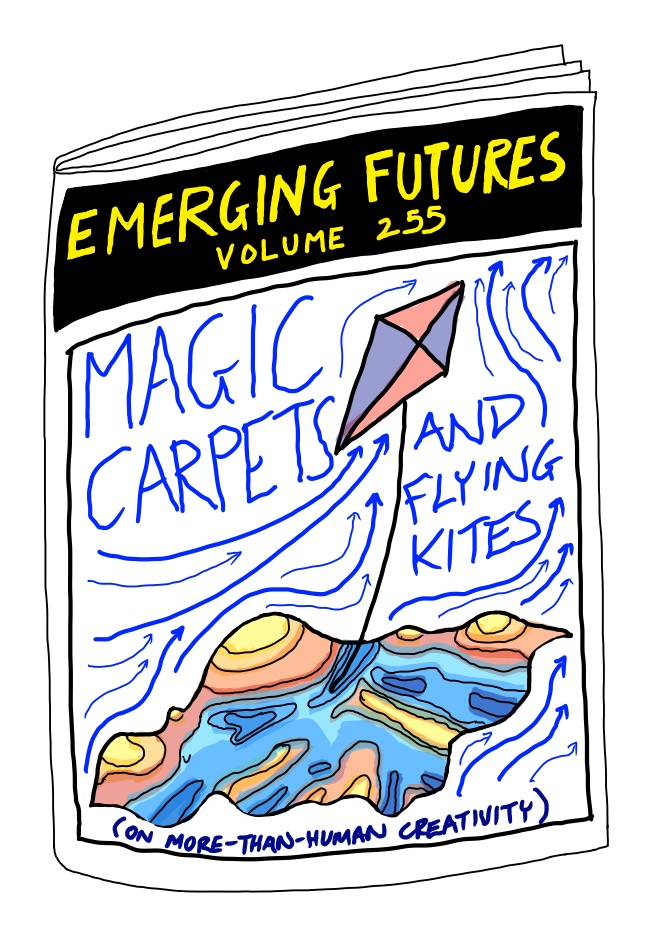
Good morning becomings of problems worth having and overly abrupt questions:
Who invented flight?
By now you might feel a bit tired of us keeping on bringing up this same question! But, we keep coming back to this one question because its ramifications for how one might approach creativity, innovation, and change-making are just so interesting:
Obviously, by now you know our answer: It was not the Wright Brothers – and more importantly, they were not even critical to its invention.
Certainly, they, and the work that they were part of, did play a role – but it was not a significant role. While it is impossible to ever rewind the tape of history and then play it again to see if we would get the same results with the Wright Brothers excised from the picture, after all, the irreversibility of time, the near constant avalanche of creative contingencies, and butterflies far off somewhere are all far too powerful to even meaningfully consider this speculation. But, despite the call of good sense, our improper preposterous hunch is that with the Write Brothers removed from history – nothing significant would have changed about how the history of the invention of flight developed.
Ultimately, we have a great admiration for the Wright Brothers and no interest in re-adjudicating historical battles for precedence – so let us move on – with just one modest conjecture: what this thought experiment points towards in relation to creativity is what is important:
Anthropocentric “who” questions need to give way to ecological “what” and “how” curiosities.
Last week we introduced the phantom traffic jam – a full-on traffic jam where traffic will come to a halt – but there will be no singular, obvious, or visible cause. The phantom traffic jam is an emergent creative outcome of the dynamics of the ecological logics of highways and traffic density. Here it makes no sense to ask “who caused this” – it is a distributed relational emergent ecological phenomenon.
The reason we introduced this creative traffic phenomenon was to suggest that the invention of flight is more like the creativity that gives rise to a phantom traffic jam – than any form of heroic individual struggle.
Now, let’s play out this logic with regards to the invention of human flight.
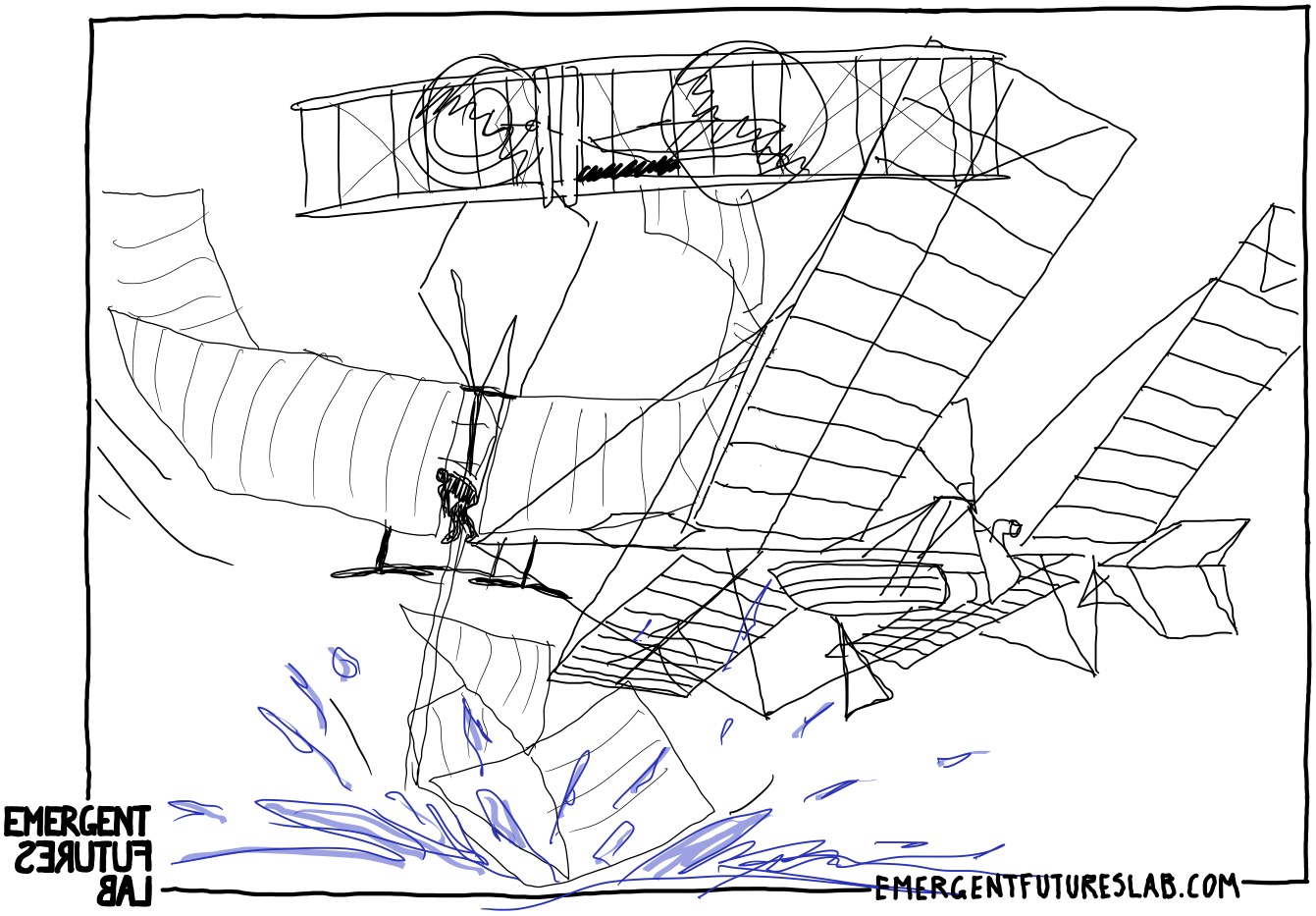
Let's take the year 1900 as a starting point: If you consider the whole global ecosystem of densely intra-connected set of immanent relations that made up the vast field of experiments in human flight – this is what we would see:
Viewed across these scales – really from the perspective of a multi-scalar whole ecosystem (of a dense thicket of assemblages, emerging virtual propensities, and their actualization feeding back into the processes) – it would be accurate to say that the creative becoming of flight emerges as a process of spontaneous ecological self-deriving.
What matters far more than the work of any one individual human participant is:
This spontaneous self-constituting creativity is what Guattari and Deleuze have helpfully termed an “abstract machine” (see last week’s newsletter).
Now, for many, including all of us at Emergent Futures Lab, who have been co-created of the global modern Western modes of subjectivity – this radical anti-individualism is a profound challenge: how should we come to terms with how we understand our individual agency if it is not so individualistic or heroic?
From within a modern global Western mode, when considering an ecological distributed and extended perspective on agency – it is easy to swing between conceptual extremes:
“If it's not about individual agency – then the “system” must be “in charge!”
“Doesn't this mean that we have no agency?”
“What about genuine free will?”
It is, starting from within a modern Western disposition with its radical individualistic agency – profoundly difficult to square the circle of how we fit inside the logic of the ecological relational agency of anything like an “abstract machine.”
Agency – like everything begins in the middle of a multiplicity – an assemblage. The self does not first exist as a pure individual – “and then enter into assemblages” as Isabelle Stengers puts it – rather “the matter of my existence is my very participation in assemblages… An assemblage is the first and last word of existence…” For many of us this requires a profound shift to a relational, ecological, distributed and emergent approach to selfhood and agency:
So, speaking very practically – what are we to make of agency? Who or what gives rise to what? Such a question about creative agency is best understood in practice – in the artful cultivation of our relational assemblage nature.
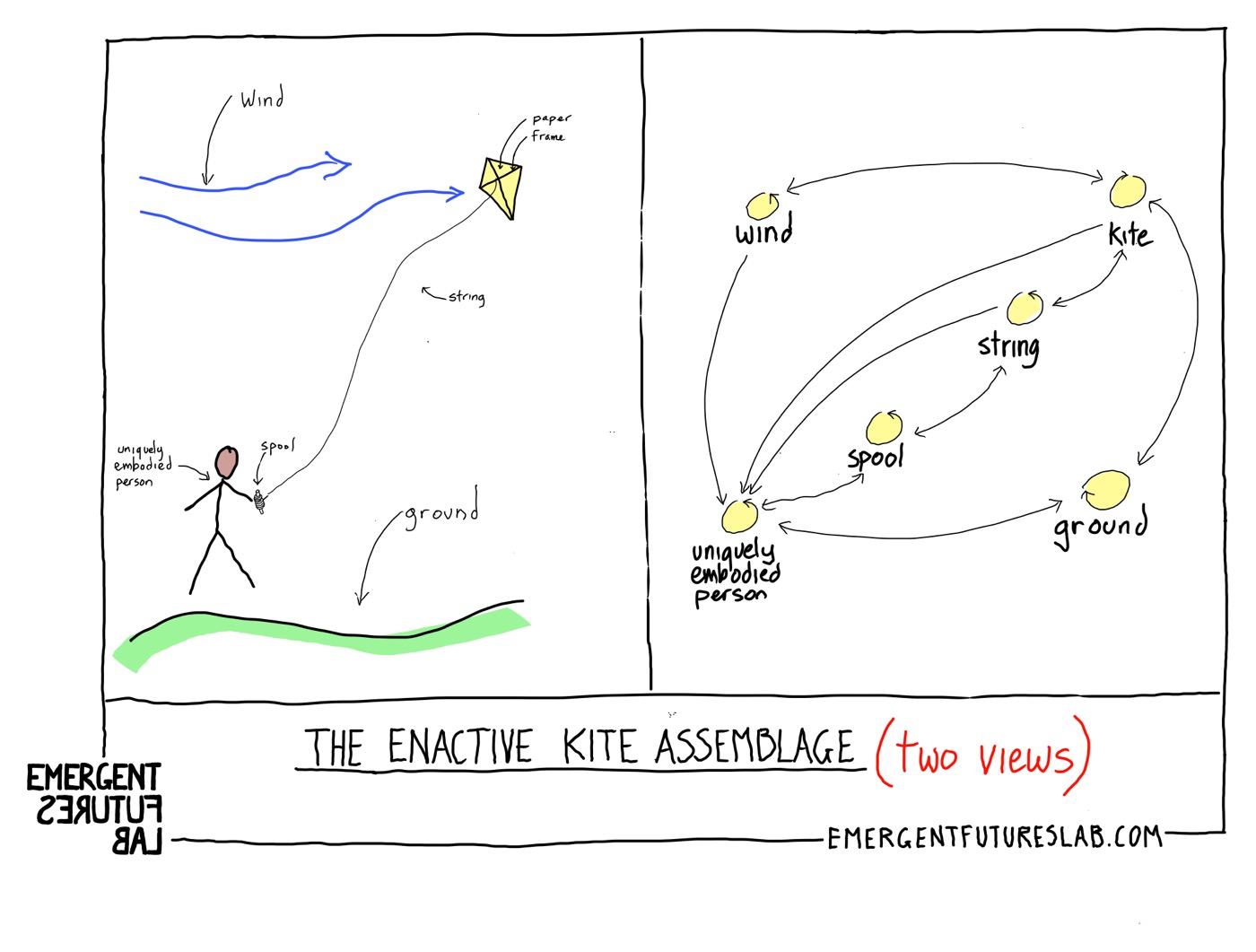
Let's return to an assemblage that many of us have joyfully participated in, was relevant to the creative emergence of flight – and is something we suggested that you try out: flying a simple kite. Where is agency in the flying of a kite? Is it something we possess as the “fliers” of the kite? Let's shift to the perspective of an enactive assemblage:
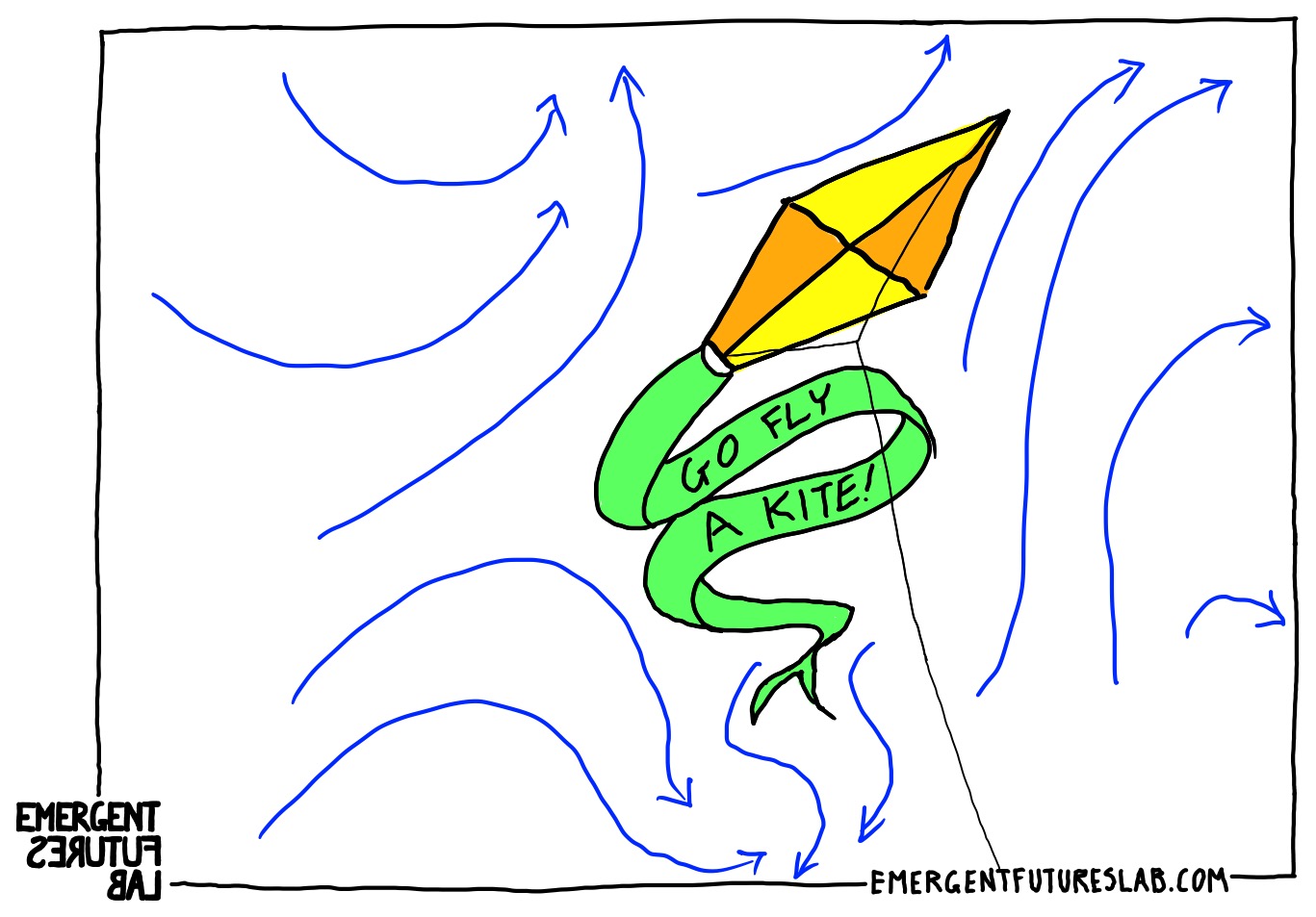
2. Practices and Virtual Propensities: If we have had some experience with kite flying we will have developed socially a relevant set of embodied habits to get a kite airborne and roughly maintain it in the air: we lay the kite down on the ground with the frame side up, ascertain the wind direction, lay out the string for a good distance while walking upwind – then pulling on the string we run for a brief distance to launch the kite.
On launch there is set of propensities – some desired and some undesired and some unexpected – that we will have some familiarity with: we expect that the kite will potentially “soar”, “twist”, “slide”, and “fall”:
It should shoot up into the air as you release it slowly into the breeze while letting out string and rapidly moving backwards – or it could veer, slice and twist and turn downward and crash.
As you run, pulling on the string and start to attune to the unique affordances of the kite-in-dynamic-environment in flight you begin to actualize some of these propensities you are somewhat familiar with.
Each flight you undertake is a type of experimental probe into the actualization of emergent virtual propensities:
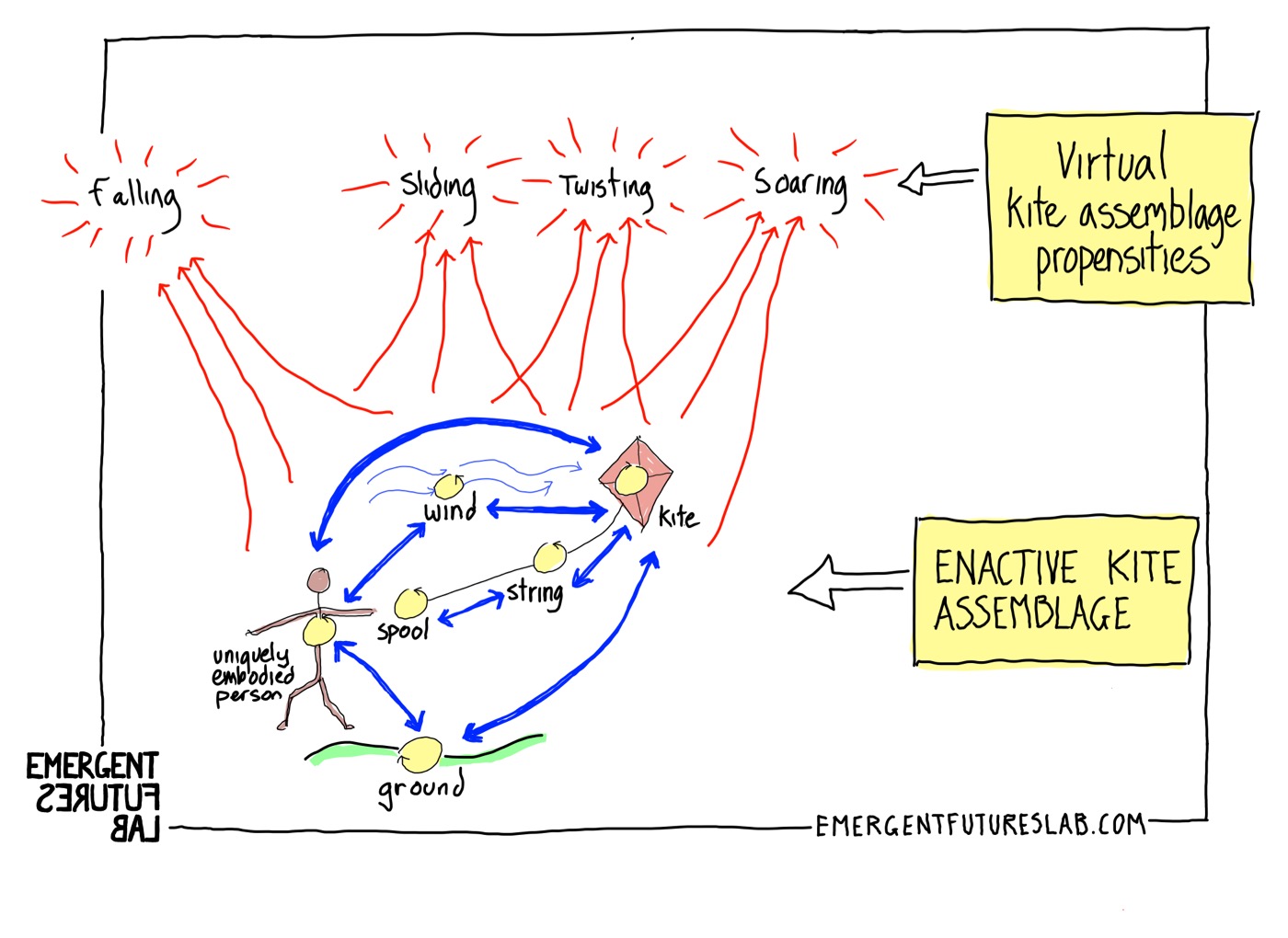
On agency: When flying a kite – or doing anything – you very quickly understand – It’s not about “you” – you can’t just will the kite to fly. It takes relational orienting, care, attention, and ongoing attunement. You are being shaped: your speeds, stances, gestures and curiosities are becoming of the “becoming-kiteness” of the immediate world. How you are embodied, extended and embedded is a quality (and co-constituted) of the relation dominant contextual dynamic assemblage.
You sense, feel, concept, act from the emergent middle of the assemblage in a way that it makes sense to say the event (the assemblage as an ongoing process) is “enminded.” The moment you pull on the line and the kite lifted you surrendered to this collective agential becoming: Too much pull on the line or too little in relation to the wind (force + direction) – or a change in the amount of line out will change the behavior propensities in ways you now begin to recognize, stabilize – and even play with or change rapidly via the range of actions that you sense are available to you (tugging, releasing, moving in directions at various speeds, pulling in, etc.). Most likely, the kite crashes many times and the kite is launched many times – and in all of this the event and its propensities are stabilizing:
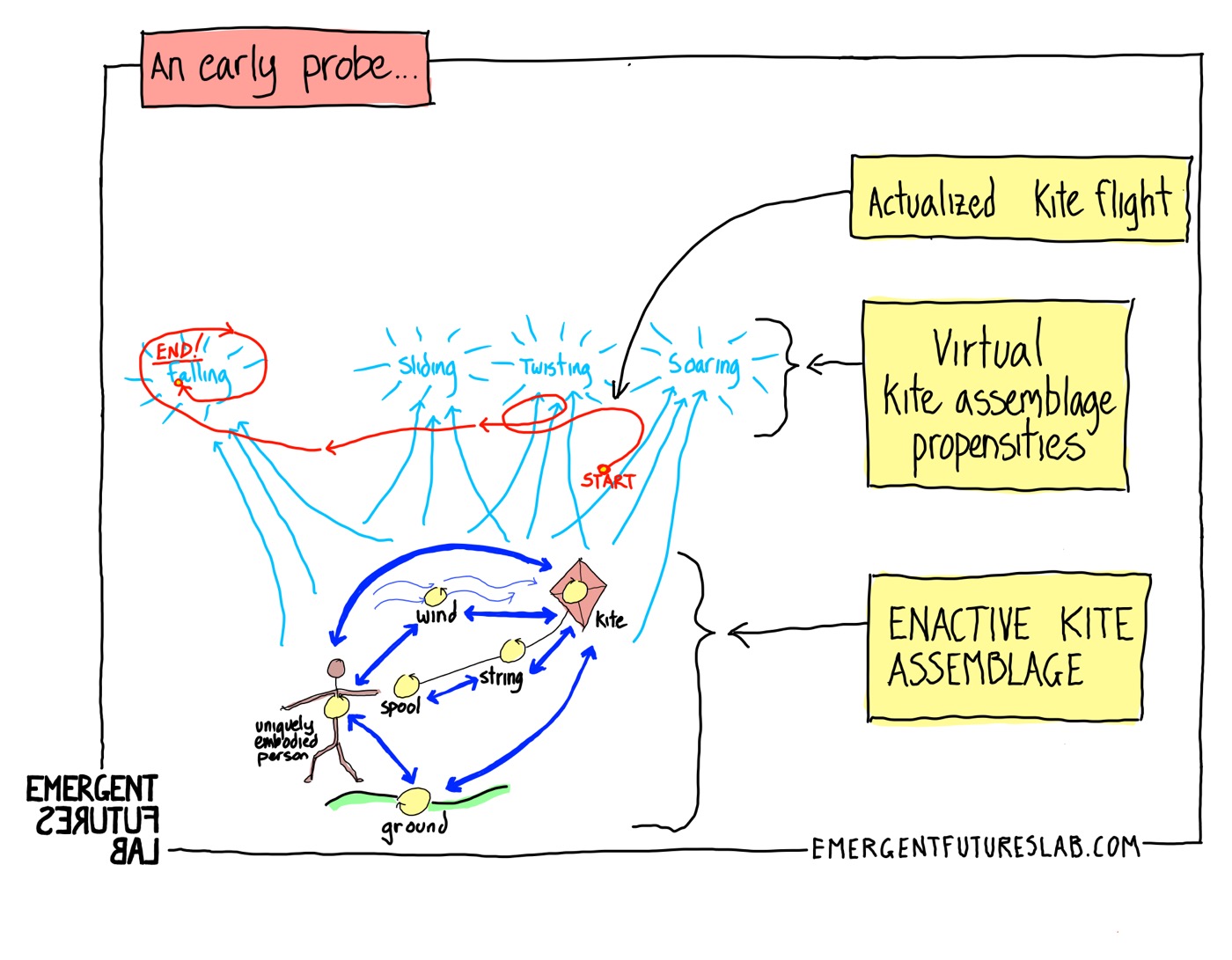
(Which is another way of saying a more-than-human ecological creative agency is emerging).
As you get better at attuning to emerging stabilities (propensities)-- you are learning to read their emergence as a sign of what is beginning to develop, For example: You quasi-consiciously notice/sense/respond to a certain felt vibration in the string that occurs roughly as a dive begins. This vibration becomes a sign-in-the-making of something relevant (the kite could be on its way to crashing!).
In some sense signs have been there all along: If you learnt from someone else how to fly a kite they probably introduced you to a rich and poetic set of possibilities: soaring, looping, diving, crashing! These symbolic abstractions oriented your behaviors. But at the same time most of what you do when flying a kite – especially as you learn – has everything to do with signs, but nothing to do with symbols.
To get a grasp on this and how the holistic distributed assemblage speaks to/in/and through you – we need to take a brief detour into the world of signs (we promise it will be brief and relevant).
Charles Sanders Peirce (1839-1914) creatively developed what is for us, a very useful approach to signs (from the perspective of creativity).
He proposes that we could understand signs as:
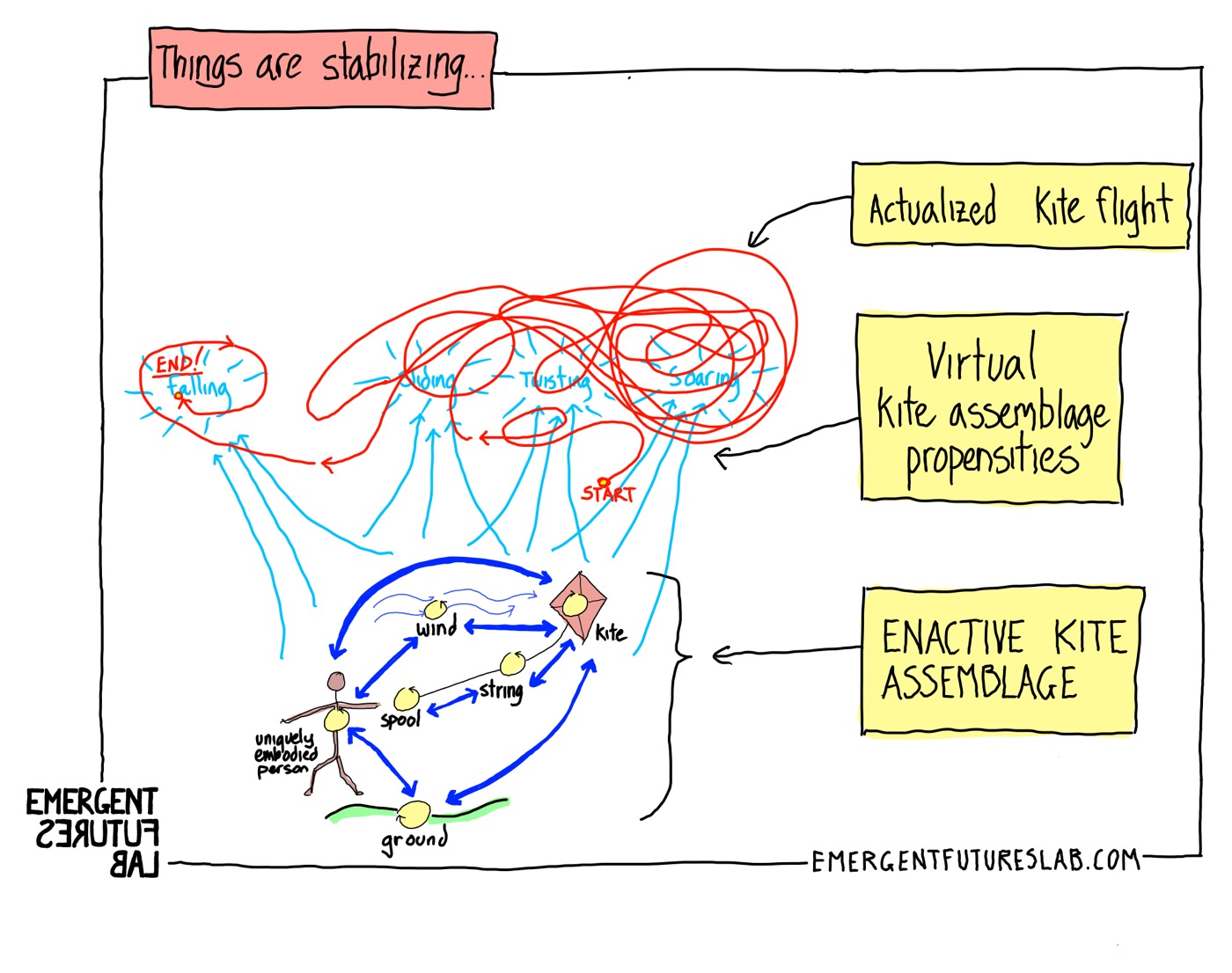
Let take this back to our kite flying:
Our creative lives oscillate between symbols and indexes. Symbols gain their meaning in how they dynamically relate to other symbols – they are high level relational abstractions. They do not directly point to things in the world – rather they stand in for them in a web of relations to other symbols. As you are introduced to the process of gaining the skills to fly a kite – you learn to understand and use a number of symbols: the string, kite, soaring, crashing – these are all rich symbols that while they help orient you to the practice they also, mainly implicitly orient you to a background of a way of being alive (a world-in-the-making).
Flying a kite (and again, all activity) requires that we use symbols lightly – we need to sense through them and also beyond them towards real time emerging relevances – in a context where there is literally no limit on what could come to be co-created as relevant.
Consider how just touching the string for the first time – you have been taught its contextual purpose and you connect it to a world of attaching, binding, holding, etc. – but in touching it things change – there are endless proto-signs being felt – the texture, weight, malleability, and aliveness of the string all make themselves felt. They are in a lived sense indexical signs in waiting. You feel that the string could be pointing towards things – this is its aliveness.
As you pull on the string when running to raise the kite into the air for the first time the string noticeably. changes – slack to taut – moving through your fingers, friction forming and fingers heating, you are already making continuous adjustments – looking, running, feeling, tugging, speeding up, slowing down, letting out string, pausing, moving… all this involves taking what is sensed as signs of something relevant happening. These signs are not words, they are not pre-establish, they are the felt transformations of the relations that point towards some emerging immanent relevance.
You see/feel slackness in the line and the kite starts to stall, dip and dive (you might not know these terms but you sense the change in behavior of the kite as problematic and you adjust – pulling, running, changing direction. These signs are what Peirce termed “indexical signs” – they immanently point towards/indicate something relevant. And as you get better your practices become filled with more and more subtle mainly directly felt indexical signs. In skilled activity you are operating in a type of hyper-indexical embodied and extended relational space.
The skill of engaging with creative processes is a practice of felt ongoing sign co-making. These are all indexical signs. And importantly this process of indexical sign co-creation involves disrupting, blocking and undermining set abstractions (symbol signs). It is not what something is – what it symbolically means – rather it is what it can contextually do. Creativity thrives in indexicality – relevance realization (co-creation).
Consider again your first moments of flying a kite – especially if you are just trying it out without much – or even any introduction. You as an extended ecological becoming kiteness are sensing your way index by index towards emergent stable states:
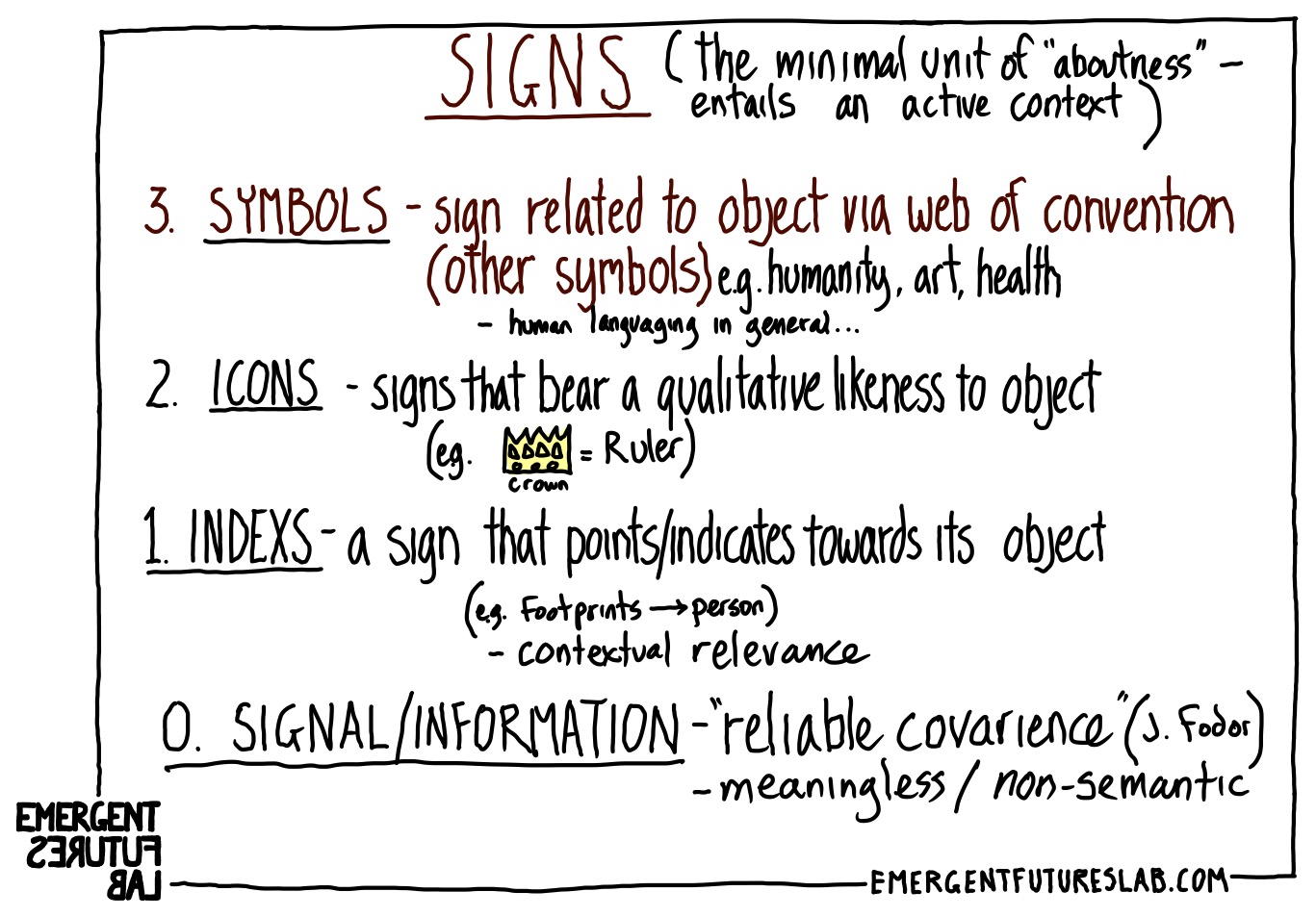
An immanent pattern is emerging – being co-created (it is not one you can directly make however you wish). These are co-stabilizing – this is what it means to actually fly a kite (it does not just go up and then crash). And as you sense and attune indexically to being of the imminent emergent states – abstractions build up: this is “soaring” and this is “sliding” and this is “looping”... indexes are becoming symbols of emergent stable phenomenon.
This abstraction is important – it allows you to articulate the emergent virtual space of propensities. It allows you to interact with this virtual space:
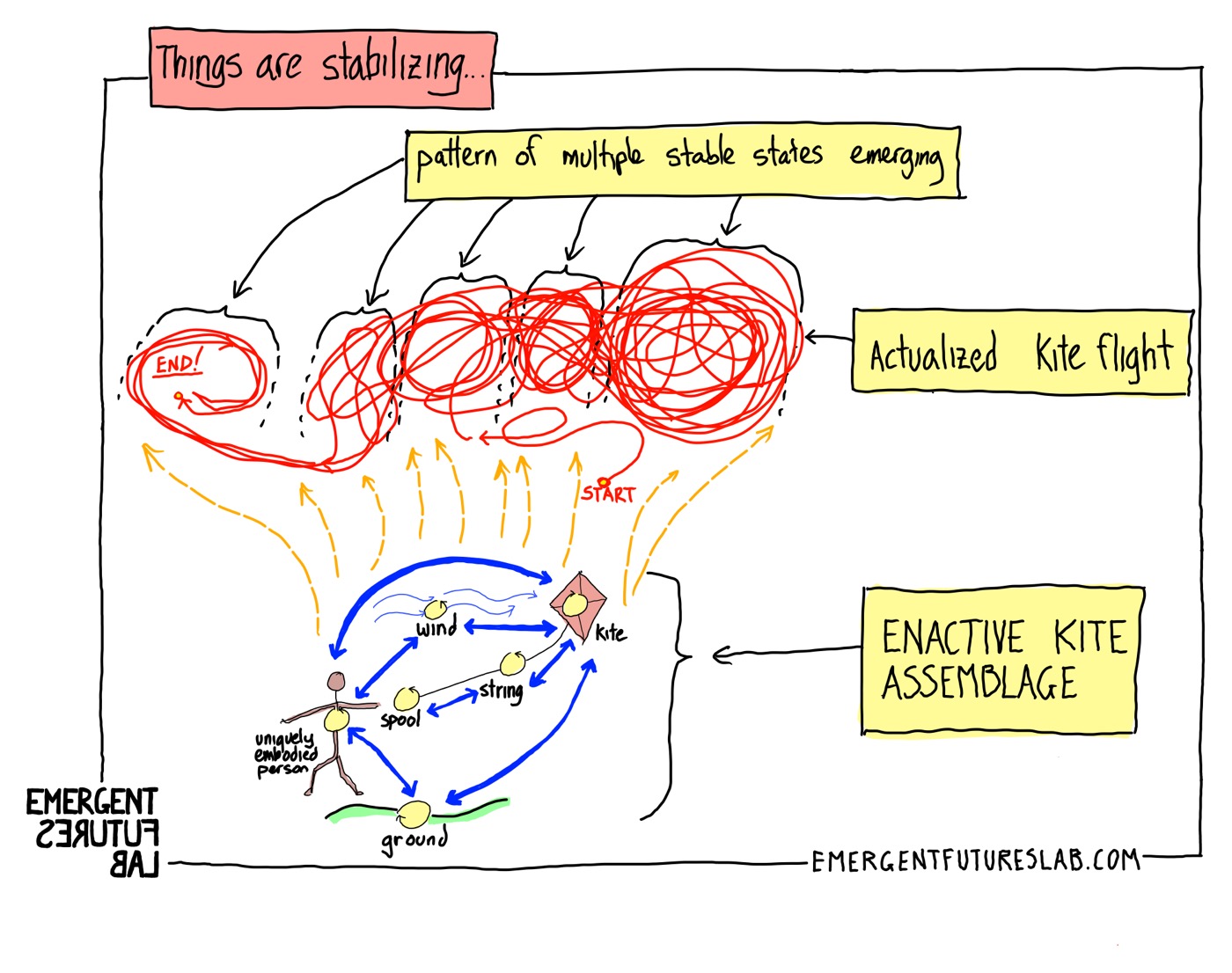
It is an immanent looping process: flying the kite (being of a specific processual enactive assemblage) gives rise to an emergent set of stabilizing propensities that are sensed-in-the-making indexically which loop back into flying the kite – which give rise to more stability and more propensities – which give rise to a field of virtual propensities that can be articulated, conceptualized and further engaged via novel abstractions (symbols). Loop upon loop…
But this is where there is a real can danger to the ongoing creative process: abstractions can lead to misplaced concreteness. We can and do easily take the abstraction as real and the enactive relational assemblage as secondary. Abstractions – symbols – are critical tools for experimentation – they are not representations of something simply “out there.”
Swoop, gliding, flying are not discreet pre-existing things out there – they are astonishing ongoing relational processual achievements. To put the abstraction “out there” – that is to mistake the map for lived emergent relational ongoing co-creative enabling and stabilizing processes.
Engaging with creative processes is always an experimental return to indexicality – to playing with actual assemblages in ways that exceed abstractions and give rise to new abstractions. It is the relational co-creation of new relevances (an exaptive process of co-opting things for novel and emergent processes). And it is co-creative ways to stabilize these achievements of novel propensities (that we did not create – but we were profoundly relevant to their emergence – and they were profoundly relevant to our emergence as someone who could be co-creatively relevant to their becoming).
No one invented flight, but many participated in its co-emergence and in doing so – flight invented them…
Have a beautiful week – stay indexical – feeling the aliveness of difference sweeping you into adventure
Until next week...
Keep difference alive,
Jason and Iain
Emergent Futures Lab
+++
P.S.: The question we hear most often from newsletter subscribers is: How can I participate more deeply in this work?
We have two ways:
1. Emerging Futures+ is where the newsletter becomes alive: post your comments, questions, or thoughts alongside practitioners across five continents, connecting each volume to their own work. Plus the extended audio version for a commute, join 2 live events per year, and the full searchable 250+ volume newsletter archive.
🧨 Start with a $1 trial for 7-days… Then $6/month or $60/year. Cancel anytime.
2. WorldMakers is where the newsletter gets practiced. Facilitators, educators, consultants, and researchers experimenting with emergence and change-making. In dialogue, in shared experiments, in the collaborative making of a different approach to creativity. Members have access to everything in Emerging Futures+, plus thirty-five live events a year, two weekly podcasts, bi-weekly creativity exercises, and the complete annotated bibliography.
💥 Start with a $1 trial for 7-days… Then $60/month or $597/year. Cancel anytime.


