Newsletter
Resources
Courses
Books

Welcome to Emerging Futures -- Volume 258! Creativity’s Leaps-in-Readings...
Good morning becomings of alphabetizations,
It has become a tradition that in the summer we share some books that have been important to our work as perennially curious experimenters, consultants, teachers, and writers of this newsletter.
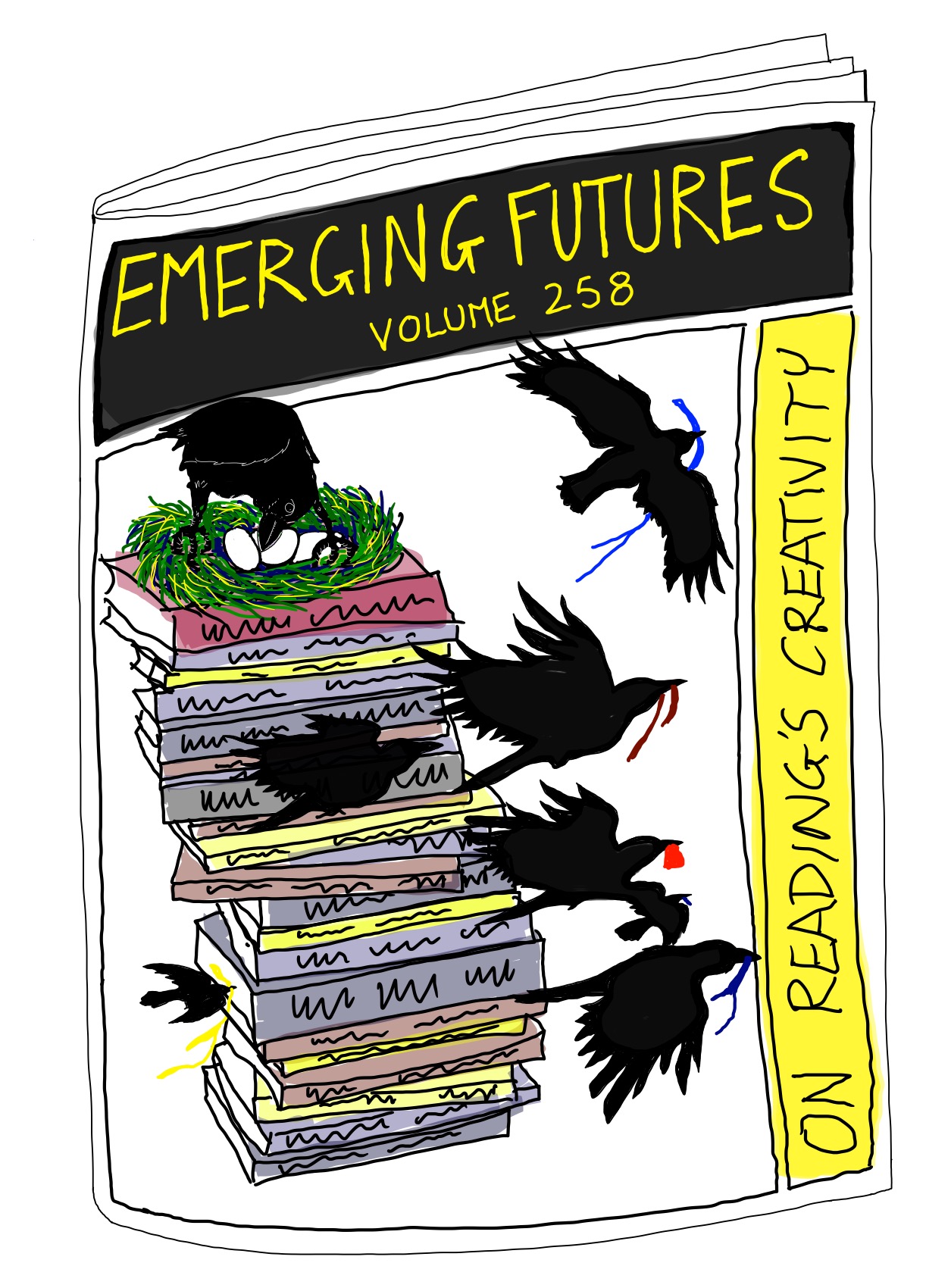
Usually we will share some “summer reads” (for past summer reading lists see Vol 47, 99, 147, 197) – books that we will have enjoyably read while traveling or sitting in the evening sun – and books we’re not sure what to call them without sounding ponderous, perhaps “long reads” that we’ve been engaging with over many months. More often than not, these “long reads” will extend into many years. Many of these start as books we feel are interesting to us in some nebulous but desirous way – but we never quite find a way into the right rhythm with them. And it is only much later that we finally work our way into a lived resonance. For us, with these long readings – we find ourselves returning to the same few authors time and time again. Here it becomes less about any one book or even an extended conversation – but something closer to the weaving of a bird's nest that is composed of bits of all sorts of things – string, wire, twigs, ribbon, insulating fibers, grass, down, sweater threads, magnetic tape…
Perhaps it’s not a real distinction – “summer reads” versus “long reads”. And it is certainly not a distinction between easy and hard – or superficial and important. Those distinctions flip, evolve, and mutate continuously in ways that track the complexities of our own engagements – such that they say little about the book in ways that might carry over to other readers. The distinction between summer and long is more a feeling about the speed of passage.
That distinction might sound obscure: the speed of passage – but reading, for us, involves the differing speeds in which words and worlds actively blur and feedback into each other. A question that writing and reading ask: what can cause a vibration – a ripple – a swerve or variation in our ongoing daily creative lived experience?
Summer reads – those books that accompany our travels are exemplary in this regard. As one travels in various ways, some books animate the journey in creative worldly loopings – reading Ray Naylor’s The Mountain in the Sea while riding, and waiting for, planes, ferries, and buses to get from the North-West edge of the Atlantic to Islands off the North-East edge of the Pacific changed profoundly how I met the ocean and all the beings in, on and around it. It is a book that gives one a way to empathically feel into the alien richnesses of complex experiences (I’m loath to describe it in any way, other than to say: it inhabits the experiential becomings of our oceans: sentient octopi, profoundly precarious labor, highly augmented subjectivities, corporate capture of difference all swimming in a vast more-than-knowable briny sea). This year Naylor’s Palaces of the Crow and Annalee Newitz’s Automatic Noodle accompanied me back from the Pacific to the Atlantic in a similar transformative novel looping of word and world.
Perhaps the quality of a book is lived in how often (and in what way) it is put down – rather than in how unputdownable it is: Some passages in books turn your body to meet and move into sensuous experiences – they all but ask you directly to put them down. Reading The Mountain in the Sea pushed me out of my seat; it pulled my spine up to look out and feel the rocky edge of the sea now compelling me towards it. I must have been stopped by this book dozens of times. I wanted to see an octopus, understand where my life met fish processing ships, and sit and watch the rocky shore while doing nothing else. The reading feedbacks into other actions and sensations and back into reading (but not necessarily this book).
The wonderful philosopher of creativity A. N. Whitehead defined a proposition in Process and Reality as “a lure for feelings.” How can we be drawn out from ourselves? How can we move into worlds? How can we move differently? Propositions pull us into this.
It’s a deliberately contrasting definition. A proposition is often defined as “a statement that could be true or false”. But the narrowness of this turns us, as readers, into strange magistrates – charged with adjudicating what exactly? – and more importantly, why? Why is reading so much about this kind of judgement?
Let’s consider an example: Ursula Le Guin begins Always Coming Home, a work of fiction about a people that “might be going to have lived a long, long time from now in Northern California,” with a propositional note:
“The difficulty of translation from a language that doesn't yet exist is considerable, but there's no need to exaggerate it. The past, after all, can be quite as obscure as the future. The ancient Chinese book called Tao teh ching has been translated into English dozens of times, and indeed the Chinese have to keep retranslating it into Chinese at every cycle of Cathay, but no translation can give us the book that Lao Tze (who may not have existed) wrote. All we have is the Tao teh ching that is here, now. And so with translations from a literature of the (or a) future. The fact that it hasn't yet been written, the mere absence of a text to translate, doesn't make all that much difference. What was and what may be lie, like children whose faces we cannot see, in the arms of silence. All we ever have is here, now.”
At this moment, two paragraphs into the book – I have to put it down – the creative vertigo is great: “The difficulty of translation from a language that doesn't yet exist is considerable, but there's no need to exaggerate it… with translations from a literature of the (or a) future. The fact that it hasn't yet been written, the mere absence of a text to translate, doesn't make all that much difference. What was and what may be lie, like children whose faces we cannot see, in the arms of silence.“
But what is the quality of the vertigo? How should we take these statements? Are they to be first judged as true or false? And depending on our judgment, do we continue to read? This is the practice the standard propositional logic asks of us in reading. So is Le Guin, right?
Or is this written as a Whiteheadian proposition? A lure to first and foremost draw us out into another sensibility…? For me this is the vertigo with which I put the book down – I am drawn sharply out of well-sedimented habits and feel a compulsion to wander with propositions:
The difficulty of translation from a language that doesn't yet exist is considerable, but no different from any other form of translation…
…and in that moment I feel little compulsion to read further – there is a powerful lively embodied pull drawing me elsewhere…
An interlude on Propositions: But no statement is simply one kind or the other of a proposition – it is not a question of either or. Both are always at work. Judgment and Lure. But what far too often happens is that we stay with judgment and don’t recognize the importance, relevance, and profound power of the lure. In treating statements as if they are first to be judged and only then followed misses how the lure is always already at work.
A pertinent and charged example: to challenge a politician's statements as being not factual and to correct them exclusively on matters of fact – and to imagine that this defangs their statements of their power is precisely this mistake. Statements are powerful propositional lures for feeling and never (simply) matters of fact.
Culturally, it could be argued we have organized reading around this mistake of separating the complexity of propositions into two neat categories: fiction and non-fiction. It's not that we cannot have these categories or that they do not matter – they do – it is just that we also need to feel how all reading – regardless of category – exceeds and precedes and by-passes judgment and pulls us into activities, and activities pull us into concepting that in turn activates writing – loop upon entangled co-constituative loop…
Erin Manning and Brian Massumi write of how books run interference – how they cut against the grain of habits – blocking on one hand and on the other experimentally opening themselves, and us – to outsides. Le Guin is running creative interference – a blocking of habits and the pull of a lure that is powerful. The importance of a lure – think of a fishing lure – is not itself – it is its role in an act – a movement to pull us. This is the looping creative pull of reading – it does not hold us in a book – it pushes out of the book, out of ourselves, into a world that is shifting as we move back into it as part of a now different experiment. Here the proposition is speculative in a focused manner – we are not asked to first judge truth – but be pulled into embodied, embedded and extended action: what can this do when you follow it? What new practices, assemblages, propensities and affordances might emerge?
Obviously, as our political example shows – none of this is without risk – real risks that certainly do not go away once we correctly judge a set of facts. Last week we ended the newsletter with an experimental ethical and aesthetic proposition from John Protevi:
“I propose an ethical standard: Does the encounter produce repeatable, mutually active joyous affect in enacting positive care and cooperation? Does it increase the puissance of the bodies – that is, does it enable them to form new and mutually empowering encounters of care and cooperation outside of the original encounter?”
Our question is: how does this remain immanent in the encounter of a creative act (such as reading)? Why does this matter? If we begin with a transcendent judgment – a judgment of so-called “matters of fact” we will never actually encounter the genuinely different or new… Creative practices ask of us to care for a beauty and an ethics that exceeds the known and the currently knowable. And as such our propositions – our readings – must put us at risk…
Erin and Brian begin this wonderful book on interference and creative practicings (Thought in the Act: Passages in the Ecology of Experience), with a proposition from Gilles Deleuze:
“Philosophy is [...] a practice of concepts [that] must be judged as a function of other practices with which it interferes. [...] It is at the level of interference of many practices that things happen, beings, images, concepts, all kinds of events.”
The quality of a book from this perspective has little to do with its purported objective value: Is this a “great” book? Where does it fit in the canon? Should everyone read it? Is it worthy of becoming the next IMAX blockbuster? Is it correct? – but rather because of the style of creative interference it co-creates in your situated “reading” of it.
Here we feel it is really useful, from the perspective of an enactive and emergent creativity, to offer another challenge: what is commonly understood to be the act of reading: the sitting for long periods in quiet contemplation, and carefully reading from cover to cover – is not that relevant – or the practice we imagine to be involved in much of the forms of reading we are discussing.
For us, as we hope you already sense, reading is all far more lively, sensuous, disjunctive and loopy. “Reading” a book might just consist of one sentence that has thrown us out into an unexpected and as yet unknowable adventure. “Reading” is a transversal – symbiotic adventure – the lures and leaps jump from book to book, book to activity, from activity to book. Looping, weaving, interfering, and diffracting into a messy thicket of creative experimentality.
This should not be read as a call for chaos and a superficial reading. Rather, it is a call to build immanent methods suitable to experimentally extending the force of what is read. Reading and understanding the facts of niche construction should open you to the possibility that you change how you live and how you interact with your environment. Reading and understanding the situated agency of tools should open you to change the shape and contents of your kitchen. To be open to the power of what is read is to experimentally, cautiously, and openly let it interfere in our lives.
Often one sentence will begin this iterative adventure – but we are never stopping at that one sentence or the one experiment…
We work (and live our daily lives) in loops of experimental doing – and in this reading is not sequestered neatly from washing dishes, rushing out to the seashore, discussions with strangers while walking, or talking with collaborators about a project. Reading, in all its diverse and seemingly haphazard ways, has an embodied and felt constitutive role. Readings are co-creative with us and our becomings.
And, yes, this, for us, rarely looks like any form of “proper reading.” Books do pile up, some cracked open in precarious stacks. Some are lures to podcasts, and YouTube videos such that the actual book is never quite cracked open. We move them around as they move us around – a shifting architectural landscape of quasi-orders and temporary megaliths appearing beside the couch, near the bed, on a table, then back on the shelf, or into our bag, or saved on an ereader. For us, the mess and movement – the fitful starting, stopping and leaping are signs of the lived co-creative semi-bookish becomings of reading – and not failures to read “properly”...
For us, there is a need to resist the image and ethos of what constitutes “proper reading” – the self policing that we can all fall into of “what reading is” – that sense of not having “actually” read (fill in the blank) because of whatever reason… Reading is, like everything, partial – relationally constituted (Pratītyasamutpāda) – more a transversal mode of reaching out, or experimentally transformatively connecting and co-constituting – than an exercise in solitary knowledge conquest.
Erin and Brian continue:
“Every practice is a mode of thought, already in the act. To dance: a thinking in movement. To paint: a thinking through color. To perceive in the everyday: a thinking of the world's varied ways of affording itself. In each of these cases, and the others encountered in this book, the practice in question will be construed as a mode of thought creatively in the act… For us, the techniques of philosophy are writing techniques.
This book runs writing interference. It seeks to compose concepts, of a certain kind, in writing. And in the composing, it articulates in the breach, in the fragile difference between modes of thought, in the act.
Our goal: to experiment with the breach. Not to tell art how to think, or to tell dance how to understand itself. But to bring into relief techniques, in the painting, in the dancing, in the creation of events, from which a singular proposition may breach. For it is in the breaching that thought acts most intensely, in practices co-composing.”
Breaching and broaching. A whale rises to the surface – breaching and breathing to plunge and be pulled down into the embrace of a dark visibility. “For it is in the breaching that thought acts most intensely, in practices co-composing.”
It is easy to drift away from this sentiment and feel that reading is acquisitive – that we are receiving some “thing” – some “takeaway.” We will often get asked:
“What is your big take away from reading Deleuze?”
Of course now AI will answer this for you in a neat set of bullet points. And it’s the same neat bullet points of the complexity consultant’s PowerPoint deck. But how will this participate in the creation of novel events – where will it lure an Octopus and us into novel co-compositions? Where are the propositions in all of this?
Now coming back to where we started: This is what makes it hard for us to, each year, recommend books in a classically organized fashion of “the best books for….”.
In the tangled thicket of ongoing experimentation – with the rapid movements between practices of making things and making concepts – exaptive aspects of books are everywhere without any one book being there as an architecture or anchor. This is, for us, the “long read” of engaging with books in a creative practice.
Thus there is a musical – compositional sense – to our recommendations – they emerge in resonances: how often are certain concepts, authors and books part of a broaching and breaching in our practices?
For us, some books come to act like a refrain – a melodic line – surfacing and sinking in practice. Others feel like relays – they might pass on some feel for the practice.
Looking back across the rippling surface of the last year or so of newsletters, it has felt like Isabelle Stengers and John Protevi, where, for example, strong refrains – broaching into multiplicitous co-creations.
The books Making Sense in Common, and Regimes of Violence for example, surface most weeks in some manner. And this is in itself interesting – nowhere in the newsletters are we ever really dealing with the main aspects of either book (and it is not that we don’t feel these are both interesting and important) – but our co-creative acts of bookish engagements are exaptive – John is luring us to experiment with richer and richer practices of being fully bio-enculturated – “we live by somatizing our socialization.”
NOTE: His work is woven throughout our experimental practice and it is with great excitement that we share that he will be the first guest of our fall series of Live Events in our Worldmakers community on September 17th - we’d love for you to join us!).
But, the central focus of John’s book, Regimes of Violence: the exploration of the co-creation of violence in human social practices – is not part of our newsletter experiments. We have recommended this book to many – and quite understandably many have come back to us puzzled: “That was a really interesting read – but I'm not certain it has much to do with creative practices.”
This is the paradox: You can watch chickens lay eggs and chicks hatch endlessly and never be lured into an experiment that might lead to an omelet. The omelet is not hiding invisibly in the egg. The egg first has to move transversally and exaptively out of a chicken-becoming and shift into a lure of other unpreknowable becomings. But there is also no objective reason that it must. Something must interfere and breach chicken becoming. And each broaching into and through an existing becoming will need to invent and develop its own assemblage and follow its own lures and propensities.
A novel shared understanding – really a novel shared field of propensities and tendencies is the achievement of creative collaborative assemblage building – there is a need, as Erin Manning writes, to “invent techniques of relation” – that breach the habituations of the social present (a breach is as much a block).
Reading involves this.
Our concerns, curiosities and ongoing experiments are what cautiously and creatively interfere in reading Regimes of Violence. A book like an egg has no fixed destiny – chick, omelet, or thrown at a politician – each of these happens via our sustained experimental assemblage building care…
Many other books joined us in sustained adventures of exaptive becomings – and some that bubbled up to the surface more often than others were: Nagarjuna’s The Fundamental Wisdom of the Middle Way, Marisol de la Cadena and Mario Blaser’s A World of Many Worlds, and The Blind Spot by Adam Frank, Marcelo Gleiser, and Evan Thompson. (Here context matters: a big aspect of this was because much of our most sustained creative experimentation this year has been with logics and practices of World-Making).
And as our focus in the Newsletter shifted towards human flight as an example of creative more-than-human invention – the work of Gary Tomlinson returned to the thicket: A Million Years of Music, Culture and the Course of Human Evolution, and The Machines of Evolution and the Scope of Meaning. Again, on the surface of things – it is hard to make the connection – but they have become some of our favorite books in both obvious and hard-to-explain ways. Shorn from the kite-flying, bird watching, model making, workshopping, travel, ongoing conversations, and other messy exaptive “readings” – their lived, passionate, vital and enacted assemblage – reading these books could be no closer to an omelet than watching chickens astonishingly and beautifully reproducing…
Near the beginning of this newsletter, in passing, we mentioned a second category of books – those that act as relays – those that convey a similar sensibility – a family resemblance to what we might be thinking or exploring. Often these are the books or articles we read with a profound and excited sense of recognition. “Yes – this is what I’m thinking!” And, while the similarity might be a complex one, nonetheless a clear resonance is there.
It's worth pausing on this sense of recognition and what it might mean as a “family resemblance”. The enigmatic Austro-British philosopher Ludwig Wittgenstein created the concept of “family resemblance” as a tool to help us escape from understanding similar things as needing to share the same essence. He asks us in his posthumous work, Philosophical Investigations:
“Consider for example the proceedings that we call "games".
I mean board-games, card-games, ball-games, Olympic games, and so on. What is common to them all? —Don't say: "There must be something common, or they would not be called 'games' "but Look and see whether there is anything common to all.—For if you look at them you will not see something that is common to all, but similarities, relationships, and a whole series of them at that…
And the result of this examination is: we see a complicated network of similarities overlapping and criss-crossing: sometimes overall similarities, sometimes similarities of detail.
I can think of no better expression to characterize these similarities than "family resemblances"; for the various resemblances between members of a family: build, features, colour of eyes, gait, temperament, etc. etc. overlap and criss-cross in the same way.”
Such a beautiful propositional image. For us, there are a few recent books that we have read that fall into this category of family resemblance with our work: Mercedes Valmisa’s All Things Act, Anthony Chemero’s Intertwined Creatures, and Ezequiel Di Paolo’s F/acts: Ways of Enactive Worldmaking – these three jump to front of mind. They are all wonderful, uniquely insightful, and very readable.
And this is where it finally starts to feel like we might be able to answer the question: what books on creativity would you recommend right now? We would not hesitate to suggest any of these three (along with Erin Manning and Brian Massumi’s Thought in the Act). In all of these works there is no shared essence or even approach – “if you look at them you will not see something that is common to all, but similarities, relationships, and a whole series of them at that…” – just beautiful propositional resonances…
Check these out (and any other books in this newsletter) – perhaps they have a unique place in your own milieu of exaptive reading that is always more-than “reading” – your dancing, wandering, gardening, organizing, resisting – your collective creative experimental ways of surprising becomings – those future and as yet un-spoken languaging practices… Just remember Ursula Le Guins mischievous wisdom: “The difficulty of translation from a language that doesn't yet exist is considerable, but there's no need to exaggerate it.”
Yes, there is no need to exaggerate – perhaps because all we ever have in writings is the propositional creative interference that is entangled in larger experimental sideways movements of emergent surprise:
“For it is in the breaching that thought acts most intensely, in practices co-composing.”
Until next week,
Keep Difference Alive,
Jason and Iain
Emergent Futures Lab
+++
P.S.: The question we hear most often from newsletter subscribers is: How can I participate more deeply in this work?
We have two ways:
1. Emerging Futures+ is where the newsletter becomes alive: post your comments, questions, or thoughts alongside practitioners across five continents, connecting each volume to their own work. Plus the extended audio version for a commute, join 2 live events per year, and the full searchable 250+ volume newsletter archive.
🧨 Start with a $1 trial for 7-days… Then $6/month or $60/year. Cancel anytime.
2. WorldMakers is where the newsletter gets practiced. Facilitators, educators, consultants, and researchers experimenting with emergence and change-making. In dialogue, in shared experiments, in the collaborative making of a different approach to creativity. Members have access to everything in Emerging Futures+, plus thirty-five live events a year, two weekly podcasts, bi-weekly creativity exercises, and the complete annotated bibliography.
💥 Start with a $1 trial for 7-days… Then $60/month or $597/year. Cancel anytime.
Two questions, every Friday since 2020:
What is creativity? and How do you innovate?
A weekly experiment in emergence, creativity, and change-making.


