Newsletter
Resources
Courses
Books

Welcome to Emerging Futures -- Volume 265! Bending Events Back (On Events, Part II)...

Good morning enjoyments of a becoming-rain,
One of the many joys that follows an early fall nor’easter is the emergence of mushrooms seemingly everywhere.
Taking a brief shortcut past the train tracks to get to the station platform on my way home, I was greeted by a giant puffball mushroom somewhat bigger than a soccer ball and slightly irregular – like a smaller ball had fused with a bigger one.
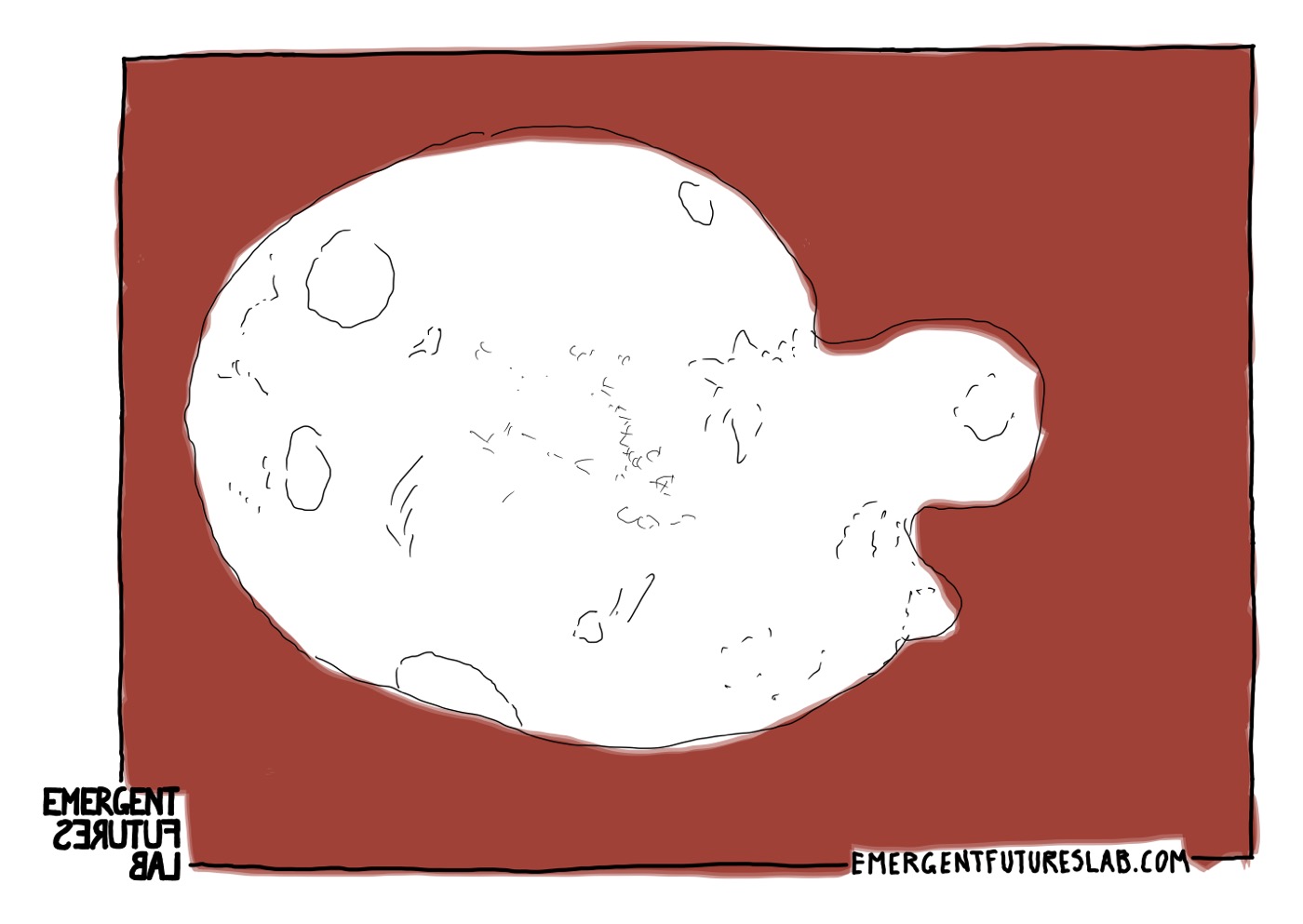
In greeting it and picking it up gently, I was being pulled into a new creative “becoming-with” this inchoate event as my actions now followed into its uncertain virtual propensities; what will we, this very new and still in-the-becoming-of-forming “we” become together? And so I felt myself becoming of a novel creative swerve as the puffball conspired with me to be placed in my pack and joined with a train home.
Here sitting on the train I sense the pull of multiple discrete processual events on distinct dynamic trajectories moving sideways to come into new processual configurations and semi-stable becomings – an ever shifting web of living dynamic open creative configurings – a world ever in-the-making.
Coming home, the forest-floor smell slowly radiated into the trajectory of the afternoon’s unfolding, and as the Earth turned such that the sun disappeared, I was pulled into the kitchen.
Its relational rough texture, lightness, and earthy smells activated me into a washing and trimming – sensing slowly – edging into configurational propensities – event headings: perhaps we can move together towards a “meal”? Having trimmed the bottom off, I had been introduced to its inner characteristics – a distinct soft but firm skin and a spongy, almost marshmallow-like inside.
On this cold and windy evening, the soup horizon is compelling and indirectly pulls at the process. Habits and practices are being activated by this pulling – I slice it in thick rounds and come to peel the skin off. It comes off easily like a very soft leather, and it is set aside in a pile on the edge of the cutting board.
I’ve gotten a large saucepan out – almost without thinking – a micro-ritual – a stable micro-habit event – and in reaching over to pick up the peeled slices – my direct sense is to just break them into the pan.
Stirring things a little later as I am drawn back in by the smell of the transformations of heat – an onion and some garlic are diced and join the sautéing. Then in goes a bit of miso, water, pepper, and thyme, and it is left to simmer for a bit.
While the soup is simmering, there is time to consider the skin and feel into where everything is heading. I slice the skin into long thin strips on a vague inexplicable hunch, and sauté until golden brown and crisp. Just before it is time to serve, I blend the soup. To serve, I ladle out the surprisingly creamy soup and place a handful of the now straw-like skin strips on top and accompany with a living liquid fungal event (e.g. a wine).
With the wind blowing, the windows open and a fragrant steam rising from the bowls – it is a wonderful simple becoming-dinner transversely extending us into the creative becoming-mushroom of the fall.
Now, I could say “I created a wonderful mushroom soup for dinner,” but that would not feel right.
Till late in the process, I didn’t even know it all would become a soup. And not till the very end what kind of soup. It’s not like I was sleepwalking – but it does feel like it just happened – that I was more pulled along than I was leading this dance.
But it also wasn't like the Puffball told me what to do either. Or that some recipe-like memory told me what to do. And as much as I was pulled along, I was certainly very active in this process of responsive and creative following.
In our live discussion this week in our community of practice, Worldmakers, we were discussing the immanent creative qualities of events, and I was reflecting on this experience: If we go back to the “beginning” – me meeting the mushroom at the forest edge on my way home. It was not “I” alone who recognized the puffball – left to my own devices, how would I know anything about this? I had been introduced at an early age by my mother to eating forest mushrooms long before I consciously recognized this as something one did. And many others, from friends to books, had co-created this living embodied trajectory. Now I sense the creative event of fall as the enactive pull of mushrooms…
Then without running water, a stove or a deep saucepan, the soup propensities would have sat dormant on the far side of the evening horizon. In a very real way, we (the mushroom, the forest, the evening, the kitchen, and I) were all prepared by the configuring agency of many prior event processes still swarming through the processes of us, to find each other.
In a very real sense, the event, in its open, but temporally sequenced configuring and individuating across qualitative thresholds of irreversible becoming, created itself.
Perhaps it is more accurate to say “co-created”?
But who are the co-creative collaborators but other events, other ongoing processes coalescing?
I’m most certainly an event co-created by the configuring of my mother taking me foraging and wonderment of the forest pulling me in… It is an event – a vast configuring of dynamic emergent configurings that should rightly be taking creative credit…
The “becoming-mushroom” is a creative event of wetness and coldness conspiring with the still warm soils of summer and the abundance of wind-blown, falling nutrient-rich leaves, all configuring with the vast webs of fungi living in and of co-created forest niches, themselves micro active relational configurings (what we recognize as “mushrooms,” the fleshy umbrella-like things forest gnomes sit upon, are but the fast forming fruiting bodies designed to release spores into the wind; the real mushroom is the vast dense web of infinitely thin tendrils in the soil). Without the rain, the astonishingly creative rapid growth of the fruiting bodies is not possible. But the rain only matters if the soil is warm and the air cool. Configural relations are produced and held so that these immanent qualitative thresholds of mushroom transformation can be co-created and crossed successfully.
That the giant puffball showed up at the forest edge on my walk home isn’t nature following an internal plan simply triggered by the brute presence of wetness – it is a processual event of an ongoing relational becoming – far more a specific individuation of disparate dynamic forces converging rather than instantiation of a mechanized plan.
And so too is the becoming-dinner that swept us into a novel creative evening dance – both the becoming-mushroom and the becoming-dinner are configurational emergences dancing transversally with other events.
While it might sound peculiar to say “becoming-mushroom” or “becoming-soup,” it feels more accurate to the creative, processual, open unfolding-relational event quality of things.
It certainly feels better than saying “I picked that mushroom” or “I created this dinner.”
The thing we call a mushroom is a process, a process-event of coming into being, staying in being, and then eventually becoming other things. It is a becoming – but not simply an ongoing flow of becoming – it is a “becoming-something.” Here the hyphen matters: becoming hyphen something – the becoming and the something are one open and ongoing process – not a “becoming something” – not an instance of a process reaching a pre-proscribed conclusion.
This openness of the becoming-something is critical to the creative nature of events. The processes that configured to become it – could have become something else. The earth transversally pulled into a becoming-peat, for example. The arrival of the event of becoming-mushroom in a mushroom was not pre-ordained or ever certain. Hence what “becoming-mushroom” means – and where it might go – is always an open question – one to endlessly be transversally taken up by other becomings. And the event of becoming-something will always be taken up by many other open becoming-somethings.
The acorn is not destined to become a tree – it might be participating in an event of “becoming-tree” but when a wild pig comes along and eats it – the event-in-becoming is creatively changing – and ever changing.
Events: always also a becoming-others
\A [transversal line to follow: There is a wonderful chapter/plateau in A Thousand Plateaus that has pushed us into novel configurations over the years and is alive in the writing of this newsletter: 10. 1739: Becoming-Intense, Becoming-Animal, Becoming-Imperceptible…]
Yes, now it is raining as we write.
Creativity’s pronouns are “it”. As in: it is raining (or it is mushrooming, or it is souping or it is gentrifying, or it is newslettering, or it is four o’clock in the afternoon…). And it gifts us the preposition: “of.”
Events: It individuates. We are of it.
This becoming-rain is not a thing. But it is nonetheless, even though it has no clear and absolute boundary around it.
Rain is often understood as the event of the condensation of atmospheric water vapor into a liquid that happens up there in the clouds and then falls down on us.
But atmospheric water vapor does not simply magically condense into water droplets at will. It is not simply happening because there is an excess of moisture in the atmosphere. There is no automatic, simple, obvious internal quality of atmospheric water that leads to rain. Nor is there an on switch that starts the rain or an off switch that ends it. High humidity is just high humidity…
It turns out that rain won’t form without dust, much like mushrooms without rain. The qualitative threshold crossing from an atmospheric gaseous state to a liquid one of droplets - that is critically assisted by ultra-fine particulate matter in the air – “dusts” of all kinds.
And dusts that are themselves processual events – but being swept into the astonishing world of the events of dust becomings – that would lead us too far astray.
Dust is often described as the “seed” that leads to the formation of rain. But that makes it feel far more automatic, or “plan-following,” than it is. There is no seed, source, or plan that events follow…
Atmospheric water condenses in a configuring with dusts to begin to become ultra-small droplets of water or ice crystals. And then this can potentially grow through wind-based interactions with the moisture in the atmosphere, leading to larger ice crystals or micro-droplets meeting each other. Weight, gravity, wind, moisture, heating and cooling, land and ocean masses, traffic jams and car exhaust all entangling dynamically to individuate potentially towards rain.
Rain is the coming together of many dynamic and varying processes, in the right relative sequence with the right relational intensities. processes configuring…
So – Why is it that we tend to assume that there is a source – a seed – an author – that singular cause that is the creative agent of things?
Why such assumptions when it – like all emergences – is a relational creative process – an ontogenesis irreducible to any (one) source?
Now, it is raining: really raining. The heavens have opened up. The sounds of honking have changed on the street below. Something is happening.
Rivers are forming. Traffic rerouting. The water is seeping into cracks that emerged via a dance with the summer sun and now, in the darkness of the night, freezing and further cracking. Landscapes are creatively changing – a pothole is forming at the edge of the road that in a couple of weeks might have its own late fall event of becoming-mushroom.
Deleuze and Guattari write of these becomings as lines – lines of flight:
“there is a mutual immanence of the lines. And it is not easy to sort them out. No one of them is transcendent, each is at work within the others. Immanence everywhere… so many possible mixtures and passages”.
[A note on words and their lines: “flight” – as in “lines of flight” here translates the French fuite – which is similar to some aspects of the English word flight – but also quite different – flight in English speaks of escape but in French it is also that of flowing, leaking, and disappearing/vanishing – while the French “fuite” has no relation to flying…]
Creative becomings of flow/escape/leaking/vanishing…
So here’s the question: we witness and participate in and of all of this astonishing creative activity, creative events of raining, mushrooming, dinnering, on and on, why and how do they happen with such consistency and regularity? How is it that there is in all of this change and dynamism clouds, mushrooms, trees and flowers, soups, newsletters and potholes?
What causes things to form out of the chaos whatsoever?
Historically, within the knowledge practice traditions spanning far western Asia to North Africa, we have observed the world around us and, when we have asked this question: in the vast changing world, why does a cloud form?
How did this come into being?
How did this tree take this shape, or this flower this astonishing form?
Historically, especially with the classical Greeks, the answer always began by looking directly and exclusively at the thing itself for the answer: this discrete plant blooming, the person making the soup, the rainwater by itself.
But that problematic discrete focus on where to look for a creative cause was not the only implicit assumption silently guiding this inquiry – there was another implicit assumption already there in regards to what form the answer could take.
For these historical inquisitive explorers of the world, these regularities pointed not towards dynamic but stable distributed relational processes in ongoing creative becoming (something sensed by Classical Chinese researchers of a similar period, for example). No, the Greeks sensed no creative becoming-rain nor any event of becoming-mushroom, rather, they profoundly and fully intuited in a very different direction: that the what of creative agency must be some “thing” behind or underneath these discrete physical manifestations. And this hidden agential “thing” was directing the visible material stuff to take on a certain form.
For the classical Greeks, the implicit space of possible answers to locating the what and where of creative causes was shaped by a tacit logic: the cause must be some discrete thing – some unique source that alone actively guides and forms passive matter into what we behold.
This logic emerged from the context of specific enactive observational practices and their emergent conceptual propensities: It began from the observation that all material things changed. The story of the Ship of Theseus is perhaps the paradigm example of this: a famous ship that over time had been repaired so often that no original plank remained – what made it – this changing thing, still recognizable as the same thing? In this context, the search was for something unchanging that could ground this identity, and the only thing that fit the bill was the immaterial realm of ideas.
For the Greeks, behind and directing the forming of the visible must be some unchanging ideal idea. And the more they reflected on this logic and scrutinized the world around them from within this logic, the more certain they became that this had to be true:
They were looking at the world for evidence of unchanging immaterial regularities in the world around them, and they found these via the application of mathematics.
Perhaps the most impressive and impactful of their discoveries was that the mathematics of the “Golden Ratio” could be found everywhere: In human bodies, in plants and shells, in musical pitch ratios…
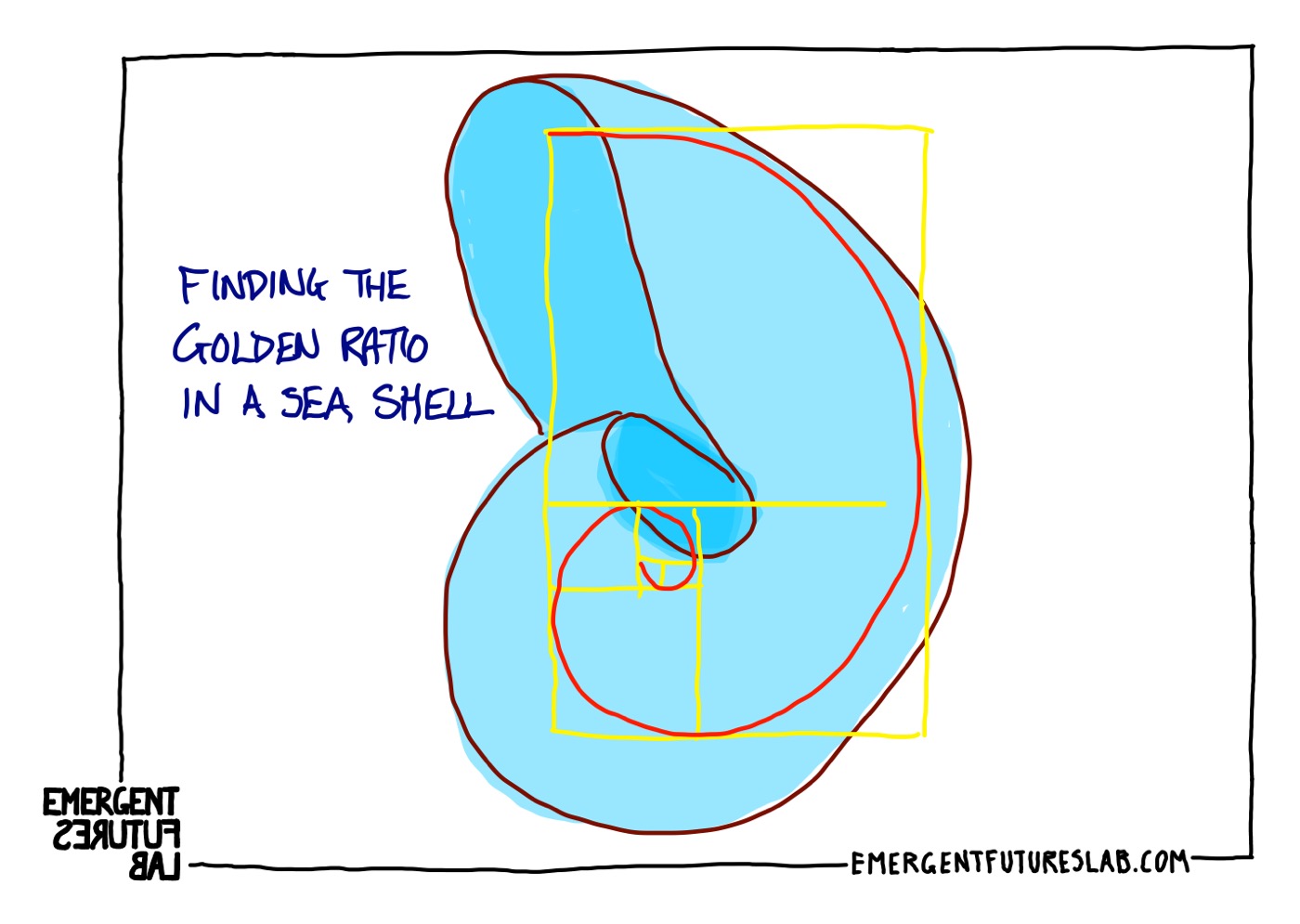
The Golden Ratio is the ratio of two quantities, equal to the ratio of their sum to the larger of the two. Geometrically, this can be expressed as:
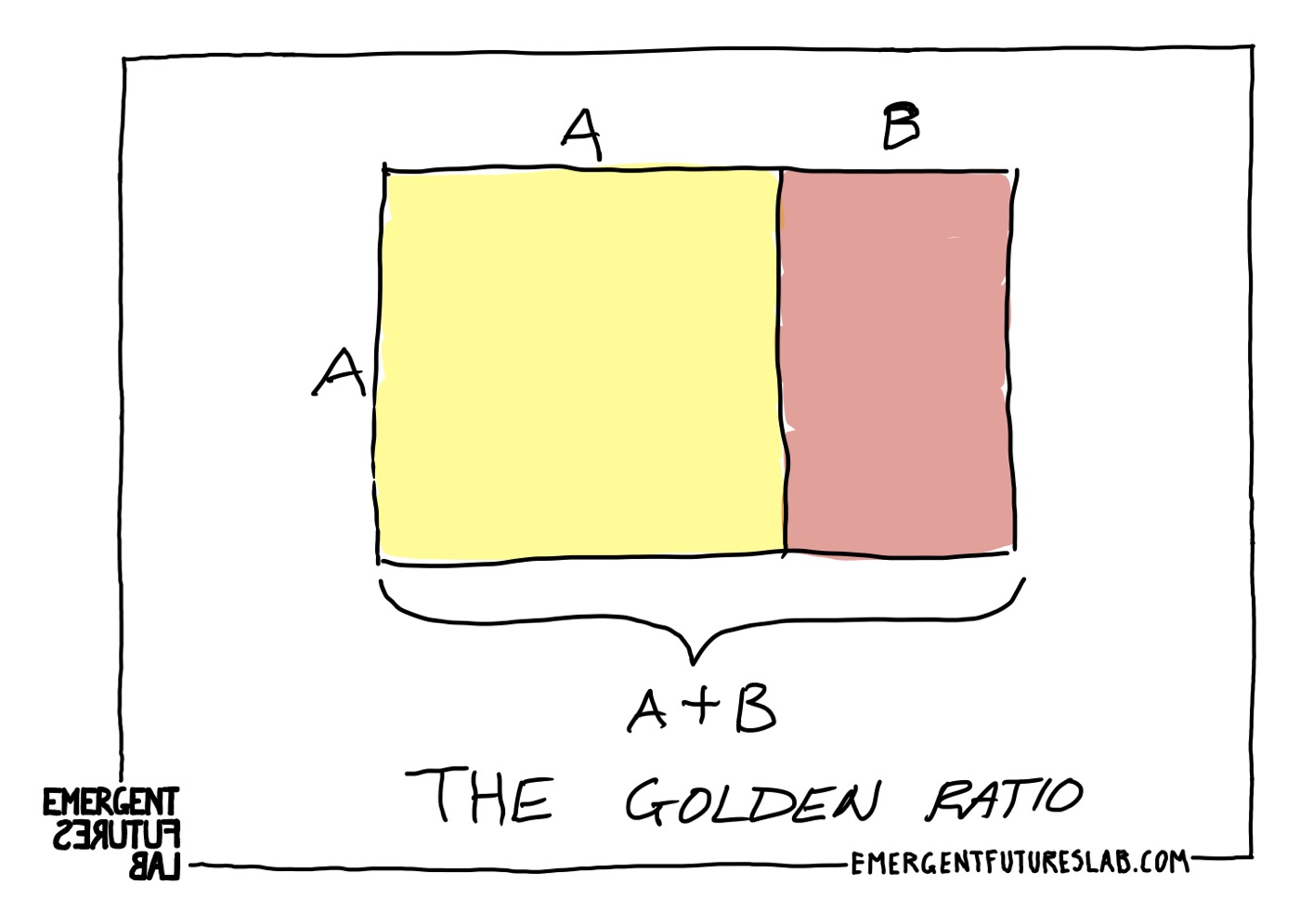
And this double rectangle can be subdivided by itself infinitely:
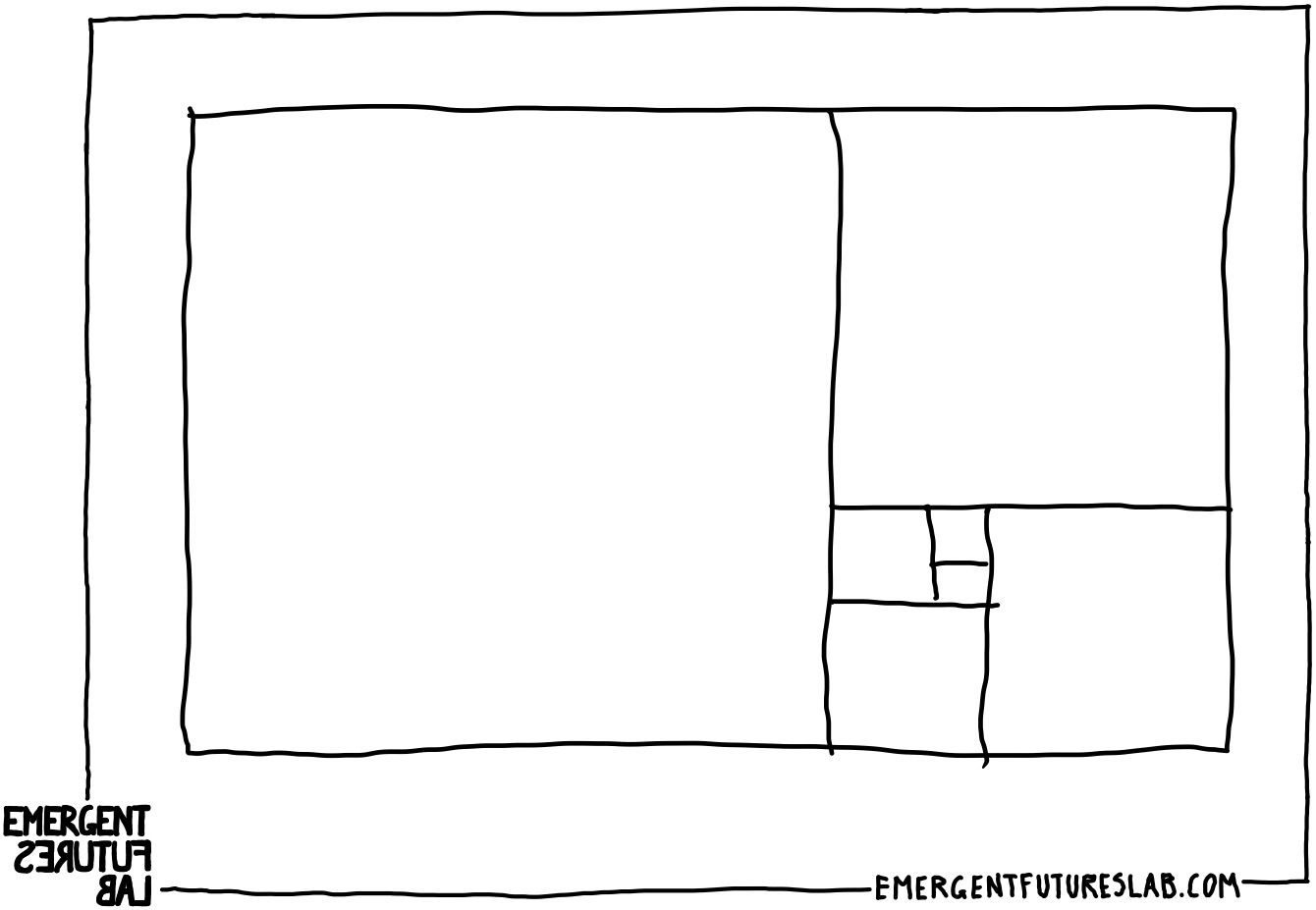
And when the corners are connected there is a spiral:
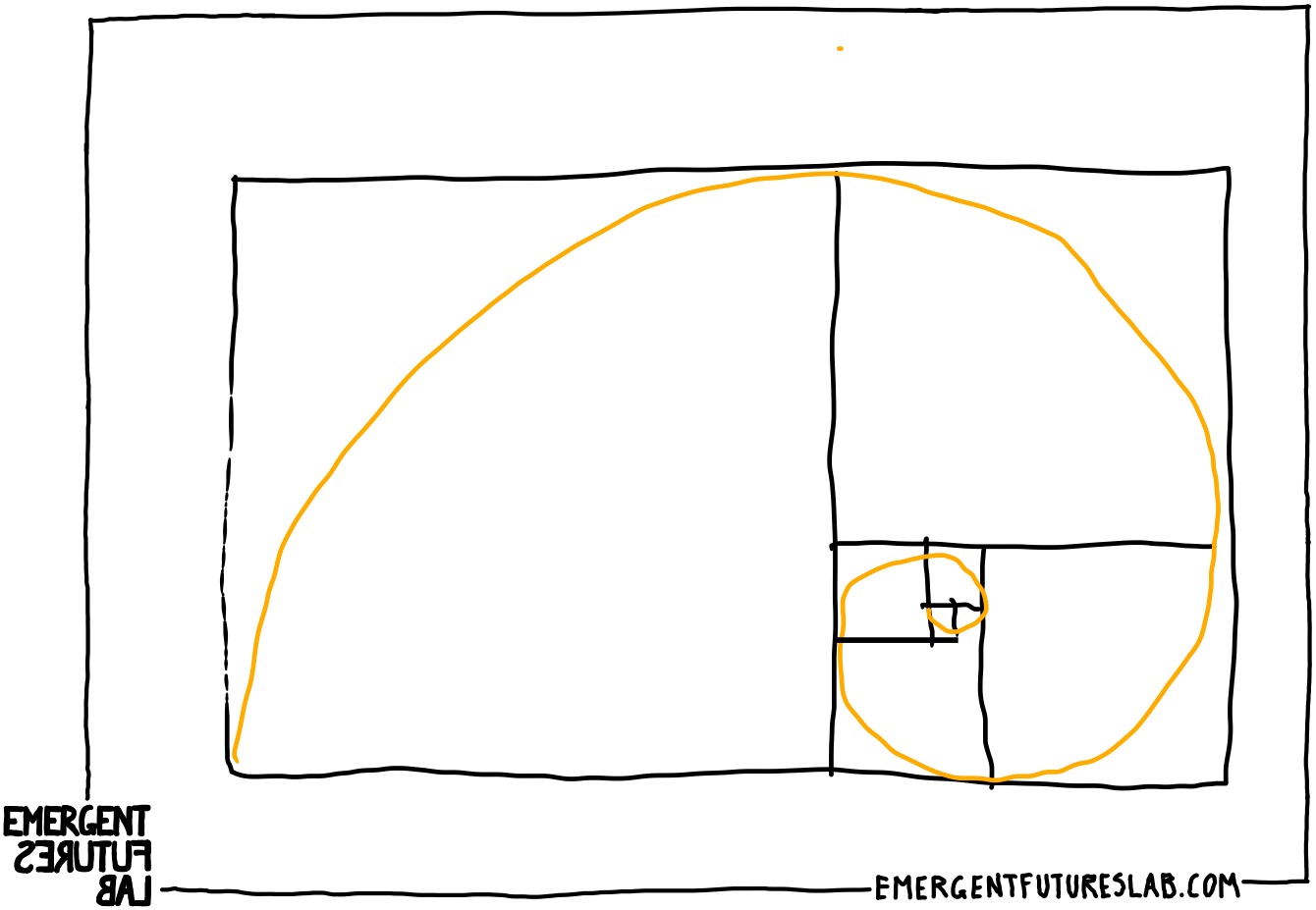
And this is what they found everywhere.
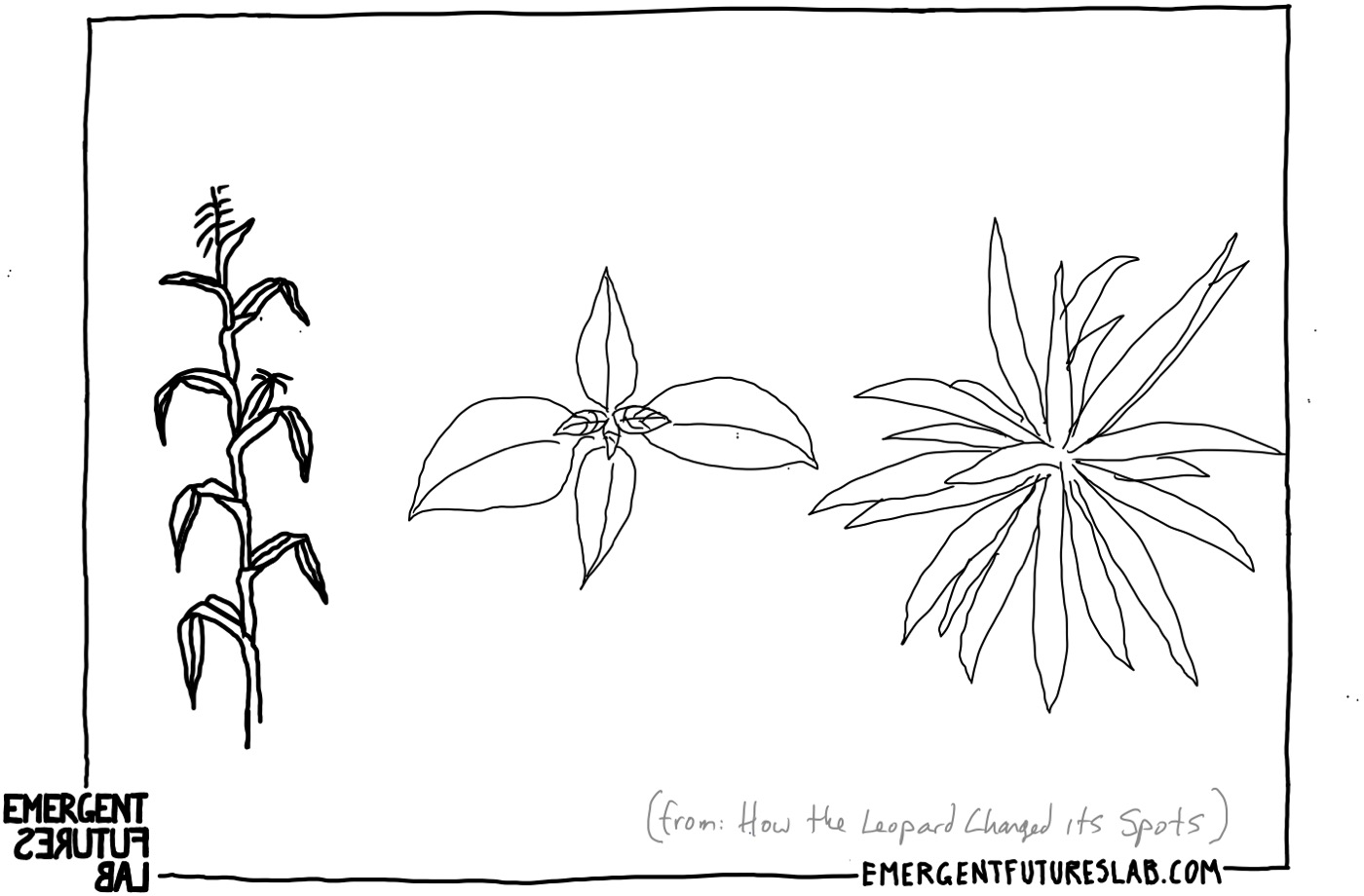
The Greeks were, in their seeking for hidden mathematical regularities, profoundly struck by the fact that all plants had a regularity to their form. They observed that the leaves always came in one of three patterns – opposite pairs, alternate opposite pairs at right angles, or in spirals:
And these spirals – found in so many plants – and especially visible in flowers – have a surprising regularity:
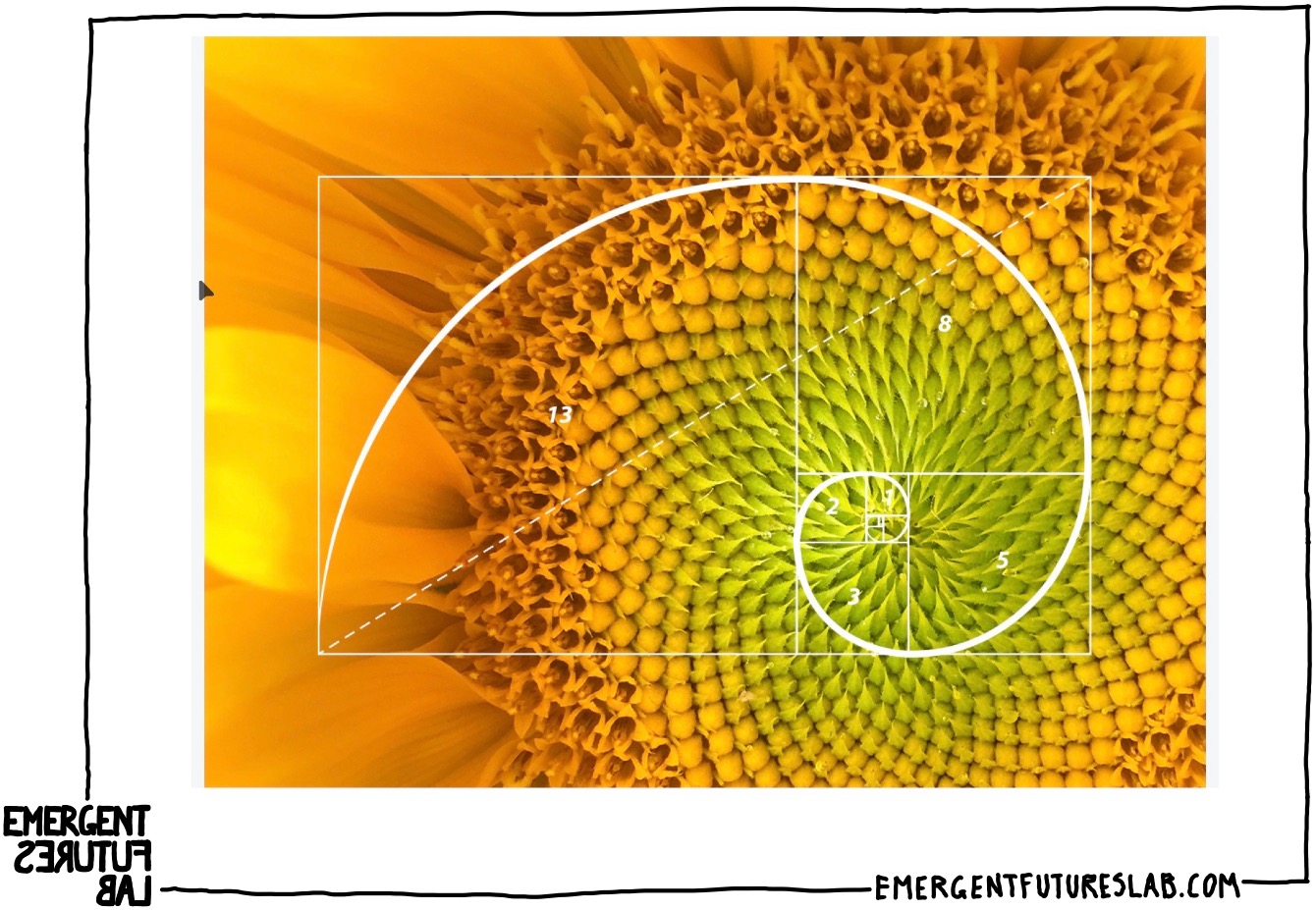
The golden ratio. And the finding of it in the world around them both fascinated the Greeks and confirmed for them that what is created by nature must be an expression of some deeper immaterial ideal source.
Now all that was left to do was explain exactly what this immaterial forming force was. There was much debate of how this logic worked – basically it was one of the ongoing obsessions of Classical Greek philosophers: what and where is the creative cause of things?
While the scope of these debates is beyond the possibilities of a newsletter – for our purposes it suffices to focus in on the speculations of Plato and Aristotle (for they had the most far-reaching impact on how the coming into being of things was understood in the West).
Plato creatively engaged these propensities towards an understanding that this “plan” – this agential idea must be in another realm.
Aristotle – Plato’s student – felt that it was illogical that there was another realm, and proposed that all things must consist of two parts: an unchanging immaterial active forming plan and a formable matter. Interestingly, the Greeks had no word for matter in general, so Aristotle used the word for wood – hyle for matter and coined this concept: hylomorphism.
Wood + Forming.
Keeping it simple and clear, today we might say: Passive Matter + an Active Plan. And, according to Aristotle, and much of the traditions that followed, in all things we find both.
The basic analogy was that of brick making: you have an essential passive and infinitely shapable material: clay, and then you have a mold. The mold imposes its form on the passive material to give it a final form: the brick. But, as should be obvious to anyone who has ever attempted to collaborate with clay (or a mold), there is no passive partner in this relational dance. “Clay” is itself a complex event of the coming together of many processes, and the wooden mold used in making the brick is equally the active coming together, not to forget the person doing the work of molding is a sensitive skilled agent…
Nonetheless, genesis – creation – creativity – is explained by those that followed Aristotle – as the meeting of a pre-existent form/plan that has all the agency and some passive matter/reality awaiting the action of being formed.
Why are there clouds or plant spirals, or mushrooms?
The explanation of their creative process of becoming is always the same: an active form is imposed on a passive matter. But this logic does not end here – the early French complexity philosopher Gilbert Simondon (1924-1989) – who is our inspiration here, noted that the explicit form-imposing logic of hylomorphism has an unconscious aspect: it inherits from the Greeks a profoundly impoverished social relationship – that of the slave who must mold the bricks and the master who gives the orders on how to do it. (This should come as little surprise as the classical Greek city-state of Athens, for example, was composed of roughly one-third persons who had been enslaved).
This, both explicit and unconscious Hylomorphism is not some ancient, quaint and charming superstition; it is very much alive and well everywhere one cares to look today.
Everywhere we enact creative processes that begin in ideas or focus on ideation, or consider the plan as the source and agency behind what emerges – there is hylomorphism.
Everywhere we propose changing paradigms, frameworks, uncovering the source or revealing the hidden mindset…
And so too when we attribute the cause of things to a singular discrete source/plan: DNA, the mind of a truly great individual genius, the mind of the great leader – and everywhere there is a focus on coming up with a plan first – or the looking for the “source” inside of anything from an individual to a mushroom or a water molecule…
Today – we are still very much of the event of becoming-hylomorphic.
So how can we begin to shake ourselves out of this? What might be a very different line of flight?
Here we want to turn to the work of the late Brian Goodwin, who experimented with this question in a wonderful book, How the Leopard Changed Its Spots. And in it he offers the example of a devastating experiment that puts an end to the core example from the Greeks of hylomorphism: the finding of the Golden Ratio in nature and drawing the conclusion that it – this ratio – is what is secretly directing the coming into being of what we experience.
He begins ironically, referencing the Golden Ratio:
“Plants seem to know a lot about harmonious properties and architectural principles. How are we to explain this?”
And then he draws our attention to an interesting experiment:
“A recent model of phyllotaxis [the ordering of plant leaf structures] by French scientists Stéphane Douady and Yves Couder gives a significant insight into this question. They used a simple physical model to generate patterns by letting drops of a ferrofluid (a fluid with magnetic properties) fall at the center of a disk covered with a film of oil, in which the drops floated. A magnetic field polarized the drops so that they became little magnetic dipoles that repelled each other. The morphogenetic field of the meristem was thus represented by a magnetic field.
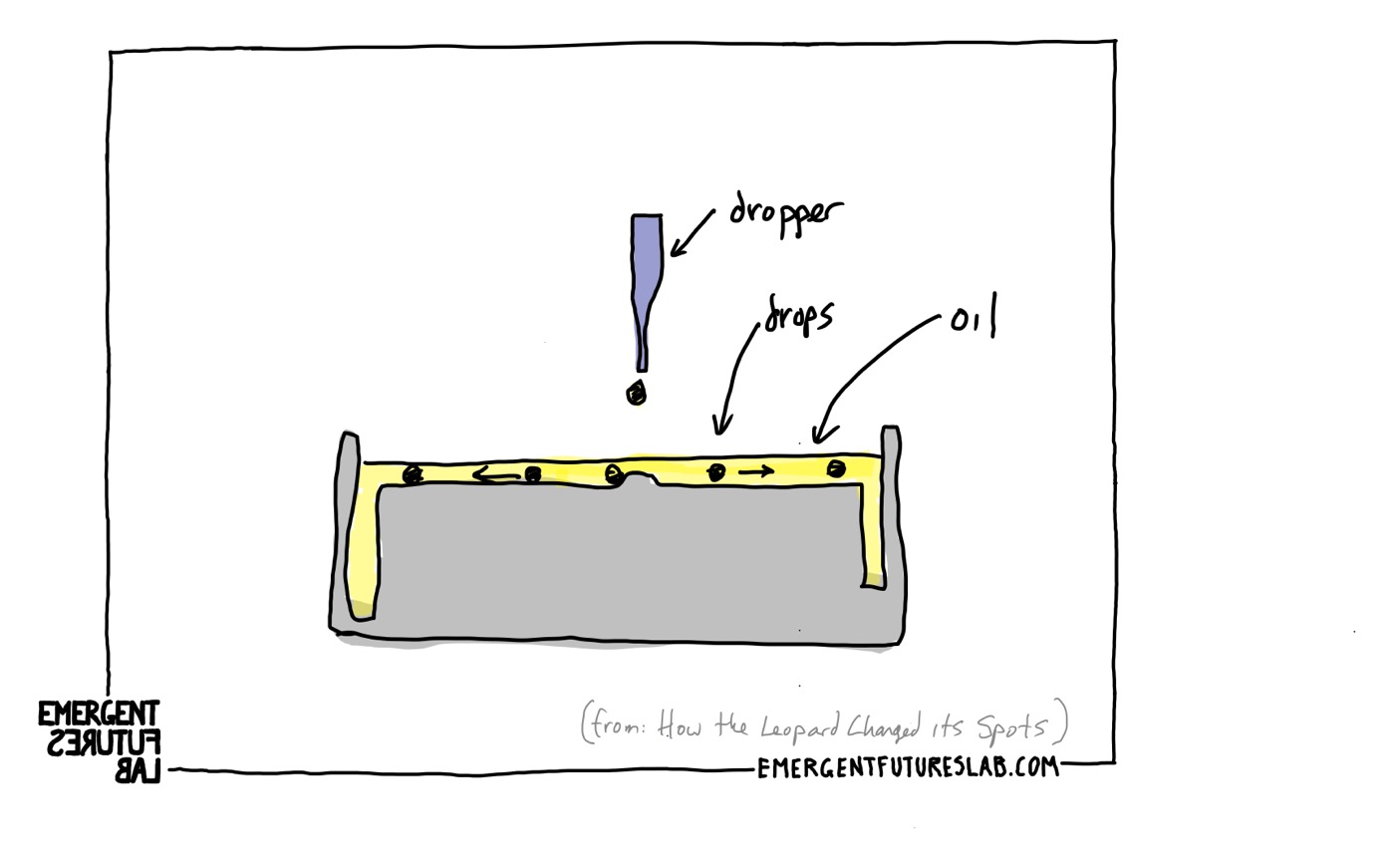
As the drops fell at the center of the disk, they experienced a repulsion from polarized drops already present, and they also were exposed to a steady magnetic field that pushed them out from the center toward the edge of the disk. The result is that different patterns arise depending on the conditions of the experiment, but they all correspond to observed phyllotaxis patterns.
If the drops are added slowly, then by the time the next drop is added, the only drop that has any influence on it is the immediately preceding one; the others are too far away to have any effect. As a result, a new drop is repelled to a position 180° away from the previous one, so that the pattern produced is like alternate or distichous phyllotaxis, as in maize [see previous image]. As the rate of adding drops (equivalent to the rate of initiation of leaves in a meristem) is increased, a new drop experiences repulsive forces from more than one previous drop, and the pattern changes: the initial simple symmetry of the alternate mode gets broken, and a spiral pattern begins to appear. It takes a while for the system to settle on a steady pattern, the duration of this transient depending on the rate of adding drops. If this is rapid, so that there is strong interaction between drops, then a stable pattern emerges rapidly, and successive drops quickly settle into a divergence angle of 137.5°, the spirals obeying the normal Fibonacci series [a version of the Golden Ratio]. An example of this is shown below, which also shows the rapid convergence of the divergence angle on the value for the Golden Section, starting at 180°, which is the angle that will always form between the first two drops. The actual Fibonacci number pair that describes the spirals depends on the rate of addition of drops…
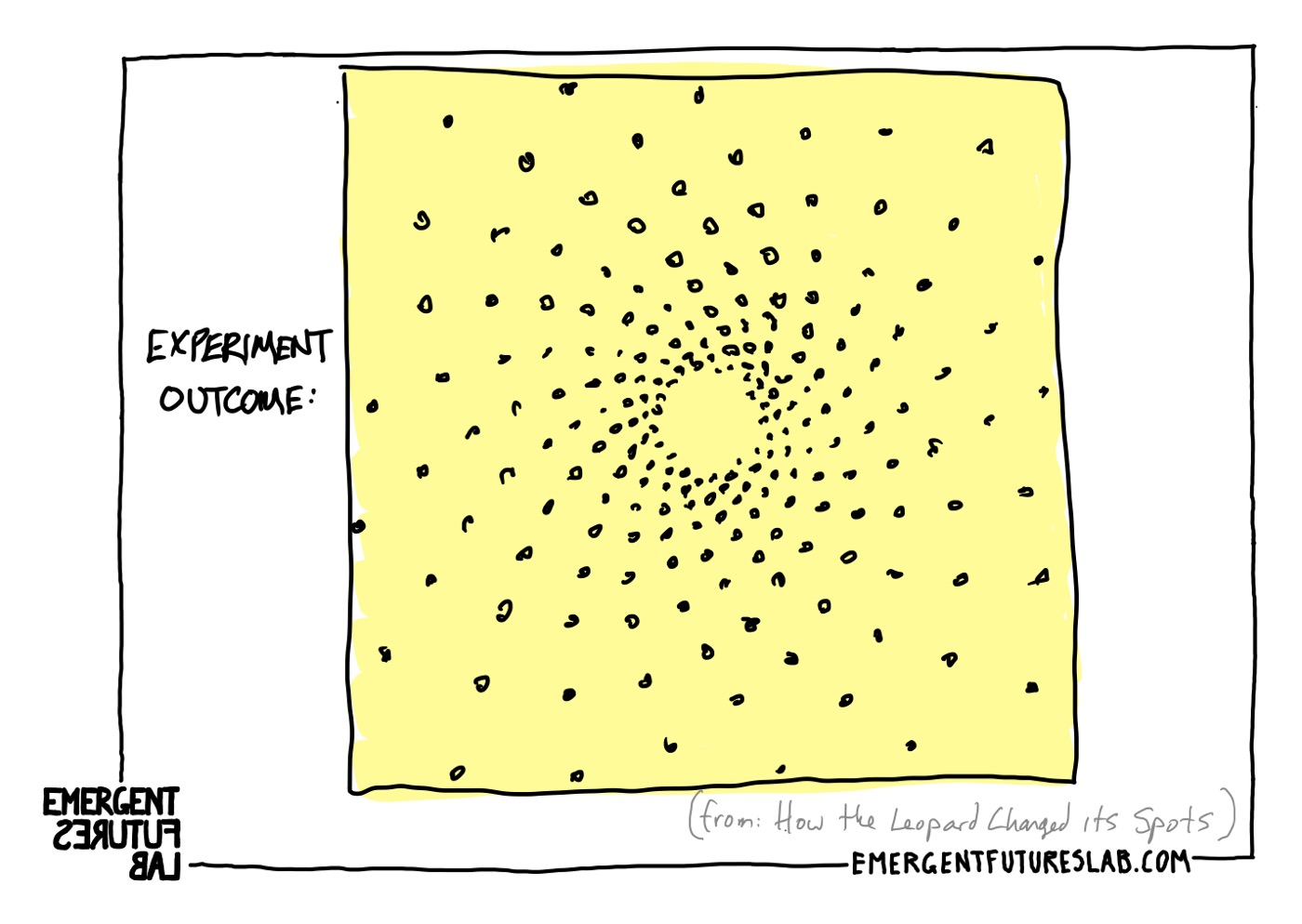
Over 80 percent of the 250,000 or so species of higher plants have spiral phyllotaxis. This is also the dominant form generated in the model, which identifies it as the most probable form in the generative space of possible phyllotactic patterns. So we get an interesting conjecture: the frequency of the different phyllotactic patterns in nature may simply reflect the relative probabilities of the morphogenetic trajectories of the various forms and have little to do with natural selection [or genetics directly]... “
So – no plan, no underlying mysteries of mathematics hidden here giving rise to these forms. The explanation is as simple as it is “planless”: The immanent relational dynamics of a processual event is all that is needed. The perfect spirals found everywhere in nature are not the expression of some similar – perhaps even universal underlying plan – it's just a similar immanent process of growth…
The event is creating itself…
The contemporary cultural propensity is to put some thing at the creative center of it all – some thing directing things, some thing causing things – to unconsciously continue the legacy of hylomorphism – but what if there is no thing there? what if there is no hidden plan – no discrete causal source?
What if there is no center?
No silver bullet – no smoking gun – no guru – no genius?
What if it is just the configuration itself – as a configuration that is the “source” of creativity?
It's not that genes or plans or ideas or charisma or persistence or unique individuals do not play a role – they do – they all do matter – it's just not in the powerful central starring causal role we imagined.
And they too turn out to not be the discrete things we imagined them to be: They are relational participants – made by the events that they co-create – who are themselves the outcomes of dispersed processes (events) coming together.
It is all creative relational processual events – we are all now of eight o'clock in the morning.
But this too can give a false impression – and become a dangerous logic that far too many fall into: yes – it is processual events all the way “up” and all the way “down” and there is no scale that takes precedence over another – but what “determines” – what gives shape to an event is always other events – those “above” “below” and “beside” – the sideways – transversal injection of dust into the complex configuration defined by injections of sun energy (above) and the atmospheric movements from/of oceans (below) is relationally what creatively gives rise to the event of becoming-rain.
And this brings us all the way back to the beginning:
What are mushroom spores drifting upward on the winds but “dusts”?
The becoming-mushroom in releasing spores is a collaborator in the becoming-rain that is a relational condition of its own creative becoming…
How far can we speculate with this logic of a sourceless creativity of events? Well, we think pretty far – but that is an experimental question for our online discussions of the newsletter and the next becoming-newsletter…
Until next week -
Keep difference alive!
Jason and Iain
Emergent Futures Lab
+++
P.S.: The question we hear most often from newsletter subscribers is: How can I participate more deeply in this work?
We have two ways:
1. Emerging Futures+ is where the newsletter becomes alive: post your comments, questions, or thoughts alongside practitioners across five continents, connecting each volume to their own work. Plus the extended audio version for a commute, join 2 live events per year, and the full searchable 260+ volume newsletter archive.
🧨 Start with a $1 trial for 7-days… Then $6/month or $60/year. Cancel anytime.
2. WorldMakers is where the newsletter gets practiced. Facilitators, educators, consultants, and researchers experimenting with emergence and change-making. In dialogue, in shared experiments, in the collaborative making of a different approach to creativity. Members have access to everything in Emerging Futures+, plus thirty-five live events a year, two weekly podcasts, bi-weekly creativity exercises, and the complete annotated bibliography.
💥 Start with a $1 trial for 7-days… Then $60/month or $597/year. Cancel anytime.


