Newsletter
Resources
Courses
Books

If linear, projective, future backwards approaches to creativity will not give rise to novel outcomes (see Psychological Creativity) – what is an effective alternative way to engage with creative processes?
For this, we need new guiding metaphors. If the reductive and essentialist metaphors of classical individualistic creativity – the tree, onion, pyramid, and iceberg all lead us astray, where can we turn? A very helpful contrast to the tree with its convergent roots is the Rhizomatic root with its transversal spread.
Rhizomes are also rooting processes, but they do not converge on a single plant stem or tree trunk – rather, they can infinitely diverge, wander, and multiply. Rhizomic plants have no center, no single source, nor final form:
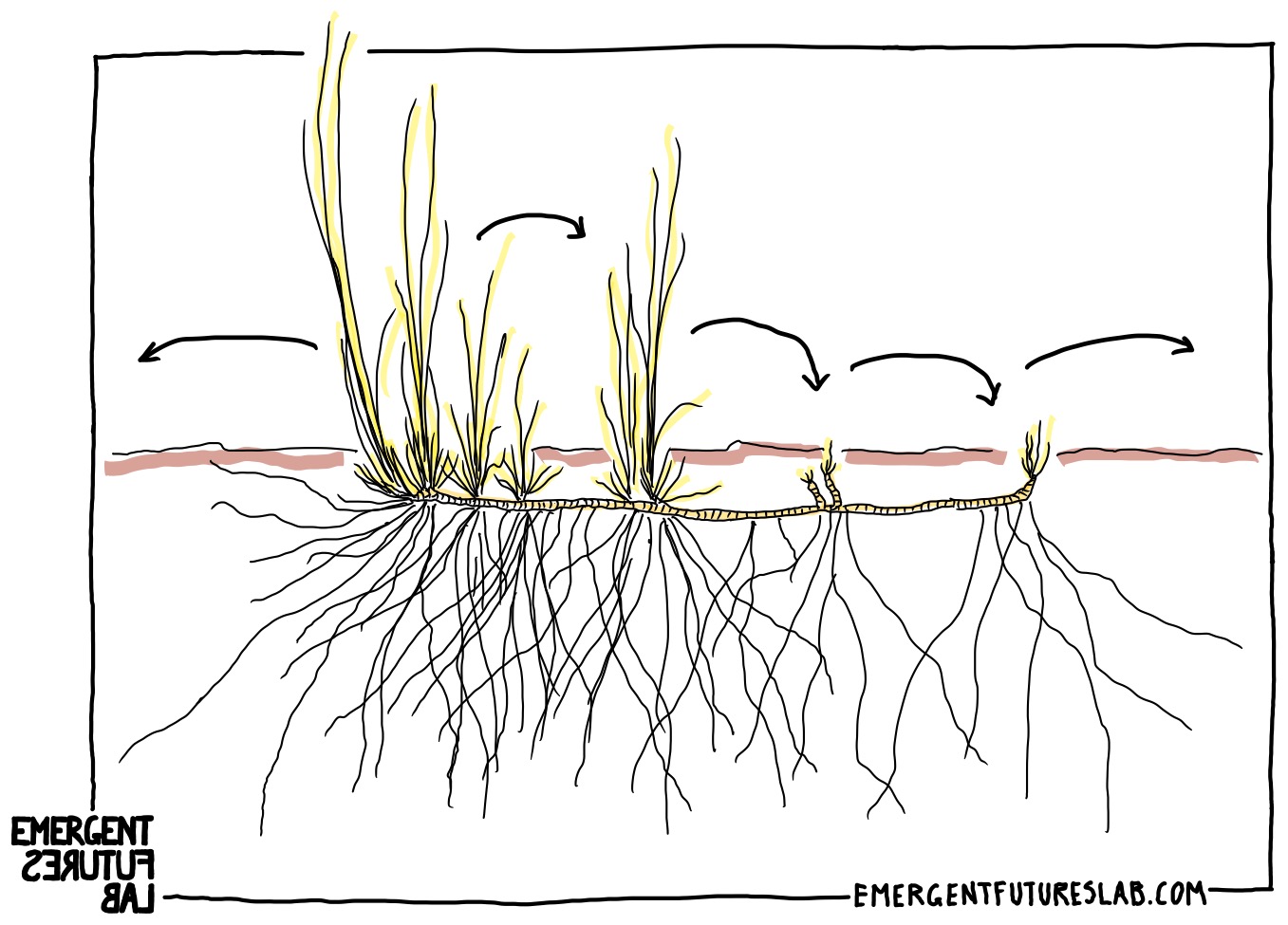
The examples are vast: corn, dandelions, bulbs, tubers, mushrooms, and some trees (such as aspen) are all rhizomatous. And to this, we should, following Deleuze and Guattari, add: rats, wolf packs, and even their burrows.
Here we have a new image/metaphor of creative processes – as an open-ended, relational, and ever-changing creative process, which can be understood as:
Transversal, Transversal Thicket, Thickets, Tree Models, Future Backwards Design, Creativity (Psychological), Temporary Autonomous Zones


