Newsletter
Resources
Courses
Books

Tree models are one of the four classical and deeply problematic reductionist/essentialist ways of presenting the creative process (the others are the multi-level pyramid, the iceberg, and the onion).
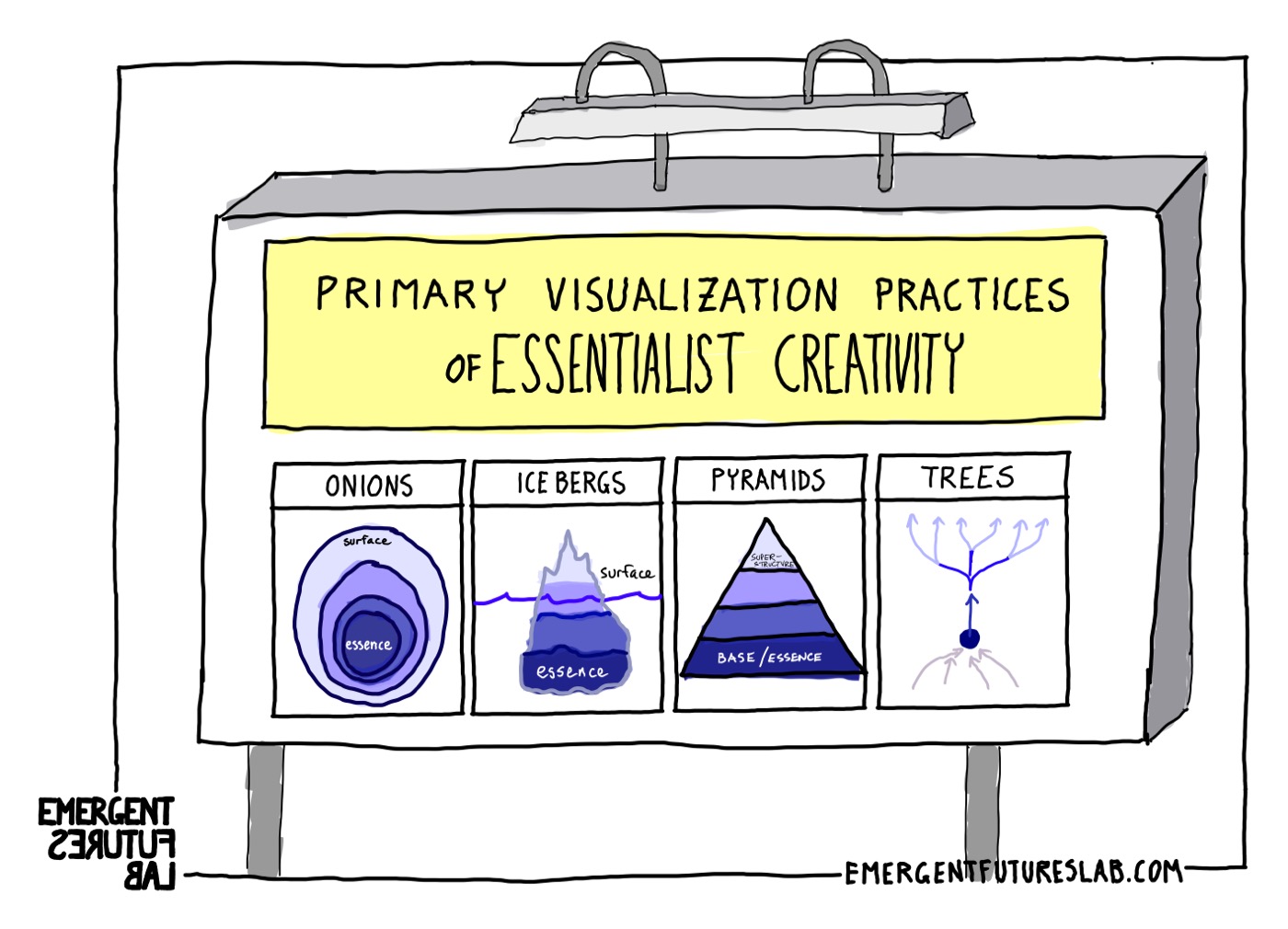
Tree metaphors have two operational logics in relation to creativity: (1) the Seed, and (2) the Root-Tree.
Seed Metaphors and Creative Origins: The seed gives us the paradigm image of a discrete source – a discrete self-contained essence that holds all the necessary information to generate the final outcome (the mature tree). But seeds don’t work that way – they simply do not magically turn into trees alone – humidity, temperature, fires, animal digestion, fungal networks, soil, tree relationships, and much else are required in a continuous and ongoing manner. And then we are back to the transversal thicket and its entangled emergent possibilities. Seeds as part of very specific, contingent, thick, and wide assemblages will, with great good fortune, open up the propensity for a tree becoming.
And more than that, the seed has no fixed relation to the tree. The seed does not equal a tree – it could just as easily become pig food or be used to make ink, or be crushed into soil. Or digested by bugs, fungi, and worms. And again, things always move sideways – transversally far more than linearly.
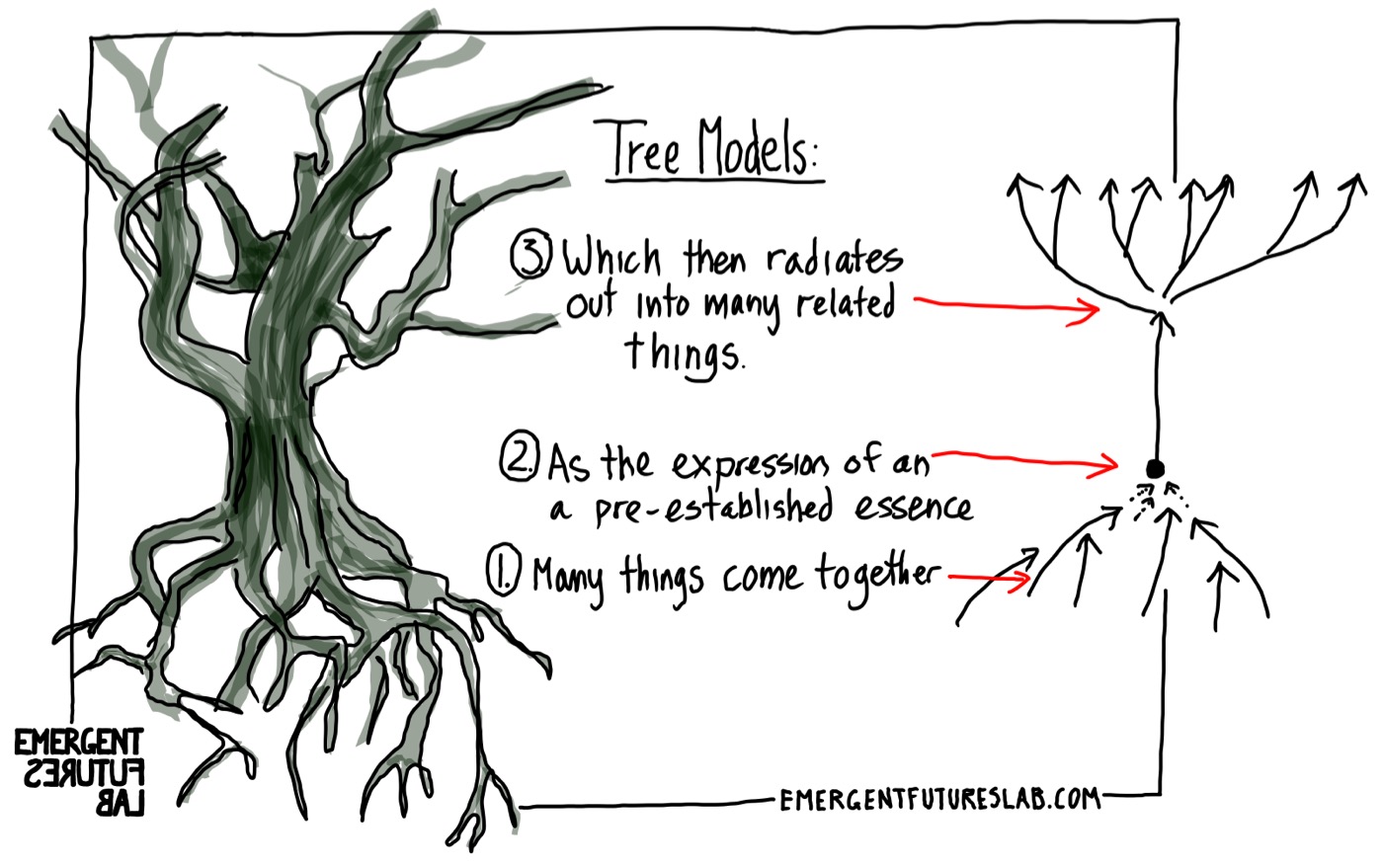
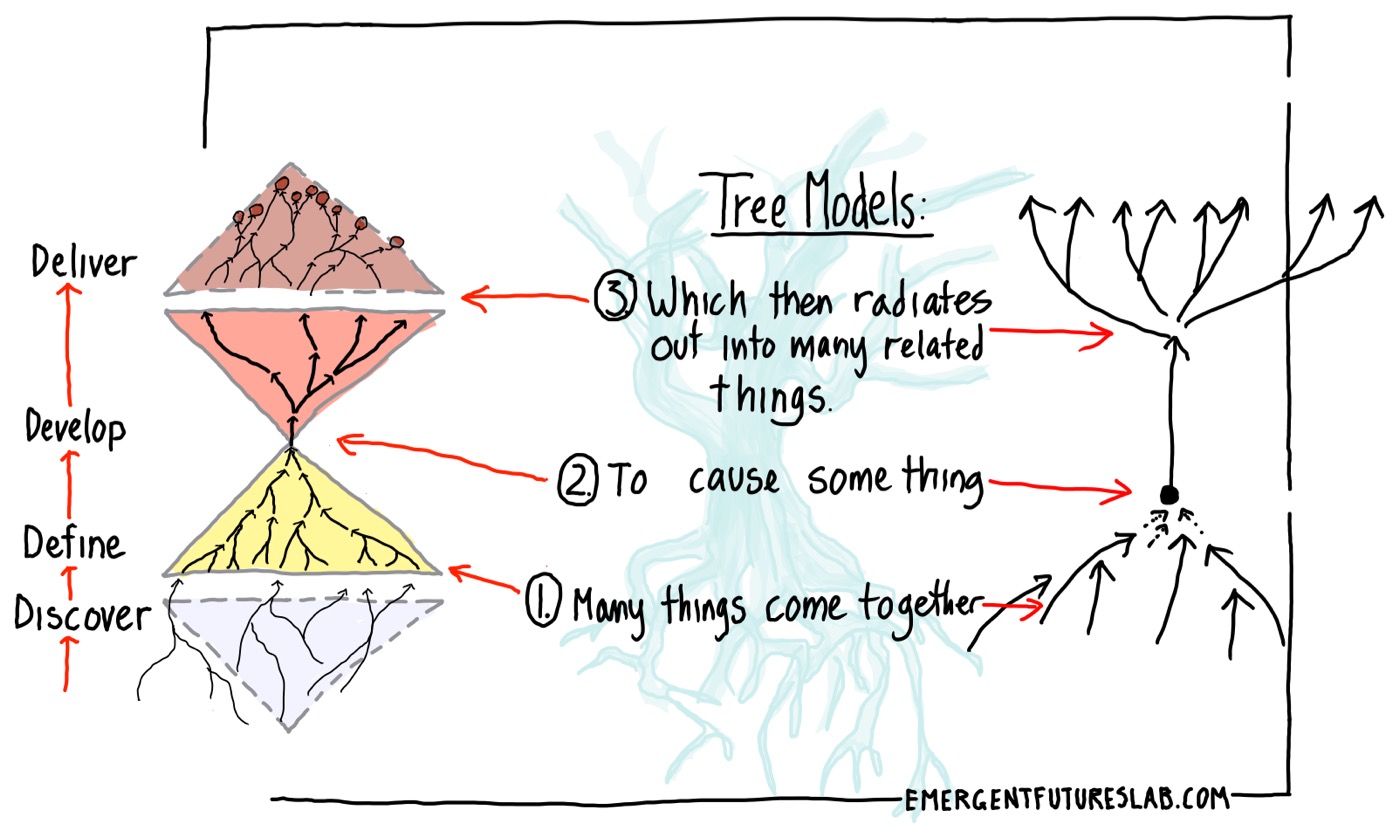
Tree Metaphors and Creative Processes: Tree models offer a three-part metaphor of the creative process: (1) Roots as Convergence, (2) trunks as the Core of the New, and (3) Branches as the Divergence and spreading of the new.
Why roots? This metaphor activates how roots lie hidden beneath in the soil and “give rise” to visible things – trees, plants, flowers, bushes, and weeds. Simply put: Roots give us one image of the creative processes of becoming: from the many to the one. The many could be research, empathy, or preparatory inspiration – any form of preparation. And then creativity bursts forth into the light as a singular, powerful thing:
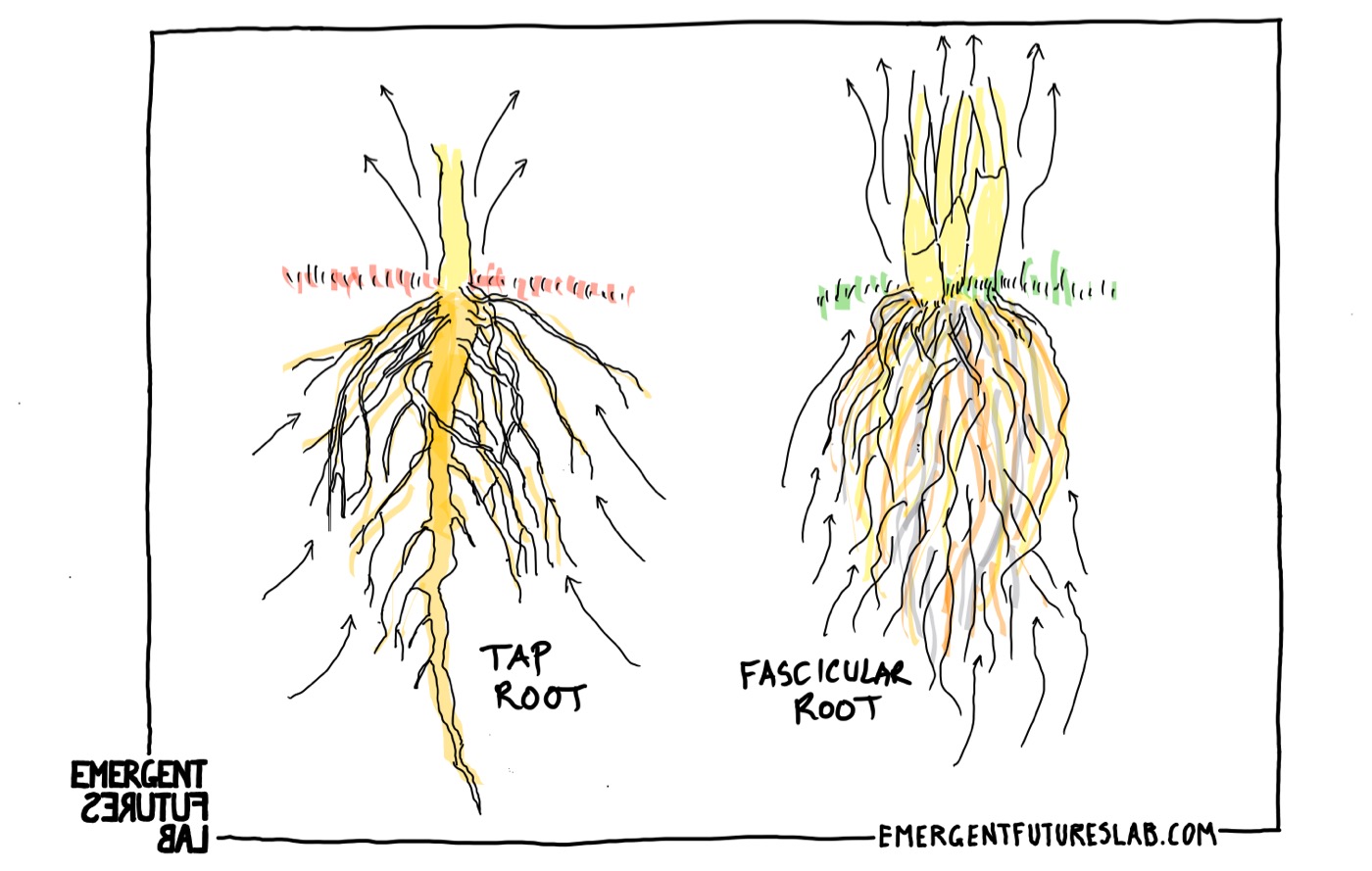
And this leads to some pivotal eureka-style moments of ideation/imagination. But, again, this is more mythic than actual: The highly distributed configuration is giving rise to the possibility of ideas emerging in a thick context (and again, we are once more in the processes of transversal thickets).
But this metaphor does not end here: The Trunk becomes an image of the singularity of creative outcome, idea, and imagination. Which then radiates out into many possibilities:
Perhaps the most famous contemporary model of these tree logics of the creative process is the “Double Diamond” (which is also one of the most ubiquitous and problematic images of a creative process):
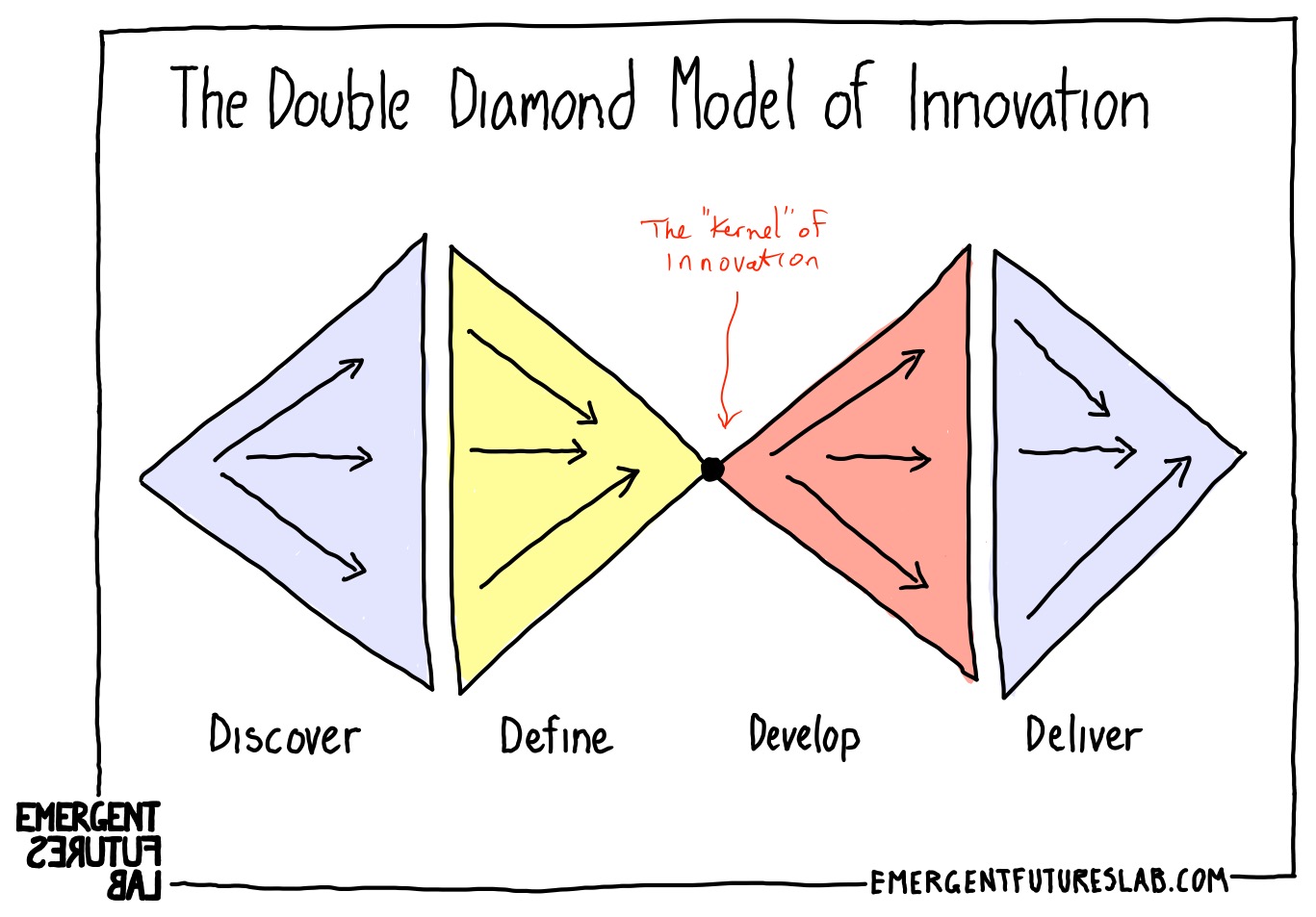
How are these diamonds a tree? – We just need to turn it on its side to see this:
Ultimately, what is the issue with the tree model of creativity?
The tree logic is a process by which imitation, representation, and reflection work, where the many novel differences are forced to become one and then forever reflect the one. What is the problem with this process? It is a process not of creativity but of forcing differences to correspond to a tacit pregiven assumption that underneath all of the surface differences is sameness – a common essence: The many become one, and then one becomes the many as only variation in degree.
The double diamond, like so many purported creative processes, is in fact an anti-creative process unconsciously designed to produce imitation. It is unhelpful if our goal is to engage with creative processes. Trees are “over-coding” processes of producing sameness.
We need new approaches and guiding metaphors – and these ultimately start with the transversal, transversality, thickets, and rhizomes.
Transversal Thicket, Transversal, Rhizomes, Emergence, Configuration - Creative & Enabling Configurations, Assemblage, Thickets, God Model, Traits


