Newsletter
Resources
Courses
Books

Traits, as in Trait Psychology, is an approach to understanding human individual subjectivity or what is commonly termed “personality”. This approach posits that human actions can be best understood and explained via the positing of deep, fixed internal personality traits. Such a theory offers an essentialist and reductive approach to human subjectivity, personality, and actions. Why do we do bad things? Why are we late? Why are we empathic? Why are we creative? It’s the way deep down we just are… (or so this approach claims).
This essentialist approach activates an “onion” metaphor that posits that underneath the various superficial layers of the self is a deeper, unchanging core.
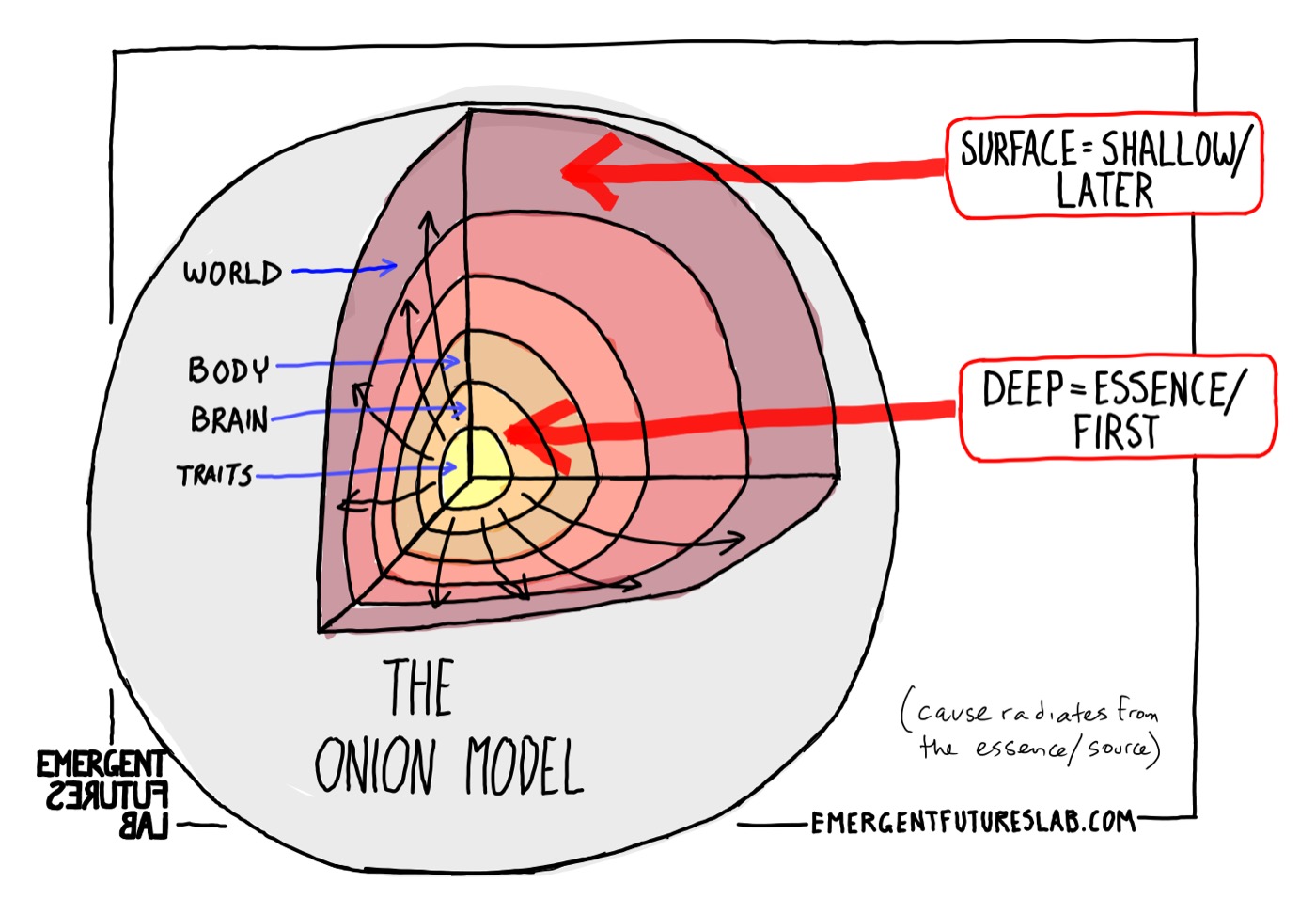
Despite overwhelming evidence, far too many organizations hire, judge, and train employees based upon a trait-based approach to job aptitude (over 80% of Fortune 500 companies).
The most common of the trait models is the “big five,” which classifies personality in relation to the traits of Openness, Conscientiousness, Extraversion, Agreeableness, and Neuroticism.
After countless studies, there is little correlation between observed behaviors and how individuals are rated by various trait-based models. The research in Social, Ecological and Situational Psychology has shown that our actions, and “personality” are far more dynamic and variable than a trait-based approach would suggest. Countless studies, the most famous being Stanley Milgram’s teaching experiment, have conclusively demonstrated that our actions are best understood to be the emergent outcomes of many distributed environmental factors. Why we act in a moral or immoral manner is not because of any deep internal moral trait but because of an emergent interplay of environment, tools, practices, and habits.
Trait-based approaches have had a detrimental impact on approaches to creativity in that they ascribe to individuals what should be properly ascribed to the configuration of an assemblage that includes people, practices, environments, and tools (see Fundamental Attribution Error). We see this error writ large in the romantic ideal of the lone creative genius.
Fundamental Attribution Error, Configuration - Creative & Enabling Configurations, Emergence, Affordance, Bio-Enculturated, Romantic Creation, Creativity (Psychological), Human Nature, Assemblage


