Newsletter
Resources
Courses
Books

Welcome to Emerging Futures -- Volume 187! Tools are World-Opening...

Good morning beings who accompany world-opening objects,
As you receive this newsletter in your inbox we’re simultaneously publishing:
If you’d like to go deeper with this premium content, apply for access to our WorldMakers community today →
With that invitation extended, let's dive into this week's big question: "What do tools really do?"
If, as we have claimed, tools are no mere improver of some human capacity – what is it they specifically do?
Last week, we looked at this question by comparing the agency of a typewriter in contrast to that of a portable computer:
“While the activity of typing on a laptop could be mistaken for typing with a typewriter in the mid-twentieth century – this is a radically qualitatively different practice. Consider one aspect of the practice of typewriter typing: correction. With the typewriter, we made “drafts” – discrete physical iterations page by physical page. Each piece of paper was a distinct achievement. Major corrections were done as a separate process with a pen to the draft. Sections might also be crossed out. The paper might be cut, parts moved around, and then taped back together. After this, a new draft of the whole document would be typed out. “
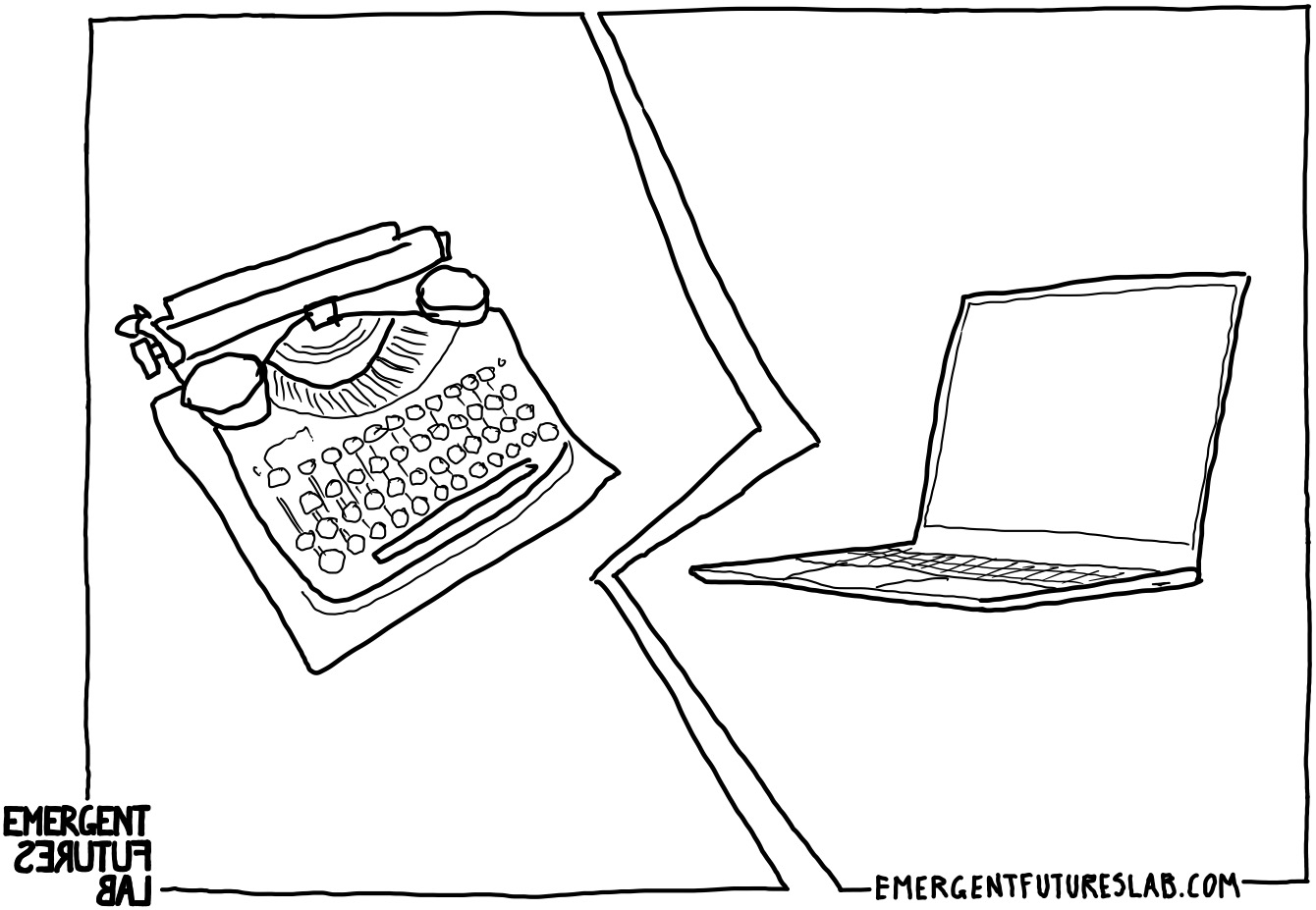
And just from reading this, it could seem that what the modern laptop does is basically the same thing – just much, much easier. How could one disagree with this? After all, there is no need for scissors, whiteout, or retyping out the whole draft. Now, we just highlight and delete, highlight and copy, or even simply ask AI to “make this read more like a formal letter.” And that is only the beginning of what AI will do with one's digital “data”.
If the typewriter was an improvement of writing with a pen and writing with a pen was a more effective way of preserving, organizing and communicating the spoken word, and the spoken word was itself a more effective way of thinking than just feeling – how can the laptop not be rightly seen as simply the improvement and extension of typing?
We can think of this as the debate between:
Technology is an “extension” of a pre-existing human capacity
Versus
Technology is a “transformation” of a pre-existing human capacity.
Another way to put this debate is that it is between those who frame technology as being a neutral “utility” and those who see it as an active “agent”:
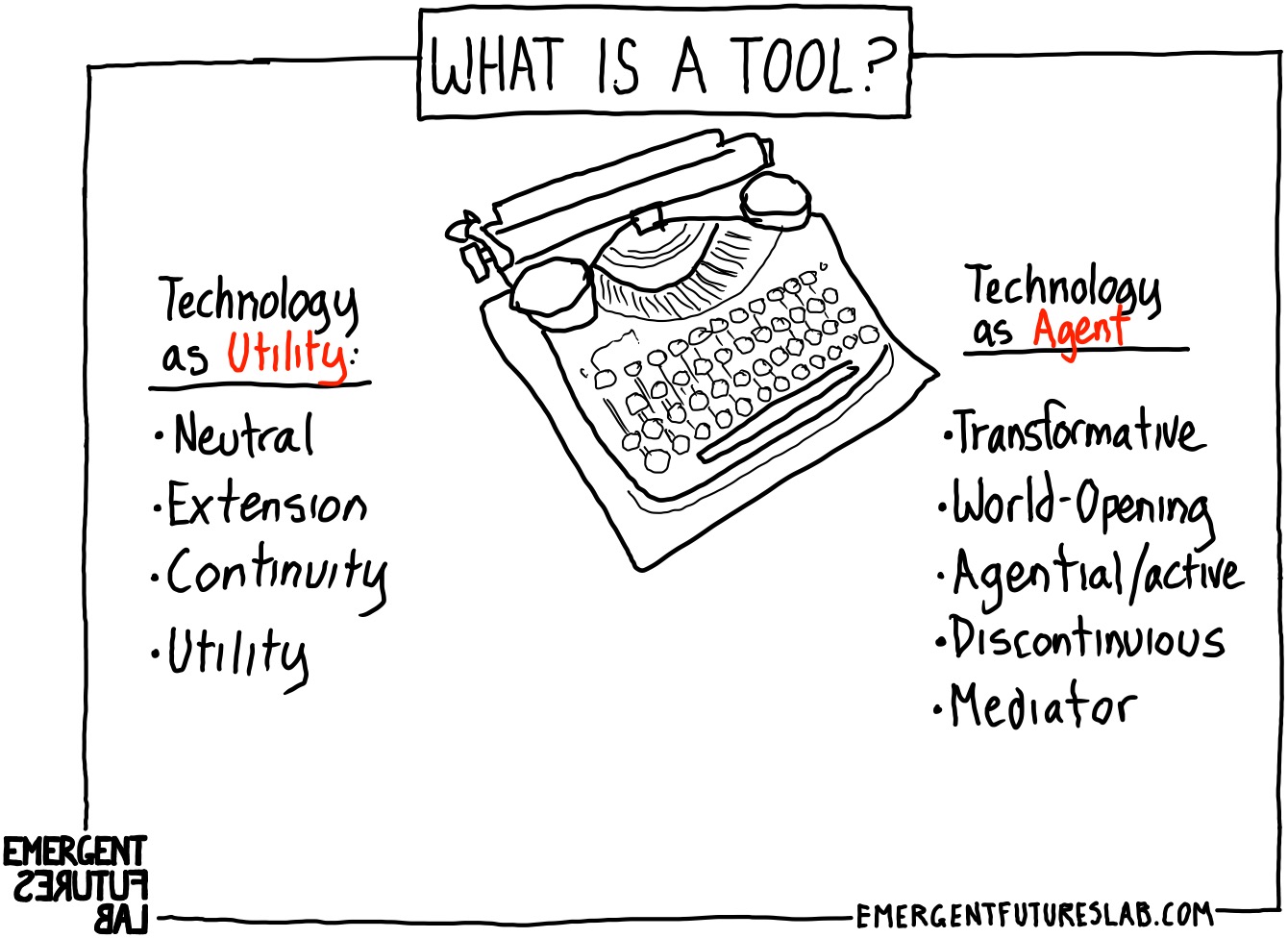
We are obviously on the side that technology has a transformative agency and is no mere utilitarian extension. And last week, we started to lay out how a laptop was no mere extension of a typewriter and how the typewriter was no mere extension of writing. This took us into a complex discussion of the history of “text” and the very modern world of “data”. This discussion is a long and complex one that we wish to return to so that we can discuss how AI is now radically transforming everything even further.
But this is a dense and heavy topic. This week, we thought it would be nice to explore the agency of tools in a lighter and simpler manner by focusing on everybody’s favorite item of clothing: shoes!
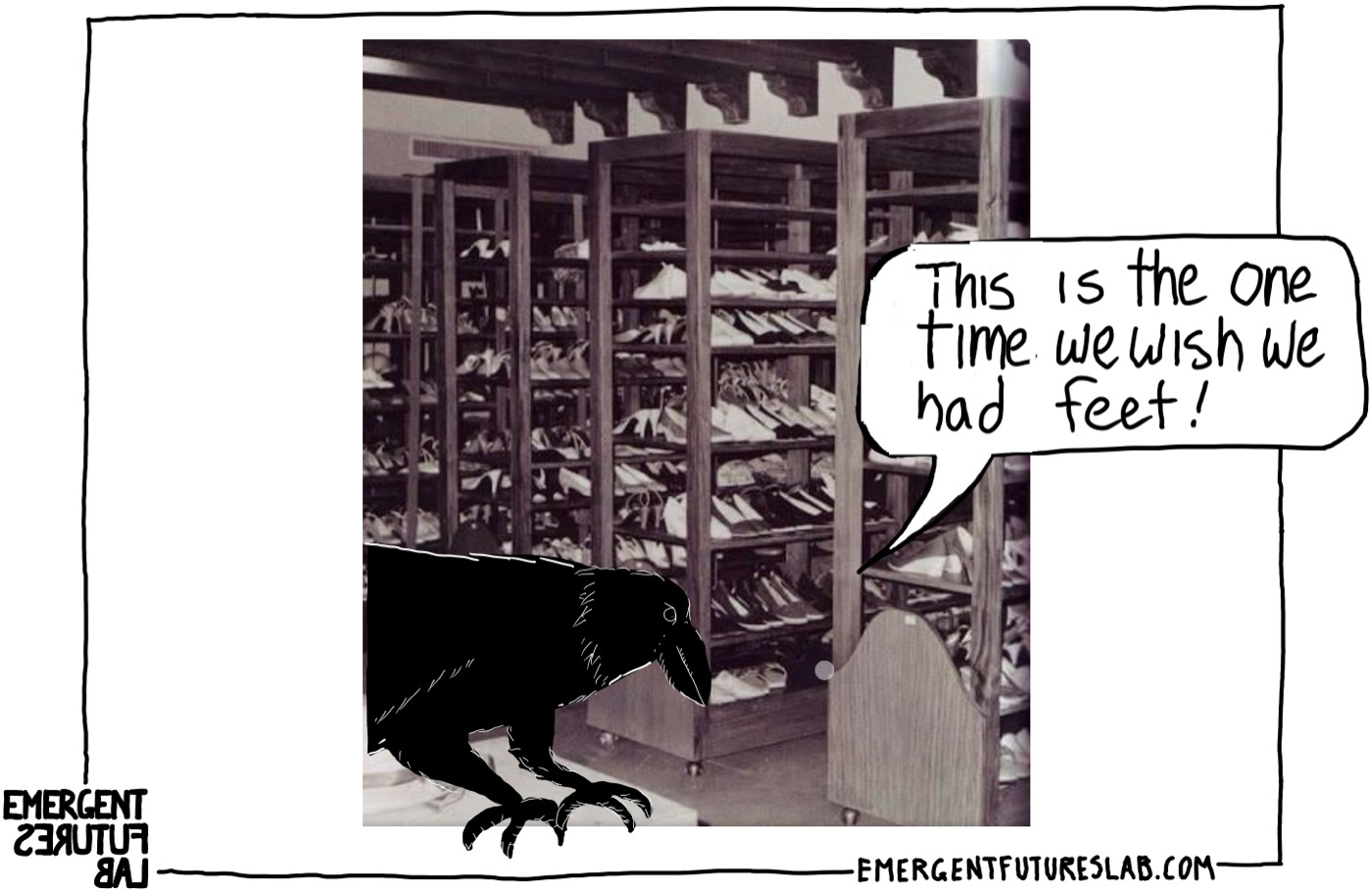
Shoes – we have so many. There is a shoe for everything and every occasion.
We can all agree that a shoe is a tool that joins and extends various existing capacities of the foot: it will keep the foot warm, make it look sexy, stop it from slipping, and relieve it from the pain or danger of the ground. But how is a shoe transformative beyond the improvement or extension?
We can see that it is a “mediator” in the simplest sense of the term: it sits between two things. The shoe mediates between the foot and the ground.
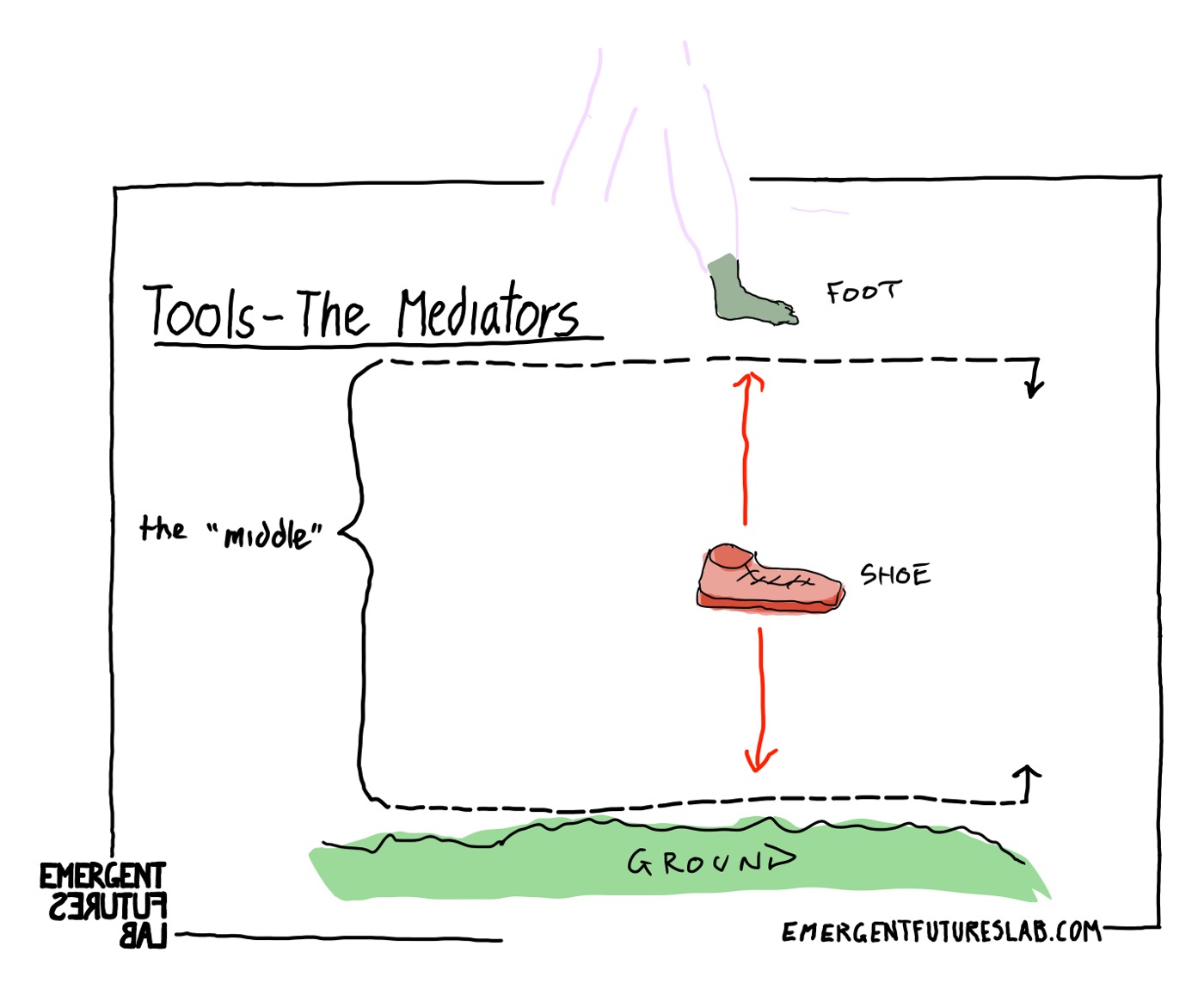
And we can see that there is always one more mediator possible: Between foot and shoe, there is the sock.
Between the shoe and the ground, there is a sidewalk.
Between the sidewalk and ground, there is gravel.

And we could keep going, adding powders and salves to the foot before the sock or micro-spikes between the shoe and icy sidewalk. The space of tools – the middle is ever expanding. This is how technologies operate.
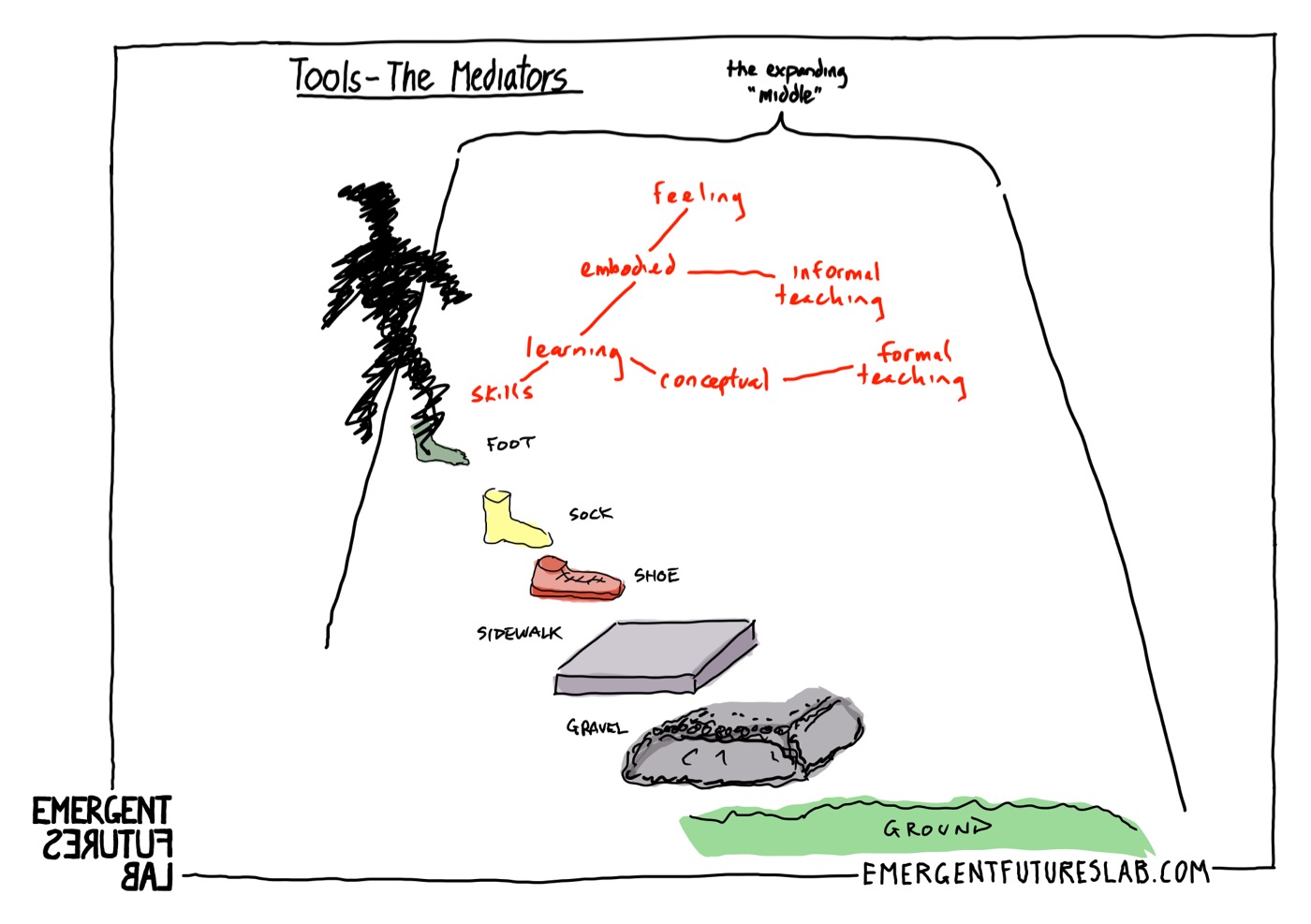
They are an entangled thicket – mediating between, beside, above, and below us.
But if we stopped here, considering tools as extensions and mediators, we would be in danger of having it all wrong. For it is not that they extend or mediate some aspect of our bodies, but how they do this that matters. Understanding how tools mediate – which is to say – what they bring as agents to this process is what matters. And this brings us back to the initial question of today's newsletter:
What do tools really do?
If we had to answer this question with a single word, it would be:
“world-opening”
Tools are not simply world-expanding but rather world-opening.
Our favorite examples of this come from the world of outdoor activities – hiking, rock climbing, and mountaineering – and the role of shoes in these activities.
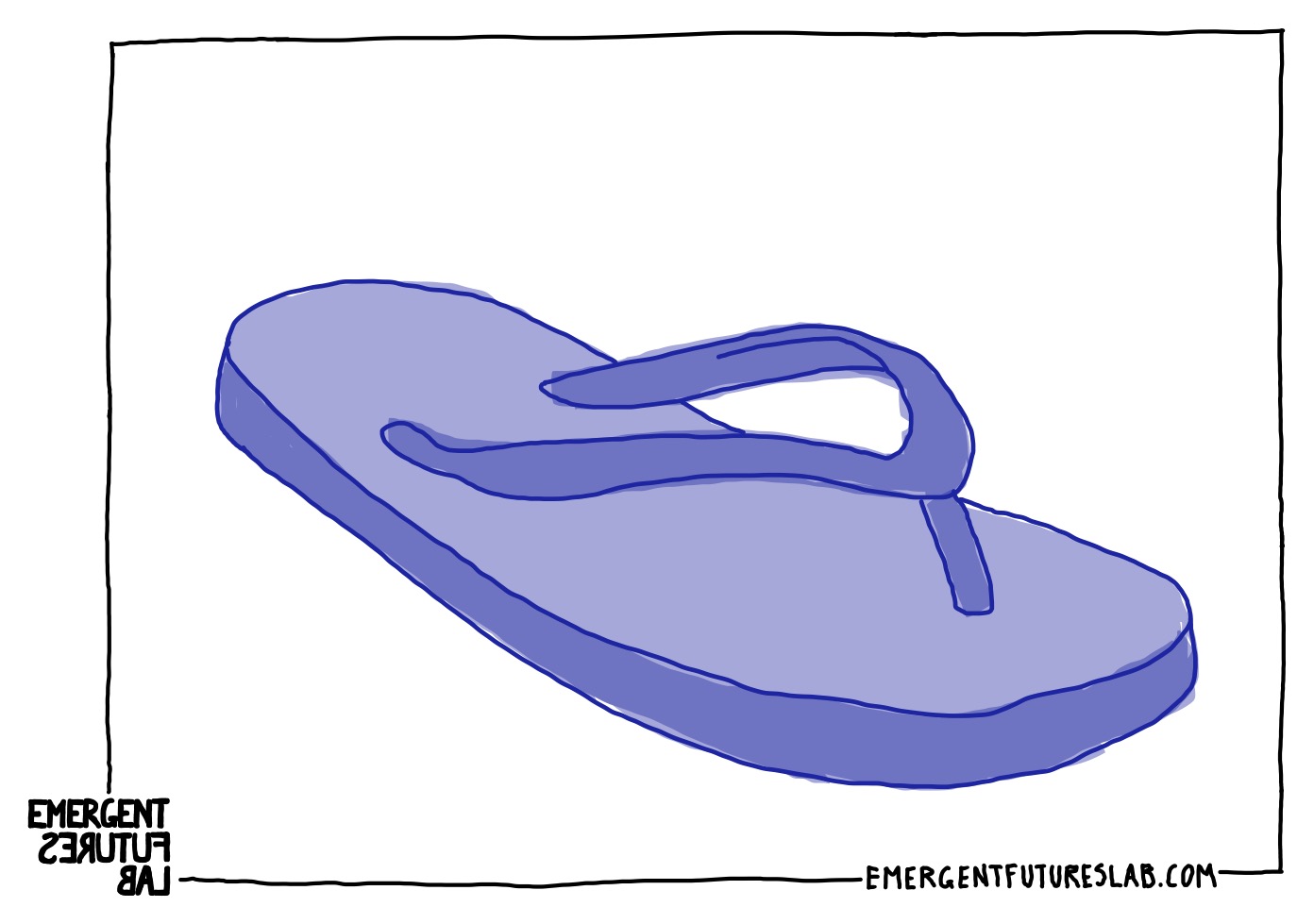
If you had on a pair of flip flops – which are themselves one of the most amazing of shoe forms, and wandered down a path on a wet spring day into the woods, passing large boulders and cliffs and crossing the occasional stream. Your walking experience could be a beautiful one, but it would not involve many things such as climbing those boulders or cliffs.
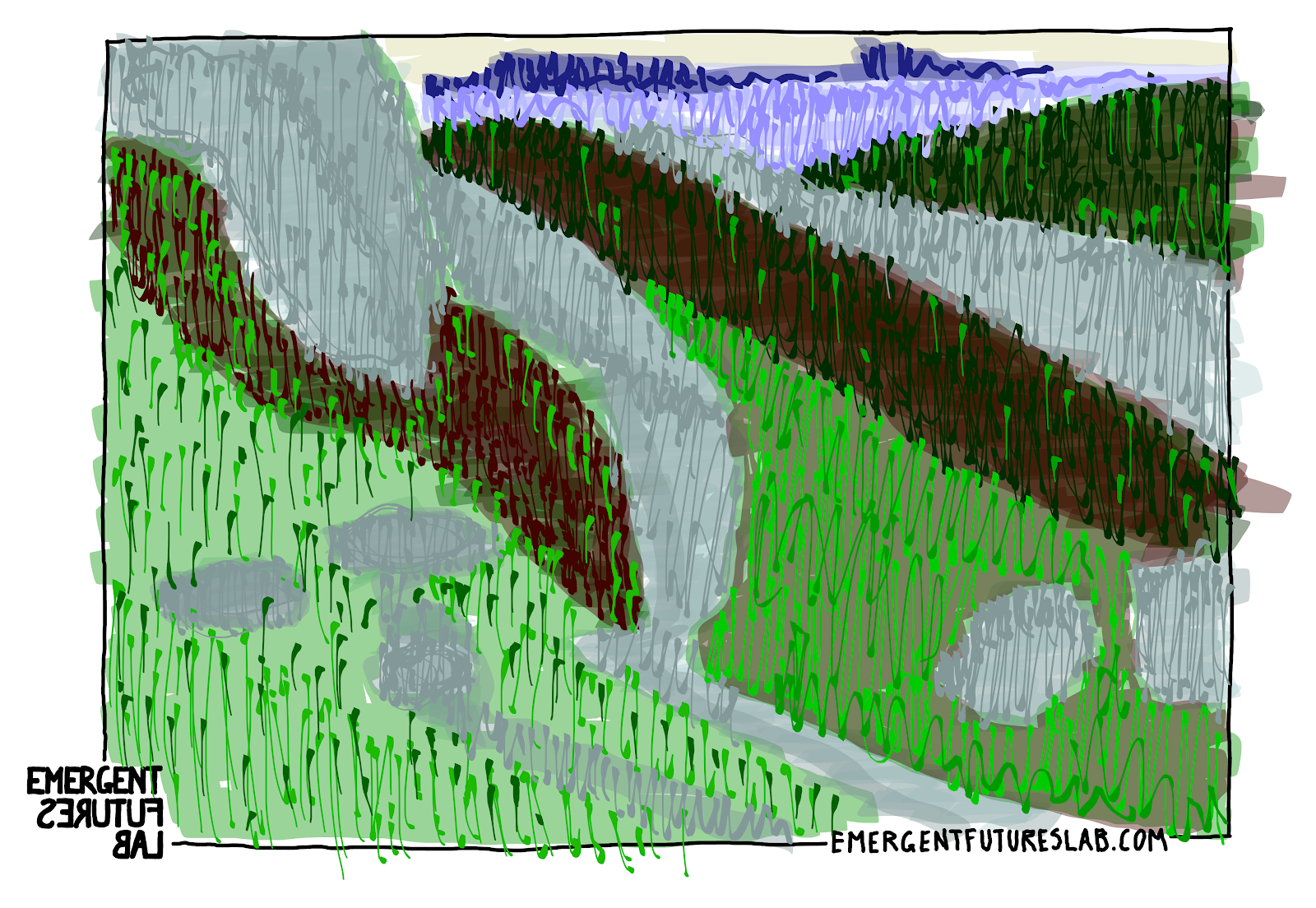
Consider for a moment that it is you walking this forest path, and you come across a steep cliff. You pause as its beauty and the verticality of the rock face pull your gaze upwards. The top seems to touch the blue sky and the clouds drift in the afternoon light. Up there trees sway, birds sing and the cliff seems to invite you to leave the path and venture up.
You look around, searching for a way onto the cliff. Your hands reach out, and your feet try to step up. Nothing seems to work. Your hands grasp at ledges and cracks, but your feet in their flip flops just twist and slip. Your flip flops twist off your feet. And you shrug, put your shoes back on, and continue on the path.
Here on the wide and well-groomed path, they find their footing. Drawing you into the smoother middle of the path. And as you continue deeper into the forest, they pull you towards a route that stays to bigger paths with fewer roots, rocks, mud, and gravel. After an hour or so, you are back at the trail head, having completed an enjoyable circuit.
In this walk, the well-made path opens up to you, and it shines forth, pulling you along. Your walk can speed up and slow down as you look at things or feel the urge to move your body. And the boulders, the cliff, and the small paths also shine forth – as things to contemplate from a distance. These stones, and small foot paths become like the dense forest around the trail – an immersive visual backdrop to your experience.
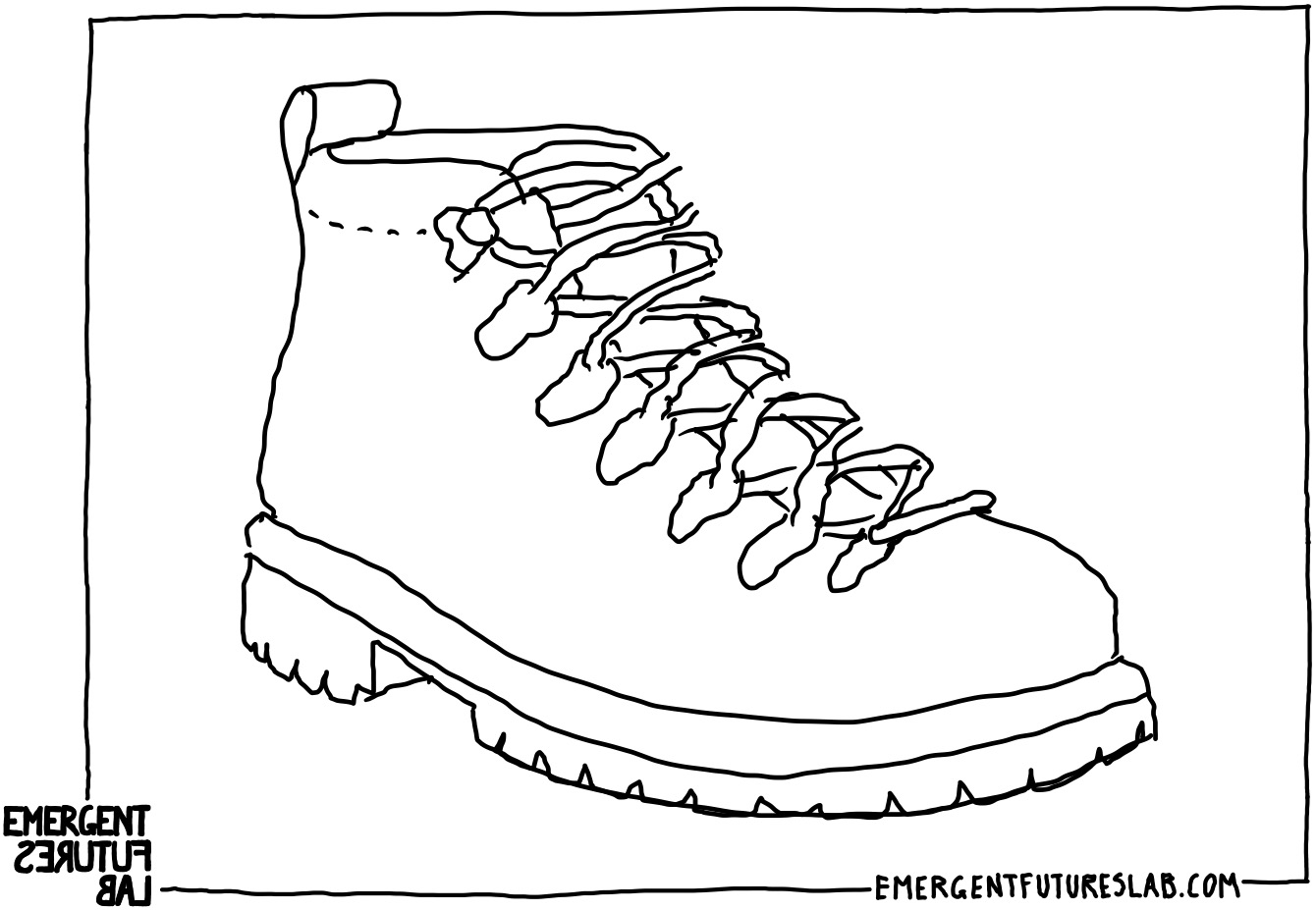
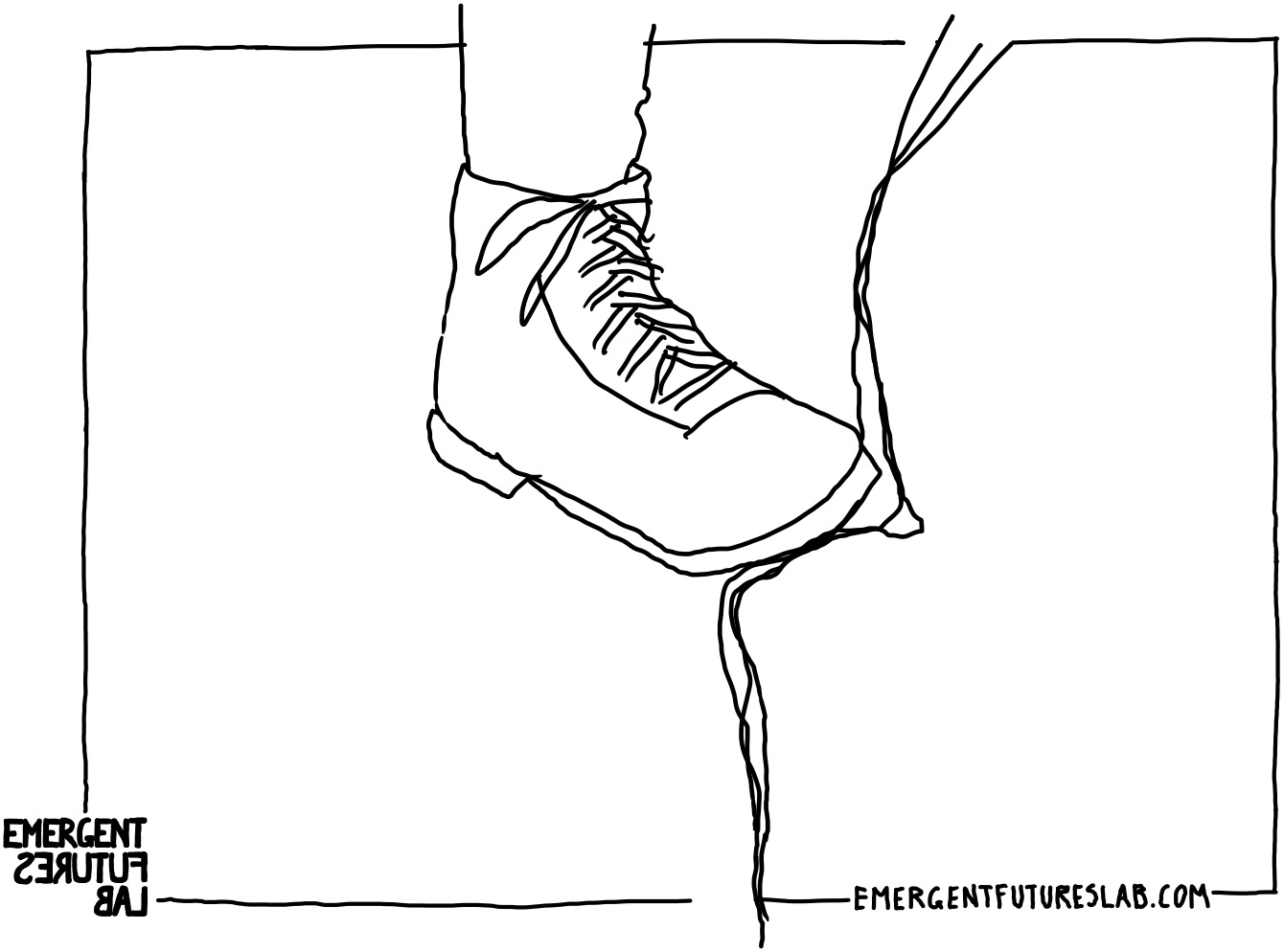
Now, if one were to change shoes, say to something with a closer fit and a stiffer sole, and you tried the same experiment of wandering off the trail to climb onto the cliff. Your feet would find small ledges and rest comfortably. Your curiosity and feeling of being drawn upwards by this rockface would be met with an opening. A novel propensity in the now relevance of the stiffness of your boots would shine forth: Feet would step up finding ledges and hands and eyes would coordinate with each step to balance and support. We would soon be off the ground. Now, a feeling begins to emerge and take over. Yes – this is interesting. Yes, this is new. We move up more.
What just happened?
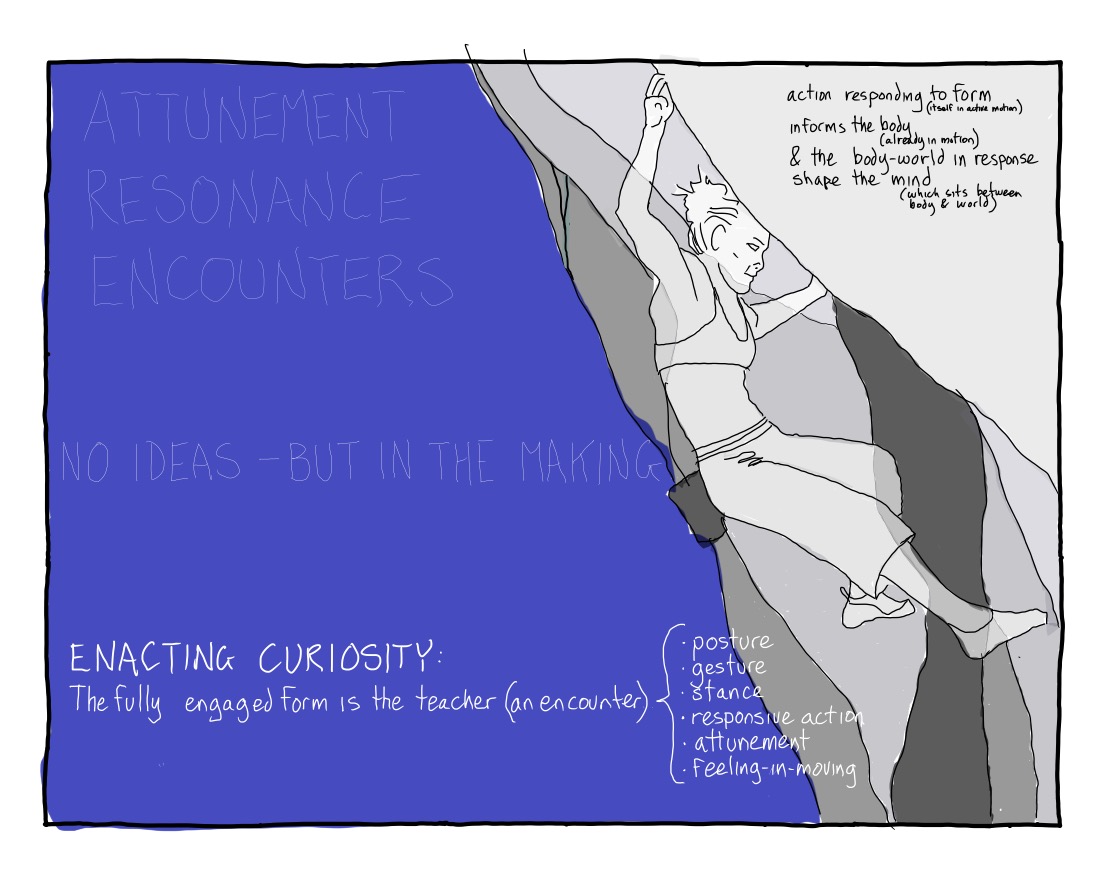
This tool, our shoe, actively mediated our embodied actions as they responded to the forms – cracks, ledges, bumps, and pockets. These forms, while being in some very general sense “always there” as a “rock face,” were brought forth into a very specific salience – relevance by having these boots. How? These boots could actively mediate between the weight of our body concentrated in our foot and a very small protuberance in the rock. And they could do this because of their stiffness and thickness. Where the flip-flop was soft and flexible, our boots are now thick and stiff. With this newly actively mediated action, our world shifted, and the rock face went from being of visual interest to being composed of distinct opportunities for a climbing action – footholds. And with the opportunities for feet also emerge handholds. This engagement of “finding” footholds (really the collaborative co-creation of stepping opportunities) then informs the body – weight is shifting in new ways, and the hips are moving the center of balance in ways that at first feels profoundly odd and deeply uncertain. Knees and ankles are bending, tensioning, sensing, and strengthening in new ways. Hands reach upward from this novel centering of gravity and tensioning of the body's core towards possible zones of grasping, pushing, and pulling. And this novel coupling of body-world shapes mental attunements. We feel-see a novel world unfolding in tune with our movements. The feeling-moving-seeing becomes an anchor: habits form.
There is an attunement – a new resonance in the ongoing encounter. The world of the visually compelling field of vertical stone surfaces of the “hiking world” with its sense of picturesque beauty now meets our body affording novel actions and in doing so it is becoming a novel set of signs pulling us as a new creative agent into a novel world-in-the-making.
The rock becomes visible in a new manner – full of Indexical signs. Pointing signs. The stiffness and roundness of the toe of our boots finds purchase only on certain sharper edges. These begin to differentiate themselves from the general perceived complexity of the rock. With these shoes in action, we come to “read” the rock as a world of edges. Edges of all kinds begin to coalesce into something distinct and meaningful and, as such, shine forth. Embodied action (us scrambling) mediated by these specific shoes in a specific environment has given rise to a new landscape of visibility. We see “affordances” – opportunities for possible action now as the thing itself.
New questions are emerging. But ultimately, we did not get that high off the ground. Discomfort, uncertainty with musculature and balance lacking, and fear ascending brought us back to the ground. Nonetheless, we scramble back down excited and transformed. We feel our body differently as the affective tone of the environment shifts. In the oddness, discomfort, and fear was also an affective tone of pleasure – something else could be felt pulling us.
As we walk home, thoughts bubble up: Perhaps “more” is possible if we change our shoes further? Perhaps a narrower toe box? a softer rubber? More laces and a tighter shoe? What then?
Not knowing there is a vast world of climbing and climbing shoes, we work on our own. We search out a lighter, stiffer shoe. We grind the sides and bottom of these shoes down, poke new lace holes, and relace our shoes as tight as we can bear. We try these around the house, standing on various little edges – the wall trim, edges on our mantle piece – all are suddenly made anew for us. The shoes “work”!
The assemblage of body, action, rock, and shoes is folding back on itself transformatively in response to the world opening agency of tools (in assemblages) to co-create new mediators. A new “loop” is being co-created in mediated and situated actions – an epicycle is forming.
Now we try again. A few days later, we find ourselves back with our new shoes at the rock face in the woods. Lacing on the shoes, we begin scrambling again.
A world that was not there before is emerging. A vertical dance emerges. Not all at once. But we are being pulled in and upwards. We return again and again. An encounter becomes an event: “climbing” which in turn becomes a practice which in turn becomes a way of life. Jobs are quit. Other relations fade into the background, and a new identity emerges. Climbing becomes its own thing – an epicycle with an agency to transform a life into being of a new world in the making. It is feeding forward to reshape a larger world: Alongside a practice, much is emerging: an identity, a language, a set of concepts, ways of feeling and intuiting – an ethos is all co-emerging and co-shaping the practice towards an autonomy.
So what of our shoes? Did they “create” this climbing world? Of course not. But, did we alone in our thoughts and dreams “create” it? Of course not. There was a long co-emergent dance. And what role(s) could we say the shoes played (and play) in this dance?
First, it is clear that they were not simply neutral, nor did they simply help us do what we wanted to do all along (the “extension” argument). We can see this in the contrast between the flipflops and the hiking boots. With the change in shoes, a small portal to a world yet to be made opened up as a possibility. Adding different shoes to the assemblage allowed for a “world-opening” potentiality to exist. What was an enjoyable world with practices of engaging with picturesque landscapes from paths to be sauntered, shifted to a vertical world…
Tools are “world-opening” and then “world-expanding” and “world-supporting” as they fade into the background of a new way of being alive. And we only catch a glimpse of this when they break, fail, or go missing. Without our winter boots and crampons, we cannot even come close to the frozen waterfall we wish to climb. The world closes and recedes from us.
We all experience this in our everyday lives. On a very icy day, our comfortable world of sidewalks disappears. In our sneakers, we can barely make it to the corner, holding onto every surface, pole, and friend for any support. Our affective state transforms from peace and belonging to loss. But add micro-spikes to shoes or salt or a snow shovels to sidewalks – and things change. The tools in the configuration of an assemblage matter – their mediation is agential.
And thus we can be excused for loving our shoes a little too much…
Have a wonderful week, with the full moon rising just before sunset – it is a good time to set off on adventures that might edge a little into the crazy as you might just have the right amount of extra light to see you home!
Keep Your Difference Alive!
Jason, Andrew, and Iain
Emergent Futures Lab
+++
P.S.: Loving this content? Desiring more? Apply to become a member of our online community → WorldMakers.


