Newsletter
Resources
Courses
Books

Welcome to Emerging Futures -- Volume 223! Gifts for Creativity’s Darkness...
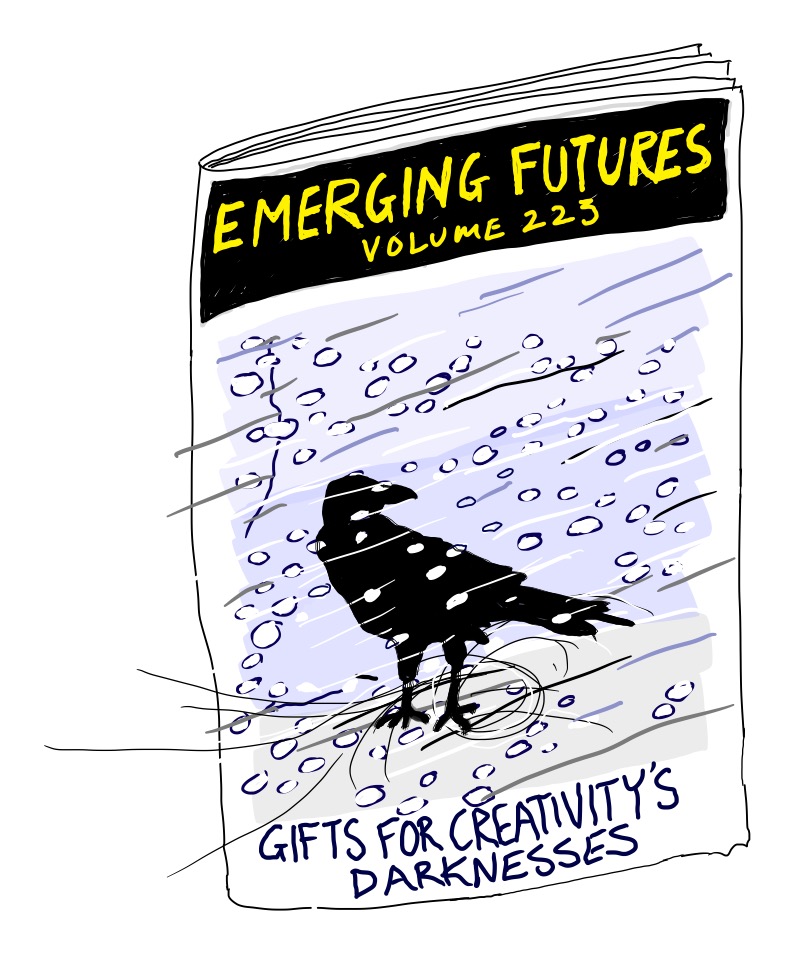
Good Morning creative place-makers and holders of the solstice. We, here in NJ, are looking forward to a snowy winter solstice. Last weekend the snow came down thick and deep. And we have been graced with freezing temperatures.
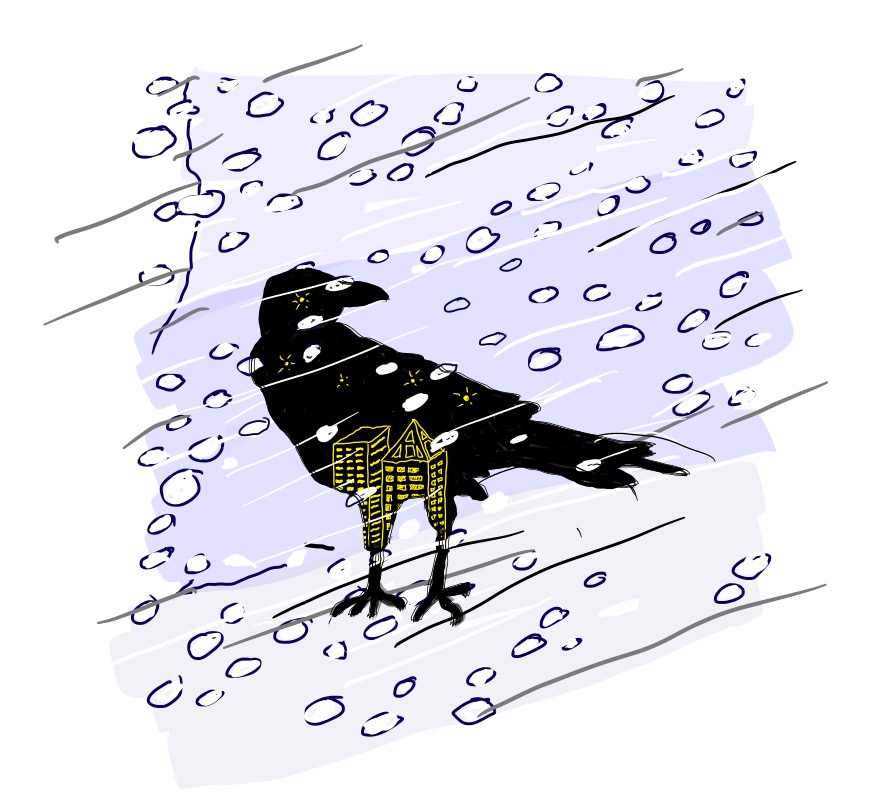
These last nights between now and Sunday are the last of the lengthening nights of this Georgian Calendar year.
Creativity’s emergent newness thrives in the darkness of the non-existing and consequent non-knowing. And thus these nights before and after the Northern Hemisphere’s Winter Solstice are moments that call for a special celebrating of the darknesses of creative becomings.
We will be celebrating these in our own ways.
Many of you are in the thick of other holiday traditions as well. The next Newsletter will come out on December 26th, which is one of the biggest holidays of the year in Canada. It is the day in which everyone can rush to the stores to return the presents they received but did not want, and then turn around and get the things they want at super discount prices.
Because of this, this week we wanted to give you a few special gifts in this newsletter (not that you can return them for anything better!).
The first is some good winter reading materials: This year, we decided that the three of us at Emergent Futures Lab: Andrew, Jason, and Iain – would each select a newsletter from our archive that they felt would be worth returning to at this moment:

Re-visiting, re-membering, re-turning are practices I cherish. I think of these small acts as forms of mapping: in the re-reading I move across a terrain of concepts, expanding some boundaries, contracting others, planting new markers, and making new meanings.
On my return to the newsletter archive, I came back-again-for-the-first-time to Newsletter 210: Creative Processes: Blocking Expansive. My summation, mini-manifesto style:
The above tasks are wonderfully counterintuitive:
The counterintuitiveness is their magic, a whisper reminding me to take the “I” out of the process, and understand, in an enacted way, that my “ideas” are not spontaneous in their creation. That I begin in a thick, sedimented mesh of habits, tools, environments, and concepts that quietly steer everything back to the already-known.
There is no such thing as a blank canvas. There is nothing neutral in how we start.
So the first task of creativity isn’t to invent a new idea; it’s to interrupt the system that keeps reproducing the old ones.
Blocking is that first move. For Deleuze & Guattari’s the (n-1) formula is a helpful guide: subtract the “One”, the things that are doing the work of overcoding: fixing identity, purpose, and meaning, and forcing all potentials to a singular convergence.
In a sense, revisiting this newsletter gave me a renewed sense of liberation. Relax. Creativity is well underway and on-going. It’s happening all around me and co-shaping my experiences. I am already in the middle.
Over the fall and winter, I have been experimenting quite a bit with “how do things show up as things?”
The stuff of everyday life: The hardness of a chair. The liquidness of water. The foamyness of an egg white. The pressure of thumbs massaging a back. How do these come into being? It can seem like a very odd question. But as we tried to make clear in the last couple of newsletters, water, for example, shows up as a liquid to beings like us because of our specific embodied engagements. And when relevant aspects of this change enough – water will show up as something qualitatively different.
How things show up as specific things involves great creative achievements that intimately involve the making of importance/relevance – in short value. Creativity for us involves experimental relevance creation and switching. Parkour – the practice of “building running” is a great example of this: what is relevant in a stairway – what shows up as a stairway is enacted – not objective.
And over the last two series of newsletters we have introduced some new concepts like the “Transjective,” and “Relevance Creation,” to help orient and activate this approach.
But all of this is really part of an “affordance” based approach to how living beings (us) actively come to have a world and make sense of this – their world. And way back – over one hundred and forty newsletters ago, we started a series on Affordances with this newsletter: Volume 88: The Enabling Constraints of Creativity
This was a series that came out of a series about why the “problem solving” approach to creativity is a deeply problematic way to frame creativity (here is our concluding argument on this). And with this Newsletter (Volume 88) we introduce a reorientation to Creativity where the concept of Affordances connects and animates what makes this a unique and distinct approach.
And so this is what I will be returning to on these wonderful long winter nights – starting with Volume 88…
After exploring our newsletter archives twice, I landed on Volume 181: The Assassins of Creativity - The Yeah Yeah Yeahs.
I suspect it has to do with my practical approach - always seeking connections between our work and everyday examples. The Yeah Yeah Yeahs felt closest to breathwork. Something we can practice anytime, everywhere.
Three reasons drove this choice:
First, because I disagree with a small but important part of the newsletter that says "the new is weak -- always too weak to make any reasonable claim."
Nothing so weak would require such deadly assassins.
Nothing so weak would draw the visceral ire of experts, managers, and gatekeepers who work to ensure things remain as they always were, protecting their positions of power and relevance. The force of their response reveals the existing order's fragility - a tower built on soft ground. The slightest deviation threatens to swallow it whole. Precisely why disproportionate force gets deployed against nascent difference.
Consider the scene in Death by Lightning at the Baltimore train station where President Garfield has just been shot. A younger surgeon arrives at the scene and immediately begins tending to the president, but Dr. Willard Bliss arrives moments later and casts him aside—taking no time to wash his hands or instruments. The younger surgeon cites new research on germs and sterilization, but Bliss brusquely dismisses him in real time, insisting on his authority while probing the wound with unsterilized fingers and instruments. Here was emergent medical knowledge—slight, vulnerable, too new to carry weight against established practice—yet powerful enough to render Bliss's entire career of Civil War battlefield experience irrelevant. To accept these new approaches would be to admit he should not be the attending physician to the president. His ego and authority mattered more than the president's life. The yeah-yeah-yeah didn't just kill an idea; it killed a president.
The new is weak only in the language of the existing. But it possesses a different kind of power: the power to make established expertise obsolete simply by offering a different way.
Second, for its practical connection - the easiest way to lean into emergence in daily life is to sense the welling up of a yeah-yeah-yeah response, whether in ourselves or others. Each time we feel that dismissive reflex, change is present. Each time we hear it from colleagues, leaders, or institutional voices, difference is trying to emerge.
This is a practice of attunement available everywhere, always, to everyone - as accessible as breathwork. When we sense that preemptive shutdown, that "I get it, let's move on," we're being offered an invitation: to assassinate the assassin by sensing and following toward whatever comes next.
To follow the deviation rather than foreclose it.
To ask "where might this lead?" rather than judge it against what already exists.
Third, because this newsletter most closely aligns with my favorite EFL saying - Keep Difference Alive.
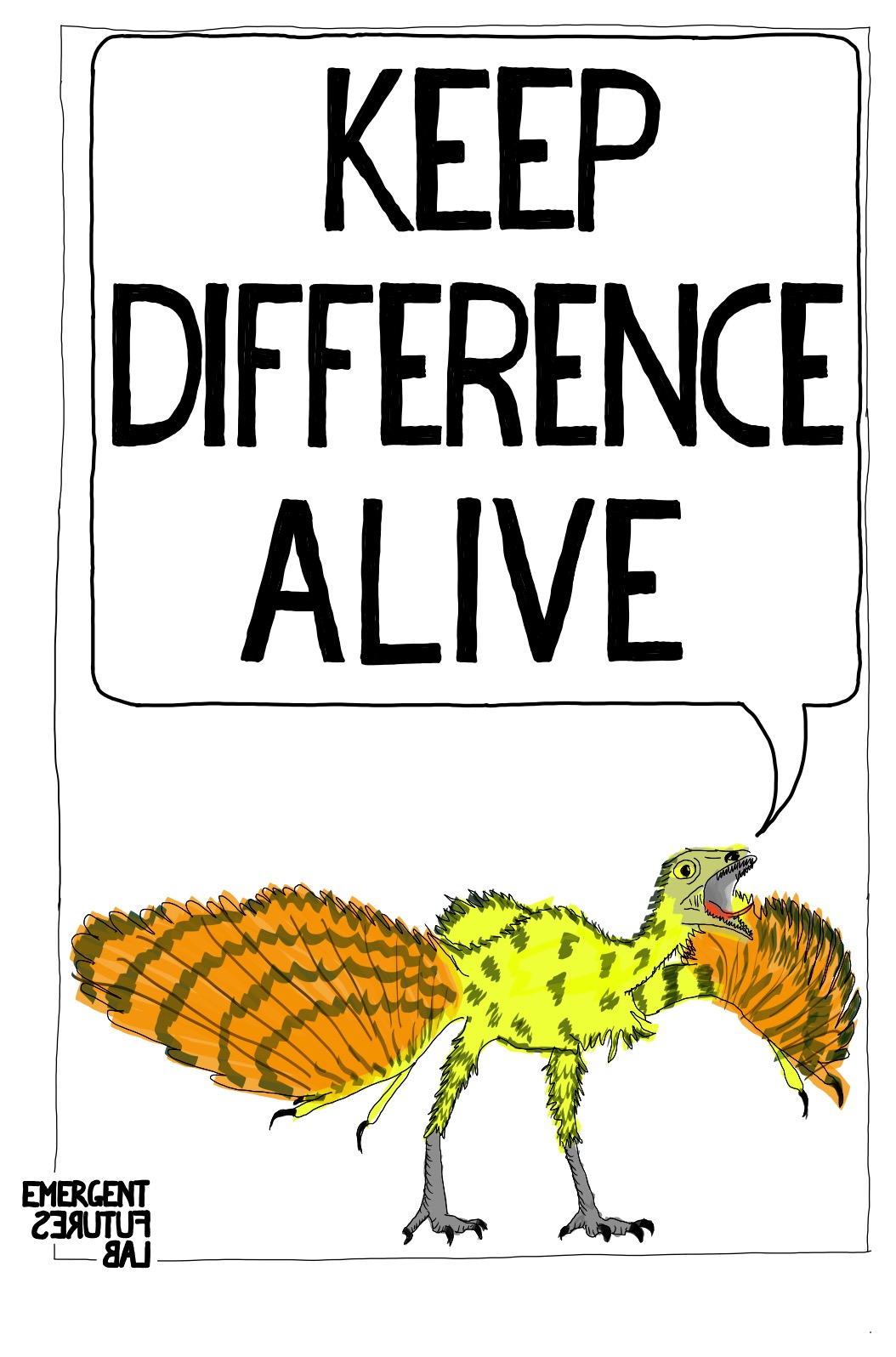
To allow the silent assassin of creativity to dominate conversations and actions is to deny difference the chance to exist, to become, to transform into a difference that makes a difference.
The new cannot announce itself in the language of the existing.
It cannot prove its worth before it has been walked into being.
The most critical step in keeping difference alive is actively sensing when the new is present, then refusing to let the practices of reasonable questions and dismissals kill it slowly and softly.
Because other worlds exist, and other worlds are possible - but only if we actively sense difference, follow its deviations, and refuse to let it be assassinated.
At the beginning of the newsletter we promised other gifts. Based on today’s newsletter we have two posters. These are high resolution PDFs of:
Both of these look great, printed large and framed. Any local print shop can make you a good quality copy – or copies. And your local frame shop – or Ikea will have a reasonably priced frame.
We wish you a wonderful time celebrating and experimenting with those dear to you during the long nights of creative darknesses.
Keep Your Difference Alive!
Jason, Andrew, and Iain
Emergent Futures Lab
+++
P.S.: Loving this content? Desiring more? Apply to become a member of our online community → WorldMakers.


