Newsletter
Resources
Courses
Books

Welcome to Emerging Futures -- Volume 230! An Experimental Process Found in the Archives...
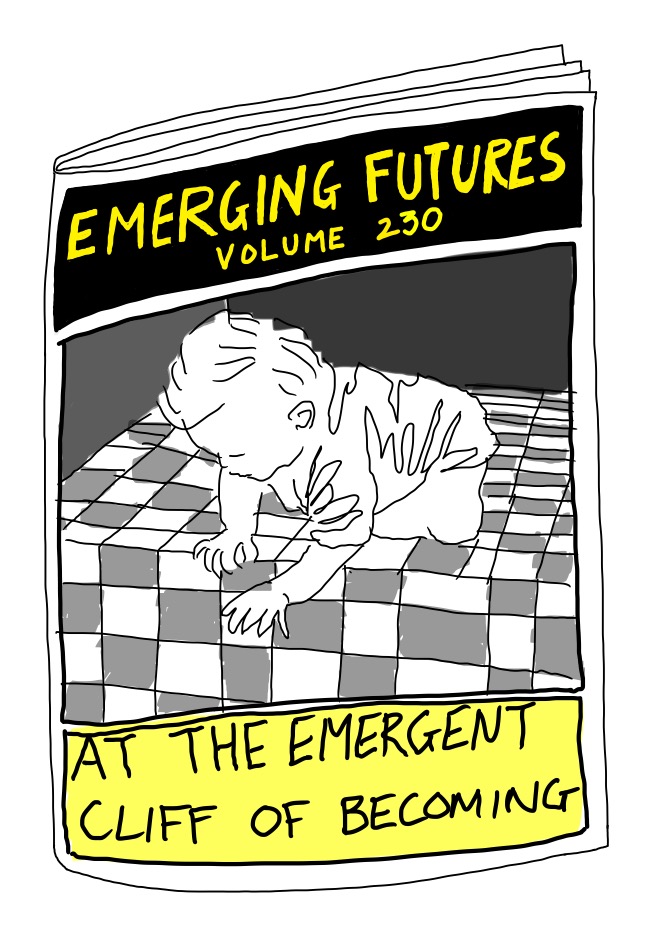
Goodmorning multi-scalar experiments in attunement to novel emergences,
Last week in the newsletter, we explored how the outcomes of creative experiments are most often something that is not immediately understood. But this is – as we stated last week – a profound understatement…
Let’s back up for a moment and reset the stage:
It’s 1906-1907, and Picasso, a Spanish artist who is modestly well known for the making of interesting but relatively conventional post-impressionistic paintings, makes over two hundred sketches which explore the many directions that a painting of a group of nude women might go. He then begins a painting, Les Demoiselles d’Avignon, that changes considerably during the process – at various moments there are two male figures which subsequently disappear, then a man contemplating a skull emerges and later becomes a sitting woman with no skull to contemplate, the number and posture of the women change, african masks come in and change at differing points, parts move around, forms change, spatial planes and continuities are formed and rupture – and then are moved around again – nothing is quite certain – even after it was finished it is changed.
Upon completion, Picasso showed it to fellow artists in his studio – there was a near universal strong negative judgement: disgusting, horrible, pointless – and perhaps most cutting – Matisse considered it a childish self-satire. After which, Picasso basically rolls it u,p and it is rarely seen for the next thirty years. But by the early fifties, it was considered one of the most transformative, pivotal, and groundbreaking works.
While the real importance of this work is certainly up for debate. The question we were exploring in the last newsletter was a different one: Who knew the radical meaning and potential of the work at the time it was made?
Clearly, most of his fellow painters and colleagues did not – after all, they thought it to be simply terrible. In our reading of the art historical literature on this painting, it was only the artist, Picasso, who is given credit for knowing what it meant. But we should take this with a massive grain of salt. This conclusion relies on reports by Picasso and others from thirty or more years later. That alone should give us pause. Of course, with the hindsight of exactly what has come to pass, we all would recognize its importance – and as the maker we would tend to ascribe our knowing to the moment of origin.
But, the important question in relation to experiments that are intended to be radically creative is:
Did the maker – in this case Picasso, really “Know” in the moment what it meant? Did he, upon creating it, think:“This is the beginnings of a new approach to art that one day we will all call 'Cubism’”.
Can the makers of the early experiments that are pivotal in the emergence of the qualitatively new “know” what they are doing?
The more we have dug into this work, and other similar experiments that participate in radical qualitative changes (from the creation of the iPhone to the invention of steam power to revolutions in the arts), the more we have come to see that no one knew what they meant in the moment – including the makers.
If the question is: did the makers know what their work would come to do and mean when they made them? The answer is unambigiously: no.
And this has very important consequences for how we approach creative experimentation – much of the experimental creative work is still ahead of us when such an early experiment (such as the first iPhone, internet system, or painting like Les Demoiselles d’Avignon) comes to an end.
Les Demoiselles d’Avignon is not the revolution, nor is it the first iPhone, nor is it the first internet network. These are, on their own, in the moment – at most odd things that point vaguely in many directions – some of which are potentially quite novel. But most of the creative work is still to be done.
The thing is, we have a reasonable sense of what these early experiments might entail – these stories have been told – but what exactly comes next is rarely considered. Why? Because there is a false belief that there is little more to be done other than to champion the new (which is thought to be somehow clear and obvious to some, even though it does not exist).
But nothing could be further from the truth. Here, it is worth reading the letters, journals, and collected notes of those involved in these experiments. Pick a group of artists, scientists, or a design team involved in an important qualitative innovation and read their letters, notes, etc. You will get a very clear picture of the uncertainty, the vagueness of what is happening, the not knowing. Why? Because these are written in the moment, they are most definitely not retrospective.
Note: Out of interest in going further into this question, we re-read The Letters of Samuel Beckett (Volume One: 1929-1940) this week. It is hundreds of letters of hesitancy, probing, admitting loss, vagueness, frustrations, rejections, uncertainties, wanderings, and further open experiments. Nowhere is there any sense of knowing what any of this should mean or lead to.
In over six hundred pages of letters, there is, for most critics, only one (maybe two) sentences that vaguely point towards his future work – here is the first from 1937: “To drill one hole after another into it [language] until that which lurks behind, be it something or nothing, starts seeing through…” And for this reason alone – well worth reading.
Now that a creative experiment has put us in a place of “not knowing what might happen next” – and “not knowing what it might mean, nor whether the experiment is working whatsoever” – the hard work of creativity begins.
But – What is this “hard work”?
The early German Phenomenologist Martin Heidegger makes this claim: “To be a work means: to set up a world.” Les Demoiselles d’Avignon – might become such a work. The first iPhone might become such a work, but this is always a radically open question. And this is ultimately the creative project that experiments that verge on qualitative transformations are potentially moving towards.
To become a radically creative work is to enter into a journey towards the potential of emergent novel worldmaking. The tricky part is that no one knows if or how they are on this journey, as it is entirely an emergent journey. The knowledge and certainty are only ever retrospective.
The question is: is it all up to chance? Can we do something to put a thumb on the scales of possibility to tip it a bit in our favor?
Over the last few decades, we at Emergent Futures Lab have worked with this question in very diverse contexts across the spaces of art, design, social, and environmental change-making. And during our engagements with these processes, we have found ourselves countless times in various creative review sessions. Contexts that might have similarities to that of Picasso showing his work to colleagues… Where we are all being asked to evaluate the potential novelty of something – be it art, a product, an event, or a process.
The one lesson we have learnt from being in these contexts – no one knows what the new means – full stop (and this most definitely includes us!). Not because none of us are smart enough – but simply because we are at the most, as Kafka would say – “at the first door” of something that has yet to be brought creatively into existence.
At this point, criticism and evaluation will not help. And believe me when we say – we have seen everything – and all well intended – there is the:
And obviously, all of this advice is true – and useful if the goal was variation or improvement.
But – in this context of pushing towards the qualitatively new – it is simply profoundly beside the point. Then all of these forms of advice will pull us back into the various orbits of the known, the established, and the familiar.
What we are looking for in this moment is something very different – it is anything that might help to co-create a way to make a novel approach – a novel world. And this criticism is not helpful.
At the end of last week's newsletter, we concluded with a seventeen-point “Incomplete Propositions for Creative Experiments.” Let remind ourselves of a few of these:
Creative Experiments:
Early in the week, I (Iain) was having a coffee with a dear friend and old design colleague, discussing these propositions. In talking, our conversation focused on these nine, which to us seemed most salient for the processes that might move experiments towards the qualitatively new.
And in talking through this question and these practices, processes, and propositions, my colleague brought up that we had developed a process to facilitate novel emergences well over a decade ago.
This week, we want to share this process with you. It was a process that we used in various workshops for businesses, artists, and community groups. In each case, we altered the process to best suit the context. In some cases, these were quite radical alterations, and sometimes the process followed pretty closely to what is listed below.
We share this process not as an example of “the right process” to generate qualitative novelty. Far from it. Rather, it is something that points towards an approach that you might hack, mutate, pull sideways, and radically remake for your own contexts.
The next thing to note is that there is a lot here – a lot to read through, a lot to prepare – and if you take it on, a lot to do. Don’t let this dissuade you – to get something new to happen does take careful preparation (and still, thankfully, there is no certainty). If “god is in the details,” – so too is the creative process. And it does take work. Remember, as Sister Corita Kent said: “work comes from work.” Finally, try to get the details right (considering carefully your unique context).
One, often such a process is easier to try out in a context where little is at stake. It takes time to get good at these things. Practice really helps: workshop things...
Second, this version comes from a workshop we did for doctoral students in the arts, and so it reflects this context to some degree…
“To be a work means: to set up a world” (M. Heidegger)
Something novel has been developed experimentally. What can it do that is novel? Where, that is new, could it go? Can it co-create a qualitatively novel approach?
We gather, interested not in critique but in opening up experimental pathways towards the qualitatively new – “to set up new worlds”...
Set aside the appropriate space and time for people to genuinely engage in a free and open manner with what has been developed in advance of gathering.
The space for this event should be generous, supportive, and free of external distractions. Have a large whiteboard or some similar tool, comfortable chairs, good light, etc.
Set aside most of a day for the process with time for appropriate breaks and convivial meals. We would recommend beginning with an evening meal the day before the process.
Then a program of research-in-making needs to be developed. Answer each of these questions in detail:
The answers to the above six questions are going to be the basis of the next experiments. You are being asked to develop and evolve your practice by being deeply engaged in all parts of it. This will require intensive research. This is all part of making, it is not separate from it. This will lead to a radically new remaking of the piece in new experimental contexts.
Well – it’s a lot! But our hope is that there is something here that can catalyze your own development of practices that come after the first creative experiments – that continue them into the co-creation of novel worlds.
With the waning moon now high in its journey across the night sky, as Thursday becomes Friday, we leave you for the week. Please reach out to us with thoughts and transformations to our approach – as well as your own approaches.
Till next week,
Keep Your Difference Alive!
Jason, Andrew, and Iain
Emergent Futures Lab
+++
P.S. This newsletter continues in our community—where you can comment, question, and explore further. Emerging Futures + brings you into the conversation. Join here
P.P.S. WorldMakers goes beyond the newsletter: 40 live events annually, weekly podcasts and exercises, our annotated bibliography, and practitioners across diverse fields reimagining creativity together. Discover WorldMakers
Two questions, every Friday since 2020:
What is creativity? and How do you innovate?
A weekly experiment in emergence, creativity, and change-making.


