Newsletter
Resources
Courses
Books

Welcome to Emerging Futures -- Volume 229! Towards a Manifesto for Creative Experimentation...
Good Morning anomalous efflorescent new becomings,
Here it’s cold, and there is quite a lot of snow blanketing everything. Most mornings, it is producing a really fascinating blankness – an indiscernibility to what is perceived. A grey zone of interesting anomalous vagueness – about which, from in the midst of the experience, little specific can be said.
Whitehead remarks on the importance of such a vagueness in his final lectures on “Creative Impulse” (1938): “…there is a large, vague characterization indicative of some form of excitement arising from the particular fact in the world without. This vagueness is the despair of cultivated people”. But it is not the despair of the curious.
Elsewhere, he calls this “concern” – a feeling for emergent relevance of things “divested…” as he says “of any suggestion of knowledge”. With curiosity, perhaps all there is , is the slightest of pulls – and the least noticeable of head turns, a type of “dumb” (uncultivated) “Hunh… that is odd…?”
In the anomalous vagueness of the emerging new, not much can be said in the moment. It is more a bodily reaction – the turn, pivot, pause, minor stumble in the flow of an action. But it is in this vague near blankness that slips into action outside of knowledge– that is, in a very real sense, everywhere in experience. It is everywhere we can become actively engaged with efflorescence of the new that does not yet exist but is ever coming into new becomings.
In the bodily tug of a vague curiosity, we are affirming that difference and that the new can and will have a life beyond the known, knowable, and already existent.
But, in the moment, there is never much to go on…
On Manifestos
Over the last few weeks, while immersed in this winter world, we have been exploring Manifestos and how they can be used in the extended ecosystem of creative practices, so as to affirmatively draw us through the vagueness into an experimental practice.
We started a month ago, in early January, in Volume 226, introducing an approach to creativity manifestos. We considered differing types of manifestos (the orienting, the internal, and the public), how they connect to practices and rituals, and we experimented with a few of our favorite examples of each (from Yvonne Rainer, Sister Corita Kent, and others).
Then, two weeks ago, we presented our own provisional manifesto: An Orienting Manifesto For A New Creativity. This tentative foray into producing a creativity manifesto was intended to be very broad in scope, and had fourteen propositions, the seventh of which was:
The groundbreaking writer of speculative fiction, Ursula Le Guin, said that “the only thing that makes life possible, is the permanent intolerable uncertainty: not knowing what comes next.”
In our complex reality, the only thing that is certain is that what will happen will exceed what we expect in totally unexpected ways. We cannot predict what will happen next – not because we lack the skills, but because the future does not yet exist – it is open, contingent, and surprising in how it actively comes into being.
We need to embrace and work with the reality that the encounter with the emerging and always surprising future will make us otherwise.
To “leave space for the unexpected” is then both critical to engaging with creative processes and being at home in the universe.
But the “leaving space for the unexpected” requires an active and experimental practice of refusal. We need to block the existing and the known at an ecosystemic level. It is only then that the new can move us experimentally elsewhere (see above).
To recognize that the universe exceeds prediction is to embrace that agency is not something that we uniquely possess. Our intentions alone do not determine what happens – we are always in an open collaboration with materials, processes, and environments that collectively have an agency that exceeds us.
This is not a bad thing if we are concerned for the new and different. The experimental composer John Cage famously said, “It is only an experiment if we do not know the outcome…”
The question is, how can we welcome what comes next?
A creative experiment is also very different from testing a hyphosis – to do this is much further along in the process…
For creativity begins in surprise: “I thought I had reached port, but found myself thrown back out to sea,” Gottfried Leibniz
And it was this proposition – and ultimately its quoting of John Cage,
“It is only an experiment if we do not know the outcome”
– that led to a very interesting online discussion in the WorldMakers community about “what exactly is a creative experiment?”
Obviously, there is a wide variety of experiments. But, what we have seen is that for many in organizations working on creative endeavors, an experiment is most often understood as a test rather than something very open-ended. The online discussions around this perception led us into a very interesting historical direction to investigate the roles and many meanings of “experimentation” in creative practices – and how we came to broadly understand an experiment as a test. All of which led to last week’s Newsletter 228 and us puzzling over the tension between the two main ways that the statement, “It’s not an experiment unless you do not know the outcome” is understood:
What is this potentially qualitatively new that does not currently exist? It is the anomalous. It is not a variation of what exists, nor is it in opposition to what exists – rather, it is totally and wholly other than what exists. It is “without category”.
Now, while the hypothesis testing logic of experimentation (experimentation as test) leads to very clear and linear methods – the approach of experimentation for novel emergence because of its situational, contingent, and emergent logic – it does not lend itself to any clear linear methodology.
And this brings us back to where we started this newsletter: with the blankness of this winter weather – really the question of the place of the vague in experiments (and manifestos). Perhaps the greatest challenge of pragmatically incorporating such an approach to creativity and experimentation into organizational contexts (of any kind) – is that both outcomes and the way to get to outcomes are unknowable as we begin. And not simply unknowable in the sense of a test – we are unsure qualitatively of what might emerge (not simply if a test will succeed or fail (both of which are quantitatively definable)). The new might be radically anomalous. How does one plan for this? How does one organize around this? How do we make key managerial figures in the ecosystem truly aware and in resonance with this?
We have written about the importance of ecosystemic preparations for these forms of experimentation in Newsletter 218 (as well as across the entire series on Engage – Volumes 216 to 221). Here, in this newsletter, it is not the place to rehearse what has been covered in previous newsletters. But, as this series is about the use of manifestos in creative practices, it is important to stress that there is a real use and need for a manifesto to help orient experiments for novel emergence.
Here, a manifesto that focuses explicitly on the idiosyncratic logic of such creative experimentation can help frame and orient participants to the unique particularities of experiments that are co-creative probes (let’s call these “Creative Experiments” to easily distinguish them from “Testing Experiments”).
This became especially clear to us in the WorldMakers discussions following last week’s newsletter. There were two key aspects to this:
These two aspects of creative experiments – not knowing where to begin and not being certain when it is working – are direct outcomes of the vague and anomalous logic of the qualitatively new. And they make for a very challenging entry point into creative experiments.
What does it look like in practice to (1) begin anywhere and (2) not know when the experiment is working – and still get somewhere qualitatively creative?
Ian Hacking, being a philosopher and historian of the sciences, offers the example of William Herschel, “an adroit and insatiable searcher of the midnight sky” (1738-1822).
Herschel, while studying the sun via telescopes, became curious about the seeming difference between heat and light: He was using differing colored filters to observe the sun. In some cases, with these filters, there was quite a bit of heat and little to no light. Something odd was happening – heat and light seemed not to be directly connected.
Now, in retrospect, we say that he discovered radiant heat and the spectrum of light beyond the visible – but that is not what he sensed or understood in the moment.
Here is how Hacking reports it, “At this stage… we have a large number of observations… He certainly has an experimental idea, but only one of a nebulous sort… Herschel was probing phenomena. He made many claims to accuracy which we now think to be misplaced…”
After various experiments, he senses that heat cannot be the same as light. This led to him abandoning “his original hypothesis, and not knowing quite what to think. Thus by the end of 1800, after 200 experiments and four major publications, he gave up…”
Others also had a similar area of interest, and there was an emerging weave of experiments where numerous others picked things up, there were many sideways moves, and variations of experiments. A wave theory of light develops. Radiant heat is understood, and the spectrum of light is extended far beyond the visible. And Hershel is now credited with many important discoveries in the process. But as Hacking notes in the moment, “Herschel had more primitive experimental problems. What was he observing?”
It is only in retrospect that we can answer this question with any certainty. But how does this help us during an experiment?
Nonetheless, Herschel begins: something odd perturbates his curiosity – a vague concern emerges divested of any suggestion of knowledge that draws him sideways. But for years, his probes – over 200 of them did not lead him to know what he was observing – what phenomenon he was co-creating (in Hacking’s terms). Yet because of this, today we can do many more things…
And this is the problem of doing a creative experiment that we will only understand if we try for a moment not to look from our highly unique and privileged retrospective perspective: We cannot know in the moment what exactly it is we are doing and what is working…
Let’s consider another example, when one goes to the Museum of Modern Art in New York – the painting that has the greatest pride of place and is considered the pivot point near the genesis of “modern art” – is Pablo Picasso’s Les Demoiselles d’Avignon (1907):
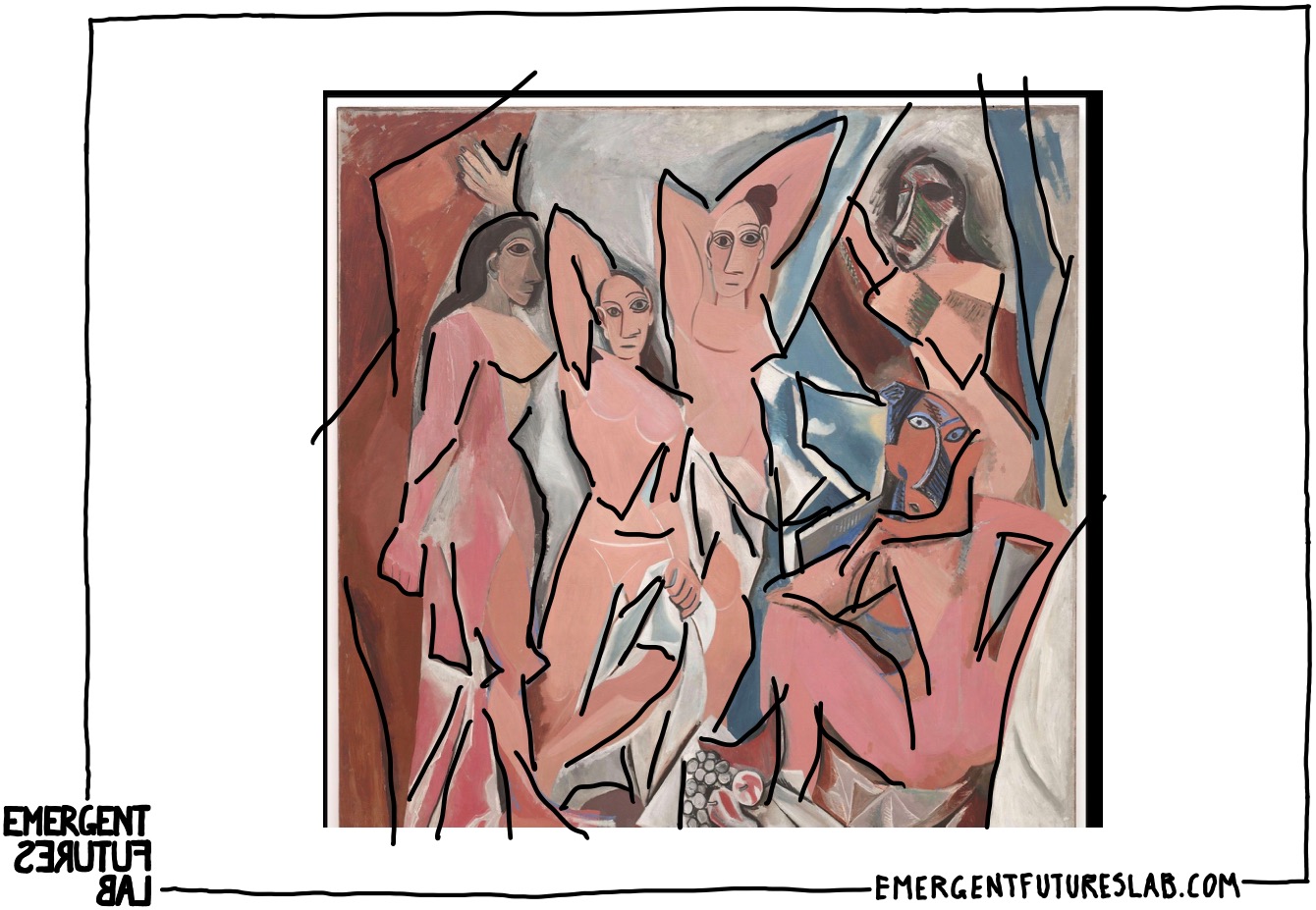
Now, countless western art historians look back on this painting and see clearly the genesis of much of what followed (we won’t get into all the problems with such an overly individualized perspective on creative change in the arts). They perceive and understand the phenomena of the radical juxtapositions of incompossible views, spaces, and styles as important and transformative. These moves in this painting are considered to be the direct harbingers of Cubism (1912-1919) and much else – pretty much all of modern art.
BUT – how was this painting and this moment understood in the moment and not in retrospect?
If we go back to 1906-1907 in working on this painting, Picasso makes over two hundred sketches which explore many directions, of which many do not end up in the painting process (this could have been many other quite different paintings or nothing). And when the painting is underway it changes considerably during the process – at various moments in the process there are two male figures, then a man contemplating a skull who later becomes a women, the number and posture of the women change, african masks come in and change at differing points, parts move around, forms change – nothing is quite certain – even after it was finished it changed.
Picasso first showed it to fellow artists in 1907 in his studio – there was a near universal non-positive judgement of various kinds – most very strong – disgusting, horrible, pointless – Matisse even imagined that it must have been a hoax or some kind of joke. One could get the sense that Picasso was in a situation where all known avenues were blocked – he was faced with the same conundrum as Herschel – what of relevance was he observing?
Deleuze says, “A creator’s someone who creates their own impossibilities, and thereby creates possibilities”. But what are these? Which are relevant?
After 1907, Picasso rolled it up, and it was rarely even seen until about thirty years later: It was reproduced in 1910, shown once briefly in 1916, reproduced in a surrealist monograph in 1925, it was sold sight unseen to a collector in the 1930’s, and shown again after their death in 1937. At which point it was bought by MoMA. To a large degree, it became what it is now retroactively. The parallels to Herschel are by no means exact – but they are close enough to be compelling…
Now we can retrospectively cast and project backwards our current sense of importance into this dynamic unfolding set of experiments. But this contemporary importance – relevance – was not there in the experiments of its making. It was experiment by experiment in a vast evolving ecosystem of experiments that gave rise to the emergence of an aesthetic way of being alive, where this work came to matter in the way it does. It is an illusion and misunderstanding of the creative processes to see it as a direct progenitor of anything. That is not how creative emergence or creative experimentation works. “History isn’t experimentation, it’s only the set of conditions, negative conditions almost, that make it possible to experience, experiment with, something beyond history” (Gilles Deleuze).
What is the creative experiment in the moment?
And, in the moment, where does it go next?
There is no one way to answer this in the middle of the creative process. It is, in the case of Picasso’s painting – like many other paintings by many other artists in this moment – a probe that, as Hacking puts it, “creates, produces, refines, and stabilizes phenomena…” and in doing so must always also pose an open question: what matters – what is important? – What is “working”?
The only answer is the next experiment – the path is made in walking something anomalous, profoundly vague, and highly contingent into being. And if paths had emerged in other directions (that in retrospect became equally important and transformative) – leading to totally qualitatively distinct modes of “art” – this work would never have become important.
These two examples – that of Herschel and Picasso are thought experiments that are not presented to adjudicate the value or importance of these experiments. Rather our interest is in understanding the lived experience – the realities of participating in creative experiments.
What is the experience of beginning? How does it develop into anything? That joyfully for some – and frustratingly for others – is, as Deleuze so succinctly puts it – is “beyond history.”
Our experiments will feel like a lot of semi-focused (at best) probing and puttering in an area of concern. But we need to make space organizationally for this activity. And we need to articulate the importance, relevance, and beauty of such experimental practices. They are not the only thing that needs to be done – far from it – but the new does require it…
Let’s pause for the week at this point. Here is our provisional and incomplete set of propositions (how would you develop these?):
Creative Experiments:
Have a wonderful week developing experiments, probes, and alternative manifestos from the inner edge of the glorious fog bank of the becomings of the new.
– But, you might ask, “before you end – what about the question you asked last week? Is there an alternative way to phrase the proposition: “It is only an experiment if we do not know the outcome?”
How about:
“It’s only a creative experiment if the novel outcome is entirely yet to be co-created”?
Keep Your Difference Alive!
Jason, Andrew, and Iain
Emergent Futures Lab
+++
P.S.: Wish you could comment and engage directly with these ideas? A Newsletter + subscription brings you into the conversation—add your voice here.
P.P.S.: Want to go further? WorldMakers brings you weekly exercises, live events, our evolving bibliography, our live event archive, and a community exploring these ideas together. Join us here.


