Newsletter
Resources
Courses
Books

Welcome to Emerging Futures -- Volume 234! Creativity and Other Worlds...

Good Morning becomings negotiating across multiple scales of complexity,
Every week in these trying times can feel like a profound challenge. There is no escaping this – but other worlds are possible.
And it is in this context that we begin the second week of our series on worldmaking. For us, it is a critical, ethical, and creative aspect of how we live our lives in these very challenging times.
Last week, we stressed two things as we introduced this series:
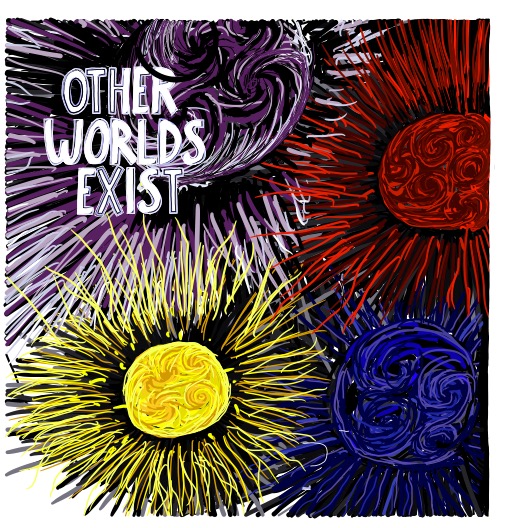
And it is this second proposition that we will experiment with this week.
While there is one reality – one environment of physical stuff on this planet – rocks, rivers, atmospheres, and the myriad living things – there are many worlds.
One Environment and Many Worlds… It is a statement with wide-ranging ramifications for how we approach life and creativity. But it is also a statement that is ripe for radical misunderstandings!
And this week, we want to start with what we feel is one of the biggest errors one could make in understanding this statement. Our hope is that in beginning with a critique, the contrast will be illuminating of what it means “for many worlds to exist.”
The seeming dichotomy between Environment and Worlds might feel like it immediately makes sense because it is quite similar to the far more familiar dichotomy – that of the Subjective and the Objective. But nothing could be further from the truth – having a world is nothing like having a subjective experience.
Let’s start by explicating what is meant by “subjective” and “objective” and how this plays out in a nearly ubiquitous Western approach to reality:
The basic logic of the subjective-objective approach to reality is to consider that there is one objective reality, but there are many distinct subjective takes on this unchanging reality. There are two very common ways this plays out – an individual way and a collective way:
ONE: Individuals:
The first form of this is a personal and individual one: While there is one stable, fixed, and unchanging reality, there are many unique personal and changing subjective views on this reality:

TWO: Groups:
The second form of this logic is about Groups: Here, the same logic functions in regard to how we view groups and cultures as individuals. While there is one stable, fixed, and unchanging reality, there are many unique group-based subjective views on this reality:
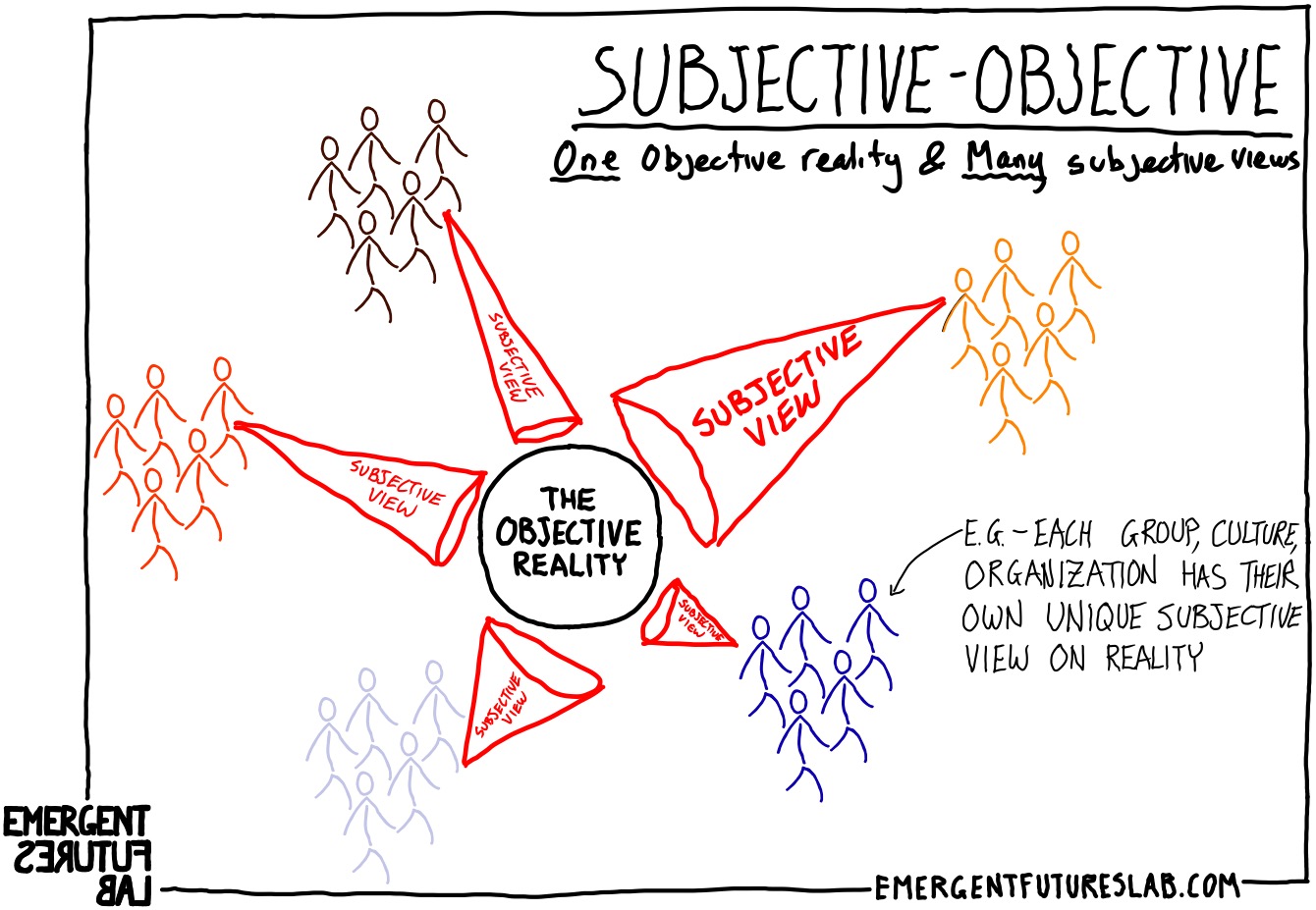
In both these cases, whether it is with individuals or groups and their subjective perspectives, there is a clear divide between a reality that is fixed, objective, deep-down unchanging, and “out-there” – versus an internal, mental, shifting, unique subjective perspective on this reality.
Two Models:
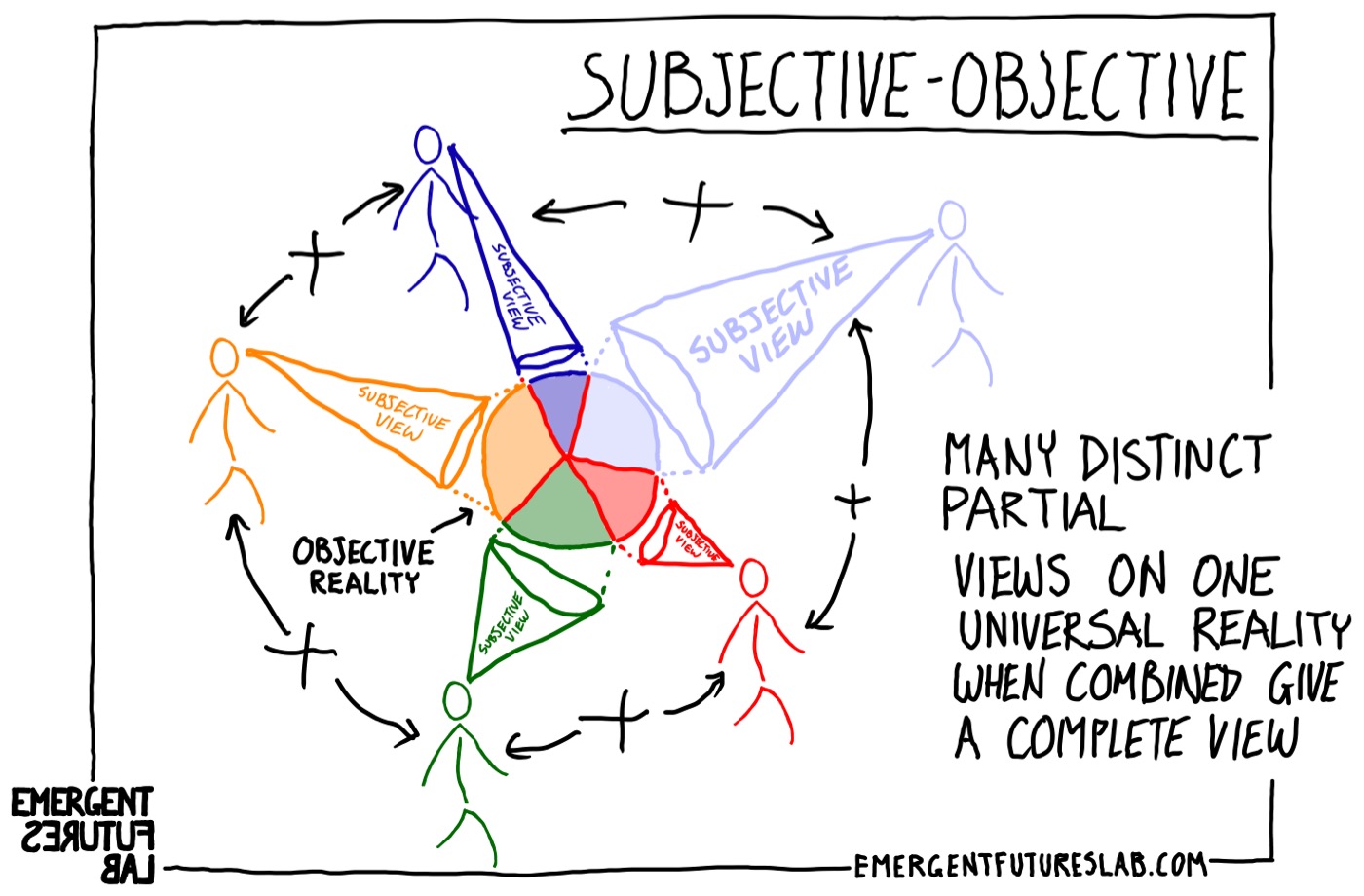
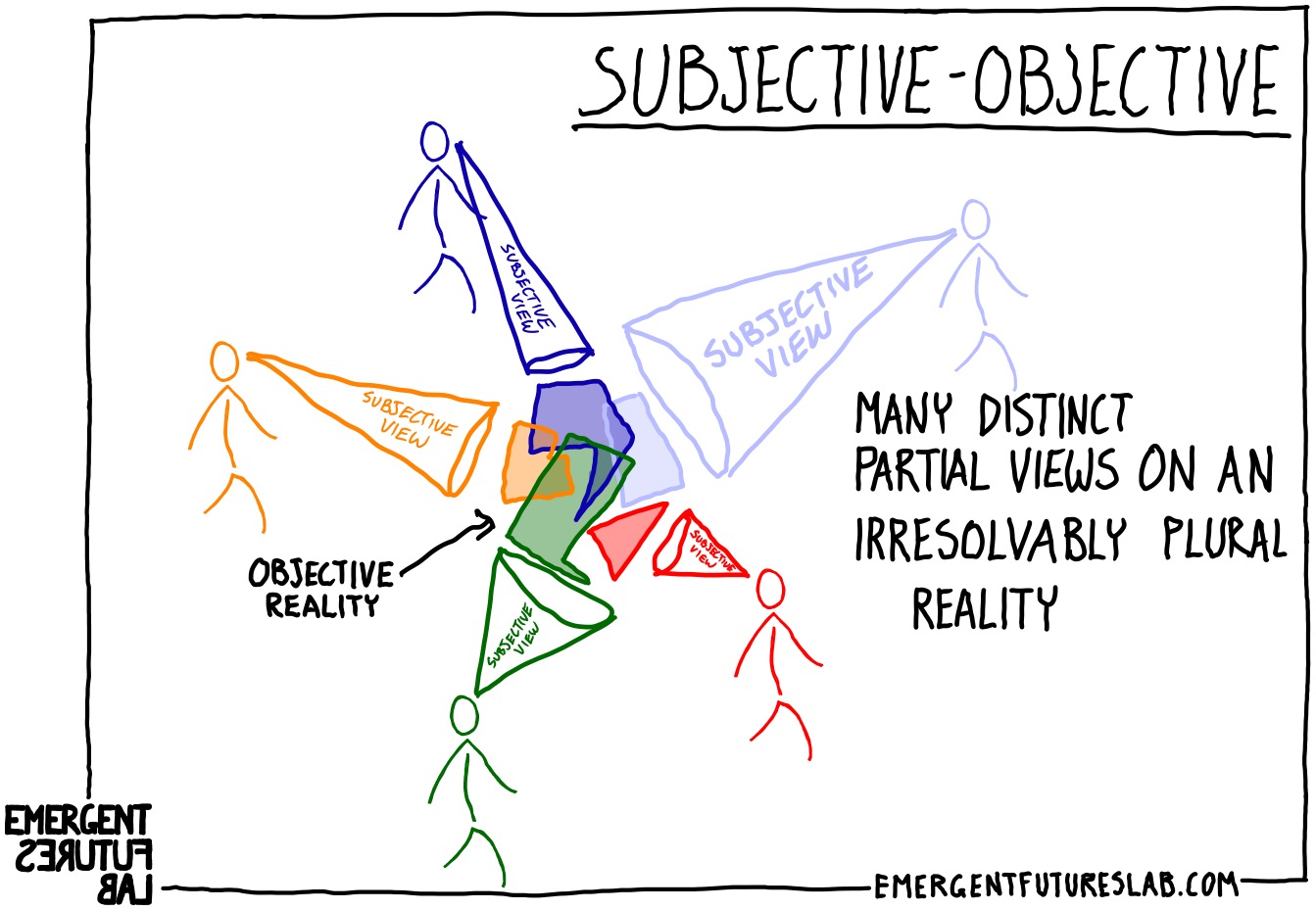
The next thing to point out with this “many subjective perspectives on one objective reality” model is that it also contains two competing models of reality: the resolvable and the irresolvable.
The “resolvable” form is that of the parable of the many blind persons touching a very large elephant: while they all have very differing subjective experiences, they can be resolved into one reasonably accurate description of the whole, e.g., if we put all of the partial and subjective views together, we will get one synthetic, holistic, and complete view of reality:
The second version of this is where objective reality is itself multiple and not cohesive, such that the various subjective views can never add up to a singular whole:
There is one last critical variation of this problematic subjective-objective approach to reality – and that is the universalistic view: one view on reality is broad enough, rich enough, and deep enough that it encompasses and subsumes all others in how accurately it corresponds to an objective reality. This is obviously far more an assertion than anything approaching a truth:
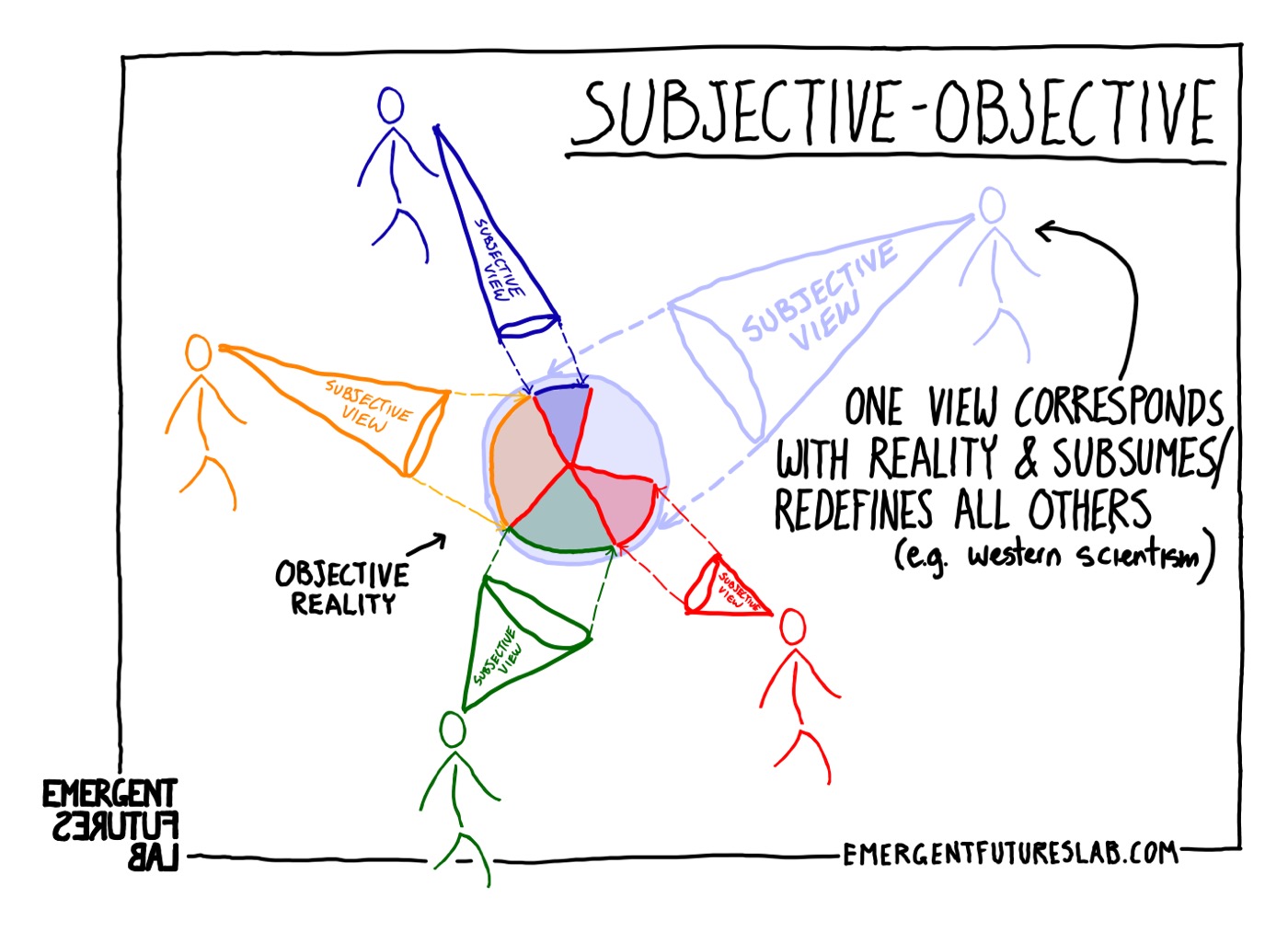
This often plays out in western scientific approaches that act to “explain away” other approaches as mere superstition, primitive beliefs, or useful fictions that had a value but only before we had a real and true understanding of reality…
But none of this is anywhere near what we mean when we say: One Environment and Many Worlds – or simply that “many worlds exist.”
We understand that this can be quite confusing – we, too, labored under such a misguided view for many years. Why this approach to reality is profoundly wrong takes a slow explanation and a careful unpacking of examples. In fact, we find the best way towards an alternative approach is by diving deep into case studies and examples:
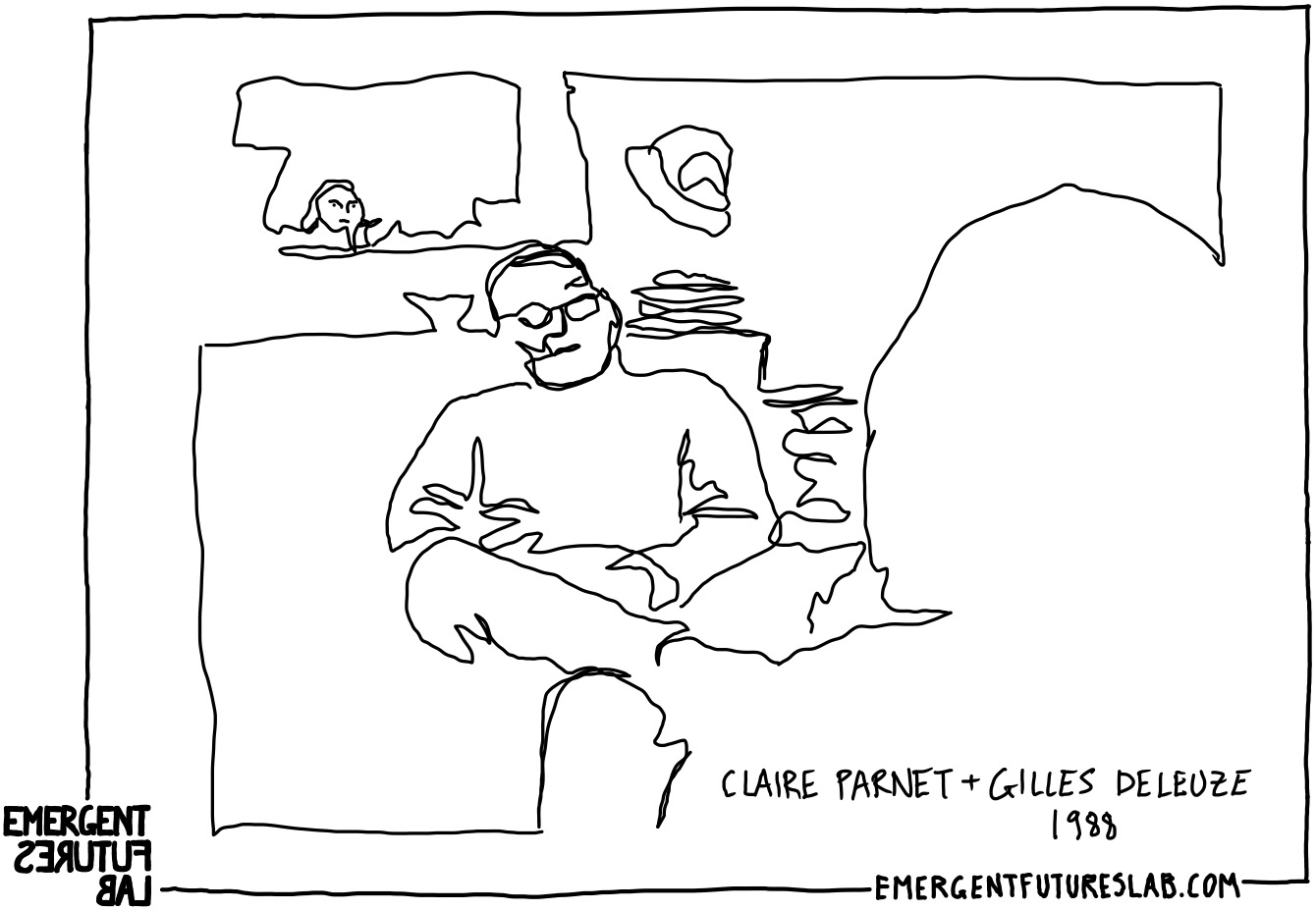
Last week, we introduced the example of the “world” of Ticks as introduced by Gilles Deleuze in a wonderful and moving interview with Claire Parnet recorded in 1988, near the end of his life, and initially intended to be broadcast posthumously.
The format of these interviews is the Alphabet, with Claire Parnet choosing a word to go with each letter. And so they begin with “A, as in ‘Animals’” and progress eventually eight hours later to “Zed of the zig-zag”. Our segment on Ticks was from the very first section, “A as in Animal”:
“… And you asked me also … Well, other animals, it’s true that I am fascinated by animals (bêtes) like spiders, ticks, fleas … They are as important as dogs and cats…. If I try to take stock vaguely of this, what is it that impresses me in an animal? The first thing that impresses me is the fact that every animal has a world… What is an animal world? It’s sometimes extraordinarily limited, and that’s what moves me…”
Deleuze then goes on to describe the life of a tick and what it responds to:
For example… the tick responds, reacts to three things: …it tends toward the extremity of a tree branch, it’s attracted by light… It waits for… an animal to pass under its branch, it lets itself fall… The tick smells, it smells the animal that passes under its branch… Then, when it falls onto the back of the poor animal, it goes looking for the region that is the least covered with hair… So, there’s a tactile stimulus… For everything else, if one can say this, for everything else, it does not give a damn… it extracts, selects three things…That’s what constitutes a world…”
While Deleuze does an exceptional job at synthesizing how a tick actively and selectively entangles with its environment to collaboratively produce a world, it is worth adding a few more details to this picture.
Ticks are a small type of mite that actively makes a home in many of the same environments as we do – grassy areas and forest edges, for example. But their activity and the lived actuality of their experience are radically qualitatively different from ours.
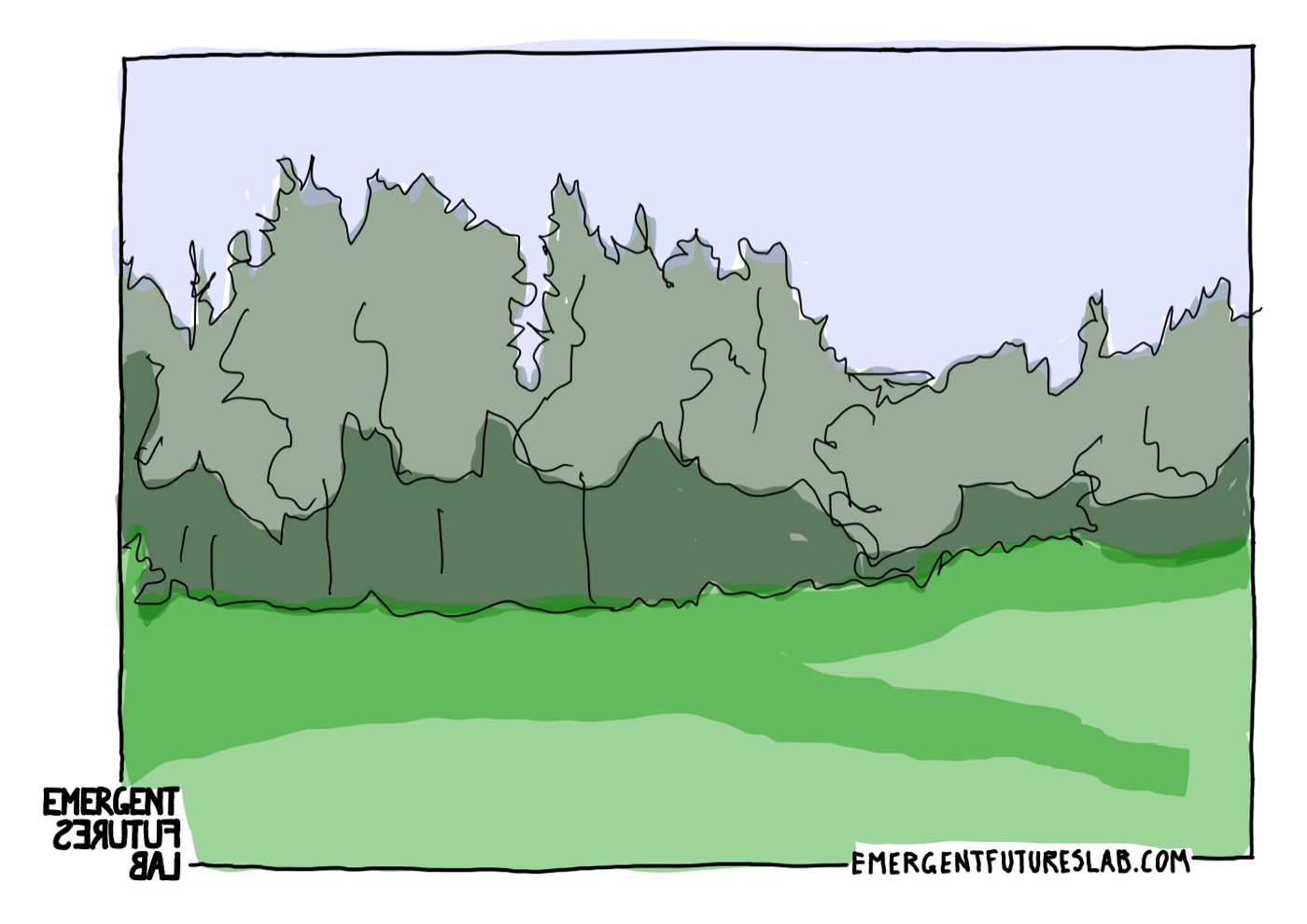
How so? First, they are a much much smaller creature than us, so where we might experience smooth, very flexible stems of grass that are soft and cool underfoot, they experience stiff tubes that are quite rough, offering good grasping, climbing, and a welcome level of humidity.
While we might fall asleep in the soft and welcoming grass for an hour or so – ticks will go dormant for extended periods, months even. They live in a state close to a coma from which they can be quickly triggered.
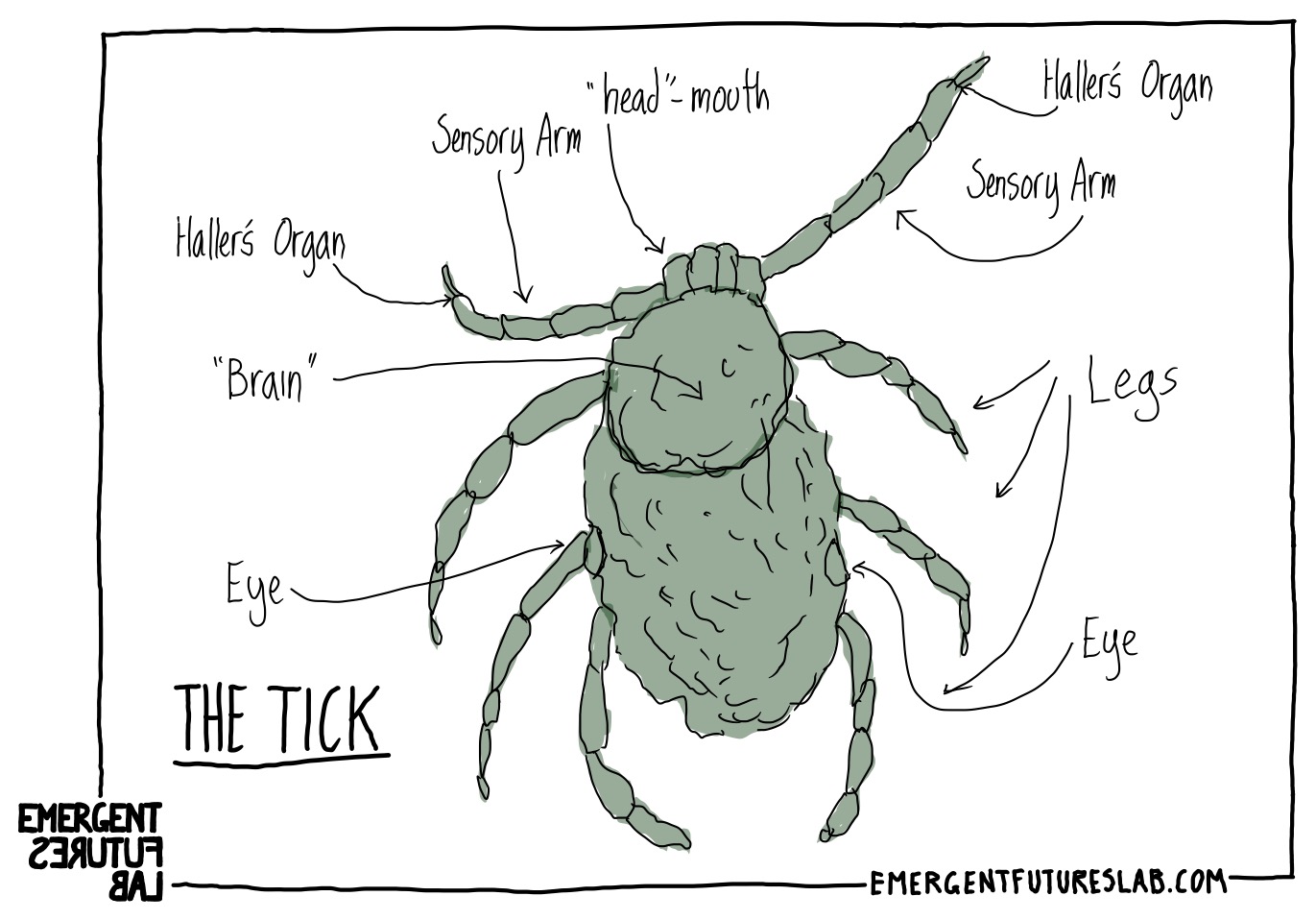
Where our experience of distant things is primarily via dynamic head-based activities of seeing and hearing, for ticks it is quite different: their eyes do not detect shapes but only the contrast between light and dark. In fact, their eyes are not anywhere near what might be called their “head” but are rather located mid-torso on the outer edge near the legs. They have eyes that do not look forward and do not see – they sense in a global manner the intensity of light and contrast.
Equally odd, if only for us, their “head” does not contain their brain – that too is located in their torso. The logic of sensing head + energetic torso + environment-engaging limbs does not fit the tick. Their two front legs are not used for grasping and moving but only for sensing (but not touching). Near the ends of these limbs, there is a unique sense organ called the Haller’s Organ. These sensing systems of the Haller’s Organ are slowly waved up and down to sense temperature, humidity, and smell the pheromones of ticks, deer, and CO2 primarily.
Ticks move mainly by crawling. They can move surprisingly quickly up and down grass stems and across hairy bodies. But they can neither fly nor jump – so how do they get from a grass stem or branch to an animal body? There are three primary ways. One is falling – they sense the presence of a body and let go. The second is being brushed off – they sense the right body as it brushes against them and they find themselves caught in its hairs etc. The third is really interesting: they are pulled across the gap by electrostatic energy. Just like the static that forms on clothing by rubbing – ticks can sense the creature, let go, and be pulled across the gap by an electrostatic charge (a type of non-jumping jumping).
Now that we know all this about what makes ticks so unique, why is this not just giving them, as a group – as a species – “ticks” – a distinct subjective perception of reality? Why can’t we say that ticks have a unique view on reality, just like crows or deer or humans do? What is so wrong with this approach?

First, they are not outside of reality looking in. No, like all living beings, they are actively and meaningfully directly connected to reality (the environment). Bodily Features (legs, eyes, mouth, etc) are connecting – forming an active, direct, meaningful relationship via Embodied Abilities with specific context-relevant Environmental Features (e.g., the roughness, verticality, location, and length of grasses):

There is meaning in this relation from the very beginning (it is not something subjectively added later) because all living beings are precarious – they will thrive or suffer directly because of what they do: for example, the tick senses the importance directly of moving upward via warmth and a contrast of light and dark. Which is to say, there is a positive and negative valence to its sensing and moving upwards and downwards.

Secondly, this is not a question of a creature fitting itself to an impassive, unchanging reality. Rather, the tick has co-evolved with the development of a specific niche, in which they had a role in co-producing. They, and their mutually interdependent food web, have played a critical role in shaping this niche in an ongoing manner (what is called Niche Construction in evolutionary theory):

Most importantly, there is a direct relationship between what a tick can do and specific features in the environment – and this relation is what is called an “affordance.” The relationship – or rather the set of relationships between what it can do and features of the environment (that it has co-shaped, as this environment has shaped it) afford it a field of relevant, meaningful potential actions. And these affordances – this relationship is what we sense and perceive directly – this is the content of our experience:
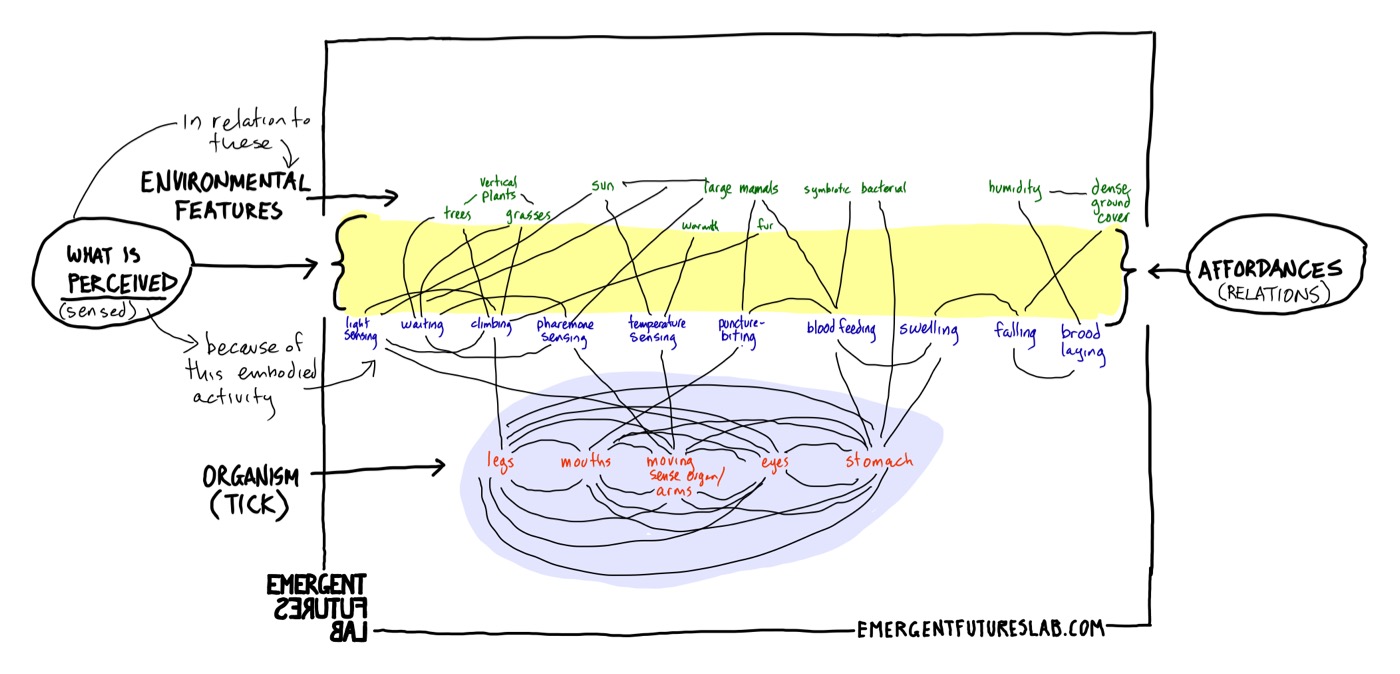
Perception and sensing in general is not something that happens “in the head” as a separate decoding of inputs and the generation of internal representations. Rather, it is a skilled ongoing relational activity done by an embodied and embedded organism, who in the process is changing and being changed by their environment – hence the term sense-making. The creature is both actively making sense – actively making perceptions come forth via actions – and in doing this, they are also re-making their environment as their environment is re-making them.
Where is the clear divide between inside and outside? There is none.
Where is the clear divide between a fixed and unchanging outside objective reality and experience? There is none.
Rather, we have an active, dynamic, complex relational co-shaping multiplicity.
Now, if we take this all together – the meaningfully active precarious tick using and perceiving the relational affordances of environmental features in a way that transforms them, while also being transformed by them – we get a Tick “World” – really a “Tick World-in-the-Making”. This is what it means to be of a World and to be involved in WorldMaking – it is the basic way of being alive of all living beings.
But we cannot stop here, for if we did, it would only explain how one creature – in this case, the tick makes and perceives a unique World from its enactive relation to Environmental Features that it co-shapes as they co-shape it.
What of the “Many Worlds” in the equation “One Environment and Many Worlds”?
For the sake of the enjoyment of variety, let’s turn to a different set of examples to explore this. It is one we have used quite often: how differing creatures engage and experience a body of water.

Thus, in this example, our “environment” will be a deep oceanic body of water. And let’s consider the active experiences of four very different organisms:
So what do they experience in relation to the “same” environment of a body of water?
So the very same water is a:
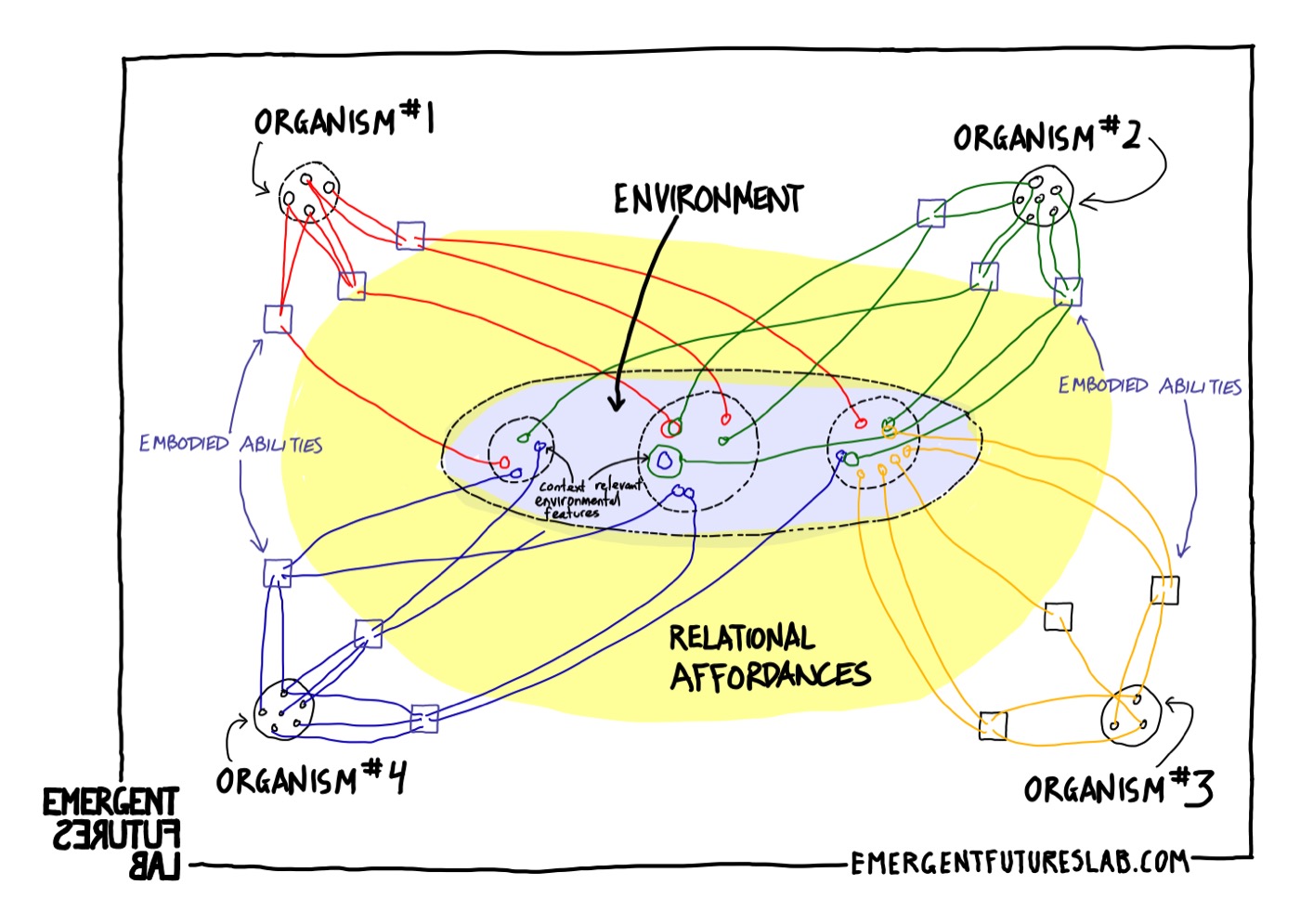
Here we have the exact same environment, but with each organism differing features are engaged with in differing ways that are salient to their modes of being alive – to their worldings…
And for each, this experience is not “subjective” – it is not something they have made up in an imaginary manner that they could change if they feel differently about things – it is very, very real and very, very different:
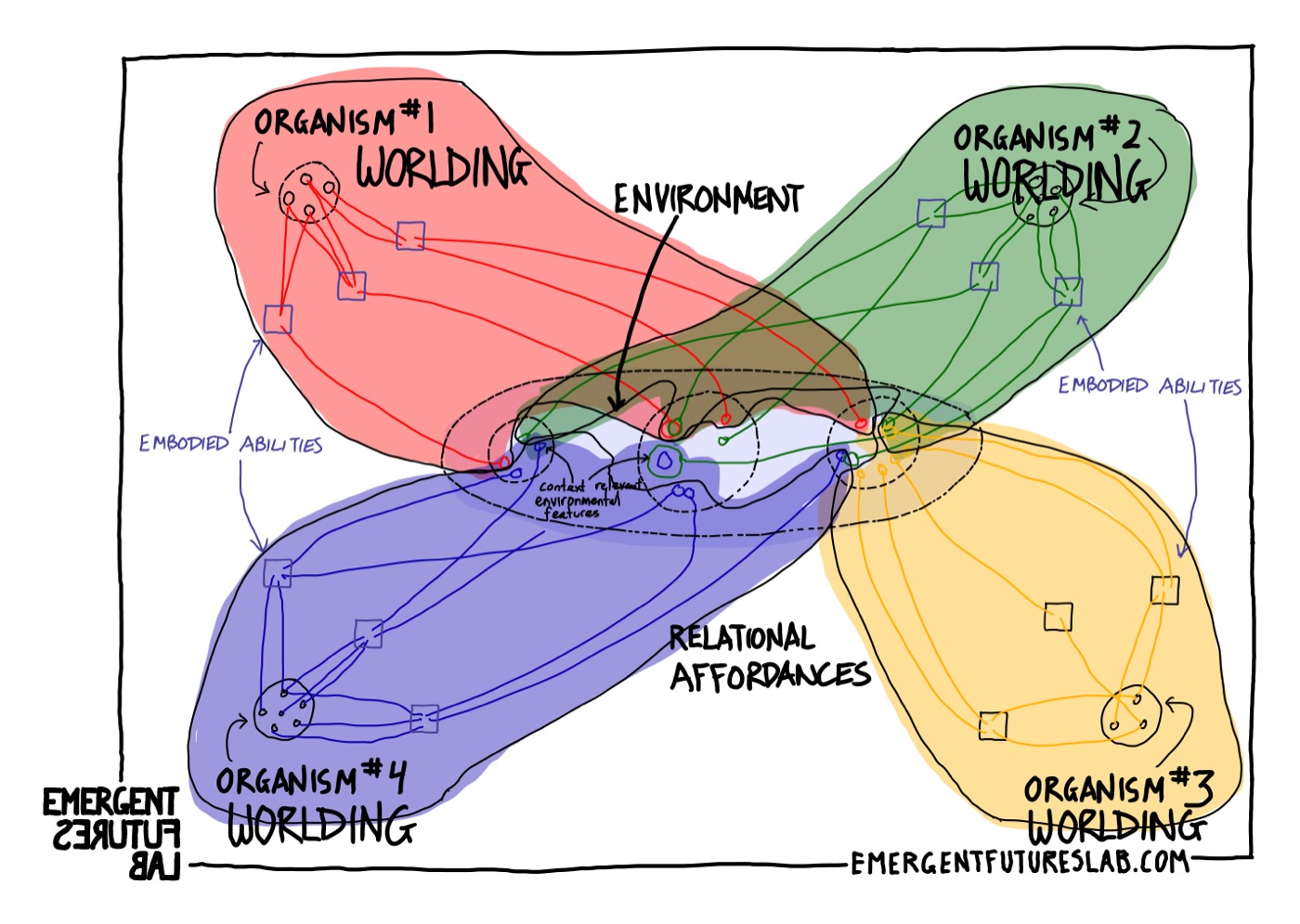
Now we can carefully begin to answer the question that began this newsletter:
Why is the equation “One Environment and Many Worlds” totally distinct from “One Objective Reality and Many Subjective Views”?
The simple answer is because Worlds are made from the bottom up by precarious beings, which are embodied in specific ways that are always already fully reciprocally entangled with an environment such that they change it as it changes them. What they experience, sense, and perceive is relational – not simply “out there” nor simply “in their heads” – a world shows up because of the relations between what they are, what they do, and in the environment they do it.
What we experience is relational. What we directly experience is a world in a reality where many other worlds exist…
We don’t each have a unique subjective take that adds up like the parable of the blind and the elephant because the world is genuinely qualitatively different but shared.
Nor can there be one all-encompassing view because to be alive is to have a world – we live in the condition of a pluriverse, not a universe.
Let’s conclude where we left off last week with a set of seven propositions to actively dwell upon and experiment with:
We leave you with a final experimental question: How can you sense the world you are of – and sense the many other worlds in direct proximity to yours without falling back into a subjective versus objective approach to reality?

Next week we will begin to explore more of the human dimensions of how we are of worlds (worldings). Till then, keep multiple other differences alive, trust in other worlds (worldings), and take joy in a mutualistic encounter that allows collective differential flourishings.
Until next week,
Keep Your Difference Alive!
Jason, Andrew, and Iain
Emergent Futures Lab
+++
P.S. This newsletter continues in our community—where you can comment, question, and explore further. Emerging Futures + brings you into the conversation. Join here
P.P.S. WorldMakers goes beyond the newsletter: 40 live events annually, weekly podcasts and exercises, our annotated bibliography, and practitioners across diverse fields reimagining creativity together. Discover WorldMakers


