Newsletter
Resources
Courses
Books

Welcome to Emerging Futures -- Volume 239! Loops of Creative Worldings...

Good morning extended and looping becomings of the middle of experience,
Before I raise a foot,
Is there motion,
A step taken or to come
Whence walking could begin?
What has gone?
What moves?
What is to come?
Can I speak of walkers,
When neither walking,
Steps taken nor to come ever end?
~ From The Fundamental Wisdom of the Middle Way, Nagarjuna Translated by Stephen Batchelor
Today, walking from the train to work, cutting across a small grassy embankment was the first day I saw dandelions blossoming – bright yellow still close to the ground as their stems rapidly grow. In this same area over the last week, I have also been following the lively flourishing of the Japanese knotweed. It is still small and seems so slow to begin its rapid growing this year.
In the next week or so, we will pick the dandelion blossoms to make a simple wine and the knotweed shoots to make a chutney. Our hands will be stained a glorious yellow and our knees a beautiful green. It will be months before we first drink it. But till then, we will listen for the faint gurgling and smell of a good fermentation. Such a moment of ecstatic abundance.
Each spring is measured not in hours, days, and weeks – but in the speeds of what is growing where and when. The spring onion emerges early along with the magnolia buds, then the dandelion, knotweed, and cherry blossoms. We roast the onions on an open fire and serve them with oil, salt, and a splash of vinegar.
As the snow melts, the sight of grass cues an awareness and calls forth actions as senses come alive to the unfolding of a world of this spring.
As we come alive of the unfolding of a world in becoming, it is week seven of our exploration of worldmaking here in the newsletter.
Ultimately, what we have been talking about the whole time is experience – this activity that arises from the middle
The question has always been – what is experience?
How do we come to have the experience that we have the experience we have?
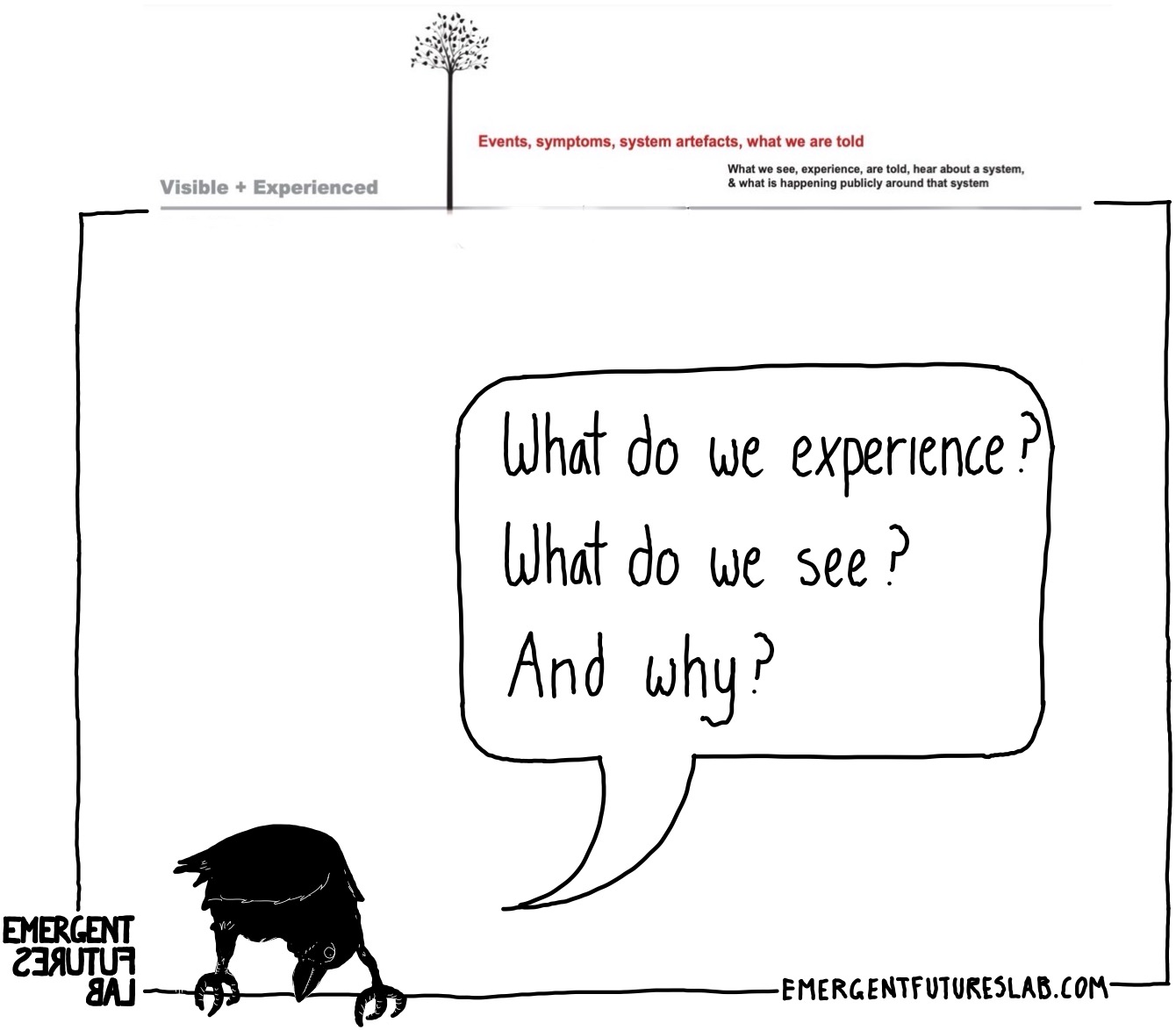
This “experience” that we are talking about is nothing mysterious – it is what we sense – the things we see, feel, smell, hear, dream, and imagine – what we know as ourselves, others, and the world around us.
It is what has also been termed consciousness. It is the astonishing quality that we show up to ourselves in a certain way, and that a world and things in that world show up to us as specific things. This is an astonishing thing – that things show up as things. Dandelions show up as “Dandelions” – that which will stain hands and give rise to wine.
How do we come to have the experience that we do – that things show up as things – that we have a world? That we are in and of an ongoing dynamic specific worlding… This is a question of worldmaking…
And from both the term “worldmaking” and that this is a newsletter dedicated to experimenting with creativity in all its forms, one could safely assume that our quality of “having” experience – of having a “world” must have something to do with creativity – that it must be some form of creative activity.
Experience is an ongoing, active, creative achievement. Having a world – being-of-a-world is an astonishing creative achievement. But exactly what kind of creativity is involved? And what exactly is the activity?
The interesting thing is the fact that experience must be created is not something contested by many. After all, as we saw last week, most contemporary explanations of experience are “constructivist” – that is to say that they assume that experience must be constructed (e.g., created) in some manner.
Last week, we looked at one of the most common versions of how this is understood to happen: experience is constructed in and by our brains.
The extreme example we used was the “Matrix” example of the brain-in-a-vat scenario, which argues that ultimately our experiences are wholly constructed in our brains from inputs, and that these inputs could ultimately come from any source:

While we do not want to rehash the arguments against this proposition again in totality, it is worth stating a core aspect of this argument and highlighting a few key aspects:
Here, then, is the enactive response…. If creature consciousness is a life-regulation process of an organism, and if perceptual consciousness [experience] is a certain kind of interactive relationship between an organism and its environment, then a disembodied brain going through the same sequence of internal states as an embodied brain is like a disembodied stomach going through the same sequence of internal states as an embodied one. The disembodied stomach isn’t digesting, and the disembodied brain isn’t experiencing, because the necessary contexts of the body and the environment are missing.” (Thompson and Cosmelli)
Ultimately, so much is bound up in the phrase: “experience is a certain kind of” interactive relationship between an organism and its environment…
What exactly is this “certain kind of” interactive relationship between organism and environment?
Another popular approach to answering this is to look elsewhere than the materialistic reduction of the brain. Here we find the systems approaches which strive to explain perceptual experience as the outcome of hidden levels of invisible processes and mindsets:

Above is an example supplied via a simple Google search on this topic. It is one example of a whole approach to explaining experience as the outcome of invisible processes and structures. This approach is pervasive – from Marx and his logic of Base and Superstructure to the work of Business Consultants like Senge, all the way to the work of systems thinkers like Donella Meadows. In each case, the visible is explained/constructed by invisible forces that cause it. Thus, what gives rise to our perceived experiences is built layer upon layer – starting just below the visible with patterns that are themselves the outcome of structures which are themselves the outcome of practices, which are themselves, as we go further and further down the layers, down until we get to mindsets and values:
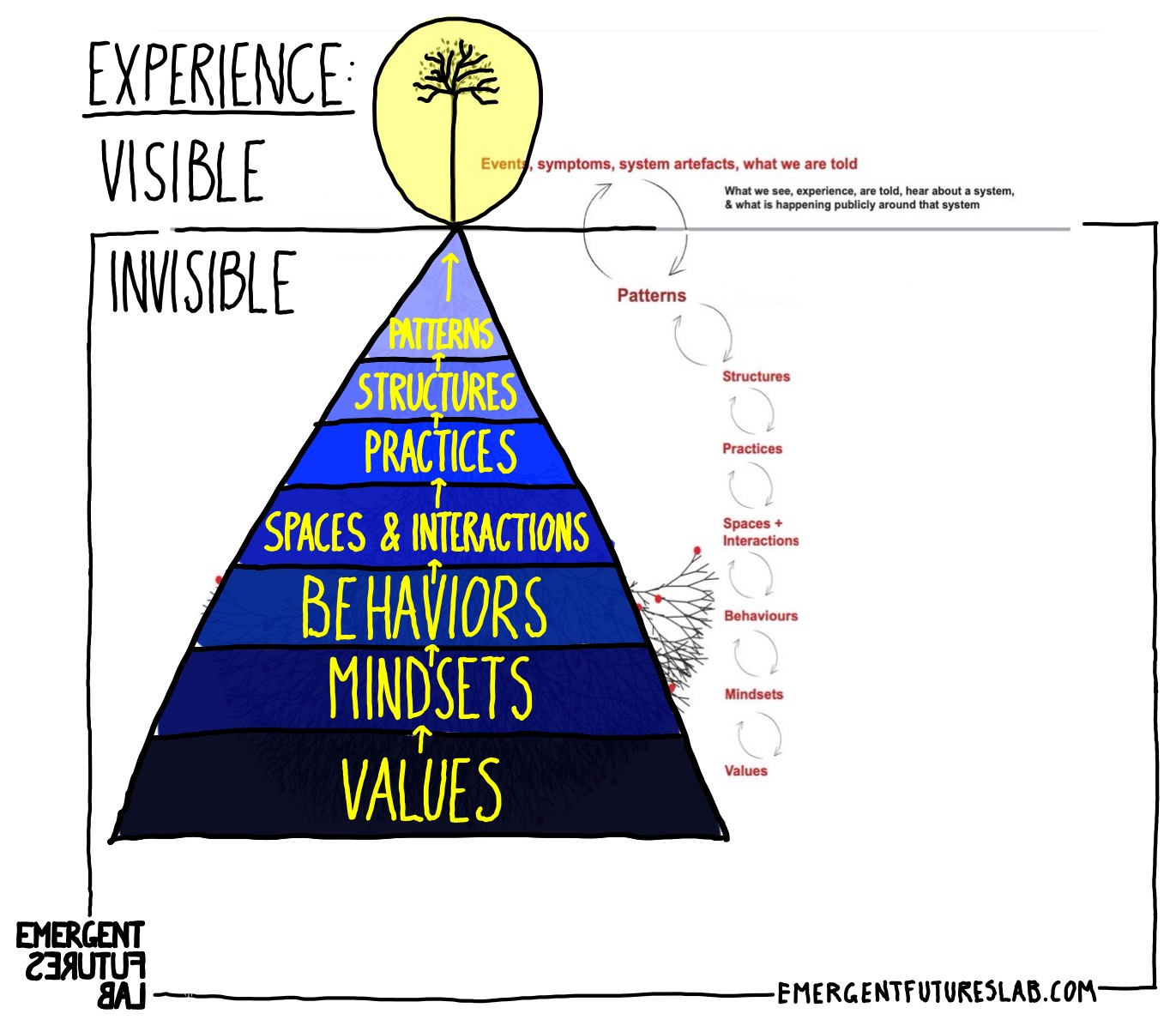
So what constructs our experience? It is back to the mind! And what is the status of what we experience? It is back to an illusion – or at least an elaborately constructed outcome of our mindset and values!
Where is anything like “the necessary context of the body and environment in a certain kind of interactive relationship”?
Nowhere.
Ultimately, we are back to a radically de-worlded and disembodied linear essentialism. We are back to some form of the “Ice Berg” model of experience – where what is both “really real” and generates “mere appearances” is invisible and ultimately mental:
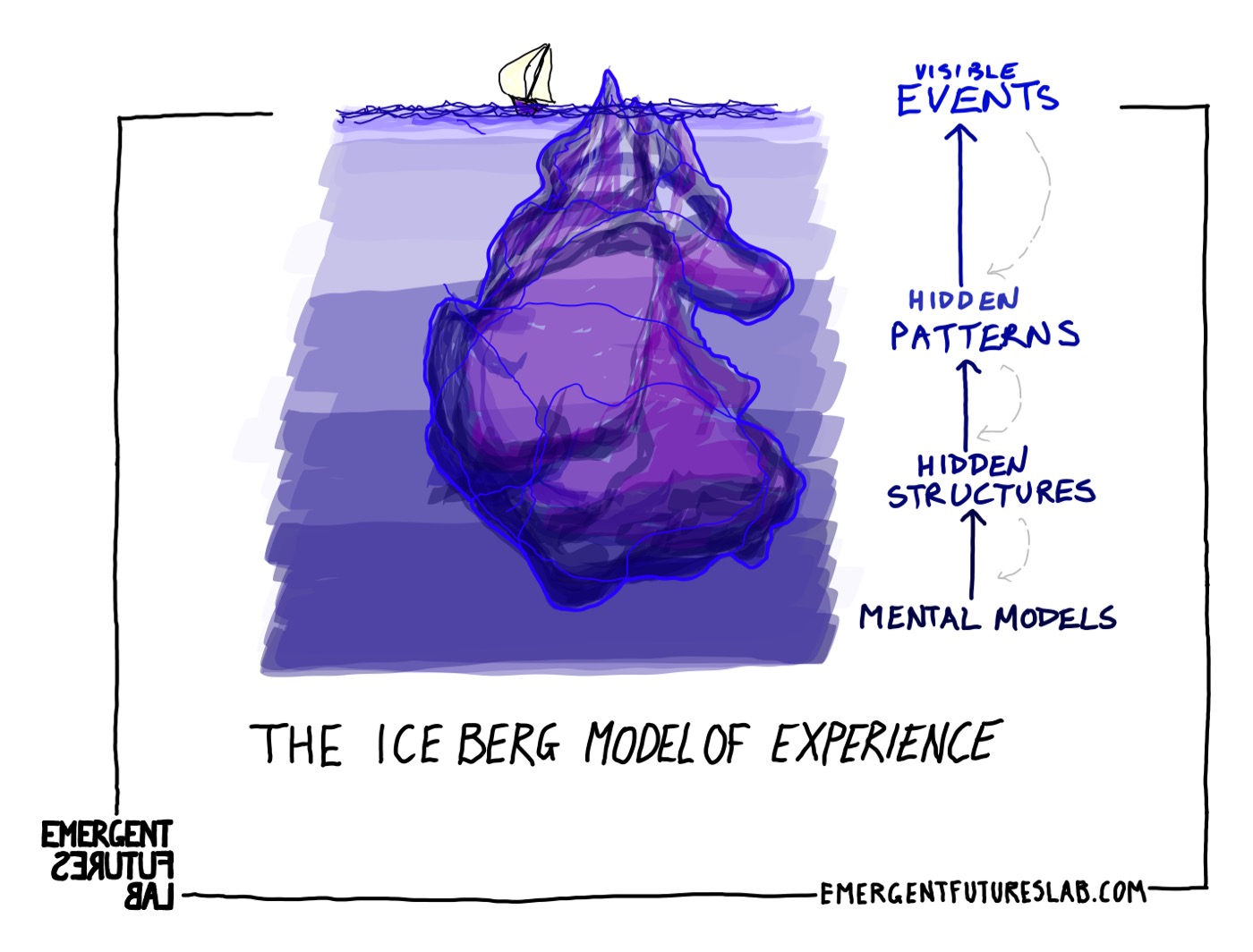
Thus, what we see and experience is not connected to our ongoing embodied activities in and of an environment, but simply to radically removed internal representations of an ultimately inaccessible “out there”. All of which begs the question: what gives rise to mental models? And from such an approach, the only answer is to continue the infinite processes of ever deeper searching. What will be the final ground? Is it something like a purported universal human nature? But as Deleuze so aptly put it, “Universals do not explain – but must be themselves explained…”
It is always as if we are some kind of profoundly detached static and immaterial observer – rather than a particular active embodied and embedded participant…

Weeks ago, we already began to build an alternative by introducing the tick as an exemplary case of how a very real and experiential world was made via “the necessary context of the body and environment in a certain kind of interactive relationship.”

Importantly, here we have activity – an activity that forms a virtuous circle and not an endless downward regress: Skillful embodied activity transformatively impacts a specific environment that in turn shapes the organism in an endless loop. But the world of the tick is far from our world – and far from how the world of dense tool users actively emerges.
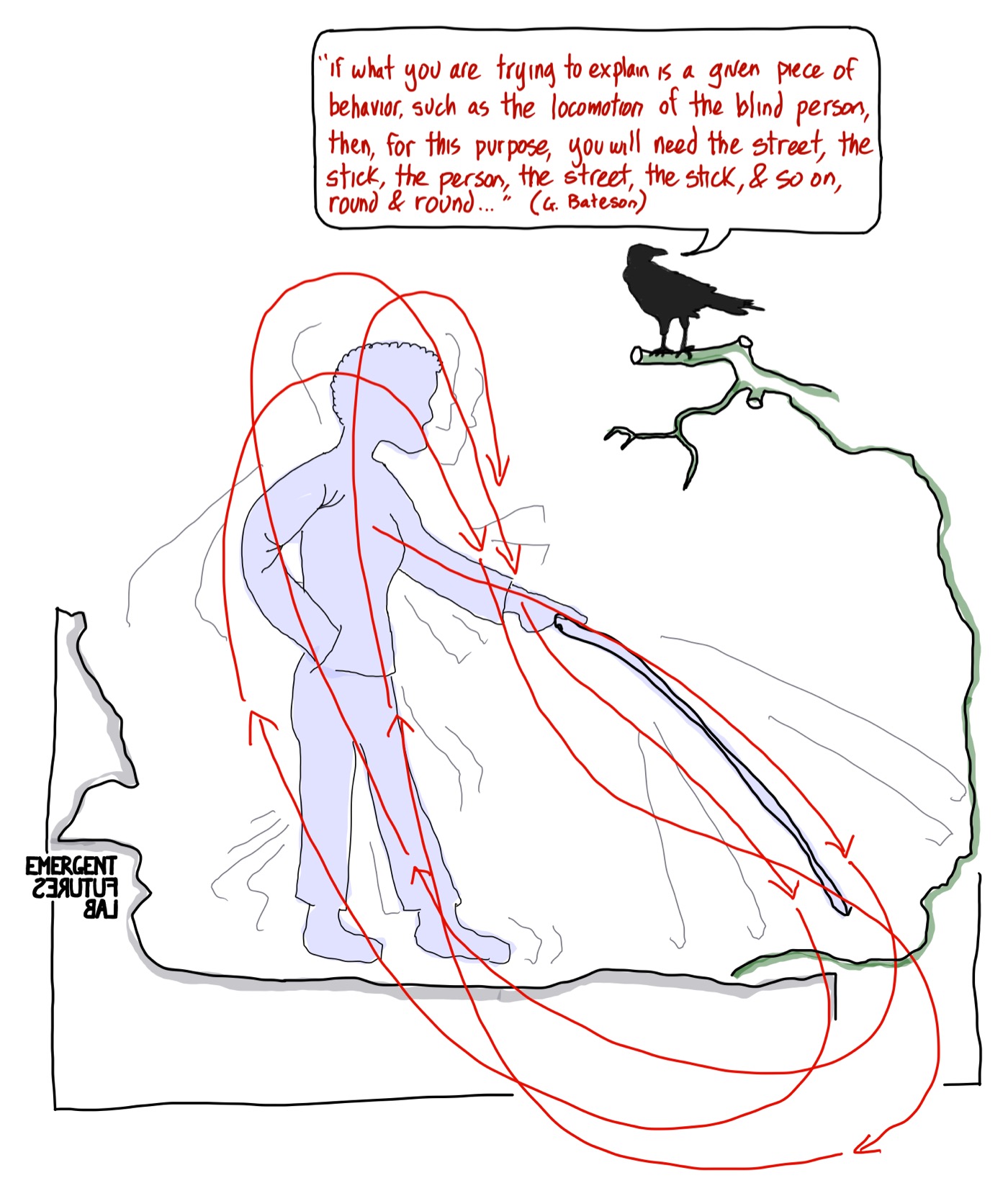
Last week we reintroduced one of our favorite examples to build from “the tick to the stick” and arrive at something like the beginnings of understanding our worlding practices in anything like concrete detail. And that is the example of a blind person and a stick. Here we draw from Gregory Bateson’s example – but there are others, the phenomenologist Maurice Merleau-Ponty being perhaps the most famous.
Bateson posed the question:

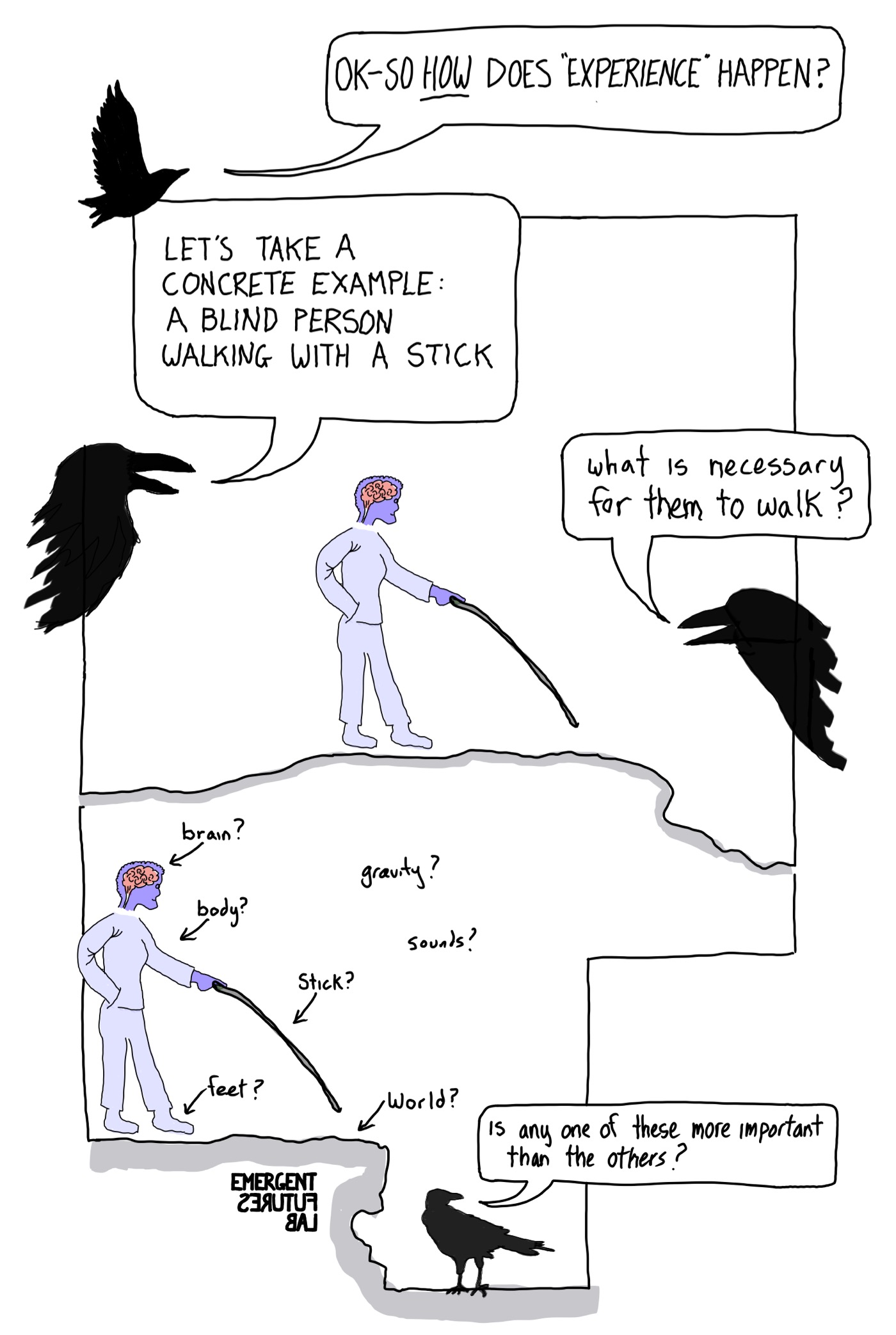

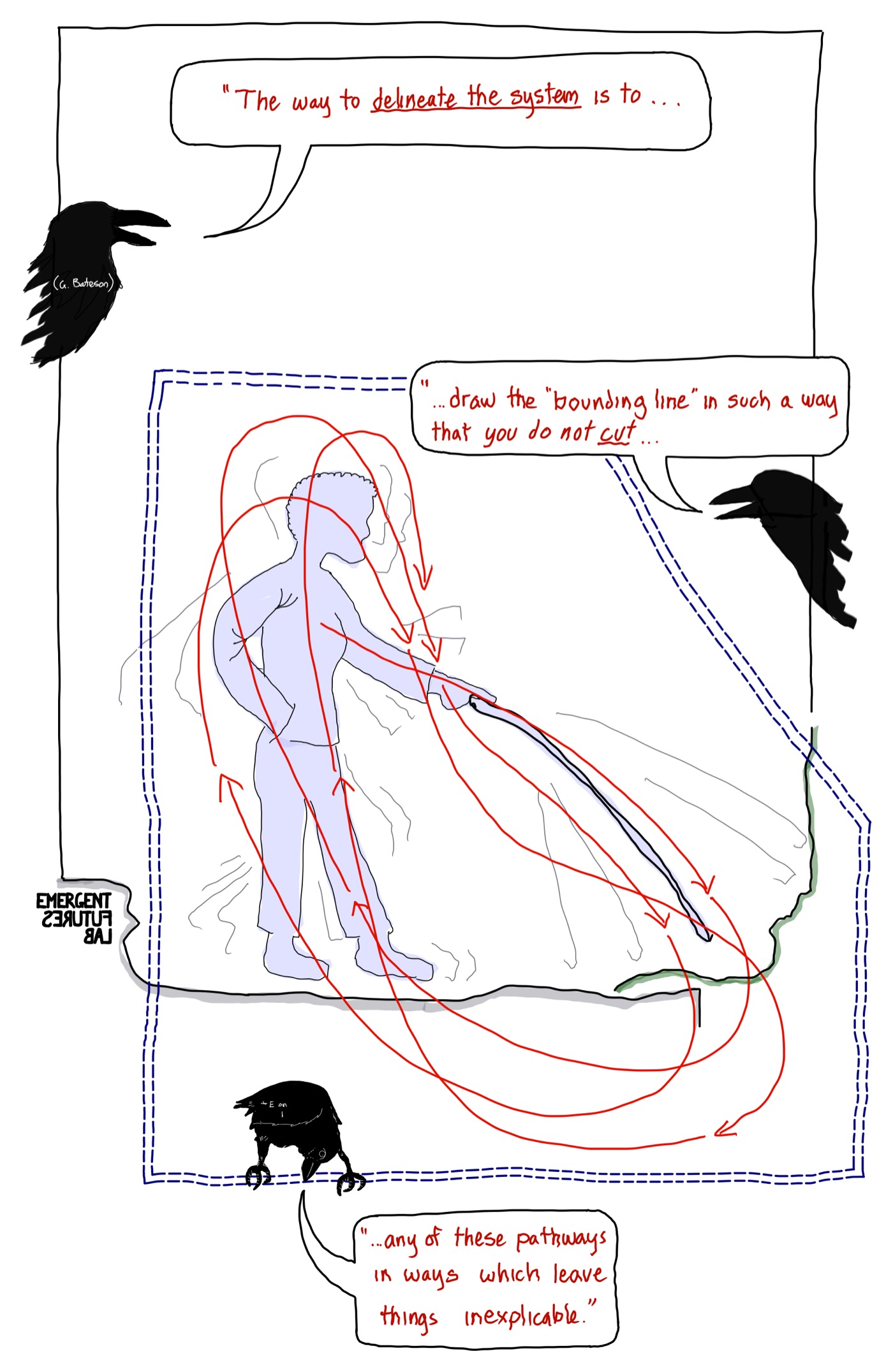
And this is the critical aspect in regards to understanding how experience emerges – and it is therefore worth repeating:
“The way to delineate the system is to draw the limiting line in such a way that you do not cut any of these pathways in ways which leave things inexplicable.”
Then he goes on to say:
Evan Thompson comments on this:
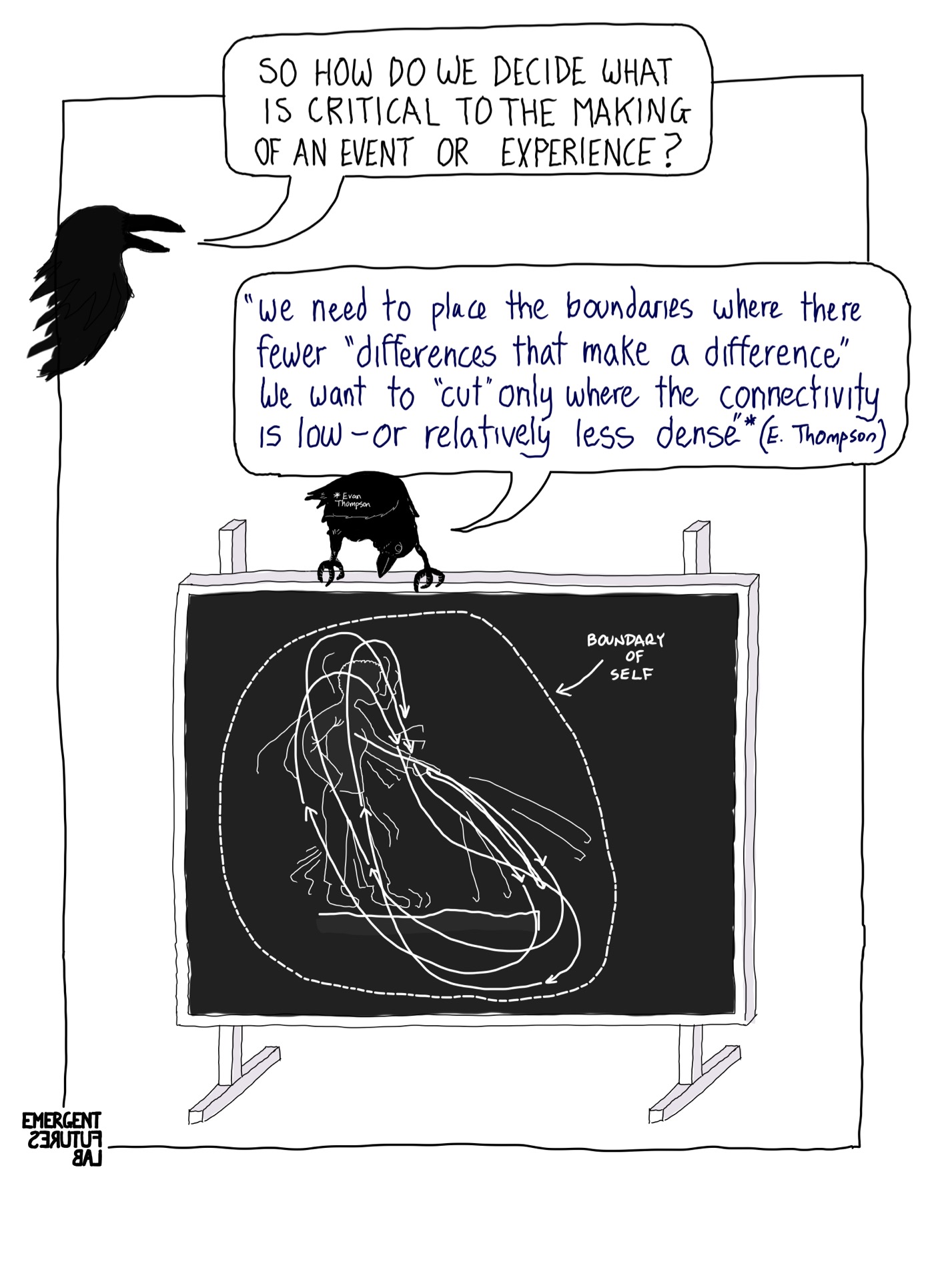
Finally, we are talking about movement and activity – of lines and loops – of connections and networks. And it should strike one – all these other attempts to explain experience – treat experience as if it were a static image and as something that ultimately happens to us. Nowhere are we active, and nowhere is the environment active.
Experience needs to be understood in relation to ongoing activity, to movement to action. And understanding action requires an explanation of agency that is also relational:
“Agency is not something given – but something realized. In short, as far as agency is concerned, what an entity is doesn’t really matter; what does matter is what the entity becomes and where it stands in the network of material engagement… The important question is not “what is agency?” (As a universal property or substance). The important question is, rather, “When and how is agency constituted and manifest in the world?” (Malafouris)
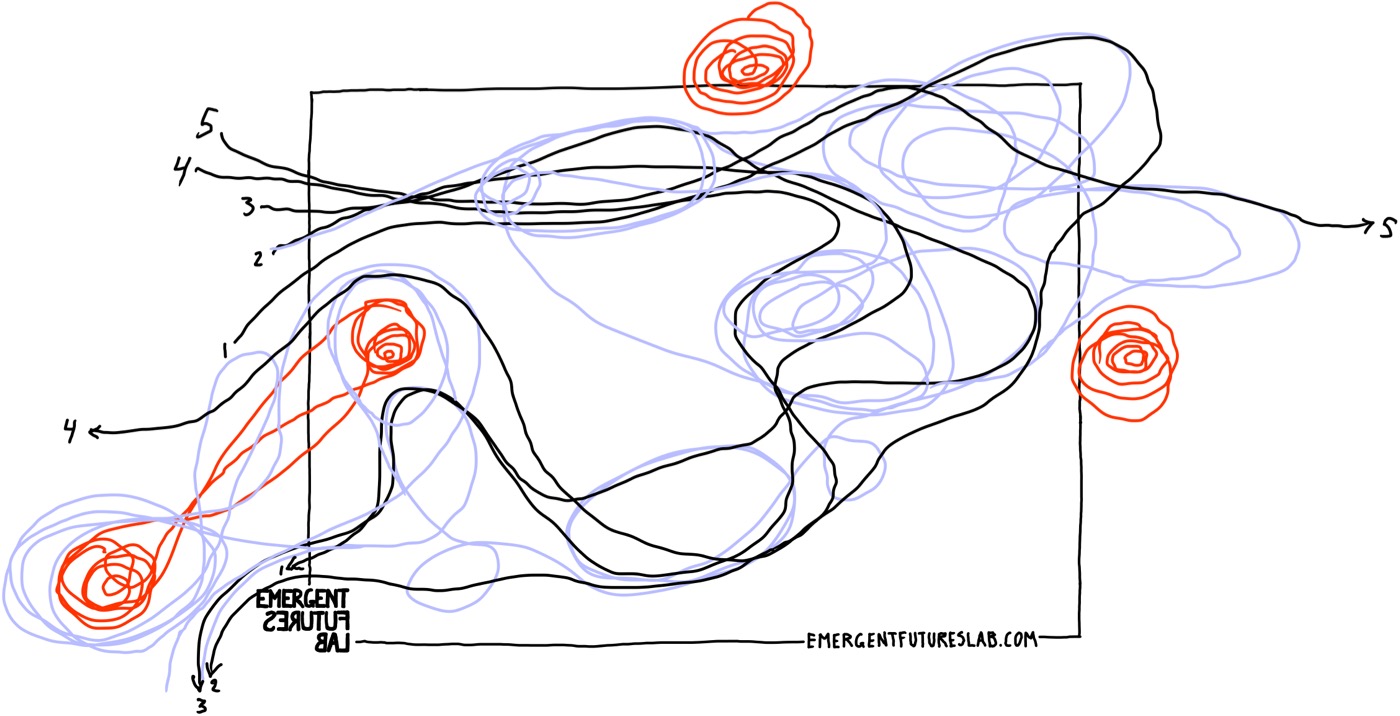
Agency, activity, and experience are conjoined in a looping dance of embodied agent extended and transformed by the use of tools in an equally active environment: lines of woven activity looping into agency and experience. When and how agency and experience are mutually constituted is in the lines and loops of ongoing embedded activity. Ultimately, it shouldn’t feel like a stretch to say that we live our lives in lines:
Last week, we ended the newsletter with an experiment for all of us to try:
To start: Reflect on the last couple of hours of your day and choose a short, roughly ten-minute period of your experience that stands out to you:
All week, we have been trying out this exercise – making many diagrams: from various individual moments in the day to work meetings of all types. As the pile of drawings built up, it has been richly informative. It has also been equally informative to see some of your drawings and talk with some of you about them (a big thank you to all who shared – especially those in the Worldmakes community).
I would like to share one example from a few minutes ago this morning: It is of me getting up and walking to our kitchen from the dining table to pour myself another cup of coffee – my movements in our open plan apartment making a line that would eventually loop me back to where I was sitting. I drew this quite simply:

But this one line does not really give us a true sense of all of the lines: my legs are moving and making their own lines even as I sit: one crossing under the other for a period, one looping behind the chair leg, both crossing under the chair – then as I begin to get up they move and plant themselves to turn my body and working with my moving torso and arms I stand up. Then they loop up, down, forward, and backward as I move into the kitchen and back. I then added these as two colors of blue, looping lines:

Now we cannot stop there – my eyes are scanning and landing upon all sorts of aspects of the environment – the table, books, my screen, the windows, art on the walls – sometimes just drifting and sometimes pausing, but also always in motion:

Obviously, we could keep adding without end. But let’s add my arms/hands in since they do play such a significant role – reaching out, grasping, pulling, steadying, holding, typing, resting…

And in all this activity, concepts begin to emerge – often in the puttering movement – in the walking and in the pausing. There is a musical quality to this, the loopings of Ritornellos and the exploratory movements of improvisation building in and of these loops – only variations …
Let’s return to Bateson – So, what about “me” and my experience? Suppose I am working on a newsletter, and I use all sorts of tools and practices in a specific environment… Where do I start? Is my mental and experiential world bounded by my skin? Does it start where I touch the keys on my tablet?
This is a nonsensical approach.
My embodied, embedded, and extended activities loop into a pathway along which transformations of difference are being transmitted.
The way to delineate the system is to draw the limiting line in such a way that you do not cut any of these pathways in ways which leave things inexplicable. If what you are trying to explain is a given piece of activity and experience, such as the writing activity of a person, then, for this purpose, you will need the environment, the tools, the specific person, the practices; the environment, the tools, the practices, and so on, round and round…
Experience, agency, and ultimately this newsletter are emerging from, as Nagarjuna might put it, “the empty middle.”
In a discussion on this example by Gregory Bateson in the Worldmakers community today, Mark Stolow shared the example of how the TV personality and chef Gordon Ramsey would blindfold experienced chefs and get them to try various vegetables, and surprisingly, almost all of them would have a hard time identifying anything. Then he proceeds to berate them…
But shouldn’t their surprising loss of ability come as no surprise? – for Gordon Ramsey had cut experience in such a way that the chefs had their worlds fall apart and their entangled and loopy capacities severed where they could not be cut.
If we cut how experience is individuated and enminded as a looping configuration, it should not come as a surprise that we cannot sense, recognize, have agency, or experience in general – for the active loops of worlding are being cut where they cannot…
And this is where we will cut things… Have an ecologically active and loopy week. Till the next newsletter – keep the differences that make a difference flowing, looping, and wandering.
Until next week,
Jason, Andrew, and Iain
Emergent Futures Lab
+++
P.S. This newsletter continues in our community—where you can comment, question, and explore further. Emerging Futures + brings you into the conversation. Join here
P.P.S. WorldMakers goes beyond the newsletter: 40 live events annually, weekly podcasts and exercises, our annotated bibliography, and practitioners across diverse fields reimagining creativity together. Discover WorldMakers


