Newsletter
Resources
Courses
Books

Welcome to Emerging Futures -- Volume 236! Experimenting with Stable Worlds and Mutable Assemblages...

Good Morning becomings of both many regular and equally many irregular variations. Both Spring and Fall are well underway for many of you, depending on your location on the globe, as is the novel but consistent swing of global warming. The beginning of the shift towards summer for those of us in the northern hemisphere now brings new calculations for all life.
We hope that for those of you who celebrated Ramadan, Eid al-Fitr was a joyous event, as was the whole of Ramadan. Today is the spring equinox, and as the sun appears to fall beneath the horizon, the thinnest sliver of a moon will be visible for those jumping the Nowruz fires of the New Year tonight.
We will be jumping a fire this weekend in our own equinox-Nowruz celebrations – listening to Lowen in the windswept meadowlands of NJ.
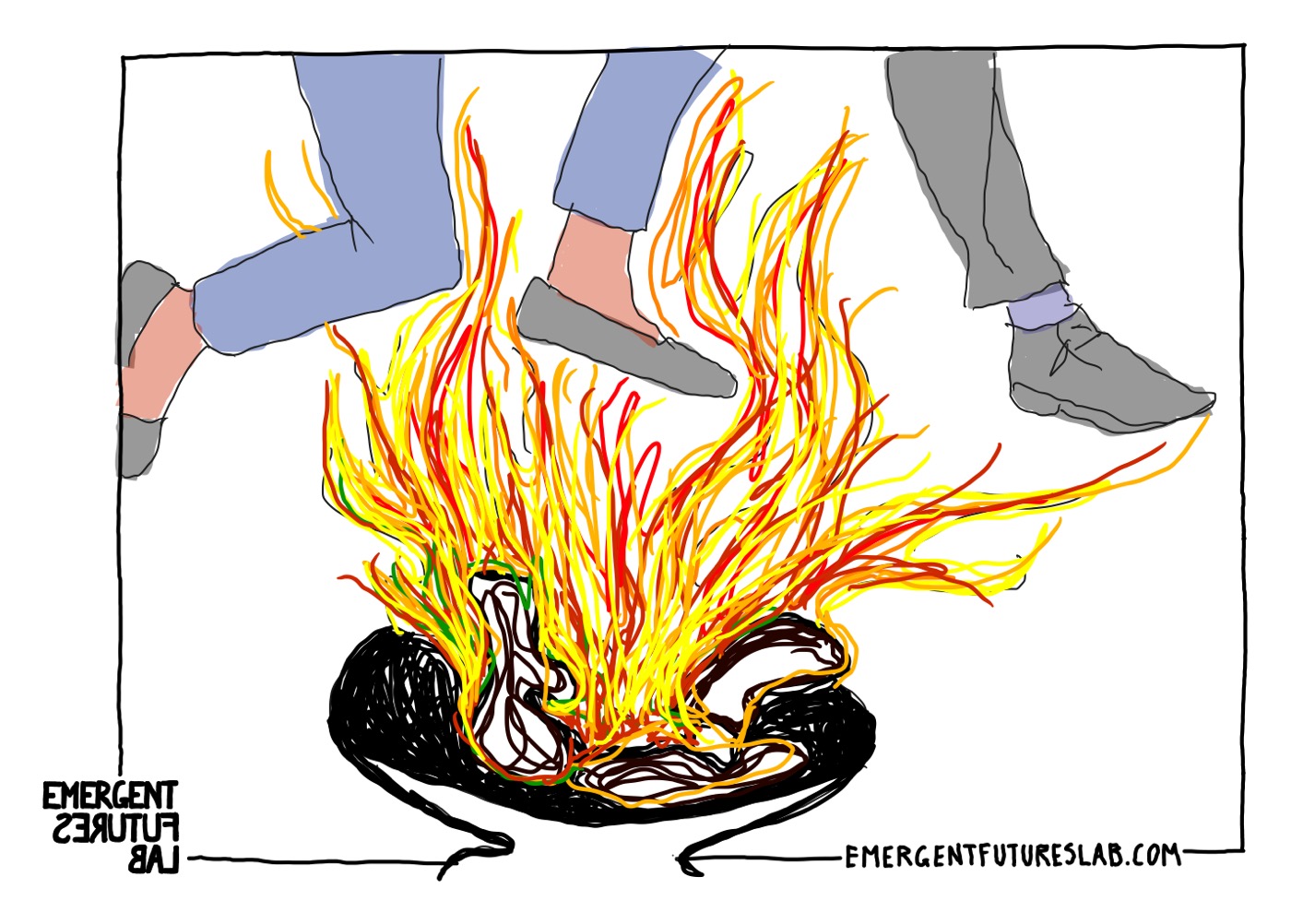
May this moment find us all in joyful relation.
Nowruz Mubarak!
A very happy New Year and equinox to all!
Last week in the newsletter, we made what might be considered quite a radical claim: the smallest unit for being and understanding a living creature must include far more than a naked being floating in outer space – and certainly far more than the mere contents of their brain:
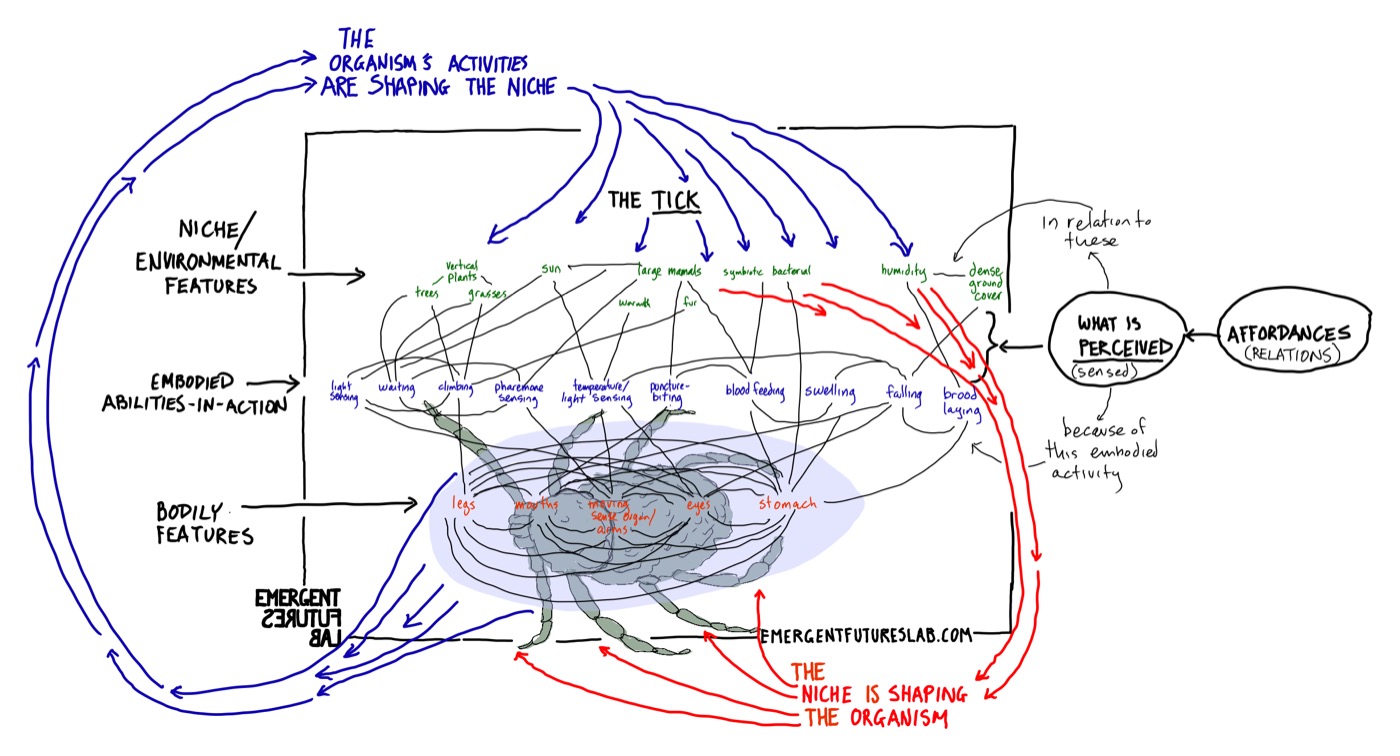
The smallest unit of life is a very particular kind of assemblage.
Creatively borrowing from one of our favorite speculative philosophers and writers, Ursula Le Guin, we said:
“The word for a being is assemblage. And the word for assemblage is worldmaking.”

What makes this a unique assemblage is that it is an assemblage that includes:
The smallest unit of life is a relational assemblage.
How do we know this to be true? An individual organism cut wholly from all of its relational assemblage is as fatally harmed as cutting that individual in half with a very sharp sword. In both cases, life has ceased. (Cue FKA Twigs video):
But – how radical a claim is this in the end?
From a global perspective, not really. Let’s immediately put the “radicality” of this claim in scare quotes.
How radical is such a claim in Buddhistic traditions, where the concept of dependent co-arising (Pratītyasamutpāda) of all things is fundamental?
In Buddhist traditions, all “things” arise and continue to exist intra-dependently. No thing whatsoever has radical independence or an independent internal singular essence. No thing is autonomous.
Every thing exists relationally, has come into being relationally, and continues in existence relationally. And the historical development of human desires for unchanging essences, a radical independence of things, and an autonomous self is precisely the delusions that lead to suffering (duhkha) in this tradition.
Buddhistic approaches play a very strong role in the shaping of the outlooks of roughly four billion people on a planet of roughly eight billion. So while this claim that the most minimal self is an assemblage of self + environment might feel “radical” for many in the context of modern West Asian and North American traditions (regions with collectively a bit over one billion people) – it is not at all radical for many, many others. We could extend this number further by looking at many other practices of relationality within indigenous traditions (as Marlyn Strathern does in the wonderful book: Relations: An Anthropological Account).
Thus, we need to recognize that other modes of being alive exist – many other worlds exist where all things are relational processes – full stop. This should give us serious reason to pause and renew our curiosity about how we came to be historically of an assemblage that produces such a unique form of essentialism, reductionism, individualism, and its related form of individualistic mind-focused ideational creativity (we have written about this history in an early newsletter: The Greeks weren’t Creative).
One of the critical lessons that the Buddhistic philosophical traditions focus on in great detail is: what and what does not change in regards to Pratītyasamutpāda (dependent co-arising).
What does not change is the meta-logic that all things come into being via the dependent co-arising of a creative relational assemblage. And that all things stay in a process of existing via an equally creative relational assemblage.
But what varies is the exact composition of any assemblage. The assemblage is not fixed – there is no essential, natural, pre-determined, or ideal assemblage that is associated with any being. Why? Because if this were the case, we would be back to the very fixed essentialism that Buddhism identifies as problematic – it would just have shifted from the individual to the system. To understand the importance of this can be quite challenging, coming from essentialist worlds where there is always assumed to be a proper singular fixed and ideal essence or approach to all things.
Following the arguments from Buddhism (as well as Deleuze and the Enactive Approach to cognition), Assemblages are inherently mutable, and this mutability is an important quality to life in all its forms – from the mundane to the mystical. We see this in our own daily life: as we engage with tasks we call upon differing embodied practices and connect these to differing environments, tools, and affordance landscapes: Making coffee, showering, changing diapers, getting children ready for school, walking to the train, praying at the appropriate hour, scrolling through social media – in each the assemblage varies in an open non-essentialist manner…
In all of these practices, the dependent co-arising of “self + environment + meaning” happens in and of the dynamic shifts and attunements of weaving into and out of assemblages. There is, for example, an assemblage involved in coffee making that shifts profoundly as one transitions into changing diapers. This dynamic and ongoing logic gives a profoundly creative, experimental, and anti-essentialist quality to being alive (and these philosophical and worldmaking traditions).
The challenge of daily life is that these assemblages loop through us and our world in transformative manners. The dragon is forever eating its tail.
Currently, we are becoming more and more aware of this as we understand what it means to be engaged with novel practices (such as scrolling on social media).
Let’s briefly consider the actual practices of engaging with social media: The physiological gesture of swiping down with a finger to refresh the screen is no accident; it was designed in reference to the pulling of slot machine handles. Additionally, that there is no end to what comes next in our feeds (and how it is dynamically shaped by how long we attend to previous items) – is also no accident. The assemblage is looping this object in your hand, through others, creating content that is then brought in front of you in an endless scroll. While behind the scenes, there is a vast network of servers, fiber optic cables, algorithm writers, advertisers, just-in-time manufacturing, research, and testing – all of which are acting in an ever-looping of dynamic response. It is a looping that goes directly through your body, shifting how, when, and why chemicals are released – changing your general forms of attention and embodied engagement. In this assemblage – as in all assemblages – your physiology is changing, as are your patterns of action.
Now, there is much to critique in this example of the worldmaking logic of social media assemblages – but that is not in this instance our primary point. What we wish to illuminate is how, in shifting from one set of practices, say, changing diapers to dissertation writing to social media scrolling, is a far more entangled and dynamic looping process. Each of these transitory assemblages is profoundly shaping/creating the distributed us at every level as we, in turn, shape them.
In “switching” from one set of practices to another, we are rearranging an assemblage such that certain relations are cut or significantly transformed and other differing ones are taken up or brought to the fore.
Because of this, the descriptor of “switching” is unfortunate and profoundly inaccurate. There is no unified, independent, unchanging “I” who simply switches between tasks all day long. Rather, there is a modulating transforming mobile looping assemblage that is both myself and exceeds me. Changing diapers, walking to the train, scrolling on social media, and buying groceries – these mundane “tasks” are the ever-mutating and transitioning assemblages of our daily lives – each individually and collectively profoundly transforms both our physical selves, our sense of experience/selfhood, others, and our environment.
To return then to where we started this section: in understanding the Buddhistic perspective that we and all living beings are dependent co-arising beings/assemblages – we need to pay attention to what and what does not change in regards to the assemblages of dependent co-arising. What does not change is the meta-logic that all things come into being via the dependent co-arising of a creative relational assemblage. But what varies is the exact composition of these dynamic assemblages – and because of this, we are non-essential relational, creative, and changing beings/assemblages.
Emptiness: In Buddhistic practices, this understanding that all things are non-essential relational beings that are equally impermanent and co-arising develops into the practices of sunyata, which is often translated as “emptiness”.
Sunyata – emptiness, is a term and practice that is easy to misunderstand when one is coming from Western assemblages that co-create a strong internal essence form of individualism. From a Western perspective, emptiness is far too often equated with the loss of self and the loss of meaning whatsoever. But in sunyata, the self is not lost, it is just realized to be something quite different than what we assumed it to be. And life is not without meaning – rather, meaning is everywhere emerging via consequential relationships. In this Buddhistic approach, relations matter, connections matter, assemblages and the practices of making and caring for mutable relational assemblages matter. The paradigm of what matters has shifted from deep essences to dynamic relations.
Now we have fully moved from an individual essentialism to: The smallest unit of life is a very particular kind of assemblage.
A Coda: If one senses a strong and critical shift away from modern Western patriarchal traditions of hyper individualism in this argument for alternative views of life and creativity, that is no accident.
Here, there is an important connection to the work of feminist philosophers. One critical connection for us is to the work of Donna Haraway and their Cyborg Manifesto (1985). What is important for this discussion is that we are developing new modes of being and understanding selfhood that are inherently intra-dependent and anti-essentialist. The image of human beings as a cyborg – a creative and open fusion of body + environment + tools is thus an important one.
Importantly, this speculative confluence is also rippling through and out from other sciences – namely, the ecological, enactive, and distributed approaches in the cognitive sciences and psychology – as well as the various complexity sciences.
So far in our experimental engagement with Worldmaking over the last three issues of the newsletter (Vols 233, 234, 235), we have given the Tick a starring role. And it is good to give them a starring role – far too much of our understanding places an exclusive gaze upon the human. We are far more similar to ticks than we are different. But how we are different does matter.
Now we need to turn our attention in this series on Worldmaking more and more towards human practices – and human creative practices. This has already begun in this newsletter with a shift to focusing on human assemblages and their general consequences. Next week, we will take this further.
Looking ahead: The first important quality of human assemblages that we will focus on is that there are always others. To be alive and to be human is to be with and of others: participatory worldmaking. Our individuality is a particular variant of our inherent collectivity – not the other way around. And so too is our creativity – it is always inherently collective – even when we seem most alone.
We hope that wherever you find yourself this evening, you can, in your own collective manner, celebrate the equinox. And to all those who celebrate: Nowruz Mubarak!
Until next week,
Keep Your Difference Alive!
Jason, Andrew, and Iain
Emergent Futures Lab
+++
P.S. This newsletter continues in our community—where you can comment, question, and explore further. Emerging Futures + brings you into the conversation. Join here
P.P.S. WorldMakers goes beyond the newsletter: 40 live events annually, weekly podcasts and exercises, our annotated bibliography, and practitioners across diverse fields reimagining creativity together. Discover WorldMakers


