Newsletter
Resources
Courses
Books

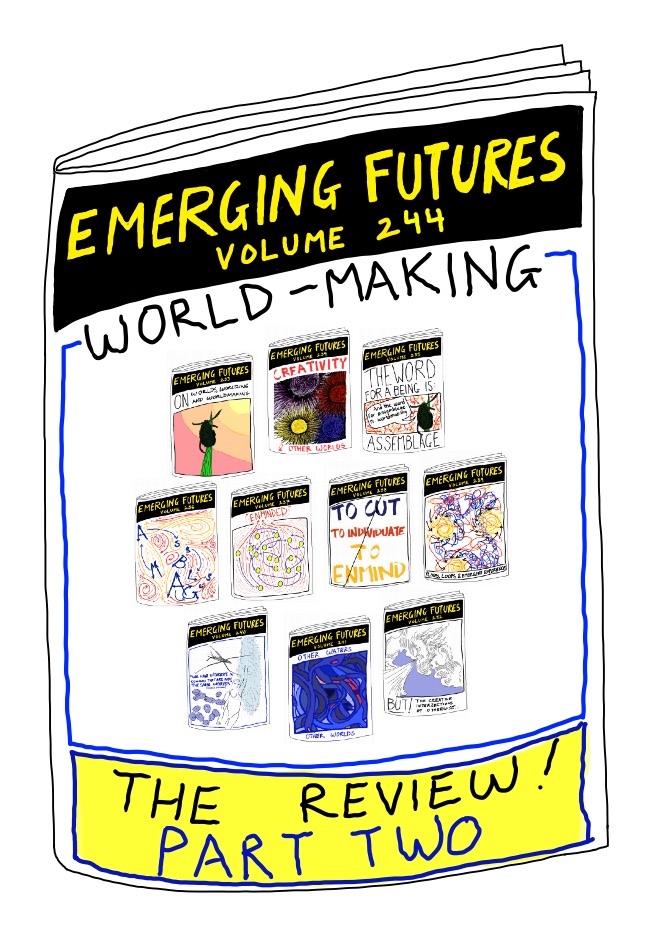
Welcome to Emerging Futures -- Volume 244! World-Making – A Review Discussion - Part Two...
Good morning multiple multiscalar enmindings,
Iain: This week, we are continuing our overview and review discussion that Jason and I had on the whole of our ten-volume series on Worldmaking. Last week, we presented the first half of this discussion – and now we present the second and concluding half of our “meta” discussion on World-making…
Jason: We ended last week with the discussion of how we can most clearly sense that we are of a world in the moment our worlds and sense-making collapses when the loops are cut in the breakdown of a key tool – really, when things stop working. In the seamless ongoingness of everyday life, the emergent loopings of a vast distributed network fade into invisibility. But when something stops working – our smartphones, our shoes, our speech, our hands, our friendships – our world becomes visible in its absence – that we can no longer “make sense.”
And this is a really natural segue to one of the next topics covered in the series, which was ontology and ontogenesis – the study of how “things” show up as specific things.
Iain: Yes – we were talking last week about the analogy Bateson develops with the blind person and the stick. And how their cognition – that is, their thinking or their having experience necessarily must include more than their brains and sense organs – in this case, the ability of the blind person to navigate a world, which is to say to “make sense” – constitutively requires having a certain type of skilled body, the stick and the environment, and all of their multiple intrawoven loopings.
Jason: This concept of cognition as an activity of entangled distributed feedback loops that allow for one to “make sense” of things is critical. And it is the radical – critical move that the Enactive Approach to cognition makes in arguing that “cognition” in the sense of a brain-based activity is the wrong way to approach how living beings “make sense.” We need to move from framing the “intelligences” if living beings as something brain-bound and computational and understand it to be a distributed, entangled, and emergent form of “sense-making”. Cognition is sense-making.
The basis of our skilled abilities – our abilities to do anything – our abilities to “make sense” – which begin long before knowing and extend far beyond the sayable and conceptualizable is the distributed active loopings of an “enminded” assemblage that gives rise emergently to “sense-making.”
And just to be clear – we are not talking about the now ubiquitous corporate speak and jargon of trademarked techniques of so-called “sense-making”. What we, and the enactive approach, are engaging with is something quite distinct and far more primordial…
Iain: Yes – we were talking last week about the analogy Bateson develops with the blind person and the stick. And how their cognition – that is, their thinking or their having experience necessarily must include more than their brains and sense organs – in this case, the ability of the blind person to navigate a world, which is to say to “make sense” – constitutively requires having a certain type of skilled body, the stick and the environment, and all of their multiple intrawoven loopings.
Jason: This concept of cognition as an activity of entangled distributed feedback loops that allow for one to “make sense” of things is critical. And it is the radical – critical move that the Enactive Approach to cognition makes in arguing that “cognition” in the sense of a brain-based activity is the wrong way to approach how living beings “make sense.” We need to move from framing the “intelligences” if living beings as something brain-bound and computational and understand it to be a distributed, entangled, and emergent form of “sense-making”. Cognition is sense-making.
The basis of our skilled abilities – our abilities to do anything – our abilities to “make sense” – which begin long before knowing and extend far beyond the sayable and conceptualizable is the distributed active loopings of an “enminded” assemblage that gives rise emergently to “sense-making.”
And just to be clear – we are not talking about the now ubiquitous corporate speak and jargon of trademarked techniques of so-called “sense-making”. What we, and the enactive approach, are engaging with is something quite distinct and far more primordial…
Iain: Yes – and brings us directly back to the question you raised at the beginning of this part of our discussion: how do things show up as specific things?
And to lay out this question more fully, the issue is that in direct experience, things always already show up as specific, meaningful things – they “make sense” in direct experience. How is this possible?
Importantly, for us, as practitioners interested in creativity in all its forms, this is a fundamental creative process that is inherent to life itself – living is creative sense-making.
Jason: And when one says, “I’m not creative!” – that is because they don’t sense this. They have come to only equate creativity with a human, individualistic, and mental activity. An approach that is radically blind to this far larger and more fundamental creativity – the always active, mainly tacit processes of creative sense-making…
Iain: Here is an example of how things always already show up as things in our direct experience: Think about entering a classroom – at every moment you flow into activity mainly with much thought: opening the door, moving down the rows, finding a seat, putting your bag under the seat, and sitting. Now you might have all sorts of hesitancies about what exactly to do – but you know what it “is” immediately and directly. By this I mean when you open the door, you are not greeted by strange colors pressing against the inside of your eyes – no, you directly and immediately see things as specific things. Of course, you might mistake things – from a distance, you thought that was a pile of books, and on closer inspection, it is a colorful shopping bag. And you might interact with things incorrectly – but nonetheless, things “show up”.
The first part of the answer to how is sense-making. And it is a critical part of the answer. But, while this is often positioned as the approach, this is only a partial answer or approach. To understand the process by which things show up as things, we have to extend sense-making into world-making.
Now, what does it mean to extend sense-making into world-making? A good place to start is with the recognition that other worlds exist.
Jason: The wonderful quote from the Anthropologist Marshall Sahlins from Volume 241 really gets at this:
“When the Javanese say, 'To be human is to be Javanese.’ Geertz, who reports it, says they are right, in the sense that “there is no such thing as human nature independent of culture” (Sahlins)
Iain: And in relation to direct experience, what is culture if not a set of foundational stabilized embodied habits and practices, tools, concepts, and environments – all deeply entangled – looping through each other to give a general qualitatively distinct sense to sense-making? Sense-making is bio-enculturated – and this is world-making.
Our direct experience – how we always already sense things as specific things is always of-a-worlding – a world-in-the-making: world-making.
Living is a collective creative world-making.
Jason: This is getting to the heart of worldmaking and the concept of the Plurivese that we began our initial discussion with (see Volume 243).
The question of “how do things show up as specific things?” is often assumed to be part of what are called epistemological questions: “How do we know what we know? How can we ascertain that it's true or it's just subjective?”
But there's something else going on in direct experience: before you can come to know something abstractly, you already have a direct and meaningful experience with it as something because of your relationships – the assemblage – because you are of a worlding.
And this means that understanding direct experience is an ontological question and not an epistemological one – it goes deeper than “how do we know”? To “how do we become the type of beings that come to have this kind of experience?” And this is an ontological question – a question of being and becoming and not simply knowing.
This goes all the way back to the tick, and our water analysis – that abstract knowing the kind of knowing you can ask questions of (such as “is it real?”) rests on and abstracts out from direct experience and direct experience rests on and emerges out of a set of interwoven assemblages – and there's no getting behind it in a certain sense. Water shows up as something – a liquid, a tensile surface, or marbles – because of the relation dominant assemblages the living being is of.
And that it shows up as a liquid is already meaningful – it directly and immediately affords both positive, neutral, and negative possibilities – that are felt as the vague general emotional valence of direct experience. It is those vague and conjoined feelings of the nearly magical pleasure of floating, and the anxiety of slipping under.
Because we're living beings, which is to say we're fragile and profoundly dependent, thus the activity of direct experience makes meaning inherently. This meaning of direct experience is not the same as knowledge – it is more a lived feeling. This form of meaning begins for living beings in the actuality that all our actions have consequences in regards to our fragile livingness. It is part of what it means “to be” – and this is ontology – really ontogenesis – not epistemology – that comes much later…
Iain: Here is another example: when you sense through your foot that you stepped on something “sharp” – it's not that you first get immediate sense data of molecules out there meeting your body's molecules and that then you internally process this into some form of abstract knowing that you later add meaning and certainty to: “Fascinating! My interpretation of my sense data is that I seem to have stepped on some glass and am bleeding!” – which is what computational theories of cognition would have us believe,
Rather you are walking as part of a meaningful ongoing activity, entangled with the environment such that it affords walking, stepping, standing, etc. and upon stepping on glass you immediately sense it's “sharp” – which has an inherent relational meaning – and this is perhaps not a good situation – it is not that you “believe” that you are bleeding – you are both bleeding and it has a meaningful felt valence. More likely your response will be an immediate “Oh Shit!!!”
But the worldly perspectival nuance of this experience goes much further. Given the bio-eco-cultural assemblages that you emerge from long before birth and are more and more directly brought into via the affordances developed in mimicking embodied stances, comportments and actions and being transformed by responses which are all scaffolded by tools, environments and concepts (and all that they collectively afford) – your “foot”, the “glass,” the “ground”, and “bleeding” will afford very different worldly possibilities for action.
For example, in an animist culture/world, the glass, and ground – might show up directly in experience as a person, and the bleeding is directly felt as a form of retribution for a family member's action towards some other non-human person (say cutting down a “person-who-trees” without the correct care) in the near past. Thus, action perception, action sensing, and action affordance – and ontological meaning are always already connected in non-linear and emergent ways that give rise to a direct worldly experience.
The “Oh Shit!” would not simply mean “Oh shit – i’m bleeding because of this material I know as glass!” – rather it would be directly experienced as “Oh Shit! I’m bleeding – this glass has been called upon to exact retribution for my family's actions!”
In each “world,” active direct experience affords qualitatively differing immediately felt potentials for action.
Jason: And all explicit knowing comes from that.
All practices, including formal ones, are grounded – or arise from a type of fundamental direct non-explicit experience too, (and that fundamental experience is equally relational, situated, and of a world).
This approach, which has been termed, especially in relation to Anthropology, the “ontological turn,” is really important. It gives us a new way to begin to address what many are calling the “meaning crisis” – that in our contemporary western science-shaped cultural practices, we've “lost” meaning, or to say it more accurately: we’ve put fundamental meaning outside of direct experience.
Meaning has become something we can choose to add.
In this problematic modern assemblage, there is bare reality – “the facts” so to speak – to which, if you are so inclined, you may add meaning – it could be a personal meaning, such as artistic and spiritual practices do, or it might be more of a cultural meaning as formal systems of ethics and religion is seen to offer. But in this modern scientism, meaning and value is just a condiment. The universe is just poorly understood stuff shifting around.
Iain: This logic gives rise to the so-called “fact-value distinction,” and that, as the argument goes, “you can’t get from an “is” to an “ought””
Supposedly, Science tells us what exists – what “is” – but it does not tell us what it means – the “ought.” And this leaves us in a pernicious kind of relativism: “it means this to me, it means that to you…” And thus – the “meaning crisis.”
Jason: But this all rests upon a mistaken understanding of what it is to be alive and have experiences. In all cases, it always involves our tenuous, fragile livingness, and because of which things are always already specifically meaningful in direct experience.
Meaning and value is inherent in being alive –it is always already there relationally in our worldly sense-making – and this is precisely because we are precarious situated beings in and of a world. As precarious beings, at any moment, things can go wrong or right. Things inherently matter to us because our livingness is always at stake. And this sense of “going right” or “going wrong” is a meaningful valence of all experience. We are always feeling pulled towards and repelled away. Thus, if you're a precarious being, all experience is always conjoined with values as a type of vague sensibility or comportment and specific field of affordances. Meaning is not something optional we can choose to add later – meaning is there co-creatively from the very beginning
Iain: Whitehead diagnoses this logic of our science-shaped culture as one that operates via “misplaced concreteness.” What he means by this is that we put highly abstract things like matter, space, atoms, etc., prior to – and as the basis for direct experience. Without ever noticing that space, matter, time, and atoms are high-level conceptual tools that are profoundly abstract. These concepts are in no way “concrete” – rather, they are the achievement of long, complex processes and assemblages. As such, having these abstractions “ground” experience is to misplace where and what is “concrete” – foundational to direct experience. And in doing so ignores that direct, a conceptual but meaningful experience precedes these abstractions.
The modern global western culture shaped by the modern western sciences that grounds experience on high-level abstractions ignores that you are always already of an assemblage – of a world, and that this gives rise to experience, which gives rise to non-conceptual value and meaning, which gives rise to knowledge, and that gets abstracted into things….
It's not that abstractions are bad – we need them – it is just that we falsely place those abstractions before lived experience and the assemblage from which they emerge. Once you place abstraction first as a ground that everything arises from, you lose that you're of a world, and that you lose that there are other worlds and other worlds are possible because you've made universal ahistorical abstractions the concrete grounds of experience.
Here is another Anthropological example: Our specific distinctions and their affordances between plants, animals, rock, mountains, clouds, and humans do not exist in Animist Worlds. Sure, we could be pointing to the same “thing” – a plant, for example, a Salal Berry Bush. But for an Animist, historically, this bush might be a person and a member of a human family. As such, this world would never afford an ethical system like vegetarianism, because there are no plants in our sense of the concept – only personful plants. And without plants in our sense of the concept, how would one ever get to Vegetarianism? Thus, placing our abstractions, “Plants, Animals, Bacteria, Rocks” as “the” universal foundation of experience and knowing means that we cannot meet other worlds without first explaining away their culture as wrong and consequently, in a real sense, “meaningless.”
We do think our abstractions are experience, and we in the West too easily make the claim that “if you don't experience those abstractions as primordial, you live in superstition – or you don't understand reality”. All of this gets to the historical aspects of the modern West being both world blind and world-denying.
A meaning crisis indeed!
This brings us to the creative need to consider the ethical and aesthetic experimental part of worldmaking: we have to care differently for our abstractions, and we can't confuse our abstractions with all experience. We need to experimentally co-create new abstractions for new worlds-in-the-making.
Jason: And that's Volume 241 – where it starts with David Foster Wallace’s fish analogy, the impossibility of sensing water when you are of water – world blindness as a condition of experience.
But then it really gets into, I think, the heart of what we're talking about here, which was in the story of Don Svanvik, who was one of the hereditary chiefs of the Na̱mǥis First Nations, and his diplomatic greeting: “Welcome to our world. In your world, these things are the case… in our world, quite different things are the case…”
I thought that was a real illumination of these points we are making.
Iain: It is a very relevant story – and one that was personally powerfully transformative. Here is the compressed version of the story: my partner and I were visiting Alert Bay, which is a Na̱mǥis First Nations community off Northern Vancouver Island. We were there as part of this sea kayaking event, and the Na̱mǥis First Nations peoples were one of the hosts.
Don Svanvik, in greeting us to a final celebratory dinner at the conclusion of the race, articulated what it is to have a world so well, where it wasn't an argument, but rather it was a type of diplomacy. It starts with acknowledging not just that we, the visitors, have a world, but that it's not right or wrong, or the only one. He makes clear that it's worthy of consideration, that it is a world, and that it matters to us.
In his welcome remarks, he was talking about time, history, place, and people – and he said something to this effect: "In your world, this is how you understand history and time – and we acknowledge it, and we understand that it's profound and it's true. But in our world…” And then he went on to explain a qualitatively different approach to all of these. Which I understood in the same way that we have been talking about water, and if I said to you, "Water is a liquid,” – it is a transjective truth. And there are other worlds (say that of a waterstrider or someone who only dives from very great heights) where something qualitatively different is equally true. And so this greeting by Don Svanvik is an act of diplomacy – not a diplomacy between nations but between worlds. He was making clear that we were crossing into another mode of being alive that's also worthy of being taken seriously. Here, the opposite of a truth is not a lie, but another equally valid truth.
I think the difference is that we in the global west usually start with an non-worldly logic – something like, “this is the truth, and we know it, and we understand that you have a 'different view' – you believe clouds are alive, but we know better – that said, we can be tolerant of you and your quaint different view."
Jason: That ”we know better” and that we're “tolerant” is fundamentally and totally dismissive of the reality that there are other ontological ways of being alive, and it doesn't understand the emergent assemblage part (the creative ontogenesis of worlds). And so I think that this story was really illuminating in absolutely that aspect – at the end of his welcome greeting, one can really get a sense, “OK! – This is what it means to live in between and across worlds as humans."
Iain: I think that it is important to add that he wasn't saying that we couldn't have a debate, and we couldn't disagree, and we couldn't think something's right or wrong about whatever aspect of worlding. Only that we couldn't start by denying the equal validity of each other's worlds and distinct modes of being alive. Which is to say – we cannot start from: "This is the truth, and what you're saying is superstition, but I like your superstitions because they're nice and resonate with things I care about, or I dislike them because they're reactionary," whatever it might be…
It's not just a mind”set”, it's not just a world”view” – this is an actual thriving world-in-the-making that we are meeting – and it is worthy of being considered just like our world is worthy of being considered: “Let the discussions, debates, and shared experiments begin – but don't give us a tolerance which is already says that we don't really exist”.
Jason: This is where the series starts to really shift into what I'm referring to as the aspirational creativity that it ends on, and we'll get to that.
But in the podcast – our Deep Dive conversation we recorded for Volume 241, we got to the heart of the issues you are bringing up, and the word that really struck was the concept “believe”.
“You believe that holy water is holy”
– Which is a complete leveling and carpet bombing of one's world. It's so dismissive. It's beyond tolerance. It's the complete lack of respect, the complete dismissal of another people's world.
Iain: Let’s get at this, but let's take an unconventional approach. We need to consider direct worldly experience (e.g. experience) through the logic of affordances. It starts with this great Marshall Sahlins quote in the newsletter, where he is critiquing anthropologists – they wouldn’t ever say that the Yanomami “believe” that Curare (which is a poison they make) that will kill you. They just say that the Yanomami used Curare to kill the prey they hunt. But the same anthropologists will say that “the Yanomami believe that the monkey's souls are humans who see us as leopards…” And so this word “believe” is deployed in this very strategic way to already dismiss things..
The way out from a Western singular and narrow “misplaced contentedness" approach to move to a more worldly affordance approach.
Jason: A quick reminder – an affordance is what we directly experience as the environment – both physical and conceptual. It is the relational quality that emerges between us and the environment that gives rise to specific possibilities for action. For example: we directly perceive a lawn as directly affording the possibility of walking, or napping, or wiping our hands…
Iain: Yes, and what is really important is that it is an approach that begins in direct experience in a way that allows us to ask ontologically creative questions: "What world/worlds does this assemblage afford to be possible?" And then you can understand the ethical diplomacy of Don Svanvik and the Na̱mǥis where, in saying, "In our world and in your world…” – they are asking us to care for the differences they afford.
My understanding of this was that they're saying something like: “our world affords these possibilities… and your world affords these…" Thus, if one is an Animist that knows that a mountain is alive, and if you see that trees are alive and they're persons – then this is what it'll afford one as a comportment and a general way of being alive and a worldly unique sense-making – this is then how, in general, you will behave, interact, and do things…
And if you live in and of a different world, you have differing practices, habits, tools, concepts, and abstractions – and this will afford qualitatively different things as direct experience. You will, for example, from being of our world, sense directly that the mountain is rocks and minerals, with plants, animals, etc., on it – all of which affords certain rich possibilities from mining, to hiking, to vegetarianism
And the world of the historical Na̱mǥis will afford something else. So rather than starting with this comparative analysis via the misplaced concreteness of assuming our abstractions are the fundamental grounds of all experience (that they are true in a way nothing else could be true) – our suggestion is: let's pay attention to what each world affords as modes of being alive – with an active diplomatic curiosity, see what new modes-of-being alive become possible. Acknowledge these as achievements worthy of becoming.
With this ethico-aesthetic worldly affordance-based approach, what is really important goes all the way back to the analogy at the beginning of the newsletter series: if you've developed a specific set of practices, water will afford slowing the body down. It'll afford the body floating, it'll afford all these things. And we want to come back to this so it's not subjective, it's not relativistic, it's not just a mindset – these are real experiential qualities that can be both real and qualitatively otherwise.
Transjective affordance-based world-making = human creativity.
Remember – If you're 400 feet above water and you're just jumping, it affords the breaking of your bones. And if you did very different practices with different tools, perhaps jumping from 400 feet would end very differently. And I think this is where the power of this approach is of worldmaking is a profound shift – you're not lost in the subjective versus the objective, the reduction to the mind, but you are focused on: if we build this assemblage that has conceptual things, physical things, relational things, it will afford this, and what does that allow for as a form of worlding?
What this shift gets us in Whitehead's language is that we see all worldings as a type of “achievement” of a certain set of affordances that gives rise to a worldly sensemaking (cognition/experience) – and not to see it as superstition, false belief, stupidity – and as you're saying that this is becomes a type of “carpet bombing”: we have the truth, that's it. End of story.
And when we have the “Truth,” What does everyone else get? Superstition… – and what's the answer to that? Education. “If they only knew better”. But once you say to somebody without the diplomacy of recognizing worlds, "If you only knew better…” it's a type of violence. It's a re-education camp. And this is what happened in Canada. It was, as is now officially recognized, a form of cultural genocide where we just took all the indigenous people and we said, "With your backward practices and superstitions, you don't know enough to raise your kids. For their own good, we will take them by force, and we will teach them better. This is both for their own good, and yours – so they know better, and then they will become fully capable humans”.
This logic is not a thing of the past. What we're talking about has contemporary social, political, and experimental world-making ramifications that are useful in trying to address genuine pressing concerns by exploring creativity and change-making from a world-making perspective (with this robust set of tools).
Jason: All of this is very important – but what about those who rightly worry today that we live in a “post-truth” reality – can’t this approach be seen by some to further such a reality?
Iain: That concern is certainly legitimate. But the answer cannot be one that shuts down concerns and cuts the loops. To simply say, “These are the facts, Science is right – end of discussion” is both to misunderstand the complex practices involved in the production of facts, how they circulate, and what their very real effects are, and the reality that we do live in a world where many worlds exist. To refuse worldly diplomacy, dialogue, difference, engagement, and openness to change is itself a dangerous and reactionary stance.
It is important to remember, as Bruno Latour argues, that facts become true because of how well they are constructed – not because they are simply “discovered.” And the political and creative questions must go beyond what it is to “what does it afford in this context?”
Jason: And that really brings us to almost the end of Volume 242 – the last volume of the newsletter in this part of our series –where we turn a further critical attention to the modern West.
The modern global west, as a world, is a world-blind machine that destroys ontologies – we have already explored this both in this conversation and in Volume 241, referencing especially the work of Isabelle Stengers. Now at the end of Volume 242, we introduce new tools: the concepts of apparatus and dispositif to explore and get at that logic.
Iain: Yes, we started to add more very helpful tools in this last volume – I think that to say that “everything's an assemblage, and it's all relational” is a really good starting point, and this is where we started with the tick – and the sun and the plants and warm-blooded creatures as part of an assemblage that co-emerges into a world.
But for humans and our many distinct historical and cultural ways of being alive, we need to go much further, and we need other conceptual tools that can nuance the logic of the assemblage – both in terms of what is involved and how it interacts in time.
This is where Foucault’s work, in general, and this concept of an apparatus, is very helpful. The term in the original French is a dispositif – a concept which is hard to translate accurately in a way to get at all the nuances he was interested in. Let’s try to say a bit about this concept. It is a way to get an eco-social grasp on the actual assemblages that give rise to our historically situated experience – that we always already experience things as things. A dispositif is the agents, practices, systems, tools, infrastructure, concepts, and their regularities that afford certain things more than others – that make certain things more likely – that co-emerge as a particular way of being alive. And from the feedforward looping of a dispositif, specific forms of thinking, feeling, knowing, and doing co-emerge. Elsewhere in the newsletters, we connect this concept to that of Epicycles.
When we, in Emergent Futures Lab, present the creative tasks of Engaging and Disclosing in our approach – what we're talking about a process that begins in Engaging with some matter of concern and you're experimentally Disclosing the dispositif – the historical, distributed, heterogeneous, multi-modal, and multi-scalar apparatus that makes some thing show up as some specific thing and the unique creative practices by which it becomes knowable, feelable, thinkable, and doable…
And this practice of Disclosing goes all the way down to an ontology and its related dispositif (that is, ultimately creatively ontogenetic). Disclosing a dispositif is very helpful because you can trace a specific creative emergent process via its loosely bottom-up logic – that co-make a world.
Foucault’s toolkit gives us the real pragmatic ways to do Disclosure effectively.
In a critical-creative undertaking, one begins by collectively engaging in practices of an area of interest. You're not just thinking about it, but experimentally asking: How are we engaged? How has it been enminded. Then, from this engaged and situated collaborative stance, we can now segue into the task of disclosing, which is ultimately focused on disclosing both the emergent field of the possible and the dispositifs/apparatuses involved in their emergence. Here, one is using what Foucault calls “genealogical techniques” to figure out how a historical and situated mode-of-being-of-a-world emerged and how it works. But the goal of moving from engaging to disclosing is far more than “understanding for the sake of understanding” – it is to set up the practices of deviating.
Deviating begins from the assumption that other worlds are possible. Thus, deviation is a collective and distributed novel world probing and emergently co-making processes. All of which ultimately involves experimenting collectively to co-emerge with a novel dispositif.
Jason: The kinds of world blind and world-erasing practices of the modern West are also part of a dispositif of creativity that produces it as human, individual, and brain-focused. Our creative project necessarily involves strategically dismantling this dispositif – while simultaneously collectively working towards the collaborative development of a dispositif(s) that will allow for a more expansive, much more engaged, and much more emergent set of creative practices for how other worlds can be possible.
And that's the perfect segue to the very last sentence of the series. The way this series ended is what I was referring to as aspirational creativity, a different kind of creativity. It ends,
“let us analyze the states of things in such a way that non-preexistent modes of being affordances and concepts can be extracted from them such thatother worlds become possible”.
There was something really inviting. It was a very open way to end a series that was 10 weeks long. We often say we don't profess to have answers, but that we're experimenting with these matters of concern and curiosity with everybody else. And that's what the newsletter really is – this creative experiment with these questions.
When I read that sentence, I felt like I was in a movie that didn't end with the victory or the final word or the gavel, but instead was the open vastness of an unfinished path before me, where there was a tremendous amount of unknowable potential and possibility.
So it was really a visceral response for me in reading that last sentence. And it's really stuck with me. It's just like this very open-ended, possibilistic – I felt that it truly embodied absolutely everything that we're trying to do with Emergent Futures Lab, with the newsletter, with the community and world makers, where we are wrestling with these two questions: what is creativity, and how do you innovate?
Iain: Yes – I felt this too. Concretely, that last sentence is a reframing and reworking of what Deleuze and even Foucault were saying. It begins from the quote we used earlier in the newsletter about Deleuze being an empiricist – “that the universal doesn't explain but must be explained” – that the things we take for granted as experience in our world are not just out there – not universal, but they're essentially the creative emergent outcome of some type of historical apparatus, some type of assemblage. The important part is that you're not just trying to figure it out to critique it – but you're figuring it out so that something else can become possible.
And that's what I think is really important – it's not that critique's a problem, but we do need to ask differently: “what's the purpose of critique?” The purpose of critique is creativity: let's analyze the state of things such that non-preexistent modes of being, which is to say things that don't yet exist, that don't exist, period, can become possible.
It's always a creative question, and I think a lot of critique begins – whether it is social critique, or political critique, with an assumption already built in of what things should be like, where we should be headed – an idea of emancipation, justice, truth is, and it takes that alternative universal goal as a stance to say why something's wrong and that “It should be more this way”.
But what would an open co-emergent creative critique look like? It's not simply saying “it should” – it's not saying that whatsoever. Rather, it's trying to figure out where and how strategically you could creatively intervene such that something else might begin to co-emerge, and what that something else is – you cannot say – you can only actively and co-creatively collaborate in the adventure.
This comes back to the importance of these key creative techniques of Disclosing and Blocking – you might not know what will emerge – most likely you can't know it – but you can know what dispositifs you're trying to experimentally work out of – go elsewhere. And I think a big part of what we're trying to experimentally and collectively put aside is the world denying, the world blindness – the conflation with our way being in the world with “the truth” – and how this is entangled with a human individual mind-centered approach to creativity. Rather, we need to sense profoundly and directly that collectively other worlds are possible, other worlds exist – and that is a powerful, rich, and creative place to begin, but not to end.
Jason: That's a beautiful spot to end. Other worlds are possible. Other worlds exist.
Until next week,
Jason, Andrew, and Iain
Emergent Futures Lab
+++
P.S. This newsletter continues in our community—where you can comment, question, and explore further. Emerging Futures + brings you into the conversation. Join here
P.P.S. WorldMakers goes beyond the newsletter: 40 live events annually, weekly podcasts and exercises, our annotated bibliography, and practitioners across diverse fields reimagining creativity together. Discover WorldMakers
Two questions, every Friday since 2020:
What is creativity? and How do you innovate?
A weekly experiment in emergence, creativity, and change-making.


