Newsletter
Resources
Courses
Books

Welcome to Emerging Futures -- Volume 251! What is the story - PT I...

Good morning becomings of disjunctive weavings,
Over the last two newsletters - Vol 249 and Vol 250 -, we introduced some key aspects of our approach to engaging with creative processes: qualitative change, enactive assemblages, and feedforward epicycles. These are aspects that we would argue are of relevance to any approach to creativity that sees clearly the profound limitations and problems with the historical human, individualistic, and essentialist approaches to come to terms with engaging with creative processes.
Two of these concepts: Enactive Assemblages and Feedforward Epicycles – can seem esoteric at the very least, and give many the feeling of radically overcomplicating a much simpler story.
Often when we are doing keynotes or workshops, a discussion is opened up with innovation consultants: “What we just did, and what you are saying completely makes sense – but the people who hire us want simple answers that they can claim show results immediately…”
What, with some regularity, comes out of this conversation is that part of what is often meant by a “simple answer” doesn’t actually have anything to do with the simplicity of the answer – rather it carries in it an implicit assumption about the tacit form the answer should take: that of a known linear, easily executable and repeatable step-by-step method.
We find that what is taken as “simple” or “difficult” more often than not has to do with familiarity and an ecology that can support the logic being discussed. And part of why there is such a strong desire, and belief in the existence of such magical linear causal methods is the long history of how we tell the story of innovation and how this is co-shaped and reinforced by the highly developed ecosystems that support it.
It is important to challenge these deeply embedded narrative patterns and spatial ecologies that are reflected not only in storytelling but in how we organize job roles, organizational departments, and work environments. Creativity, in its linear, human-centered, individualistic, and idea-driven form, is found ubiquitously and in a self-perpetuating automaticity in how events are conceptualized and how institutions and infrastructures for creativity are developed. In short, the effectiveness of existing enactive assemblages and feed-forward epicycles – that is what makes things “simple.” We need to change the assemblages, and we need new feedforward epicycles if we are really curious about engaging with novel qualitative change processes.
In an effort to do this – over the next two weeks, we want to experiment with an exemplary story of creative changemaking – the story of human flight. And use this as a test case to explore both how human creativity happens – and how different this is from how we have traditionally explained it.
Our hope is that in experimentally presenting familiar stories, while critically deconstructing their familiar narratives and their ecosystemic logics – we might be able to offer a more realistic alternative – perhaps we can get to both new narrative conventions and new approaches to the practices of engaging with creative processes and make all of this a bit “simpler.”
Our plan is to use the complex multifaceted histories of human flight as a test site to experiment with these questions over the next two newsletters. It’s really a chance for us to make some of the concepts introduced in the last two newsletters more graspable.
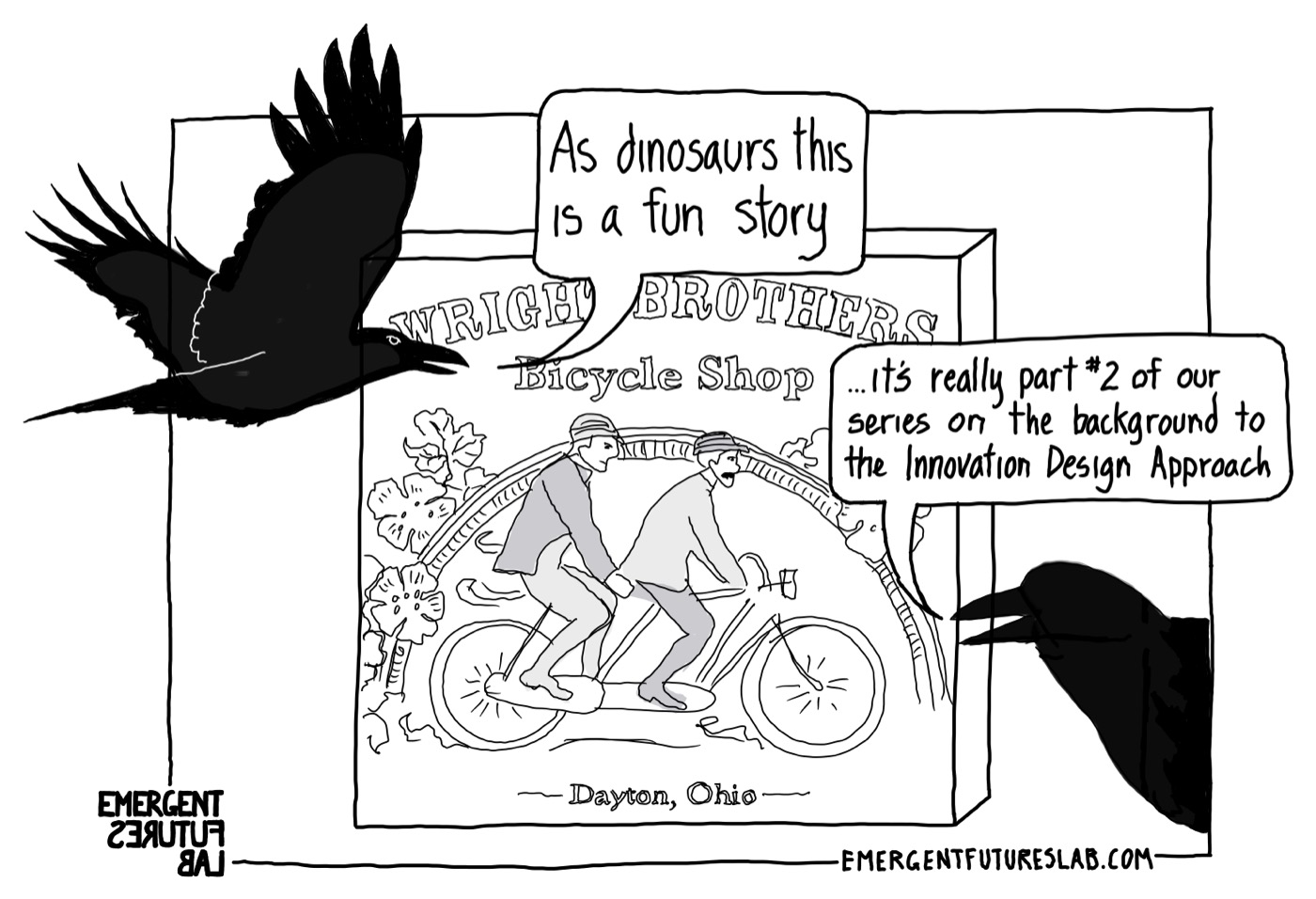
And like the last two newsletters, this newsletter has its immediate origin as a presentation that we gave in the Worldmakers community of practice last year (you can find the full presentation and discussion here). While it has its immediate origin in a presentation – it has since evolved in its own unique ways.
The reason we wish to take two newsletters to tell this story – beyond the fact that it is a long one, is that to understand the problems with how we tell innovation stories and how this connects to the desire for magical simple direct methods – we need to both slow down and add a conceptual context and tell the “same” story from differing conceptual perspectives – and this just takes longer. (It is also fun to end the newsletter with a bit of a cliffhanger!)
Conceptualizing an Innovation Beyond these newsletters being derived from a lecture – this experiment has another possible catalyst: a few years ago Jason and I were introduced to an innovation consultant who approached innovation from a perspective that recognized the importance of architecture and environmental design. We were excited to meet, as for us the built environment plays a critical role – we are, after all, embodied, embedded and extended beings – where the embedding and extended very much creatively transform how and what we can co-emerge with.
Upon meeting and after all the enjoyable banter came to a natural end, they shared a project they were working on – it was a design for an innovation lab based upon their understanding of what made the Wright Brothers succeed where others had failed to be the first to fly a motorized heavier-than-air machine. And this project further excited us as we have been interested since forever in the long, globe-spanning complex history of the innovations that led to the world of human heavier-than-air flight.
The design was interesting, incorporating many salient features of the Wright Brothers' processes – but we were puzzled by the exclusive focus on the Wright Brothers. We felt that it was important to point out that within fifteen years of their first successful flight, they were no longer making any airplanes and ultimately contributed little long-term to the evolution of flight as we know it today. For us, this much larger ecosystemic context was relevant – after all, the innovation of flight went far beyond the work of one innovation team. He was puzzled and frustrated by our response. For him – and for many others it seems – why would one not focus on the special creativity of those who got there first?
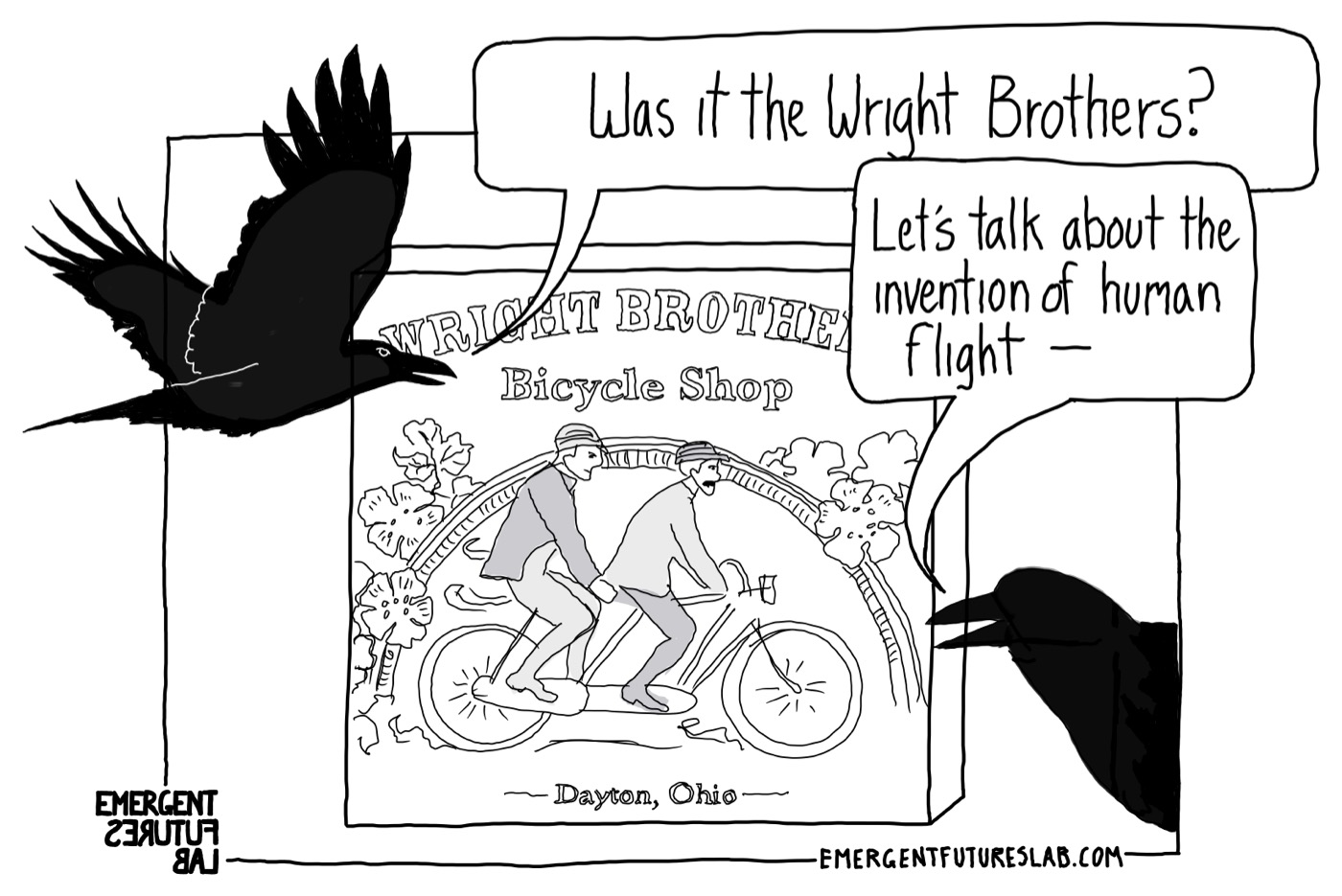
After that meeting and its very interesting discussions of how, why, and where we draw a frame around an event of interest – we realized that the story of the invention of human flight is an ideal one to critically investigate and tell in a differing manner to explicate differing approaches to engaging with creative processes.
And so we began with a few initial questions: Was it really the Wright Brothers? Why are we so focused on them? What are the methodological consequences of this focus? Why is it so hard to tell ecosystemic stories? This became a presentation and workshop we have given in a number of differing ways – and with further experimentation and curiosity, this two-part newsletter series:
As this meeting with the Wright Brothers inspired designer (and many others we have had over the years) made amply clear to us – implicit in most creativity stories, is a series of storytelling conventions that are now so ubiquitous that they have become a type of invisible second nature. They are now so intertwined with actions and storytelling practices that almost any time we, as a culture, are faced with a creative outcome, the explanation follows the same logic. It is a logic that we have detailed often (and most recently in Volume 249).
It’s the de facto narrative form that creativity takes in the West:
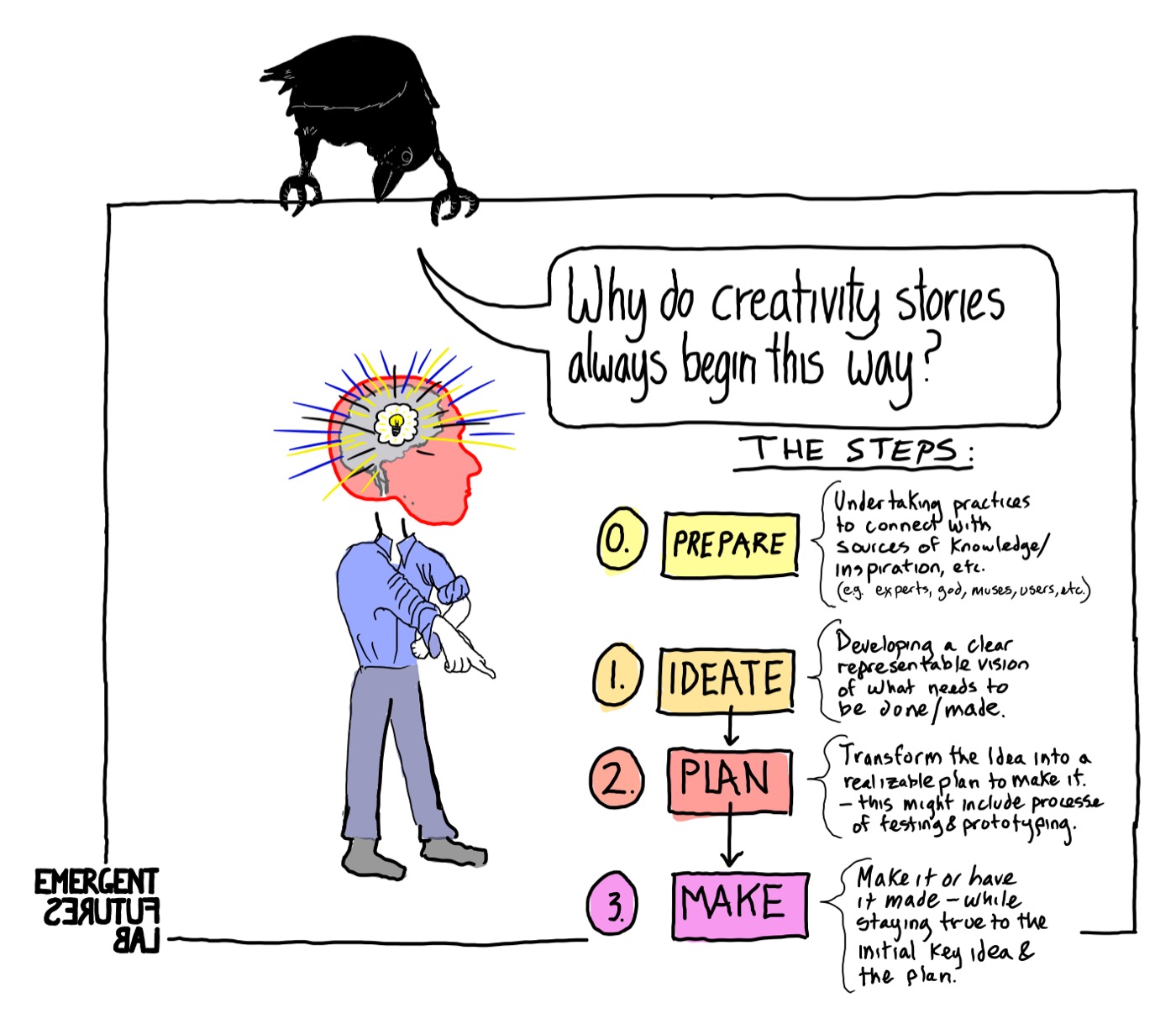
– the lone individual seeking inspiration and ideating their vision, which leads to a period of planning and eventual making against all odds.
A lone human plus this linear process. Why is it ubiquitous? Is it because it is accurate? Contrary to what many an expert or popular film might claim – it's not ubiquitous because it's correct – that much can be ascertained from many fields – from the earth sciences to evolutionary biology to the complexity sciences and more specifically in our immediate context to an understanding of novel emergent processes.
These arguments can be made by focusing on two of them:
One: If creativity is any process that results in the production of novelty. Then it cannot be reduced to the realm of humans. We find creativity everywhere and everywhere ongoing – from the Big Bang to the evolution of multicellular life. Human creative processes are ones that ultimately always collaboratively engage with these ongoing creative processes that they are never separate from.
Two: In Newsletter 249, we used one of our favorite analogies (from Even Thompson) to demonstrate why creativity cannot be reduced to the agency of any one thing – or treated as something that could be possessed (e.g. a brain region, a person, or a conceptual moment, etc.). Thompson asks: Consider a bird in flight – where is “flight” located? The essentialist answer is that there is an essence to flight and that it must be located in some “thing.” It must be some where. Is it in the wing? In the feather? Is its essence deep in the bird's thoughts, neurological instincts, or DNA?
But – you can look as carefully as you like and you won't find flight “in” the feather – or anywhere else. The logic that there must be some key singular source somewhere — that's an essentialist trap. And it will not help us understand how flight comes about. Flight does not have its source in any one thing – flight cannot be found “in” any thing. It is an emergent property of a distributed relational system – that cannot be found in any of its component processes.
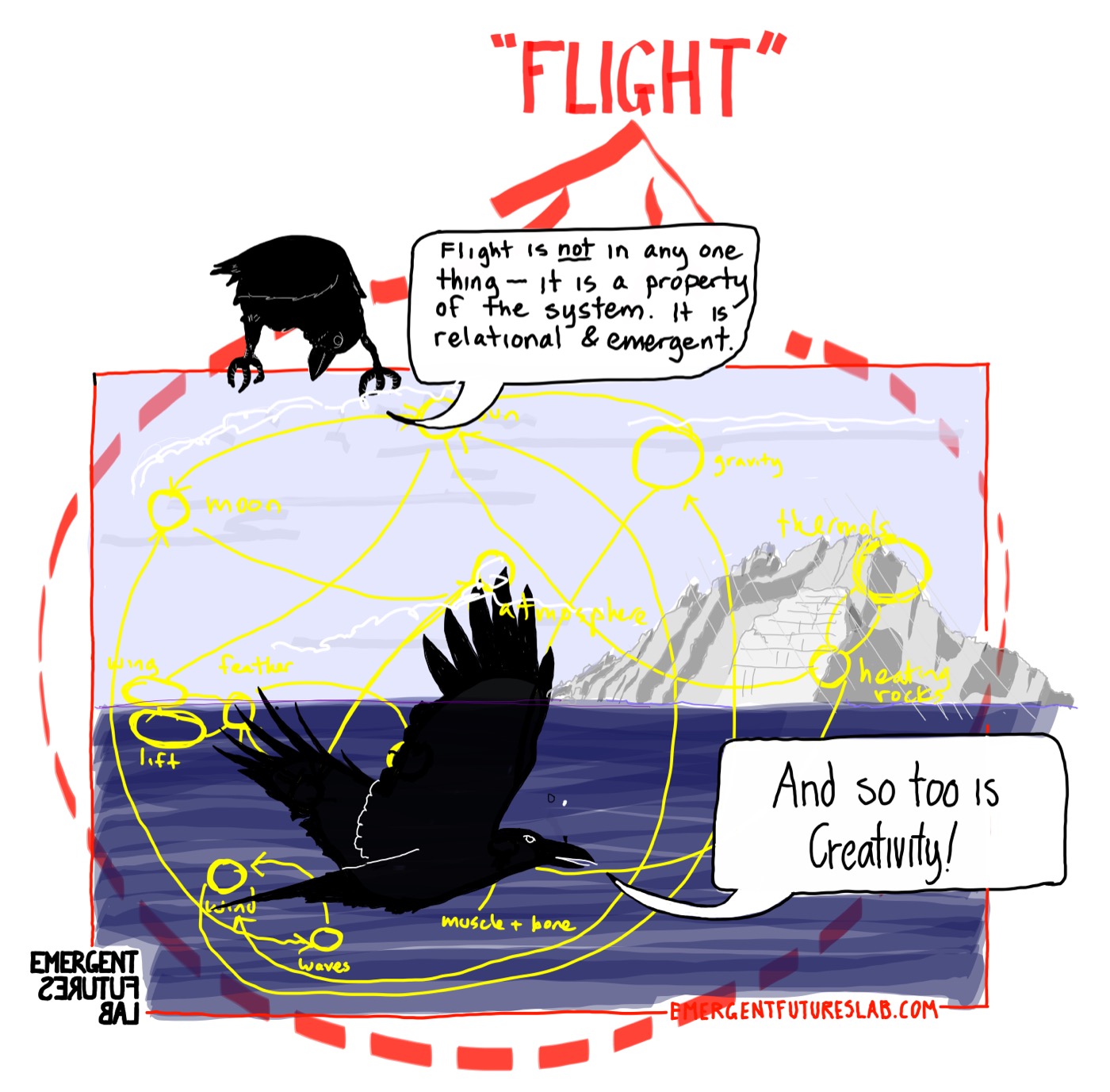
And so too is creativity. Broadly speaking, novelty comes about in both human and non-human contexts via emergent ecosystemic processes that cannot be reduced to a single moment, thing, or agent. Causality is distributed – relational – ecological.
Flight is a process of getting a grasp on the creative emergent relational propensities of a dynamic ecosystem and being able to enable, stabilize, expand and transform relation fields of propensities in an ongoing manner.
Again – so too with creativity.
To meet such a reality – we need to become curious for new narrative forms and ecologies of practice that can help us experimentally engage with emergent creative processes that have nothing in common with the individualistic linear and human-centered assumptions of what creativity is and how it works. For us, this means becoming curious about and engaged with forms that pay attention to non-linear, ecosystemic and emergent creative processes and the propensities that they give rise to.
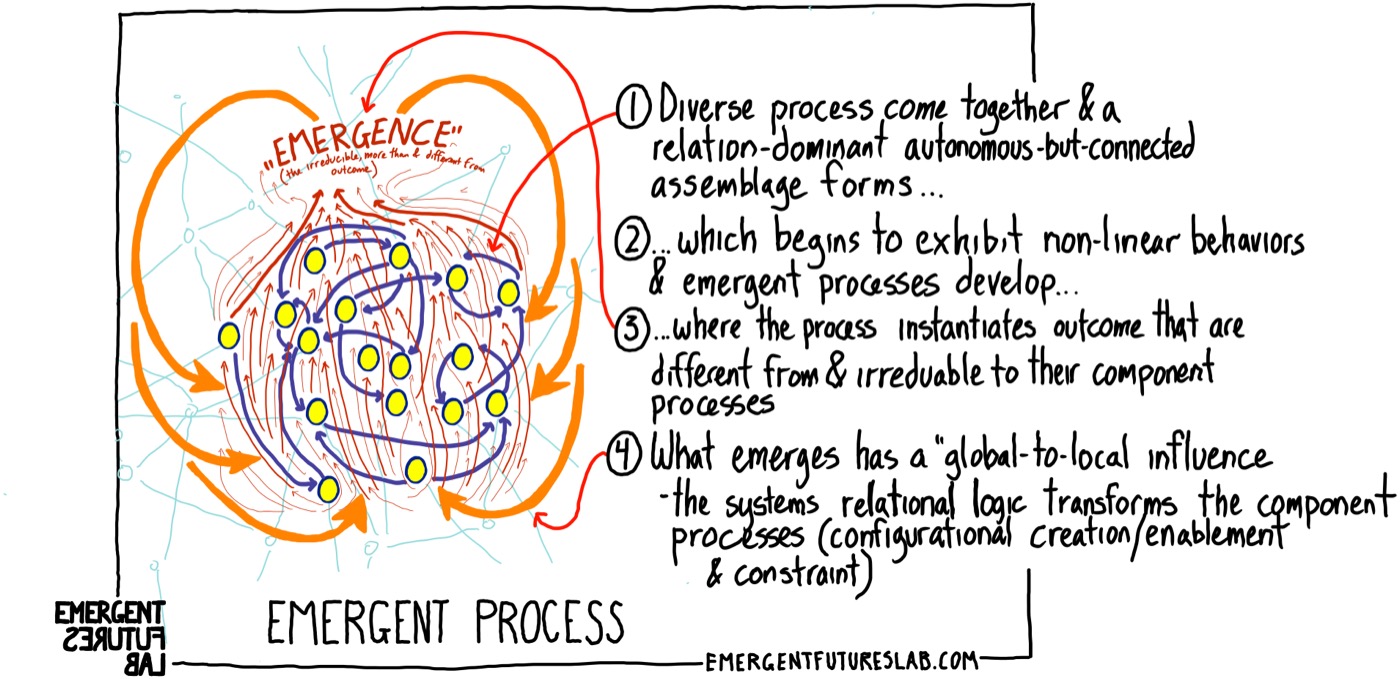
We are interested in stories that can get at the poetics of loopings upon loopings of highly distributed more-than-human feedback systems – ones that integrate heterogeneous multi-scalar processes into relation-dominant networks that are co-creatively working in real time, at different timescales, producing outcomes that could not have been predicted directly from the components alone.
How can our narrative habits meet the fact that complex systems – which is to say, all lived reality – are relational and emergent through and through?
How do we actively conceptually engage with relation-dominant assemblage that emerges in a bottom-up fashion as something novel and irreducible to their component processes and will eventually transform these component processes? Where are the stories of a creativity that emerges from the middle? What is the narrative logic for a creativity process where there is no outside from which a plan is imposed, and no inside from which an essence radiates?
Our hope is that there is an end of the road for the practices, ecologies and narratives that enact approaches of simple linear causation in complex contexts. To frame contextless disembodied ideation as a source of anything should feel beyond preposterous.
But as we should expect from a complexity perspective – nothing is ever that simple. So to come back to our question: why is the linear heroic story of creativity so ubiquitous? It is absolutely not because it is accurate. And while it would be exceedingly hard to say why exactly it developed in the West, again, this is to be expected from a complexity perspective) – what we can say is that it has a history.
The logic of human creativity as the practice we are now familiar with first emerged in the West beginning in the late 1700’s and early 1800’s. Prior to then, in the European context, only god could be actually considered to be creative – while humans could, with great effort and grace, gain insight into god's plans and carry them out. This human creativity emerged within the context of the recent emergent invention of capitalism and the related creation of new forms of individualism. The tropes of the “self-made man” and the artistic “genius” creatively emerge during this period in tandem. And they both emerge bearing structural similarities to much older theological script that itself emerges from Greco-Jewish dialogues going back to Alexandria in the second century BCE. It was here that we find the first creation in the Abrahamic theological traditions of the logic of a creator “that did not make creation out of things that existed – unformed chaotic material, but summoned creation out of nothing” (D. MacCulloch). \Note: a very good essay on this history is [The Invention of Creativity: The Emergence of a Discourse. by Camilla Nelson].
This particular theological model of creativity – the heroic individualistic making of something from nothing – from ideas alone – becomes a model that shapes the western conceptualization of human creative actions.
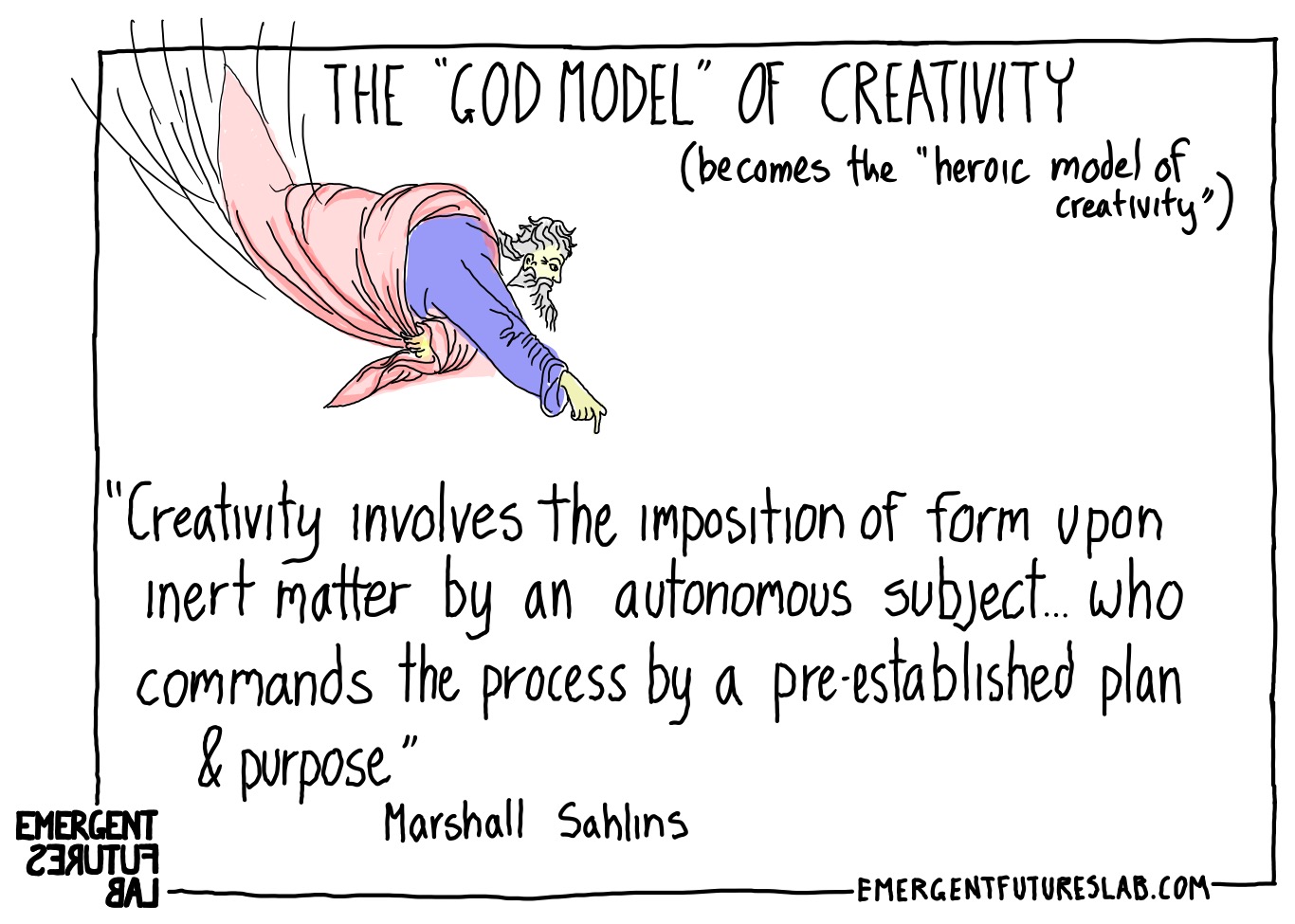
As the anthropologist Marshall Sahlins so precisely articulates this historical and ongoing logic when describing the Western mode of production (e.g., creativity):
“By our naturalistic sense of things, production is… a “heroic mode of creation” involving the imposition of form upon inert matter by an autonomous subject, whether god or mortal, who commands the process by a preestablished plan and purpose. This scheme of action is a combination of an ingrained individualism and a naturalistic materialism.”
When we ask “what is creativity?” – we need to pay attention to where the answer comes from – we need to be paying a lot more attention to the historical patterns of storytelling that are being deployed – what are the scripts? And where do they emerge from?
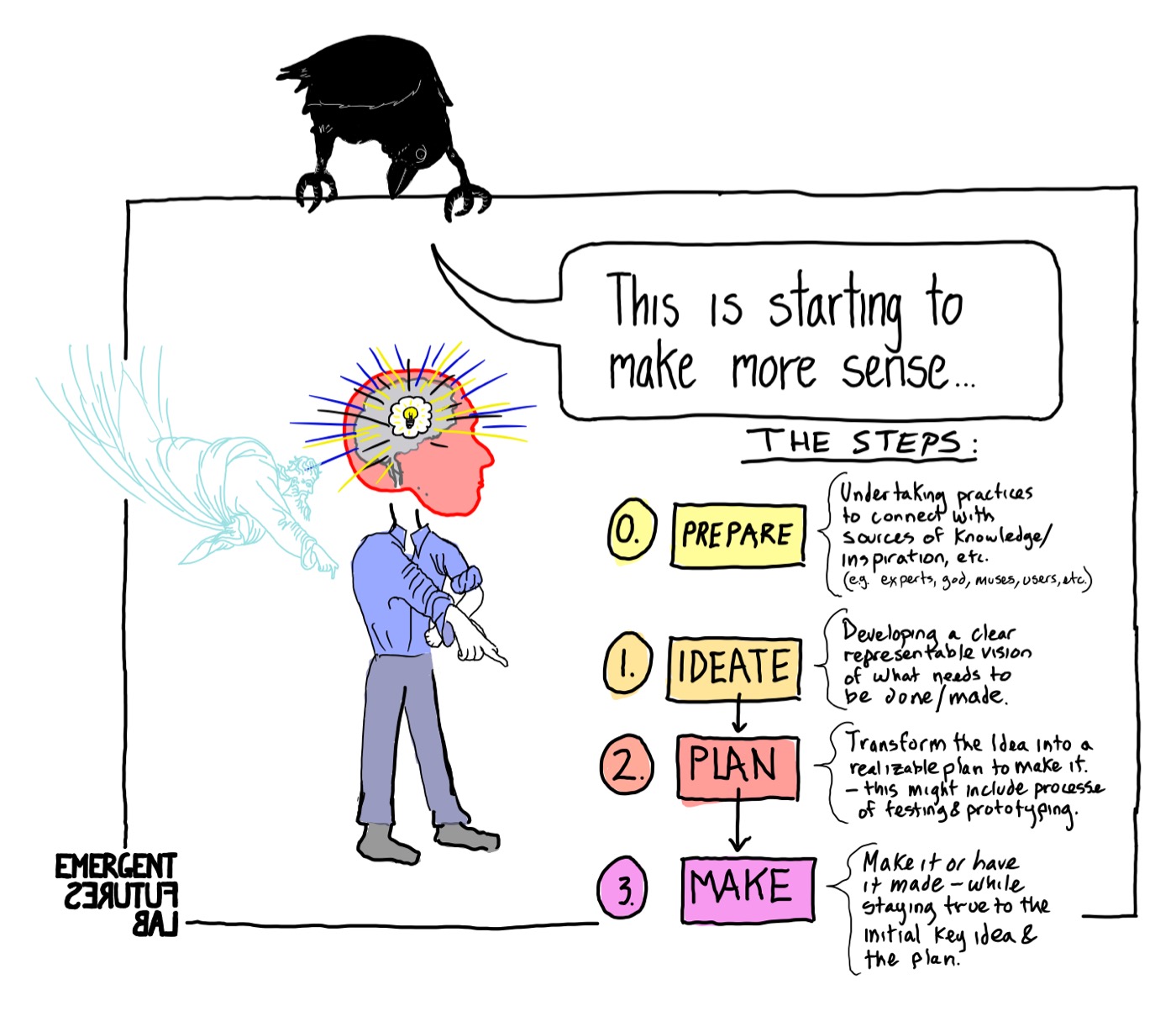
This Western creativity script historically developed to begin with a specific implicit assumption: that creativity is human, that it's individual, and that it begins in the mind as an immaterial idea. And this idea is not just a starting point, but it is the essence of the whole process: some immaterial, unique, and novel idea arising in the brain is what propels everything forward.
What's implicitly embedded in this linear anthropocentric model – and can be easily overlooked is twofold: (1) creation involves imposing an immaterial concept onto passive matter; and (2) the outcome is always judged solely in reference to how close it is to the original idea. What's actually made is treated as a copy, closer to – or further from the pre-established source. The ideational origin remains the unchanging origin, essence and reference throughout.
To begin a process with an idea of what the end form should be, and to end with the same idea as the measure – signals a profound failure of the imagination to imagine that things might emerge that qualitatively exceed what can be imagined, ideated or conceptualized. And this reveals an approach to creativity that does not recognize change-in-kind – that does not recognize that difference is something other than a difference-in-degree. It is an approach to creativity that disturbingly has no understanding of the existence of radical differences that have nothing in common – in short it is oblivious to the radical nature of change-in-kind. Ideational approaches to creativity are failures to recognize the radicalness of contingency – things in the future can be totally otherwise.
All explanations of creativity are in this way also explications of a causal ontology. And the heroic imagining of creativity is closely tied to an ontology of causality where the outcome, what is caused, ultimately comes from an unchanging essence.
The logic of causal essences is expressed via visual tropes of depth. Where what is deep is a buried or hidden core from which things radiate outwards: russian dolls and things to be peeled layer by layer – till we get down to the real authentic kernel, seed or core.
From a narrative perspective, the most general visual trope deployed is what we fondly call the “onion model.”
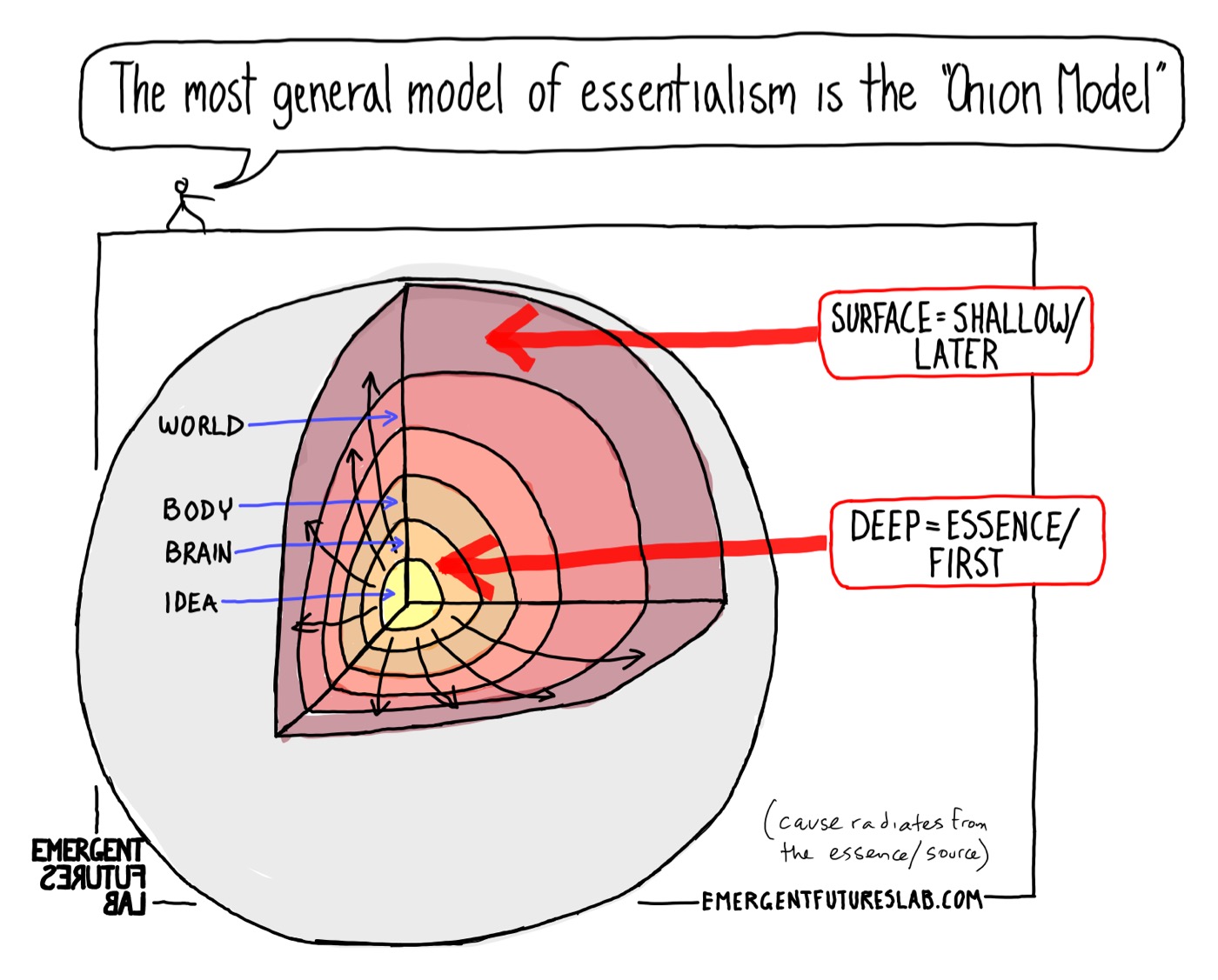
We can see it play out in relation to creativity: the idea sits at the center – for it is the essence, and then layer by more superficial layer we move outward: the brain wraps it, the body wraps that, and the world is the outermost layer.
But it is not just in relation to creativity – our most common causal answers are equally essentialist and reductionist – consider genetics, string theory, human nature, etc. Everything can be reduced to some essence from which things radiate outward.
A relative of the onion metaphor and its nested logic is the pyramid with its vertically layered logic.
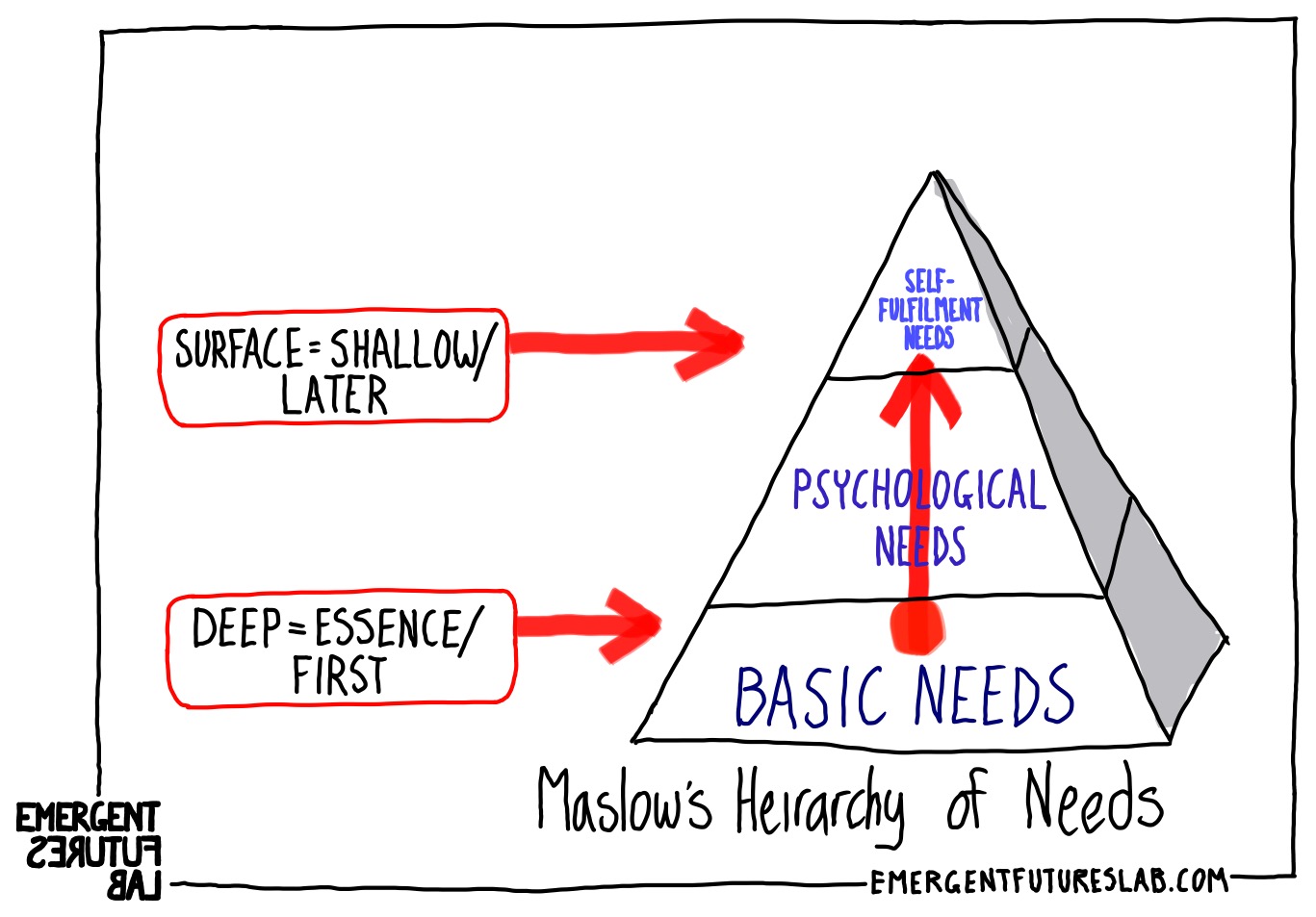
Things causally and creatively build up layer by layer from unchanging essence to the less critical levels above. Maslow's hierarchy of needs is exemplary in this regard. Something basic, something essential, sits at the foundation. The more elevated needs are the more superficial ones. Structure runs from essence to surface.
The painful irony is that these logics are so fully interwoven into how we approach both creativity and causality that many a complexity researcher and consultant will, despite knowing better, still neatly stack things:
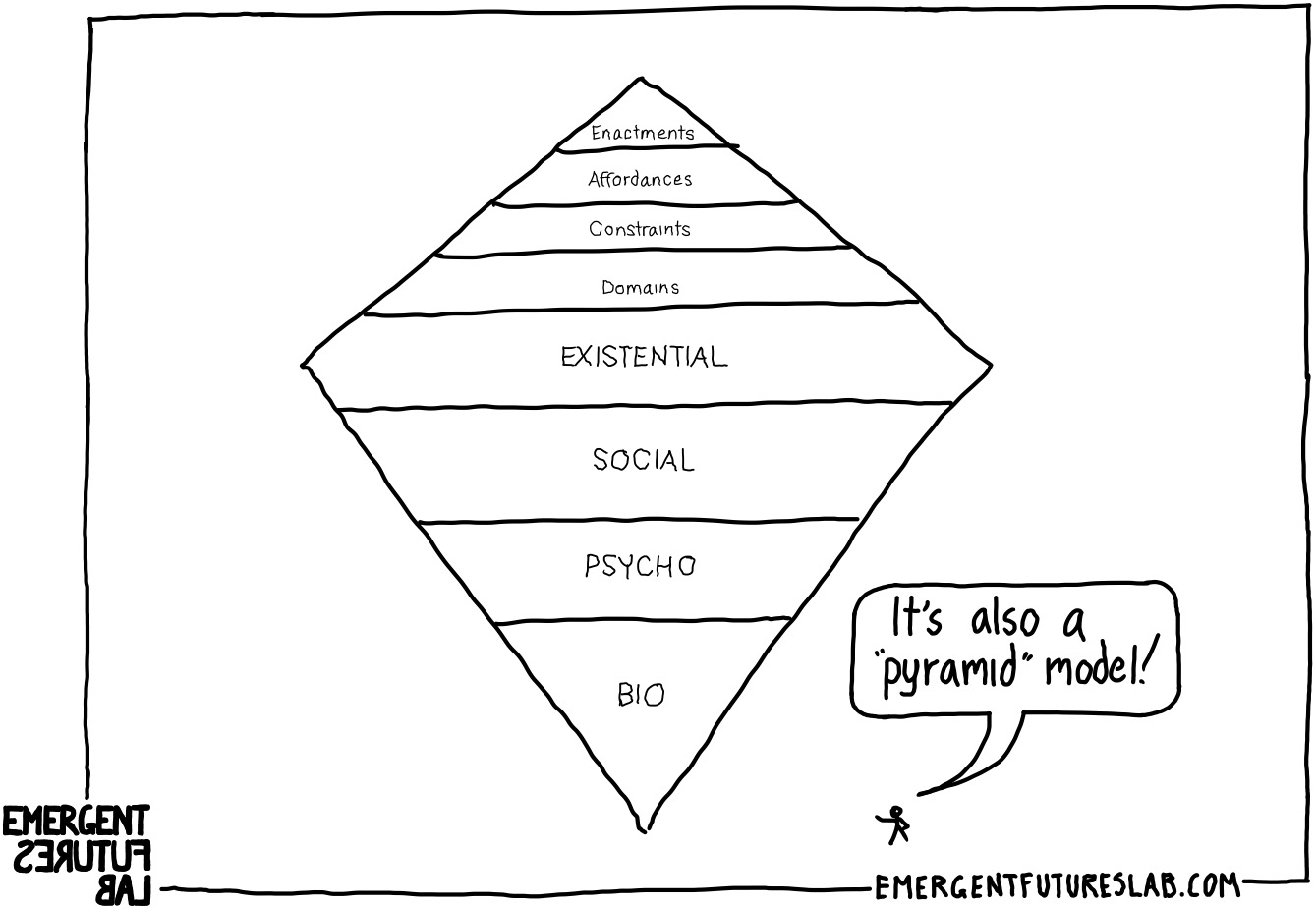
Here we see a model where systems causality (constraints) and affordances sit on top of a vast layer cake beginning in the biological. This preposterous layer cake is built without noticing that even a basic understanding of system causation would make the above approach obviously spurious. The social does not “rest” upon, or “build up” from the biological. Complex systems are not additive in the sense that one thing builds up the previous in a neat and reversible manner. When some thing joins something else in a temporal sequence, they enact a co-transforming emergent network that leaves no part unchanged. “But “biology” is not a separate realm to which you add "culture" to end up with a human being… The somatic and the social are not separate levels but processes linked in a spiraling interweaving of temporal scales… We are “bio-enculturated”...” (John Protevi)
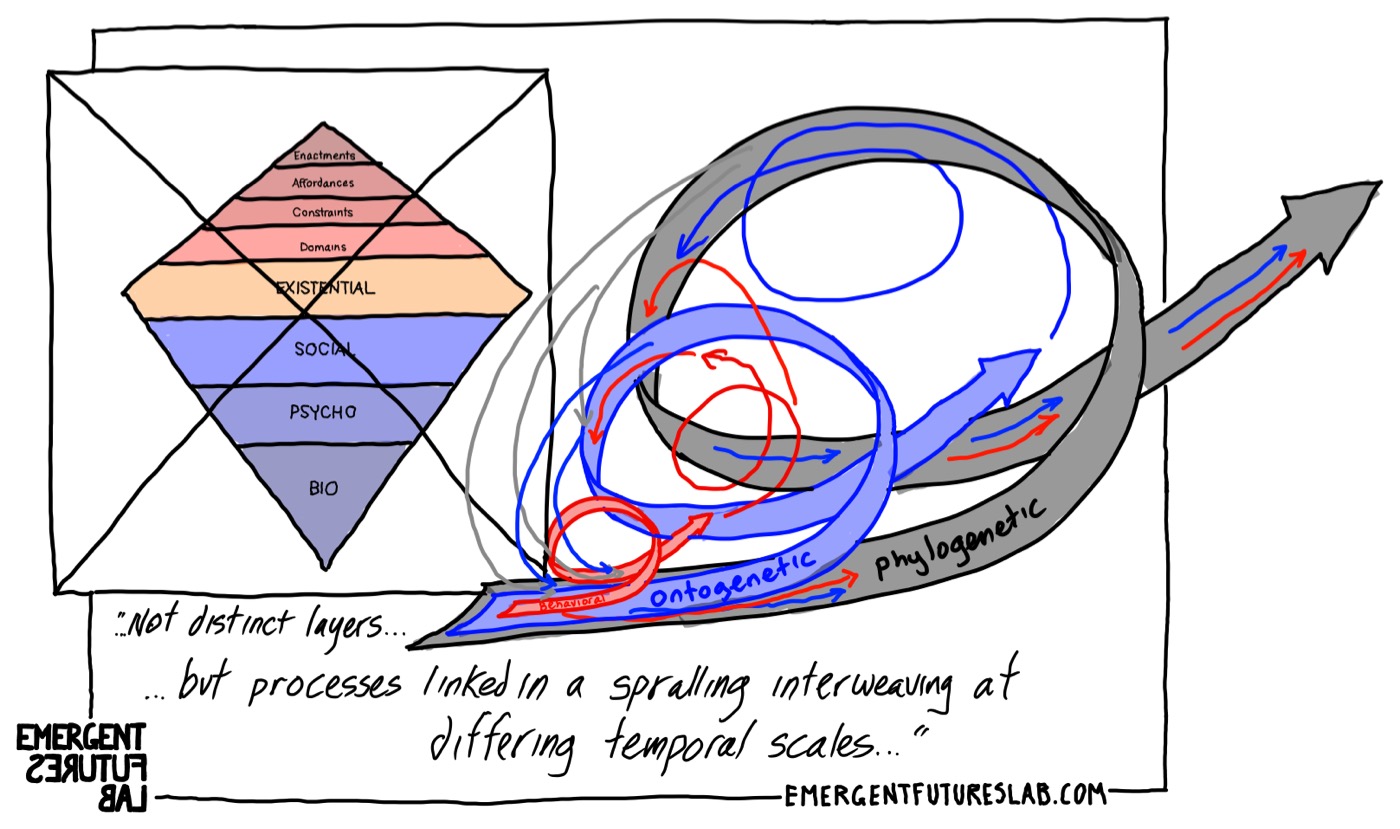
These catalytic tropes – visual and otherwise of depth, essences, and layers, while powerful and ubiquitous, are patently false in regard to complex systems. And this gets at the challenge – while we are developing powerful dynamic ecosystemic approaches – we are still falling back upon a set of problematic historical tropes in an unreflective manner.
Here is one last example of this phenomenon: Systems approaches have developed more recently as an alternative to linear causal explanations. Systems thinking tries to come to terms with the complex distributed patterns that shape reality. But, as systems theories' favorite visual tool, the iceberg, demonstrates – essentialism and reductionism are hard to shake:
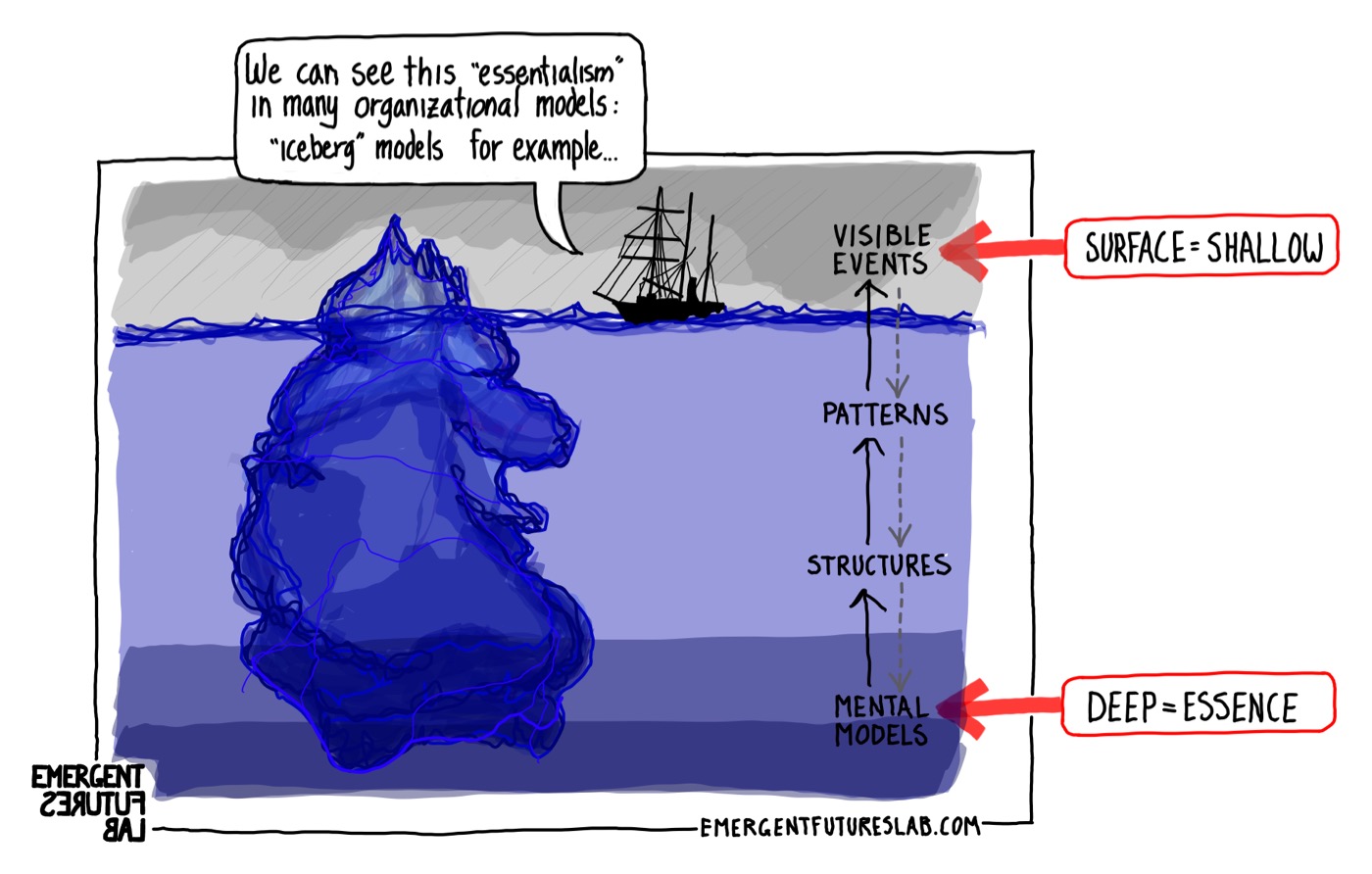
The argument the iceberg puts forward is that there are visible events above the surface of the water, while hidden from view are patterns, and still deeper are structures. And then go deeper and we are back to reductive essences: some mental model, some version of human nature, rest deep below driving everything that occurs above it.
From our perspective, this is where a great deal of the problem lies: We are unreflectively bending complexity, systems thinking and ecosystemic approaches back into the ontology of a reductive essentialism – and in doing so we miss their dynamic non-linear and emergent powers entirely (and if you look closely at our own we work – we too slip into these problematic logics… It is not that easy to work one's way towards a differing ontology.)
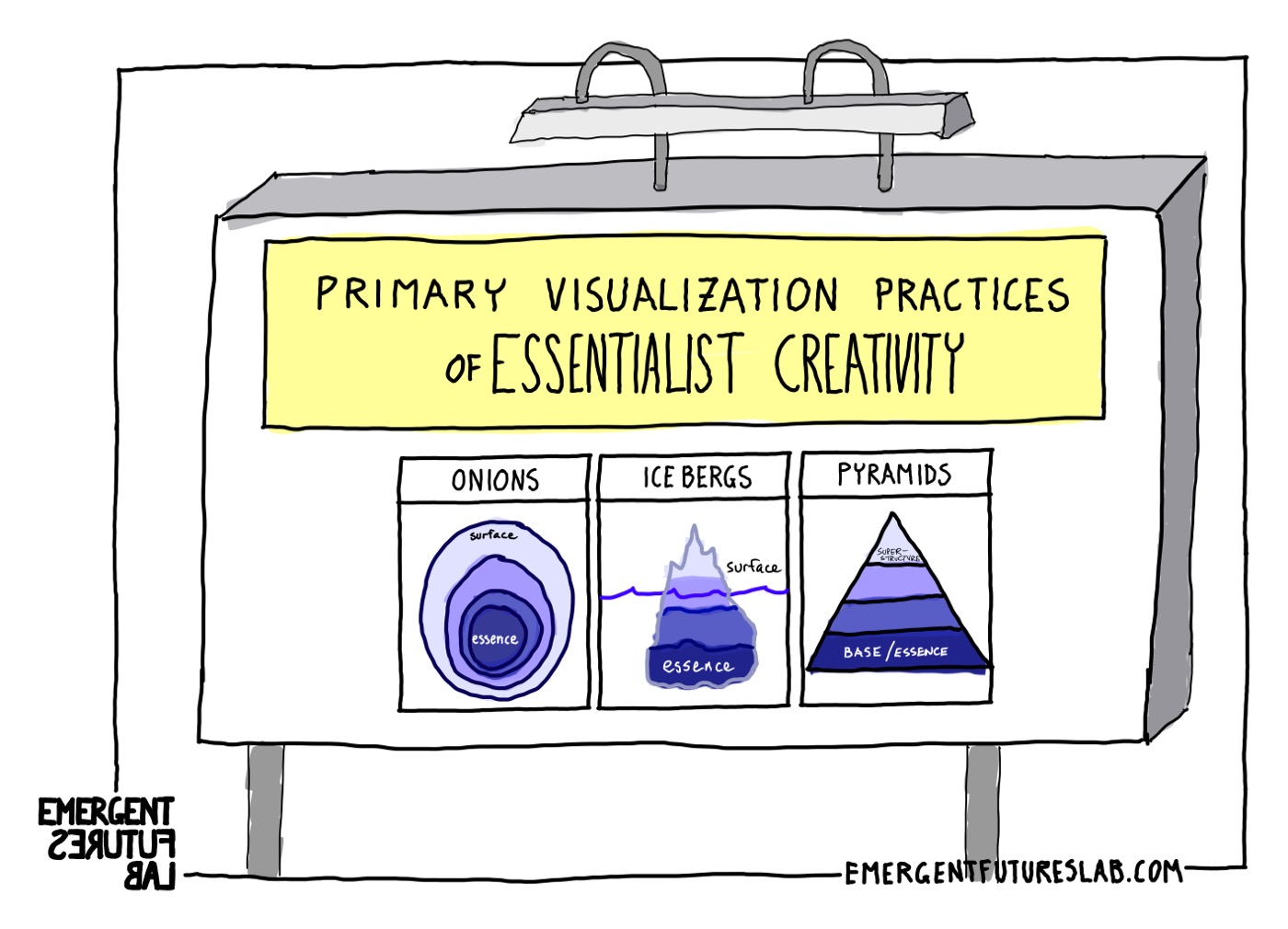
Onions, icebergs, and pyramids – these are three primary conceptual logics of an essentialist approach to causality and by extension creativity. But these are static models designed to explain the relation between the visible and the hidden, and the changing and the unchanging (more problematic visual tools). None of these address the processes by which things come about. And creativity stories are inherently stories about processes.
And this brings us back to our topic of investigating the long-standing heroic storytelling traditions and their causal process of creativity: What is the visual processual logic of: The individual getting inspired, ideating, planning, and making?
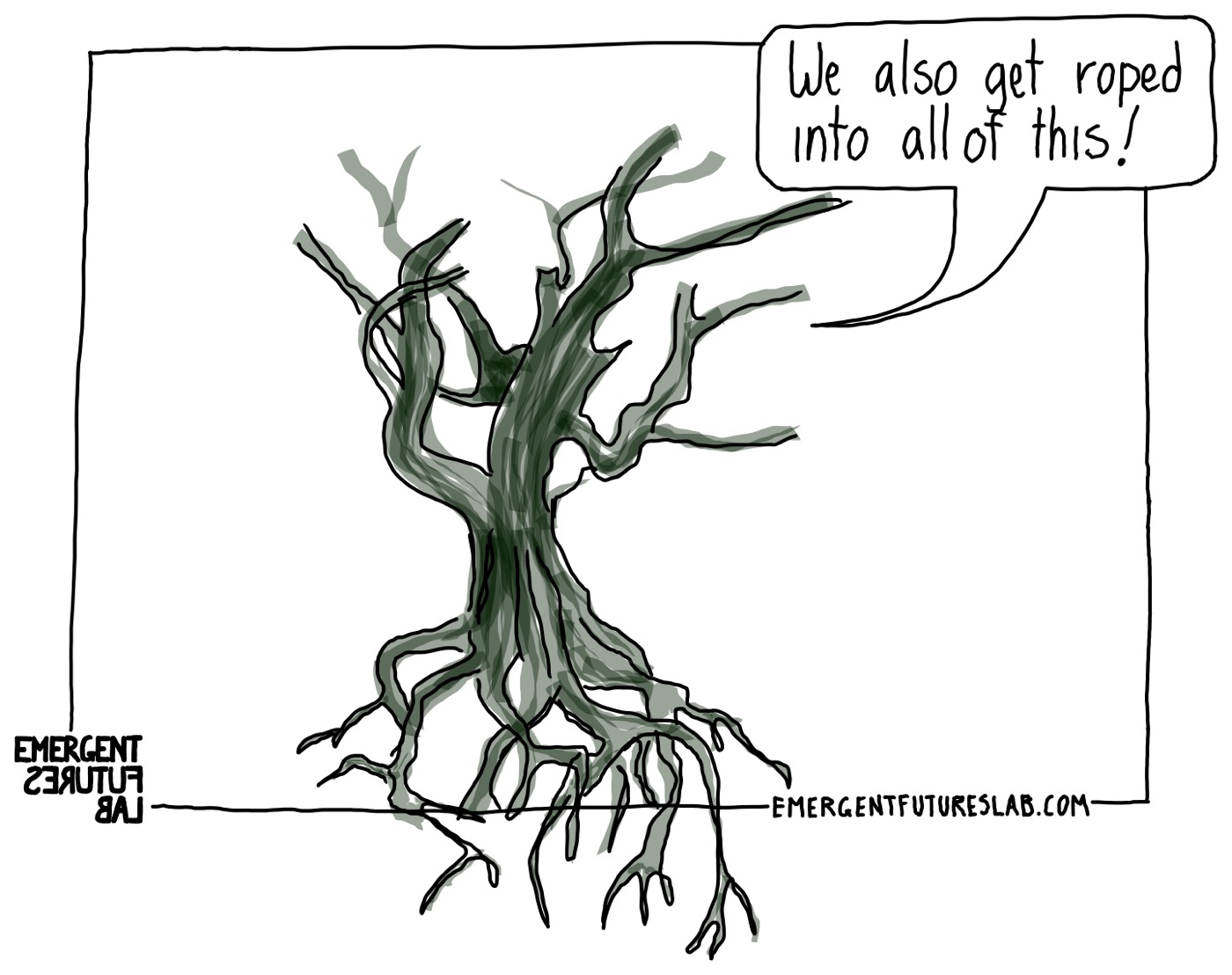
The most prevalent of these is the tree model. The tree model is about process, and not just structure. Guattari and Deleuze begin their great collaborative work on creativity, A Thousand Plateaus, with a critique of the tree and its processual logic: ”The Tree or Root as an image, endlessly develops the law of the One that becomes two, then the two becomes four…” And as they suggest, while trees involve the processes of convergence and divergence – they never stray from the “One” (here explicitly meaning the singular unchanging essence that is the source).
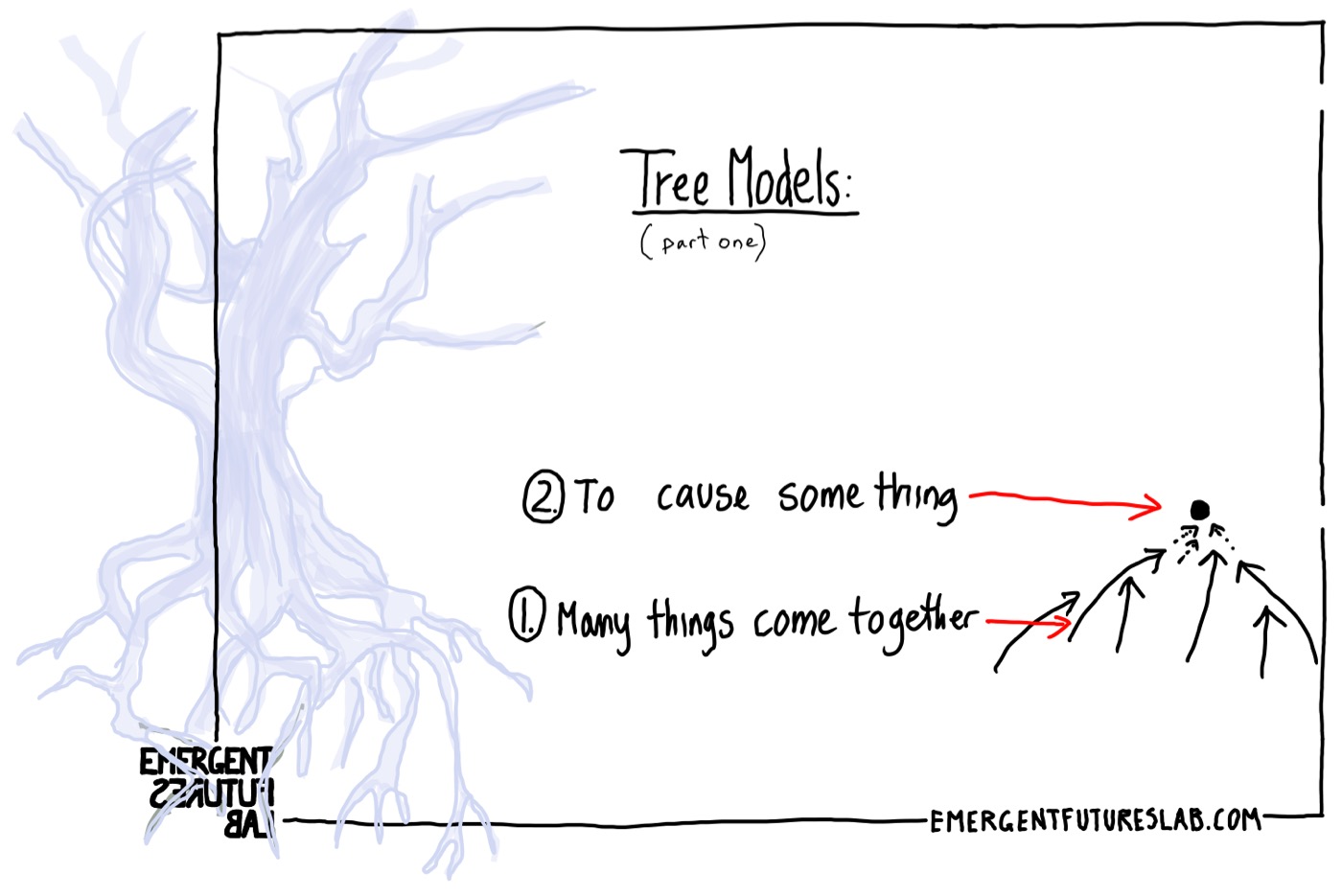
Many things converge — think of the roots — and give rise to an essence – the one.
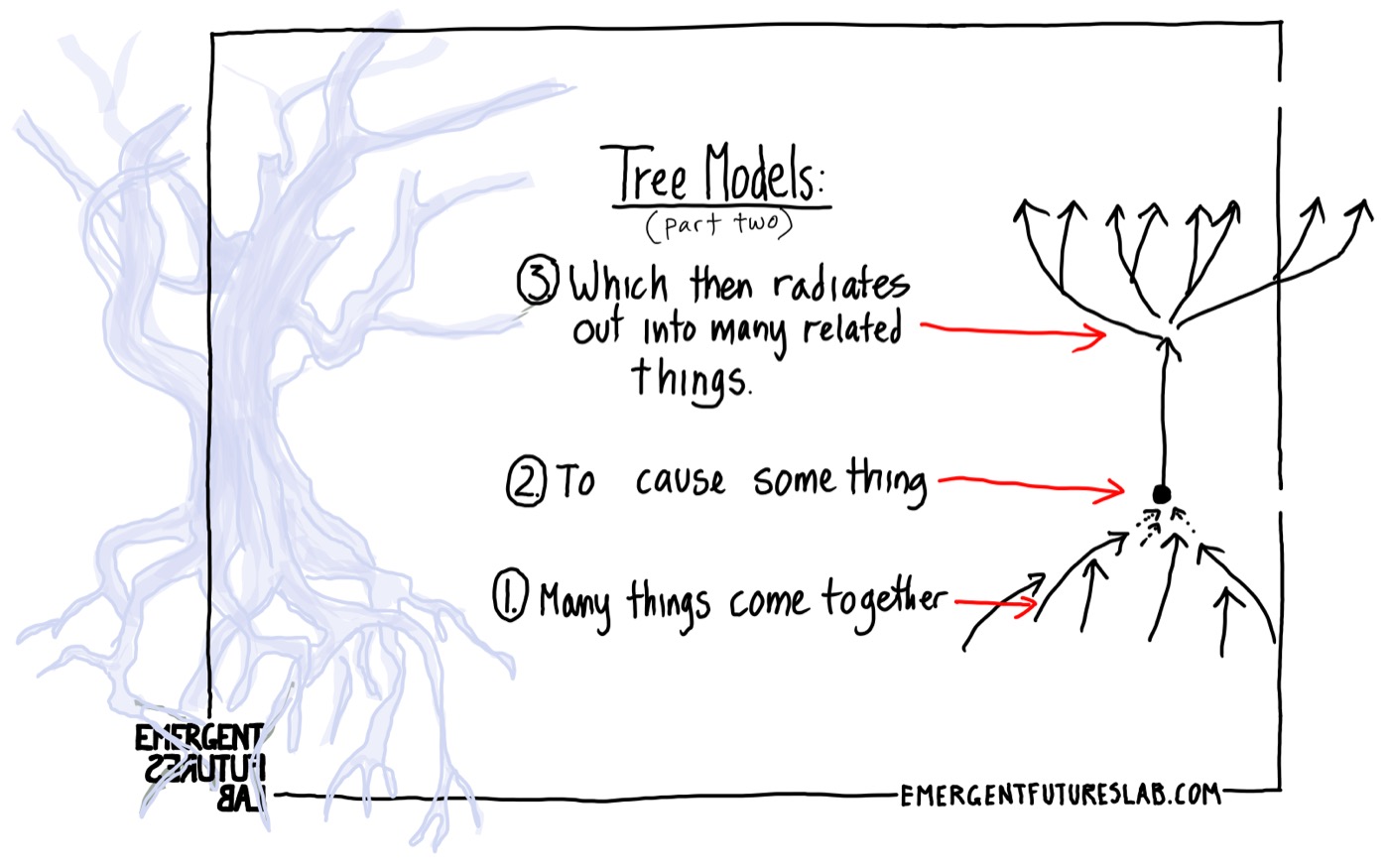
That essence then develops (the linear progress of the trunk) and radiates outward into all the parts (the change-in-degree branching of the “crown”).
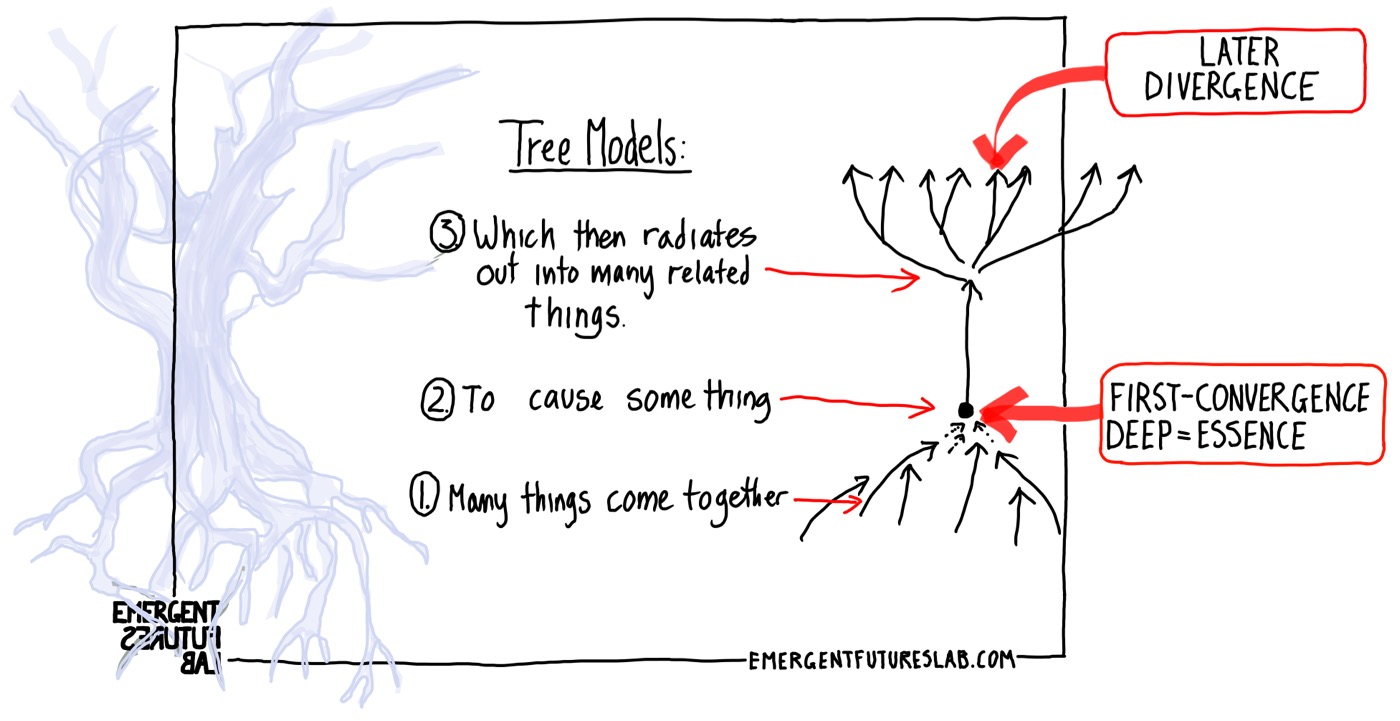
We have the essence logic – now moving through time in a manner that neatly articulates the heroic logic of creativity moving through time:
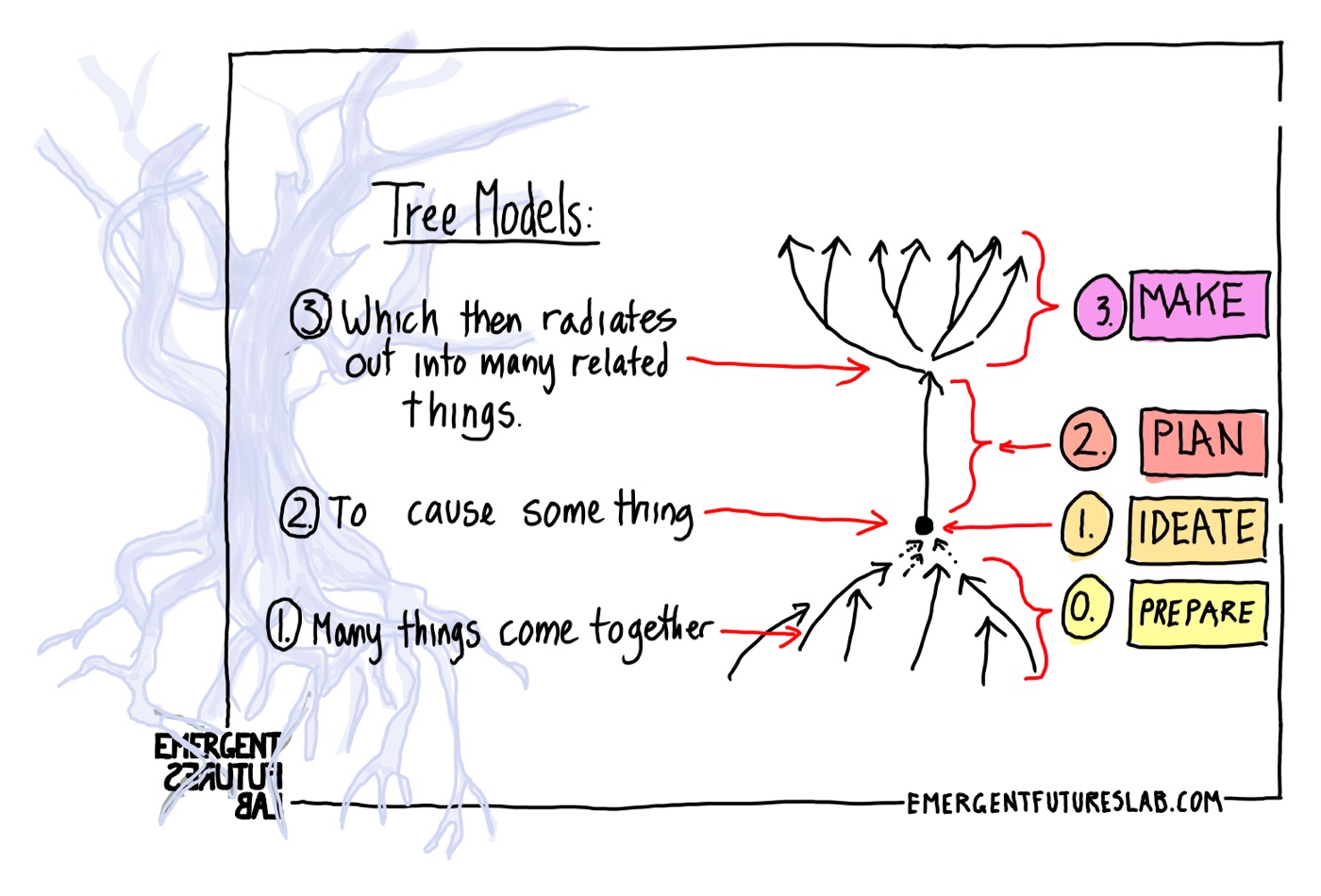
It is a process model that, as Guattari and Deleuze point out, cannot come to terms with genuine multiplicities (differences qualitatively differing)– never mind any non-linear highly distributed emergent logic. Our interest in the visual logic of trees is by no means academic. The tree underpins both one of the key tests of so-called individual creativity (the ability to do divergent thinking) as well as one of the most ubiquitous and successful models of the creative process – that of the double diamond. Major design and innovation councils treat the double diamond as the best – the “simplest and most reproducible" creativity process:
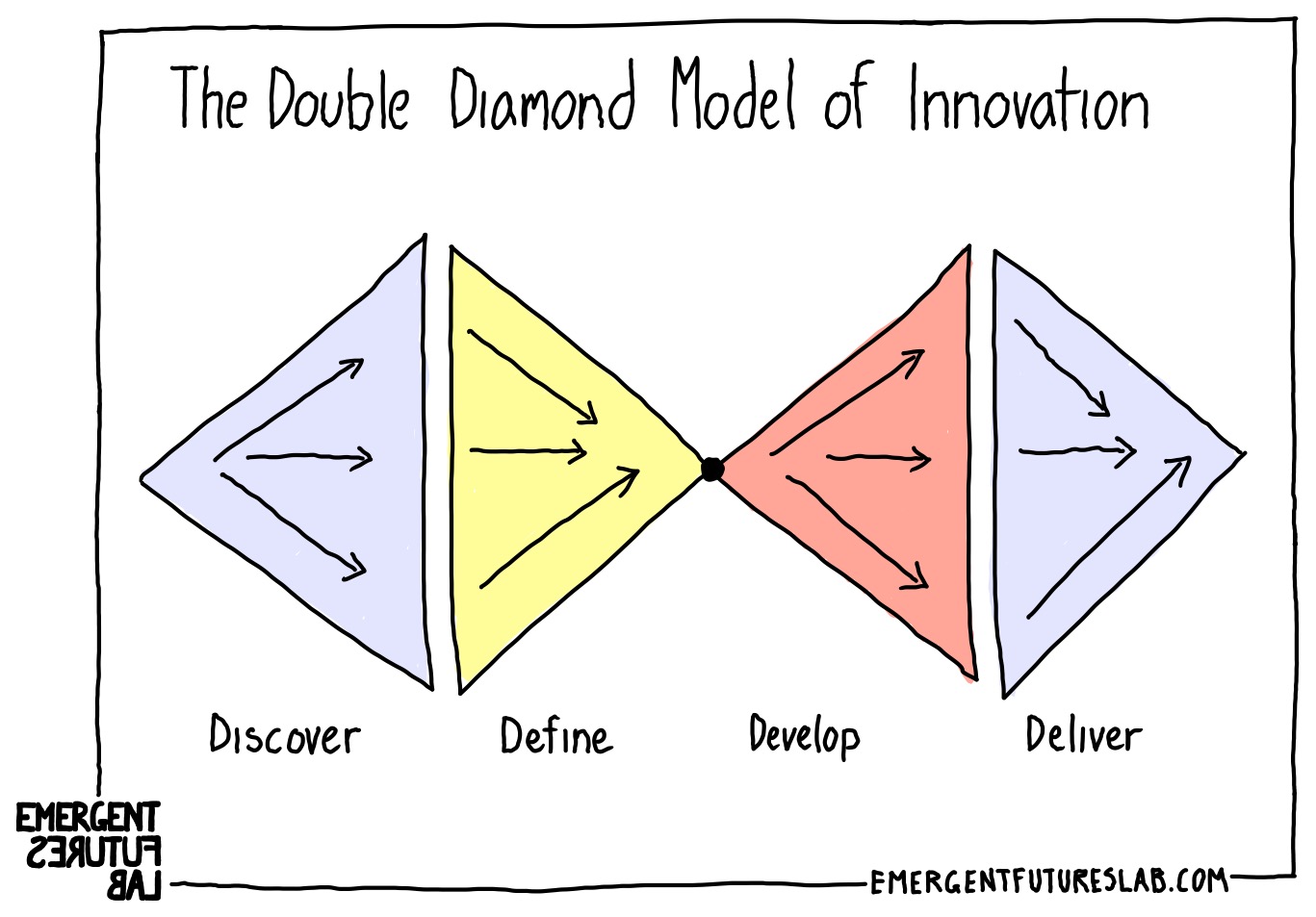
Notice how the divergence of discovery radiates out from a source and then converges back on defining a new essence. From which it then radiates outward in an exploratory development only to return to a new singular outcome. This could remind one of two things:
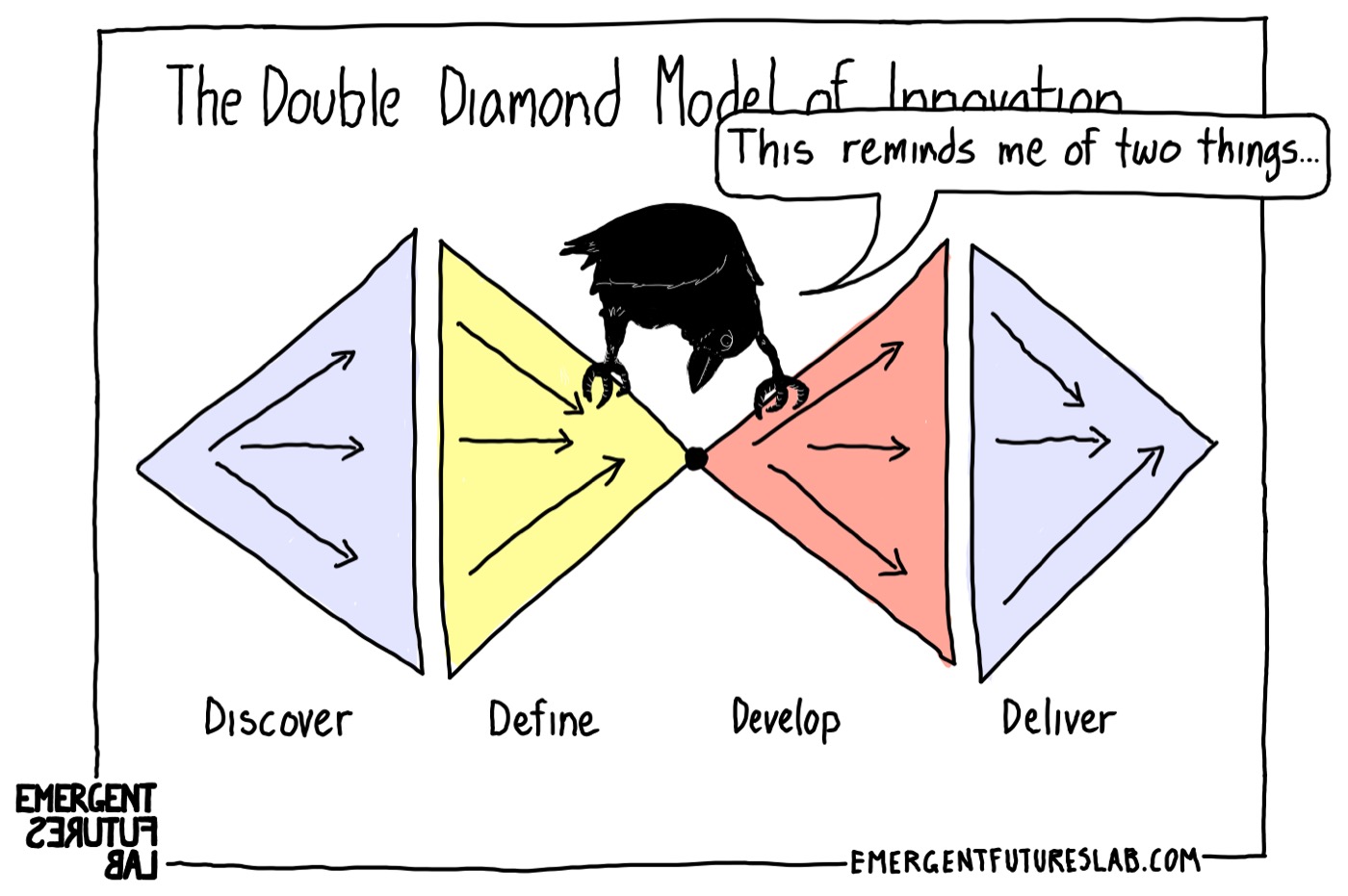
One: The double diamond model of design innovation — has four steps: discover, define, develop, deliver – and we have seen these before:
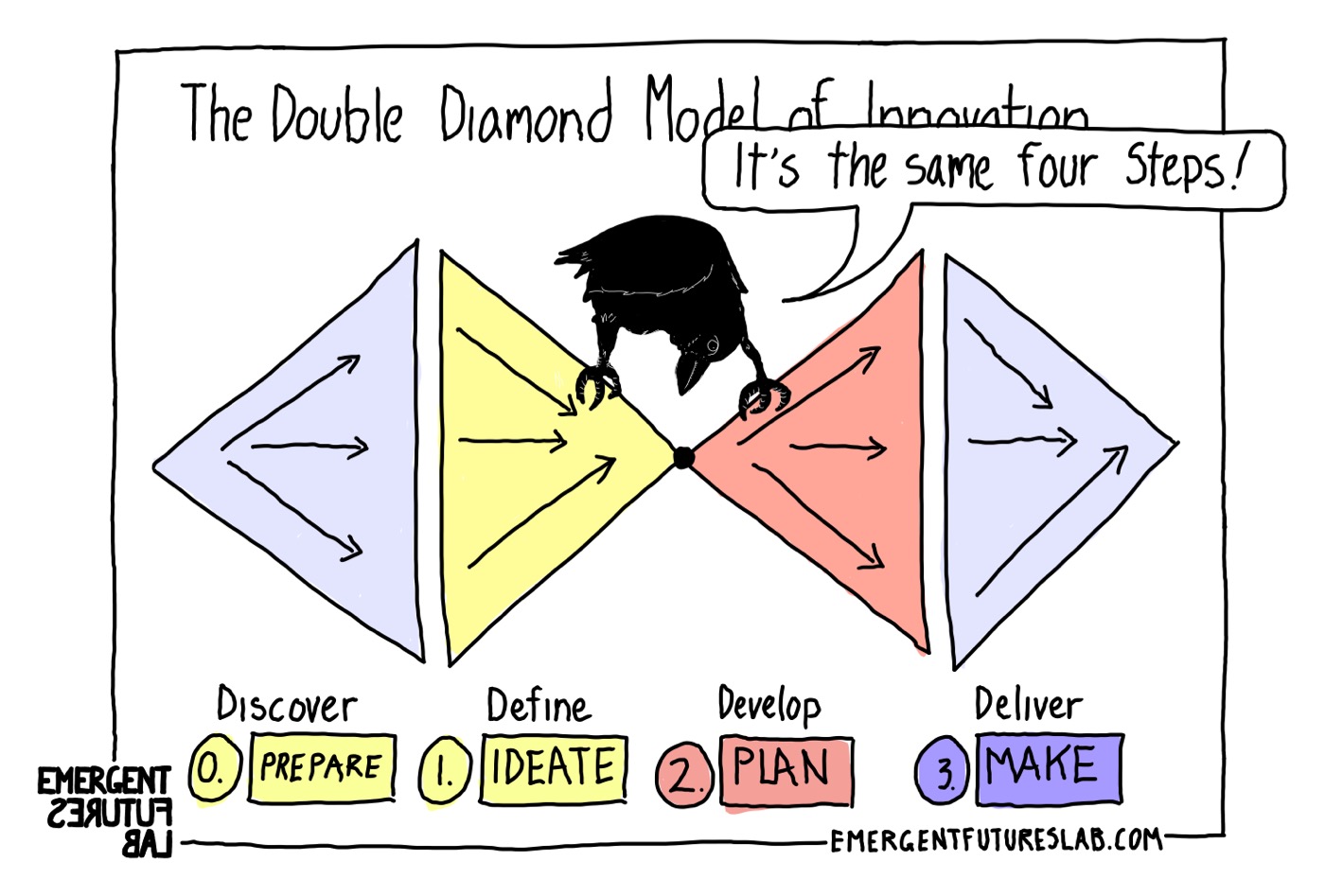
The double diamond is the same four steps as the profoundly problematic linear heroic model: prepare, ideate, plan, make. One could say that they just chose D words to highlight the diamond’s logic of divergence and convergence. This is essentialism as process: many things converge on the aha moment, the essence, and everything radiates out in the exploration of the essence – to finally converge once more on the ideal singular outcome.
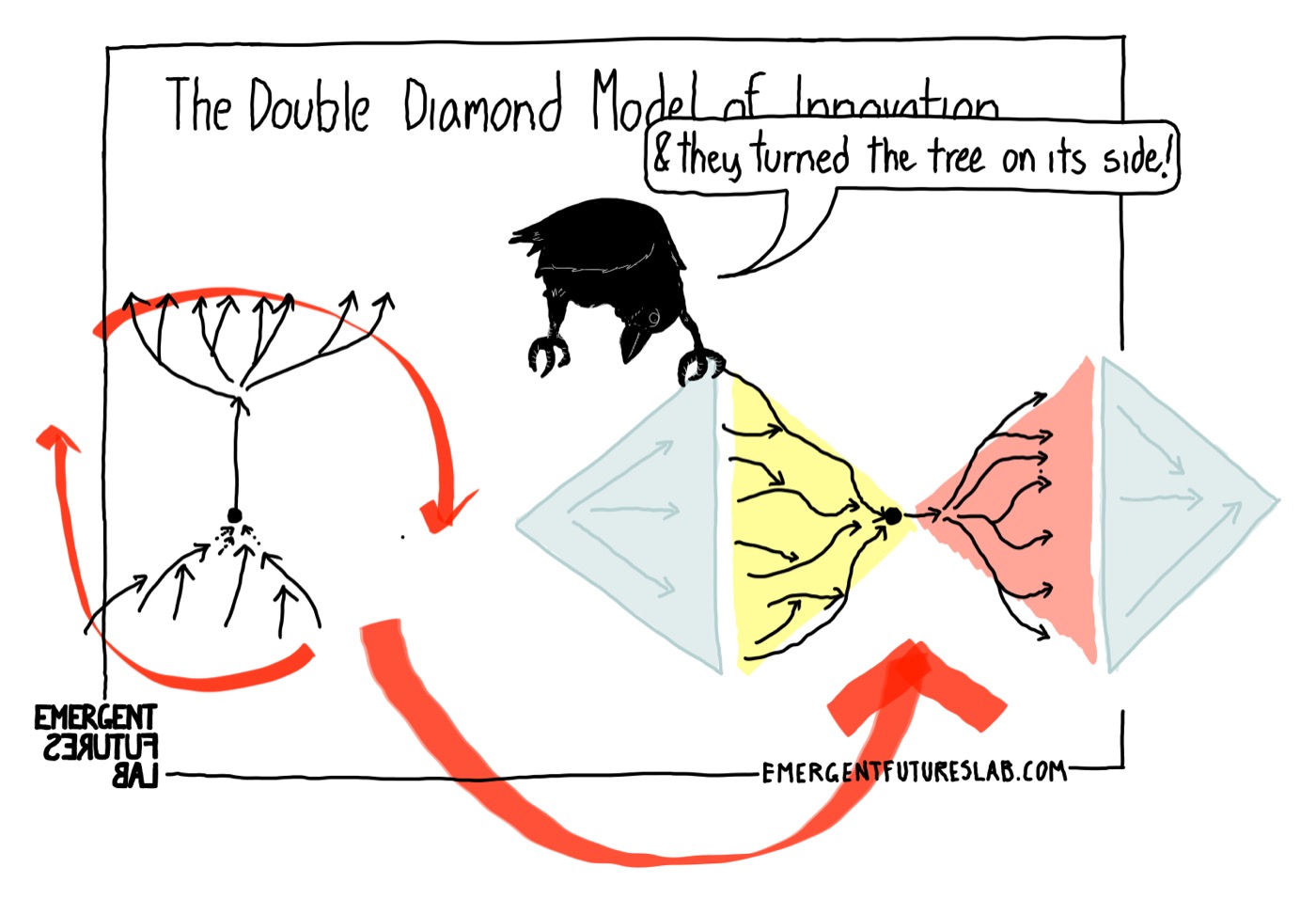
Two: When you turn the tree model on its side, you get the double diamond. It is essentialism as a process…
When we look across these four visual tools — the onion, the iceberg, the pyramid, and the tree — we see the same reductionist and essentialist causal logics at play.
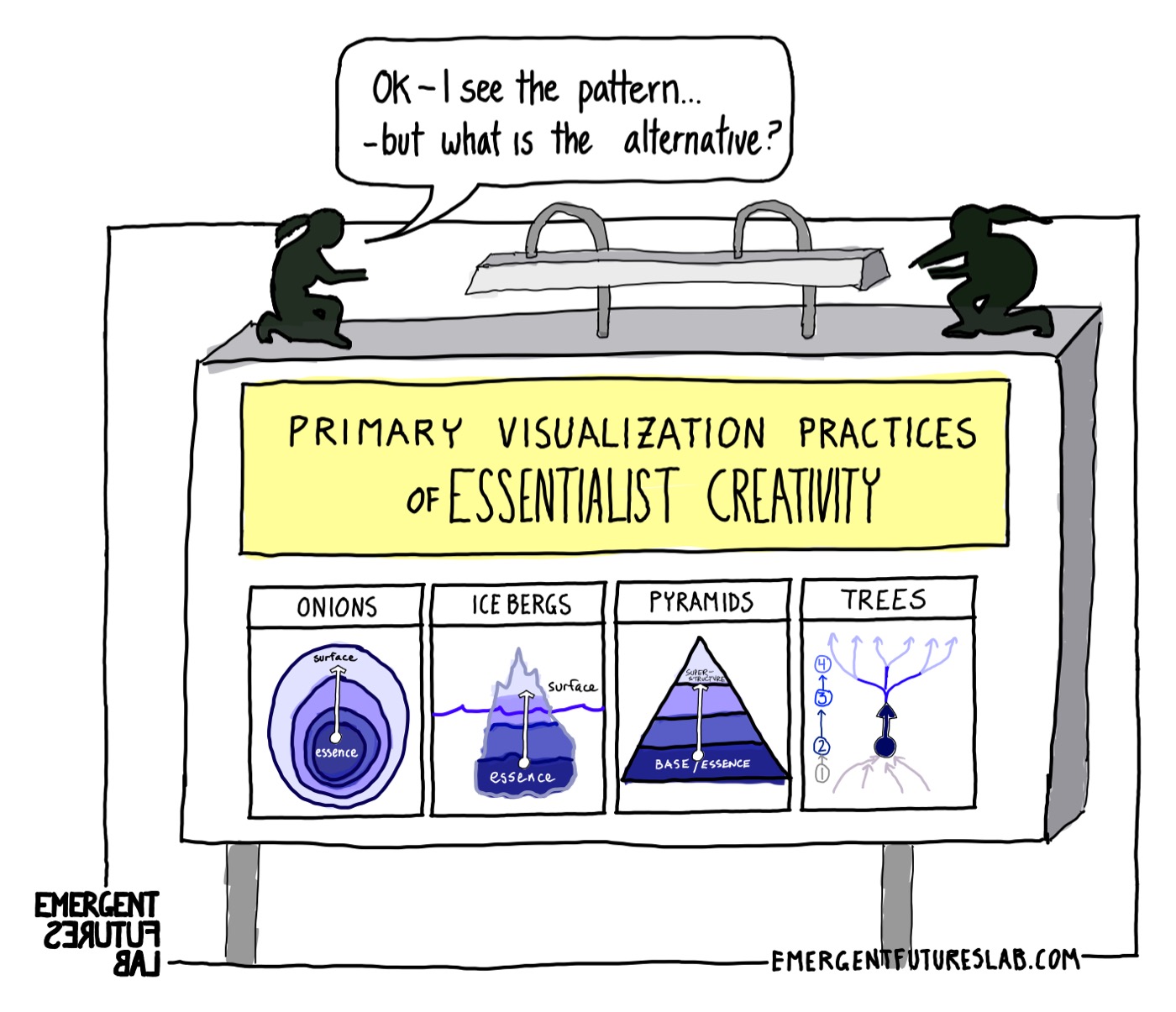
Four expressions of a singular approach that cannot effectively come to terms with the distributed and non-linear nature of creative emergences. Four playings-out of a historical Western “god model” of a heroic creativity narrative – that is certainly as ubiquitous as it is misleading.
Intermission
As we come to the conclusion of this week's newsletter:
Based on our earlier elaborations of alternative strategies and approaches to visualizing these – both in this newsletter and in our previous series on worldmaking, we can put three alternative visualization approaches on the table, so to speak:
1. that of emergent processes and system causality 2. enactive assemblages and the dynamic field of affordance propensities they give rise to 3. and feed-forward epicycles (which we did not talk about whatsoever this week – which is deliberate, it’s next week's special guest…)
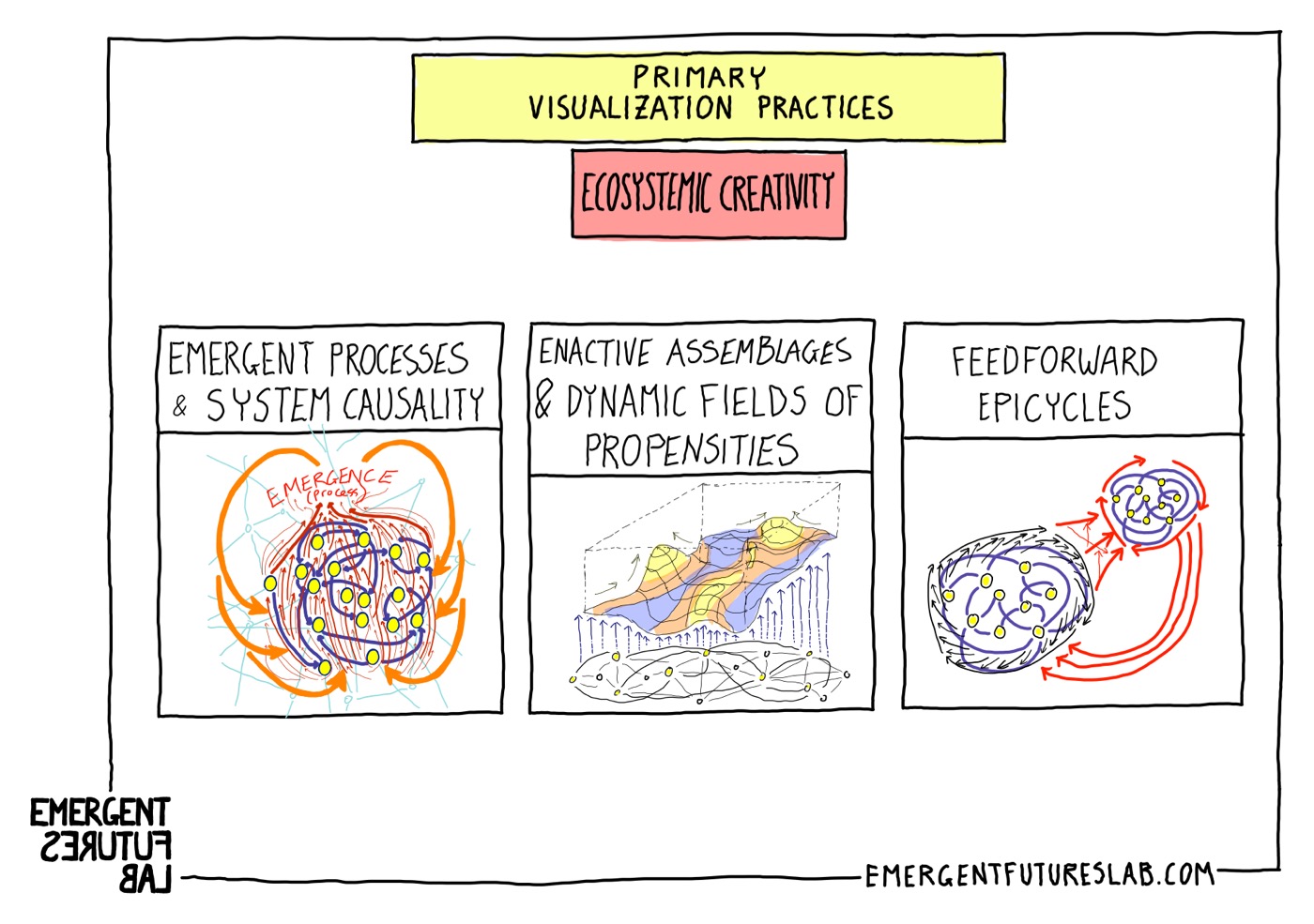
Now that we have laid the ecological groundwork to critically reconsider how we both tell the stories of innovation, and enact specific ecosystems for innovation. Next week we will dive deep and wide into the story of the Wright Brothers – as well as the story of the invention of human heavier-than-air flight.
While the Wright Brothers are part of this story – they are neither the story, nor even critical to it. We know that this might agitate some, but we would ask you this week to reflect on:
What are the narrative structures that have been deployed to tell this story over and over again? Do they ever really deviate from some combination or variation of god model + double diamond? How do these narrative structures relate to environmental and organizational structures? Have you ever come across the telling of human innovation that was ecostemic, gave agency to non-humans, considered system causation or assemblages and their affordance landscapes?
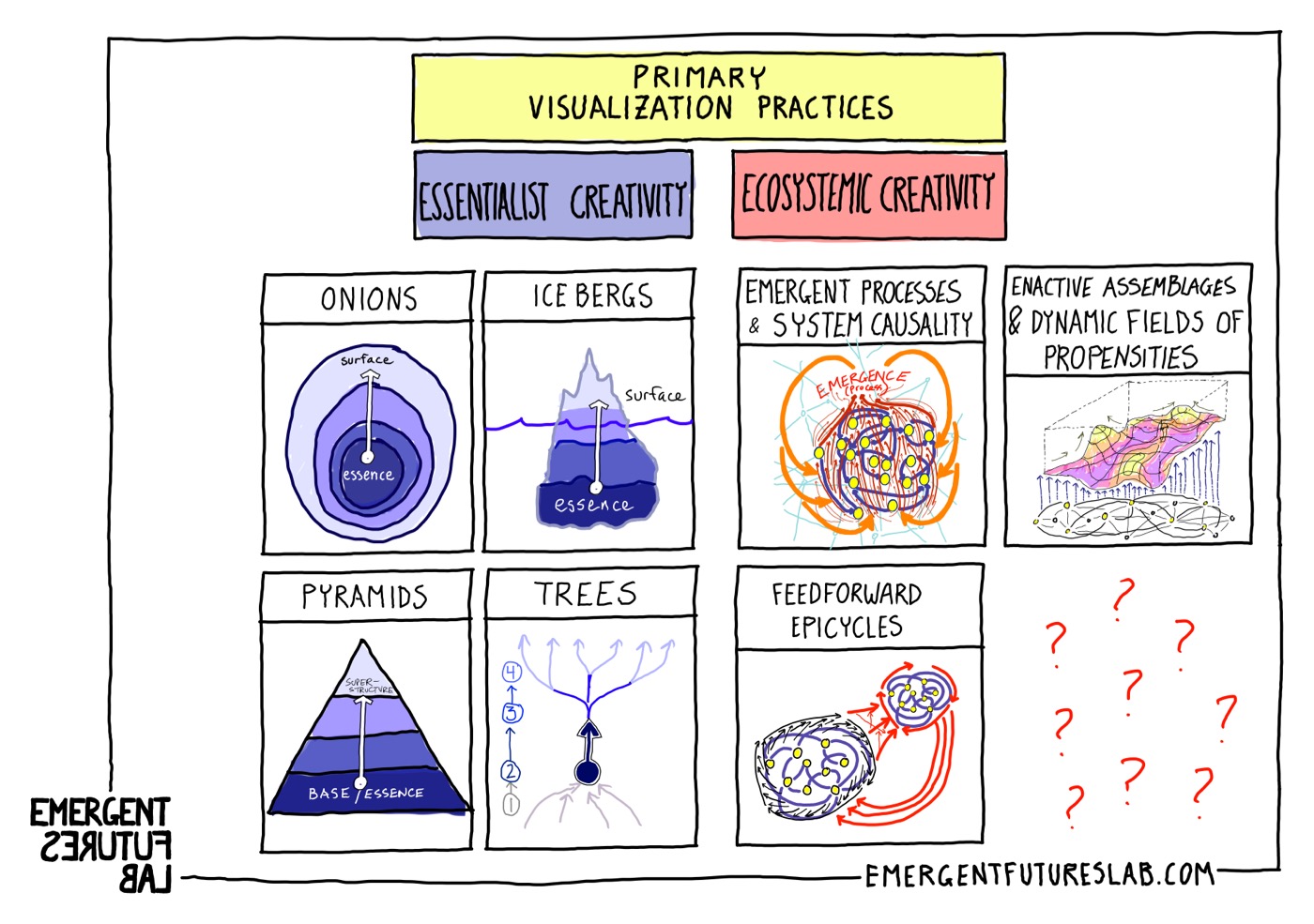
What other new visualization practices are required?
We would love to hear your thoughts on all of this.
Keep experimenting with distributed relational emergences.
Until next week - keep difference alive,
Jason, Andrew, and Iain
Emergent Futures Lab
+++
P.S. This newsletter continues in our community—where you can comment, question, and explore further. Emerging Futures + brings you into the conversation. Join here
P.P.S. WorldMakers goes beyond the newsletter: 40 live events annually, weekly podcasts and exercises, our annotated bibliography, and practitioners across diverse fields reimagining creativity together. Discover WorldMakers


