Newsletter
Resources
Courses
Books

Welcome to Emerging Futures -- Volume 252! Was it the Wright Brothers - PT II...
Good morning perfectly maladjustive experimental collectives,
It’s the dog days of summer, and this week is officially Creative Maladjustment Week. What a wonderful phrase to meet us in this strange and excessively hot season.
Some years back, Martin Luther King called upon all persons of good will to be proudly and creatively “maladjusted” to racism and oppression in all its forms. This is the week that this is celebrated. In a climate where so many stupidities and cruelties are celebrated as great innovations, we would propose that this become an ongoing creative focus and celebration. Let’s all become more and more creatively maladjusted to oppression in all its forms, past, present and future.
Last week in the newsletter, we began an experimental case study: what can we learn from the invention of human flight about creative processes? We began by first experimenting with the question of form in relation to how we investigate historical creative processes – what are the forms that we use to tell innovation’s histories and stories? What assumptions do these forms carry? What practices and ecologies do they help scaffold?
In this regard, the problem that we wanted to draw attention to was that while human creative processes are inherently distributed, involve many collectives of humans and non-humans in complex assemblages of emergent practices – far too often we both investigate and narrate these events in a linear, essentialist and reductive individual human-centric form. In short, creativity is reduced to the internal property of a singular heroic human mind (who might stand on the shoulders of other creative giants). It's creative giants all the way down…
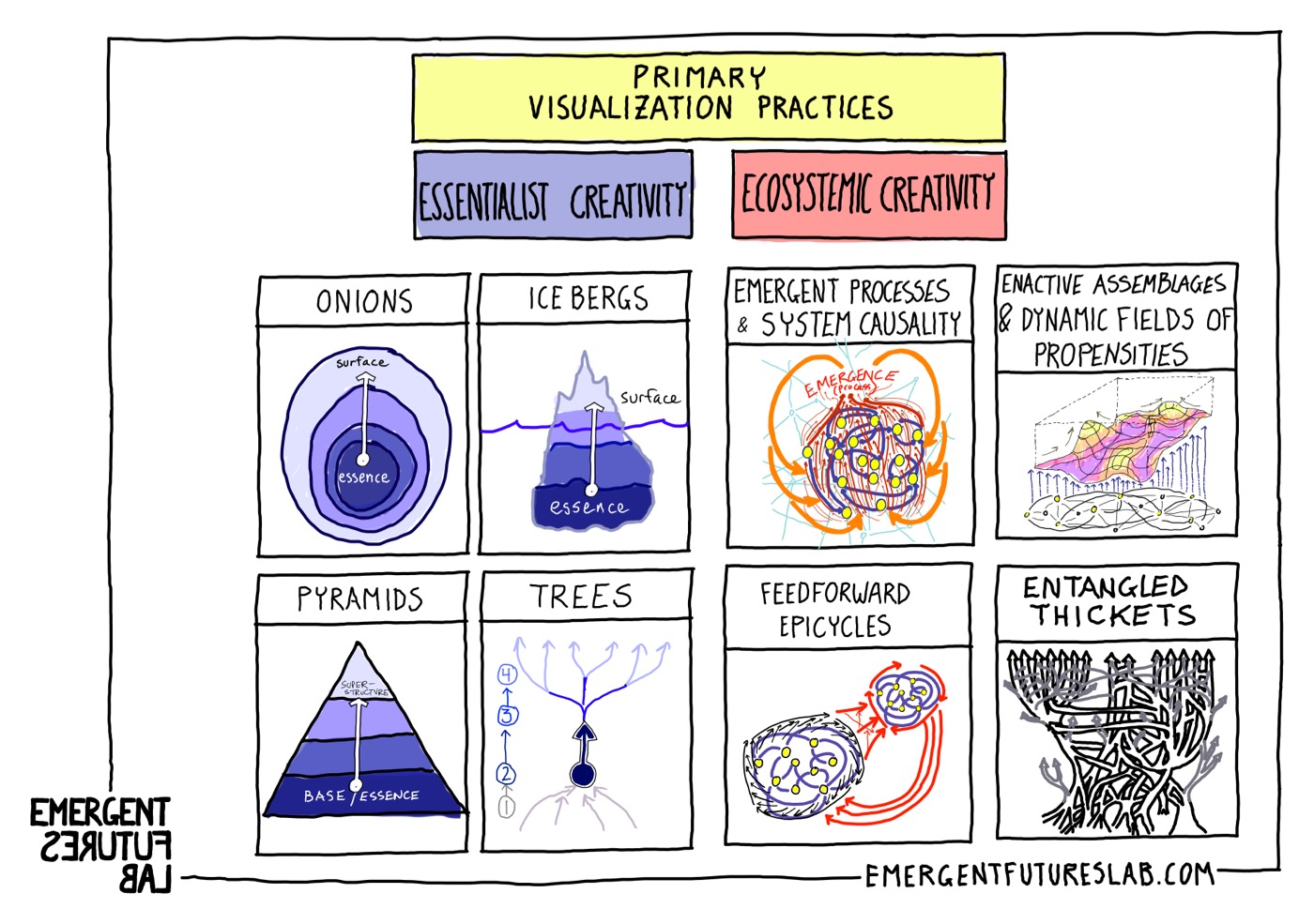
From a very broad perspective, this approach is linear, layered, reductive, and essentialist. In the last newsletter, we drew attention to the visual logics that are critical to the analytical capacities of this narrative logic: the onion, pyramid, iceberg, and tree.
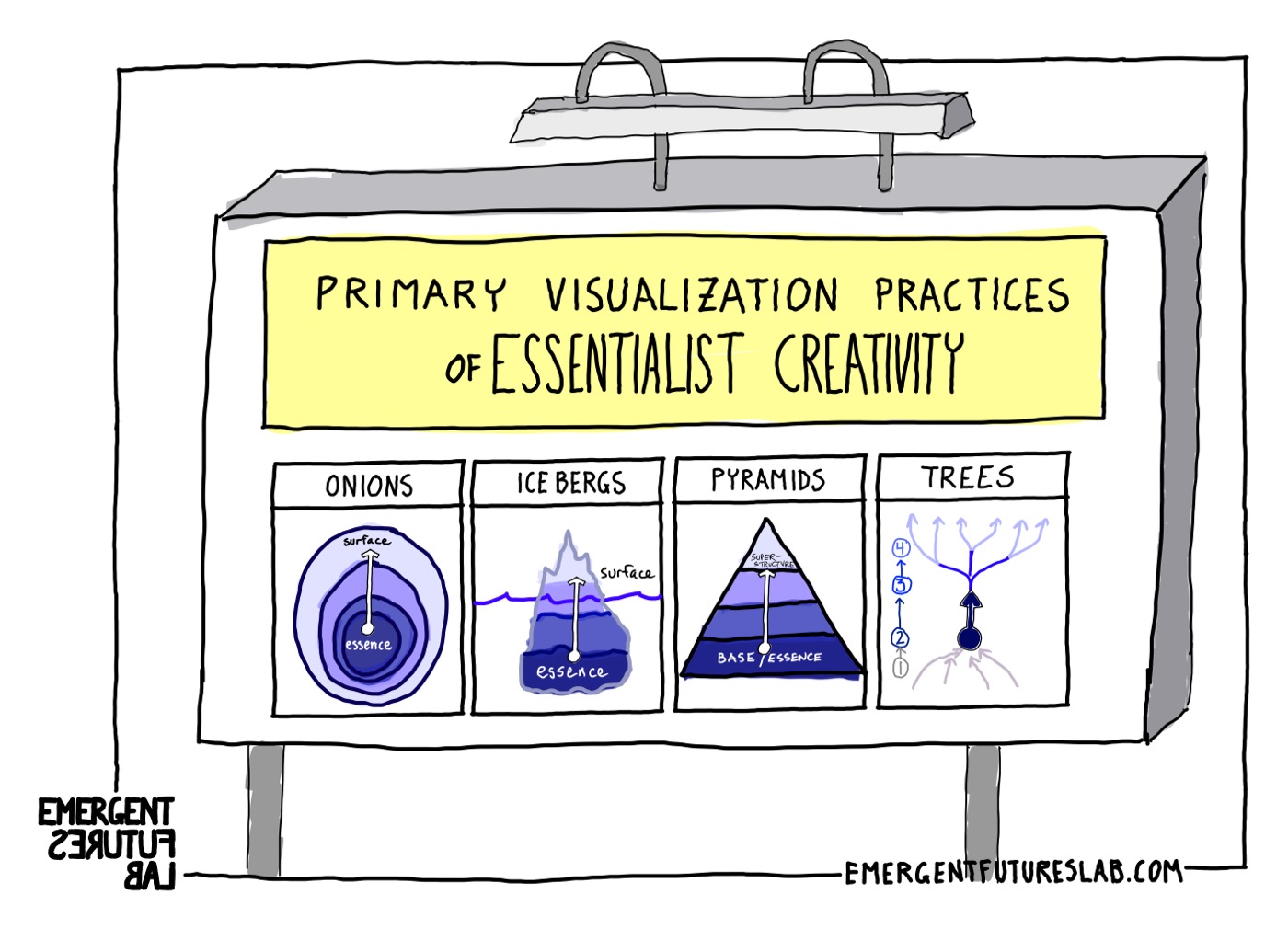
We hope that you noticed how often this logic becomes active in the discourses you might have been a part of. We certainly are part of such discourse on an almost daily basis (and ourselves still slip into them!)...
While in very tightly circumscribed, highly unique situations, this linear, reductive + essentialist logic can be helpful – in both the engagement with and analysis of creative processes, it makes no sense.
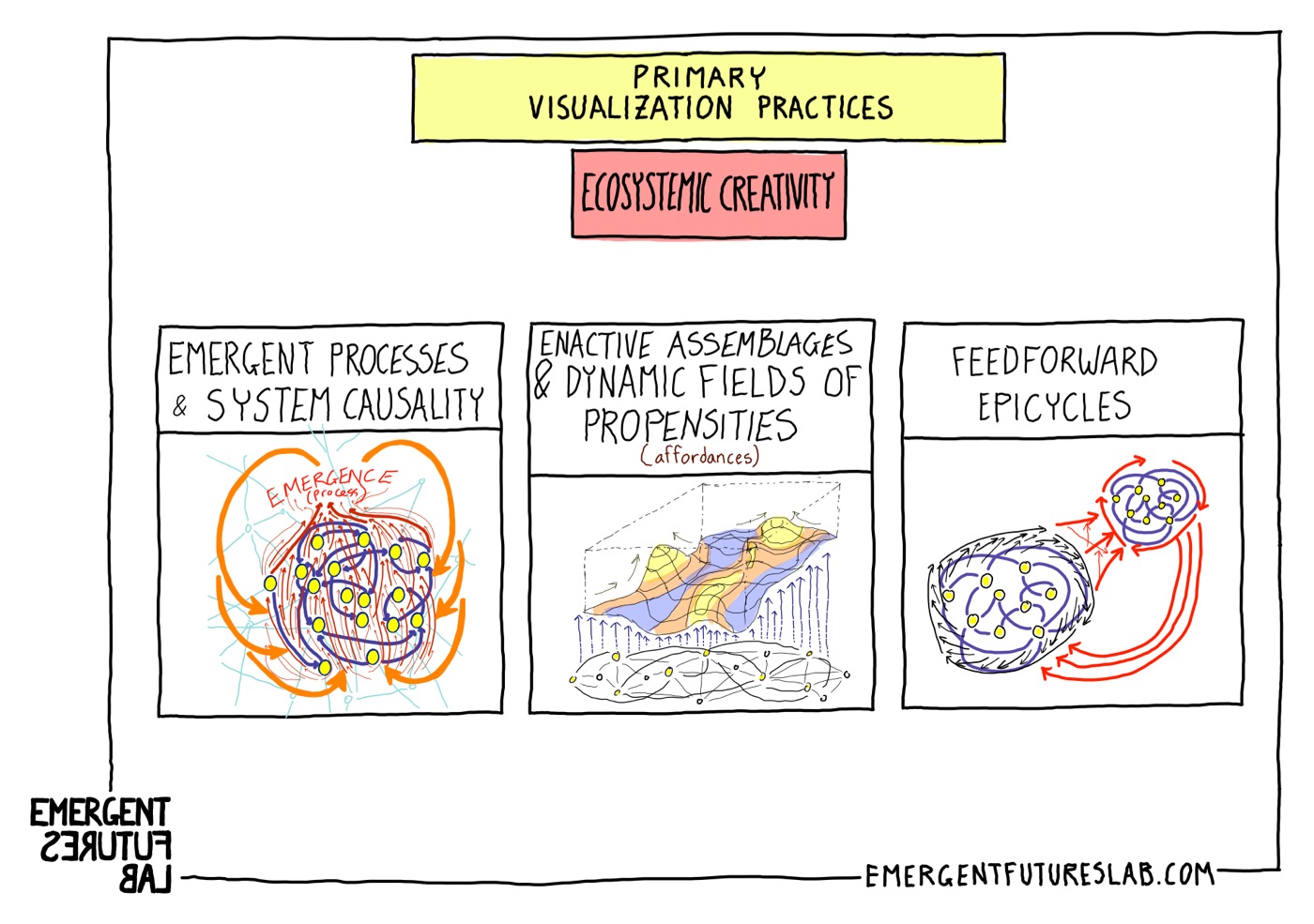
While the critique is in itself important, our larger interest is in the collective development of alternative approaches, practices, and concepts to engaging with creative processes. To this end, we concluded last week's newsletter with a discussion of what we would argue are three important processes to understand for engaging with qualitatively novel creative becomings:
1. Emergent processes and system causality (enabling constraints)
2. Enactive assemblages and propensities/affordances
Onto the Story…
The promise we made in the last newsletter is that with these contrasting concepts in hand, we would then turn to the story of the invention of human flight. And using these concepts, we could experiment towards a new and very different understanding of the invention of flight specifically – and more generally – a very different grasp of innovation.
We ended with a polemic claim in regards to the invention of flight – said:
“While the Wright Brothers are part of this story – they are neither the story, nor even critical to it”.
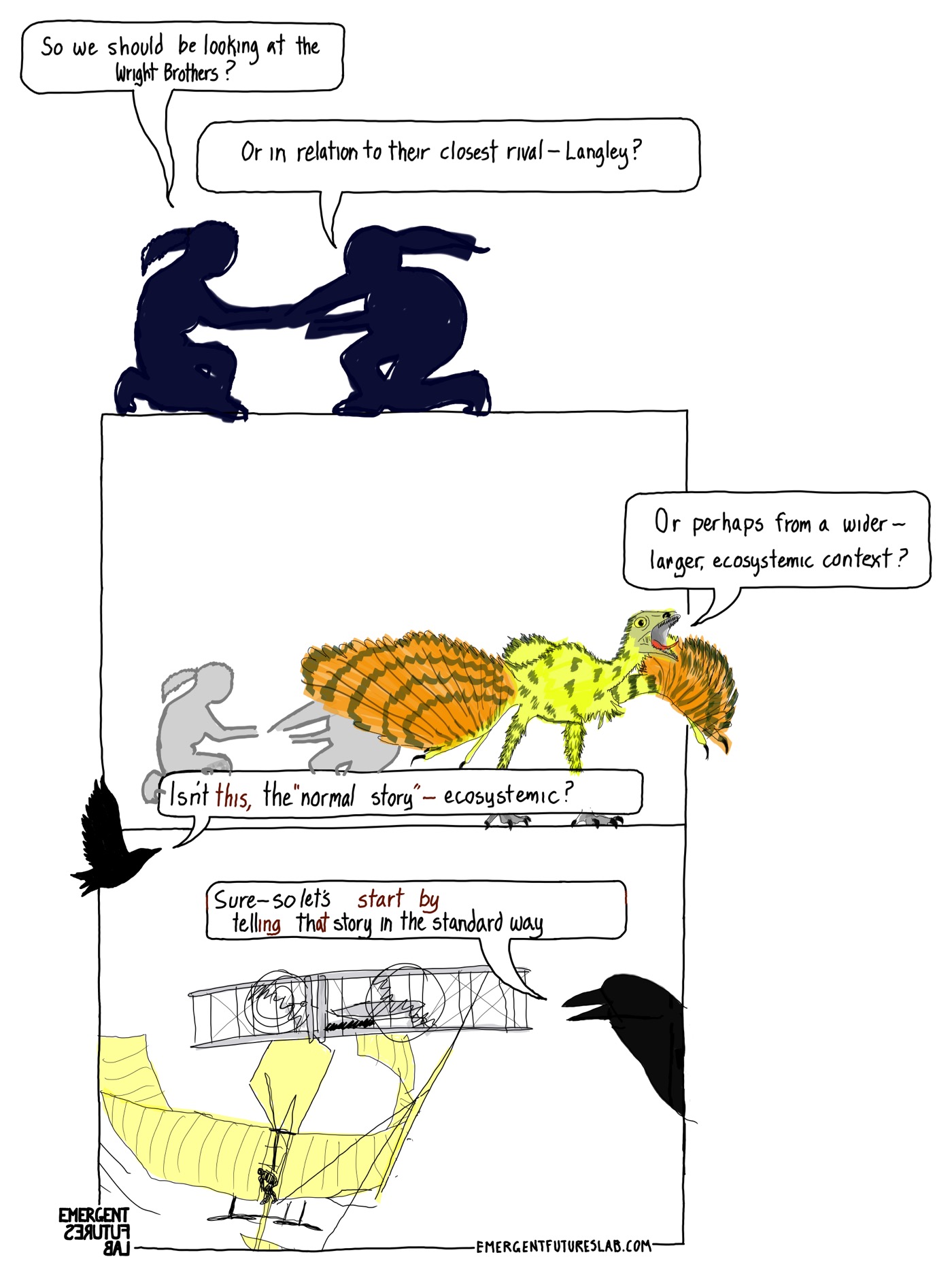
This might sound needlessly polemic. And we have heard this before:
“How can you claim the Wright Brothers are not critical to the invention of flight – they invented flight!”
We hope that by the end of this newsletter you can understand why we say this – and why it matters to the understanding of invention and creativity.
The invention of human flight is a story that most of us are quite familiar with – we might not remember all the details, but the standard version goes something like this:
“Since the earliest days, humans have been fascinated by flight. This led to many unsuccessful, poorly thought-out attempts from Icarus and his waxed wings to all sorts of people jumping off things believing that their contraptions could fly – only to find out in their terminal moments that it was not flight, but a death fall that they were participating in. Bit by bit, scientific processes took hold, basic principles were understood, and via trial and error, applied. Then at the beginning of the twentieth century, in fierce rivalry with Pierpont Langley – and against all the odds, the Wright Brothers succeeded – and the rest is history…”
Let’s take a moment to look a bit closer at this approach to understanding the invention of flight. First, it is a story of a great rivalry: the Wright Brothers vs Samuel Pierpont Langley. It is a story with heroes and villains: The down-to-earth amateurs versus the arrogant, well-funded self-professed expert.
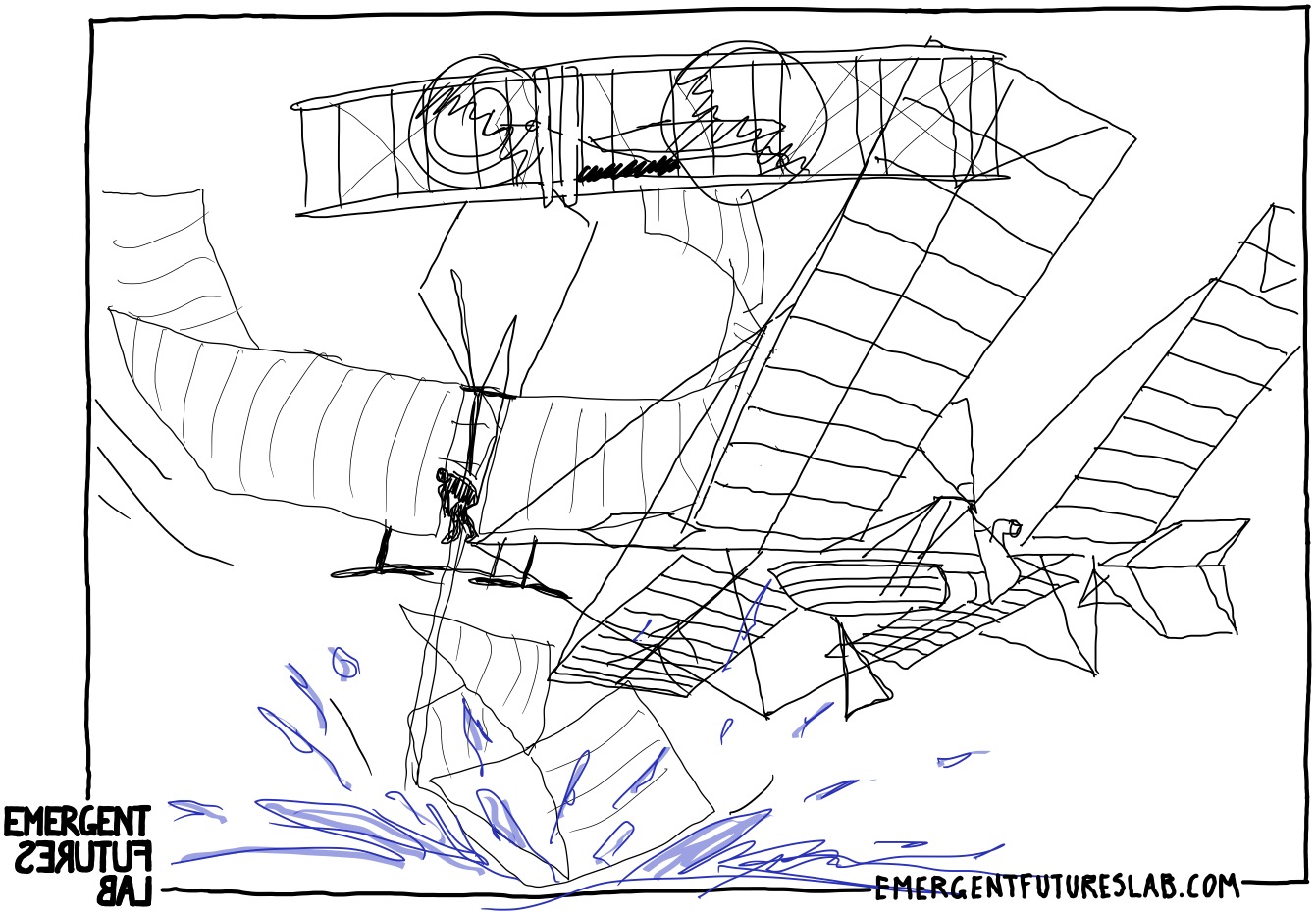
Rivalries – these mythic binaries are echoes of forms – Horus and Set, Devas and Asuras, Manu and Yemo that go back seven thousand years. This should already give one pause. Why have we placed this story into such a convention? Why do so many of these seemingly factual creativity stories have the same mythic logic as Proto-Indo-European creation stories? How close can any of this be to the actual idiosyncratic facts of this complex event’s unfolding?
Of course, the standard narrative is not so reductive as to ignore those that came before the Wright Brothers. They were not alone, but building upon the achievements of others in a step-by-step fashion – “we see and go further standing on the shoulders of giants” – as Newton phrased it so memorably in another context.
Let's add in some of these giants: From Icarus, we move on to a genius ahead of their time, Leonardo Da Vinci. He developed designs including a delta-wing glider utilizing air currents. Then things became more systematized: George Cayley, in the 1700s, identified the four fundamental forces of flight: weight, lift, drag, and thrust, as well as establishing the concept of the fixed-wing aircraft.
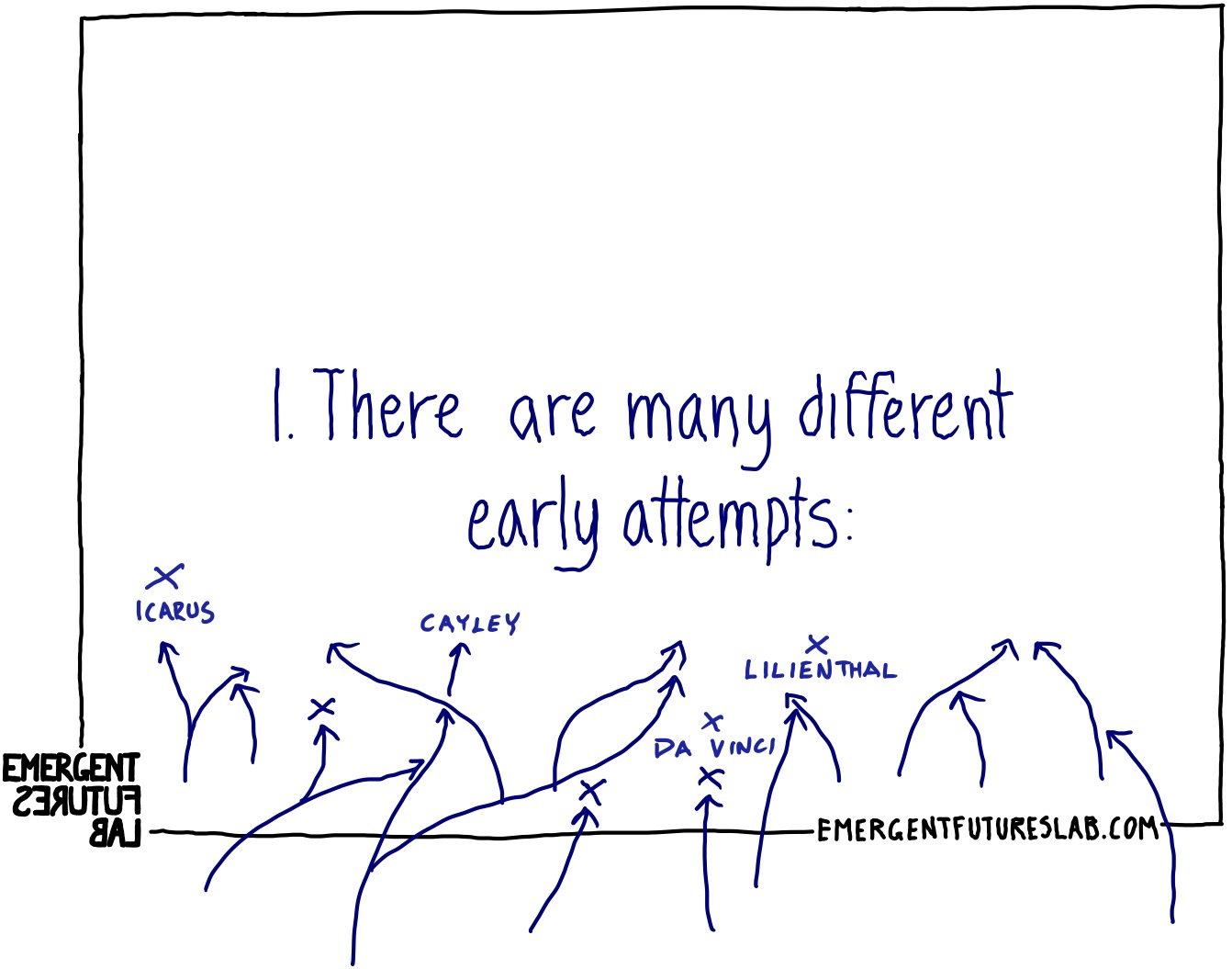
Then those working on non-motorized flight (gliding) made great strides: Otto Lilienthal is a key figure who made over two thousand highly documented glider flights between 1891 and 1896.
Step by progressive step – innovators kept the good and left behind the bad. Trial and error – and the occasional success. Each leapfrogging and building upon the past innovators.
And then from these early efforts, two teams emerge, working in parallel and taking vastly different approaches: Samuel Pierpont Langley and the Wright Brothers.

Each had quite distinct approaches:
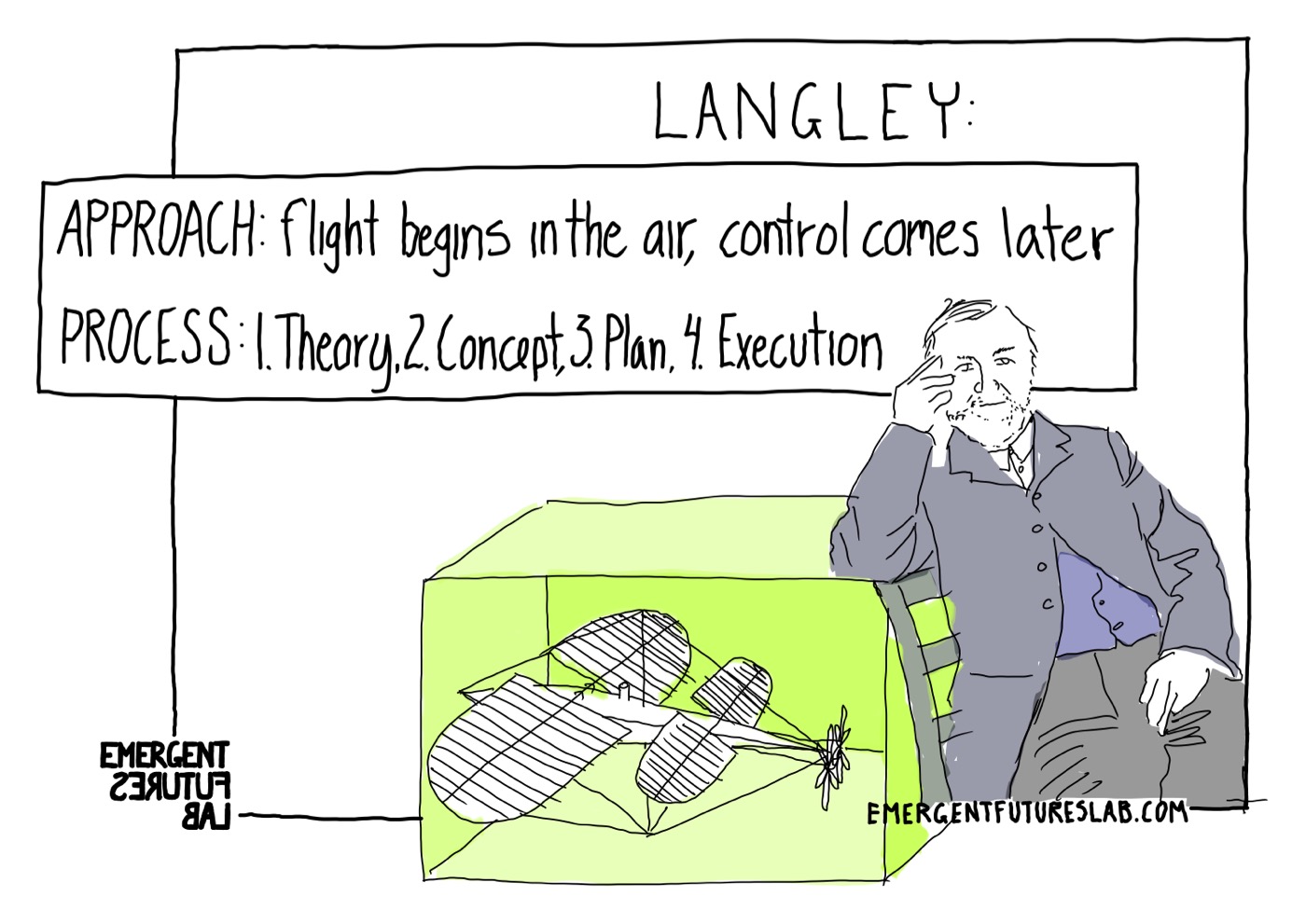
Langley came to his interest in flight later in life; by the time he began, he was a renowned physicist, an important astronomer, and the director of the Smithsonian. He brought his theoretical knowledge and scientific connections to the project. He believed that he could develop the basic design on paper, relying on existing research. And from this, he could build and test a series of ever larger-scale models until he got to the quirks worked out. Then it would only be a matter of making a full-sized version, manning it, and upon launch, flight would be achieved.
His approach to what this first plane should be was to hone it down to the bare essentials: all it needed to do was “fly,” and everything else could come later. What this meant in practical terms was that the first plane just needed to be (1) motorized, (2) have a person on it, and (3) fly some distance – control, take-off and landing can be figured out later. Thus, his models and final design had no mechanism for taking off, control in flight, or landing. The idea was that it would be catapulted into the air, fly under power, and when it ran out of steam (literally), it would glide to a safe landing.
The Wright Brothers take a very different approach:
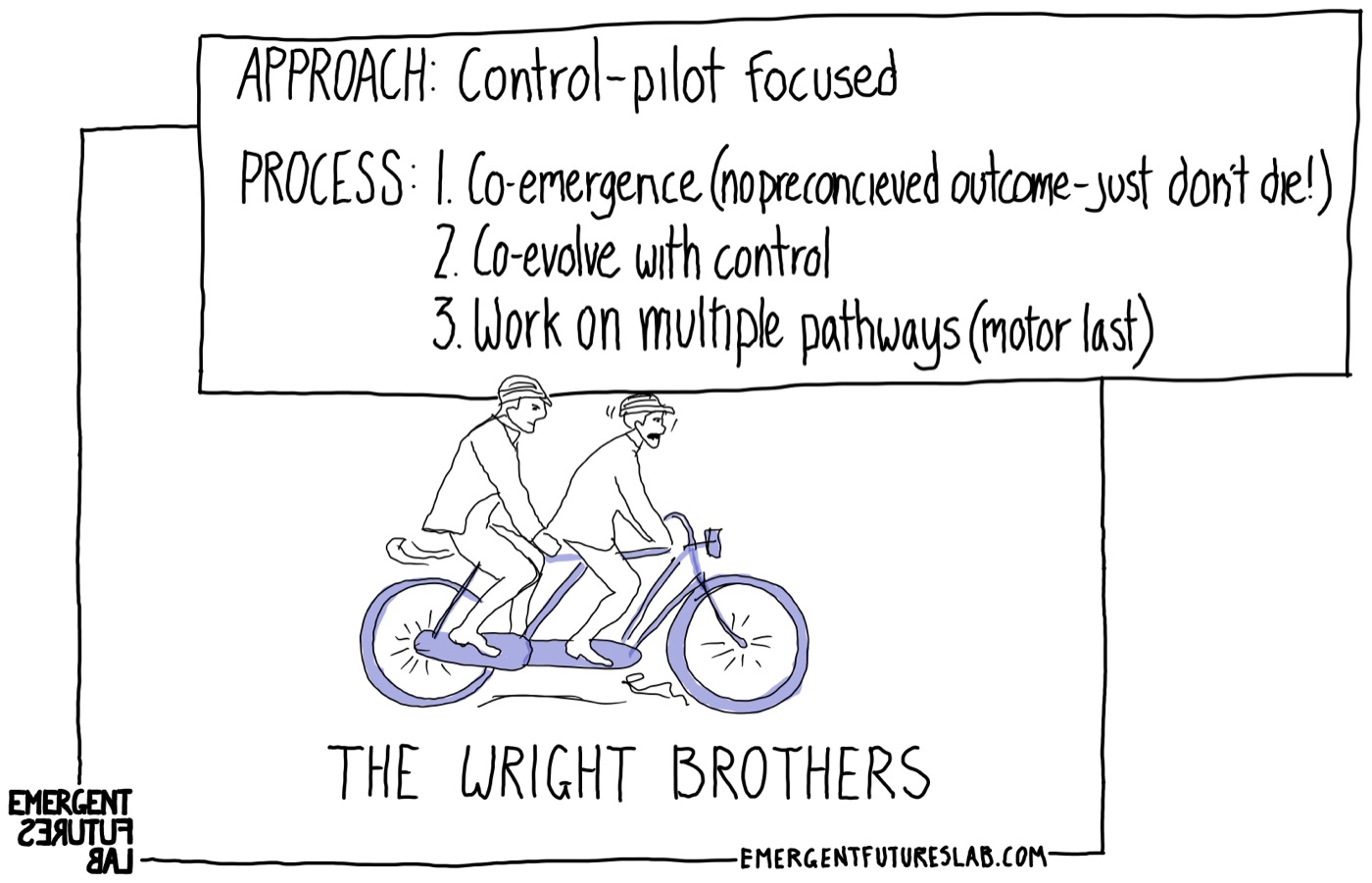
They were bike builders and shop owners working out of Dayton, Ohio, who, in their early thirties, developed an interest in flight. Wilber had finished high school, while Orville did not – that was the sum total of their formal education.
Their approach was quite the opposite of Langley – focused on developing in-flight control. And when they realized how many early pioneers of flight had died carrying out experiments, they organized their experiments around the key premise: don't die. With a focus on developing a profound sense of in-flight control, they saw their approach as one of co-evolving with ever more controllable gliders to which a motor could be added at the end.
As hands-on bike designers and builders, they drew on their own skills to fabricate and build things, allowing them to work in a highly iterative, flexible, and expeditious manner.
By 1903, working in parallel, each team was getting closer to motorized flight.
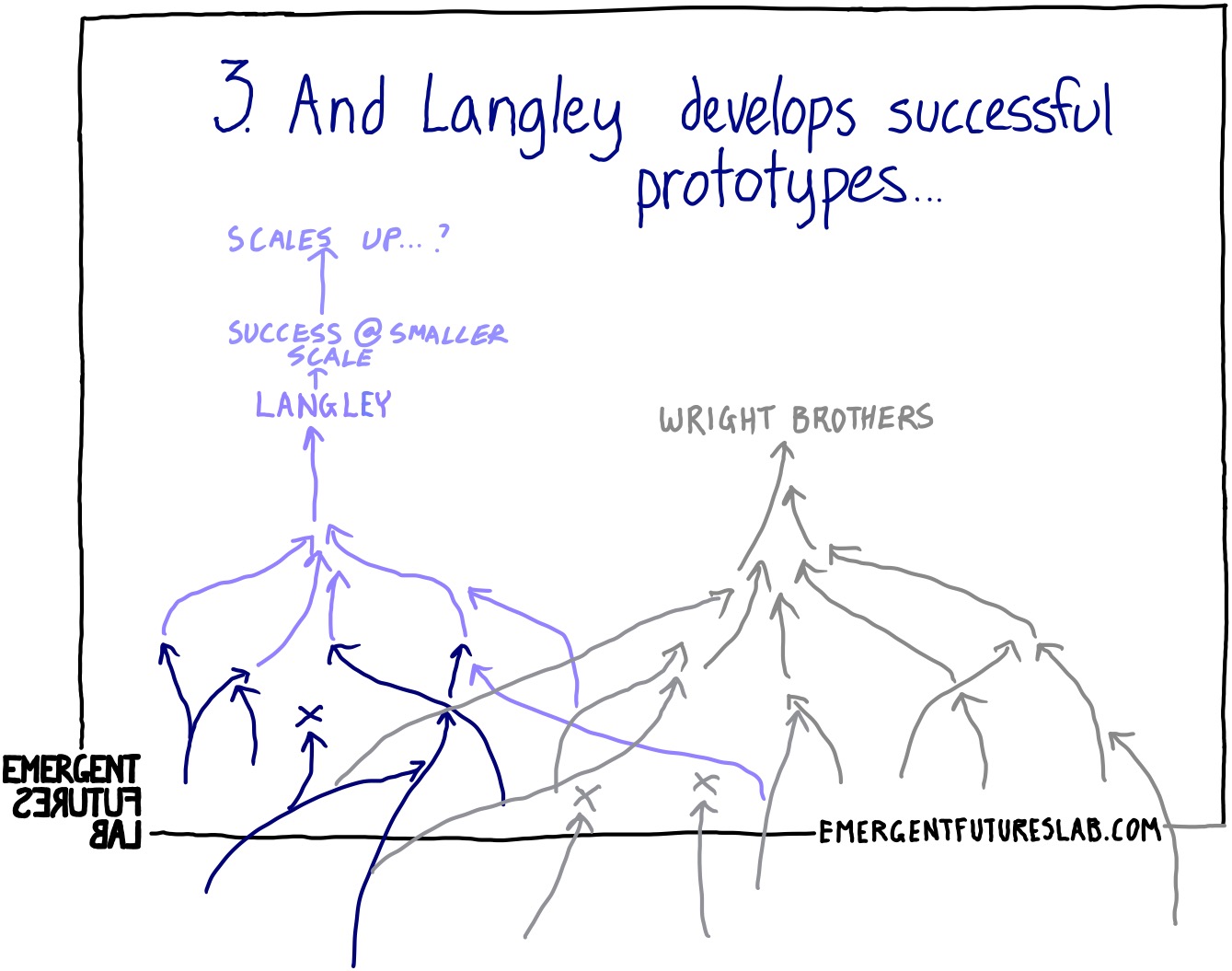
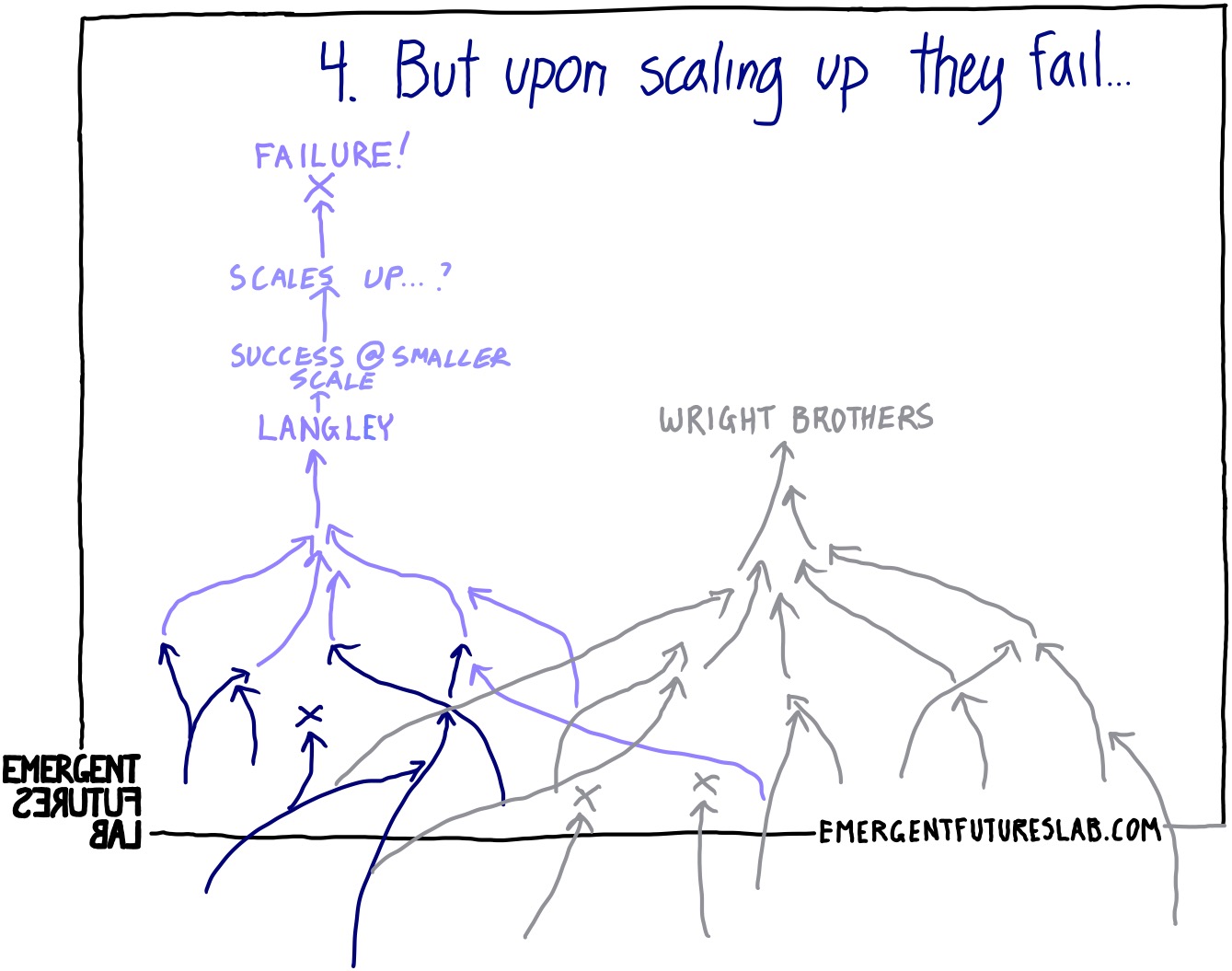
Langley builds a number of small motorized models; they get airborne via catapult, eventually fly quite stably, and glide to ok landings. And with the knowledge and confidence gained from this, he and his team assume that the results will scale up. Based on sharing these very promising successes he receives from the War Department a very large grant to build a full-scale version. The plan is to launch it from the middle of the Potomac River in Washington, DC, with a pilot and eventually glide to a river landing.
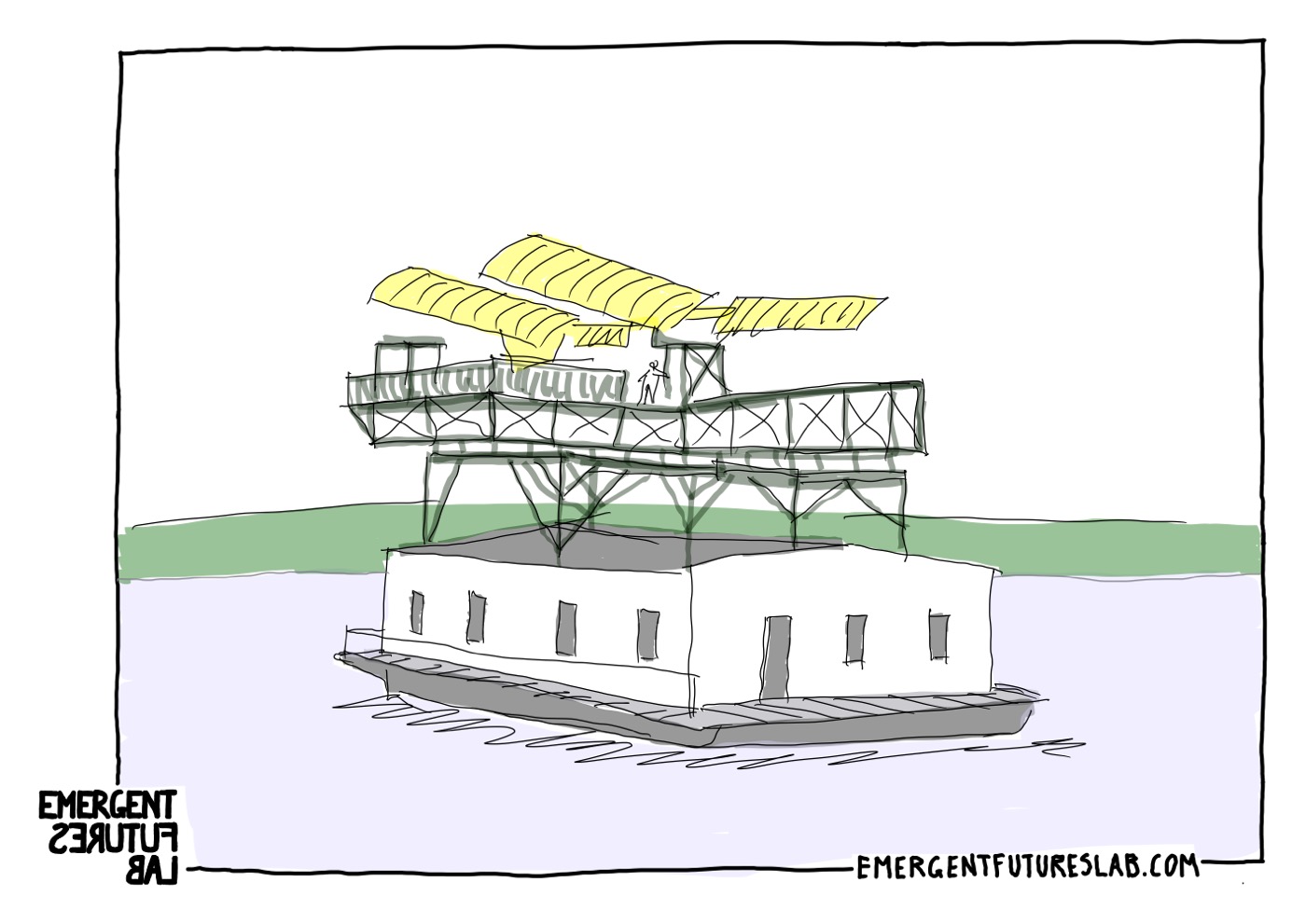
Everything is built, and in front of a large scientific and military audience, his team catapults a full-size manned plane over the Potomac. The wing clips the launch system…
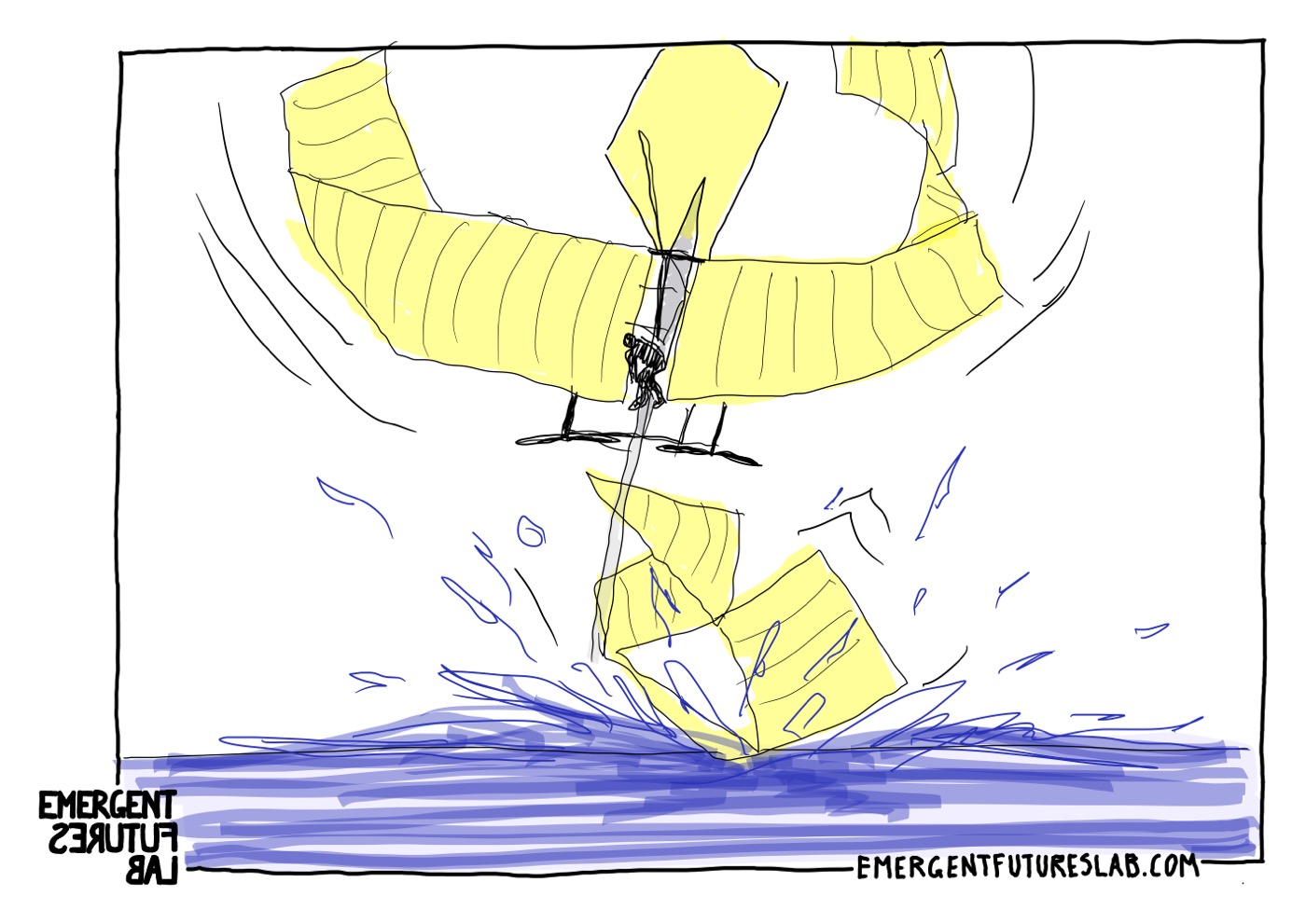
…and it goes into the river like a sack of cement.
Given that this seems to be an incidental and correctable error, he secures the necessary funds to build it and test it again. Two months later, in December of 1903, his team tried again. This time the craft breaks apart as soon as it leaves the catapult – and this time the pilot doesn't survive. The design could not withstand the forces of this method of launching.
Meanwhile, out of the public glare on the Outer Banks of North Carolina…
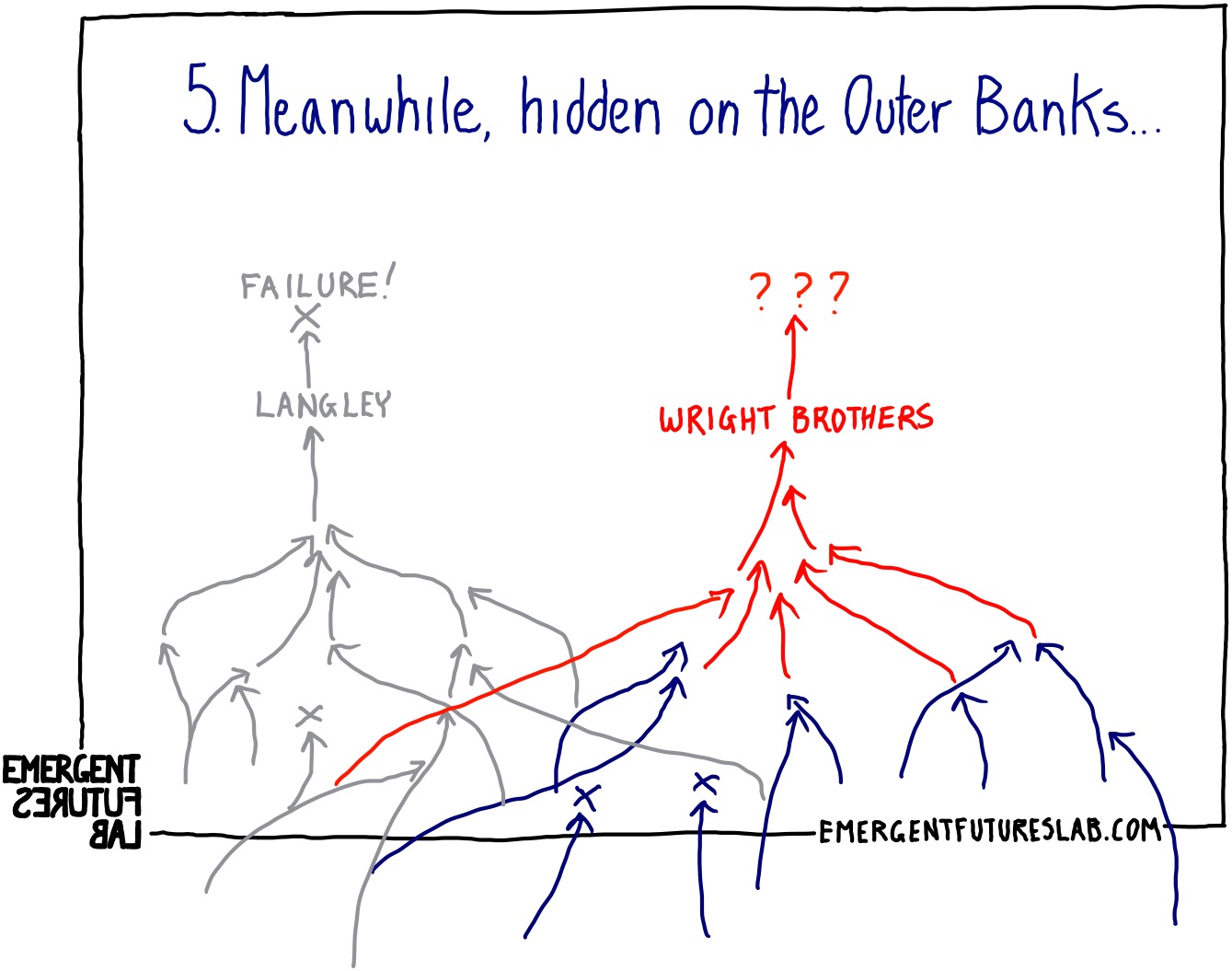
The Wright Brothers had based themselves in a site specifically chosen for its seclusion, consistent low-speed winds, and large rolling sand dunes (ideal to provide height for launch and softness to survive landing). To find this spot – they'd sent letters to post offices across the country looking for the right conditions: soft landings, consistent winds, distance from public view.
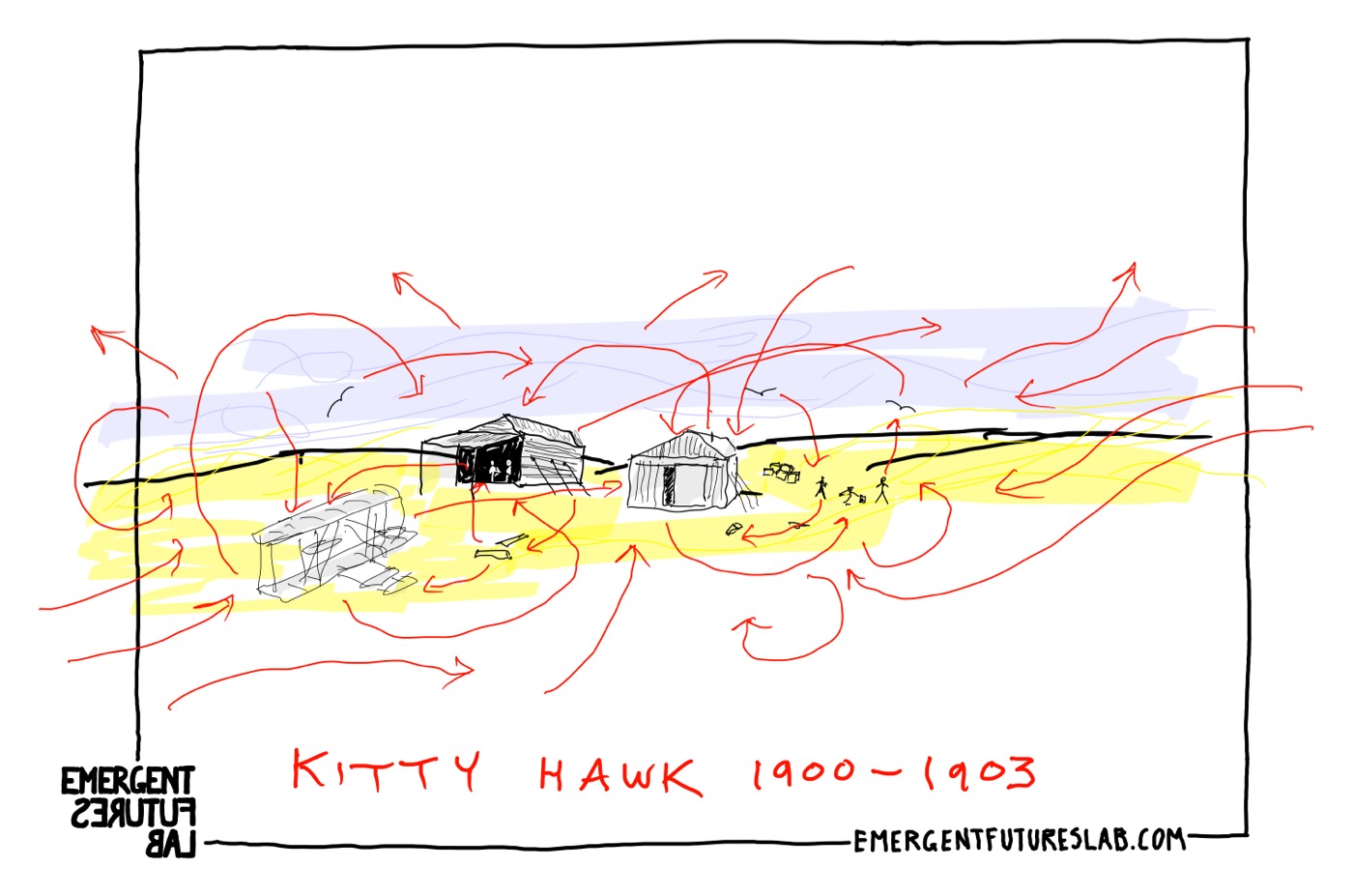
Florida and California were considered, but felt too exposed. Kitty Hawk had hundred-foot dunes, birds to observe, predictable Atlantic winds, and a small village for provisions, materials, and support.
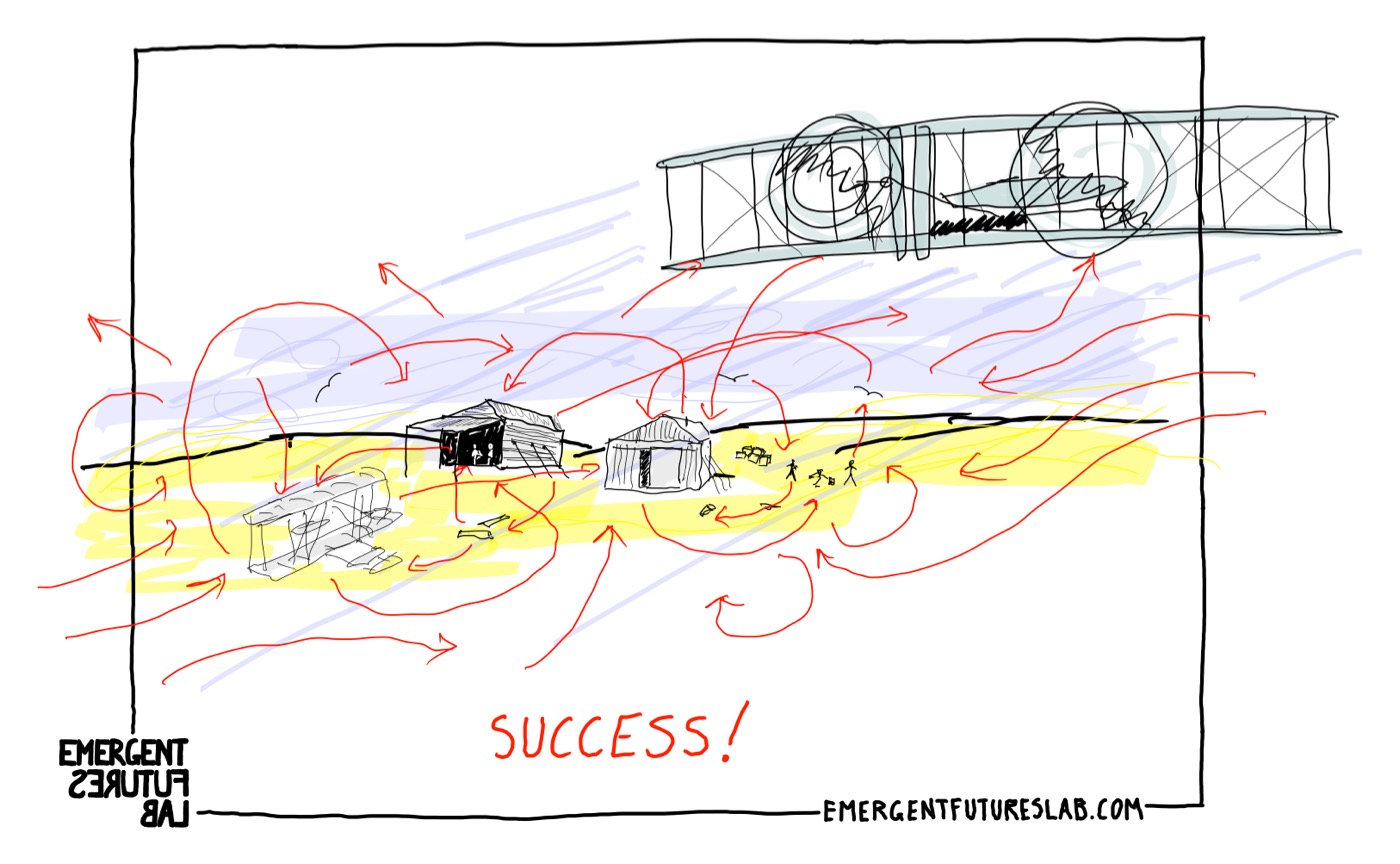
By the winter of 1903, they had been going there every summer and fall for the previous three years. First testing kites, and eventually progressing to a motorized plane. Nine days after Langley's second failure, on December 17, 1903, the Wright Brothers achieved motorized “flight”. It is, by any stretch of the imagination – not much of a flight: a straight flight of less than fifteen seconds, just over one hundred feet in distance, about ten feet off the ground and aided in take-off by a light headwind (meaning that it was more of a slightly motorized pseudo-glider).
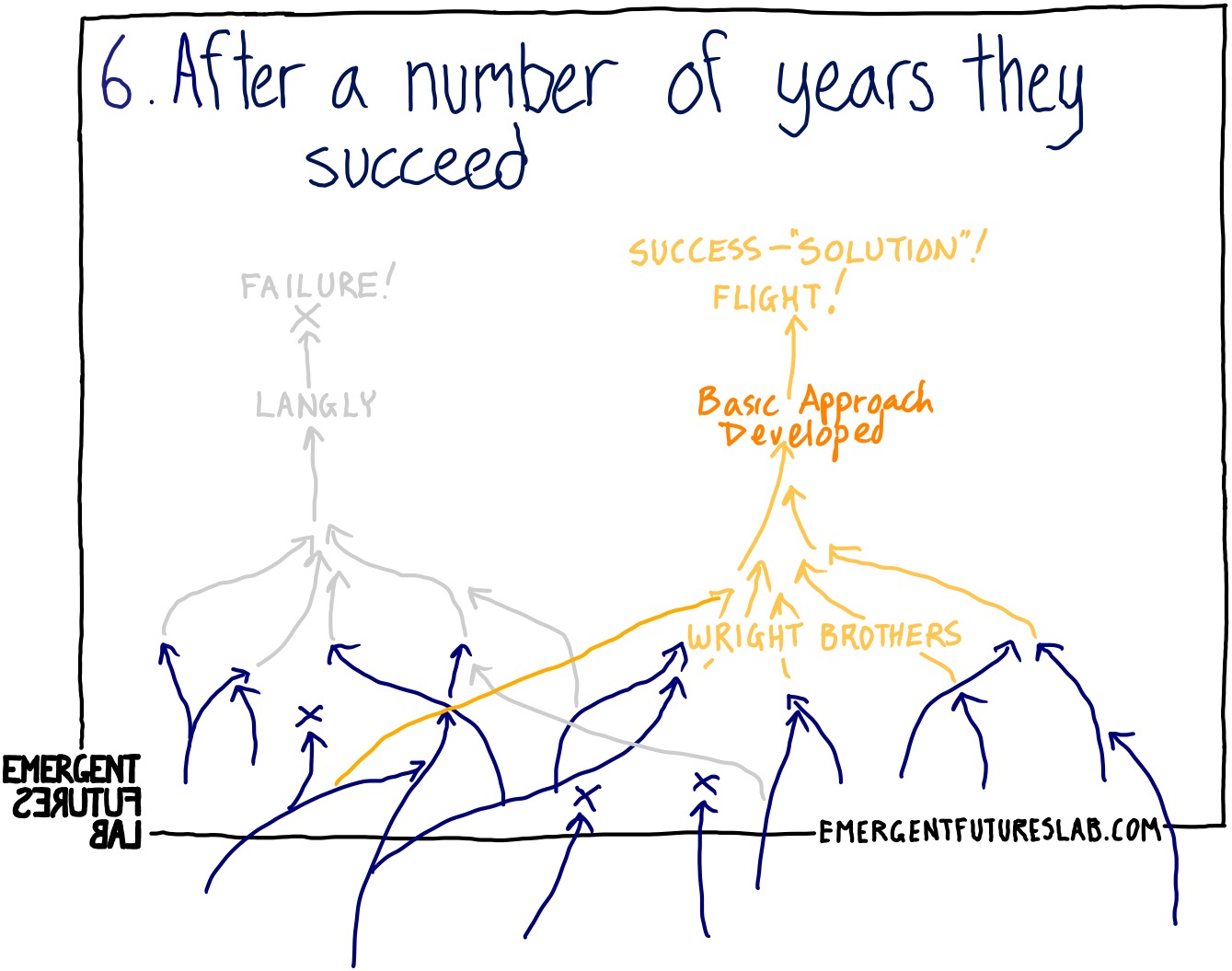
And, as the story is told, from this pivotal moment of innovation develops the world of flight:
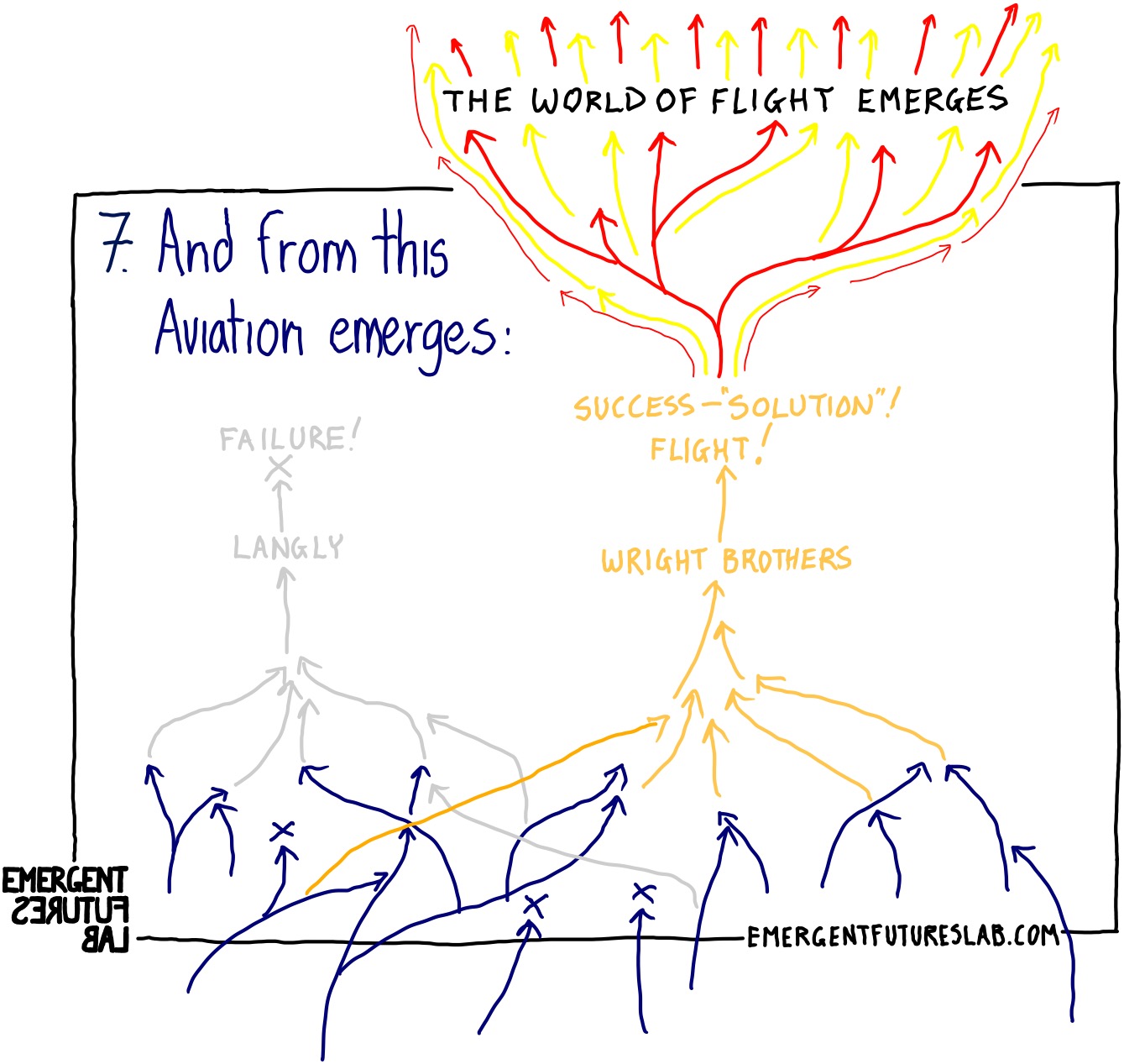
It is the moment when everything that followed became possible.
And this – if the analysis is correct (a very big if…) – gives us a basic sense of the creative process that is worth replicating. Which is precisely what the architectural innovation consultant we mentioned in the last newsletter – as well as methods such as the double diamond attempt to do.
So – is it correct? Is this story correct?
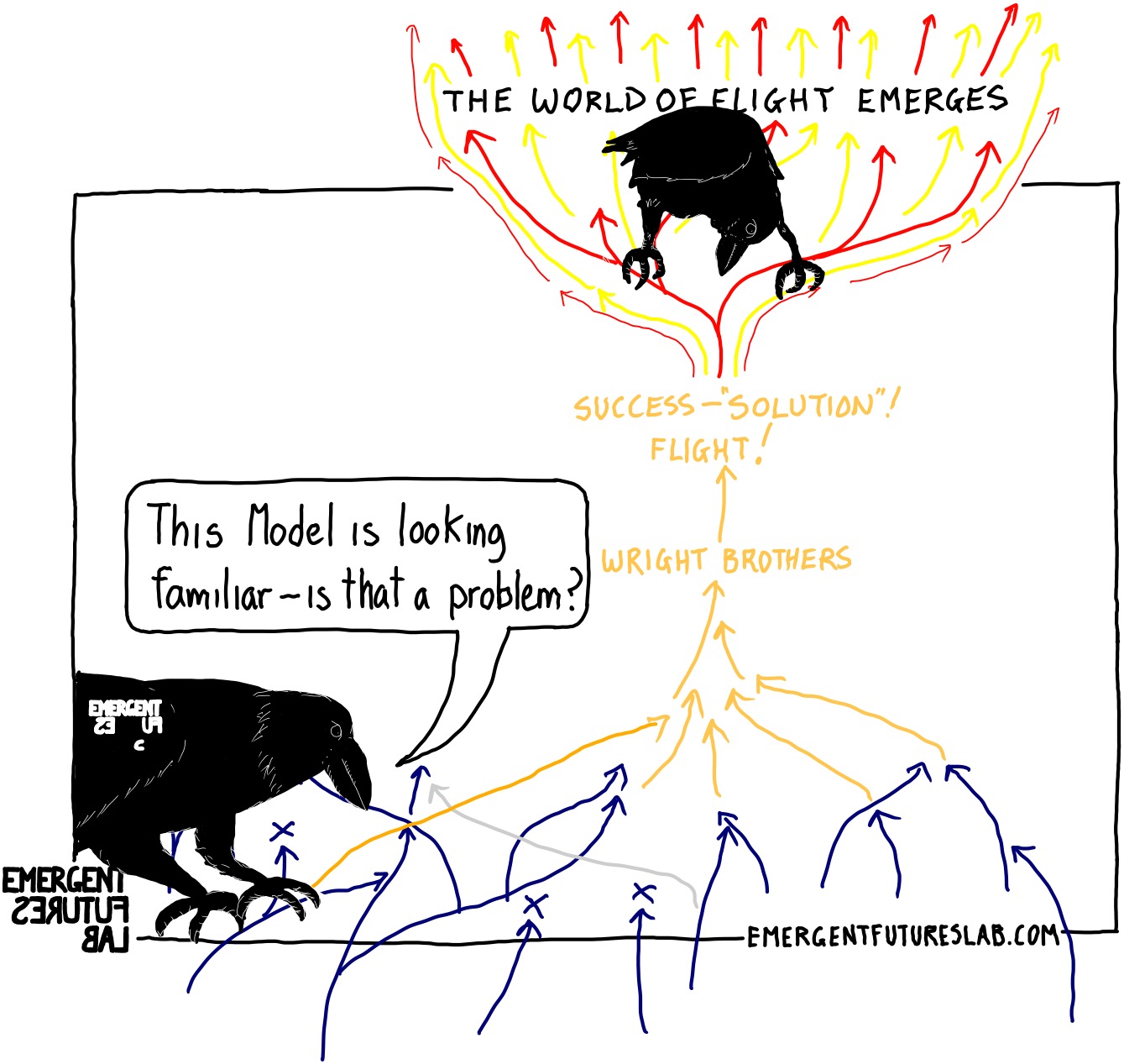
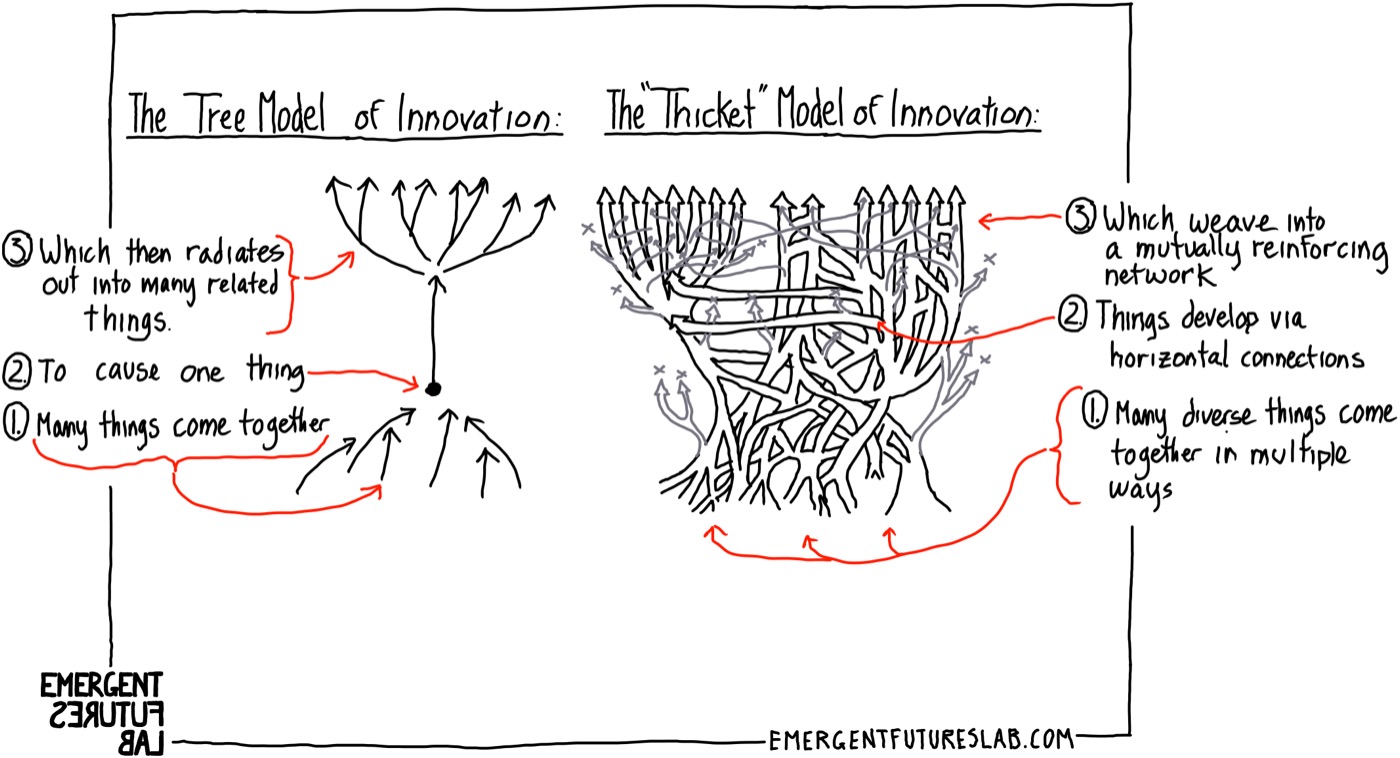
But – this should already give us grounds to pause and re-evaluate: notice what's happened: We have a linear, essentialist tree model.
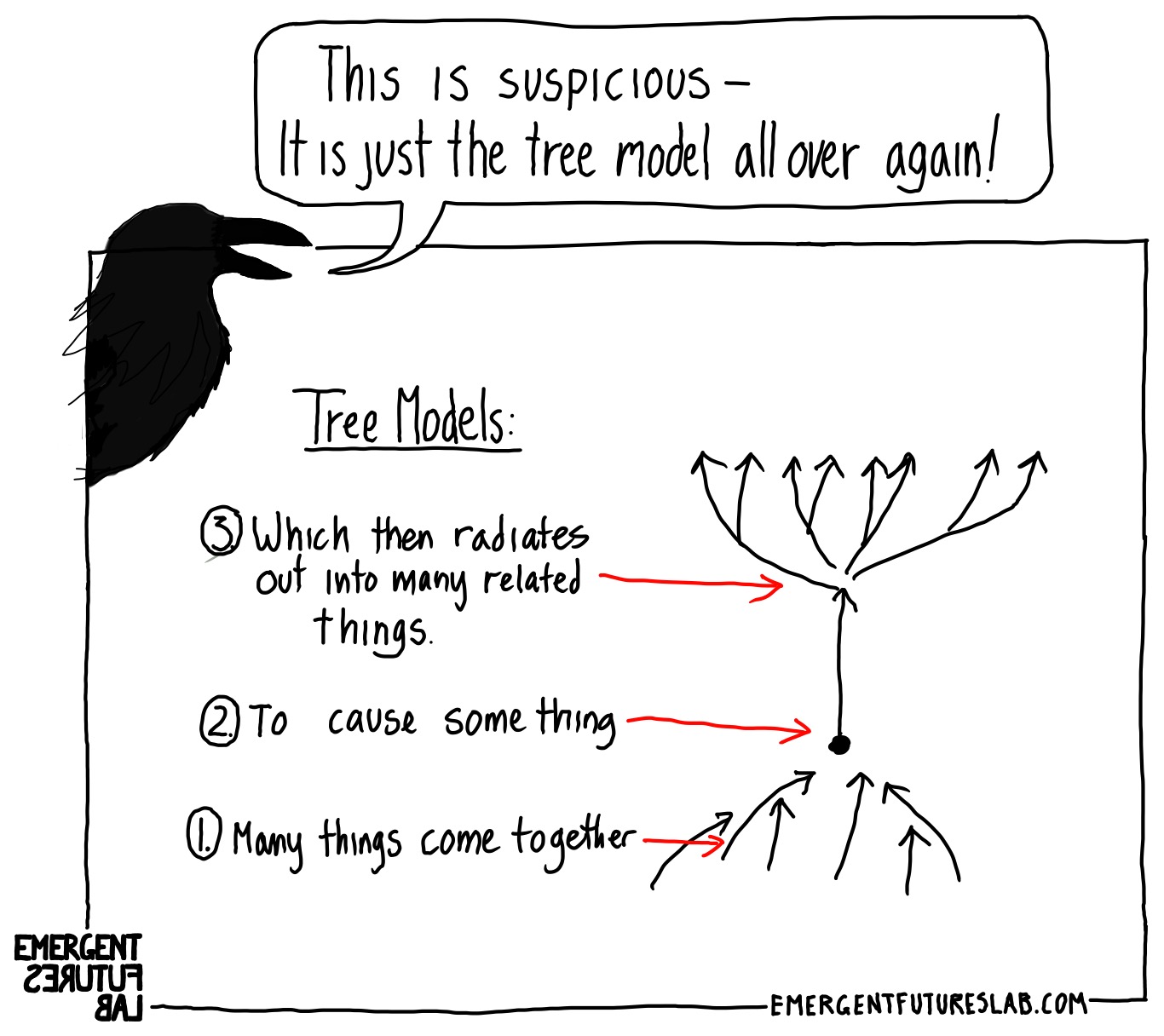
Has our innovation story inadvertently fallen into a well-rehearsed set of problematic innovation tropes – or is this actually the way things happened?
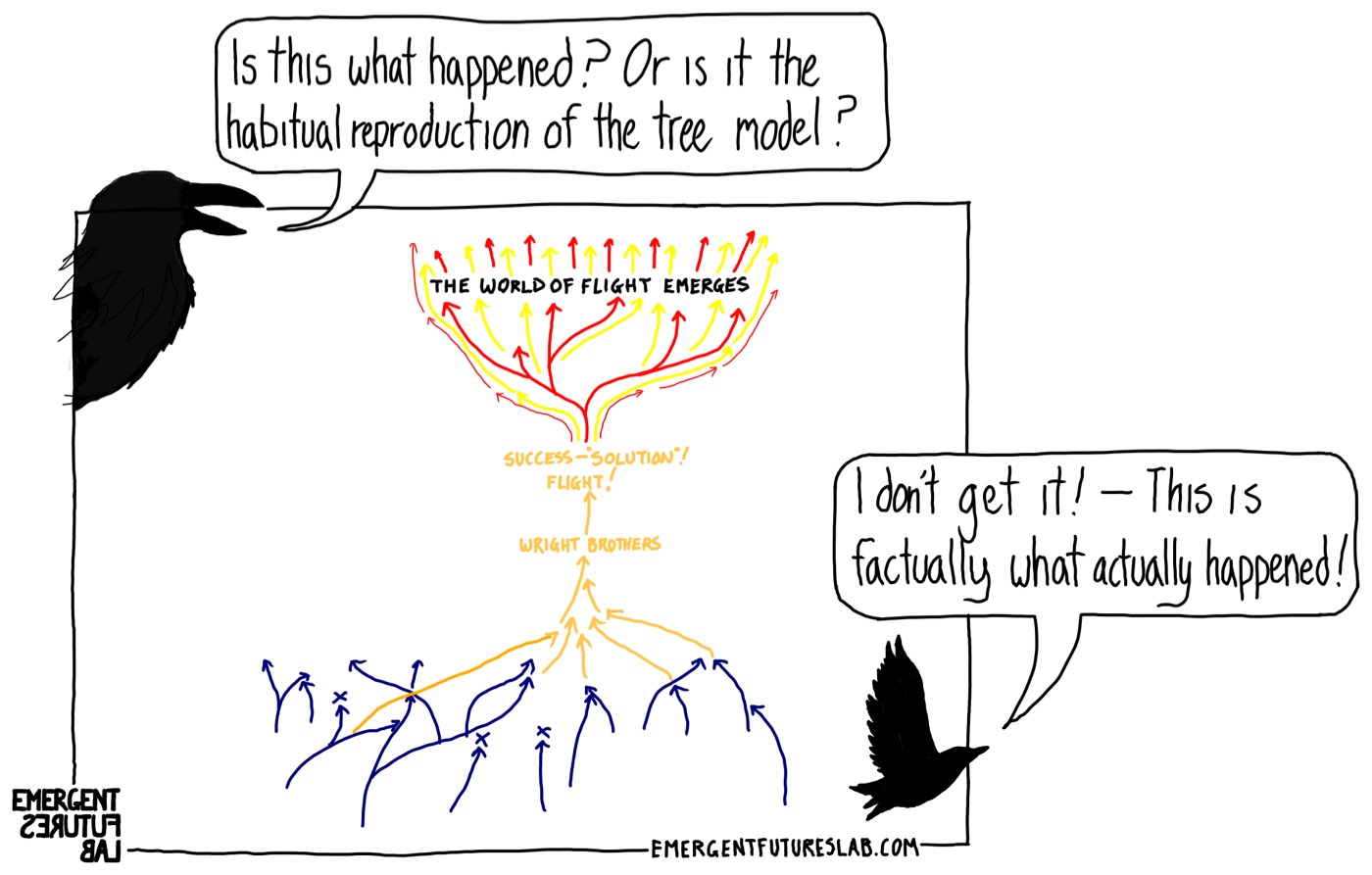
The first intimation that there might be a problem with this linear narrative is the still-ongoing debate about who was actually the first to fly. For some historians, there are a number of plausible competing claims to who was actually the first to fly. Now, to be clear – we are not interested in entering this debate and suggesting anyone other than the Wright Brothers was actually the first to fly. No – that is not what is most interesting to us – rather, what is interesting is that at the moment that the Wright Brothers lifted off – around the world there were many other experiments that were also on the cusp of flight. The world was thick with air-bound experiments – and it had been for some time (some of the claims precede the Wright Brothers by forty years).
Let's take a look at some of these starting over fifty years before the Wright Brothers:
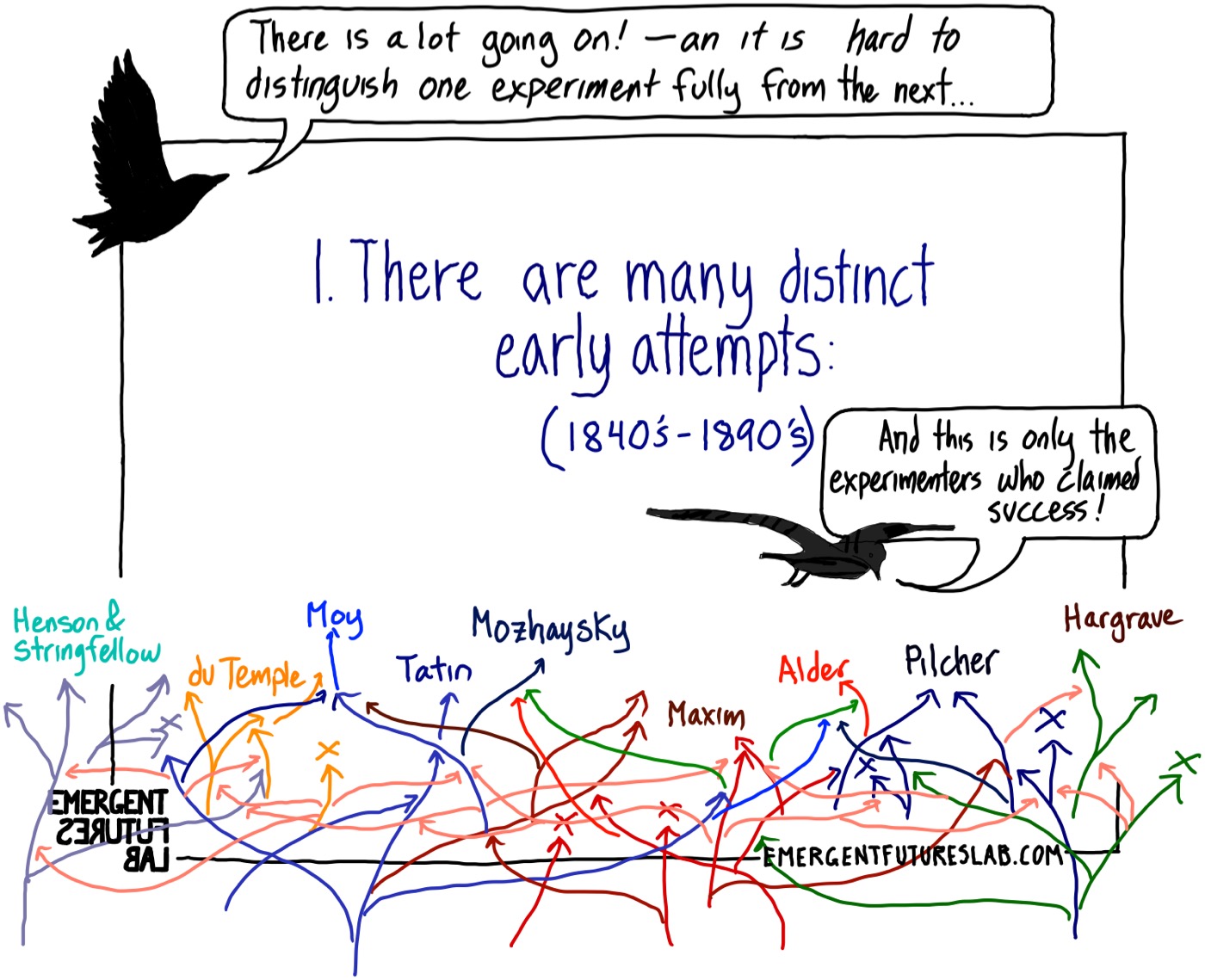
These early attempts most likely did not actually succeed in motorized flight (many achieved what could be considered to be “hops” – but there is a very ambiguous line between a “hop” and a “flight” – as we will see with the Wright Brothers' first flights). These experiments were nonetheless very successful. What made these and the many other experiments a success is that they developed and expanded the spaces of possibility. This evolving ecosystem of diverse experiments was characterized by much transversal and exaptive sharing (the sharing of unintended capacities and possibilities via co-optive replication). What was developing was not a series of radically independent linear experiments in a face-to-face zero-sum competition – rather something more akin to a highly intrawoven “transversal thicket” (what Guattari and Deleuze would call a rhizome).
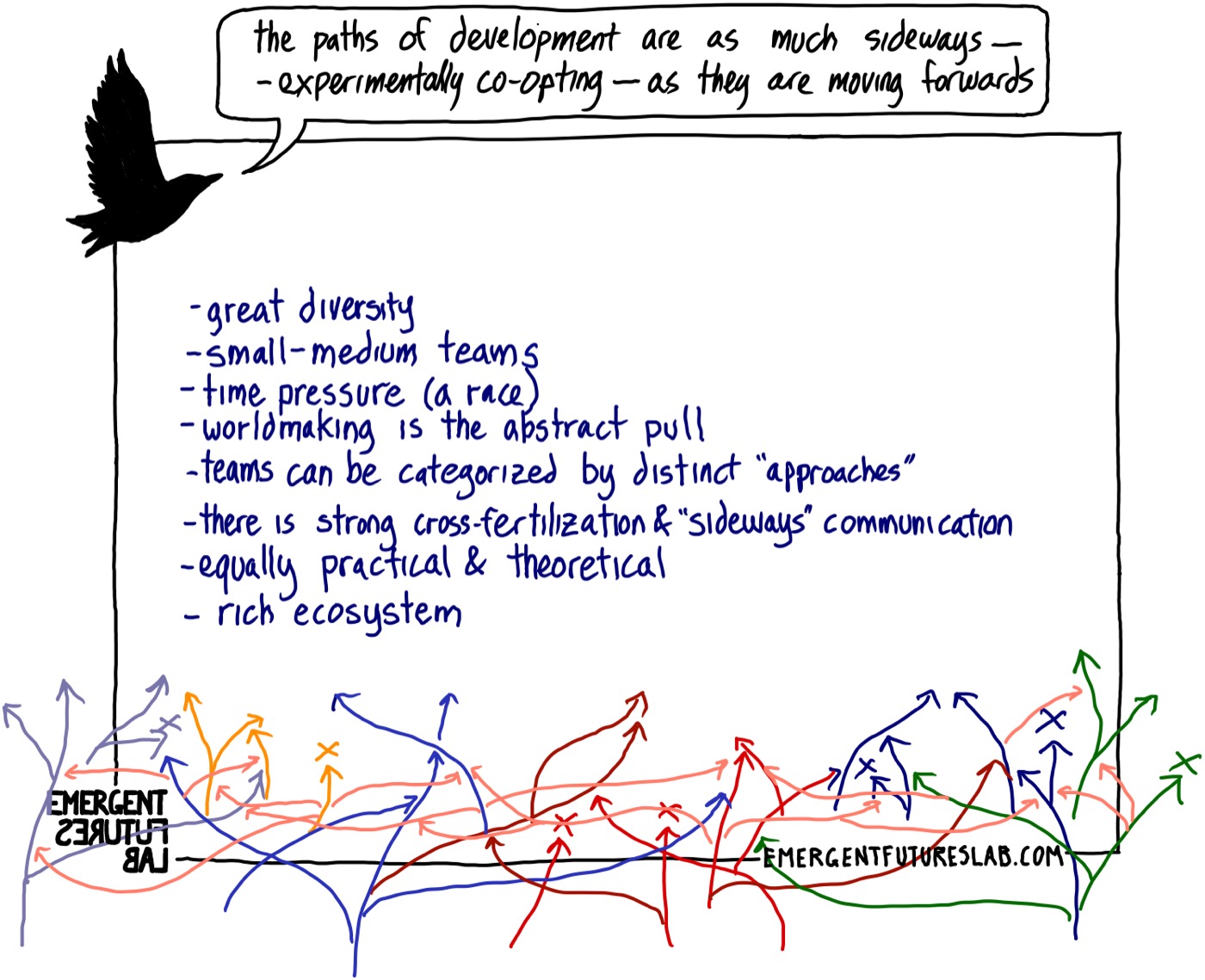
Most of these experimental programs ended – either via death, destruction of the plane, or lack of funds. Now, if we look at the immediate period prior to and during the period when the Wright Brothers were most active, we see more experiments yet:
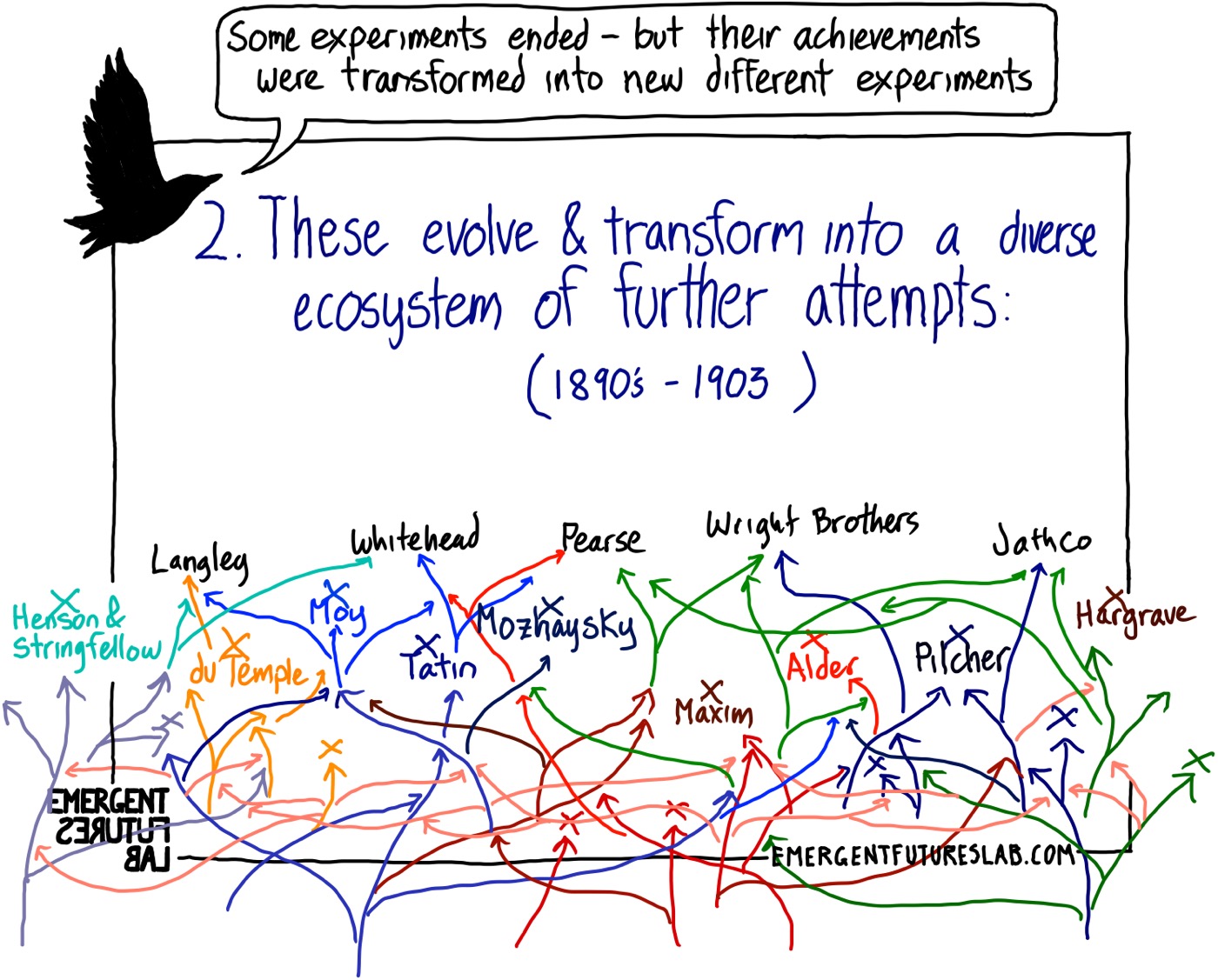
Now consider this scenario for one moment: If the Wright Brothers had the smallest bit of bad luck – a storm came through the island, an arm broken during a hard glider landing, an piston over heating and seizing up, a family emergency – any number of other experiments by others would more likely than not have succeeded – and these other innovators would now be hailed as heroes – and we would be writing about what made them so unique and different from everyone else (and perhaps designing innovation models and architectures based on their work. And perhaps, just perhaps, we would be writing critically about what the Wright Brothers did wrong – in exactly the manner we do today in regards to Langley...
But this is not the end of the story – yes, in December of 1903, the Wright Brothers were the first to fly. But these early flights are very short, exhibit little control, and are wind-assisted (arguably slightly more than a hop). It is only a year later, with a much improved plane, that they achieve anything like a controlled flight. By 1905, they were flying for thirty minutes at a time, covering more than twenty miles. Between 1905 and 1910, they designed a half dozen planes – each going a little further, faster, with more reliability and control.
And, as before, they are not alone in the development of motorized flying machines. Whitehead, Jatho and Pearce continued to experiment, as did many others – some newer to the field and others who had been at it for some time:
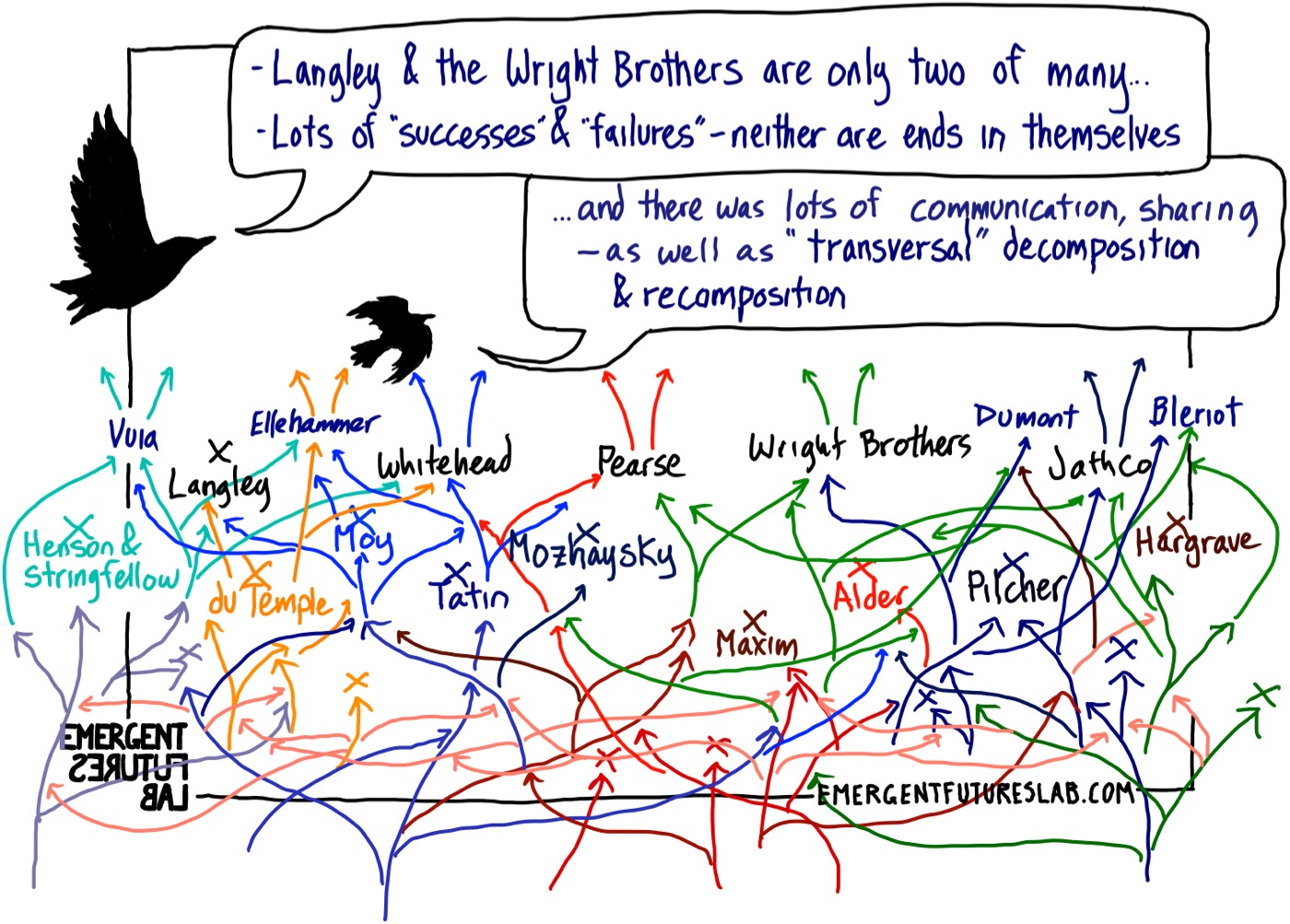
In the mix of the early years of flight, the Wright Brothers eventually began traveling to showcase their approach – and became more of a catalytic inspiration to others with quite different approaches. Their designs represented one approach. The key to their approach was wing warping: you twist the entire biplane wing system with your body through hip movement (Your hips being connected to the machine through a harness). It's a highly skilled approach (so much so that faithful modern replicas of their early designs are nearly impossible to fly). Because of this, it is an approach that has real difficulty scaling to different sizes of aircraft and being accessible to anyone other than the most skilled (and under limited environmental circumstances).
And here is where the second intimation that the classic linear innovation story goes fully off the rails: in 1914, Orville designed their last plane using any of the key innovations that were critical to their first flight. Their approach couldn't scale. They couldn't keep pace with the other innovations. Control flaps had become more complex and more effective. Wing warping essentially died. Other approaches took over.
After 1914, Orville left their original approach of “wing warping” behind and used techniques developed by others. And between 1915 and 1919, Orville continued to design planes – but in an ever more limited capacity: he had a small part in the design of a biplane, then he designed a small unmanned plane, and his last project was collaborating on a larger biplane that never saw production. By 1919, the Wright brothers had designed their last plane and no longer played any meaningful role in the development of the world of motorized flight.
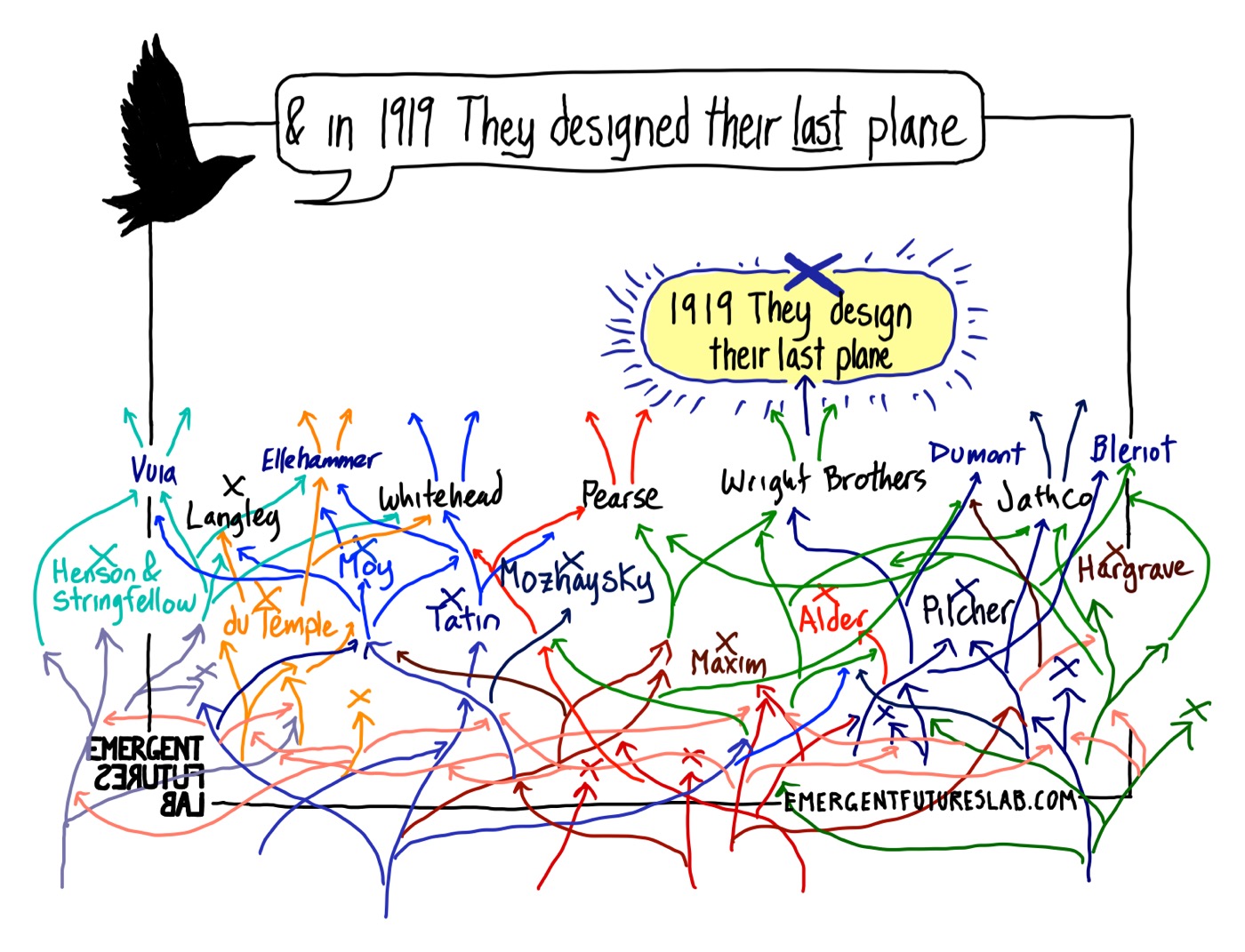
But nothing in the ecosystem stopped.
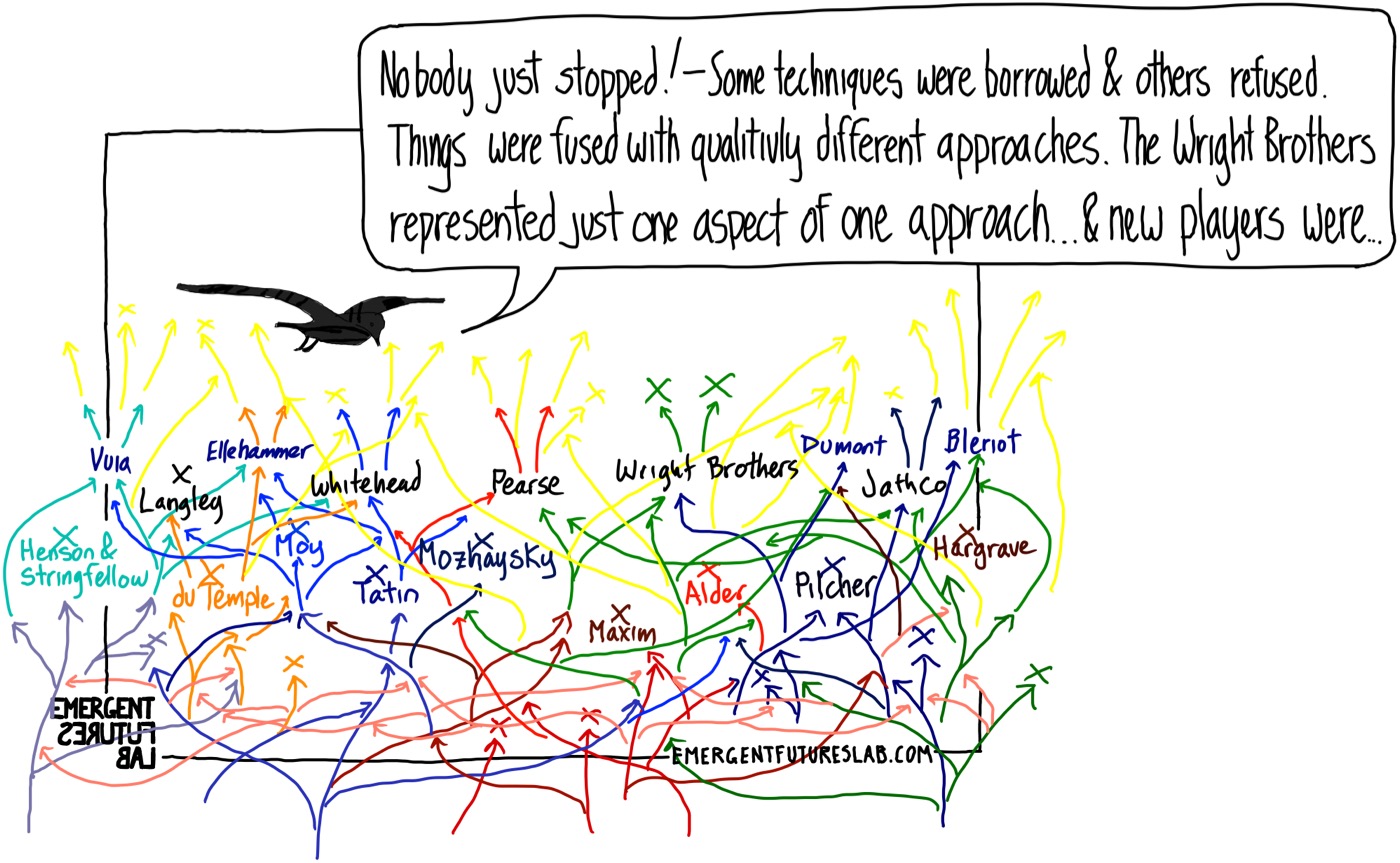
The approaches being pursued at this time are genuinely diverse: lighter-than-air and heavier-than-air, dynamic wings and static wings, two wings and one wing and five wings, front wings and back wings, moving wings, only wings…. And critically, there's significant cross-fertilization — books, research articles, visits, shared data sets. Things are moving sideways.
For a while, certain experiments come into prominence and system-wide relevance – Langley and the Wright Brothers, yes – but also Maxin, du Temple, Alder and others. They each played a critical active role – talking to people, visiting, reading, sharing research, testing, developing, flying... and eventually stopping. Around them is a landscape of “successes” and “failures” in all sorts of configurations. It is a dynamic ecology where the successes and failures matter far less than how some aspect of some experiment – intended or not – is transversally moved into other projects – no success or failure final – all of them – no matter how long gone – are potentially available to still contribute in open and as yet unknowable ways.
From the perspective of creativity and innovation, there is nothing that could be meaningfully understood as a linear, tree-like double diamond process. Yes, the linear story can be said to be factually correct – but in its Procrustean cutting away of the actual relational ecology to isolate one strand – it renders the entire process incomprehensible.
And from the perspective of creativity and innovation – nowhere would it make sense to exclusively focus on one innovator – or to invent one linear tree-like thread… The agency is in the dynamic ecosystem…
Thus, “While the Wright Brothers are part of this story – they are neither the story, nor even critical to it”. What is critical to it is this unique type of highly dynamic transversal ecosystem.
Last week we ended with a question: What other new visualization practices are required?
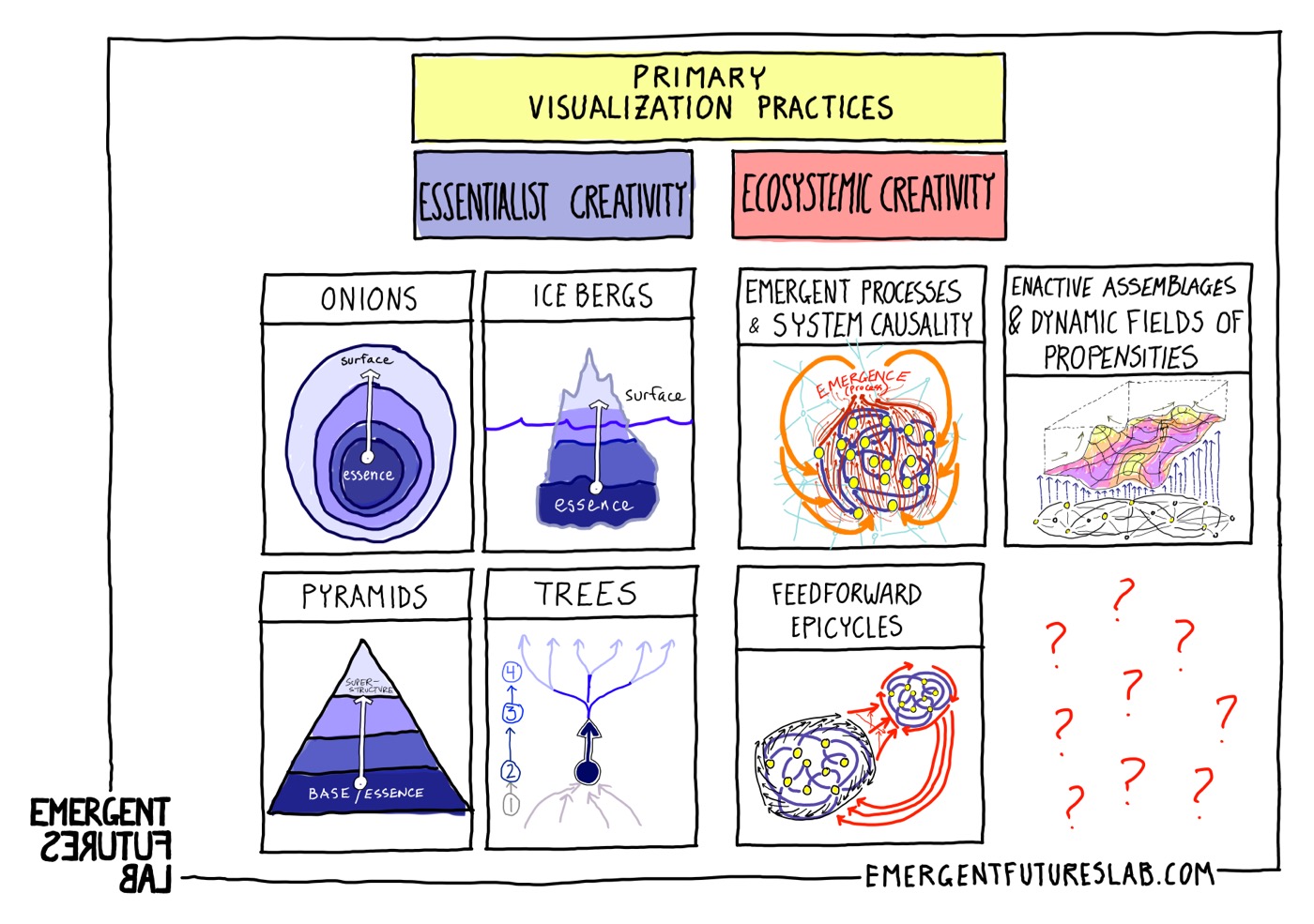
And now we can give an answer: The Transversal Thicket:
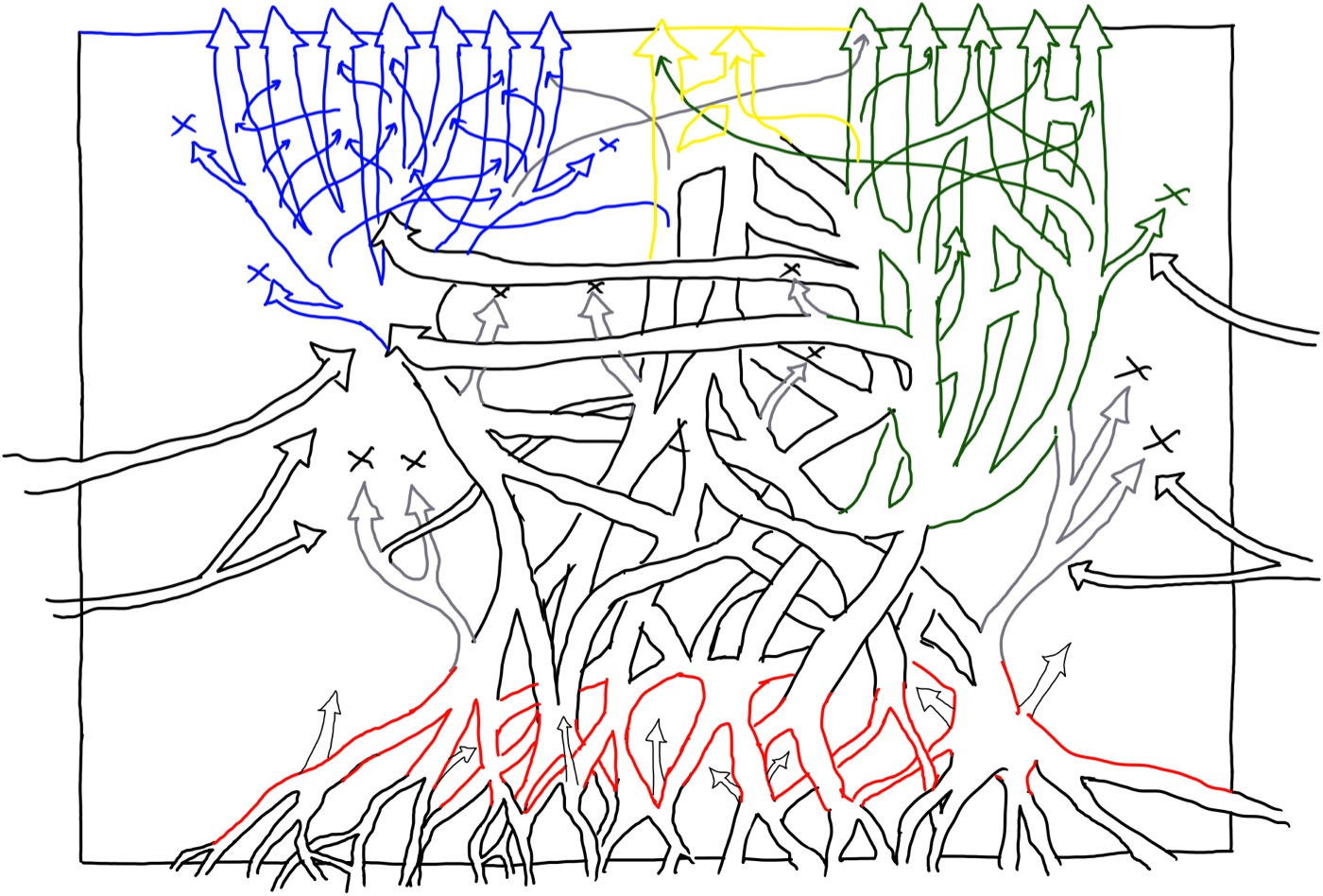
The term “thicket” and its visualization requires some caution. It is easy to get caught up in the visual metaphor of a vast bramble thicket with spider webs and all – which, after all, has a long history in explanations of creativity – the most famous being Darwin in the concluding chapter of On the Origin of Species:
“It is interesting to contemplate a tangled bank, clothed with many plants of many kinds, with birds singing on the bushes, with various insects flitting about, and with worms crawling through the damp earth, and to reflect that these elaborately constructed forms, so different from each other, and dependent upon each other in so complex a manner, have all been produced by laws acting around us.”
What we wish to suggest with the concept of transversal thicket is something far more dynamic and shifting – forming ever new sideways (transversal) connections that lead to qualitatively novel outcomes. As such, it draws far more on the critics of Darwin: Lynn Margulis and the Russian theorists of Endosymbiosis/Symbiogenesis (reaching back to Petr Kropotkin).
Here is a quick visual summary of the process (it is worth taking a moment to study this diagram):
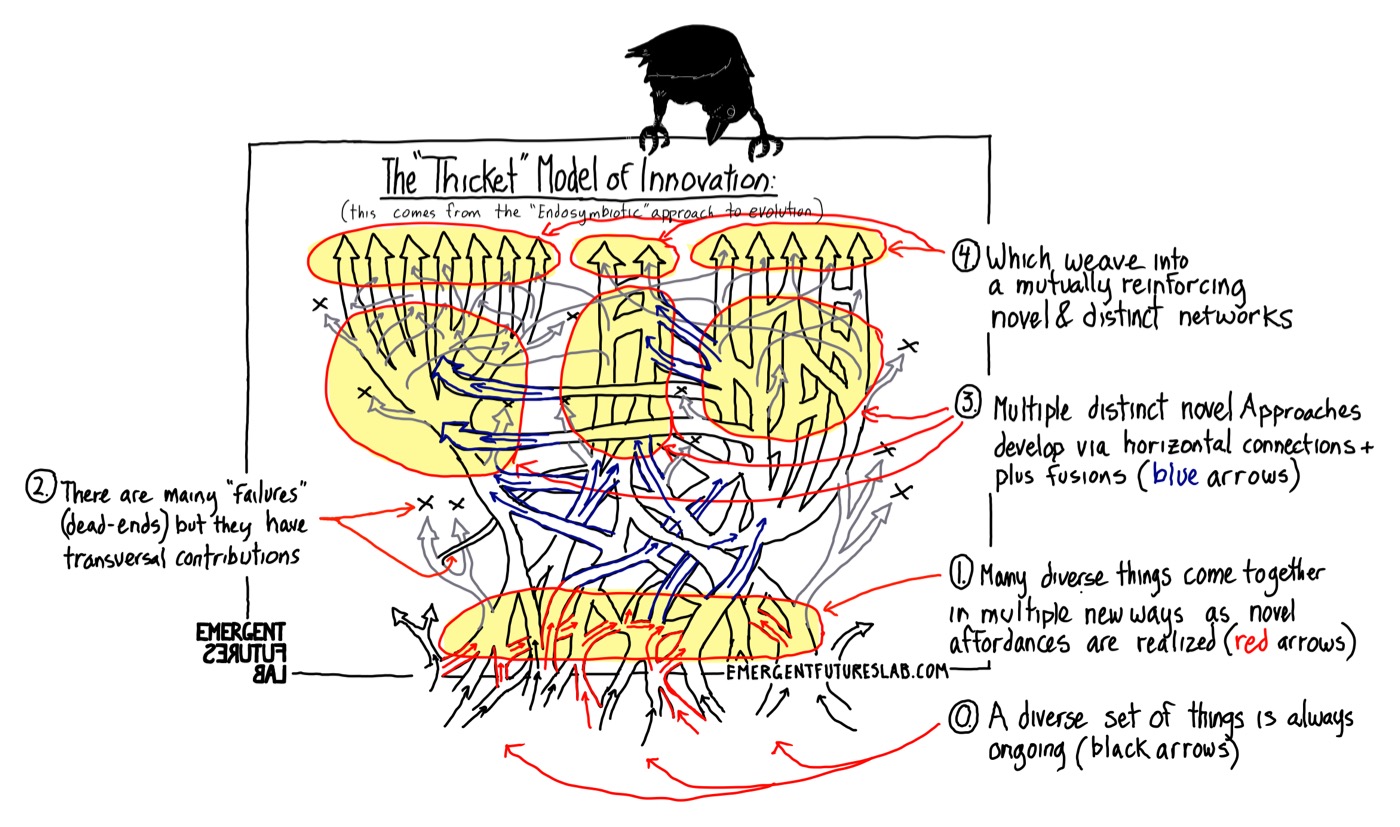
A great ongoing process of sideways movements, qualitatively transformative hybridizations, novel connections, and exaptive co-options. An ongoing creative process that is “thick before and thick after” – never a narrowing down to the one – and never radiating out from the one:
As we come to the conclusion, let us add the Transversal Thicket to our alternative set of ecosystemic creative practices:
What are some tentative lessons we can take away from this expansive telling of the story of the innovation of flight so far? Here are a few:
What lessons would you draw from this? We would be very interested in your speculations. Email us – or comment on this Newsletter in Worldmakers.
But even in getting to this point – as interesting as it is in re-telling the stories of the invention of flight – what of a discussion and application of Emergent Processes, System Causality, Enactive Assemblages, Propensities and Feedforward Epicycles?
We have said nothing of them…
There is yet another telling of this innovation story that is needed – one free of proper names and fully embracing of assemblages.
But, that is for next week. Till then keep experimenting sideways.
Until next week - keep difference alive,
Jason and Iain
Emergent Futures Lab
+++
P.S. This newsletter continues in our community—where you can comment, question, and explore further. Emerging Futures + brings you into the conversation. Join here
P.P.S. WorldMakers goes beyond the newsletter: 40 live events annually, weekly podcasts and exercises, our annotated bibliography, and practitioners across diverse fields reimagining creativity together. Discover WorldMakers


