Newsletter
Resources
Courses
Books

Welcome to Emerging Futures -- Volume 253! Was it the Wright Brothers - PT III...
Good morning becomings of architecture’s breezes, narrow streets, deep shade, caves and cooling waters.
Early mornings and late evenings are refuges in this anthropogenically ever hotter summer (not all creativities are as welcome or welcoming). As we adapt to the cooler temporal micro-climates of the night, we have been enjoying the dark, moonless, cool, starry nights of this week of the seventh new moon of the Gregorian year. Meanwhile, during the day – it's been a beautiful week of a growing sliver of a moon crossing through the sky in tandem with the sun (at least until the smoke of the wildfires became our sky and atmosphere late in the week).
This week is the third week of our experimental foray into the question of “How do we, and how else could we, tell innovation stories?” The premise that catalyzes this series is that how we tell creativity stories profoundly shapes how we engage with creative practices. The site of these experiments has been both the conventional stories of the invention of human flight and the archives of the processes of the inventions of human flight.

Two weeks ago we began by looking at the formal structures of the conventions that these innovation stories instantiate and how these forms in turn play a significant role in co-creating some of our primary historical assumptions about creativity – and how it is best to engage with creative processes.
Stories, amongst other things, explicate the processes by which something happens – something comes into being. From a very general perspective, such stories are always stories about creativity – the coming into being of something new and different. As such, they are ideal sites to experimentally explicate the larger, mainly implicit, patterns/ forms/logics that our common approaches to creative practices enact and tend to live in our cultural blind spots of the-too-obvious-to-even-consider.
The first cohesive pattern or formal logic, that is living quite a good life in our culture’s blind spots, is that of essentialism – or to be more specific, “property essentialism." We like to colloquially name this the “Onion Model.” Today, in the global West, the lived propensity is to approach creativity as some special thing or essence that an individual possesses – an onionlike essence found somewhere deep “inside” – most often the brain, the soul, the unconscious, etc. It is one of many internal capacities that an individual is said to possess: courage, empathy, leadership, creativity… which are in turn expressed via our outward bodily actions in the world. And if you don’t possess this deep internal property, it cannot be cultivated, developed, or expressed.

It is common to hear: “I just don’t have the empathy gene” or “they’re just lazy” or “I’m not creative” – as if all of these qualities were some deep internal possession.
This logic enacts stories and practices: ”when this creative essence is rich enough, and is put to work in the right circumstances with the right support, it will give rise to novel outcomes”. The process form that this enactment-of-essence takes is that of a “tree model”:

“Creativity happens when many things come together to catalyze into action an individual’s creative capacity, such that it materializes and develops a unique idea that radiates out into myriad effects and related outcomes.”
Speaking in terms of its formal logic, human creativity is implicitly enacted as: The Onion and the Tree.
And this is the logic of how the invention of flight is told:
(1) There have been many unsuccessful attempts throughout history.
(2) Then come along the Wright Brothers, who take inspiration and some insights from this history, but follow their own unique creative genius to become, via trial and error, the first to invent motorized flight.
(3) And this leads step by step in a radiating fashion to the eventual world of flight we have today.

This is how David McCullough, the great biographer of the Wright Brothers, articulated their own understanding of what they did: “Of the greatest importance to both… was to secure credit for having invented the airplane.” Here, the conflation is complete – and nothing could be further from the truth (as we sketched out last week): while the Wright Brothers might have been the first to fly – they were profoundly marginal to the collective more-than-human richly transversally entangled and ongoing emergence of human motorized flight. As we said last week, “while the Wright Brothers are part of this story – they are neither the story, nor even critical to it”.
The challenge is that so many of our creativity and innovation stories, explanations, and methodologies follow this linear essentialist logic – and not just these, but pretty much the entire logic of what it is to be human and act (in the global West) follows this logic. The problem is that when it comes to creative action – which is to say any and all action – there is no such thing as individual action, linear action, or layered actions – no actions involve neat convergences and divergences, and no actions begin in the head of an individual and then are neatly made manifest in the world. Bravery, empathy, leadership, creativity – these are not possessions – but emergent processual relational outcomes co-constituted by highly distributed more-than-human processes.
The mistake is to see the world – tools, practices, concepts, others and environments as merely supportive of (or hindering) an already pregiven internal capacity (for bravery, leadership or creativity). The world is relationally co-constituative of these emergent capacities. Skills, capacities, intentions, and actions are better understood as the emergent property of deeply intrawoven intra-activities of an assemblage (the specific tools, bodies, practices, concepts, others, and environments understood as co-constituting processes).
Because of the problematic emergent outcome of the West’s particular logic of the imagination and configuration of the sensible – the relational logic of all agency can only be sensed and imagined from within a circular logic of pre-given essences:
“How does creativity show up in the world?” “It first comes from the individual's internal creative capacity” “And where does that come from?” “Well – it was there all along”
The truth of an alternative emergent relational worldly creativity is what we attempted to experimentally sketch out last week in regards to the invention of flight: At the moment the Wright Brothers first successfully flew, they were not alone – nor was their approach (of wing warping control of a double wing lift assemblage) the only approach. The approaches being pursued at this time are genuinely diverse: lighter-than-air and heavier-than-air, dynamic wings and static wings, two wings and one wing and five wings, front wings and back wings, moving wings, only wings…. And critically, there was significant cross-fertilization — experiments, tools, materials, concepts, books, research articles, visits, data sets, etc. were all moving sideways and co-constituting an emerging world of ever greater differentiated and stabilized affordances. The agency that led to the emergence of flight was relational, distributed, dynamic and ecosystemic. The question is not who invented flight – but what invented flight.
Last week, because of the argument we were trying to make in regards to the relevance of the Wright Brothers, we presented the story of the invention of flight as one focused on Individuals and their achievements:

We too were focused on the “who.” Granted – it is a larger, messier, and more complex who – and one that convincingly makes the point that it was not the outcome of one individual or team. But it does allow one to imagine a very human-focused process: each individual inventing something and the collective sum of their intra-woven efforts leading to flight as we know it today. We can easily walk away from last week's argument and understand that this transversal thicket of the genesis of flight was a genealogical thicket of the interactions of a number of genius-like figures (where their creative genius is still an internal attribute).

It is certainly true that all these individuals – from Henson to Dumont to du Temple were key to the process, but such an approach falls short of illuminating the other-than and more-than human relational qualities of the processes of innovation.
So what are these entangled lines of the transversal thicket suggesting if not the relation between individuals?
The coming together of assemblages and the emergence of their fields of affordances.
To better grasp this, let’s experimentally explore one of the most significant and long lasting/varying of the assemblages that played a major role in the becoming of human motorized flight: that of the kite.
The kite assemblage is a coming together of particular trees – branches split and carved into frame members which are connected via twine to each other (a multi-step process of growing plants and transforming them into twine), over which a paper or fabric skin (often reinforced with paint-like treatments) has been attached. And to which a long string is affixed. This, when adequately fabricated, is skillfully launched into the air (itself bearing the right consistent properties – themselves relational) by one who has developed these capacities in a collective context. It then affords a specific space of airborne maneuvers via the attunement of the particularities of kite, atmosphere, gravity, ground conditions, string, bodies, etc.
Early on, it was part of war and signaling assemblages, as well as seasonal ritual and play assemblages in Far East Asia. And as it moved westward across Asia, its propensities entered into other assemblages, some of which afforded various forms of lifting humans into the air (a widely distributed and probed assemblage+affordance across all of Asia from far east Asia (China and Japan) to far west Asia (Iraq and Italy).

There are a number of key things to say about this assemblage:
At this point, it is important to pause for a moment. We have discussed in the newsletter assemblages at great length – they are a critical concept for engaging with a worldly creativity. And we have diagrammed assemblages quite frequently. Most often as some form of a dynamic but atemporal relation dominant network with a field of emergent propensities/affordances (see fig. 1 below).
But now we are doing something necessary, important, and different.
It is also critical to consider assemblages + affordances in time and in ongoing open transversal transformation. This is what a thicket form of diagramming affords one. – it allows us to sense and experiment with the ongoing nature of distributed symbiotic emergence (see fig. 2 below).

Each perspective affords us access to key aspects to engaging with creative processes. But these two perspectives are themselves not sufficient. If the network + field perspective gives a good sense of the relevance of the network and what it affords, and the transversal thicket gives us a perspective into how novel networks assemble and recompose over time – neither do a good job of giving us a sense of the “strange loop” of how what the assemblage affords will in turn transform the component processes in an ongoing dynamic loop enabling and stabilizing/constraining. This is where the third diagram of that focuses on Assemblages + Emergences + System Causality, is critical:

These are not three distinct diagrams of three distinct processes.
Rather, they are three necessarily distinct perspectives on the same process of creative becoming. In the creative practices of storytelling, critical analysis, and experimentation with creative processes, we necessarily move between and across all three distinct perspectives. Emergent processes and system causality are not something different from enactive assemblages and their fields of affordances. Each illuminates an aspect and gives us specific tools for creative engagement:
We cannot end without giving more of a sense of how the kite assemblage has a transversal agency that mutates as it actively shapes the becoming of flight. While we have neither the time, skills, or knowledge to tell this story in anything that might approximate more than the loosest of sketches – there is much to be gleaned from sketches.
The kite assemblage changes in shape, size, and materials while maintaining a recognizable identity all the way into the first planes that fly:

This assemblage – the skillful attunement between tools + practices + relevant features of the environment gave rise to a powerful set of affordances that stabilized as habits, practices, techniques, and material configurations:
Hopefully, one can sense how this dynamic assemblage, its transversal reconfigurations and semi-stable fields of affordances played a varied and significant role agentive role in the creative evolution of flight.
The kite assemblage was neither alone nor stable – it continually evolved and joined other assemblages in unexpected ways. Other assemblages and their affordances came into prominence and system-wide relevance (and also evolved and joined other assemblages in unexpected ways) – bird emulation assemblages (flight as the mechanical moving of wings), lighter than air assemblages (balloons + motors + airfoils), three dimensional skin as structure (monocoque assemblages), differing energetic assemblages (motors, thermals, kinetics, solar), non surface forms of lift assemblages (rotating balls and tubes of the “magnus” effect).
Idiosyncratic aspects of assemblages were used for novel purposes in new assemblages:
Many assemblages disappeared only to become relevant later:
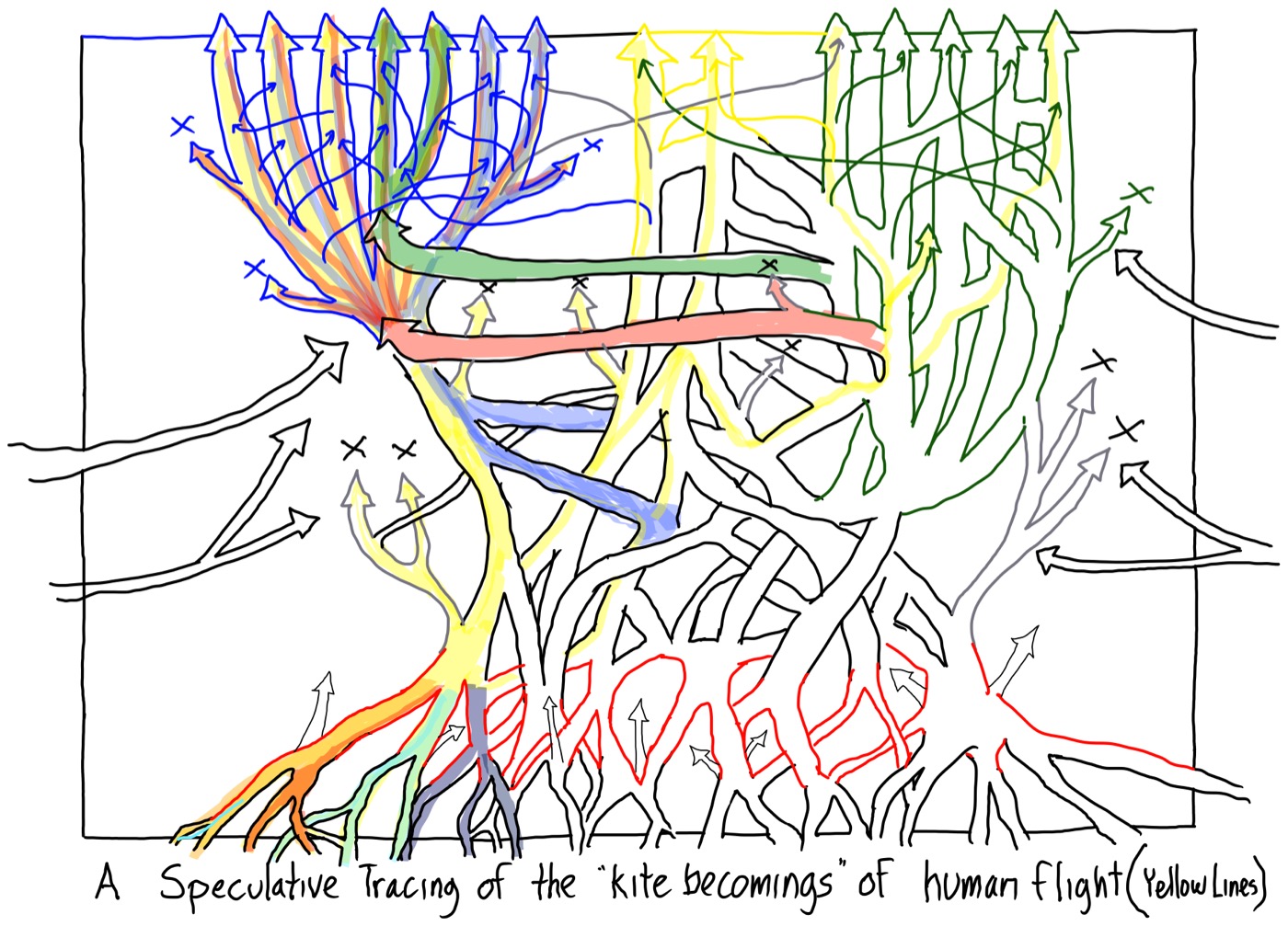
Each dynamic assembling and transversally re-assembling otherwise played a critical active role in the “kite becomings” of flight (see above). The ever-changing dynamics of this assemblage and its transversal flights into qualitatively different assemblages are not the whole story of flight by any means. But we bring this into the discussion primarily to give a sense of the creative agency of an assemblage. We know that the Wright Brothers did not invent flight, nor did anyone else – and far more importantly, giving the credit to any human or group of humans would miss the actual distributed, relational more-than and other-than human agential processes that gave rise to human flight.
Some of us participated in the making of the early kite assemblage – alongside trees, winds, knives, birds, and much else – and as this assemblage and its transversal becomings gained agency, it has in differing creative ways transformatively remade all of us.
Understanding assemblages, relations, emergence, system causation, enabling and stabilizing configurations/constraints, affordances, and dynamic transversal thickets gives us a way to engage with creative processes that obviates the illusory distractions of essentialism, reductionism, and linearity.
Who invented flight? That is the wrong question. What are the creative conditions that gave rise to flights' ongoing becomings? From the perspective of creativity – perhaps this is a more helpful question…
Our speculative hope is that with these experimental perspectives, we gain agential insight into how creative action and agency are emergent processual relational outcomes co-constituted by highly distributed more-than-human processes. We are not at the center of these – because nothing is. And because everything is active and collectively co-constituting, we matter – just how we matter is always a distributed relational and collective question.
Returning to where we began this week: Bravery, empathy, leadership, creativity – or the invention of human flight – these are not things we could possess or ever claim as our own – not because we lack some critical attribute – but because they are not things that could be possessed whatsoever. These are rather the ongoing dynamic emergent realizations of deeply intrawoven intra-activities of an assemblage (the specific tools, bodies, practices, concepts, others, and environments understood as co-constituting processes). Yes, we are relevant – but our relevance and individuation are co-constituted by an assemblage. We creatively play in and of assemblages and their thick and wide transversal becomings.
How to sense this?

Well, that is it for this week. Stay joyously distributed and collectively agential as “your” assemblage soars. Till next week.
Until next week - keep difference alive,
Jason and Iain
Emergent Futures Lab
+++
P.S. This newsletter continues in our community—where you can comment, question, and explore further. Emerging Futures + brings you into the conversation. Join here
P.P.S. WorldMakers goes beyond the newsletter: 40 live events annually, weekly podcasts and exercises, our annotated bibliography, and practitioners across diverse fields reimagining creativity together. Discover WorldMakers


