Newsletter
Resources
Courses
Books

Welcome to Emerging Futures -- Volume 260! Feeding Forward Across Novelty - Pt VIII...
Good morning active creative differentiators between feedbacks and feedforward,
Feedback is everything when it comes to life and creativity.
In our daily lives, feedback is nothing mysterious, technical, obscure, or far from mundane experience. It’s part of all action.
Let's feel our way into this: Consider how you are climbing a cliff. Now, more likely than not, this is not something you do frequently – if at all. But this unfamiliarity can be helpful.
Imagine that this activity – climbing cliffs – is something you do a lot. And like the many things you have potentially done a lot – say breastfeeding, walking with friends, washing a cup in the sink, watering plants, using Google Maps to get around town, eating breakfast, flying a kite or swimming – you are actively and responsively embodily attuning in the ongoing experiential flow of this way of becoming.
By now you are already climbing high up on the cliff face and standing on a good ledge.
How do you know it is good?
Before your feet in their new climbing shoes got to this ledge, your chalked hands got there (the chalk is absorbing the sweat from your hands to afford a more secure gripping). And in your hands shifting and feeling across the ledge for the right affordances of holding you, they have pulled your angled, tensioned body up to and higher than the ledge. In this flow of actions, forearms rested and pushed. Knees lightly touched. Scratches accumulated, and the mild sensations of pain attuned the level of effort to the constraints of your fleshy, bony body. At various moments, your eyes also landed on this ledge as your body's relational actions pulled your gaze across surfaces to potential zones of grasping, pulling, pushing, smearing, and shuffling.
And then your feet positioned themselves on this ledge – not in a static or a clunky manner – but with an inquisitive curiosity – shifting your body's balance as they shifted from inside edge to heel to full foot sensing the texture of the ledge – learning how far in or out the foot could sit, what it would push off or from what it might gain an inward pull from…
And you sense in all of this – in how arms and legs move and how your body moves – this is a good ledge.
With a good ledge, your breathing changes and the sensation of wind feels comforting and expansive. You call down to your companion, who is belaying you as you climb, about the beauty of the movement, and they respond affirmatively. Looking down at your feet, your gaze continues – it is only pausing for the briefest moment – for this looking is only a secondary confirmation of what you already know: It is a good ledge.
That is feedback.
It's happening in multiple highly intra-woven ways, it is a continuous loop of creative sensing-adjusting in action. It’s worldly lived sense-making. Fingers tighten, and the rock grasped is felt as positive or negative – it's a relational, embodied, and active judgment: how you are pulling through a hold is changing, and your body is adjusting – hips move, and eyes turn to where balance suggests moving.
Now, we can sense how profoundly embodied and rich this is by changing some of the qualities of the engagement: Imagine that now it is winter and you are on the same cliff face. As you climb, your hands quickly go numb. This, because of the cold, is both expected and unavoidable. Now, as you reach up far overhead, your numb hands report nothing back. They work ok – fingers move, and muscles strain – it's just that they don't tell you anything of what you are encountering. You look up, and you can see the shape of the grip your hand is making, and you can see muscles tense as they pull – but what exactly you are pulling on, or how hard – that you have no idea. It is a profoundly unsettling and out-of-body experience. It is as if your hands are not you – they are just things that you control and can watch from a distance.
The intimacy that comes from a density of feedback is gone. Here the loops are few: sight, memory and not much else… It takes a while to adjust – you have new tools: boots, gloves, crampons and icepicks to meet a differing environment of ice, cold, snow and wind. And you are learning a new set of skills – perhaps you have taken a course or are going with an experienced friend – in either case, you are being brought into an archive of skills, techniques and modes of being that have sedimented into a practice and ethos over the years: Winter Climbing. In this activity, you quickly realize that there is a formalization and independence to what you are participating in – summer sport climbing and winter ice climbing.
In all of this, most of the feedback loops serve the general purpose of keeping things stable – keeping you connected to the rock, moving in the right direction, and joyously alive. If you feel that a hold won’t “work” – that it won’t relationally afford a possible movement for whatever dynamic contextual in-the-moment reason, you shift – adapting, moving onwards in a continuous flow of adjustments. You are dynamically configuring relations to enable and stabilize affordance possibilities in an ongoing manner. This form of stabilizing feedback is termed Negative Feedback. Negative because there is no qualitative change in the overall state of things. You are climbing a certain way, and that is working well via negative feedback.
Speaking formally: This negative feedback is part of a self-maintaining process. As a system falls out of a desired state, an action is triggered to return that system to the desired state. This is why it is often called negative feedback, because there is no change — things are brought back to stay roughly the same. But it is not negative in the value sense of the word — it can be a very good thing if things stay the same. That our body temperatures stay within their narrow range is critical to us staying alive; that you stay on this ledge is a very good thing.
There is also a second form of feedback at work: Transformative Feedback, which is a self-reinforcing loop that enlarges or magnifies whatever change is happening. It will push a system across a threshold into a differing state. The enjoyment you develop in climbing, pushing you to train, buy equipment, and go up into the mountains more often, is a positive feedback loop. But this positive loop could also push you to ignore dangers and be swept down a mountain in an avalanche (a differing, far less desirable relational state of the emerging systematization of your climbing life…). This transformative loop is also termed Positive Feedback.
Our always creative everyday lives are lived in the dance of Stabilizing and Transformative Feedback – shifting between states, staying within states and co-emerging with novel states. It’s the dance of being of dynamic configurations – what they emergently afford and constrain.
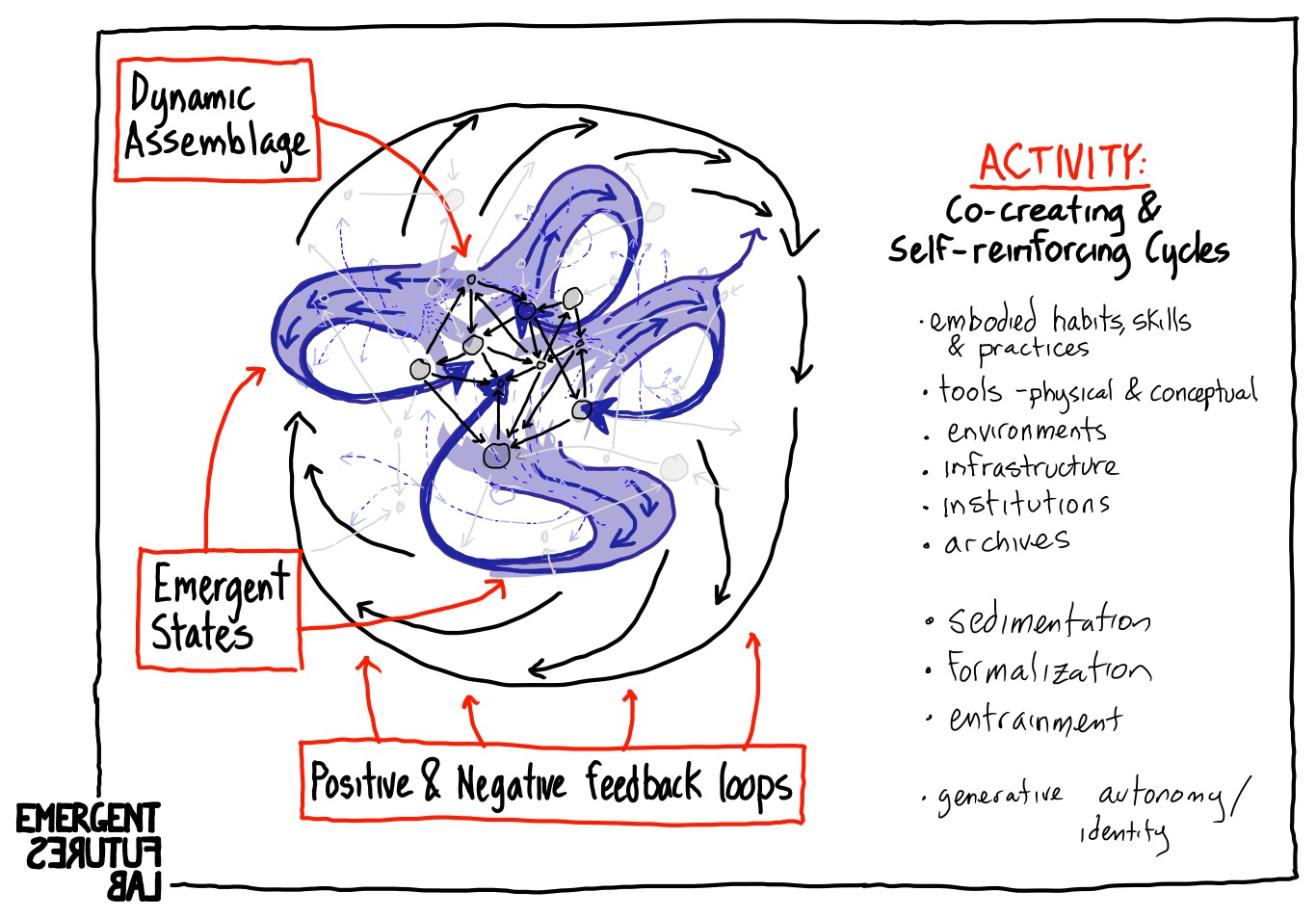
In all contexts, feedback is everywhere and everywhere critical to how things creatively emerge, develop and stabilize around relational potentials. While at the direct embodied scale many of these feedback potentials have been co-created on an evolutionary timescale (our sensory systems) and can feel simply given – it is important to remind ourselves they too are co-creations of activity.
Feedback systems are made and emerge in all activities. We see this also at work in larger institutional contexts and scales. Here, informal and formal feedback systems are everywhere: From seeing familiar cars in parking lots to gossip on the way into work. From daily stand-ups to work left out – feedback is everywhere.
It is important to recognize that this allows for the spontaneous, ongoing emergence of differences and samenesses via both the inherent contingencies and variations of any complex system – and feedback: the latency of stabilizing (negative) feedback and the work of transformative feedback (positive):

In most cases, most of experimental novelty (positive feedback) is stabilized or dissipates on its own, and in this way we can sense how any moment reality is dynamic, changing and stable. This is not a contradiction. Change and stability are rarely in opposition. To sense this, we need to see how various diverse and seemingly contradictory propensities have a formal logic and propensity that, alongside other diverse qualitatively distinct outcomes, can be seen to be “common” – that is to say occurring with something like a regularity. Positive feedback moves us across many stable states, and negative feedback keeps us in each of these stable states:

At any moment, reality is all of these different connected multiple stable states – always a system with more than one stable state.
A climbing culture reproduces itself and its emergent states through the activities of its participants. So too a university reproduces itself. And so too a transportation system reproduces itself. Habits, practices, skills, concepts, discourses, institutions, laws — all of these things are looping, self-reinforcing. Entrainment. Sedimentation. Formalization building on and of feedback.
Consider the transportation system in the 1800s: a semi-stable configuration with multiple stable states – all keeping things moving roughly as they've been moving. But nothing is ever fixed in a “locked in” sense – it is all variation staying close to certain ongoing process logics. Positive feedback is always active. And always transversally moving.
Thus transportation is varying – land – and water-based systems are evolving and mutating. Roads for the most part were terrible in the 1700s, but new technologies in construction are changing things: the breaking down of stones for the road surface to half the width of a carriage wheel. And canals are becoming a well-established system, with barges being pulled by horses and enslaved peoples. The steam engine is developing exaptively from mine pumping systems (from Taqī al-Dīn in the 1550’s forward). Lots of variation and lots of experiments. Lots of transversal connections. Lots of feedback.
And on the margins and in the cracks, flight and all forms of airborne movements, in a vast and semi-stable experimental manner, are thriving – but they have little to no meaningful impact on the evolution, expansion and diversification of the existing multiple stable states of the world of movement/transportation:

And this brings us back to last week's newsletter. Last week we ended with an aspiration, a question and a promise:
“Our hope is that we all feel how astonishing it is to ask the question: How does something novel gain the agency such that it can overcome the strength of what is already happening? – And sense that we are asking about a big, wondrous, and less noticed aspect of creativity – all that happens after …
We are most curious about all that happens after the first plane tentatively hops a few hundred feet. For at this moment nothing is inevitable – and everything is still to be invented…“
So much of the attention in the world of invention and creativity is given over to “the first” – to the purported origins. Most of which is a fantasmagorical exercise in the impossible shoehorning the diverse landscape of transversals and their long timeframes into the imaginary head of an equally imaginary genius. After which a progressivist narrative of inevitability takes over.
The irony is that if anything could be said to be inevitable, it would be the tentative emergence of difference and novelty. Obviously, all irony aside, this long, complex, highly diverse transversal nested coming together of exaptations that is proto-flight is by no means inevitable. And this is why we spent seven newsletters getting to this point. But the undertheorized and poorly considered reality remains: how does something novel gain the agency such that it can overcome the strength of what is already happening? This is a fundamental question of creative practices that cannot be resolved by calls to better attend to weak signals or develop better practices of abduction, as so many a complexity consultants are wont to do.
In working on this question, we have found many resources in those looking at the processes by which pre-humans and early humans developed as fully bio-enculturated beings. Of these, Gary Tomlinson and his development of the concept of epicycles and feedforward loops has been of critical importance to your own work. Tomlinson notes that complexity-based accounts of bio-cultural change, while giving a good sense of how change is non-linear, based in dense webs of feedback and emergence – still fail to miss key aspects of the process:
“Even this level of complication, however, misses an element of hominin coevolution… that will be basic in my account: the presence not merely of cultural feedback cycles, but also of the systematized epicycles they spawn. The failure of most accounts to identify this element, even more than the complexities of behaviors, selective terrains, and their reciprocal interactions, has made it difficult to model the emergence of the distinctive capacities of modern humanity…”
Tomlinson continues, explicating what he understands to be a key logic for the creation and stabilization of novelty:
“Scrutinizing the sedimented cultural archives of late hominins, we will see that they gave rise to many repeated patterns or formalisms in behavior and environmental accommodation.
According to their various natures, these assumed the character of more or less complex, independent, and self-organized systems. These systems, then, came to stand within culture but detached from the coevolutionary feedback from which they arose.
Such detachment from the reciprocity and control of feedback is the defining feature of feed-forward elements in any network, and, while the measure of the detachment from the feedback loops differed from one instance of cultural systematization to another, in every case it enabled the cultural systems thus formed to persist and to feed forward into coevolutionary patterns”.
How should we understand this and bring it into the ecology of experiments that eventually gave rise to the world of flight as we experience it today?
Let’s turn from early hominin activity to the period of proto-flight (from roughly the 1840’s to the 1910’s). Transportation and human movement had stabilized around evolving land and water-based systematizations that were rich, sedimented, formalized, and entrained by forces, technologies, environments, and beings into multiple stable states via a dense weave of feedback. Novelty within these logics was also emerging – especially around the mechanization of movement, and new material processes. In this context, the diverse experiments in early flight as an actual propensity were emerging. Materials, systems, techniques, practices, tools and environments were gaining a consistency and semi-autonomy:

As the density, richness and diversity of this feedbacking set of practices gained coherence, it emerged with a distinct systematicity that was functionally independent of existing practices (of transportation). There was a formalization of techniques – a teaching of ways to fly, ways to test systems, ways to build things correctly. Abstractions and concepts appearing. Materials, tools and practices were converging: this metal, with that weld, plus this fabric and this kind of lever. Certain propensities starting to hold: ways of taking off, banking, rising, dropping, diving, rolling and landing could be done and, more importantly, repeated.
This is emergent formation of what Tomlinson terms an Epicycle – a formalized emergent process outside of existing feedback cycles:
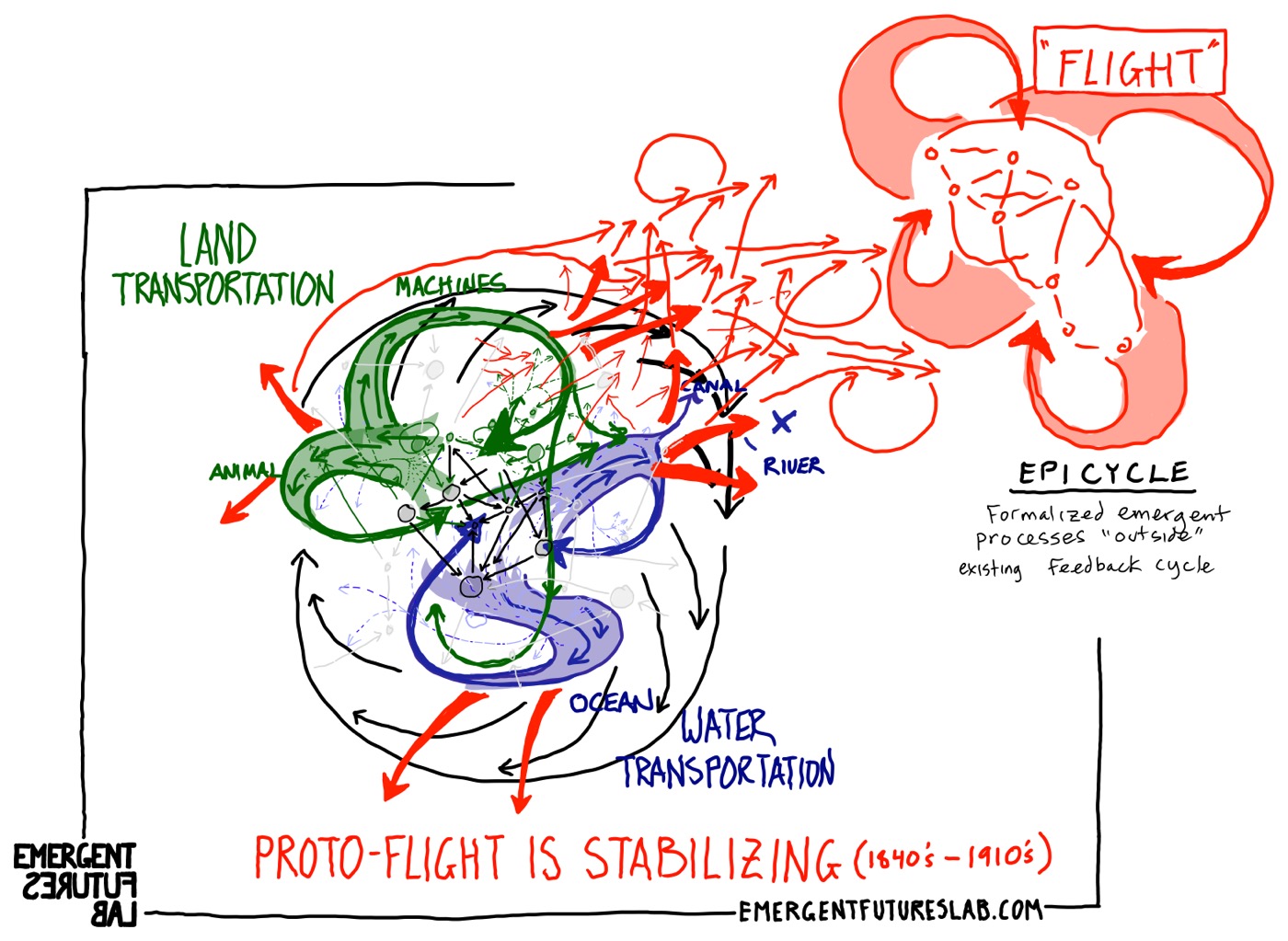
At this point, it is a small new cycle that is forming. It is not an alternative form of transportation – we are a long way from that. But what has emerged is important: it is a cycle that has stabilized outside the main cycle, with its own coherence, autonomy and agency.
As it emerges, the epicycle gains more and more autonomy. There is an expanding richness and stability to the new feedback logics. More stabilizing feedback systems form to put a break on the more dangerous forms of transformative (positive) feedback (e.g. there are now ways to sense and avoid many different ways to lose control). The ecosystem of flight that emerged as a vast field of variations now gives way to a narrowing of major propensities (e.g. landing with retractable wheels on hardened land surfaces versus landing on water).
And then, because of this epicycles autonomy and agency, it begins to have an impact on existing logics of transportation: The integrated logic of flight as an autonomous system begins to exert a control-like function over the transportation and manufacturing cycles from which it emerged and differentiated itself from. This is what Tomlinson calls a “feed-forward” loop:
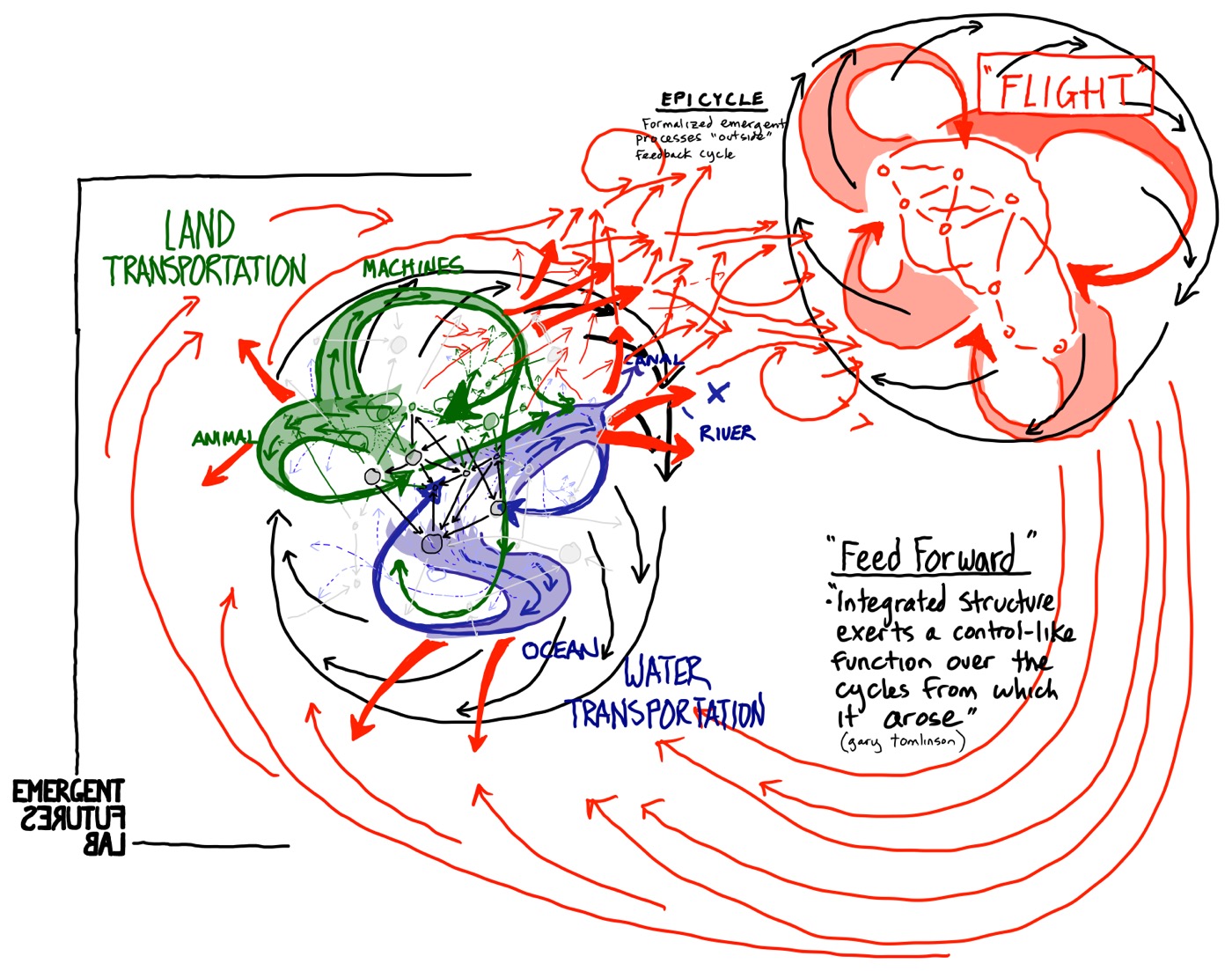
The term “feedforward” is a term from the environmental sciences usually used to refer to things that have an impact on a system – but are themselves not affected by that system. For example, a large mountain has an impact on the nearby weather patterns – but the mountain is not changed by these patterns). Feedforward is thus quite distinct from feedback (and it especially should not be confused with positive feedback – which it all too often is).
The feedforward logic of the epicycle of flight now bends cities, roads, and oceans to the logic of the air. Roads give way to runways; cities become defined by airports and their distance from each other in flight hours. And what was once very dangerous becomes far safer than any other means of travel.
This autonomy and feedforward agency can make it seem like the new just appeared out of thin air – rather than something that emerged via a long and wide process. Because, in a short time, the world of transportation was radically changed: within thirty years of the first reliably repeated controlled flight – we came to live within and of the world of flight as much as any form of movement:

Tomlinson himself comments on this,
“It is worth pondering a bit more the independence of the epicycles, with their feed-forward effects, from the broader action of biocultural feedback. The systematizations or formalisms of these epicycles could not, of course, be truly divorced from the broader feedback networks, since that feedback gave rise to them in the first place. But the natures of their individual formalisms enabled them to establish varying degrees of autonomy from the feedback mechanisms, and with the increase in this autonomy came a multiplication of the effects of their feed-forward impact. There could be no cultural system that was, so to speak, dropped into biocultural coevolution from the outside, a feed-forward ingredient of utter independence from the coevolutionary network; all such systems could only arise from the network itself. But once they began to arise, and once their systematic formations took shape, they had a special power to alter coevolution as if dropped into it from outside.”
Epicycles and feedforward logics are, like feedback, transversal thickets, exaptation, and abstract machines – to be found everywhere novelty is found. It is not just a question of big global transformations. Rock climbing, dishwashing, breastfeeding, and walking all are giving rise to epicycles and feedforward logics.
Think of how you began this newsletter – speculatively standing on a good ledge high up a cliff. Where did this as a propensity emerge from?
It is a history of emerging epicycles and feedforward processes: Not long ago, the practice of taking in Europe as a Grand Tour led to many crossing the Alps to get to fabled Italy (mainly the English in the seventeen and eighteen hundreds). This practice, exaptively, gave rise to a Mountain tourism of the Sublime, which gave rise to the Mountaineering epicycle and its feedforward logics. Mountaineering itself required practice and training, which spawned rock climbing – which quickly gained an autonomy from Mountaineering as its own epicycle: rock climbing. And the feedforward logics of this in turn gave rise to many subworlds: bouldering, trad climbing, sport climbing, aid climbing, big wall climbing, competition climbing, indoor climbing – of which indoor climbing is becoming its own distinct epicycle and giving rise to a world in which outdoor climbing is mainly irrelevant…
But there you are, high up on an astonishing ledge, in the midst of all of this experimenting with the multiscalar creative forces that reach above, below, and beside you – leading into adventures quite stable and quite disruptive…
Until next week...
Keep Difference Alive,
Jason and Iain
Emergent Futures Lab
+++
P.S.: The question we hear most often from newsletter subscribers is: How can I participate more deeply in this work?
We have two ways:
1. Emerging Futures+ is where the newsletter becomes alive: post your comments, questions, or thoughts alongside practitioners across five continents, connecting each volume to their own work. Plus the extended audio version for a commute, join 2 live events per year, and the full searchable 260+ volume newsletter archive.
🧨 Start with a $1 trial for 7-days… Then $6/month or $60/year. Cancel anytime.
2. WorldMakers is where the newsletter gets practiced. Facilitators, educators, consultants, and researchers experimenting with emergence and change-making. In dialogue, in shared experiments, in the collaborative making of a different approach to creativity. Members have access to everything in Emerging Futures+, plus thirty-five live events a year, two weekly podcasts, bi-weekly creativity exercises, and the complete annotated bibliography.
💥 Start with a $1 trial for 7-days… Then $60/month or $597/year. Cancel anytime.


