Newsletter
Resources
Courses
Books

Welcome to Emerging Futures -- Volume 261! Invention Invents - On Feedback and Feedforward...
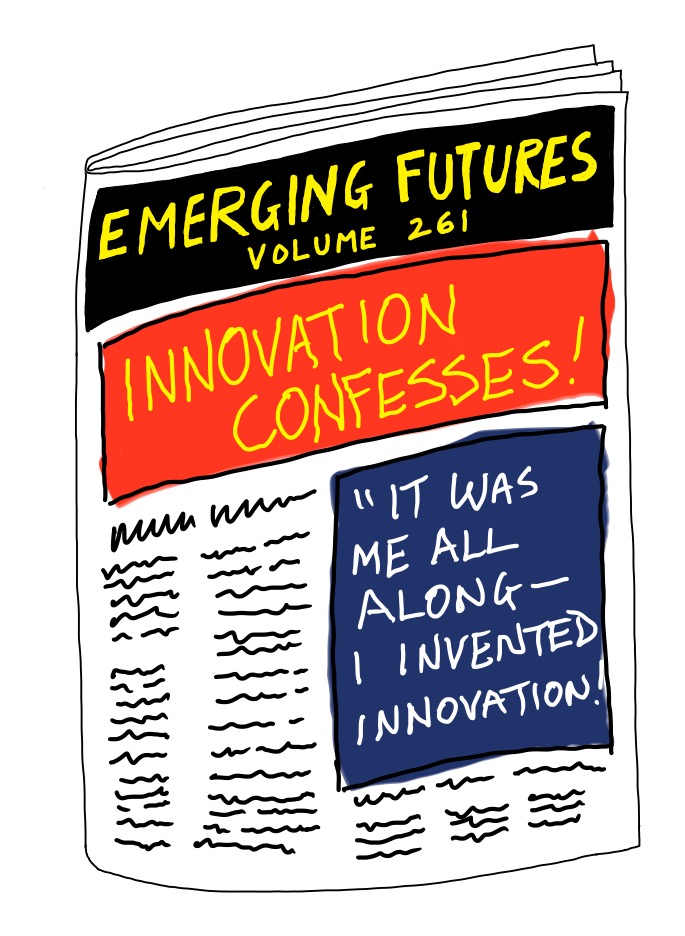
Good morning surprising becomings of feedbacks rich creative loopings,
It’s been an interesting week of being co-creatively drawn back into a differing very stable dynamic state of our everyday lives: “the fall”.
Work patterns are changing into new familiar states and we are being pulled along by all that this entails. Day follows day with a familiar regularity that we experienced in previous fall seasons – such that it can be hard to sense the creative dynamics of living in an integrally inventive reality.
It’s such a wonderful phrase, “integrally inventive” – it is one we picked up from our friend Brian – he actually terms it “integral inventivism” – which is even better, but we are getting ahead of ourselves… (we will come back to this shortly).
Last week we were experimenting with feedback to get a sense of its integral role in the profound and all-encompassing creative agency of reality itself. In pointing out that it is “reality” that is creative – to some this can feel deeply challenging and even polemic – with it, we are all too quickly brought back to discussions that emerge from our culture’s obsession with assigning responsibility: but who did this?
In our contemporary culture, we like to understand creativity as something very human that exists in a directly controllable world: someone does something innovative, and it has some directly knowable novel effect – such that we can say, “the Wright Brothers did it – they are responsible – they invented the first working airplane, and this gave us the world of flight”.
Alexander Fleming discovered penicillin, and this gave rise to the modern world of Antibiotics.
Johannes Gutenberg invented the printing press and gave us the world of print.
On and on:
James Watt and the steam engine, Thomas Edison and the light bulb, Roger Easton and GPS…
Of course, today we know that others were involved in all of this – and so the list for each of these stories will expand:
“It was not just Roger Easton who is responsible for the invention of GPS – it was really the work of Roger Easton, Ivan Getting, Bradford Parkinson, and Gladys West.”
But whether we tell this type of invention story in the narrow or expansive form – it is still a distraction from getting a grasp on how creative things happen. It is still a distraction from sensing the integral inventivism of reality. This individualizing – really atomizing and linear approach to how things creatively come into being is so profoundly problematic that sometimes it can feel hard to know where to begin to work our way out of it.
This feeling of “not knowing where to begin” is perhaps, while deeply frustrating, as good a place as any to begin because it puts us right in the thick of the problem: our historical approach to creativity – really life and agency – assumes that things “begin with us.” Or, speaking more generally, that they begin at all. It is an approach that imagines being able to neatly stand outside of things, survey the world dispassionately, identify problems, develop solutions and then neatly insert them into the world, see their impact – offer a few tweaks and there we go – things are “changed.” There is a wonderful naive confidence and clarity to such an approach.
But the beauty of reality – and problem for this approach – is that there is no “outside” – we are always fully in and of life’s vast, fully relational, non-linear emergent ongoingness. The Wright Brothers did not just wake up one day, leave bike building behind, decide to invent flight, and in being successful, change the world. They, like us – and like all life, woke up to find themselves in the midst of a rich, thickly entangled world full of many stable and many novel propensities – propensities that had their own systemacity and co-evolving agency. They didn’t choose to “step into the river” – they were already in it and, more importantly, of it. It pulled them along – far more than they transformed it (modesty is seemingly not a relevant quality for those claiming so much). The neat dichotomies of inside and outside, self and other, subject and action tend to mess everything up and make it nearly impossibly difficult to get even a tentative grasp on things.
Now, the moment we bring up such a relational perspective on creativity, there is pushback – and a very specific form of pushback: It is the concern for the agency – really a concern for the importance and free will of individuals (human individuals): where do we fit in?
“Are you saying we don’t matter? Don’t we actually have agency in all of this?”
This concern is understandable – we reasonably want to sense that we matter, gain an understanding of where we fit in, and what we might be capable of actually achieving. But jumping directly to this concern and keeping our focus on this individualistic human concern for “who is responsible – who really caused this” makes it difficult to see the forest for the trees.
There is a need for another way – an approach that senses – and is not afraid of the “integral inventivism” of reality and its creativity (Brian Massumi talks of this in a wonderful interview on the work of Gilbert Simondon). Massumi speaks of invention being “less about cause than it is about the self-conditioning of emergence… [where] the [individual human] designer is a helpmate to emergence.” But, here too – we are being pulled too quickly back into the question of “our role” – without fully being able to sit with the question of “our role in what” – and this what is our big concern…
Speaking very broadly – perhaps too broadly and generally, what is more helpful than an atomistic and linear approach to creativity and reality in general – is a dynamic relational approach. But, as the saying goes, the devil is in the details.
In coming to sense that all reality is interconnected, we have to be cautious to not recycle our old, reliable concepts from an individualistic and atomized conception of reality. Relational dynamics are so very different from what we expect:
Everything is relational, and everywhere relations transformatively make their “relata” (the things that are in relation to/with). It’s creative relations all the way up and all the way down. And it’s all a vast dynamic profoundly entangled world of active co-creative relations. Here it is important to note: we are not making a claim that relations are inherently good or better than something else – it is rather that all reality is composed of dynamic relations full stop. We are not making a claim about how we, or things in general, should be – rather it is a claim about how we – and everything is.
It is because relations are everywhere and everything that we talk about assemblages – integrated networks of relations – as being fundamental: “An assemblage is the first and last word of existence. I do not exist, and then enter into assemblages. The matter of my existence is my very participation in assemblages…” It is this point that Isabelle Stengers is making that is so critical: There is nothing – no “I,” no “object,” no thing that is independent and exists before relations.
But that is not how we (in the modern global West) usually see it: we exist in our autonomy and then either choose, or are forced into, relations. And in our autonomy we possess things – qualities: the quality of creativity, subjecthood, and agency. But from a dynamic relational perspective – we are not originally discreet agents who internally and authentically possess anything, and then later come into relations – this is the belief that there is an “outside” – a “before”...
But when or where would this be?
How could we be genuinely outside anything?
And how would it be that this outside is not, in some very real manner, creatively shaping us? – How could the world not be co-constituting things? (It is worth noting: this is why we try to refrain from using metaphors of glasses or frames – and how we can switch these out or remove them entirely – these metaphors can give one the impression that we can be separate from the assemblages of forces that individuate us as us).
Here again, the Madhyamaka tradition in Buddhism offers a helpful contrast to an atomistic perspective: it develops from a relation-dominant emergent assemblage perspective; the dependent co-arising of all things (Pratītyasamutpāda). The scholar of Classical Chinese philosophy Brook Ziporyn terms this ontological ambiguity – in dynamic relational ontologies (such as Madhyamaka Buddhism or Daoism), no scale or relation is more fundamental than another – and which comes to matter more depends on the engagement (which is itself co-creative).
The key, again speaking very generally, is to locate everything relationally: “I am not gifted with agency, the possessor of intentions or initiative. Animation, agency, intentionality… belong to the assemblage as such” (Isabelle Stengers).
But, as important as this is, none of this really helps us get at agency – it just moves the question from being some possession inside an individual to the possession of an assemblage. Now we can correctly say something like: “The Wright Brothers did not invent flight – because no one did – rather it was the emergent outcome of an assemblage” – but, as profound as this might be if understood in its most expansive and nuanced form – it is close to becoming another hollowed-out platitude (and there is already enough of this littering the world of complexity consultants).
How does anything actually come about? Where and what is agency in the emergence of the new? This is where the importance of understanding feedback (and feedforward) logics really comes into play.
Feedback and Feedforward logics are critical to the agency and creativity of relational systems (reality). Again, speaking at a high level – this is what the term “adaptive” is meant to highlight in systems terminology when one says a “Complex Adaptive System” (CAS). Adaptivity is the co-creative dense non-linear feedback that shapes systems – either in ongoing stabilizing or transforming ways.
To speak of adaptivity and dynamic relations shaping – really co-creating their relata – is to speak of feedback and feedforward logics – dense complex networks of feedback, emergent epicycles (individuations) and feed forward processes (which is what we introduced in last week’s newsletter):
In dynamic living relational networks (assemblages), as change is happening (and it is always happening), it loops back to affect the system in all its aspects. Some of these aspects are stabilizing and others transforming (in complex non-linear ways). What is important is that because of the density of the relations: in all assemblages the feedback is itself profoundly non-linear and emergent in its creative outcomes. A change in one seemingly discreet area will creatively participate in the relational dynamics of other areas such that surprising things happen at differing scales – that in turn will have a creative agency to shape the assemblage or other distinct assemblages in surprising ways.
Let’s turn to a concrete example: Here is a profoundly worrying creative example from the news (a good reminder, if we do need any, that creativity is not an inherent good):
The Guardian is reporting today that the emissions of industrial pollutants (part of a specific assemblage) are leading to global warming (an emergent outcome with its own relational creativity). And that the relational creative agency of this warming is changing distinct ecological systems/assemblages (permafrost landscapes, wetlands and forests) such that they are now becoming their own stable emergent creative cause of global warming (what we would term novel epicycles or individuations that are having a feedforward impact).
Let's look directly at this article (note: we have added a few clarifying terms in square brackets to make the connections to feedback and feedforward logics more explicit):
“Rising global temperatures caused by the [assemblages of the] burning of fossil fuels are [creatively] transforming the world’s forests, wetlands and tundra [assemblages – via positive feedback] to the point they are [becoming new stable assemblages – epicycles, that are] releasing emissions that could [feed forward in distinct ways that] further worsen global heating by as much as 30%.”
The article goes on to explain further:
“As the world heats up, permafrost in the high latitudes is thawing, fiercer wildfires are burning in drying forests and wetlands, and lakes are warming. All of these changes are themselves causing the release of planet-heating methane and carbon dioxide locked in trees and soils, therefore worsening the climate crisis… While scientists have long known of these “feedback loops” that amplify the impact of direct pollution from burning coal, oil and gas, the emissions from natural sources are largely unaccounted for in climate projections. This additional heating is however, significant, researchers found, with emissions from natural sources set to amplify global heating by 20% to 30% by the end of this century. This would add an estimated 0.2C to 0.4C to the global average temperature by this time…” (Here is the scientific source this reporting is based on).
Consider, in all of this, for a moment: the drying forest as its own emergent novel and stabilizing event. Transformative feedback of emergent rising temperatures has participated in its co-creation. But these transformative feedback loops are meeting stabilizing feedback loops that collectively, in their non-linear density, have given the forest a new relative relational autonomy: it is what ecologists would term a “novel ecosystem” – the dry forest. What is happening is that these older stabilizing feedback loops have not gone away; they are now being entrained by transformative feedback loops into the co-creation of a qualitatively new kind of dynamic dry forest system with a propensity to burn in new, distinct, and regular ways.
We should understand this as the becoming a novel epicycle (all dynamic adaptive systems are cyclical – massively full of the loopings of feedback – hence these systems are also appropriately termed “cycles”). In this novel epi-cycles non-linear emergence, it is becoming semi-autonomous and agentially distinct from the specific heating dynamics that gave rise to it (which is to say we could lower carbon emissions and it, and its propensity for fires, and their impact on heating, carbon emissions and creative processes of global warming would still remain).
Here in this process there is a genuine novel circular causality emerging. This is the moment of invention. Before, there was industrially caused global warming on one hand, and on the other: a deleteriously impacted forest. Now something new has come into being (emerged via a dense weave of non-linear feedback loops). What has emerged as an innovation is a novel dry forest ecosystem/epicycle that can maintain its autonomy and have transformative/ creative feedforward effects on the world it co-emerged from… The creative potentials have been invented by the novel relations stabilizing.
That the conditions that gave rise to it could change and it would not change means that invention exceeds its history – it is irreducible to its genesis. This is one of the great paradoxes of inventions – they do have a history, but they are not their history. Invention, as Brian Massumi noted, “is less about cause than it is about self-conditioning emergence.”
Whether industrial global warming or the Wright Brothers could be rightly said to participate in the cause of the non-linear emergence of an invention – they inevitably become secondary to the “autonomous taking-effect of the relation… “ – as an epicycle/the proto-invention gains autonomy – becomes truly an “invention” (in the sense of being genuinely novel, having its own agency) as it begins to pass across a qualitative threshold which “depends on the potentialization of the elements presently in place as a function of their future.” (Brian Massumi).
Here there is a further challenge: we can see all the parts, all the players, and all the related systems – they too maintain an autonomy, but alongside and in addition to them a novel effect of the system as a whole is emerging. And this too has an autonomy. We could call this the “flight” effect or the “warming” effect. And it is, in its autonomy, what has been “invented” – and as such is irreducible to its sources.
Many systems, materials, processes, ecosystems, teams and individuals are the relational “helpmates” to the emergence of novel epicycles (innovations), but they are not the cause of the innovation (in the classical way we would attribute cause in a direct and linear manner). There is no individual, idea, vision, plan or proposal sitting somewhere as the source: the emerging system as a cohering system gaining autonomy in all of its non-linear feedbacking richness that is ultimately the ‘source” of its own invention.
In relation to creativity and invention, it is not that helpful to focus on some distinct source – some origin – some “who” or “what” – for this is not how things happen – there will always be many helpmates active in the non-linear and emergent dynamics of an assemblage. The agency will be in and of the emergent epicycle itself. But where does that leave us? Does flight or global warming “just happen”? Are we irrelevant and powerless?
Certainly not – but the heroic approach, the atomistic approach, the linear approach — those are dangerous fictions that will only make matters worse. We need to collectively invent new practices, techniques, and archetypes of distributed, collective, and emergent agency for our profoundly relational and relationally creative reality.
Next week we will begin to experiment directly with these questions. Until then, keep sensing, engaging, and experimentally helping the integral inventiveness of our dynamic and relational reality bend towards the thriving of a world in which many worlds flourish and yet new ones will emerge.
Until next week -
Keep Difference Alive,
Jason and Iain
Emergent Futures Lab
+++
P.S.: The question we hear most often from newsletter subscribers is: How can I participate more deeply in this work?
We have two ways:
1. Emerging Futures+ is where the newsletter becomes alive: post your comments, questions, or thoughts alongside practitioners across five continents, connecting each volume to their own work. Plus the extended audio version for a commute, join 2 live events per year, and the full searchable 260+ volume newsletter archive.
🧨 Start with a $1 trial for 7-days… Then $6/month or $60/year. Cancel anytime.
2. WorldMakers is where the newsletter gets practiced. Facilitators, educators, consultants, and researchers experimenting with emergence and change-making. In dialogue, in shared experiments, in the collaborative making of a different approach to creativity. Members have access to everything in Emerging Futures+, plus thirty-five live events a year, two weekly podcasts, bi-weekly creativity exercises, and the complete annotated bibliography.
💥 Start with a $1 trial for 7-days… Then $60/month or $597/year. Cancel anytime.
Two questions, every Friday since 2020:
What is creativity? and How do you innovate?
A weekly experiment in emergence, creativity, and change-making.


