Newsletter
Resources
Courses
Books

Welcome to Emerging Futures -- Volume 266! The Creativity of Persistence (On Events Pt III)...

Good Morning intensive aggregative becomings,
This week we – the intra-dependent dwellers of the North-West edge of the Atlantic, became of an event of the moving inland and northward of the transformations of an elongating band of low pressure with emerging and changing wind shear patterns over a week before, that came to have an emergent closed circulation pattern, which, in the lively context of high oceanic heat plus decent levels of relative humidity and an upper-level atmospheric divergence in the Gulf of Mexico, creatively individuated into Hurricane Isaias – the first named hurricane of the 2026 Atlantic Hurricane Season.
In short: it rained a lot here in Northern New Jersey last week.
Now that statement certainly feels easier to say and quicker to grasp than the previous convoluted sentence. The prior nearly hundred-word run-on sentence can feel profoundly exasperating:
Oh my god! – Get to the point already!
And that feeling, which we too feel, is what interests us: Is it that even our emotional and physical attunements have been shaped at a cellular level to almost only feel at home with the neat, clear, and direct? What is being lost in our deep, full emotional participation in this narrow logic?
It’s week three in our new creativity series (Pt 1: Vol 264, Pt 2: Vol 265), and we are taking on this question of “why might we be so attached to the neat, clear, and distinct?”
What is lost is arguably the most important aspect for creativity: that of the ability to directly sense how all things emerge from highly distributed and unlike processes as events.
Our opening sentence is an experiment in a cartography of the conditioning of an event’s becoming.
While “It is raining heavily” speaks to a condition – really a static slice in time – a moment in experience – how can we sense and take into account the creative eventing of this (and all) experience?
How can we extend the logic of the creative conditioning of an event more broadly to include the becoming of chairs, feelings, actions, and large-scale regularities such as capitalism?
Speaking generally, our approach in Emergent Futures Lab to creativity has always had an “event logic” – which is to say that it's always been roughly about processes: how they relationally come into being – individuate, persist, change and intra-act with other relational processes. But this could give one a false impression of our living and ever-evolving experimental practice. It’s as if we are claiming that we knew all along what we now know. As if our practices, tools, enactive states and ecologies have been immune to transformations. As if this approach, this event logic, somehow transcended the processual logic of events that it strives to articulate. But it certainly has not. It too is an event in the ongoing becoming otherwise.
For us, the evolving intuition – the enactive hunch – the speculative proposition – that has persisted and transformationally taken hold of us over quite some time is that everything begins and remains of the middle.
But this raises the question: the middle of what?
Our simple response is: an event (of course).
That, as we would be the first to acknowledge, is not the most satisfying of responses. On one hand it begs the question – and on the other – well, nothing is ever that simple…
If we were pressed in convivial circumstances (say while roasting urban foraged mushrooms over a provisional fire at the edge of Newark Bay) for a simple definition of an “event”, we would colloquially propose that an event is:
the relationally creative coming together of many ongoing processes such that they configure for some length of time to give rise to certain stable active emergent outcomes. And that these outcomes would themselves be open creative processes.
And if asked why this is relevant to a creative practice – our response might follow this line:
An “event perspective” engages with things from the creative perspective of:
Under what dynamic relational configuring circumstances did it emergently come into being? How does it relationally persist? And how could it engage in a qualitatively open way with other event processes?
Importantly, such an “event perspective” allows us not to cut things in ways that make them impossible to understand (the classic example of this is Gregory Bateson’s discussion of a blind person and their stick – see Volume 162 for a more extensive experimentation with this):
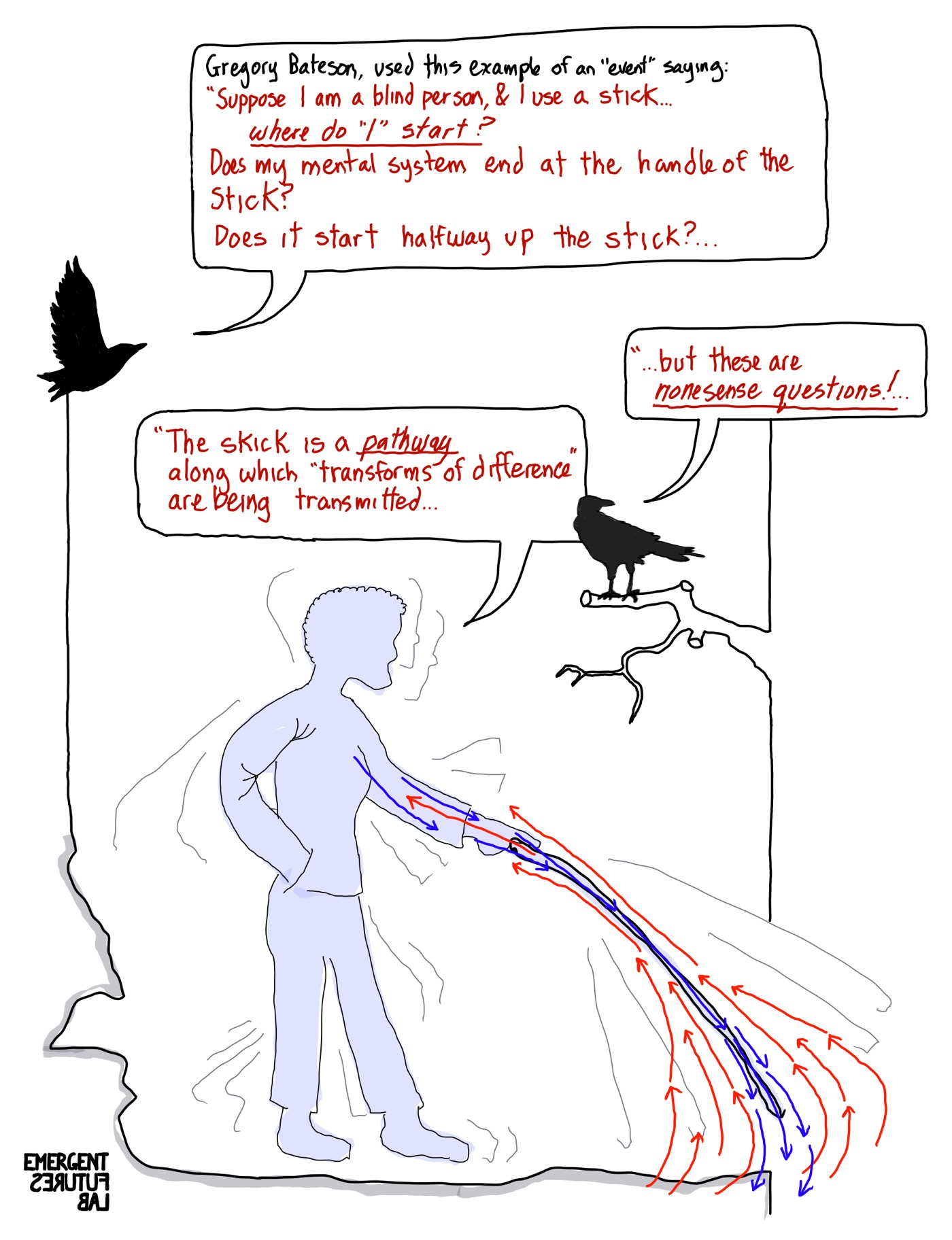
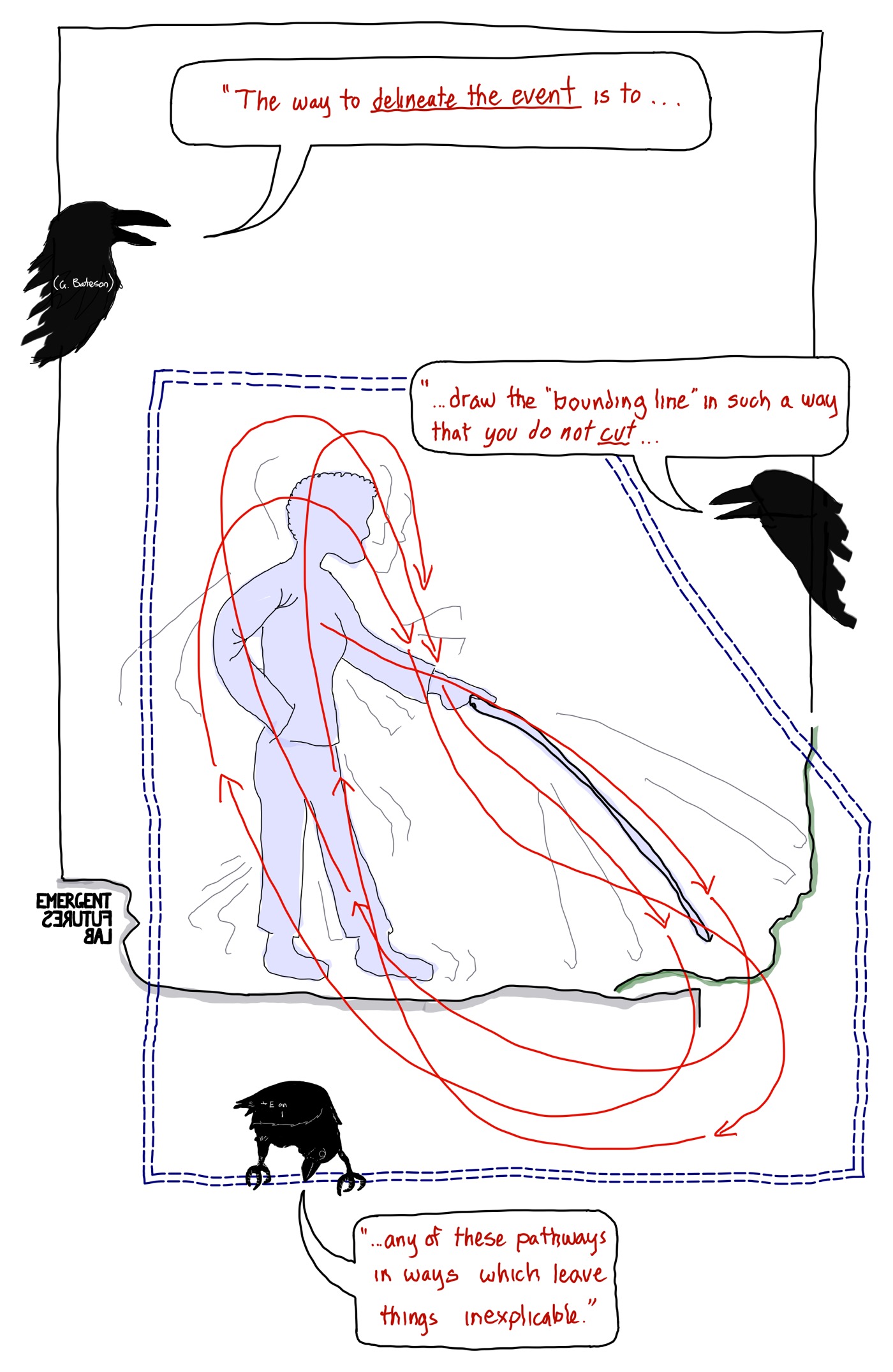
To engage with reality from the perspective of an event is, for us, an alternative, and more helpful way to approach engaging with the inherently creative relational and emergent logic of all reality.
An alternative to what?
Historically in the West, by the very early Christian Era, only god was understood to be creative. And the world that we experience – rocks, mountains, sun, moon, animals, plants, and people sprang forth fully realized from an ideal immaterial vision in the mind of a god:
And God said, “Let there be light,” and there was light…
And God said, “Let there be a vault between the waters to separate water from water.”...
And God said, “Let the water under the sky be gathered to one place, and let dry ground appear.” And it was so…
It is ideated and then it “is” – no process, no relations – “and it was so”
– end of story.
This being, god, is the creative source of all things – full stop, end of story. As such, he is necessarily outside (in all senses of the term) of what was created (the changeable and fallible) – he has to be a type of “unmoved mover” – An unchanging essence of all essences, source of all sources.
In this context, all human actions, from the prosaic to the profound – from the carving of a peasant's stirring spoon to the carving of Michelangelo’s David, were understood to fundamentally involve the grace of being given access – insight – inspiration – into the unchanging immaterial “mind” (vision/plan) of god.
Michelangelo, for example, did not understand himself to be creative or that what he was doing came from himself – such an understanding is fully misguidedly anachronistic (applying our contingent and distinct logics and world to the past). Rather, he understood that he, by grace, was given access to transcendent ideals – the vision of god, and with the right kind of care – itself a literal “gift” – he was allowed to make this visible for others.
Lest we forget, Inspiration once literally meant to be in-spirited – to be graced with having the holy spirit enter and move one.
It is an approach to creativity that puts agency in a pre-given immaterial agential idea – a plan – an essence that is then simply made real: “and it was so…”
Now, if an event approach to creativity answers the question: “why did this come about?” with a potentially exasperatingly distributed and vastly relational emergent processual answer – this essentialist and transcendent approach responds to the same question with an answer that always takes the form of: some pre-given immaterial essence gave rise to the outcome.
Today, in the global West, it is not a stretch to claim that we approach creativity according to a similar god model as animated the ecology of Michelangelo’s milieu – just brought to earth. Which is to say, that much of our contemporary approach to creativity has simply substituted an idea in a human brain, or some other essence logic (DNA, or the reductive “Theory of Everything” from physics, for example), for the idea in an absolutely transcendent god. In our near-theological worship of those individuals that “genuinely” think outside the box – these so-called creative ones have become little gods – visioning and imposing visions. This near complete parallel should give us pause: That today we are still on the search for essences in things – or really “behind” things – despite having all the evidence we should need that this just isn’t so (see Volume 265 for this argument).
But, that this logic still persists, mutates, transforms, and seems to maintain an almost zombie-like unstoppable persistence should also be expected.
Why?
If the relational conditions that configure to give rise to an event dynamically persist – then the event continues to exist – to individuate – even when strong conceptual criticism exists – precisely because they do not directly change or challenge these conditions.
The criticism remains at the level of immaterial ideas.
The mistake is to engage with this essentialist logic as if it were an abstract thing (a model). This is to fall under the spell of its very ideational and immaterial logic.
Here, it is important for us to be clear: while we have always made note that the “god model” is a set of embodied practices, tools, and environments – we too have fallen into the spell of this logic. For example, we have been all too quick to call it “the god model” – as if it too were an agential immaterial idea that could alone shape and bend reality to its will…
But there is no “god model” – nothing is ever simply an idea, an abstract model, or a discrete mindset. It too is an event. It too is the coming together and ongoing development of practices, tools, affective states, values, environments – robust and rich ways of meaningfully being, doing and knowing. It's an event of great durative qualities – a “becoming-god” – and we are still very much of the event of this logic.
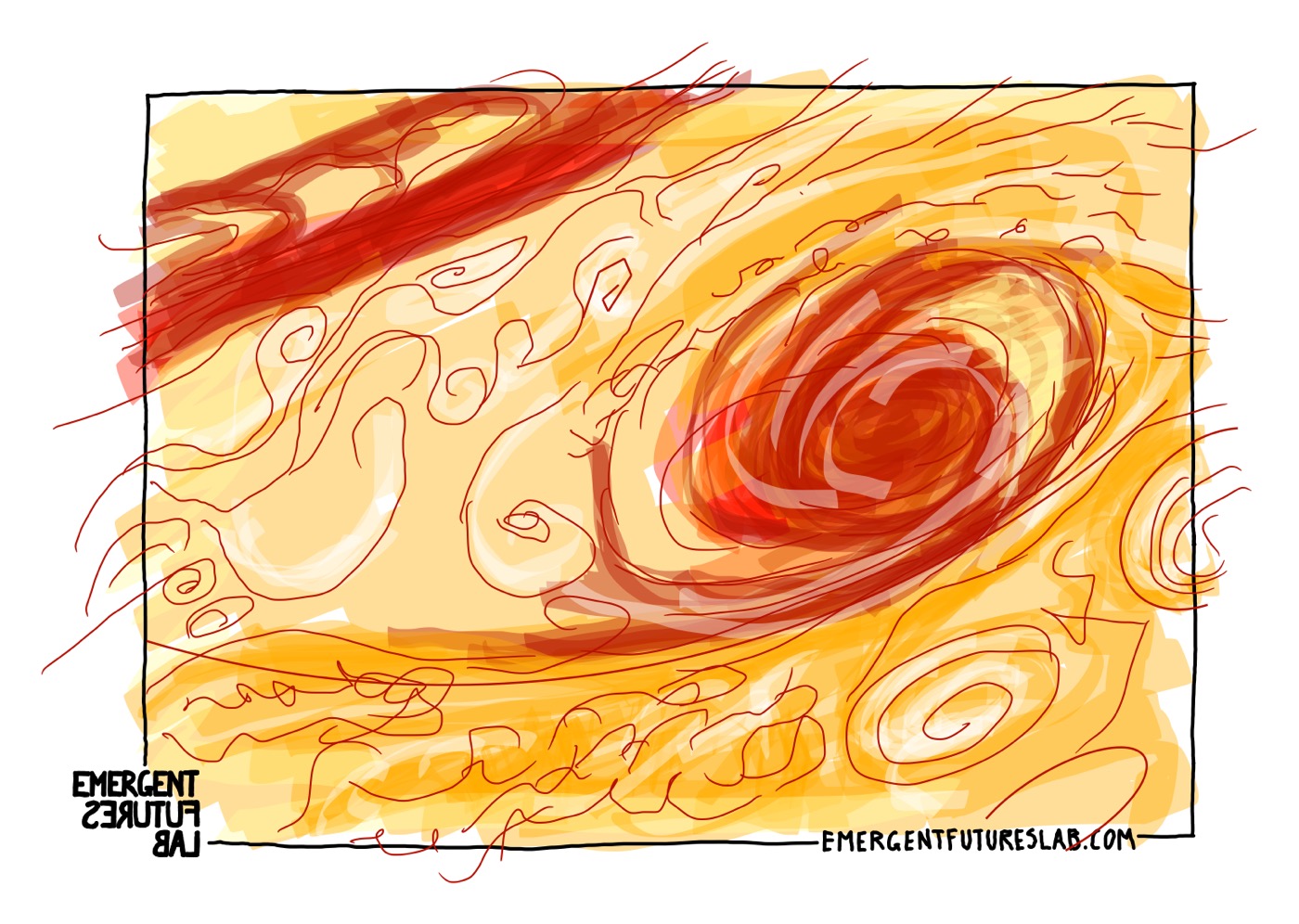
Perhaps, as a first experimental attempt to grasp the odd circumstance of the persistence of this immaterial ideational logic, it is more helpful to understand this persistent event as being somewhat like “the great red spot” first observed on Jupiter by humans in the seventeenth century.
This, what looks like a giant “red spot” on the planet Jupiter, is in actuality the largest storm observed in the solar system: a massive, more than three hundred-year cyclonic storm that is currently about three times the size of the Earth. It too persists, mutates, transforms, and has large-scale impacts in a dynamic context. Could we consider the “god-model” an event like Hurricane Isaias – only far bigger in scale and impact – and persisting far longer?
Last week in the newsletter we gave this very large-scale persistent ideational event a name: Hylomorphism.
Hylo-morphism, the classical Greek term for the logic that separates passive matter from an active immaterial forming/molding plan – is a useful way to name this great event of ideating reality.
It is the persistent emergent outcome of a specific assemblage – an apparatus (a system of generative capture), as it were – an emergent relational co-ordination between heterogeneous interacting worldly intensive processes, that have the effect of separating creative agency from things and events.
It is an event that gives rise to a form of subject that senses and engages with the world from the perspective that “there must be a discrete immaterial plan that creatively gives rise to all things.”
Now, giving credit where credit is due: Quite a while back (sometime around 354 BCE), the philosopher Aristotle named the creative process of an immaterial logic molding a passive reality: Hylo-morphism as part of an argument he developed about how things came to be the way they are (we discuss this in the previous volume in this series: Volume 265).
But he is certainly not the source of this logic – which is to say it did not come about in a god-like fashion when he began to discourse on the concept with his fellow peripatetic thinkers. The “source” is not Aristotle ideating on ideation. Like the beginnings of Hurricane Isaias, it is not because of a “seed” – a micro hurricane – a micro idea – put out into the world by Aristotle that gathered energy to it as it grew. Rather, the event of “becoming-hylomorphic” is the coming together and emergent, ongoing configuring of disparate interacting intensive processes/forces of which Aristotle played a relevant but small role.
What are these intensive distributed relational processes/forces that exceed Aristotle?
While it is very difficult to say what exactly they were historically (the work of Pierre Hadot and Peter Brown is interesting in this regard) – we can say something about what they are today: This week in WorldMakers (our collective online community of practice) we hosted a live session to experiment with how the event of place creatively shapes us. One of the outcomes of this really interesting session was to sense how profoundly our environment has been transformed to make it possible to be “in our heads” – such that almost wherever we go and nearly whatever we are doing – this is our experience. Consider how far one could walk today without ever really paying attention to our surroundings (how we can, for example, be fixated by our phones is a perfect example of this). Here sidewalks, the urban grid, traffic lights, paths, enactive habits of moving past each other, street lights, all participate in the emergence of this ideational propensity.
Here is a clip from WorldMakers Live Event 265: Places Provocations Practices... Watch the entire event on WorldMakers.
Consider equally how actively disembodying our work environments are – the rolling chairs, wide tables, multiple screens – all conjoined to the perfect heating and cooling of the interior environment, alongside the removing of wind, sun, heat, coolness, rain or sleet from mattering. The minimizing of windows, sound, doors, etc. The panoptic affordances of open office plans. How our Zoom calendars sequence time into discrete units with clear objectives… There is a profound architecting towards an emergent event of ideational subjectivity.
These logics and their careful choreographic configurings are not incidental to the emergence of a hylo-morphic event – how we come (via eventing logics) to shape our bodies – our sensibilities will follow…
Now contrast this urban infrastructural eventing of experience with how differently embodied and enacted an experience of walking through the woods without a trail or scrambling up a mountain without a step-by-step guide on an app or attending to a crying child is…
This analogy of the red spot – of the giant persistent cyclonic storm might not be quite the right one. While this essentialist and ideational logic might have first emerged as something like the disparate relational configuring that gave rise to a hurricane-like event, at some point it became something quite different: taking on a feedforward logic – a type of meta-configuring configuration – a becoming of a far more distributed meta-stable state that can immanently and spontaneously give rise to the unique individuation of a more localized (and often surreptitious) ideational becoming.
Here the analogy might be more like the meta-stable configuring of the North Atlantic as an event that, when the conditions are right, gives rise seemingly endlessly and persistently to hurricanes…
The eventing of creativity is multi-scalar: both the initial storm – and the emergent distributed meta-stable configuration that might follow (the “North Atlantic”). This meta-stable configuring is the pre-individuating creative event that allows for the open collaborative configuring that gives rise to the unique and discrete instantiations of ideational logics… – the zombie-like persistence of an immanent ideation sensibility. And this is what needs to be challenged.
The storm is – and then is not – the creative event…
Next week we will begin to consider ways to sense and challenge these event logics that persistently pull creative processes back into ideational individuations.
Until next week...
Keep Difference Alive!
Jason and Iain
Emergent Futures Lab
+++
P.S.: The question we hear most often from newsletter subscribers is: How can I participate more deeply in this work?
We have two ways:
1. Emerging Futures+ is where the newsletter becomes alive: post your comments, questions, or thoughts alongside practitioners across five continents, connecting each volume to their own work. Plus the extended audio version for a commute, join 2 live events per year, and the full searchable 260+ volume newsletter archive.
🧨 Start with a $1 trial for 7-days… Then $6/month or $60/year. Cancel anytime.
2. WorldMakers is where the newsletter gets practiced. Facilitators, educators, consultants, and researchers experimenting with emergence and change-making. In dialogue, in shared experiments, in the collaborative making of a different approach to creativity. Members have access to everything in Emerging Futures+, plus thirty-five live events a year, two weekly podcasts, bi-weekly creativity exercises, and the complete annotated bibliography.
💥 Start with a $1 trial for 7-days… Then $60/month or $597/year. Cancel anytime.


