Newsletter
Resources
Courses
Books

Welcome to Emerging Futures -- Volume 264! The Event’s Perspective...
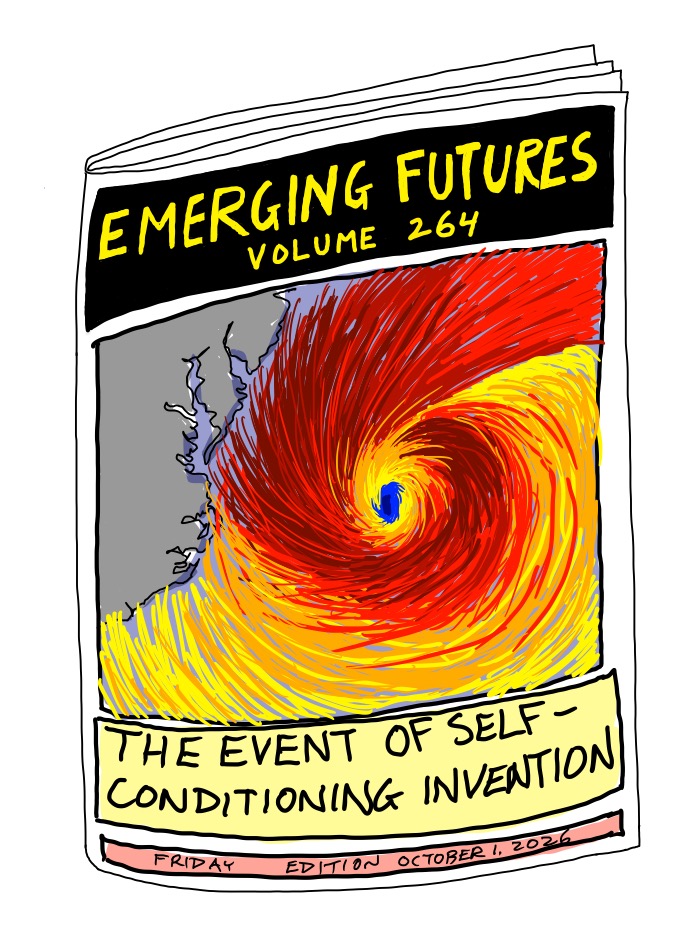
Good morning becomings of multiple divergent multi-century long events,
This weekend, at some point during the day, the radio was on in the apartment. We were just doing the usual weekend puttering, and getting ready to go out. There was a big Nor’easter slowly bearing down on the region, and we were going to go into the City – it was the last day to see a retrospective exhibit of drawings by PopeL, and we were going to see a performance piece by Steve McQueen, End Credits, on the decades-long government harassment of Paul Robeson.
Outside it was spectacular, with dark skies, dense rain reducing visibility to a few hundred feet, and howling winds.
And into all of this, emanating from the radio was an interview with an author who had written a book about creativity and evaluating how innovative societies are from a historical perspective. You know the kind of question:
Are we more or less innovative now than in the past?
Why do some cultures stagnate and others innovate?
Questions so loaded with all sorts of hard-to-justify assumptions that it can be hard to see the value in most of these discussions. Why, for instance, is it that a culture that does not seem to change (according to some arbitrary metric) is considered to be “stagnating”? And why in all of these arguments is innovation always measured by the narrowest definitions of technology as a physical technology such as the printing press, the gun, the steam engine, or the computer – and not social ones such as animism or new practices for commoning?
Anyway, we must have caught this interview near the end, so I am not sure what had all been discussed prior to us tuning in. But as we were watching the rain pick up outside our now hurriedly closed windows and pulling out all the different rain pant options – they were talking about the Wright brothers and why they succeeded in “inventing flight” where others failed…
Now – it shouldn't – but it still shocks me to hear this kind of preposterous claim. While it is certainly true that the Wright brothers played an important (if complex) role in the emergence of flight – it should be obvious – no one “invented flight.” (If you missed these recent newsletters and you are curious to delve into this question – check out these newsletters: Volume 253, 254, and 255)
But this was not the main focus of the author's work or the conversation. Their larger thesis was about collaboration – and two things: (1) the difference between “we” and “I” cultures, and (2) the need for the right balance between collectivism and individualism in any culture for creativity to flourish and the culture to not stagnate. And in this discussion of collaboration – the Wright brothers were the perfect example of a “we” practice of innovation – the two of them could talk, debate, and bounce things off of each other in ways that heroic individual inventors could not. He framed it as a contrast between “DaVinci and the Wright brothers.”
What struck me immediately was how comfortable they were talking of collaboration as if it only existed in the narrowest of human senses. It’s as if collaboration is something that only happens between individuals – and not only that – but that it primarily involves forms of discussion. Why is this? Why, when the word “collaboration” is brought up – does the discussion not turn to all of the critical and constitutive near-infinite daily collaborations with coffee, traffic lights, climatic regularities, door cameras, automatic spell-checking software, futures markets or kitchen knives?
Our lives – in every aspect are the emergent outcomes of vast collaborative more-than-human relational webs. And if we are considering the Wright brothers' collaborations – and we would be the first to say that they were astonishing collaborators– what of vast, rich and equally constitutive collaborations between the wind, the exact curve and height of a hill, the twisting nature of a large box kite form, fabrics, wires, woods, soaring birds, books, woodworkers, machinists, poems, other innovators (some dead and some living), bikes – on and on? What of the longer ongoing richly intrawoven collaborations that emerged into the becoming of flight from over a hundred years of experimentation that the Wright brothers and their generation were born into?
Our agency is an inherently relational one – and our emergent contingent historical practices of individualism or collectivism are themselves outcomes of specific relational assemblages (collaborations). It makes no sense to position collaboration in opposition to individualism – individualism is the contingent historical outcome of specific fundamental constitutive collaborations between embodied practices, tools, environments, and others. Some specific form of relational collaboration is fundamental and necessary for all life and all living.
To hear this radio interview where they spoke so knowingly – with such certainty and with such obviousness about what collaboration was – while speaking of collaboration as if it is only something that already fully formed and autonomous individuals enter into with other autonomous individuals by choice was quite frustrating.
One of the most painful parts, for me, in these kinds of discussions – is how things are silenced and made passive. There is such a lack of curiosity or concern in this anthropocentricism. The wood that made the struts of the planes was not just a handy lump of material that could be shaped to any form some human mind demanded. This astonishing wooden strut is not some trivial thing – some plank that the inventors of flight just found conveniently lying around and made fit their already fully worked out visionary plans. No, it grew relationally – co-evolving as a tree to have certain specific material configurations allowing for a unique strength, flexibility and lightness – but only if it was split, cut, cured and shaped in a way that worked with the grain of the wood, etc. – which is equally a co-emergent configurational understanding that developed over centuries and lives relationally in the tools, environments and embodied know-how of the people who cared for forests, cut the trees, the blacksmiths who made the tools, and the workers who collaboratively fashioned a cut tree eventually into an astonishing strut. No, the wood, metal, cloth, and paint were never just “materials” – passive stuff that the Wright brothers “used” to fashion their gliders and planes. They were – and are – real collaborators – with real agency in the process.
All humans learn how to attune and listen to the relational voices of things. All human life is lived creatively of collaborations – in this relational web of configurations, voices and emergent capacities. So why is there such a lack of curiosity for this in such discussions?
But we don’t even need to enter our more-than-human worlds to get a sense of how preposterous the “we versus I” argument about collaboration is: Even at a purely human level, the myth of the solitary genius – or even the solitary individual is a full-on fiction. There are always others – many many others. There is no Steve Jobs, or Da Vinci, or you or I alone.
And so too with all the great pairings – Fred and Ginger, Gertrude and Alice, Cage and Cunningham, Lady Gaga and Beyonce, Emmanuelle and Jennifer, Wilbur and Orville – they were never (just) two. For Orville and Wilbur, there was their sister, the motley crew of other flight enthusiasts, engine fabricators, woodworkers, day laborers, and many others – there was and is always a vast dynamic swarm of others that is part of each of us.
To focus on the one versus the two – is to believe the myths and go no further.
To make the one versus the two into an argument about collaboration versus no collaboration is to believe the myths and go no further.
To believe that invention is the outcome of one inventor or one group is to believe the myths and go no further.
And it is this last myth that really struck us this week. Invention was, for the two on the radio, something somebody did. Now, in our contemporary innovation culture this could sound obvious – of course the invention of flight has to be something that someone or some team did!
But – we think this claim should not sit comfortably – should not feel intuitively obvious. And just to be clear – the radio discussion was not about how the Wright brothers managed to get one particular style of motorized glider into the air for just a bit longer and further and sooner than the many others also doing the similar thing. No, their claim that needs no explanation – was that this one astonishing act by the Wright brothers constituted “the invention of flight.”
On this key point they were very clear: “it is remarkable how the Wright brothers invented flight.”
And, don’t get us wrong – the very human story of the Wright brothers is a wonderfully enjoyable story: that two lightly formally educated bike builders hailing from the seeming middle of nowhere became amateur flight enthusiasts and figured out how to get a motorized contraption into the air where so many well-funded important people could not – is astonishing by any measure.
Consider how odd this sounds: It is as if the moment the first Wright brothers plane took off – there was “flight” – end of story. Or that after this first moment it was just a matter of filling in the pieces, scaling things up, and convincing people it was all a good idea…
But flight – like all innovations, was not something that was just magically invented by one act.
In the midst of us hurrying to get out the door, the interview wrapped up, and we were joyously walking sideways in the embrace of the strong winds and rain. But the discussion has lingered in our thinking and conversations this week.
The all too common equation of “Inventor = Innovation” that was so aptly demonstrated in the radio interview made it all the more apparent for us that far too much of the Western innovation discussion tends far too often to approach invention from a profoundly limiting perspective: that of the human.
Flight did not just happen suddenly, or because of one set of innovators, or because of one grand idea – but it was rather something closer to the contingent unfolding of a few hundred year process that in fits and starts – tangents, dead-ends, unexpected flourishings and emergent non-linear sideways bubbling – involving thousands of human actors in dynamic co-creative relations to thousands of other directly unrelated inventions, complex material processes, the developing of tools, concepts, environments, other creatures and their co-ordination into novel assemblages with unique emergent outcomes that lead to what Brian Massumi terms a “self-conditioning emergence.”
The perspective of an individual, their mind, and its ideation is a perspective that focuses on two things: humans and cognition. And from this perspective, you get a battle between competing individuals (or groups) and their ideas. And who has the best idea and can execute it the fastest succeeds. The author being interviewed on the radio spoke in these terms of the magic of the Wright brothers' ideational collaboration. But is this the right perspective to really get a grasp on how the new comes into being? Is innovation really best understood as a human cognitive activity? Is innovation encompassed by focusing on the “first”?
An experimental proposition: We need a radical change in perspective and focus to get a grip on creativity and innovation. It is not enough to augment anthropocentrism and cognitivism with a sprinkling of complexity science, relational dynamics, and supplement this with a light scaffolding of matter.
What is necessary is an all-together differing perspective:
Can we approach innovation from the perspective of innovation itself?
Can we approach invention from an experimental perspective that is immanent to its emergent self-forming, to its emergent form-taking activity?
What would this mean?
First we can say what this would not mean: personifying invention or anthropomorphizing it. That the becoming of an invention is a “self-conditioning emergence” is not to treat an invention as a type of cognitive agent – able to put ideas, so to speak, into the heads of human makers. Some kind of meta-human puppet master.
Rather, it would be to recognize that inventions individuate via the differential coming together of precursor conditions that they will eventually come to emergently and qualitatively exceed and take on a “life of their own.”
This is also not a perspective where humans and their relational agency do not matter – rather they very much matter, but their mattering is transformatively conditioned by the emerging invention itself: While the Wright brothers did not invent flight – flight in its own becoming invented them – they became “of flight” – it transformatively swept through them – swept them agentially into its own becoming. They became helpmates – not originators. Careful weavers, creative surfers, experimental followers, attuned, collaborative, sensitive and highly aided.
This week in Worldmakers we were having a live video conversation on the generative nature of invention. Invention is not reducible with the assumption that the purpose of a living being's ingenuity is to fill some “lack” – to solve some negative problem – rather is always a differential generative process (event) of world-making that we are actively of.
Perhaps it is more helpful to take inspiration from how crystals form or how storms such as this weekend's Nor'easter or the hurricanes that have not emerged out of the eastern Atlantic this season come into being? How might these give us a better way into the becoming of the new?
Consider a hurricane: it comes into being – creatively individuates, as the emergent coalescing out of a series of precursor events joining and crossing a series of imminent thresholds. And this event persists in its creative self-making as long as a certain set of energetic conditions are met. We do not look at a hurricane from the perspective of the emergence of one conditioning event – for the simple reason that no one conditioning event gives rise to such an event.
What if the emergence of flight was not the story of a very long series of failed human attempts until the success of the Wright brothers and the birth of flight. What if flight was a long developing event full of contributing precursor events that stretched back a few hundred years and continued forward well into the second half of the twentieth century (ultimately it is a creative event that is not over – and it would be impossible to predict when it would end)?
What if we viewed all innovations from such a perspective – as unfolding emergent self-conditioning immanent events and not individual cognitive achievements made real? From the perspective of an event…
And it is with these lightly sketched out questions, probes and provocations that we will end this week. Over the next few weeks, this is what we will be experimenting with. We hope that you can join us in the discussions – such that we are all becoming part of an immanent event taking form…
Until next week -
Keep difference alive!
Jason and Iain
Emergent Futures Lab
+++
P.S.: The question we hear most often from newsletter subscribers is: How can I participate more deeply in this work?
We have two ways:
1. Emerging Futures+ is where the newsletter becomes alive: post your comments, questions, or thoughts alongside practitioners across five continents, connecting each volume to their own work. Plus the extended audio version for a commute, join 2 live events per year, and the full searchable 260+ volume newsletter archive.
🧨 Start with a $1 trial for 7-days… Then $6/month or $60/year. Cancel anytime.
2. WorldMakers is where the newsletter gets practiced. Facilitators, educators, consultants, and researchers experimenting with emergence and change-making. In dialogue, in shared experiments, in the collaborative making of a different approach to creativity. Members have access to everything in Emerging Futures+, plus thirty-five live events a year, two weekly podcasts, bi-weekly creativity exercises, and the complete annotated bibliography.
💥 Start with a $1 trial for 7-days… Then $60/month or $597/year. Cancel anytime.
Two questions, every Friday since 2020:
What is creativity? and How do you innovate?
A weekly experiment in emergence, creativity, and change-making.


