Newsletter
Resources
Courses
Books

Welcome to Emerging Futures -- Volume 237! Creative En-Worlding...

Goodmorning semi-sedimentations in becoming both more and less,
Walking to the train yesterday morning in the bright sun, my eyes landed on a young Magnolia tree just coming into bloom. It was such a delight to see that it swerved me off my path and pulled me towards it. And after being held suspended in awe of the blossoms opening, I collected a few of the buds that were still hard – for they make a wonderful spice (we dry these and then grate them as needed). While delicately pocketing the precious few I took, I couldn’t resist the urge to crush and smell one of them. The smell of early spring.
“This spring lies neither in the human world nor in a buddha land, but in plum twigs. How do we know this? It is raising eyebrows of snow and cold.” (From Plum Blossoms, Dogen Trans. Mel Weitsman & Kazuaki Tanahashi)
Over the last few weeks, we have been building up a rich basis for experimenting with the all-encompassing logic of Worldmaking. As it has been four weeks of developing things, this week we want to pull all of the various threads together and experiment with why any of this matters to creative practices.
To begin, let’s experimentally review and extend the two key lines we have been developing :
ONE: From a General Reality to a World and Back:The first aspect of this that we explored in Newsletters 233, 234, and 235 is sensing that all living beings are in and of networks – assemblages and that this makes a “world”.
But compressing assemblages, worlds, and worldmaking into this short sentence simply leaves too much unexplained.
Let’s return for a moment to our tick:

As we saw with our tick, it co-evolved with a particular environment such that it only connected to and responded to very specific aspects of the environment in very particular ways that were uniquely meaningful and relevant to it.
So, we could say that while the tick exists in a very broad reality, it lives in a much more unique and circumscribed world. What is this “world”? – It is composed of the things that have been taken up in very unique ways because of what specific action possibilities they afford to the tick. And through the looping of activity in a co-shaping circumscribed action environment, generic “stuff” becomes deeply relevant and uniquely meaningful “things” to it. A world is actively brought into being.
It is important to understand that the very same stuff or “components” – the things that compose reality in the most general sense – play qualitatively different roles for different beings and in differing contexts. For example, grass is brought into a concrete meaningful existence for the tick as something to climb and be brushed off of to meet warm bodies that feed it; and for us, the very same grass is brought into a meaningful existence as something soft to sit on or play sports on. In both these examples, the activities and the effect/role of the components cannot be fully prespecified; they are an emergent outcome of the embodied historically embedded skilled activities.

Thus, being alive is inherently a creative activity (done by all beings all of the time). Now, one could argue that this stretches the term “creativity” too far, such that it loses all meaning. But that would only be true if we conflated the myriad forms into one general and generic term. Creativity can be found everywhere and at all times – but everywhere it is not the same.
Let's return to understand the specific creativity of this worldmaking and world-maintaining creativity: This conjoined creative ongoing activity of life is changing both the living beings and the greater reality. How? A non-prexisting and thus a world that is not knowable in advance, and a living self are co-created in a mutual looping dance out of this larger reality. And as this is done, this world of relations between body, practices, and uniquely extracted parts of reality – becomes and is maintained as a stable assemblage that is experienced as “what is out there” – as reality – as “The World” – because it is the lived reality of the self. This, worldmaking, is a radical and foundational form of creativity – and one that most other forms of the creative practices of the living build up (world-expanding creativity and world-transforming creativity).
This unique lived world is what is actively perceived – or more accurately: what is actively sensed. Here, “sensed” is meant in two ways:
Here, what is co-created (for all creativity is co-creative) is the sense that the living being has of its world. Living for the tick, as is living for all beings, an ongoing activity of sense-making.
What is critical to realize is that this fusion of “sensing” and “sense” is co-created from/with/of this larger reality: A world that did not exist prior to this being and its activity, and that does not exist separate from this activity, has been brought forth: worldmaking.
This is worldmaking. Living is the ongoing creative work of worldmaking.
The term for the activity of making this world is enaction. Here we are using the term in the way it is utilized in the Enactive Approach to cognition. It is worth pulling this word apart and getting a good grasp on how this term is being activated in this context.
En-Action: is a special form of action, we know this because of the “en” prefix in front of the main term “action”. But “action” is important here because it highlights that this is an action-oriented approach: what can some embodied and embedded thing do? Action always emerges and lives in the middle. The prefix “en” modifies the action to stress that the action is of a form that brings forth its own domain or world. In the ongoing activity of life, a non-pre-existing world is enacted relationally by the unique active coupling the organism is capable of.
It means that we do not just carry out an action – like pouring a cup of coffee – but rather, the action brings forth a unique us (the “coffee drinker”) as it makes a unique relational world transformed by this act come into being. The tick's actions (sensing heat/light and climbing, smelling and falling, grasping and drawing blood, etc.) do more than fulfil a task but taken collectively make (enact) a meaningful world. A world that is both very much real, but which would not exist without all of the actualities of the assemblage.
Importantly, all of this moves us beyond a reductive conversation about “subjective vs objective” and the hyper individualization, humanization and internalization of creativity. The tick lives in and of a co-created world that takes an active perspective on a larger reality that it also shapes. But it is not just the tick that has a unique active perspective on reality – it is all creatures. Yes, we all live in a common reality – but it is a reality composed of many worlds – many active perspectives.!

But this logic of world and reality could still be seen as being in opposition – that this is just a new version of the radical separation between the subjective and the objective. But nothing could be further from the truth. No living thing is separate from this common reality – nor is this common reality at a distance from us – it is not somewhere “out there” that is ultimately inaccessible and unknowable. The tick is in and of this reality in an active manner: changing it as it changes them. But in engaging this reality, it co-creates a unique world. This is a meaningful world that did not exist before the tick and does not exist apart from the tick – but it is very much a real world. And this real world is of a common reality, such that it affects and is affected by this common reality – but nonetheless is not the same as it.
Our common reality is not singular, it is not a uni-verse – but a dynamic intra-looping, co-creative and evolving pluri-verse.
TWO: On Being Enlivened from the Middle:How should we understand this active assemblage that gives rise to a world?
We find that when we introduce many of the above concepts in workshops there is much agreement: “yes, we and all living beings do not and cannot exist alone but are profoundly dependent on tools, practices, and environments”. But, when we go further into what is meant by this, and inquire into “how would you visualize this?” The most common image that emerges is one of a radiating web:
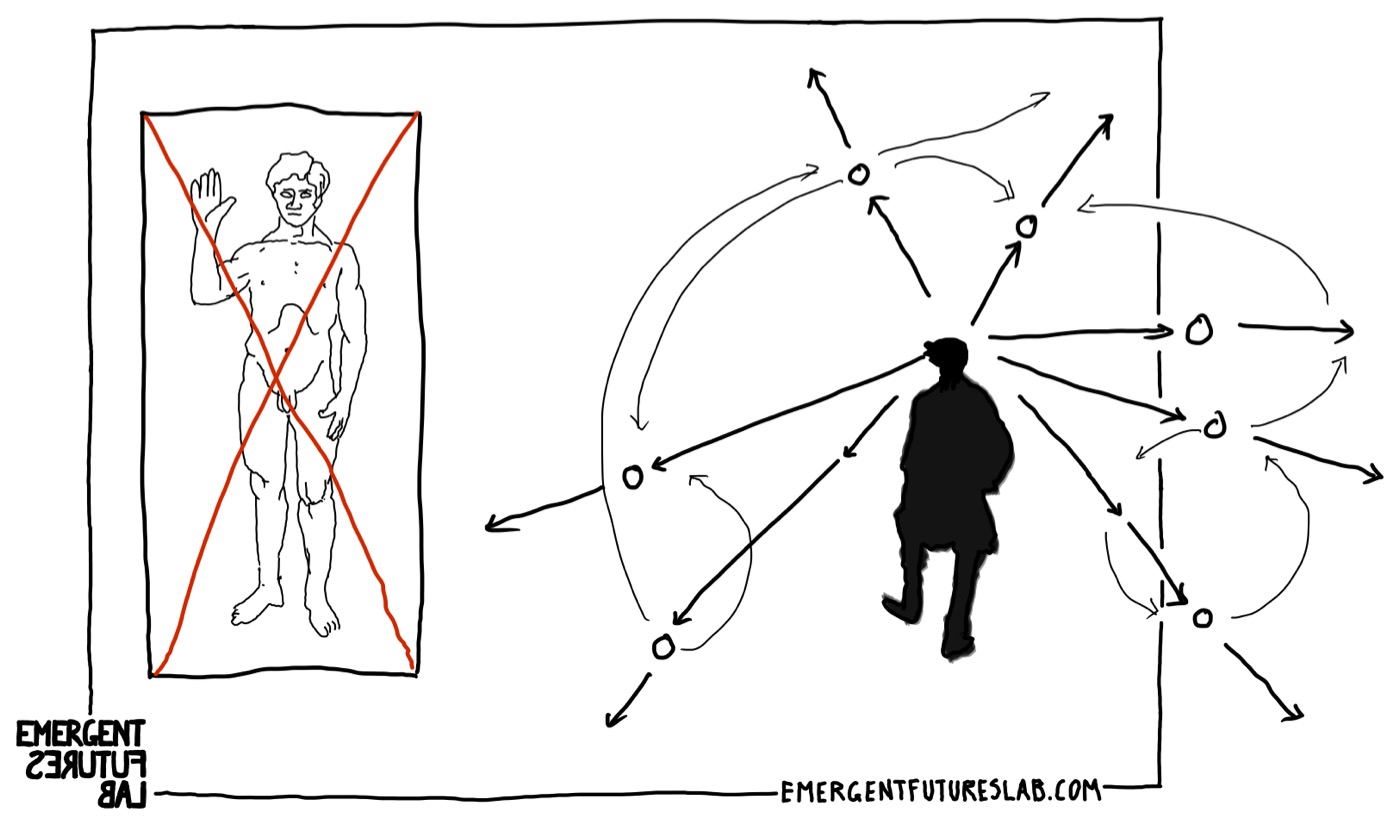
Then, when we ask: “What is at the center of this radiating web?” The common answer is the mind, the brain, consciousness, etc. We are back to an essentialist model: there is a core to the self that is located in something (brain, mind, consciousness, etc.) – it is just one that cannot function without the “support” of outside things:
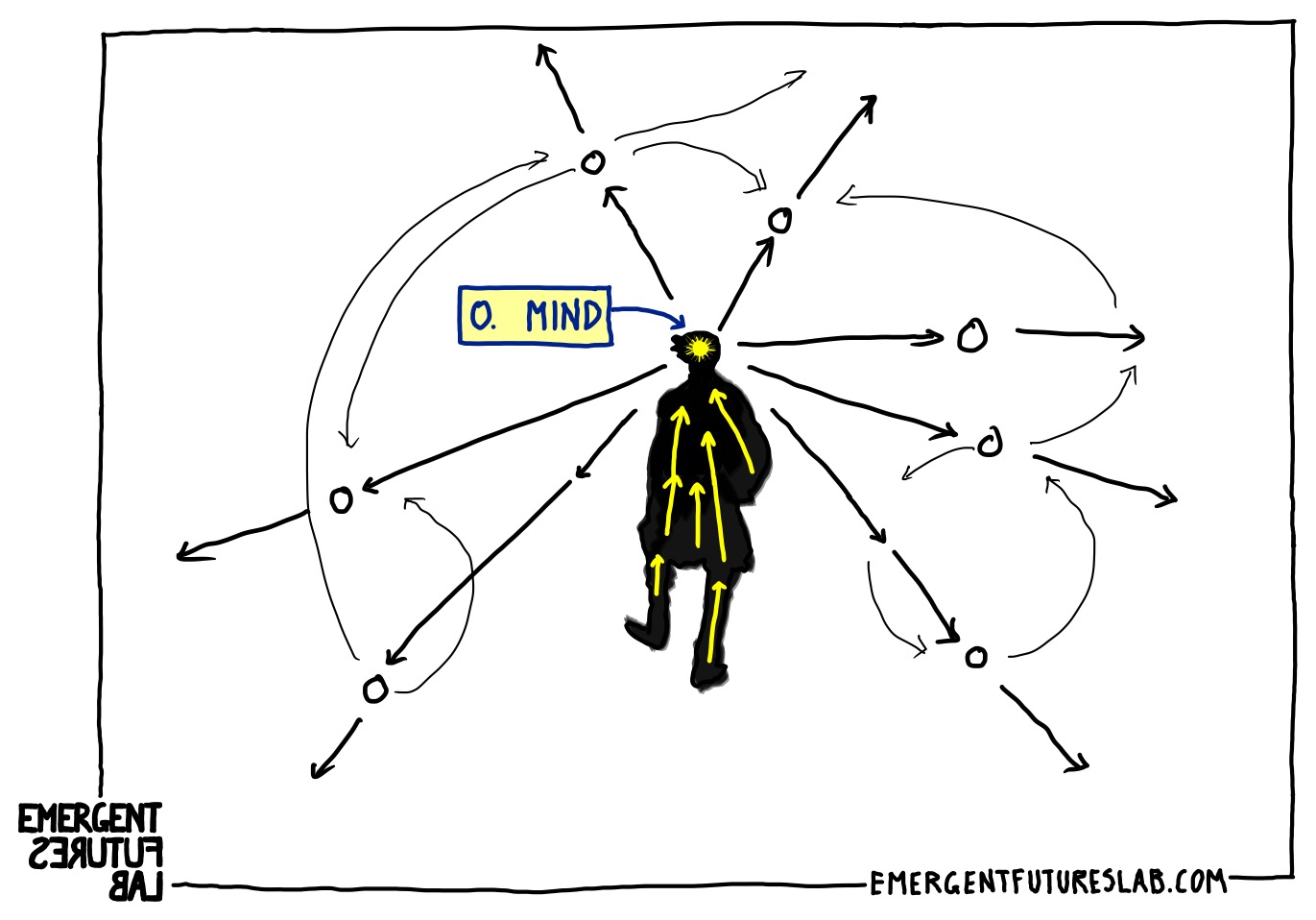
Ironically, this approach is even latent in the concept that the “mind” is “embodied.” Here, in the embodied approach to cognition, all that has seemingly changed is that the “mind” now extends to a “body” that supports it. This is something that Bhavana Nissima, a member of our Worldmakers community of practice, made clear to us in a recent email: “even embodied cognition is still first a cognition (continuing the mind-body disconnect).”
We are still in relation to a false essentialism that focuses on the mind as being in a fixed location that all else radiates out from. So yes, we have embodied and extended the mind – but it is still what is essential and at the fixed center of an assemblage:
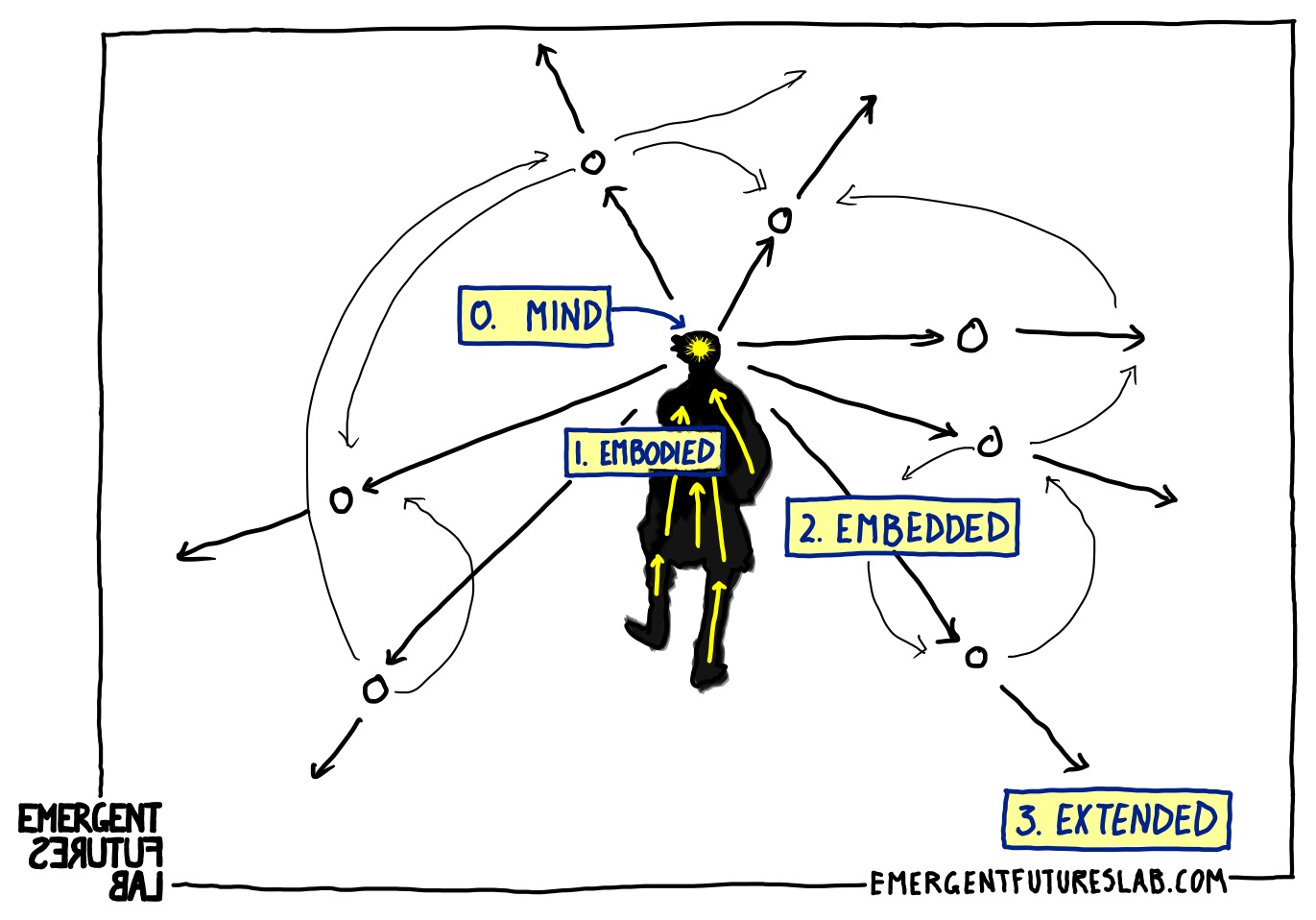
Here we equate the essence with the core of the self – the brain in which the self resides, and the self is like a little CEO taking input, getting the big picture, and making decisions.
This issue of “what is the logic of the assemblage? – Is it radiating from a core or something else?” became the question we experimented with last week in Newsletter 236: Experimenting with Stable Worlds and Mutable Assemblages.
It is a debate between two contrasting ideas of “what is a living system?” Is it a radiating networked web with a thinking core, or is it a dynamic distributed network with an emergent mobile self?
To put it crudely: Is the mind “embodied and extended” or is an assemblage “enminded”?!

We talk a lot about how the “mind” is “embodied” – that thinking requires more than a brain – and that it is “distributed”. But this does not go far enough – it is not that the brain needs the body and uses the world – that still allows us to think in mind vs body and mind vs world terms. But to say that the body is “enminded” or better yet, an event is “enminded” is far more correct and interesting.
Last week we experimented with this by turning to Buddhistic conceptual traditions, where the concept of dependent co-arising (Pratītyasamutpāda) of all things is fundamental: In Buddhist traditions, all “things” – including our selfhood and mind arise and continue to exist only intra-dependently. No thing whatsoever has radical independence or an independent internal singular essence. No thing is autonomous.
Pratītyasamutpāda needs to be explicitly unpacked: Every thing exists relationally, has come into being relationally, and continues in existence relationally.
Now we are considering how a practice of “worldmaking” is enminded. And this is where worldmaking begins. One's very distributed contextual thinking is “enworlded” and one's emergent world is “enminded.”
The mind – or better said: the practices of ongoing sense-making do not have a fixed location – experience is rather enminded and the emergent locus of experience/sense-making is roving – where it “is” depends on the context and the activity. Thinking moves around…
Sense-making as a worldmaking activity involves the creative activity of assemblages forming, modulating, and attuning as they become “enminded” in specific ways.
This is where the parable of “where is flight?” that we have borrowed from Evan Thompson is quite helpful:
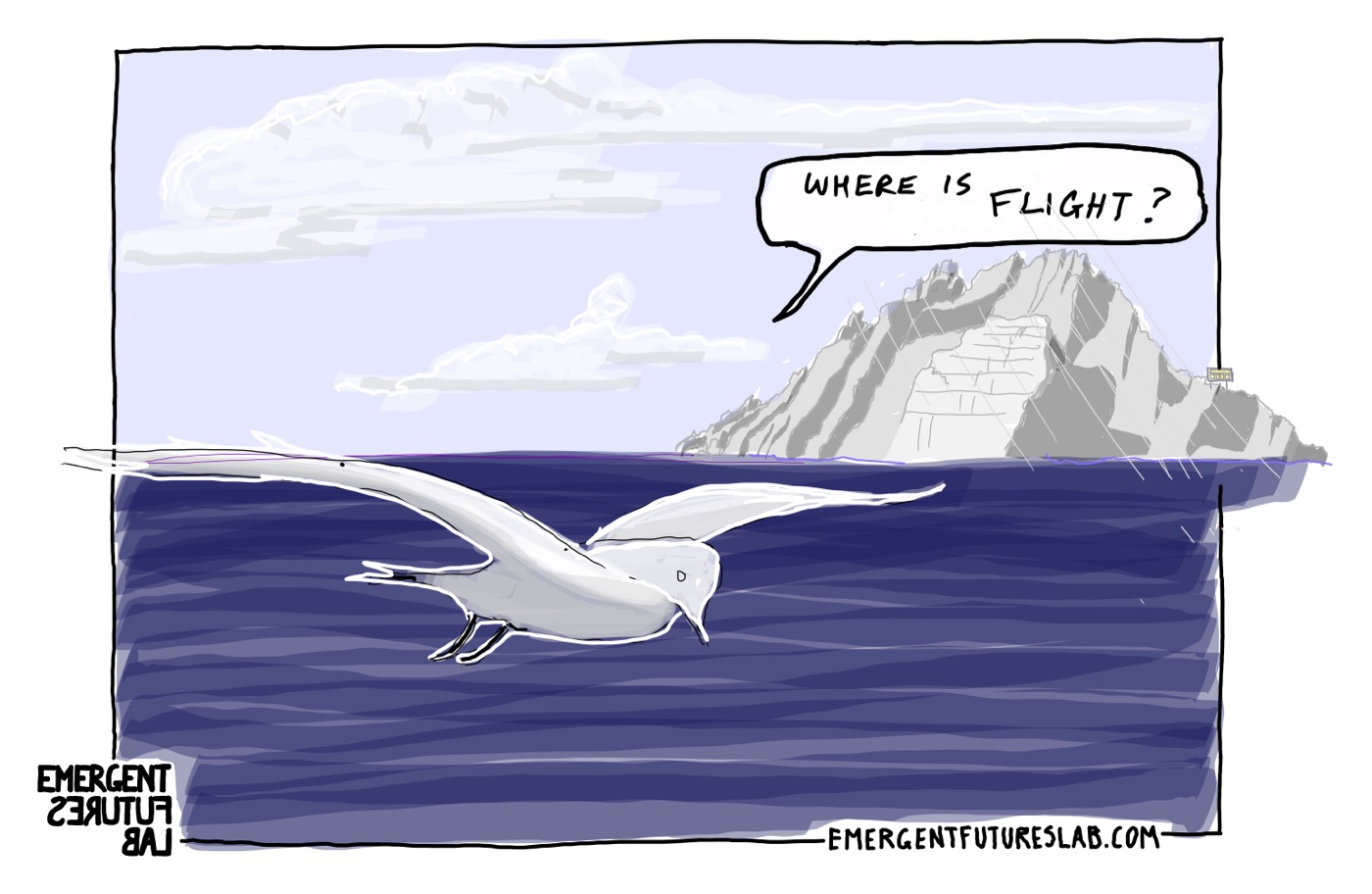
If you inquire about the location of flight, you will come to realize that you cannot find flight in any part of the bird (feather, wing, muscles, brain, etc.) – nor in any part of the environment (thermals, wind, environmental features) – nor in any goal (getting from a to b, predation, escape, survival etc). Rather, it is the emergent outcome of the relational configuration of all of these. This configuration, you could say, is “en-flighted”:

We recognize that this is a very, very clumsy bit of languaging! But precisely because of the clumsiness, it starts to get at the radical paradigm shift that interests us:
We are striving to make a radical shift – it is not about extending your individual brain outward to include “more”. Rather, it is about understanding how a particular creative configuration that includes you and others can be specifically and uniquely “enminded” and that to do this, it must become “enworlded”.
Now, as we come to understand the self as a non-essentializable, mutable, and mobile emergent relational outcome of a configuration that inherently includes others, we can begin to ask new questions about “organizations” and creative practices – precisely because the self is an “organization” and not an internal fixed essence:

Worldmaking is the sense-making of a wandering assembling that is on the move with an ever-open curiosity…
We wish this for you and your creative experiments – till next week
In spring windpeach blossomsbegin to come apart.Doubts do not growbranches and leaves
(Dogen, trans. Brian Unger & Kazuaki Tanahashi)
Until next week,
Keep Your Difference Alive!
Jason, Andrew, and Iain
Emergent Futures Lab
+++
P.S. This newsletter continues in our community—where you can comment, question, and explore further. Emerging Futures + brings you into the conversation. Join here
P.P.S. WorldMakers goes beyond the newsletter: 40 live events annually, weekly podcasts and exercises, our annotated bibliography, and practitioners across diverse fields reimagining creativity together. Discover WorldMakers


