Newsletter
Resources
Courses
Books

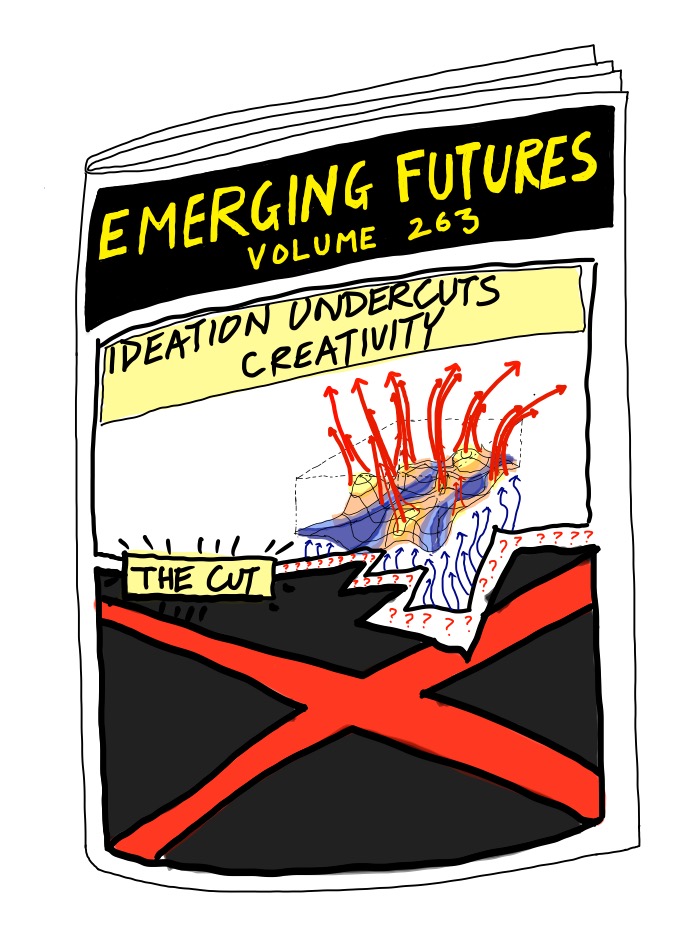
Welcome to Emerging Futures -- Volume 263! Ideation’s Cut into Creativity’s Becoming...
Good mornings becomings of the amplifying propagations of immanent structurings,
Here on the north-western edge of the Atlantic it is officially Fall, and we are at the end of a wonderfully rainy week watching the moon cross the patchy night sky becoming slowly full.
The winter clothes are coming out as the cool winds are picking up. This week we have been mending – holes and tears are getting sewn, and pilling is being removed from favorite sweaters. Waterproofing is being reapplied to jackets, pants, shoes, and gloves. With the windows open, it is nice to welcome the cold back into the house and blustery rains back into life.
Last week in Worldmakers, we hosted a live online discussion with the philosopher John Protevi. Their work is focused, broadly speaking, on ontogenesis – the study of how all things creatively and ongoingly come into being, then creatively change or stay similar, and eventually transform into qualitatively new becomings without end.
Such an approach is very much in resonance with this newsletter, and he has long been a source of insight and inspiration for what and how we experiment with things (we first worked with him over twenty years ago). Much of his work inventively brings into dialogue the complexity sciences, enactive cognition, ecological psychology and the work of Deleuze and Guattari (we reference his most recent work in Volume 193).
At one point in the wide-ranging and really interesting group discussion on creative processes, John brought up, in passing, that in trying to understand creative events one cannot make the mistake of sneaking into the beginning of the process the final outcome. And that this happens most often in the assumption that somehow there is a kernel of the final form of something right there at the beginning. It is a very common error in Western thought that most often shows up as the belief that ideas drive the creative process. And, we would argue, that this Ideational logic makes it impossible to understand how creative processes can give rise to anything genuinely qualitatively new.
We too are often critical of Ideas and the Ideation process as driving Creative processes. This week we want to experimentally unpack the what and why this critique of the Ideation matters – by getting really pragmatic in our examples.
Let’s start with the question: What exists prior to – or at the very beginning of a creative process that humans are involved in?
Much of how we historically think about how things come into being – the process of creation – already assumes at the beginning the thing to be created.
Think about an everyday practice: the making of a roast chicken. Like most everyday practices, we already know what a roast chicken is, what it consists of, how it looks, where to get the ingredients, how to carry out the process and then how to serve it.
Since the outcome of the process is something that has happened many times before now – countless chickens have been roasted – there is a clear process by which things can be abstracted and put into images and words (most of us have a clear image and set of words to describe what a roast chicken is). And for the process there are clear practices, tools, and steps that can get us very quickly to the abstractions involved in the creative process of making it: “roast the chicken in the oven for forty-five minutes at 475…”
Because this is both a ubiquitous process and experience, it is one that works with very stable abstractions (whole chickens, roasting, basting, coating, etc.). And in such cases we can and often do start the explicit aspects of the process of creation with a particular form of abstraction – ideation:
“Why are you roasting a chicken tonight?”
“I just had the idea…”
But what exactly is being implied in this statement “I just had an idea”?
Here “Idea” means, at the very least, something like: “an image came to me of what I wanted to create for dinner.” And in the phrase “I just had an idea” – the stress on the “just” suggests a type of individual autonomy and spontaneity: “It was I who did this.”
Here it is helpful to go beyond the moment of imagining – to go beyond the visualizing of a roast chicken for dinner. Such an ideation implies a process beyond a mere image: we are “casting” this image into the future: this is what should come into being. And we are assuming that there is a clear way to work backward from this desired future to the steps to realize it starting in the present. In this way, ideas are not simply abstractions – rather they are processes that either explicitly, or more often implicitly, assume a basic three-step process: Ideate + Plan + Make/Realize.
To be explicit and precise, by “Idea” and “Ideation” we mean: a creative process that begins with a clear representation in words and images (the Idea) of what we want to have in the future – and the linear “future backward” plan to directly realize this idea.
Thus it is more helpful to speak of an “Ideation Process” than simply ideas or ideation. In the Ideation Process, we do assume that at the end of following this plan, if we can control all the pertinent variables, we will have the thing just as we imagined it. Obviously, that we believe that this is a valid possibility, given the dynamics of reality, is problematic – but this is by no means the most problematic aspect of Ideas and the Ideational Process.
The critical issue with this process is the one that John noted: the assumption that a clear representational idea of the goal can exist prior to the process and guide the process to its completion.
The problem is that we believe that we can spontaneously and freely have an idea and that this is where creative processes genuinely begin.
This kind of practice of creation is seemingly everywhere in our daily lives. And it is a practice that certainly seems to really work.
A cookbook can feel like a wonderful instantiation of this logic: on one page there is often an astonishing image of the completed dish presented in some remarkable setting (this is almost the perfect archetypal presentation of the idea in its most pure form). And on the other page is the name, the list of ingredients, and the sequence of steps needed to make this image real.
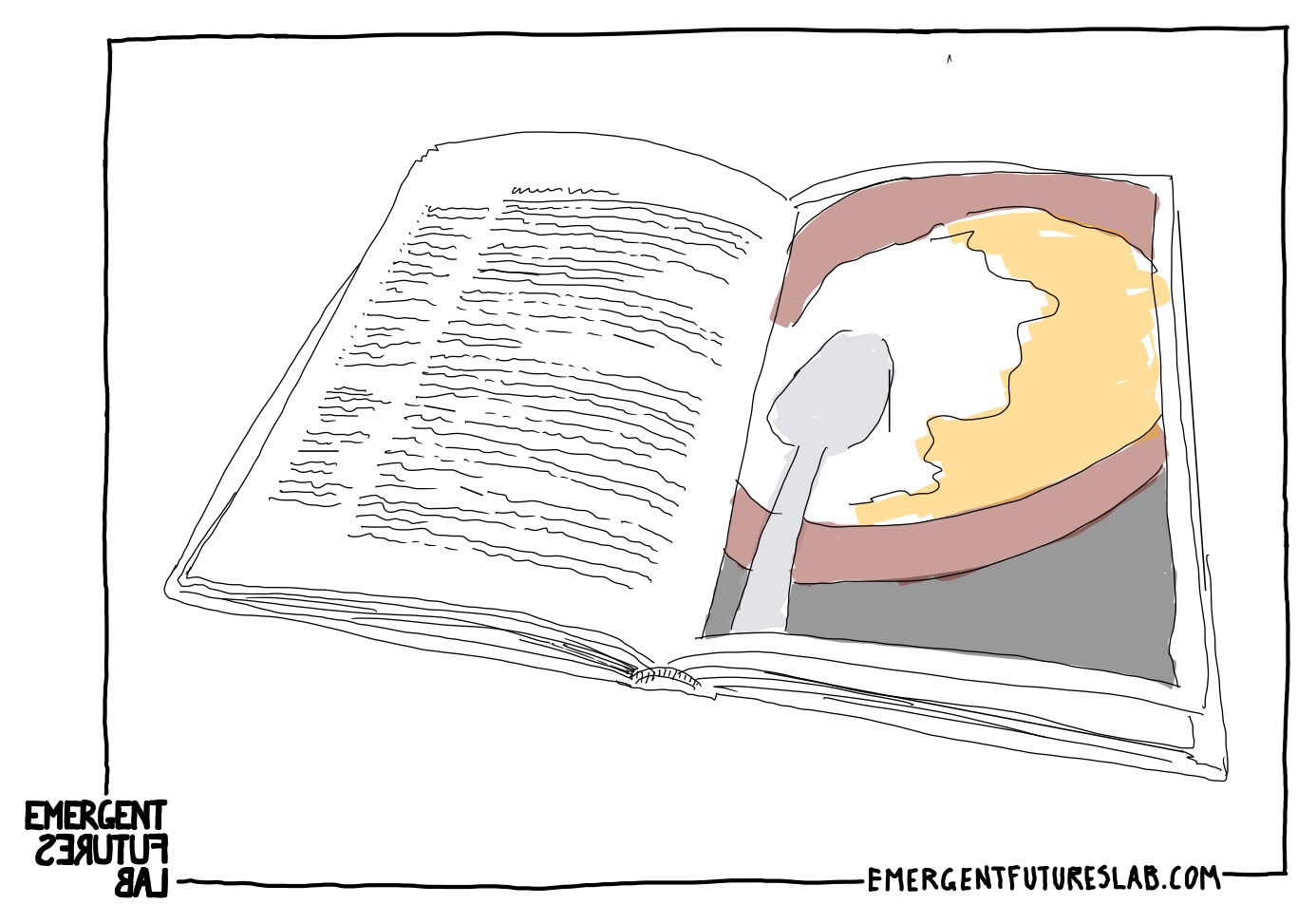
The implicit ideational promise is that if you follow the plan (the recipe) reasonably skillfully with similar ingredients, tools and environments – you will have created something pretty close to what the recipe book image presents to you.
Now, of course, following a recipe is not intended to be a radically creative process – but this in itself illuminates the conservative nature of the Ideational Process – by beginning with something that can be imagined in words or images, the process stabilizes on the known. Ideation is inherently, for this reason, conservative – which makes it all the more perplexing how it could be seen to be relevant to creative practices… But we are getting ahead of ourselves
Recipes are not intended to be a process to create something qualitatively new – rather they are considered by many to be effective processes to actualize what is ideated. But this is already a misunderstanding of both the nature of abstraction and the inherent creative processual nature of all reality. Recipes cannot be expected to deliver on the ideational promise because they are tools to experiment with the varying propensities of a semi-stabilizable configuration. In this manner, recipes track, probe, and perturbate novelty within a stabilized zone of variation. The virtual propensities and potentialities active in the assemblage (the relational creative enabling and stabilizing configuring of recipe, techniques, tools, ingredients, practices, and environments) are never trying to be fully locked in by a recipe. You must, in cooking, engage in the ongoing making of variation. In a literal sense, nothing is ever a copy or exactly the same – it is all variation. There are no literal re-presentations – no “ideas.”
The creative becomings of reality are all variation.
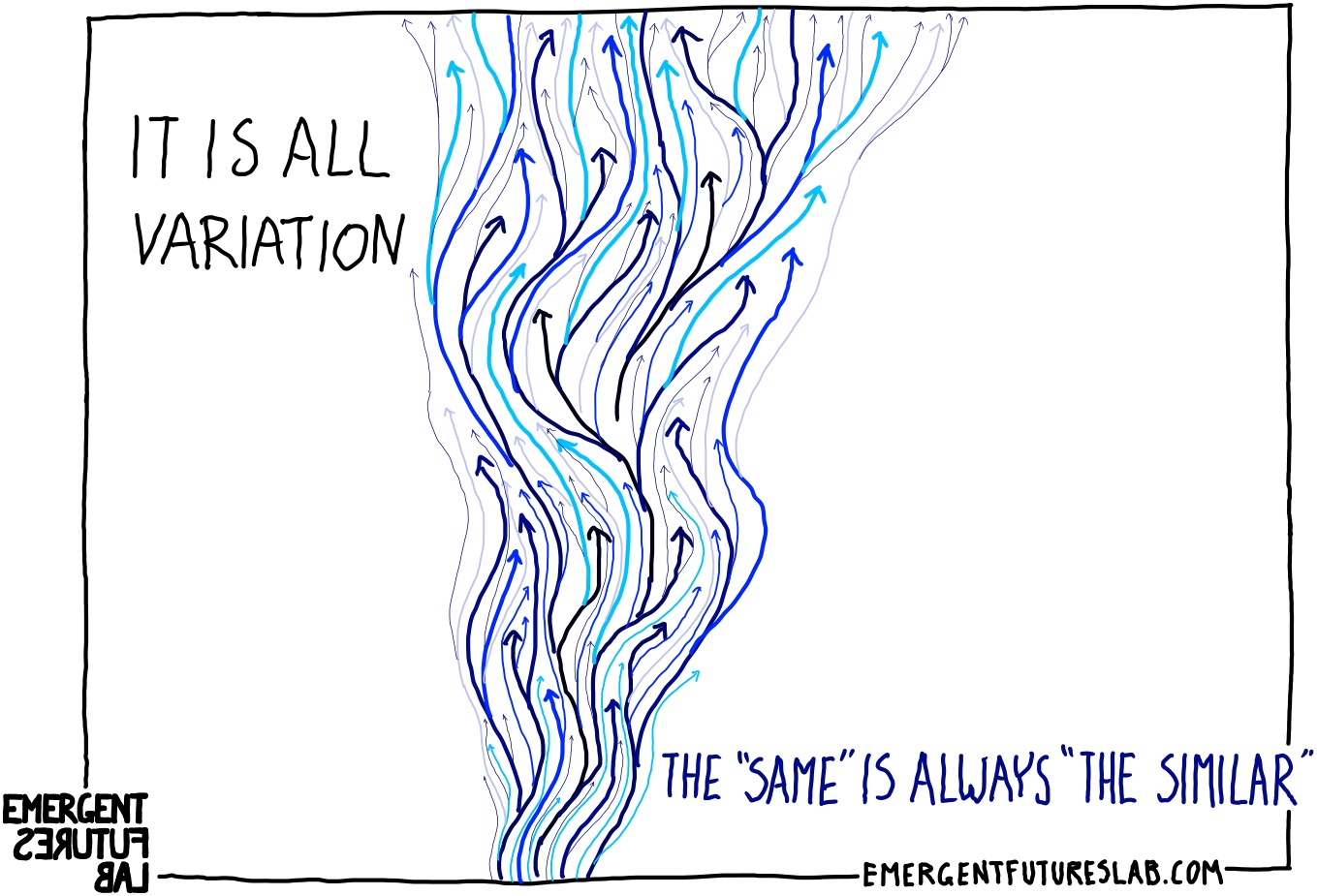
The recipe, outside of mythic tales, is not an Ideational Process – far from it. The recipe is a way into the creative enabling and stabilizing propensities that a configuration can give rise to: they allow us to enter into a zone of variation: what all can roasting or omeletting or cassouletting become?
Our daily lives are lived of semi-stable configurations and thus full of the differences and novelties of variations in degree – changes-in-degree. Each time I roast a chicken, I’m playing with variations (whether intentional or not) – a little hotter, a little longer, differing spices or herbs of an enabling and stabilizing relational configuration (an assemblage).
Perhaps, in being of this configuration, I sense that if the whole chicken sits in the spices longer, there will be more flavor, and so I experiment with marinating. The chicken is itself a variation – bigger and smaller, differing diet, or differing living conditions. The oven, the pan, on and on – variation upon variation.
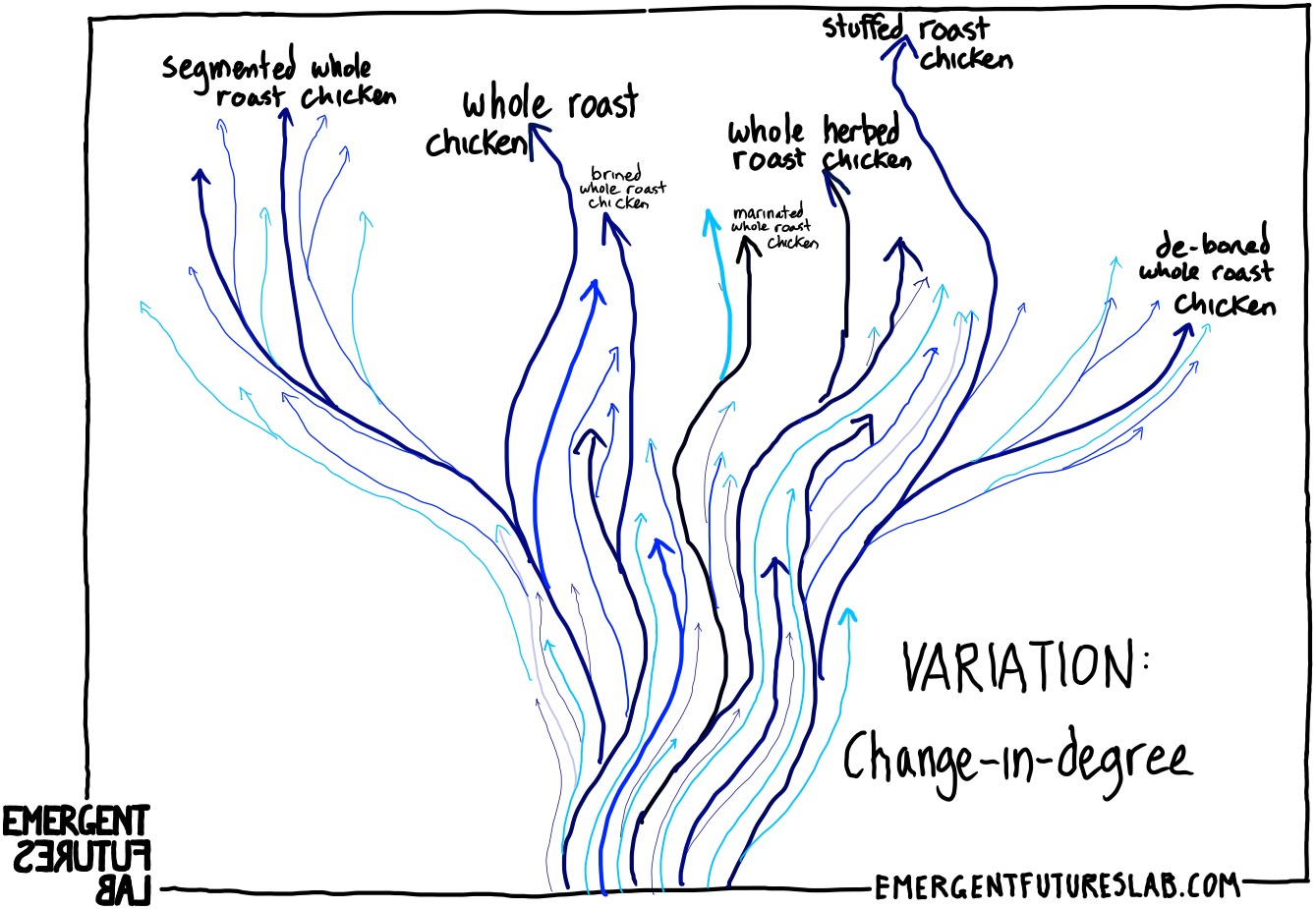
Quite often the variations are accidental – I quite often forget exactly when the chicken went into the oven, or that I turned up the heat to broil to brown the skin and left it for just a few seconds longer than normal – things are surprisingly often getting burnt in interesting ways.
However it happens – there is always an expanding field of variation emerging from a relational assemblage.
Now the term “variation” can be itself misleading: what exactly is it a variation of? Is it a variation of some pre-given essence? Or is it the continuous varying of an emergent propensity that has no essence or inherent state? The naming of the propensity and the space of variation is an act of useful abstraction. And abstraction is never Ideation. Abstraction is rather a tool to sense and actively think with emergent propensities and their varyings.
Abstracting has an important and deliberate “not quite” logic – it is a process that can deliberately approach emergent stabilities of variation as never “quite” reducible or fixable to a something like true re-presentation, or to a clear idea, or a pre-established image. Abstractions and abstracting, when it works, is a tool that holds relational things gently and generously – they are deliberately “not quite” reifying dynamic processes into static things, but they are willing to be “close enough” to engage them. They let us be knowingly of a world-in-the-making such that we can wisely intra-act.
We historically live of an ecology of practices of creation/making/doing that entangle constantly with the historical logic of the Ideation Process (ideate + plan + make). Realistically speaking, it is a major dynamic aspect of our everyday reality. We converse in ideational concepts – future-oriented propositions for that which seemingly already exists:
“Let’s go get some coffee”
“You will need to watch out for train delays because of flooding”
“Do you want to have a roast chicken for dinner?”
Implicit in all of this is a habitual process logic: after the presentation of the knowable but as yet non-realized “idea,” comes a mainly unspoken plan to realize it and its instantiation/execution: Ideate. Plan. Execute.
Now, speaking generously, this “Ideational” abstract processual logic is at best a useful shorthand for a very different set of practices (how we, for example, approach “reciping” above), and at worst it is a pernicious form of what Husserl so aptly called a "surreptitious substitution” – a practice where one confuses one's abstractions for the actuality of what is being engaged: The abstraction becomes the thing.
Abstraction is a pragmatic tool/process to experimentally and skilfully engage with reality. But when abstraction tips over into Ideation (and this is an ever present propensity)– the process confuses the tool with what is foundational to reality. We imagine that the idea is more real, more correct – and more ideal – than what emerges. The tool becomes the ontology. The experimental map becomes the territory itself.
Given the power and necessity of abstractions – their abuse should come as no surprise. But – this should make us far better at critically sensing when the process of abstracting is tipping into the propensity of surreptitious substitution – tipping into this act of “misplaced concreteness” – we should be far better than we are as a society at allowing this to become our practice.
To be clear – the problem is not that we think (effectively use concepts in a skilfully embodied, embedded and extended manner at a remove from direct material actions) – or, speaking generally, that we abstract out of the flow of experience. Abstraction is necessary to life. Thinking is not a disembodied or disembedded practice involving ideas in our heads. And concepts are wonderful tools much like any other tool – knives, cutting boards, spatulas, and frying pans.
To be very explicit: the process of ideation (Ideate + plan + make) is a dangerous illusion: nothing just starts as an idea, nothing just starts with us – and nothing is “in our heads”. And nothing comes into being via a linear process beginning in ideas, and following a step-by-step predetermined plan.
Whatever is emerging started long before the ideational process comes to kick into action (ideation is simply a problematic epiphenomenon of the situated historical processes that are giving rise to what is emerging). And what is coming into being is, broadly speaking, always far more distributed (ecological) and emergent. We can only engage in Ideational Processes (or preferably, simply abstract out concepts) because of a huge set of semi-stable self-reinforcing forces, systems, processes, tools, practices and environments are already creatively co-shaping and bringing forth an enactive reality that we find ourselves of.
The potential for the emergence of the abstract immaterial idea of a “roast chicken” is not just floating out there in the immaterial ether – nor is it just magically floating around in my head – no, it, this specific mode of abstraction, is itself the distributed relational and emergent achievement of a massive historical coming into being of highly disparate assemblages.
And before, below, beside, and above the play of variations of a roast chicken that I am conceptually and abstractly coming to engaging with is a vast co-ordinated set of assemblages pulling very unlike processes (metals, electricity, corn fields, breeding programs, genetics, taste receptors, futures markets, etc.) transversally together into a novel rhizomatic thicket – that semi-stabilizes into an emergent field of variation:
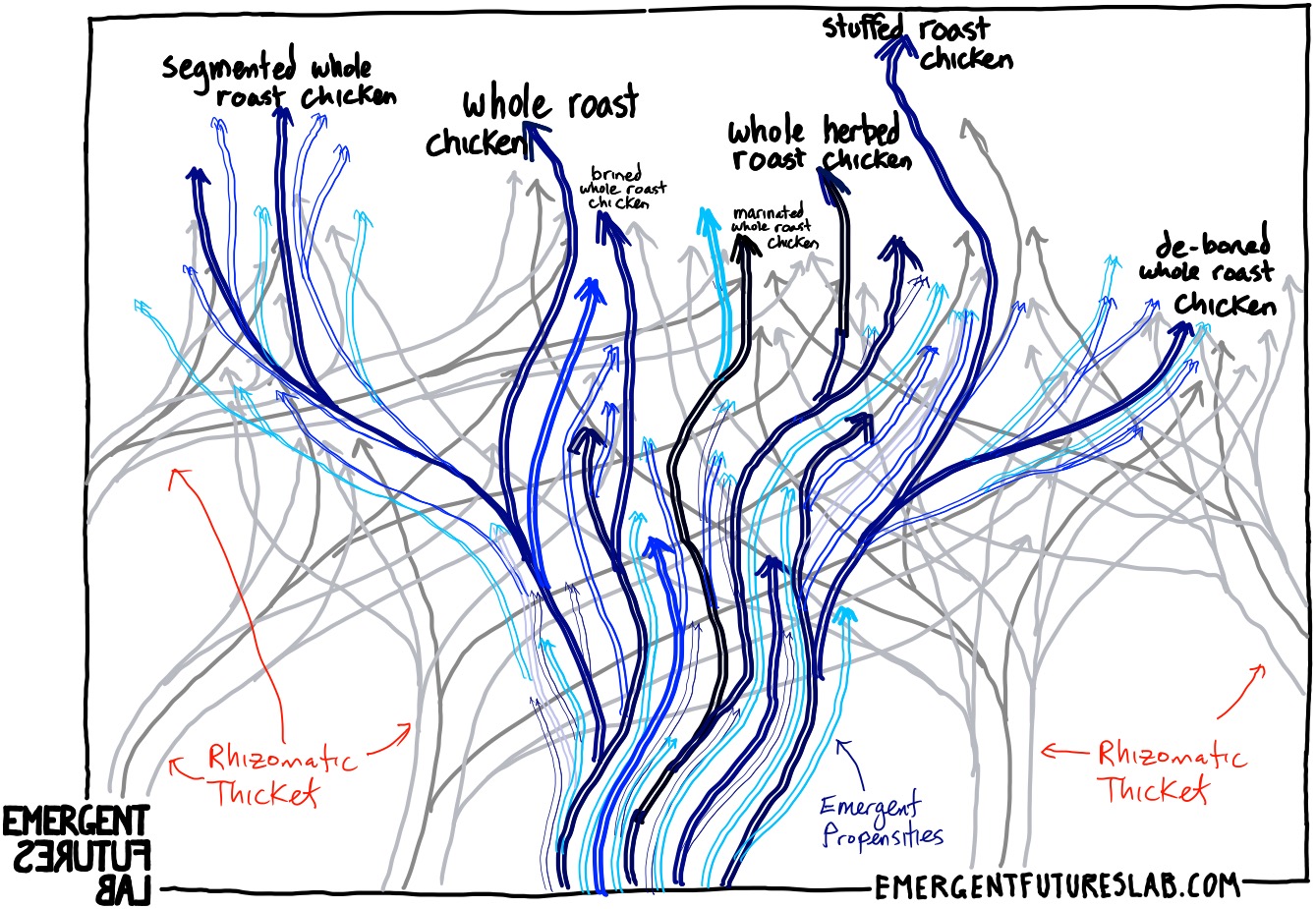
Just, for a moment, consider the insanely complex massive infrastructural ecological processual reality of bringing into being the seventy-five billion chickens eaten each year globally.
And in parallel, consider the roughly ten-thousand-year process of co-evolution that started with a very different bird, and has given rise to all of the variations of chickens.
Now add to this the development of modern ovens – and all they require and entail… – Lakes, Dams, Electrical Grids, Metallurgy, Mining, Smelting, Fabrication, Distribution…
No – nothing really begins in “ideation” – and ideation certainly does not begin “in” us. The surreptitious substitution of abstractions that allow for the practice of Ideation emerges from and dynamically surfs a very broad and very stable set of active assemblages. To believe otherwise is to fall prey to the worst of the dangers of surreptitious substitution – the conversion of (necessary) abstractions into reality at the profound cost of the denial of a far more dynamic, distributed, heterogeneous, emergent and creative reality and its agential force.
From the perspective of the desire to “roast a chicken” – in a very real sense, we, and our abstractions – are the co-creative outcome of the event and affects of the long and complex “chickening” of the modern world via feedforward processes.
In Volume 256, Visualizing the Propensities we explored a way to visualize this, utilizing a three-part diagram (inspired in part by the work of John Protevi). Here we have added our contemporary situated experience of being of the event of “chickening”:
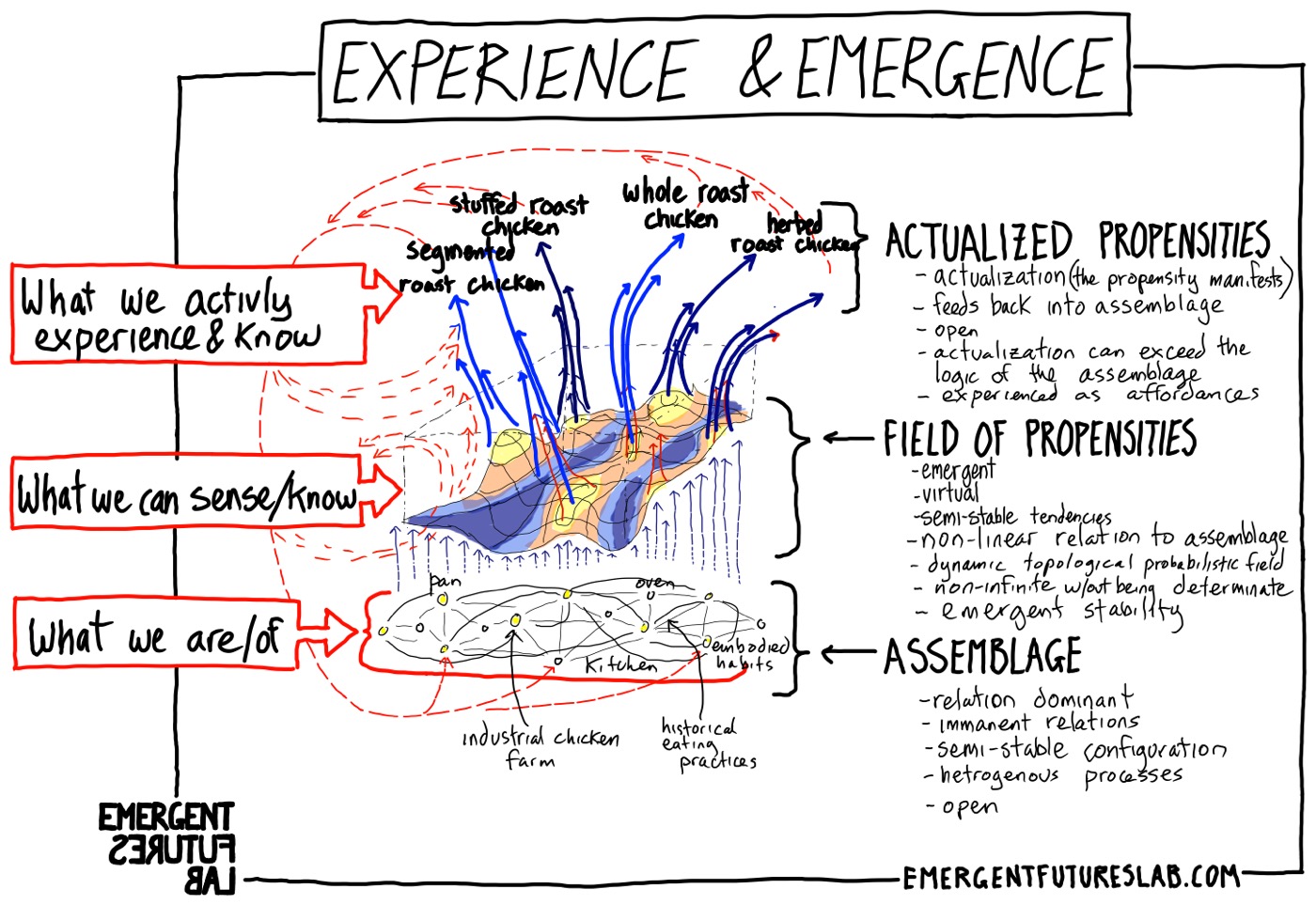
We experience actualized propensities: a roast chicken and its variations, for example. And from this there is much we can abstract and know (cookbooks importantly help stabilize this loop for concentrated experimentation). We can also sense-feel-intuit that there are more possibilities – more propensities that could be actualized – most often when we are doing things (cooking, for example). And this loops back into new variations that are actualized – unique variations of chicken roasting, for example.
What we are doing in this process is being activated and activating-changing the assemblage we are in and of – and in doing so these three intrawoven dynamics (assemblage, virtual field, and the actualized) are co-creatively dancing: we might feel the pull to change out the pan with something else (a process that does not originate with us – but also does not exist without us; we are of the path we are collectively making “in walking”)) – and this shifts the emergent field of propensities – which in changing us, we begin to sense into the process of actualization, which then loops back in distinct ways into all aspects of the process.
This process is much bigger than me, my abstractions, and a chicken in the kitchen on a Sunday afternoon. It is a vast dynamic and stabilized set of co-ordinated creative relational assemblages (what could also be called an Apparatus). Here the dynamics of infrastructure, regulation, flows of matter, embodied social habits, cultural spatial conventions, economic logics, etc. are looping back on themselves via robust canalized feedback systems to keep the variations mostly within a limited zone of possibility:
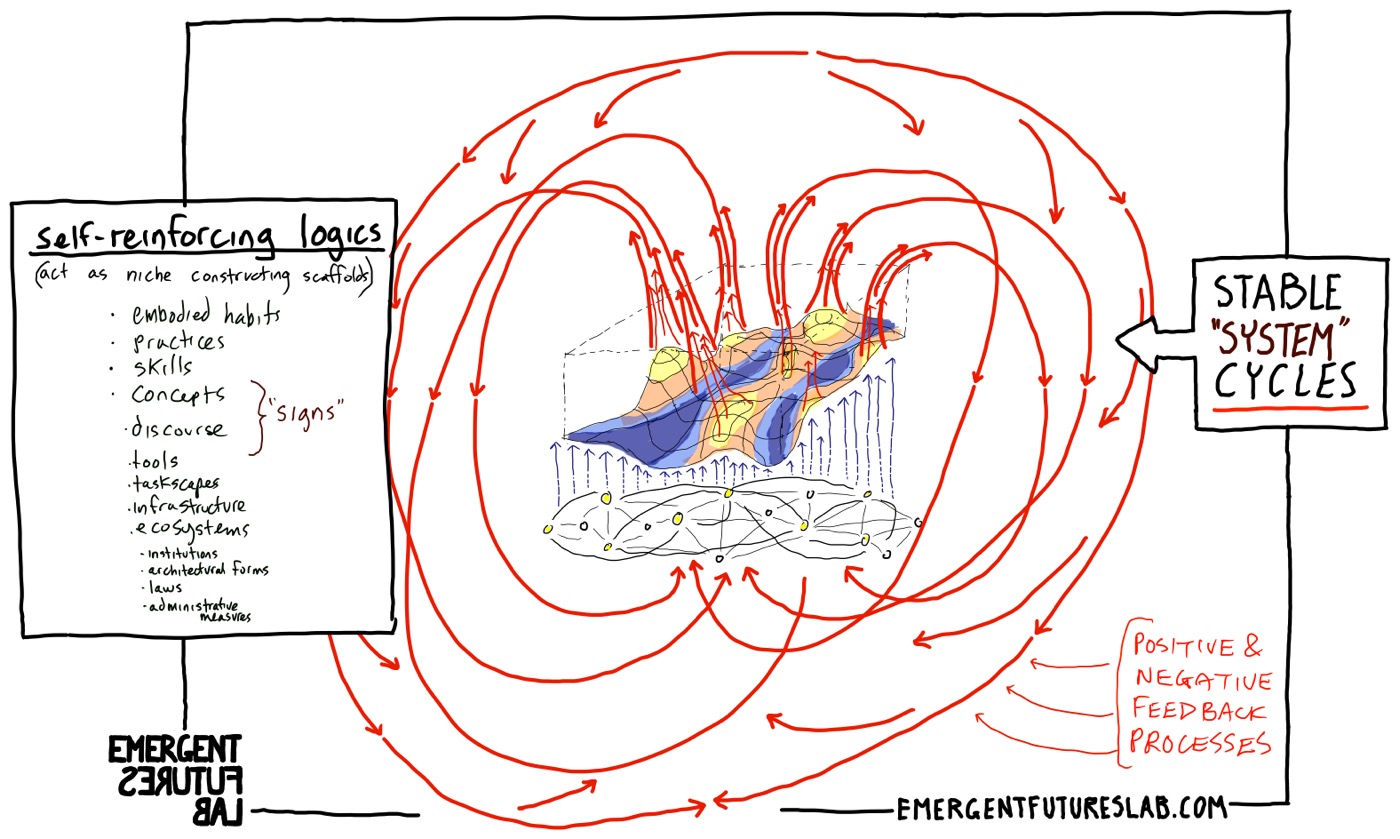
What is missing from this process (diagrammed above) is the entangled set of transversal processes that historically gives rise to this stable creative condition of variation (see below):
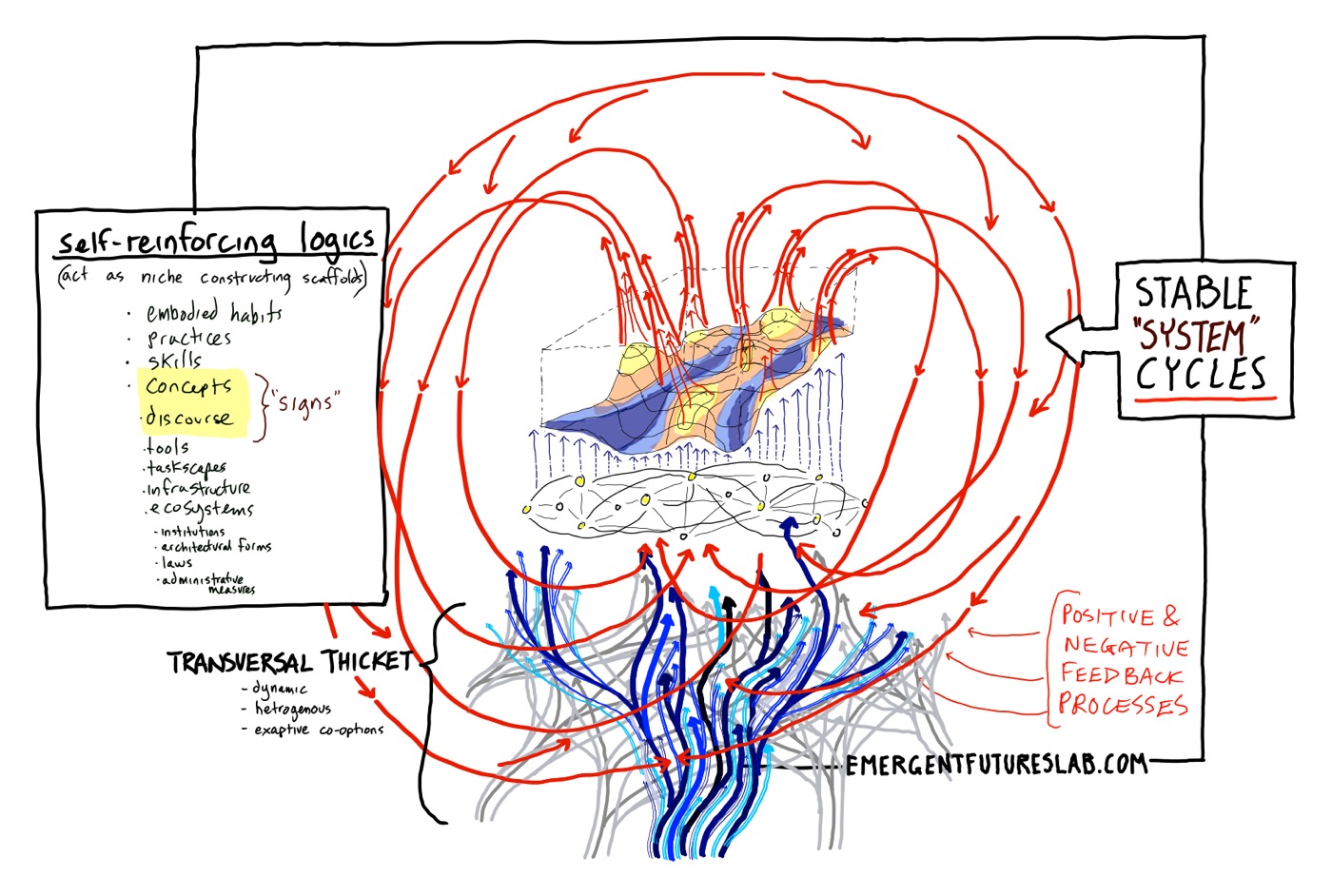
The transversal processes of the emergence of co-opting unintended capacities in diverse, highly heterogeneous processes (as a “transversal thicket”) are what stabilizes into a feedforward epicycle – that creatively, over time, gives rise to the “chickening” of the world.
Obviously this briefest of explanations cannot do justice to the messy, complex set of becomings that are entrained into this logic (we write about this feedforward process in more detail in Volume 260). But for this newsletter’s focus on the problem of Ideation and creativity – it will suffice.
Now, with this general understanding of a larger more-than-human emergent creative process sketched out, let’s return to this question of Ideas and the practice of Ideation.
The practices of Ideation Processes are ones that effectively take what we experience, sense, and abstract into knowable discrete realizations of categories of things – as in-effect all there is. The “category” as a context-relevant, useful pragmatic abstraction, in the Ideation Process, becomes more real than the processes and propensities experienced. And the self, its autonomy and ability to develop abstractions, is now also taken as a given.
Ideation practices do not – and cannot ask: how did this form of individuation, autonomy, and unique set of social practices of Ideation come into being?
In effect, Ideational process involves the cutting of an emergent looping system where it cannot be cut and still understood:
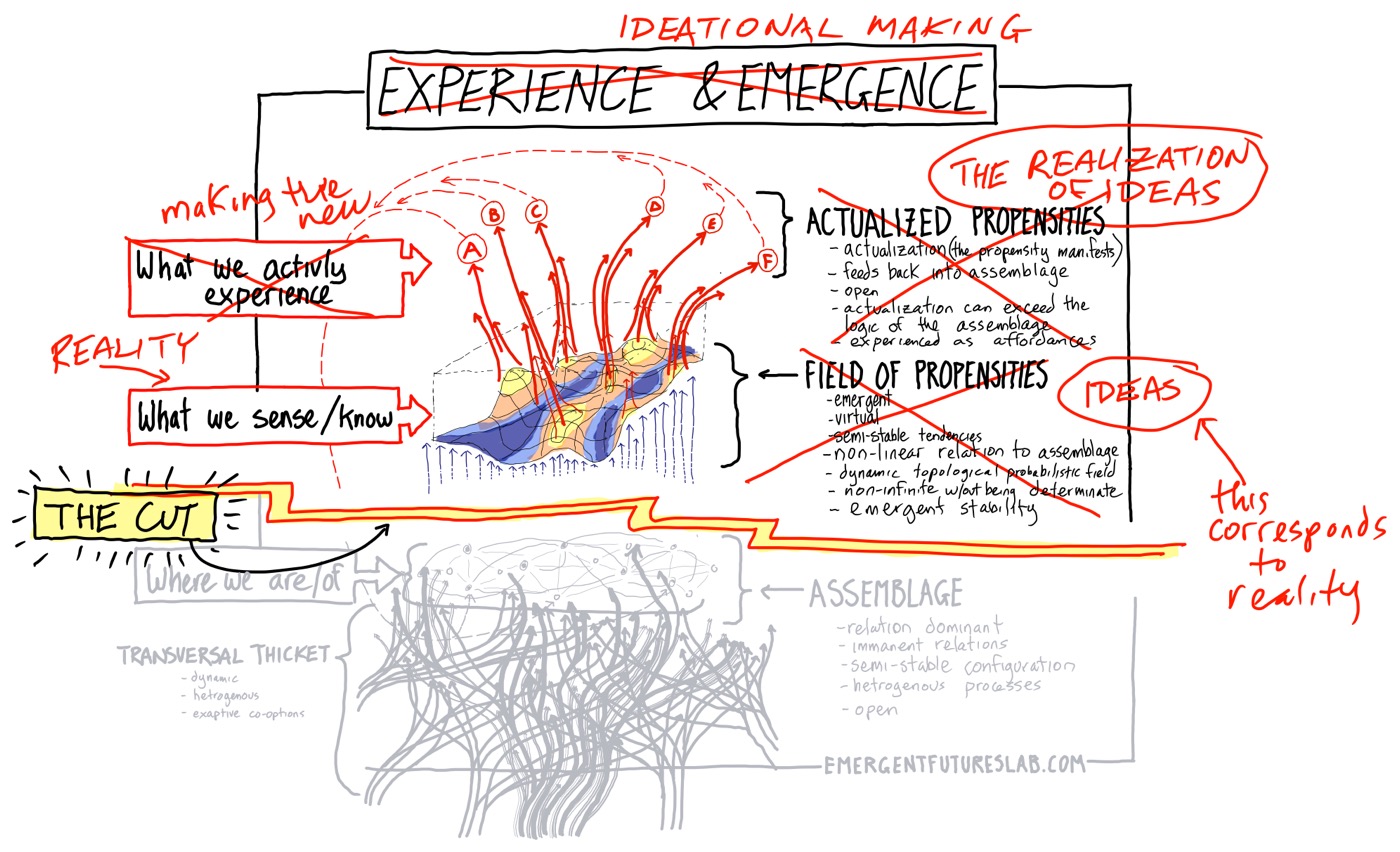
The process of Ideation assumes Ideas correspond to reality – and that reality is the creative realization of Ideas.
But this approach will always beg the question it cannot answer: what immanent process precedes, supports, and allows for Ideations?
From the perspective of creativity, we often begin by pointing out that ideas, because of their re-presentational nature, are logically of no use in engaging with anything that might be qualitatively new. That, in essence, Ideas and Ideation are inherently profoundly conservative.
This should be logically obvious: something that is qualitatively new – a novel change-in-kind has no image. Ideation processes – the logic of Ideate + Plan and Execute obviously cannot engage with that which does not yet qualitatively exist.
But, the danger is that this argument, while sound, leaves open the possibility that Ideation practices still have a utility when it comes to creative processes that are interested in “only” change-in-degree. That, in effect, Ideation practices par excellence – such as Design Thinking or the Double Diamond are useful approaches to ways of engaging with creative processes of change-in-degree. To the degree that Ideation Process mistakes the map for the territory, puts the outcome before the process, traffics in linear causality, ignores the emergent agency of the relational configuration (assemblage), and cannot engage with system causality – pragmatically speaking, what they do offer in directness, simplicity and seeming “common sense” begins to look less and less worth the illusions…
What has utility is the skillful and experimental use of abstractions, not ideation. And the problem is not that we think too much – but that we believe that thinking is anything but an embodied, embedded, relational, extended emergent experimental practice…
We can – and we do quite well without Ideas or the Ideation Processes – there is no need to conflate Ideas or Ideation with any aspect of creative processes…
Till next week – let's creatively, consciously and ecologically skillfully avoid the needless surreptitious substitutional process of Ideation to keep difference alive.
– And enjoy the experimental play with recipes for things that are going to keep the home in the creative comfort of variations of warming propensities on this stormy weekend!
Until next week,
Keep difference alive!
Jason and Iain
Emergent Futures Lab
+++
P.S.: The question we hear most often from newsletter subscribers is: How can I participate more deeply in this work?
We have two ways:
1. Emerging Futures+ is where the newsletter becomes alive: post your comments, questions, or thoughts alongside practitioners across five continents, connecting each volume to their own work. Plus the extended audio version for a commute, join 2 live events per year, and the full searchable 260+ volume newsletter archive.
🧨 Start with a $1 trial for 7-days… Then $6/month or $60/year. Cancel anytime.
2. WorldMakers is where the newsletter gets practiced. Facilitators, educators, consultants, and researchers experimenting with emergence and change-making. In dialogue, in shared experiments, in the collaborative making of a different approach to creativity. Members have access to everything in Emerging Futures+, plus thirty-five live events a year, two weekly podcasts, bi-weekly creativity exercises, and the complete annotated bibliography.
💥 Start with a $1 trial for 7-days… Then $60/month or $597/year. Cancel anytime.


