Newsletter
Resources
Courses
Books

Welcome to Emerging Futures -- Volume 238! Experimenting Into Conjoined Waymaking and Worldmaking...
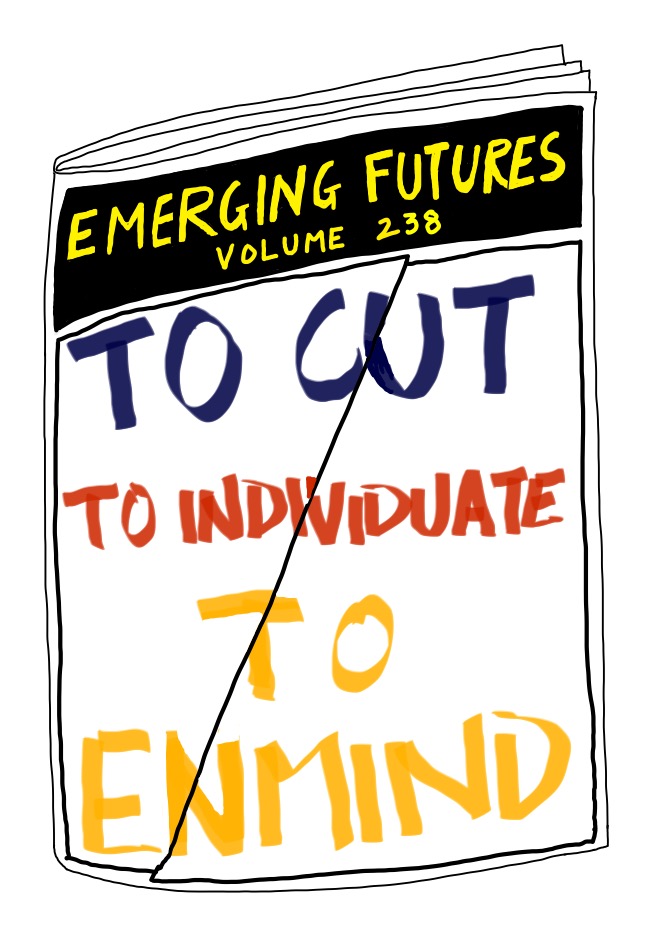
Goodmorning adventurers of the full moon’s extended evenings,
The last week has been for us, here on the North East edge of the North Atlantic, a week of clear skies and a nearly full moon rising high before sunset – which affords one extended hours of outdoor exploration and adventure.
Walking in the leafless green spring woods as the sun sets – it is a magic moment to be greeted by a bright moon above. The shift in light quality from a sun-bright day to a night-bright silvery post sunset – such an astonishing moment!
…And then we could continue wandering into the early hours of the morning before darkness finally found us!
It is also a week of great celebrations: the Yadzi New Year – A happy New Year to all those who are crossing between years! As well, it is Passover and Easter – a joyful period to all of those who celebrate.
Over the last few weeks, we have experimented with Worldmaking as both fundamental to the myriad modes of being alive and as equally fundamental to human practices of engaging with creative processes.
Over the last five weeks (Vol’s 233, 234, 235, 236, 237), we have been experimentally developing a “worldly” approach to being alive, active, and conscious of our specific aliveness. This week, we want to circle back and review the ground we have covered to make it as clear as possible what we mean by this worldly approach – and equally, what we don’t mean by this.
For us, there is something both beautiful and helpful in this seeming repetition – for if, as they say, a path is made in walking – it is going to take far more than one walk through the dense underbrush to make a path! Looping and wandering through the same zones is what leads to things creatively stabilizing into new possibilities.
This week, we conclude with an experimental exercise that we hope you will try alongside us and share with us – so we can collectively develop these nascent possibilities further.
OK – enough said – let’s get going! Our hope here is to make a conceptual and lived sense of what it means to “be of a world” – and ultimately to make this, despite how difficult it is, quite concrete.
We recognize that this is not an easy task, for it involves, for many of us, a radical reframing of how we understand what it means to be conscious and to be a distinct subject.
To do this, we first need to back up and daylight some of the tacit assumptions that are critical to the distinct modern Western approaches to consciousness:
In the contemporary West the ubiquitous approach to consciousness and selfhood is radically anti-worldly and even profoundly de-worlding. Our dominant scientific approaches to consciousness – to our sense of being alive – have a near-exclusive brain focus and computational bias (and thus have no need for any extended world). While we have been arguing for a radically worldly and enactive approach to what it means to be alive and be conscious – let’s be frank – this is far from the standard approach.
For most contemporary researchers of consciousness, consciousness is confined to the brain – it does not require meaningful embodied interactions with an environment that give rise to a coherent world that, in turn, co-creates experience. We need to ask, as Evan Thompson and Diego Cosmelli do:
“Is Consciousness confined to the brain?
According to the “enactive” view of experience, consciousness is a life-regulation process of the body interacting with its environment. Perception, action, emotion, imagination, memory, dreaming—these are modes of self-regulation that depend directly on the living body and not just the brain. According to the enactive view, the body shouldn’t be seen as a mere outside causal influence on an exclusively neuronal system for consciousness because the minimal requirements for consciousness include a living body, not just neuronal events in the skull.
The enactive view stands in tension with the widespread view in the neuroscience of consciousness that consciousness is brainbound. Many neuroscientists and philosophers would say that your brain directly determines what you experience, but your body affects what you experience only via its influence on your brain. According to this way of thinking, the body is strictly inessential for conscious experience; for example, in principle, a disembodied brain in a vat could have the same kinds of subjective experiences or states of phenomenal consciousness as an embodied brain.”
Let’s take this up directly – for perhaps the best place to start to examine this reductive and anti-worldly logic is to confront the argument behind the famous “brain-in-a-vat” thought experiment:
In this experiment, we are asked to imagine what would happen if we could take our brains out of our heads, out of our bodies, and out of any environment. And once surgically removed from all of this unnecessary “meat”, we would place our brain carefully in a vat full of nice warm liquids that contains all the vital nutrients to keep the brain alive. Then doctors would skillfully hook our brains up to the same electro stimulations that would happen if our body did things and sensed things – but these, in contrast, would just be the stimulations produced by a very special machine.

The question is: would we notice any difference? Would we notice that we are not actually experiencing and interacting with a world?
The most common answer is that, just like in the movie The Matrix, we would not be able to tell anything different.
The assumption is that we do not have any direct connection to anything “out there”, that the body is just an information input device, and that all of the magic happens in the brain, which transforms these diverse inputs into a coherent, meaningful internal representation that is disconnected – or at least disconnectable from a so-called “out there”.
Consider for a moment how radically removed this argument is from your experience of waking up this morning, of feeling the rain, touching a loved one, and feeding your cat. While this argument might get an argumentative grip upon your thinking, it does not really touch your precarious existential sense of being alive “of” a profound and astonishing, meaningful world.
Sadly, this brain-in-a-vat logic is by no means reducible to a highly successful, tedious movie series (sorry red pill aficionados). We find the same logic animating computational approaches to the brain and consciousness in the Cognitive Sciences, current confused hysteria about the sentience of AI, and the deeply desired by tech bros everywhere near-future possibility of downloading consciousness into a supercomputer.
The first question to ask: Is any of this possible? Does any of this even make any lived biological sense?
Here we wish to loop into your morning reading an exceptional paper by Evan Thompson and Diego Cosmelli – two eminent cognitive scientists who together wrote what we feel is one of the most powerful critiques of this radically deworlding and reductive logic: Brain in a Vat or Body in a World? We encourage you to read this – it is worth the detour…
For those less inclined to a morning detour (we understand – it is quite a dense read for an early morning), here is their conclusion, which is in itself worth an extended quote:
“The main moral of our examination of the brain in a vat is that brain states can’t be unplugged from body states. So internalist explanations are not a good framework for the neuroscience of consciousness. We should prefer Enactive to Brainbound.
But what about… [the argument for a] disembodied, freestanding brain that spontaneously arises from the chance fluctuations of microphysical particles? We would like to know more about this brain. Is it just the neurons and synaptic connections, somehow floating independently of its glial cells, cerebral vasculature, immune cells, and other nonneuronal, somatic partners? That seems physically impossible, not merely highly unlikely. How would such a system hold together long enough for us to suppose any experience could be instantiated?
Even if we were to allow for purposes of philosophical argument the conceivability or bare possibility of some sort of freestanding brain, completely decoupled from the body, we see no reason to think there would be any experience present at all. Why should we think that this kind of brain is intelligible as a subject of experience or possessor of creature consciousness? Neuroscience and biology in general give us no reason. We see no good scientific motivation whatsoever for the idea. It strikes us as simply a holdover of the flight from Cartesian dualism.
Here, then, is the enactive response…. If creature consciousness is a life-regulation process of an organism, and if perceptual consciousness is a certain kind of interactive relationship between an organism and its environment, then a disembodied brain going through the same sequence of internal states as an embodied brain is like a disembodied stomach going through the same sequence of internal states as an embodied one. The disembodied stomach isn’t digesting and the disembodied brain isn’t experiencing, because the necessary contexts of the body and the environment are missing.” (Thompson and Cosmelli)
Consciousness is, as they argue, “a certain kind of interactive relationship between an organism and its environment” – over the last five newsletters we have, in this spirit, introduced a radically different approach to how we are alive, have experiences, and are profoundly “of a world”.
We began with the humble Tick and how the embodied Tick + Environment co-shape – really co-create each other while giving rise to a coherent lived experience of a world (Volumes 234 & 235).
But we have never been fully comfortable with just this embodied and embedded approach – all along our concern with this approach is that all of this could still be understood as nothing more than the augmentation and extension of a brain focused approach to consciousness and experience. As we put it in the last newsletter (with some slight modifications):
Yes, we and all living beings do not and cannot exist alone – we are profoundly dependent on tools, practices, and environments. But, when we go further into what is meant by this, we cannot settle on a radiating web with the mind/ brain at the center:
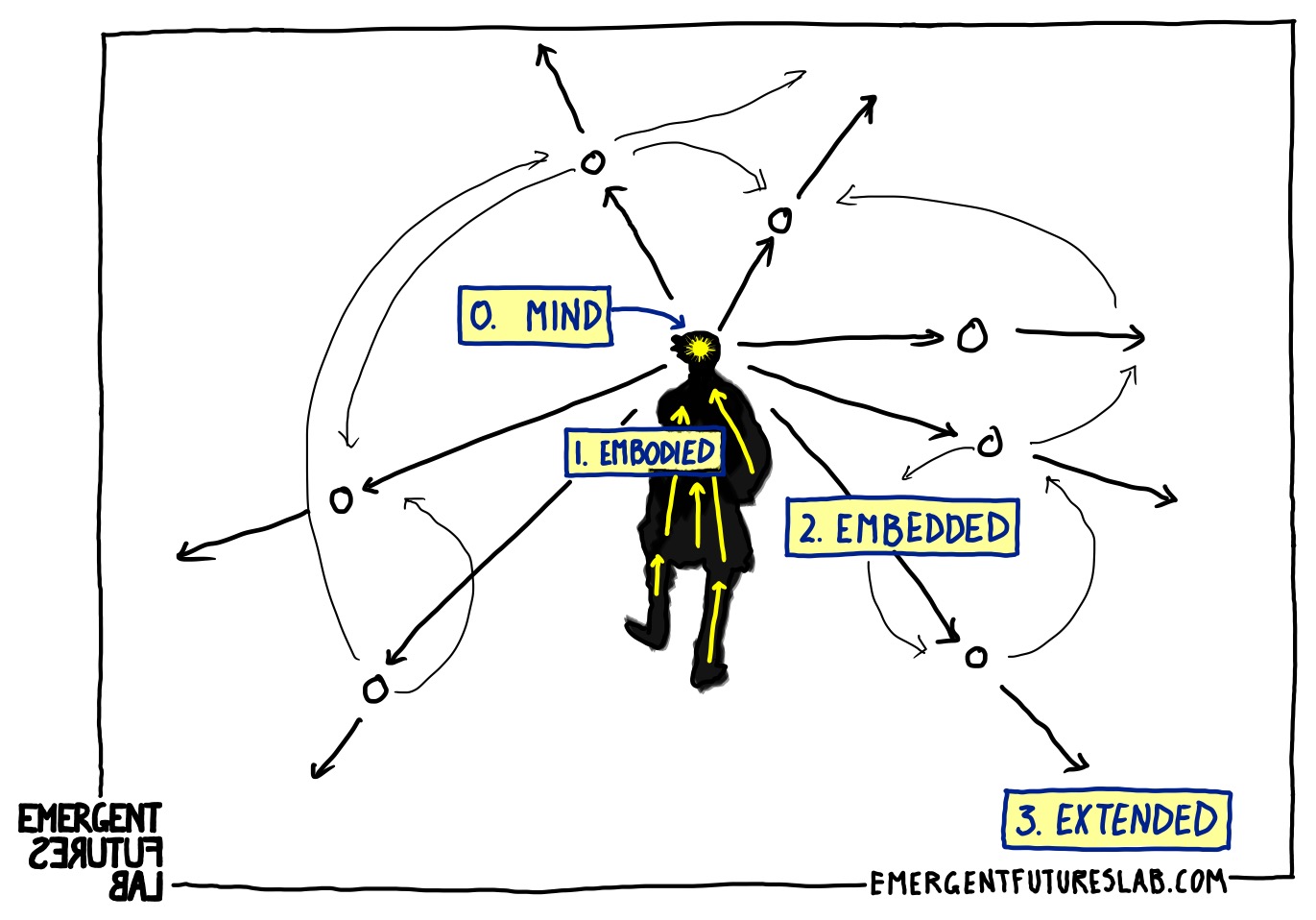
To simply make the claim that the mind/brain that cannot function without the “support” of outside things is not enough. Why? Because we are still in relation to a false essentialism that focuses on the mind/brain as being in a fixed location that all else radiates out from. While we have embodied and extended the mind, we are still employing a fixed essential center to this somewhat more worldly assemblage.
And it is here that turning to the long non-Western (really non-West Asian) philosophical traditions of Buddhistic South and East Asia that we can really begin to move in a new and revolutionary direction. The Buddhist traditions approach the question of what “is” anything from a radically anti-essentialist perspective: all things come into being via a process of dependent co-origination and continue their existence via conditioning relations (what we have called elsewhere “enabling and stabilizing configurations”).
Perhaps there could not be a more relational and worldly approach than this(?):
This Buddhistic logic allows us to grasp the relational network and emergent logic of experience. This logic puts relational worldliness at the center of all experience.
So, how can we extend this as an alternative?
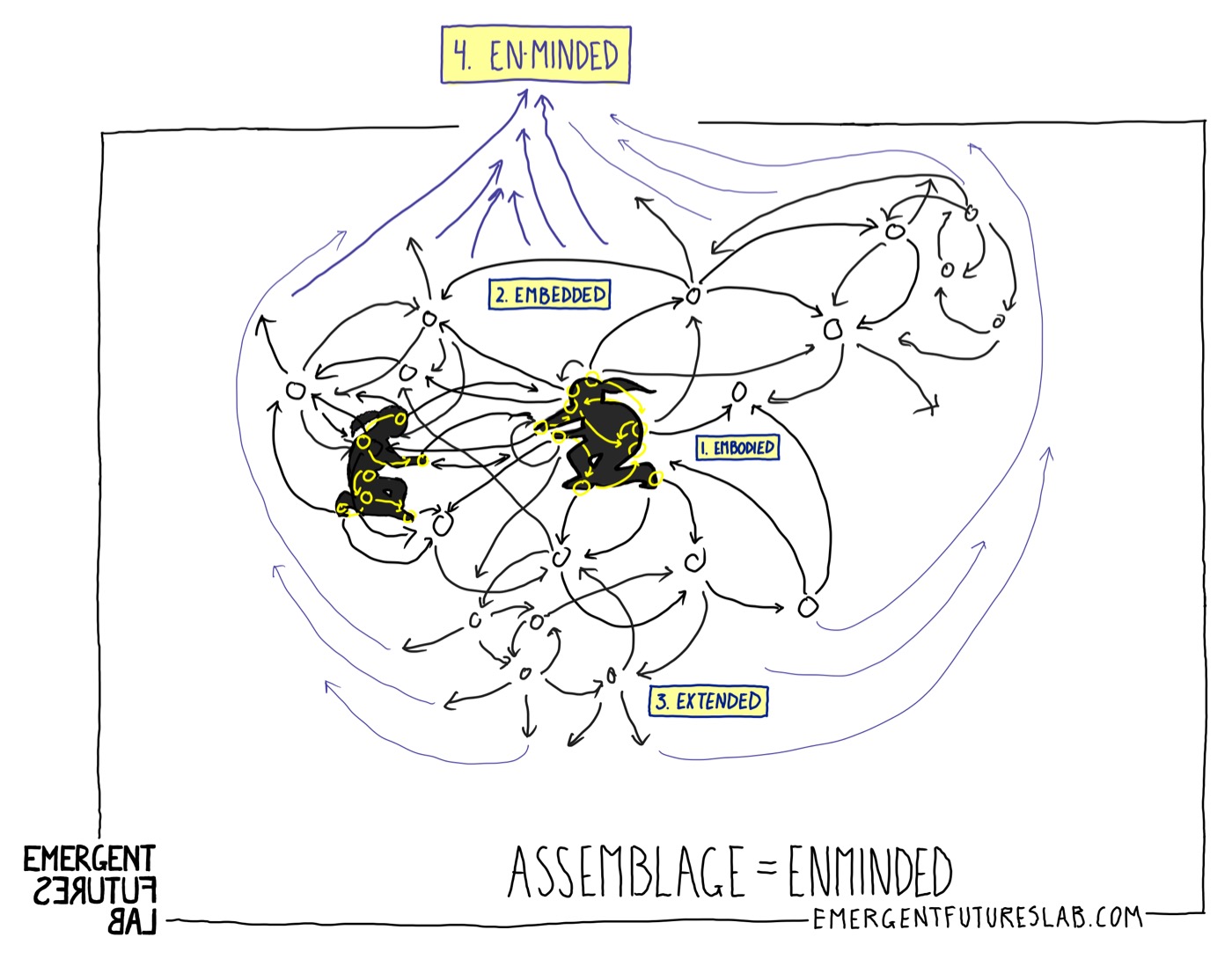
Last week, we proposed a networked emergent approach – where the assemblage (network) is “enminded”: Where we can understand the living agential “self” as a non-essentializable, mutable, and mobile emergent relational outcome of a configuration that inherently includes others.
Rather than thinking of the self as an already pre-existing unified individual – we could understand it as part of an ongoing dynamic and creative process of “individuation.”
Thus, via a collaborative creative process, a particular organized relational living system individuates and becomes enminded:
But – the problem is that this is so very abstract! How does this gain a meaningful purchase in our creative lives?
We’ve been thinking about this quite a bit this week.
The first insight that is admittedly still quite abstract is from the Enactive Philosopher and researcher Ezique Di Paulo who answers the question “what constitutes the difference between an emergent subject and an environment?” this way:
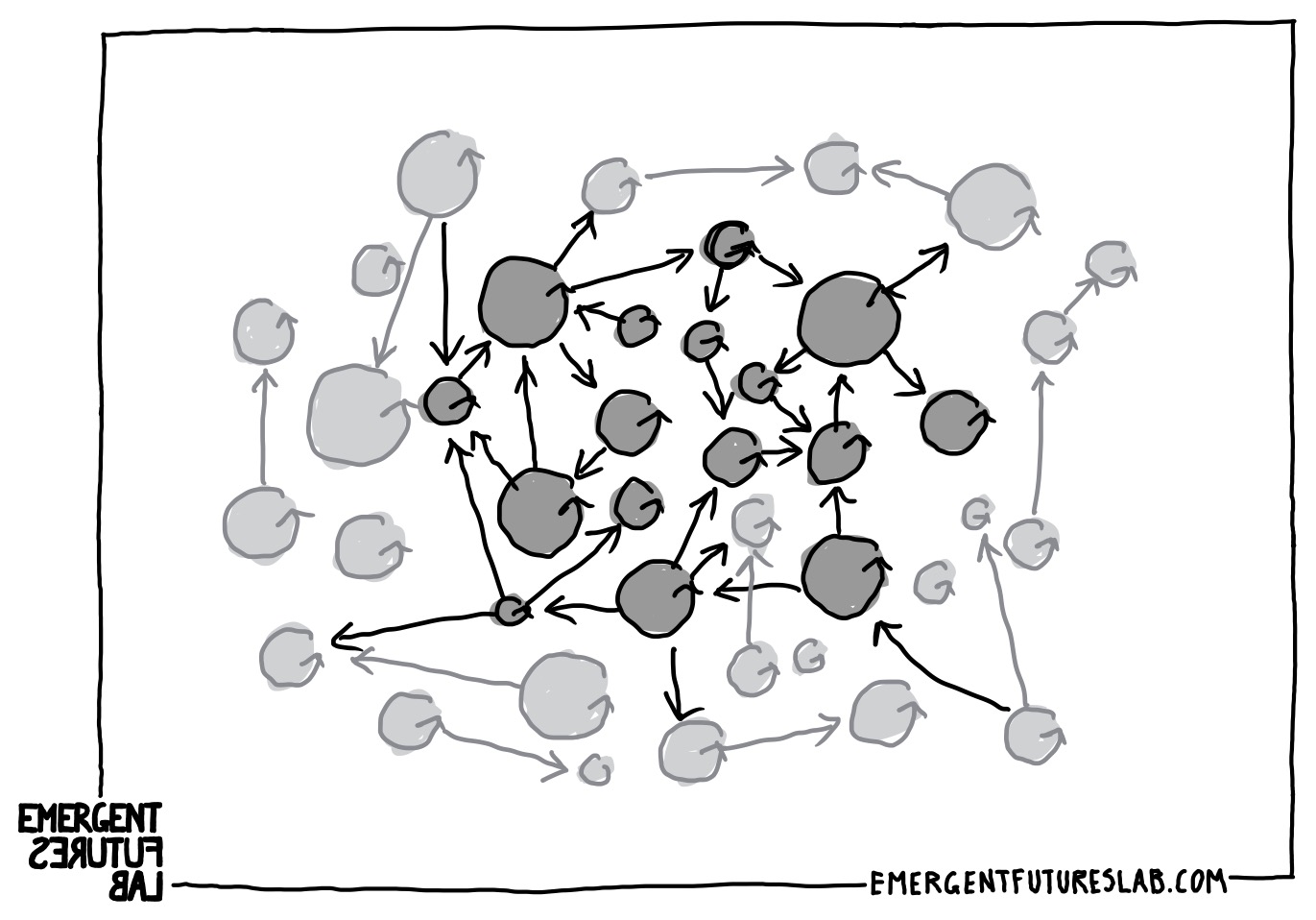
His critical insight is that what distinguishes a subject and an environment is not some clear and obvious boundary – rather it is the type of relations that the individuating assemblage forms:
There is a clear density of mutually determining relations. And that these relations extend necessarily beyond the visible edge of an entity and far out into the environment.
Here, the critical question is if relations can conceivably go on forever in all directions; how do we draw a boundary? And here we can finally get quite concrete!
Consider being blind and using a stick to navigate the environment (we encourage you to do this – it is profoundly illuminating):


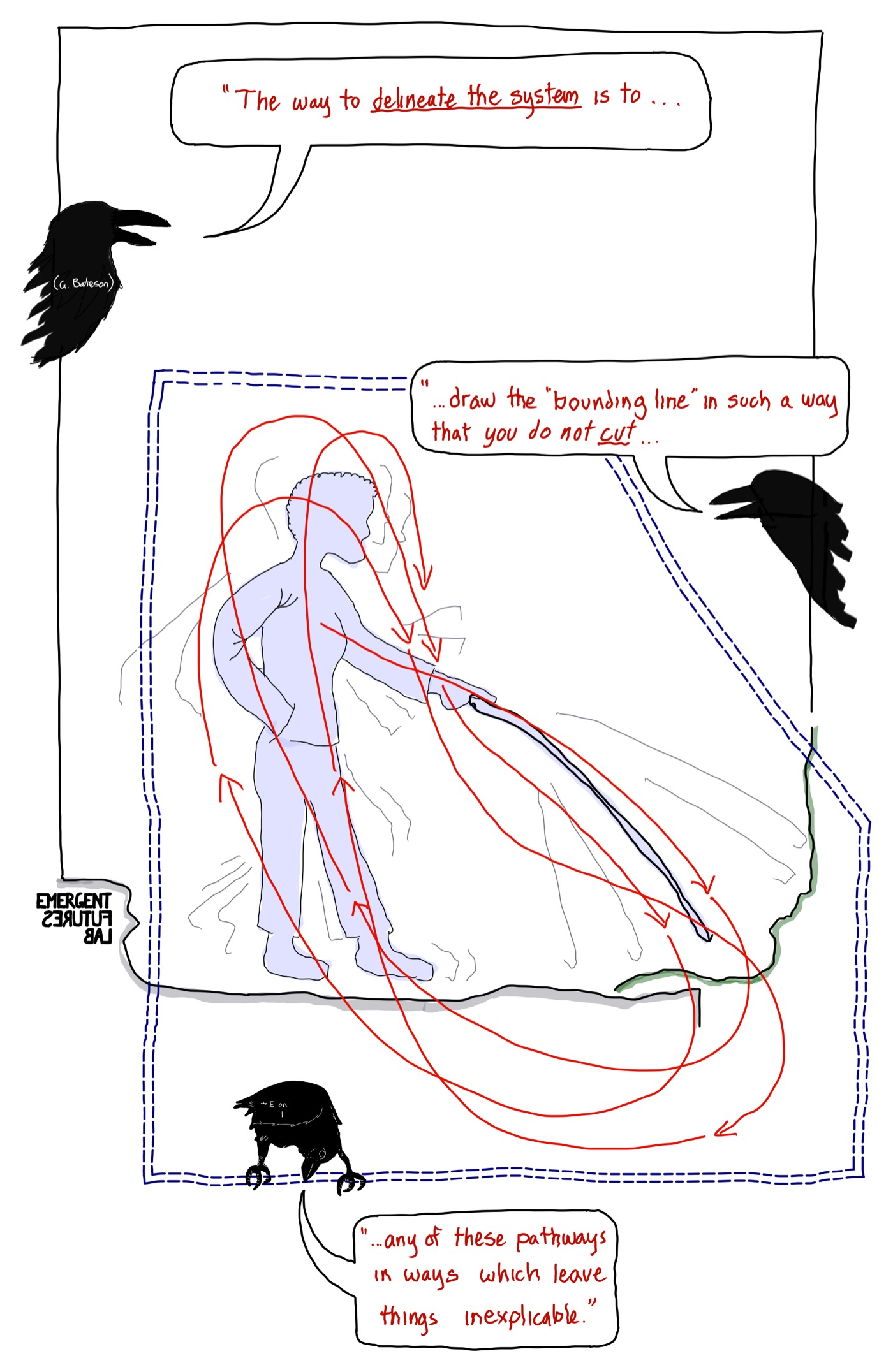
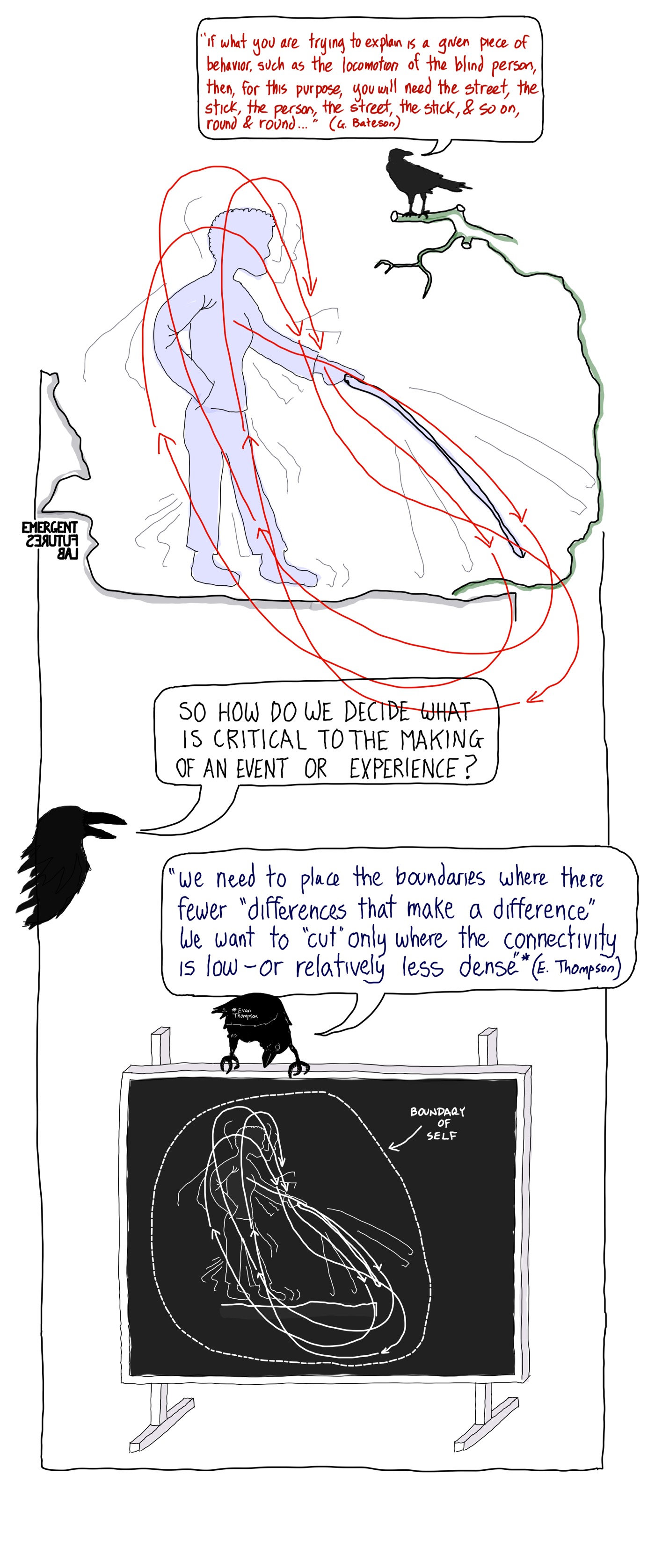
Here we wish to just draw your attention to two things:
Thus, there is nothing mysterious, hidden, or radically interior about the “mind” – it is an emergent property of a dynamic, distributed living worldly assemblage – and it does move around…
All of this can feel quite exciting, insightful, and creatively challenging – but we also know from our own experience, it can still be profoundly abstract and nebulous.
Over the last two weeks in Worldmakers – the collective community of practice that we are part of, we have been attempting to experiment in quite concrete ways with these worldly entanglements via a series of experiential diagramming exercises inspired by how our colleague and Worldmakers participant Steven Greenstein has been developing diagraming techniques for his own experiments (inspired by the work of Tim Ingold – See Lines: A Brief History, The Life of Lines):
To prepare: gather differing colored pens and a few large sheets of paper.
To start: Reflect on the last couple of hours of your day and choose a short, roughly ten-minute period of your experience that stands out to you:
Part two: Now choose another ten-minute period that happened in a different location about an hour or so apart from your first drawing.
For us, this is just the beginning of how you could experiment with these active diagramming practices. Given the experimental exploration of worldmaking over the last five newsletters, what questions do you want to explore? How can your creative use of this technique develop new, more worldly and enminded practices and subjectivities? What new practices and techniques can you develop?
We would be excited if you shared with us what you do!
And it is here that we leave you for the week – Keep difference alive and keep sensing how emergent boundaries emerge experimentally where “there are fewer differences that make a difference.”
Until next week,
Jason, Andrew, and Iain
Emergent Futures Lab
+++
P.S. This newsletter continues in our community—where you can comment, question, and explore further. Emerging Futures + brings you into the conversation. Join here
P.P.S. WorldMakers goes beyond the newsletter: 40 live events annually, weekly podcasts and exercises, our annotated bibliography, and practitioners across diverse fields reimagining creativity together. Discover WorldMakers


