Newsletter
Resources
Courses
Books

Welcome to Emerging Futures -- Volume 245! Creative Concepting for Worldmaking...
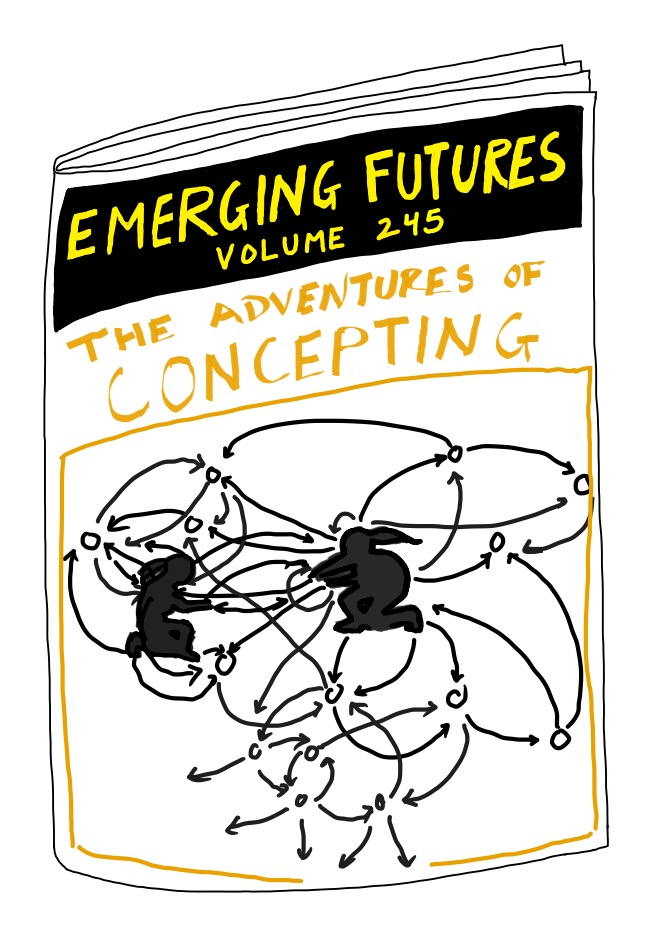
Good morning abstracting and concepting creative becomings,
It’s a bright, fresh, late spring morning – and we are just jumping straight into things:
This week and next, the plan is to explore some of the key concepts and conceptual language we have been putting to work in this series on worldmaking. In short, we are surfacing and focusing on some new concepts. But, as is usual for us, we are going slow to go fast – and allowing ourselves to be pulled by the necessary meanders.
To feel the relevance, urgency, and joy in the concepting activities of worldmaking, for us, it is helpful to go backward and connect all of this experimentation involved in worldmaking with creativity – and ourselves – how we sense and experience. After all, all of these experiments are an extended weaving, wandering, and worlding dance with creativity in all its wondrous becomings – and this too loops through us.
So – here’s the plan: We are going to get into key concepts – some old, some new, and some modified in two parts:
Part One: This newsletter is a broad overview connecting Worldmaking to creativity and ourselves while situating the key concepts broadly. We will put all of the key concepts we wish to experimentally explicate further in bold.
Additionally, we will point out the key concepts we have already experimentally developed in our glossary by highlighting these in bold+italic and linking them to the glossary. To make the text readable, we will always only do this for the first mention of the concept.
Part Two: The next newsletter will focus on this set of about thirty concepts – and offer a sense of both the why and where of their experimental possibilities in a worldly creative practice.
Perhaps a quick word on concepts and definitions. Concepts are tools – rich pragmatic tools that participate in experiments. And the work of defining is also a pragmatic one: what acts of potentiation might emerge if we use a concept in this manner? And this work of “concepting” is always tied to pragmatic practices involving environments, physical tools, other beings, etc. Concepts don’t live in dictionaries, just like physical tools don’t live in tool sheds – nor do they easily succumb to “proper” use – they, like all tools, play and wander – tipping into incipient realms: what else can we do? What new potentials for novel action can we participate in making possible?
Consider, by way of example, gardening. Distinct approaches to gardening participate in the invention of new physical tools that, in turn, shape the practices (pruning shears, different shovels, axes, etc.) – and in parallel, new conceptual tools are also arising as part of these emerging practices. A Rewilding approach to gardening will have very different practices and tools (both physical and conceptual) than those associated with a classical French approach to gardening. But now we digress and get ahead of ourselves.
Let's come back to creativity, worldmaking, and us…
If creativity is understood as the processes by which something new comes about, then given that all life and all living is complex, creativity only makes sense in light of an experimental understanding of complexity, emergence, and history.
An engagement with creativity – or what is better conceptualized as creative processes – begins by first recognizing that creative processes are everywhere and everywhere ongoing. Creativity – creative processes are not what is simply strategically added like a magic fairy dust to the unchanging bits of reality to make them eventually change. No – the processes of change are everywhere – and even to keep things similar enough to be called “unchanging” is a creative achievement requiring the enormous ingenious work of diverse processes – and worthy of the highest regard. Creative processes are found literally everywhere – from seeming sameness on one hand to the processes by which the radically new disruptively emerges.
From the formation of stars to the creative interventions of Maori political systems, everything is of creative processes. Understood in this manner, there is literally no opposite to creativity – there are no non-creative activities – it is always only a question of what creative processes are coming to the fore.
Now to say that “everything is dynamic and changing” – that there are creative processes everywhere – does not mean that all change and all processes are the same, far from it. What exactly this means we will get into later, but don’t mistake ongoing dynamism, flow, and change for the lack of stable forms (meta-stabilities) at differing scales. Our lives are not an unformed and unformable ever-changing soup – rather, via mainly self-organizing, and abstract machinic processes, stable dynamic patterns are creatively individuating at diverse scales everywhere we care to look.
The first radical insight of such an approach that sees creativity everywhere is that there is no neutral or static position outside of change to occupy, observe, and know what things “really are.” Observation is not a passive activity. There are no passive activities. To observe is to act, and to act is to participate in change. Our actions are always situated, relational, and potentially surprising acts of potentiation. We are in and of our dynamic entanglements – changing and being changed – as is everything else. An ongoing co-creativity.
This first insight is indeed far more radical than even this. For, we need to consider the question: what does it mean to be situated – to be of a relational context? And this question is the beginning of sensing the need and logic of world-making.
Here is a first intimation of what this means: If everything is co-creative, then how we feel, sense, act, conceptualize, and know – must have a history – and must be of a history (a world or better said a worlding). How we act, feel, sense, and know is not universal nor is ahistorical – who we are is the outcome of a complex, co-creative affordance based process. Before we experiment with what such processes are, it is profoundly helpful to get a sense of what it means to feel and know from a historically situated position:
“Let me begin by quoting Barbara Duden, with whom I've been working on body history for the last ten years. She has written a book, based on the records of an eighteenth-century doctor who made verbatim transcriptions of the cases of the seventeen hundred women who visited him. Duden attempted to reconstruct the way in which these women perceived their own flesh, how they felt in their bodies, how their sensations were oriented, and what they meant when they said "body."
In her introduction to this book Duden says that the first thing she had to learn was that she could not construct a bridge back to those women out of the feelings she had about her flesh as a modern woman. She says that she first had to learn to recognize that her own perceptions of her body were totally epoch-specific, and that these perceptions went through a very significant crisis in the epoch of her grandparents, and again after World War I. Only then could she listen to what these women told the doctor between 1720 and 1740.” (Ivan Illich)
For many, this might read as either perplexing or astonishing – that we cannot assume that we can construct a direct bridge to other past or present communities' most basic human experiences. There are qualitative disjunctions in time and space that ontologically separate and differentiate our most basic way of being alive. What Duden is terming “epoch-specific” is what we would term how we are historically of a “world” and a perspective. How do we come to recognize how we, too, are of a creative “epoch-specific” – of specific historical worlding ways of being? What are the conceptual tools and concepting practices that will help us? Here we will need something like an ontological politics.
When it comes to engaging with creativity, we need to critically consider our own disjunctive history of the present. Despite what almost every contemporary discussion of Creativity in the global West tells us, creative processes do not begin with us as individuals or even humans – and certainly not with the fully flawed logic of ideation and the problematic framework of internal brain-based representations (the extreme version of this is exemplified by the brain-in-a-vat thought experiment). This individualistic human-centered approach emerged in the global West in the late 1700’s, as part of the conjoined development in far West-Asia of a number of large-scale creative processes which included capitalism and the modern individual. What could be both less true and a most ideal answer for the wealth and exploitation of the newly powerful than a logic that claims a novel creation – say the steam engine or electricity- was the great creative invention that emerged solely from their individual internal solitary genius”?
That we live in and of historical infrastructures/apparatuses where such approaches to creativity thrive speaks to both a profound lack of widely understood and adequate approaches to engaging with how change happens, as well as the broadly developed infrastructures, habits, and concepting – world-making practices that keep this individual human-centered ideation-driven logic alive and well (what we have discussed as world-blind and world-erasing practices).
To actually come to terms with change and creative processes, *we need to both shift our engagements and co-evolve differing infrastructures/apparatuses (*we need to develop infrastructures that can (1) engage with a reality where many worlds exist – a pluriverse and (2) where new worlds are possible).
This focus on infrastructures and distributed multi-scalar processes brings us back to our initial worldly question:
What does it mean to be situated – to be of a historical densely intra-woven relational context?
As we stated at the outset of this newsletter: nothing about the densely intrawoven processes of creative becoming makes any sense without an understanding of complexity, emergence, and history. And it is this second concept, emergence, that we need to turn our attention to next.
To get a good grasp on the what and how of creative processes is to get a good grasp on the question: how does change happen? How does something new and different emerge? For far too long in the global West, causal explanations have been under the thrall of linearity and essentialism, which has given rise to various forms of a reductionist “this is the ultimate cause of that” logic that we see broadly in our scientific, social, and historical discourses:
As a close engagement with emergence will demonstrate: However, it is framed – neither history nor creativity are linear, essentialist, or reductive. The linear and the layered are deceptive images and practices. And the classical explanatory trio of linearity, essentialism, and reduction – the aborescent line, the onion, and the pyramid – are techniques that might have some success in very narrow, highly limited and closed situations – but this has little to do with our realities. Nonetheless, these methods of explanation and action have for too long shaped our conceptual landscape with disastrous results.
Given our context of living in a complex reality composed of a vast near infinitude of relations and processes, change in all of its forms is complex, non-linear, and emergent. Nowhere will we find things built up layer by layer, advancing in a neat progression, or as the direct expression of some internal essence.
Rather, we see complex loopings upon loopings of highly distributed heterogeneous feedback systems working in real time at differing time scales.
Before getting into emergence, we need to stress what this multiplicity of loopings means for the individual living being – whether it be a tick, a bacteria, or a person – it means that they do not find themselves as a distinct being cast into an environment to which they must adapt or “fit” the best they can based on their internal resources. Rather, they are in a fully co-creative dance with this already shaped and active environment – and in this co-creative dance they emerge as the co-created being they are becoming such that they are different from this equally co-created environment – but not separate – different but intra-woven:
How we, and all living beings, are situated is in how we actively connect to context-relevant aspects of their environment that constitutively transform them, as they equally constitutively transform their environment. This is a form of co-creation (niche construction). To imagine that we are simply “in” an environment, placed there or cast there, and then we adapt, is to radically cut the living being from these loopings in a way that renders both life and understanding impossible. In both cases, we have to care for the co-creative entanglements – the relations – these are what make a life – really a collective mode of living and its capacities what it is (a world – and its inexhaustible potentialities to become ever otherwise). Yes, we can cut relations both in creative acts and to understand things – that is not the issue. The question is (1) under what assumptions (is it because we falsely assume that we are fully separate and separable from our environment?), and (2) for what ends? When we recognize that we are of our entanglements, then cutting becomes an experimental act – to cut things only where the density of loops is far less consequential – and ultimately to co-create new relational and non-linear assemblages.
The basic smallest “unit” of life and understanding is some form of active co-creative non-linear assemblage. “An assemblage… is the coming together of heterogeneous components, and such a coming together is… the first and last word of existence. I do not exist, and then enter into assemblages. The matter of my existence is my very participation in assemblages. I am not gifted with agency, the possessor of intentions or initiative. Animation, agency, intentionality… belong to the assemblage as such.” (Isabelle Stengers)
But an assemblage should not be mistaken for simply a supportive collection of bits and bobs that a living being takes advantage of – a nifty support network. Here, the full looping logic of creative emergence is the critical process to understand.
Historically, in the face of complexity and the persistent difficulty of explaining how stable patterns of activity might come out of such overwhelmingly dense circumstances, reductive approaches have argued that while currently we might lack the tools to sort out all of the causal pathways from the complexity we observe to their ultimate base causes, eventually, as science progresses, we will be able to do this. We see this perhaps most explicitly in the study of consciousness and the brain. It is a situation where we indeed face a numerically overwhelming circumstance: billions of living, growing, and changing neural connections, plus how they are distinctly embodied and the extended practices of tools, cultures, and much else besides. To which The Human Brain Project (2013-2023) believed that cognition could be reduced to a full mapping of the brain's connections. The premise was that if you could map all of the neural connections of the brain, all the mysteries of cognition would be solved. After a decade, many controversies, and over a billion dollars, this reductionist project ended with no such result – though one could consider the profound criticism of the underlying reductivist logic of the approach that was generated, a result...
Emergent processes are a radical alternative, assemblage-based approach to causality that fundamentally challenges and refuses reductionism, essentialism, and linearity. Emergent assemblage-based processes are an alternative approach to understanding how complex processes can give rise to the instantiation of novel, clear, distinct, and stable processes (such as life, consciousness, or socio-cultural regularities) without resorting to some pregiven essence, source, or plan. Here, it would be accurate to say that the asemblage is emergently “enminded.”
The basic alternative logic of emergent assemblage-based processes is that when diverse processes come together in tightly intra-connected non-linear feedback loops, the outcome is something that (1) exceeds the component processes, (2) is radically different and irreducible to them, and (3) transforms the component processes.
Emergence is first and foremost a “bottom-up” process and explanation – whereby unique and astonishing outcomes no longer need to be explained by some form of pre-existing “seed” – or pre-existing essence, or pre-existing plan of any kind.
This “bottom-up” logic of emergence acts as a direct challenge to the basic model of creativity in the contemporary global West that always puts the essential seed first (an idea that then leads to a plan, and only finally making). Now we can both understand and effectively participate in creative processes without imagining that it must begin in someone's head, etc. Human flight, an example we have explored in depth, is the outcome of a highly distributed emergent process – not the genius of a few great men who envisioned it and then made it so.
And now if we return again to our question: What does it mean to be situated – to be of a historical densely intra-woven relational context? – but now considering it from a fuller understanding of emergent creativity – the answer will be a powerful and rich one: How we come to historically and situatedly act, sense, feel, love, and live collectively specific meaningful lives is not reducible to any essence in us – or anywhere else – rather it is the dynamic creative and emergent outcome of a specific set of distributed multi-scalar some-what stable historical processes tightly looped through each other that give rise, in an irreducible and non-decomposable way, to a way of being alive.
The Mahayana tradition in Buddhism speaks of this relation-dominant emergent assemblage perspective as Dependent Co-Arising (Pratītyasamutpāda), and we speak of this emergent mode of being alive as worlding, and world-making.
This “bottom-up” emergent logic is already so radical and profound, as it goes against the whole history of Western approaches to explanation. It renders irrelevant most reductive explanations from ideation, the mind of god, the expression of a plan, etc.
Now, as radical as this is, we cannot stop here, as many would like to. To stop at this “bottom-up” understanding of emergence (an assemblage-based process that leads to something that is both more than and different from the component processes) is to miss most of what emergence is and means.
So what are we missing?
“What emerges changes its component processes.”
This is worth reading a few times:
What emerges changes its component processes.
If we map out such a process, then we are in a strange creative loop indeed: If component processes give rise to something new and different, and then this turns around and transforms the components, where is the beginning (or end) of anything? How do we even talk about causality? This now feels closer to Alice in Wonderland than how we might think of our most basic active experiences.
Think about it: We most often understand causality as moving forward in one direction: this causes that. And from this perspective, it is not that difficult to absorb into one's thinking that the many can give rise to a one, even if it is an emergent irreducible “one”.
But this new logic is something profoundly altogether different. Consider the standard form of explaining phenomena such as consciousness in a “bottom-up” manner: highly interconnected processes give rise to the emergent phenomenon of consciousness, full stop – end of story. The “many” have become a “one” – without plan or any pre-organization, sure – but even if this aspect is hard to fully absorb, the general logic is not surprising.
But if “what emerges changes its component processes,” then none of the “parts” are remaining the same. The dragon is creatively eating its tail. The “source parts” are now, properly speaking, created by what emerged. The “outcome” is now the “cause”. The “end” is the “beginning”...
This is best understood as “system causation,” where the whole “system moves at once,” as Evan Thompson says, quoting John Searle, “the right way to think of this is not so much 'top down' but as system causation. The system, as a system, has causal effects on each element, even though the system is made up of elements.” Searle goes on to say that "an emergent quality or feature… is a feature of the whole system and is present – literally – at all of the relevant places of the system in the same way that the water in the glass is liquid throughout."
This is the end of the road for all forms of simple linear action in complex contexts. To ask “which came first – the chicken or the egg?” is revealed to be totally beside the point. The (emergent) outcome: the “last” is also the maker of the “first” – the purported causes of the “last.”
To ask any “component as causality” question becomes challenging. Consider a non-complex situation as a contrast: a car engine – you can take it apart and see each and every component. You can put it back together sub-assembly by sub-assembly – alternator, carburetor, spark plugs… eventually you will have your car engine together again, and as a “result” – it will run. The state of the whole, the outcome – whether it runs or not is always because of the same set of components doing their discreet, linear, and additive proportional actions. No matter how long it runs, the running will not creatively change any of the component parts. Engine not running? Find the problem part or parts, replace them, and start it up.
But in complex systems – which consist of all lived reality – including the actuality of working on your car engine – something else entirely is going on: the relation dominant assemblage whose emergent logic will emerge in a bottom-up fashion will transform its parts. Creativity is, in this manner, everywhere emerging from the “middle”. This is what it means to be of a non-decomposable relational emergent holism.
So how does this implicate “us”? Here we can return to, and expand upon the concept of an assemblage. As Isabelle Stengers reminds us, “I do not exist and then enter into assemblages. The matter of my existence is my very participation in assemblages”. The “most basic unit” of life and understanding is some composition of active, co-creative non-linear assemblages. But the concept of “most basic unit” might lead us astray. An assemblage is always expansive – as well as being heterogeneous, multi-scalar, and emergent. Getting a grasp on what exactly the entangled multi-scalar assemblages are and what they are emergently affording, given my particular contextual enactions of them, is the profound challenge of disclosure in world-making.
But before we go further into this, is to fully grasp the critical aspect of an assemblage and the emergent logics of bottom-up and system causation: Now we can appreciate more clearly what Stengers means when she says, “I am not gifted with agency, the possessor of intentions or initiative. Animation, agency, intentionality… belong to the assemblage as such.” The naked “I” shorn of all relations is a fable best left to the transcendent gods. The “I” truly alone is a partial entity that cannot possess any capacities – no animation, agency, or intentionality. This meta space of affordances – of specific potentialities for action can only emerge from and of the bottom up and systems' causal qualities of assemblages. That “agency… belongs to the assemblage as such” is the creative space of ontogenesis (the ongoing making of a collective way of being alive).
That said, it is important to be clear on what we are not saying: It is not that the individual is reducible to an assemblage or dissolves into it, or that there is no self. Rather, it is that the self and its situated agency continuously co-emerges of an assemblage in which differentiation happens without separation – we are of an emergent intrawoven creative process of co-differentiation.
To really locate ourselves within this logic of “a worlding,” we have to consider how we never find ourselves in a neat condition where we are only of one discreet and well-defined assemblage. Things are messier. We always find ourselves in conditions where multiple semi-co-ordinated assemblages are interacting in situations where some come to dominate and entrain others. And it is from this that we see complex historical patterns of subjectivity arising. The semi-stable entrainment of multiple apparatuses gives rise to a dynamic field of ontogenetic possibility (always near a tipping into incipient transformation).
A useful way to get a grasp on these co-ordinations and entrainments of multiple assemblages is via their meta-logic as an apparatus. “We belong” Deleuze says, “to social apparatuses (dispositifs) and act within them.” Stuart Elden, echoing Isabelle Stengers understanding of assemblages, notes that an apparatus “provides a context, framework or, even, a structure within which individual instances of behavior, pieces of knowledge and acts of resistance find their place and meaning.”
Foucault, who first developed the concept, goes further in articulates its emergent agential logic: *"*What I'm trying to pick out with this term is, firstly, a thoroughly heterogeneous ensemble consisting of discourses, institutions, architectural forms, regulatory decisions, laws, administrative measures, scientific statements, philosophical, moral, and philanthropic propositions–in short, the said as much as the unsaid. Such are the elements of the apparatus. The apparatus itself is the system of relations that can be established between these elements."
What spurred Foucault to develop this concept was that, as a philosophical historian, he began to notice emergent regularities in how a specific sense of the self, modes of action, and ways of knowing arose historically and regionally when certain heterogeneous discourses, institutions, architectural forms, laws, administrative measures, etc., developed and shifted. blocked and stabilized emergent relational potentialities into a novel “system of creative relations”. And at which point we are in an emergent worlding situation…
An example of the outcome of such an emergent socio-historical process is what Ivan Illich notes about the realization the historian Barbara Duden makes, “She says that she first had to learn to recognize that her own perceptions of her body were totally epoch-specific…” To say that how we sense, feel, and know our bodies is not something universal but “epoch-specific” as Duden does, is, for Foucault, to recognize that this is the emergent outcome of a broad, generationally stable, regional worlding or world-making apparatus.
An apparatus is, in short, productive – creative. An apparatus is the co-constructive co-ordinated relational web of multi-scalar heterogeneous assemblages entrained towards the creative production of our situated becoming-of-a-world. It productively gives rise to the nearly invisible shared emergent background of experience and intelligibility. Who we are is not something given but something that must be produced. This is, to loop all the way back to the beginning of this newsletter, a question of what form creative processes come to take.
Emergence: On Creating and Stabilizing Apparatuses (On Constraints)Ultimately, as one might sense from the too brief presentation of the relation between historical apparatuses, our historical worlds are not of a neat, clear, and singular ontology (as many in the Ontological Design community might be prone to imagine) – but are rather a more heterogeneous, blurry, and messy space of convergent and divergent apparatuses (dispositifs).
So – what does all of this mean for the co-created distinct multiple “us-es” – and the co-production of our distinct collective agencies? What does this mean for how we are of a world – even if it is a messy one?
Here, we need to return one last time to the theory of emergence and what “system causation” means in practical terms. We left, perhaps, the best for the last: What the emergent whole is “doing” is creating, stabilizing, and limiting relational component processes to act such that certain novel propensities are far more likely to instantiate than others. Thus, the emergent whole acts to creatively enable, stabilize, and ultimately constrain a new space of possibilities.
An example: Why do we see a certain limited set of behaviors emerge in crowds in certain contexts? It is neither because of externally imposed co-ordination nor because of human nature's instincts – rather, it is creatively enabled and constrained because of the “relational properties the parts possess in virtue of being emergently integrated” (Terrance Deacon). Of the potentially infinite possibility of how things might come together and what this might lead to, the emergent system creates and stabilizes only around some (statistically speaking).
The atoms in our body could hypothetically be part of anything – but when they become relationally entrained by a specifically configured assemblage, their potentiality is both radically creatively enabled (to be a specific living being) – and radically constrained (not to be anything else). To put this in the most radical of terms: We, as an assemblage of processes, find ourselves in and of a set of socio-historical apparatuses where the emergent relations between the component processes determine the component processes and thus “the components” have no non-relational status (Evan Thompson).
Now we come back to the initial proposition and question that began the adventure of this newsletter. If creativity is everywhere and everywhere ongoing such that there is no “view from the outside” – what does it mean for us to be situated, to be of a relational context? We hope that at this point you can sense how this is a profound “world-making” question – and that engaging with creative processes is, ultimately, for living beings, always an emergent world-making question. Creativity = Life = Experimental Emergent Worldmaking.
Beginning Again: A Coda
Here are a few tentative final thoughts:
A final final thought: If you made it this far, we hope that you can sense how this week, what started as a “simple” introduction to useful world-making concepts took on a life of its own. But, for us, it is important to feel the relevance and the creative, pragmatic use of these concepts – both old and new. And to just jump into a list of terms – as if we were cramming for an exam – is to lose sight of the adventure and joy of a creative becoming with the concepting relevant to the making of new possible worlds.
Until next week - keep difference alive,
Jason, Andrew, and Iain
Emergent Futures Lab
+++
P.S. This newsletter continues in our community—where you can comment, question, and explore further. Emerging Futures + brings you into the conversation. Join here
P.P.S. WorldMakers goes beyond the newsletter: 40 live events annually, weekly podcasts and exercises, our annotated bibliography, and practitioners across diverse fields reimagining creativity together. Discover WorldMakers
Two questions, every Friday since 2020:
What is creativity? and How do you innovate?
A weekly experiment in emergence, creativity, and change-making.


