Newsletter
Resources
Courses
Books

Welcome to Emerging Futures -- Volume 231! Processes, Experiments and Manifestos...

Good Morning becomings of another new year,
The waning moon of February sits high in the early morning sky, accompanying us from night into the day. As it, the sun, and the earth’s location dance towards its next moment of invisibility, we are on the cusp of the next new year. On this upcoming Tuesday, we will have a new moon, and the Year of the Horse will begin. It is the beginning of the Lunar New Year – and we wish everyone a happy new year!
Here, between the Hudson and Delaware Rivers on the North-West edge of the North Atlantic, things are still quite cold. The rivers are all frozen, and even the oceanic and salty waters of our harbors are freezing. Our once very new and improvised choreography of walking on differing snows, ice patches, and complex mounds is settling into odd routines of meandering paths through the mounds and around the frozen snow.
Over the last five newsletters, we have been exploring the conjoined topics of creativity manifestos and the creative use of experiments. It can seem an odd conjunction – the declarative propositional spirit of a manifesto and the profound openness and uncertainty of a creative experiment seem at odds. But the relay between open experimentation and the projection of the speculative grounding of emergent possibilities-in-the-making that a manifesto allows for is critical in creative processes. We need a way to feedforward what is emerging and not yet anything – really, too many potential things – back into our experiments to give them a tentative direction – a novel propensity. And this is what the manifesto can add to the experimental process.
If we – even as the makers (perhaps, especially if we are the makers) – cannot know what the outcome of a creative experiment “means” – we need a skillful way to proceed that can keep the novel differences that have emerged from being all too quickly pulled back into the old, known and given.
Novel experiments, like everything, do not have their meaning hidden somewhere deep inside themselves waiting for us to discover it. No – things are what they become by the ongoing building of relation configurations. Meaning – purpose – is an ongoing practice. Meaning-making.
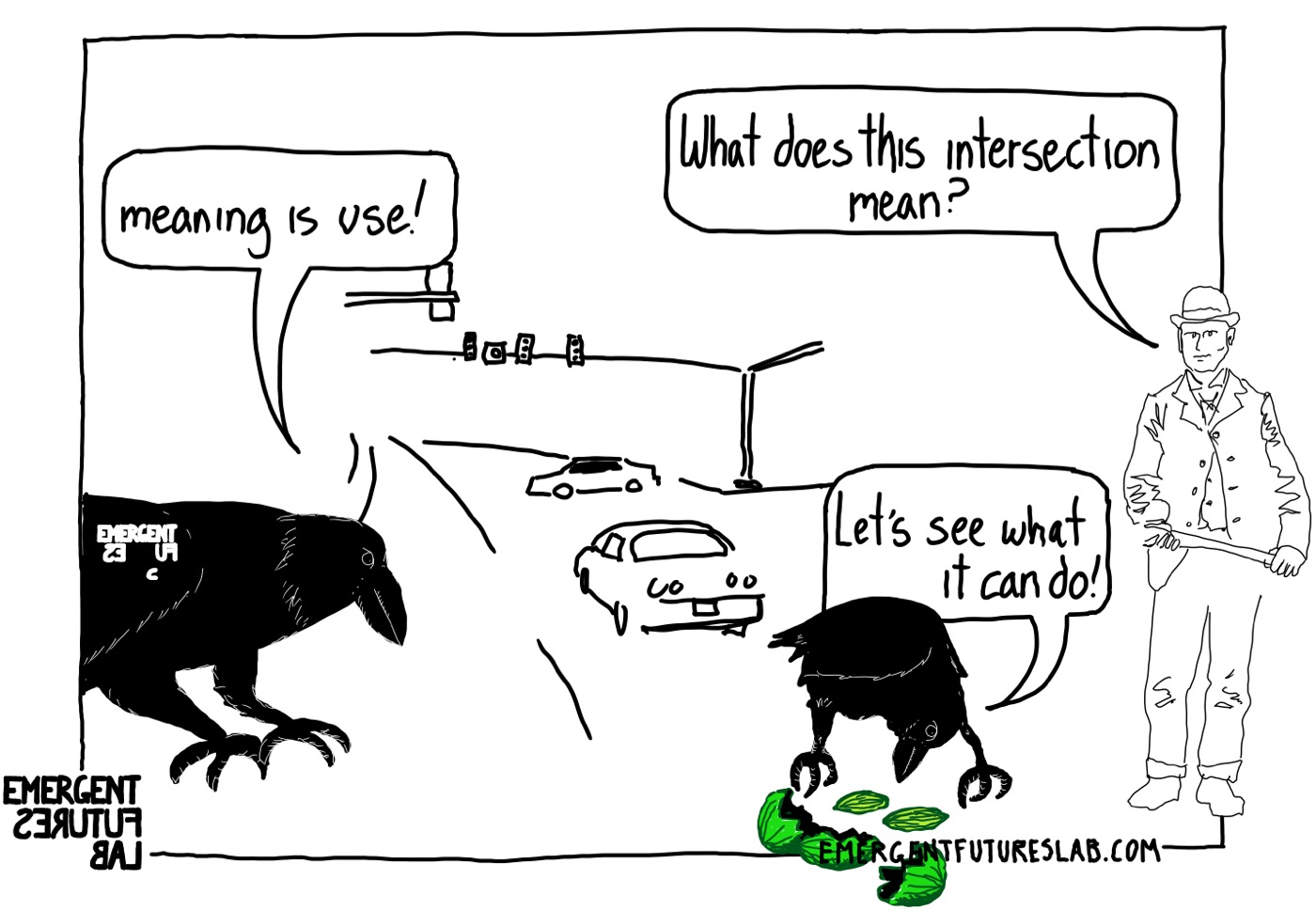
And the outcome of a creative experiment also becomes what it “is” via such practices. The concern in a creative practice – one where the ethos is oriented towards the new, is that the follow-up practices, if we move too quickly, will be ones that, while world-expanding in their developmental novelty, fail to genuinely become curious about their potentiality to be qualitatively different.
A creative ethos that places a curiosity about what qualitative difference might be emergently co-created from an experiment needs a very different approach than that of quantitative variation. And this is the important thing – the same experimental outcome can lead in either direction – it is not only about the outcome, but how and where we go next. Given that our habits, infrastructures, and the economic logics are focused on the quantitative, the knowable, and the shorter term, we need very strong processes to foster, protect, and nurture novel qualitative differences towards the strange journeys of the making of new worlds.
The practice we introduced in last week’s newsletter: A Process for Facilitating the Beginnings of Novel Emergences, was designed to address this specific issue. It is, in short, an anti-review or an anti-critique process. If the goal of a standard review or critique process is one where the goal is to determine if and how it might solve an existing problem, or whether it “works”, or how to make it more accessible – this is not it (NOTE: all of these goals are important – they are just not relevant at this moment when engaged in a process where the direction is towards the creation of qualitatively new approaches, frameworks, and worlds). Here, in our alternative process, the goal is to determine what emergent propensities might lead towards new approaches if certain further research, experimentation, and infrastructural developments could be initiated. It is about the creative work of active configuration building – with an understanding that configurations are creative and stabilizing (see our glossary entry on Creative and Enabling Configurations). In short, we need a qualitatively new approach to emerge that will give us new problems worth having before we can begin to experiment with “solutions”…
A big, and ongoing part of this process is the emergent attunement to sensing potential qualitative differences as they first quasi-emerge. This is an ongoing process – not a one-off event (which is why we try to use our above facilitation process as a way of teaching and inculcating such attunements into organizations). This is a very challenging process (we spent two of our last five newsletters digging into this challenge: Volumes 228 and 229). It is challenging because you cannot know what you are looking for (remember: the novel meaning is not hiding somewhere – it needs to be made). So what is one “not” looking for? What are we trying to sense – even if we cannot quite sense things?
Let’s return once more to Ian Hacking and his meditation on why most creative experiments don’t work most of the time – as he offers another critical insight into this moment in the process:
“As a paradoxical generalization one can say that most experiments don’t work most of the time. To ignore this fact is to forget what experimentation is doing. To experiment is to create, produce, refine, and stabilize phenomena… But phenomena are hard to produce in any stable way… Perhaps the real knack is getting to know when the experiment is working. That is one reason why observation, in the philosophy of science usage of the term, plays a relatively small role in experimental science. Noting and reporting readings of dials… is nothing. Another kind of observation is what counts: the uncanny ability to pick out what is odd, wrong, instructive or distorted in the antics of one’s equipment…”
(Ian Hacking, Representing and Intervening)
For Hacking a creative experiment only begins to “work” after we sense the odd – and attune the experiments around this emergent oddness. But the oddness, the wrong, and the distorted are what most critical analysis and review processes are trying to remove from experiments. Steve Jobs thought that most people’s use and development of Apps on their “phone” was odd, wrong, and distorting of its real purpose: to be a truly brilliant phone. He had to be strongly and vehemently persuaded otherwise. As we touched upon with Beckett (Volume 230) and Picasso (Volumes 228 and 229), it takes vast artistic networks and complex interwoven sets of experiments to get to this point. There is no path forward at the end of a creative experiment that points to where one should go. There is only the hard experimental work of attuning and playing differently with the odd, wrong, and distorted.
It is all too easy to stop at this point and either simply celebrate those who are really good at sensing the odd or just call for more curiosity and play in general. But our question in Emergent Futures Lab is always: can we do more to facilitate the co-emergence of the qualitative novel? And we think we can and do.
It is the development of processes like the one we share in the last newsletter, alongside creative experimental processes like we shared in our newsletter series on Blocking (Newsletter 213 is a good starting point), and the development of Manifestos – especially the “internal manifesto” (Volume 226) – alongside infrastructural shifts (see Newsletter 218) that can help go beyond the general (and important) call for more creativity, more curiosity, and more play.
And with this, we come to the end of this series on Experiments and Manifestos. We hope that you can bring this ethos and these practices into your creative experiments! Try things out, hack these processes, and make them your own. Be in touch with your experiments. And remember:
It is only a creative outcome if the novel outcome cannot be known in advance – and is yet to be created.
As a way to commemorate both this moment of ending one lunar year and entering into the next, as well as the conclusion of this series, we have made a poster of this phrase:
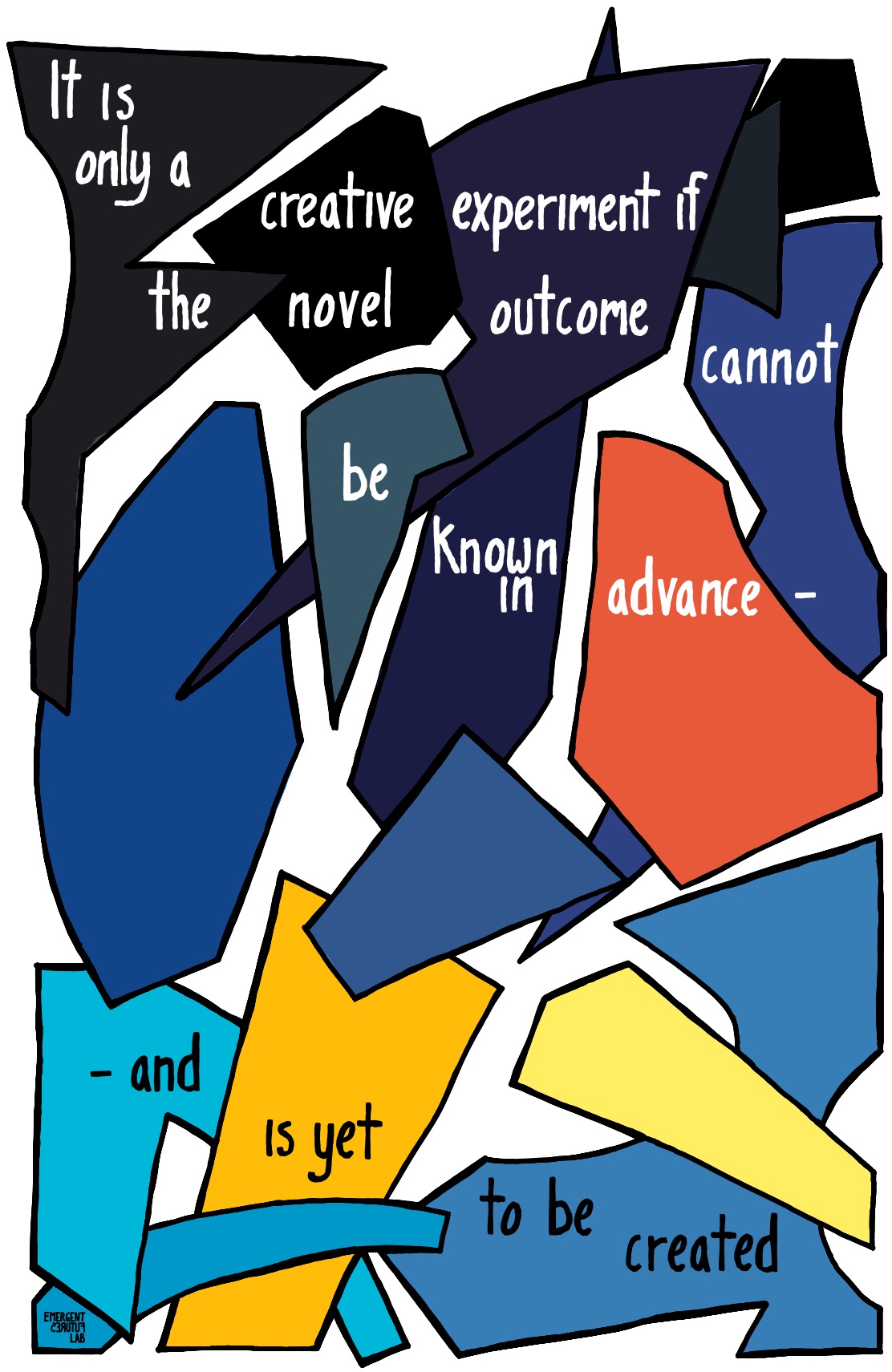
You can download and print it out as a poster – the ideal size is 11x17 (A3) or larger. It might make a great gift or act as a personal reminder hanging on your office wall – or be wheatpasted to a lamp pole.
We wish you a wonderful Friday the 13th! Stay warm, stay safe, – and keep difference alive!
Till next week,
Keep Your Difference Alive!
Jason, Andrew, and Iain
Emergent Futures Lab
+++
P.S. This newsletter continues in our community—where you can comment, question, and explore further. Emerging Futures + brings you into the conversation. Join here
P.P.S. WorldMakers goes beyond the newsletter: 40 live events annually, weekly podcasts and exercises, our annotated bibliography, and practitioners across diverse fields reimagining creativity together. Discover WorldMakers


